Looking for ways to reduce its carbon footprint. . .
By Gary S. Vasilash
While there is currently some concern in the U.S. about the consequents of wind turbines, a clever alternative that collects wind energy with no visible moving parts. BMW Group is trying it out at its MINI plant in Oxford, U.K.
The wind energy unit, developed by Aeromine Technologies, is located on top of a building toward the prevailing wind.
There are wing-like vertical airfoils in the unit. These create a vacuum and suck the air into the unit where an internal propeller spins to create electricity
As it is contained, there is little likelihood that there would be an abundance of birds meeting an untimely end.
Rather than the familiar wind turbine design, that white box-like object is fitted with vertical airfoils that draw in air and an internal propeller to generate electricity. It is said to be quiet and friendlier to the avian population. BMW is piloting the unit from Aeromine Technologies at its plant in Oxford, U.K. (Image: BMW)
The pilot project at the plant is on the body shop building, which has had solar panels on its roof for 10 years.
The rationale for trying out the wind power is because the solar panels are less effective during the evening and winter, when apparently there is an abundance of wind.
BMW Group’s engagement with Aeromine came through the company’s “BMW Startup Garage,” which works to connect BMW business units with startup companies.
The new Aston Martin V12 Vanquish and an admirer. (Image: Aston Martin)
While the longish hair may throw you off, the man in the picture above is Daniel Craig, the sixth James Bond.*
He is standing in front of the new Aston Martin Vanquish. The V12 sports car was unveiled Monday night at the Venice International Film Festival.
As Bond fans know, the previous-generation Vanquish was in Die Another Day—which has Pierce Brosnan as Bond (it was his fourth and final film in the role; Craig followed).
However, Craig as Bond drove several Aston Martins:
Casino Royale: DB5 and DBS V12
Quantum of Solace: DBS V12
Skyfall: DB5
Spectre: DB10 and DB5
No Time to Die: DB5 and V8 Vantage
Oh. The Car.
The new Vanquish is powered by a V12 engine that produces 824 hp. The engine is the most powerful V12 Aston Martin has put into sports cars that even non-spies can buy.
To get the performance they developed a strengthened block, strengthened the conrods, redesigned the cylinder heads, repositioned the spark plugs, added higher flow-rate fuel injectors, and fitted reduced inertia turbochargers.
Although some may equate performance (i.e., the Vanquish has a top speed of 214 mph) with a manual transmission, the car uses a ZF 8-speed automatic.
The vehicle is built with an aluminum body structure.
Beyond Rational.
Speaking of the design, Marek Reichman, Aston Martin executive vp and chief creative officer, said:
“Vanquish is an iconic halo model for our sports car portfolio and we’re always designing for beyond the expected, rational, and thoughtful. We captured the immensity of its performance and the imperiousness of its intended purpose while tempering the drama of Vanquish with a rare and unmistakable sense of elegance. Our team demonstrated bravery and curiosity in their quest to deliver unexpected design ideas throughout. . . . There is great passion in creating pure excitement, and this new Vanquish is a culmination of fearless creativity and human ingenuity. We have combined next level, ultra-luxury performance with British-cool sports car styling to deliver a crowning Aston Martin V12 flagship for the ages.”
A colleague and I were sitting in a new vehicle, an SUV. A premium vehicle. We were checking it out, looking at the surfaces, the way they met, the textures, the fabrics. We looked at the infotainment system and gauge cluster. Where they were positioned. How they were integrated into the overall IP. We adjusted the HVAC louvers. Opened and closed the glovebox.
We gave the interior a solid inspection.
“Does this look like the interior of an $80,000 vehicle?” I asked.
My colleague pondered for a moment.
“Well, it surely isn’t like the interior of something like a Genesis GV80,” he responded.
“Yes, I know. I’m driving one right now.”
And I didn’t make that scene up.
The interior of the GV80 has a lot of tech but it is executed in a way that is more about comfortableness rather than “Gee whiz—look at me! (Images: Genesis)
///
A couple weeks later J.D. Power released its 2024 U.S. Tech Experience Index (TXI) Study.
Kathleen Rizk, senior director of user experience benchmarking and technology at J.D. Power, said one determination that they made of the study is: “A strong advanced tech strategy is crucial for all vehicle manufacturers, and many innovative technologies are answering customer needs.”
Genesis ranks highest in the study for innovation, not only in the premium segment that it is included in, but with its score of 584 on a 1,000-point scale, highest overall, including mass market brands.
In the premium segment it is 49 points ahead of Lexus (at 535) and BMW (at 528).
The study looks at four categories: convenience; emerging automation; energy and sustainability; and infotainment and connectivity.
So clearly Genesis pays sufficient attention to these things in order to take the top position.
And it should be worth noting that this makes it four times in a row that Genesis has taken the top spot in TXI.
So within that GV80 not only is there an interior that is comfortable, but an array of infotainment technology.
Which makes it a proverbial double win for those who are within the cabin of the crossover.
If the impressive exterior styling is taken into account, then this means that the vehicle wins a trifecta.
///
For the 2025 model year GV80 there was a focus on upping the interior.
While the interior designers followed a design approach they describe at “Beauty of White Space,” it isn’t at all some sort of minimalist execution, not something that makes you think you are sitting in the capsule of a space ship.
Yes, there is a 27-inch wide OLED screen which is as technological as any you’ll find.
But the sumptuous, quilted available Nappa leather seats, the use of real wood and real aluminum for trim, the ergonomic arrangements of the interfaces all make this something that brings to mind a comfortable study more than a department at the local BestBuy.
///
The GV80 is powered by a 375-hp 3.5L twin turbo engine that is mated to an eight-speed automatic with paddle shifters.
The 2025 GV80 features a new front end with the “Two-Line Crest Grille” that accents the “Two-Line” headlamps.
It has multi-link suspension setups with high-performance gas shock absorbers all around.
It rides on 20-inch aluminum wheels.
///
The whole GV80 package is something that could be characterized as being an “executive car.”
It is stylish but not flashy, powerful but restrained.
It is in a space that used to be wholly inhabited by German marques.
But it more than holds its own compared with them.
When it was first launched in October 1998 the smart Fortwo was small. 2,540 mm (yes, millimeters) long and with a 1,810-mm wheelbase. The name of the car explained the number of people who could fit.
But with time there has been significant inflation.
Speaking of the vehicles offered by the company that is a joint venture between Geely and Mercedes, that is.
(Mercedes designs what are now EV-only models from the marque; Geely does all of the development and engineering.)
And now this. . .
smart has introduced a new model, the #5, a mid-size SUV.
The smart #5. The once innovative purveyor of small city cars is now producing mid-size SUVs like every other company. (Image: smart)
It is 4,705 mm long and has a 2,900-mm wheelbase.
Or nearly twice as long as the original smart.
That increased size is handy in one regard—if you plan to sleep in the #5.
According to smart, the seats can be folded so that there is the ability to create a “king-size, queen-size or single mode sleeping space.”
The #5, which has a range of 740 km (460 miles)—on the China Light Duty Vehicle Test Cycle—could be the ideal choice for Uber drivers who essentially live in their cars.
Given that with the exception of things that have undergone shrinkflation increased size seems to be desirable, perhaps a larger smart is a smart idea. (The necessity of another midsize SUV, however. . .)
It was a niche then and it is a niche now. But that’s not for not trying. . .
By Gary S. Vasilash
You may recall Lordstown Motors, the company that built the Endurance electric pickup truck.
That truck is notable because each of its wheels was fitted with a motor. Hub motors, the company argued, are more efficient than having an additional mechanical system that takes the power from a motor and routes it to the wheels.
In 2023 Lordstown Motors filed for bankruptcy. It announced in January that it has emerged from bankruptcy with a new name, Nu Ride.
However, the Endurance pickup assets had been acquired by Steve Burns. That truck is now under the umbrella of LandX Motors.
A curious thing about that is while it touts the truck platform and hub motors, the LandX Motors site doesn’t say much about the availability of the truck or any of the other “electric vehicles that will change the future of mobility.”
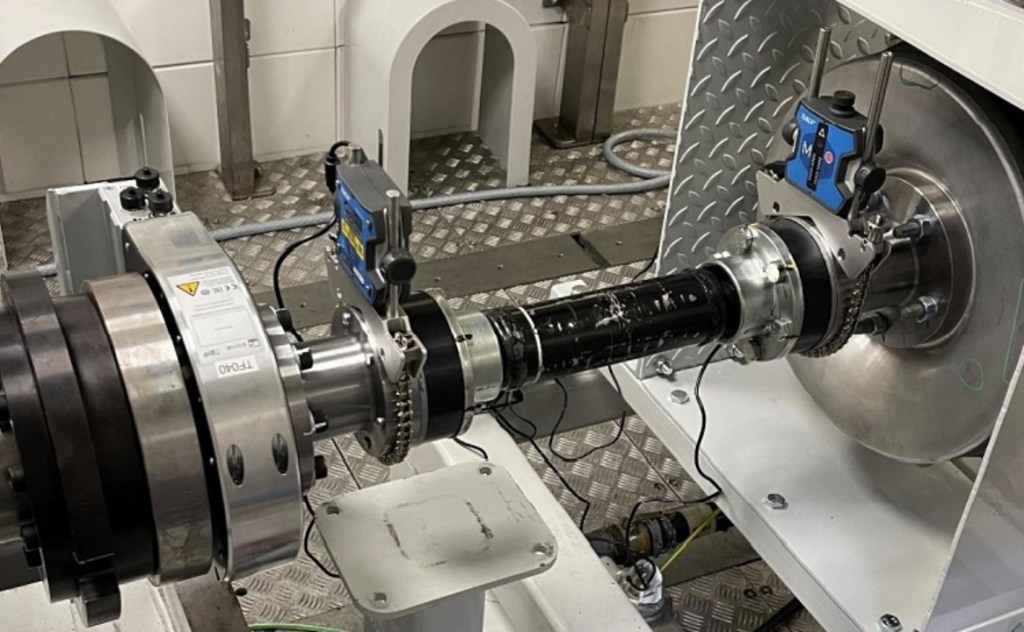
Protean Pd18 Gen5 hub motor being tested on a dyno. (Image: Protean Electric)
The Endurance came to mind because UK-based Protean Electric announced that its generation five in-wheel motor has been “developed and validated for mainstream automotive applications, meeting 15 years and 300,000 km durability requirements.”
The motor, fitted in an 18-inch wheel with an integrated inverter, can produce 1,500 Nm peak torque.
According to Protean’s Stephen Lambert, chief technology officer, the motor has been “exposed to severe shock, vibration, thermal cycle, sand, dust, water, and chemical contamination.”
While in-wheel motors are an intriguing tech, the implementation of Protean Electric products is still limited.
One clever deployment is by a UK-based company, BEDEO, which offers its “Reborn Electric” retrofit solution for diesel vans (think things like the Ford Transit). Presumably the motors are somewhat easier to integrate than having a large motor on the front and/or rear axle and the related gear train.
Earlier this year Polestar Automotive had a bit of difficulty with getting its annual report put together. That nearly had the EV company delisted from Nasdaq.
But it resolved that issue.
Then in July the company announced it “received notice from the Nasdaq Stock Market LLC that the Company is not currently in compliance with the $1.00 minimum bid price requirement, as set forth in Nasdaq Listing Rule 5450(a)(1).”
This means that it needs to have a closing price of at least $1 for 10 consecutive business days. (It has until January 2 to meet that requirement. Then it has the opportunity to get 180 days beyond that.)
Which is to say that it still isn’t out of the proverbial woods yet vis-a-vis Nasdaq.
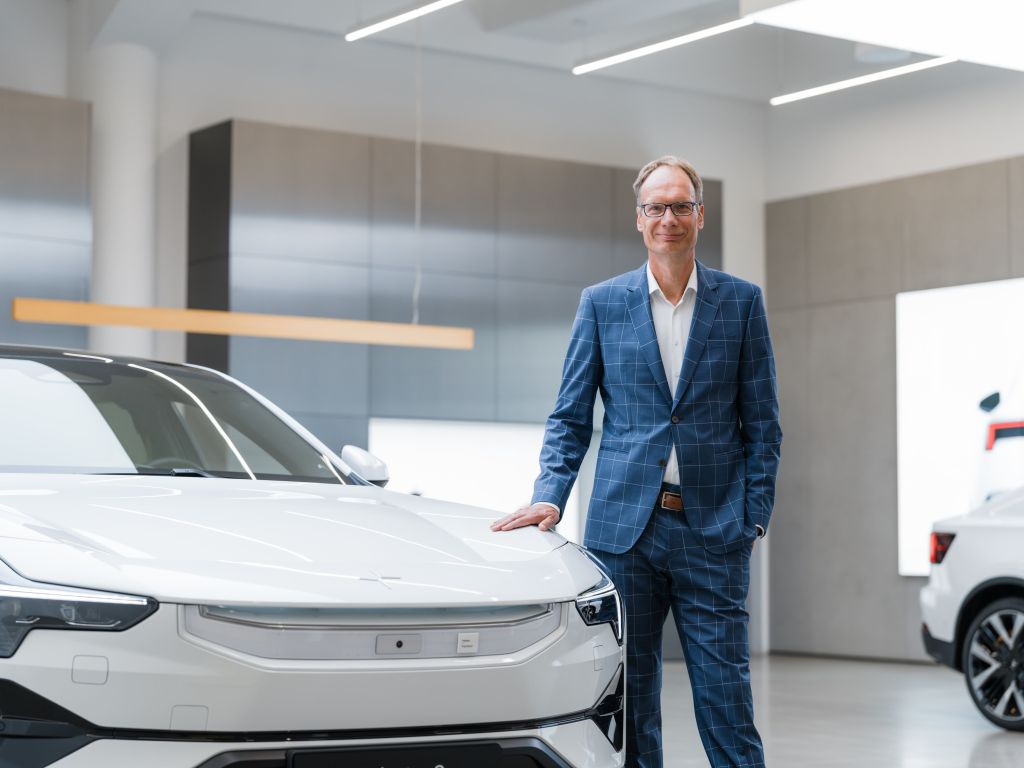
Today the company announced that its original CEO, Thomas Ingeniath, has resigned, effective October 1.
He is to be replaced by Michael Lohscheller.
Lohscheller has an extensive career in the auto industry.
Forthcoming CEO of Polestar, Michael Lohscheller. (Image: Polestar)
His resume includes being chief financial officer of Mitsubishi Motors and CFO at Volkswagen Group of America. (CFOs aren’t as flashy as CEOs or chief technology officers, but their guidance is essential to the operation of a company because at the end of the day, black ink
He was CEO of Opel.
In July 2021 he was named president of Vinfast. That lasted until late December 2021.
Next up, he went to Nikola Motor in February 2022 as president. That lasted until August 2023.
And now Polestar.
Presumably Lohscheller’s financial acumen will serve him well at Polestar.
He’ll need it.
The trying situations of his last two employers in the U.S. market should be good experience for Lohscheller.
Have a phone? You’ve got an in-vehicle game controller, too. . .
By Gary S. Vasilash
One of the features that some OEMs have offered in vehicles, once to help deal with bored kids, now to reduce the level of fidgeting among those who grew up playing video games and now find themselves spending too much time in their vehicles not going anywhere (perhaps waiting to pickup the aforementioned kids from school), is video games.
One of the issues that some of those deployments present is a vexing one: the game controllers have a tendency to do what happens to plenty of things in vehicles: disappear or break, and not necessarily in that order.
So Volkswagen AG (not Volkswagen of America), working with a Swiss company named “N-Dream,” is offering the N-Dream AirConsole gaming platform to its vehicles.
What’s notable about this is AirConsole uses smartphones as controllers.
The vehicle’s infotainment screen becomes the game console.
Look carefully at those game controllers: They’re smartphones. And Leo and Dennis are using those devices to play a game on the screen of a VW ID.7. (Image: AirConsole)
It is easy to pair the phones with the system: when the AirConsole app is opened a QR code appears on the screen. Scan it and it is ready to go.
Multiple players can participate in a given game.
However, play can only occur when the vehicle is in Park.
VW AG will begin offering AirConsole next month in the ID.7, ID.5, ID.4, ID.3 (from ID. software 4.0), the new Passat, the new Tiguan, the new Golf, and the new Golf Estate.
Odd are that this will make its way to this side of the Atlantic before too long.
This is the interior of the first-generation Toyota Prius (2000):
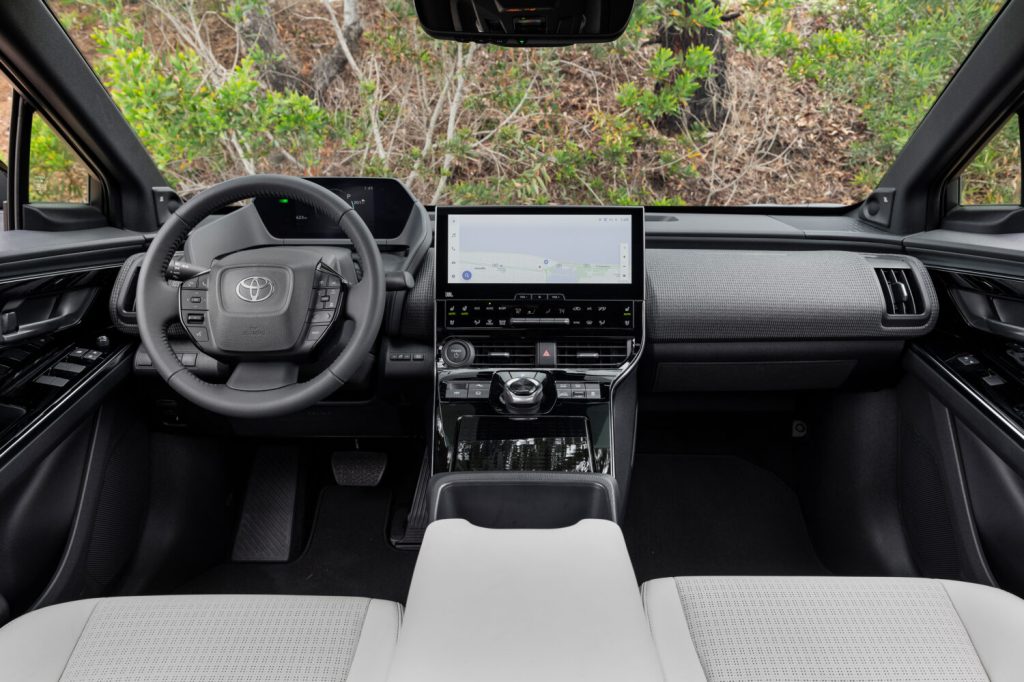
This is a similar shot of the first-gen Toyota bZ4X (2024):
Yes, there is nearly a full demographic generation separating the two.
But the bZ4X makes me think of that Prius.
If you look closely in front of the steering wheel on that early Prius you’ll note that there is no conventional gauge cluster.
That info is displayed in the horizontal slot in the middle of the instrument panel.
There is a more-conventional gauge cluster in the bZ4X in a more-conventional location.
But it is in a binnacle, set further back than is the norm for gauge clusters.
The rationale for both executions is arguably the same: the driver should keep eyes on the road.
While the Prius execution left something to be desired on that account—as in if the driver keeps eyes on the road, then there is the possibility that because there is no ready check of the speed, that could be problematic in terms of potential speeding tickets (although that risk was ameliorated by the lack of pep when you got on the throttle)—the bZ4X approach requires but a slight downward adjustment of one’s eyes to check the speed, a better approach.
The first-gen Prius instrument panel was completely different.
And while the bZ4X’s is more conventional, centered on the standard 12.3-inch touchscreen, there is something of a uniqueness to the interior, such as the use of a fabric on the interior even in places where some polymer would ordinarily be placed and the lack of a glove compartment.
Ten years after the first-gen Prius was released, in a retrospective Toyota acknowledged:
“Not all early reviews were flattering. One car magazine said, ‘With a real-world 35 mpg, this is a car that neither enthusiasts nor greenies can fully embrace.’”
And so far as the bZ4X goes, not all reviews are flattering because the electric vehicle doesn’t go particularly far vis-à-vis competitive electric crossovers:
XLE grade has an estimated 252-mile range in a front-drive setup; 228 miles for AWD
Limited grade is 236 miles FWD and 222 AWD
So here’s the thing about the bZ4X that needs to be taken into account: This one is the first Toyota EV, just as that Prius was the first back then.
People liked the first-gen Prius sufficiently well that they bought it and did so in sufficient numbers that there were the second generation and beyond.
People who buy the first-gen bZ4X will probably like it sufficiently well—and there is good reason to, mainly that it is a Toyota, and so it comes with all of the confidence that that brand brings to one’s driveway—and it will lead to future Toyota EVs.
And while they will be better, the current one isn’t bad.
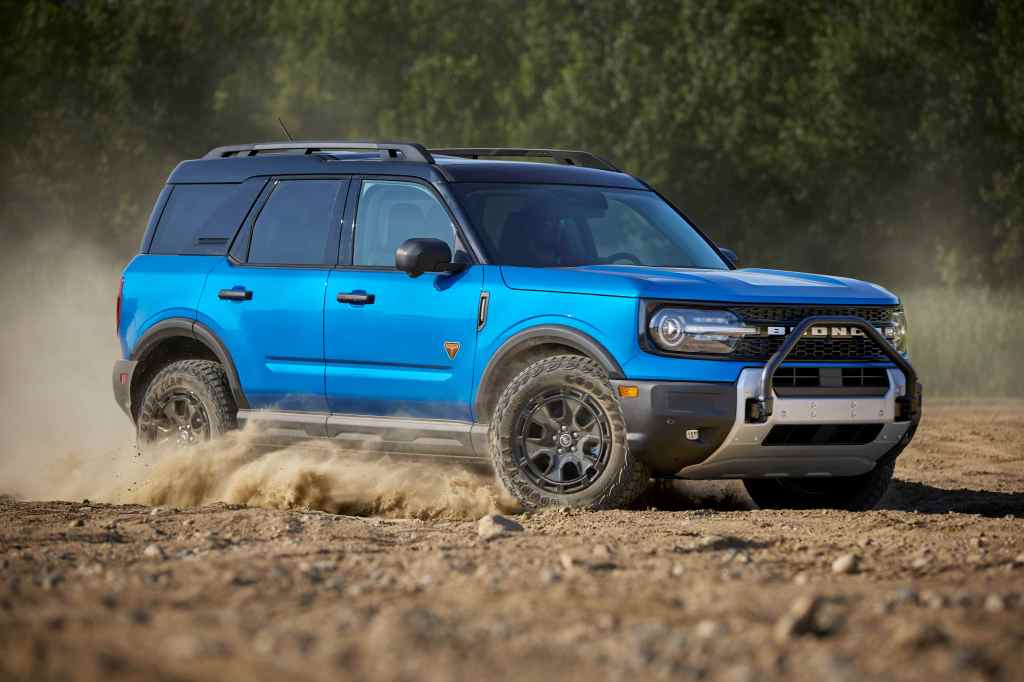
Because more than 50% of Ford Bronco Sport owners have been known to take their small SUV off the tarmac, according to Mike Weller, brand manager for the vehicle, for 2025 the vehicle is being upgraded, taking that adverturousness into account. While this is across the board for the vehicle, it is particularly germane for the 1.5-liter Outer Banks and 2.0-liter Badlands models, which can be equipped with the Sasquatch off-road package.
Eddie Khan, Bronco Sport vehicle engineering manager, notes that some other small SUVs have the appearance of ruggedness, but “Bronco Sport is engineered rugged from the inside out and top to bottom.” (According to Ford, Bronco Sport drivers go off road 3.5 time more often than competitive vehicles, so that engineering is important for go, not just show.)
The 2025 Bronco Sport. Some people drive them to the grocery store. Some people drive them over rocks and sand and such to get to the grocery store—or just because they can. (Image: Ford)
Designed to Perform
It must be admitted, however, the Bronco Sport Sasquatch has functional features that make it look rugged, as in a standard front brush guard, steel skid plates, and front and rear bumpers that are fitted with steel bash plates. There are two cast two hooks in the front and a pair of cast D-rings in the back that serve as recovery points.
But beyond those visible modifications there are several things that make the ’25 Sasquatch-fitted vehicles more capable.
Bilstein rear shocks with position-sensitive damping and piggyback reservoirs
New front and rear springs to provide additional suspension travel (8.3 inches in the front and 8.7 inches in the rear)
For both the standard Bronco Sport Badlands and the Badlands Sasquatch models there is a new Rally G.O.A.T. (Goes Over Any Type of Terrain) mode that allows the vehicle to be driven on sand at higher speeds via holding gears longer, improving throttle demand, and increasing steering feedback.
Off Road Aides
Another borrowing from the bigger Bronco there is the addition of Trail One-Pedal Drive to the Bronco Sport, which allows the vehicle to be driven with the accelerator pedal alone during rock crawling.
Also available is a 360° camera that have Trail View. When put in Off-Road or Rally G.O.A.T. modes, the camera is activated. The Badlands and Sasquatch Badlands models also have a “Split View” for the camera system that shows the front tires of the vehicle.
On the inside of the 2025 Bronco Sport (all models) are features including a 13.2-inch center display that runs the SYNC 4 system (wireless Apple CarPlay and Android Auto are standard) and a 12.3-inch digital instrument display. Recognizing that people like to accessorize their vehicles, there is an abundance of “Bronco Bolts” inside and out, fasteners specifically engineered for users who may want to add lightbars up front or mount cameras inside.
When?
The 2025 Bronco Sport Big Bend, Outer Banks and Badlands models will be available at dealers in November. The Sasquatch models will arrive in Q1 2025.
One of the considerations that OEMs—especially in the higher end of the market—have to come to grips with is developing vehicles that are as environmentally sound as they can be. This isn’t simply an issue of sticking motors and batteries into propulsion systems. It also goes to the point of the types of materials that are used in the vehicles.
Let’s face it: while companies may use recycled steel and aluminum and plastic, odds are end consumers don’t pay a whole lot of attention to that.
What they do pay attention to is what’s on the inside of vehicles.
Which brings us back to the environmental aspects.
As in:
“Leather is a timeless, luxury material that has always epitomized the elegance, durability and quality of a hand-crafted Bentley interior. It has a rich history that dates back decades in our cars and has always stood the test of time.”
That’s Marc Stang, Technical Expert, Leather and Colour Development at Bentley Motors.
The problem is one of sustainability. Leather is generally iffy in that regard.
Somehow tanning leather with olive oil byproducts even seems like it would be nicer to touch than leathers treated with all manner of potentially hazardous things. (Image: Bentley Motors)
So Bentley Motors has become the first automotive member of Leather Naturally, an NGO that focuses (no surprise) on using certified, properly-sourced leather in a variety of industries.
One of the things that Bentley is doing regarding the leather it offers is to deploy a sustainable leather tanning process.
Rather than the heavy metals, minerals and aldehydes that are typically used in tanning, the Bentley Olive Mill Waste Water tanned Leather is produced using an organic byproduct of the olive oil industry (which goes to the point of that name).
Presumably this will allow leather to stand the test of time a little longer at the venerable motor car company.









 shinymetalboxes