From advanced manufacturing tech to a really complex model. . .
By Gary S. Vasilash
McLaren Automotive, builder of an array of composite-intensive supercars, recently announced that it is partnering with Divergent Technologies, which has developed an additive manufacturing system it calls the “Divergent Adaptive Production System” (DAPS) which allows the creation of lightweight chassis components that otherwise couldn’t be created with traditional manufacturing methods.
As Michael Leiters, CEO of McLaren, put it, “This technology will help us to further reduce weight in our complex structures, which will ultimately benefit the driving experience of our customers and support McLaren’s mission to push the boundaries of performance.”
One of the interesting things related to McLaren and Divergent is that the DAPS was developed to produce the Czinger 21C supercar (i.e., it is a 1250-hp hybrid–certainly not a Prius (yes, even though the current gen Prius is rather cool, you know what I mean)).
But clever tech is clever tech, so the use by McLaren is in keeping with its drive toward even more innovation in its vehicles.
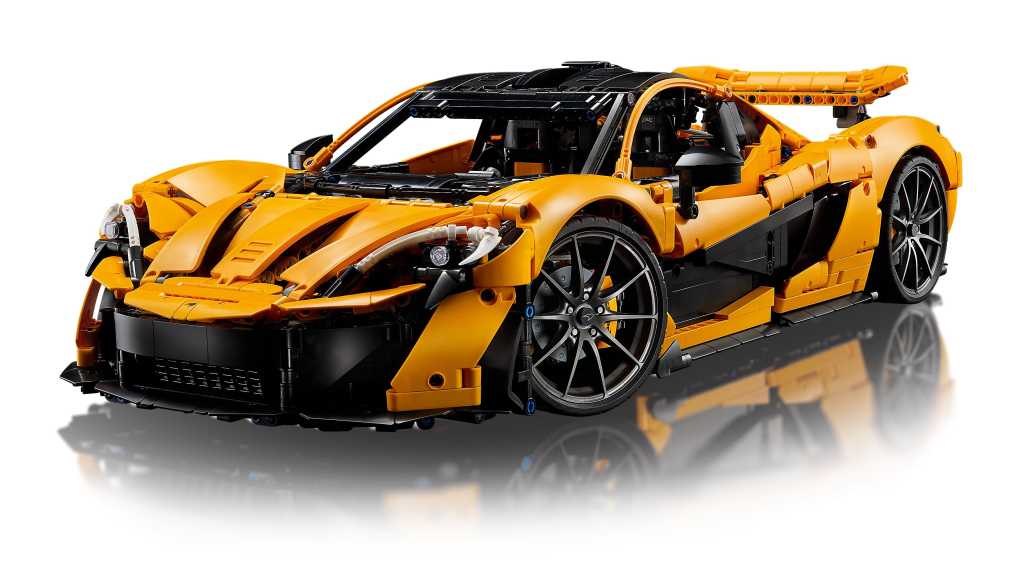
This is the LEGO Technic McLaren P1—all 3,893 elements assembled. (Image: McLaren Automotive)
But what will probably draw more attention than the organic chassis components in a future car is the LEGO Technic McLaren P1.
Yes, a 3,893-piece LEGO set.
And it is rather technical, as the model includes a seven-speed gearbox, V8 piston engine, adjustable rear wing, dihedral doors, and a suspension (undoubtedly injection molded, not 3D printed).
“It’s amazing to see so many of the elements from the original P1 brought to life by the LEGO team for the LEGO Technic McLaren P1. I hope this collaboration inspires the next generation of designers and engineers to push the boundaries of automotive innovation.”
I’m guessing that the DAPS will be more influential for next-gen designers—but then I’m not the chief design officer of a supercar company.
Incidentally, the McLaren P1 LEGO Technic model can be purchased starting August 1 here for an MSRP of $449.99.
Porsche Cars North America reported its sales for the first half of 2024, including, of course, the second quarter.
And in Q2 the sales of the 911 being nothing short of impressive.
Porsche 911 Turbo S (Image: Porsche)
That is, for the year it has delivered 6,720 911s, of which 4,790, or about 71%, were delivered in Q2.
Which means that in Q1 dealers had a bit of time on their hands as there were 1,930 911s delivered.
OK. They had other vehicles to sell, but still that number of 911s is notable.
The best-selling Porsche in the U.S. during the first half of 2024?
The Macan, at 12,004 vehicles (though that is down from the 14,306 sold in H1 2023).
Second best-selling?
The Cayenne, at 10,168 vehicles (which is up from the 8,911 in H1 2023).
Together, those two SUV models, with a combined 22,172 vehicles, are some 64% of Porsche’s total 34,733 delivered in H1 2024.
Which sort of begs the question of when there is going to be a Corvette SUV. After all, the car can be an alternative to a 911, but it is highly unlikely that anyone is going to cross-shop a Chevy Equinox or Traverse with a Porsche SUV.
Isn’t this a case of the proverbial “money left on the table”?
While you’ve undoubtedly heard about some of the people in the European Union (EU) being rather agitated by Chinese electric vehicles showing up on the streets of Rome and Paris and elsewhere, French research firm Inovev provides some interesting statistics regarding those vehicles.
Notably, within the EU, the United Kingdom, Switzerland, and Norway, during the first quarter of 2024 Chinese EVs accounted for 8.5% of all the EVs sold during that period—approximately 50,000 out of 594,000 EVs.
But then there’s more.
For example, taking into account “European models imported from China”—as in Smart (a joint venture between Mercedes and Geely) and Dacia (part of Renault)—that 8.5% share grows to about 11%.
Then there are vehicles that are built in China by non-Chinese brands that are brought in, like the BMW iX3 and the Tesla Model 3.
Add them into the mix and the number rises to 17%.
And while some might think that European exports to China might offset some of this, Inovev, using Germany as an example, points out that German vehicle exports to China peaked in 2018 and have been declining since.
Part of this is because German brands are building vehicles in China that are sold there so there is no need to export.
But then there is this observation, which ought to make people in Wolfsburg, Stuttgart and Munich nervous: “Chinese customers are increasingly moving towards Chinese brand cars and are gradually losing interest in imported foreign cars, especially with the development of the BEV market.”
When the model year 2020 Hyundai Palisade first rolled out, it pretty much changed the nature of three-row SUVs.
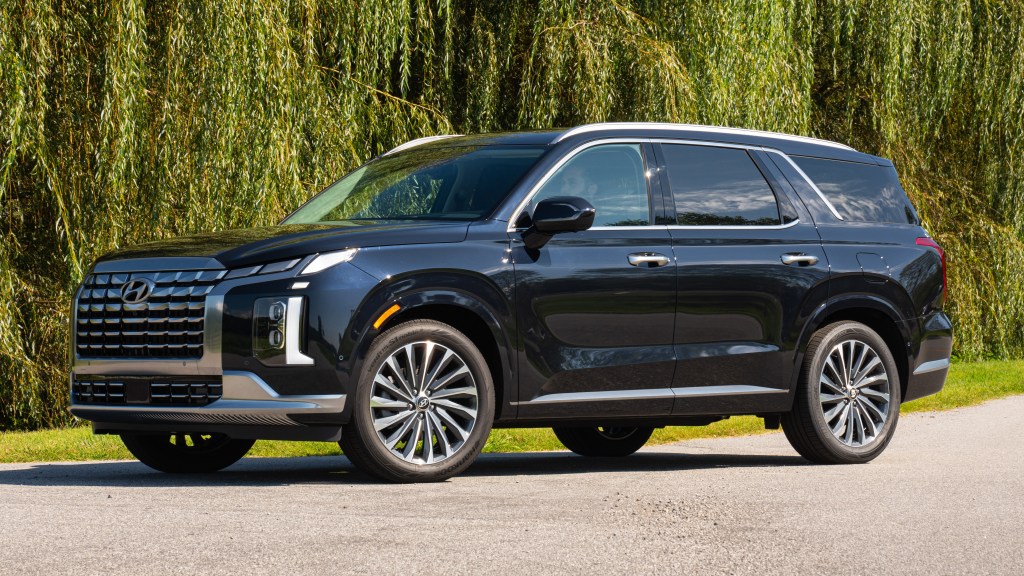
Hyundai Palisade: Three rows with style. (Image: Hyundai)
That is, whereas models in that category had tended to be more utilitarian in their styling (read: boxy and bland), with the Palisade it is almost as though Hyundai designers and engineers figured: “The others are solidly well established in this space, so if we’re going to wedge our way in, we’ve got to up the ante.”
And they did, inside and out.
Here is a vehicle that looks stylish while substantial, which is no mean feat. A vehicle that provides a sense of being in a comfortable environment (often, because vehicles are designed to transport people from A to B, the interior is executed as a waystation, something that’s temporarily engaged; here it is more like being in a room, and especially when taking long(er) road trips, that is highly desirable.)
Hyundai did a refresh of the vehicle for model year 2023 and as seems to be the case with this company, adjustments and improvements are made on a regular basis, not as some OEMs do, which is wait (sometimes too long).
Some Numbers
The Calligraphy trim is the second highest on offer, with a starting MSRP of $50,350—and given the level of amenities, the starting MSRP is probably going to end up being close to the finishing MSRP for many people. (Above Calligraphy? Calligraphy Night, for those who are looking for a blacked-out variant.)
The bigger choice that one needs to make is whether to opt for the front-drive version or the optional HTRAC AWD model, which is a price bump of $2,000.
Either way, there is a 3.8-liter V6 that produces 291 hp and 262 lb-ft of torque mated to an eight-speed automatic.
There is a 5,000-pound towing capacity.
It is 196.7 inches long, 77.8 inches wide, 68.9 inches high, and it has a 114.2-inch wheelbase.
Design Details
The Calligraphy has a unique front fascia that is largely predicated on a grille that consists of a pattern of individual metallic-appearing geometric elements, rectangular but with a create that results in three-dimensionality, that serve to accentuate the larger metallic pieces that frame the front end of the vehicle. It is a purposeful look.
Twenty-inch alloys are a key element for the body side design, as are a strong C-pillar and short front and rear overhangs.
The back has large vertical LED lamps and a wide horizontal skid plate that provide, in effect, a cubic solidity.
Pop that back hatch and there are 18 cubic feet of cargo capacity behind the third row and if you fold it and the second row down, there is 86.4 cubic feet for serious stuff.
Inside View
From the driver’s seat, the interior appears (because it is) large, but the execution of the instrument panel is more minimalist than exaggerated, than is the case in some other large vehicles. For example there is a long slot, going from just to the right of the steering wheel all the way to the passenger door panel that is the HVAC vent. Subtle, not fussy.
(Speaking of the door panel: it is quilted on the Calligraphy: again, something that is simply a nice touch.)
The seating—throughout—is comfortable and covered with Nappa leather.
Yes, there is a 12.3-inch navigation screen with a horizontal orientation. (And on the subject of navigation, it is integrated with the smart cruise control which allows curve control, as in adjusting the speed when going into a curve.) The gauge cluster is also 12.3 inches. While the vehicle facilitates digital control of features, there are knobs and buttons for things like adjusting the temperature and cranking the volume on the 630-Watt Harman Kardon 12-speaker audio system.
One thing worth noting about things of an audible nature: generally if you have something large—and the total interior volume is 173.3 cubic feet—that is rolling on 20-inch wheels, it can be noisy. The vehicle uses acoustic glass on the side windows and windshield, and I’m guessing a non-trivial amount of other materials used for noise countermeasures. And because sometimes those in the front want to clearly communicate with those in the back, there is an in-car intercom.
As this is a “family” vehicle, and as keeping members safe it a key consideration, there is a full suite of safety tech, including lane keeping assist, lane following assist, blind-spot avoidance assist, high-beam assist. . . you get it. Lots.
Final Thought
Hyundai has plenty of SUVs on offer. There are Venue and Tucson, Kona and Santa Fe, Ioniq 5 and Nexo.
The Palisade is its top-of-the-line. And there is no question that it is. On the Hyundai retail website there are comparisons made with vehicles including the Ford Explorer, VW Atlas, Honda Pilot, Nissan Pathfinder, and Dodge Durango.
While there are comparable elements to all of those, and while all of those are mainstream brands, arguably the Palisade can compete in a class above and hold its own.
A special edition of a special (as in “uncommon”) type of car
By Gary S. Vasilash
Sets are collections of objects, or elements. And the Jetta GLI is an interesting study in that it belongs to the set of automobiles, then that of sedans, then that of performance sedans, then that of performance sedans with a manual transmission.
VW Jetta GLI: quick car . (Image: VW)
While set theory in mathematics is essentially neutral (I mean, people aren’t going to get worked up about things like prime numbers), the Jetta GLI set is a rather interesting one.
That is, take sedans and the Motor City Three (MC3).
Over at Stellantis, there was the Dodge Challenger, which went out of production at the end of last year.
At Ford, there’s nothing.
General Motors, there are a few offerings. Chevy still has the Malibu, but that ends at the end of this year. Cadillac is where you’ll find sedans, with the most economical being the CT4, which has a starting MSRP of $35,990, which is certainly a good price for a Cadillac. What is somewhat unusual is that while there seems to be this notion that no one wants sedans anymore, the ultra-uber halo Cadillac Celestiq, which went into production earlier this year and which has a starting price of some $340,000, is a sedan. (Maybe the rationale is that because so few will be hand-built and sold, this almost provides credibility to the claim about people not wanting sedans: the number of Celestiqs will be comparatively infinitesimal).
Then there’s the issue of the Jetta GLI being a performance vehicle.
That is, there is the regular Jetta, which comes in four trims—S, Sport, SE, and SEL—all of which are powered by a 1.5-liter, turbocharged four that provides 158 hp and 184 lb-ft of torque.
Then there is the GLI—which in model year 2024 is celebrating its 40th anniversary, which explains the trim on the model driven here calling out that achievement—that has a 2.0-liter turbocharged and direct-injected four that generates 228 hp and 258 lb-ft of torque. Given that the curb weight is 3,358 pounds, there is plenty of pep to drive the front wheels of the car. So while this may not be “performance” in the context of a Charger with a HEMI, it is still one in the context of a competitive set, all of which includes Asian brands, from Honda to Hyundai to Subaru to Toyota (all of which also provide vanilla versions of their Jetta-competitors, too).
Then there is the manual transmission. It is standard for the GLI. There is an optional seven-speed dual-clutch automatic.
It is not like the set of vehicles available with manual transmissions is tiny. Car and Driver, which has a campaign to “Save the Manuals,” which brings Quixote to mind, puts the number of car models with manuals available right now at 27—including the Jetta.
However, it seems as though the percentage of vehicles sold in the U.S. equipped with manuals is under 2%, so here we find a rather small subset.
Sedan→performance→manual→yikes!
The Jetta GLI is clearly—based on everything from the painted black alloys to the black-and-red color scheme on the interior—a car that is meant to show that it is built for go.
Which might make some people a bit reticent to even consider it: After all, even if you drive hard on the weekends, you probably have to drive somewhat more sedately during your daily drive for the other five days.
The GLI has all of the amenities that one can expect from a contemporary car, whether it is a solid audio system, infotainment setup, various safety sensors (for things like cross-traffic alert, blind-spot, etc.), or nicely bolstered front bucket seats.
But one of the things that is important—though probably not something that someone would admit to being important, were that person inclined toward something of a performance nature—is that it has a 14.1-cubic foot trunk. Yes, a good size to carry one’s gear and groceries.
And with a starting MSRP of $28,085, stuff is more attainable (i.e., the monthly payments won’t be crippling).
This is not a car for everyone.
But looking at those sets, clearly the people at Wolfsburg know that.
(And while of the subject of sets, here’s a bonus that might be good for bar trivia: the modern father of set theory is Georg Cantor, a German.)
While “ICE vehicle” sales may decline, this doesn’t mean the number of engines necessarily is going down
By Gary S. Vasilash
It seems that when people think about types of vehicles there are:
Electric vehicles
Hybrid vehicles
Plug-in hybrid vehicles
ICE vehicles
The categorization seems to overlook one big thing:
With the exception of the EVs, all of the other types include an internal combustion engine.
So when you hear that hybrids are up, this means ICE vehicles are up.
In providing his assessment of the vehicle market in Western Europe, Matthias Schmidt noted:
“12-month trailing data shows that new models featuring an internal combustion engine under the bonnet, be that a pure ICE petrol or diesel model, a mild (MHEV) or full (HEV) hybrid, or plug-in hybrid (PHEV), saw their combined share of the new car market rise upwards once again.”
He also pointed out that EVs have been losing their spark in the Western European market, with, through May, three months of decline in a row.
According to Schmidt, “the most recent 12-month period data shows that between June 2023 and May 2024, the number of BEVs fell back to 1.97 million new units compared to 9.8 million other models.”
If you live in SoCal or NoCal, you’ve got a chance to lease a piece of what could be the automotive future. Could be.
By Gary S. Vasilash
Honda has announced its three lease options for Californians—who can access one of the 12 approved dealerships—interested in the 2025 CR-V e:FCEV, a fuel-cell electric version of its popular crossover.
Looks like a Honda CR-V because it is one. What makes this one—which is manufactured at the Honda Performance Manufacturing Center in Ohio—uses a second-generation fuel cell module produced by a Honda-GM joint venture in Michigan. Some people in California can lease the CR-V e:FCEV. (Image; Honda)
Honda thinks that the most popular option will be 3 years/36,000 miles. This will require $2,959 at signing, then monthly payments of $459.
The least expensive is a 6-year/72,000-mile program that requires $2,889 at signing and $389 per month.
The most expensive is 2 years/60,000 miles, which requires $2,989 at signing and $489 per month.
However, given that mileage allowance, perhaps it pencils well for those who drive a lot: 30,000 miles per year vs. 12,000 miles for the other two lease deals.
Honda is adding an incentive for the lease packages in the form of hydrogen fuel credits: $15,000 for the 3-year lease, $30,000 for the 6-year lease and $25,000 for the 2-year lease.
While that appears to be exceedingly serious money, it is worth knowing that the average cost of a kilogram of hydrogen, which is comparable from an energy standpoint to a gallon of gas, is about $33 in California.
So that means for $15,000 one will get ~455 kg (again, think “gallons”) at the pump.
With gas at about $5.40 per gallon in California, were one to have that deal it would translate into 2,778 gallons.
The CR-V e:FCEV, which has a battery that provides up to 29 miles of range (this is charged via a plug), has a total range of 270 miles. It has a 4.3-kg fuel tank.
Some good news is that to fill one of the vehicles it is pretty much just like fueling a gasoline CR-V both in terms of procedure and time, something that can’t be said for battery-powered electric vehicles.
Still, with that cost of hydrogen, one really has to be dedicated to an environmental vehicle regardless of the fuel credits.
McLaren Automotive produces amazing rolling sculptures that (1) go exceedingly fast and (2) cost a non-trivial amount of money.
Supercars.
Not your run-of-the-road hybrid: the McLaren Artura (price tag: ~$237,500). (Image; McLaren)
Like all OEMs, McLaren is pursuing electrification.
Its CEO, Michael Leiters, thinks that the UK, where McLaren is based, needs to do more to facilitate the creation of a supply chain that would be more EV-intensive:
“Today, our hybrid McLaren Artura powertrain has 64% UK content. If this car was a pure EV, the UK content of the powertrain would reduce to 13% because we cannot currently source the relevant componentry in the UK,” Leiters says.
He argues that because the UK has specialization in vehicles that are at the top end—“Today it remains home to some of the world’s most admired performance car brands, as well as the majority of Formula 1 racing teams”—it would be beneficial were the UK government—which, incidentally, will get a new leader on July 4—to develop a plan for electrification:
“A clear industrial strategy, led by investment in the domestic supply-chain, will deliver growth, support jobs, help decarbonise the economy and secure a vibrant future for the UK performance car industry.”
Metaphorically waving the Union Jack:
“We must harness the skills, knowledge and ingenuity of the UK motorsport and performance car industry to create a global, high-performance centre of excellence.”
Leiters points out:
“UK-based luxury and sports car brands command tremendous pricing power thanks to their rich histories, intrinsic brand value and class-leading performance attributes.
“As a result, the productivity gross value added of McLaren employees is 51% higher than that of the UK automotive manufacturing sector as a whole.”
But here’s the thing:
McLaren sold just over 2,000 vehicles in 2023.
Highly productive McLaren workers notwithstanding, it probably isn’t making the Chancellor of the Exchequer overly exercised.
Leiters also pointed out:
“The UK was once the world’s largest vehicle exporter.”
While that’s not going to happen again, the question that should be asked by the next UK government is whether it should be investing to benefit the supercar manufacturers in the country or create a supply chain so that companies like Stellantis, which threatened earlier this week that it may stop producing vehicles in the UK (among its brands are Vauxhall, which was founded in London in 1857) due to EV rules, would consider it better to build in Britain than not.
It is not hard to imagine that at some point, as the issue of Dieselgate was still burbling like the surface of the La Brea Tar Pits, there was a meeting at Volkswagen HQ in Wolfsburg at which point someone smacked the surface of a conference room table and said, “Verdammt! We’re going to develop vehicles that are going to reestablish some green credentials for the company!”
So it set to work on its ID. line of vehicles. It introduced, in Germany, the ID.3, a small hatchback, in 2020. Because the company figured that Americans aren’t all that keen on small cars, its first in the new line of electric vehicles (there had been the e-Golf, but that was more of a novelty than a commercial product) for the U.S. was the ID.4, in 2021, a compact crossover.*
The ID.4 didn’t get much of a reception given that it was available with a maximum range of 260 miles, with most models south of that.
2024 VW ID.4. A highly credible EV crossover. (Image: VW)
A Pivot
The company dedicated to that proposition of going green has improved the ID.4 for 2024 in many ways, including improving the range to a maximum 291 miles (for the ID.4 Pro, driven here, and the ID.4 Pro S), which is close enough to that 300-mile mark that seems to be what people are looking for.
(And although the starting MSRP for the ID.4 Standard is $39,735 and it, like the others in the ’24 lineup, is eligible for the $7,500 federal tax credit, a 206-mile range probably is not a good thing from a marketing standpoint—not that that is the least range in an EV out there (the MINI Cooper SE is rated at 114 miles), but if someone goes into the dealership and hears that 206-mile number, they may be a bit turned off, even though for a few grand more they can get a model with an 82-kWh battery rather than the entry 62-kWh and get a more reasonable range.)
Performance
What’s more, the ID.4 Pro is peppy: the rear-drive model (VW points out that just like the original Beetle, the motor is in the back) produces 282 hp.
All of which is to say the range and performance have both been improved, so those who were lukewarm for the earlier entry may want to give the ’24 ID.4 consideration.
(And while this doesn’t strike me as a vehicle that anyone is going to be doing performance driving in—more likely something to load up with soccer gear or Costco cargo, and it can do a good job at that: cargo volume is 30.3 cubic feet behind the second row and 64.2 cubic feet with the seats folded—it does feature a vehicle dynamics control system that debuted on the Mk 8 Golf GTI.)
Driving
To drive the ID.4 one climbs into the driver’s seat while carrying the fob, then uses a stalk (similar to the automatic transmission gear selector of yore) to select forward or reverse by turning it. No key rotation or button push.
There is an option labeled “B.” This is for “Brake.” But what it does is increase the amount of regenerative braking automatically applied so that there is more otherwise-wasted energy put back into the battery. It doesn’t provide what’s known as “one-pedal driving,” meaning that when lifting on the accelerator the vehicle doesn’t come to a full stop. Apparently VW wanted a bit of normalcy for those who are used to driving vehicles with what is still by far the dominant form of propulsion.
Useful
Another thing addressed in the new model is the interface.
In the Pro (and other models) there is a 12.9-inch touchscreen interface configured for ready access to apps without layers of confusion. Along the top of the screen are icons for things like music, navigation, and battery; at the bottom there are HVAC settings. This means that regardless of what’s going on in the center of the screen, items that are regularly used are a finger touch away. Just below the display are illuminated touch sliders that can be used to adjust temperature although there is the ability to set the temp using the infotainment screen.
American-Made
An interesting thing about the ID.4 is that Volkswagen manufactures it in its plant in Chattanooga, Tennessee. It ranks #3 in the Cars.com 2024 American-Made Index. This not only means that it is the only non-Tesla in the Top 10, but Teslas aside, you have to scroll down the list to #56 to get to another Cars.com American-Made electric vehicle: the Ford F-150 Lightning. Yes, VW at #3, Ford at #56. Imagine.
All in all, the 2024 VW ID.4 is something that ought to be on the list of those who are considering a move to an EV.
(Why didn’t I simply say “on the list of those who are considering a new crossover”? Simple. In terms of size and capacity, the ID.4 is fairly close to the VW Tiguan, which has a starting MSRP of $28,880. And the VW Atlas, the largest SUV on offer, has a starting MSRP of $37,995. Yes, the $7,500 tax credit for the ID.4 makes it effectively less expensive than the Atlas, but the Atlas is still more substantive. You have to want to move to an EV.)
*VW has made a decided shift from cars to crossovers in the U.S. market, which has been improving its fortunes here. However, I’d argue that the company should have brought the ID.3 to the U.S. market. “But people don’t buy small cars,” you say. That is partially true, but you can still buy a Civic or an Elantra and others. What’s more, consider this: when VW brought the Beetle to the U.S. in 1949 it sold. . .two. But through the 1950s, when Americans otherwise weren’t buying small cars, to say nothing of small cars that looked like the Beetle, the vehicle managed to defy expectations. In a big way. And while on the subject of small cars, when GM was boasting about the number of EVs sold in 2023, the only vehicle that really made a difference to those numbers was the Bolt EV/EUV, which had sales of 62,045. As for the rest there were Silverado EV, 461; Hummer EV 3,244; Blazer EV, 482; Lyriq, 9,154. Yes, small cars can matter and I’d submit that VW could have done that with the ID.3.
The company has landed a $27.3-million order for the MET from the U.S. Army Contracting Command – Detroit Arsenal.
Oshkosh will work with its partner Broshuis B.V., a Netherlands-based trailer manufacturer, on the project.
How many METs will the Army get for $27.3-million?
57.
Roughly $479K each.
It is worth knowing, however, the MET is engineered to handle Bradley Fighting Vehicles (BFV), Armored Multi-Purpose Vehicles (AMPV), Paladin, and Field Artillery Ammunition Support Vehicles (FAASV), so its not like this is something that you’re going to find at Trailers R’ Us.




 shinymetalboxes