For every action there is still an opposite reaction. . .
By Gary S. Vasilash
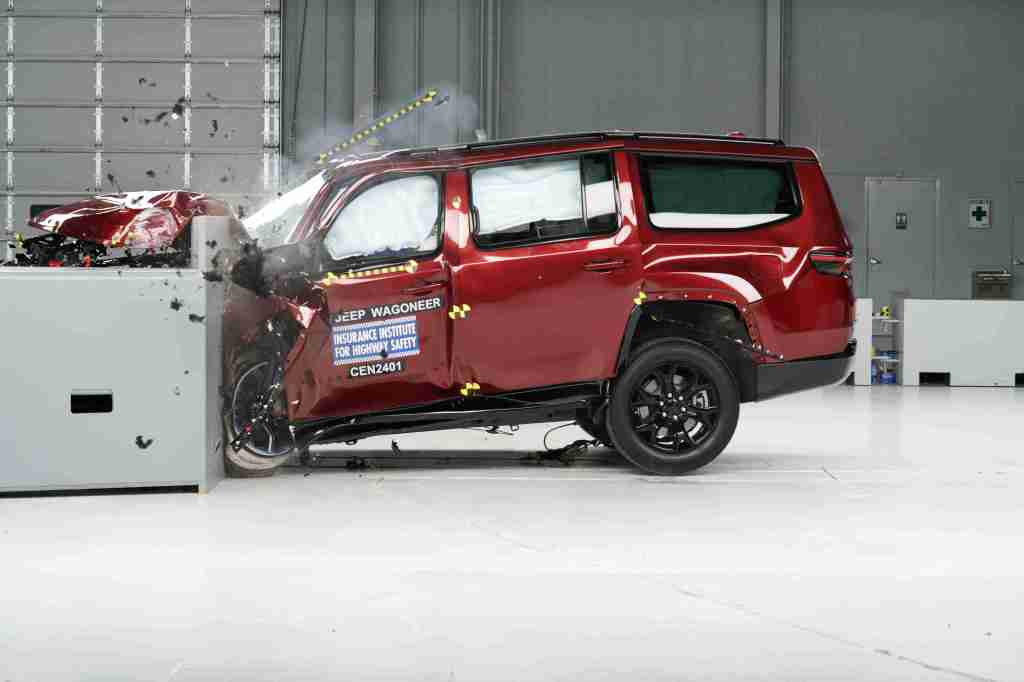
While it might seem that anyone riding in a large SUV would be safe, especially in relation to those who are not riding in a large SUV when said vehicle has a collision with the non-large vehicle—and, yes, according to IIHS president David Harkey, “The huge mass of these large SUVs provides some additional protection in crashes with smaller vehicles, though that also means they present more danger to other road users” (like those in smaller vehicles)—turns out not all is without risk.
Wagoneer in the small overlap front test. (Image: IIHS)
Harkey: “The flip side of their large size is that there is a lot more force to manage when they crash into a fixed obstacle like a tree or bridge abutment or the barriers we use in our front crash tests.”
Yes, the Insurance Institute for Highway Safety (IIHS) has a tendency to crash all manner of vehicles into barriers of various sizes and orientations.
IIHS recently tested the Jeep Wagoneer, Chevrolet Tahoe and Ford Expedition.
And of the three, only the Wagoneer received the organization’s 2024 TOP SAFETY PICK award.
The reasons the Chevy and Ford didn’t get the pick are various, including “subpar performance in the small overlap front crash test.”
What is surprising about that is, as IIHS points out, “More than 90% of new models have sailed through this evaluation with good ratings since 2021.”
The small overlap front crash test is about “maintaining survival space for the driver and front passenger.”
Survival space.
Of the three, IIHS found the Expedition to be most troubled when rammed into barriers on either the driver or passenger sides.
Another troubling thing is that while big vehicles like these are typically people movers, all three were not particularly good when it came to the second-row passengers during the moderate overlap test.
All of which is to say: No matter how big your vehicle is, drive it carefully and safely. After all, your passengers depend on it. To say nothing of how things like footwell intrusion should you be driving can be more than merely problematic.
Although the number of vehicles sold in a given month in the UK isn’t particularly large, from a percentage standpoint there are undoubtedly some people at US OEMs who wish they’d have the kind of EV registration numbers that exist in the UK:
According to the Society of Motor Manufacturers and Traders (SMMT), in May EVs have 17.6% of the market.
While the whole market was up 1.7% in May, SMMT figures show that EV sales were up 6.2%. Clearly, EVs in the UK are doing rather well.
Do British consumers know something that American consumers don’t?
Well, maybe not.
Turns out that consumer retail EV sales were actually down 2%.
The uptick in the EV market came from fleets.
In the UK there is something called the “Vehicle Emissions Trading Scheme” that mandates zero-emissions vehicles represent 22% of a manufacturers’ annual sales.
Apparently there are incentives available to businesses for getting EVs that are not open to consumers. The SMMT believes that it is necessary for “the next government to provide consumers with meaningful purchase incentives.”
Conservative leader Rishi Sunak, current UK prime minister, will square off against Labour leader Keir Starmer on July 4.
Mike Hawes, SMMT Chief Executive:
“As Britain prepares for next month’s general election, the new car market continues to hold steady as large fleets sustain growth, offsetting weakened private retail demand. Consumers enjoy a plethora of new electric models and some very attractive offers, but manufacturers can’t sustain this scale of support on their own indefinitely. Their success so far should be a signpost for the next government that a faster and fairer transition requires carrots, not just sticks.”
While of the subject of incentives and such, it should be noted that in May plug-in hybrids were up 31.5% are regular hybrids up 9.6%, both handily outperforming EVs.
And while the May ’24 market share for plug-ins is 8% and hybrids 13.2%, each below the EV’s 17.6%, combined they represent 21.2% of the market.
Evidently consumers aren’t against reduced emissions but are in favor (favour?) of the convenience and range provided by hybrids.
One of the things that seemingly more European drivers—particularly those in Germany—do that isn’t as frequently performed by Americana drivers is to swap out their tires from summer tires to winter tires. Winter tires provide more grip than even the all-season tires that are more common in the U.S. And a lot more grip that that provided by summer tires.
Apparently there is a bit of an issue with winter tires and electric vehicles.
BMW/Pirelli jontly developed winter tire with EV applicataions as the focus. (Image: BMW)
The compounds and the tread patterns found on winter tires that provide the grip are such that the rolling resistance is increased.
And when it comes to EVs in particular, that rolling resistance can decrease range.
So BMW Group and Pirelli have developed 20-inch P Zero Winter 2 tires, specifically for the BMW 7 Series, including the electric i7.
The companies say that compared to a conventional winter tire, the i7 can get 50 km (31 miles) of additional range.
According to Dr. Mihiar Ayoubi, senior vice president, Development Driving Pleasure, BMW Group (with a title like that, I’d quote him even if it was not even tangential to the subject), “These tires exemplify our commitment to pushing the boundaries of our cars in even dimension.”
The tires will be available in August, then fitment for the new BMW X3 later this year.
One of the aspects of electric vehicles that is regularly not talked about is that because they tend to be pricier than vehicles with gas engines (according to KBB the average transaction price for an EV is $54,021 compared to $47,218 for vehicles in general) is that insurance rates are higher.
Higher because the vehicle itself is more expensive.
Higher because the cost of repairs is higher.
(When people talk about the need for more EV infrastructure, it is mainly about charging stations. But here’s something to consider: what is the level of availability of repair shops for EVs? I recently went to a repair shop on a Monday to find out when I could get some simple service performed for a non-EV. The scheduler said, “Erm, how about Friday? We’re understaffed.” I suspect that had it been an EV I would have heard, “Well, the EV guy is pretty much booked through. . .” and it would have been beyond Friday.)
According to the U.S. Bureau of Labor Statistic’s Consumer Price Index, while prices for goods and services across the board is up 3.4% from April ’23 to April ’24, motor vehicle insurance over the same period is up 22.6%.
Experian has surveyed consumers and found that 71% say that inflation has “impacted their road trip plans.”
However, over the past 12 months food away from home is up 4.1% and gasoline 1.2%, so it is hard to understand why so many people see inflation as being a big problem.
For the past few years it seems like there hasn’t been a Hyundai the exterior design of which I haven’t been most impressed by. Sedan or crossover, ICE or electric, the design team at Hyundai has been delivering in a way that I’m sure there are some at other OEM studios can only shake their heads at in wonder, admiration and jealousy.
Former head of Ford design J. Mays used to say, in effect, that it cost as much to stamp a boring body panel as it does an intriguing one. So given that. . . .
It does seem to be the case, however, that Hyundai’s competitors have watched the way the company is gaining market share, going from a brand that didn’t seem to be having much of an effect on the market* (in effect, just getting buyers on the margin) to one that is growing, step by step (i.e., in pre-pandemic 2019 Hyundai sold 668,771 vehicles in the U.S.; in 2023 that number was up to 801,195; 2024 sales through May show a 2% increase over 2023, not a big number by any means, but one that is still on the plus side). And what those competitors see is that people in non-trivial numbers like non-boring sheet metal, so they have, in an increasing number of instances, elevated their games.
Which is good for consumers.
That said, Hyundai design has persistently produced vehicles that are striking.
Which led me to fear that I was becoming too enamored with the marque.
A shift (and it has a single-speed reduction gear transmission). . .
But then I saw the rear of the 2024 Kona Electric and that fear became unfounded.
Rear of the 2024 Kona Electric (Images: Hyundai)
It strikes me—yes, yes, entirely subjective—as simply too slabby.
The rear of the original Kona, model year 2018, is something that I think is far more interesting. And as I spend time looking at photos of the earlier iteration of the Kona, I think its design is superior to the current one. The forms are much tighter.
Rear of the original, 2018, Hyundai Kona. I like this one better. Much, much better.
Of course, OEMs are interested in moving their current models, not ones from the past. (Interestingly, in terms of purchasing, the Cox Automotive 2023 Automotive Car Buyer Journey Study found that 68% of buyers considered both new and used vehicles and it is worth noting that there some 36 million used vehicles sold in 2023, more than double the number of new. For the consumer, used matters.)
OK. Now completely objective info.
Just the facts. . .
The Kona Electric is, well, an electric vehicle. It is powered by a permanent magnet synchronous motor that produces 150 kW (a.k.a., 201 hp). The motor powers the front axle. There is a 64.8 kWh lithium-ion battery. According to the EPA this setup provides a range of 261 miles.
With DC fast charging the battery can go from 10% to 80% in approximately 43 minutes. With a Level II charger, using the 11 kW onboard charger, it can go from 10% to 100% in 6 hours, 14 minutes. (This is the sort of thing that can happen at home.)
The Kona Electric’s outside measurements are: wheelbase, 104.7 inches; length, 171.5 inches; width, 71.9 inches; and height, with roof rails, 62.2 inches.
The Kona Electric’s inside measurements are: passenger interior volume with sunroof, 96.8 cubic feet.
The Kona Electric’s cargo capacities are: behind the second row, 25.5 cubic feet; second row folded, 63.7 cubic feet.
The Kona Electric’s frunk capacity: 0.95 cubic feet. (Think of a place to store the charging cable.)
Not just the facts. . .
On the inside (now going back to the subjective mode with some numbers thrown in) there is the clean, contemporary look that Hyundai is bringing to all of its vehicles.
There is a 12.3 driver information screen and a 12.3-inch infotainment screen. While it doesn’t fake being one screen, for practical purposes this is 24.6 inches of screen, which is quite impressive. (Plus the visual appearance is first-rate.)
There is an eight-way power driver seat; the passenger has to adjust their own, xix ways. But both front seats are heated and ventilated and are trimmed out with “H-Tex” leatherette (a.k.a., pleather).
There are wireless Apple CarPlay and Android Auto and Bose premium audio.
There is Hyundai Digital Key, which means you can use your phone in lieu of the fob; the fob has proximity capability which means you can approach the locked vehicle and it will open when you tug the handle.
There is an array of safety tech (e.g., blind-spot collision warning; parking distance warning; navigation-based smart cruise control with stop and go; lane-keep assist). There is also something that is useful in regular driving: use the turn signal and there is a camera view in the driver information screen showing what’s along side the vehicle (yes, the sort of thing you can see in the side-view mirrors—but better).
So. . .
Drives well. (Somewhat) reasonable range (I am in the 300-mile club). Good tech and nice interior. Excellent MSRP for this loaded (Limted) model: $41,045.
The 2025 Grom is part of the miniMOTO model lineup that American Honda has on offer.
The “mini” is absolutely spot-on.
You’ll meet the nicest–and possibily thriftiest–people on a Grom. (Image: Amercan Honda)
The bike has a 47.2-inch wheelbase and a seat height of 30 inches. It weighs just 224 pounds.
The Grom has a 124-cc, single-cylinder, four-stroke engine. (It meets current EPA and even CARB standards.) It has a five-speed transmission. Hydraulic disc brakes.
There is a 1.6-gallon fuel tank.
If you go to Home Depot for a gas-powered push mower, odds are the engine is going to be bigger than the one on the Grom (though the fuel tank will be smaller).
But here’s something very cool about the Grom:
Its fuel economy is an estimated 166.5 miles per gallon.
Consider: If the average American’s commute is a total 40 miles, then the Grom, with a single tank of gas, would allow five days of commuting and still leave gas in the tank for weekend errands.
And when you go to the gas station to fill the Grom, the price will be so low you’ll have plenty of money left for snacks.
(And speaking of spending, the starting MSRP for the ’25 Grom is $3,599.)
Of the 100% of people who are planning to purchase a new or used vehicle in the next two years, Cox Automotive finds that 55% are “Considerers,” as in considering an electric vehicle and the remaining 45% are “Skeptics,” as in interested only in internal combustion engines.
From a demographic point of view, the Considerers are probably more appealing to dealers in that they have a higher average income than the Skeptics ($71,756 v. $60,625) and are younger (42 v. 46), which means they may have more vehicles in their future.
However, speaking of the future, Cox Automotive personnel expect that within the next three to five years 54% of the Skeptics will become Considerers, then an additional 26% in 10 years, meaning there will just be 20% remaining dedicated to combustion.
It is interesting to note that as for now, when it comes to barriers to EV adoption Considerers rank as 1 and 2 “Too expensive” and “Lack of charging stations,” while Skeptics flip the order of those two.
What is an interesting difference in barrier rankings is that for the Skeptics “Inability to charge EV at home” is in third place (tied with “Concern about battery losing charge”) while it is in fifth (or last) place for the Considerers.
Which presumably means home charging is acutely important for EV sales.
There are some potentially concerning numbers regarding the Considerers, however.
For example, in 2023 the EV Buyer was 41 years old, had an average household income of $139,00 and 84% of them had excellent/very good credit.
In 2024 the Considerer is 42, has an average household income of $72,000 and 53% of them have excellent/very good credit.
Still, according to Isabelle Helms, vice president of Research and Market Intelligence at Cox Automotive, “We remain bullish on the long-term future of EV sales in America, as many Skeptics today will be carefully considering an EV by the end of the decade. With more infrastructure, education, and technological innovation and improvements, we believe electric vehicle sales will continue to grow in the long term.”
One thinks about Keynes’ quote regarding the long run. . . .
Recently Tim Kuniskis announced his retirement. Or, well, Stellantis announced his retirement. Kuniskis was the CEO of both Dodge brand at Stellantis and Ram.
The ’24 Dodge Charger: a muscle car with a motor, not an engine. Things change. So do execs. (Image: Dodge)
Having had the opportunity to chat with him on several Dodge-related occasions I concluded that the man was really into the Dodge brand in a way that wasn’t a “This is my job so I’ll do what I need to do in order to fulfill what needs to be done, period.” There was evident commitment.
Over the past several years Dodge has become an enthusiast niche brand, one predicated on high-octane muscle cars. Dodge has made an art of creating cars that are pretty much unlike anything else—anymore.
It once was that there were the Dodge Challenger, Ford Mustang and the Chevy Camaro that would line up at stoplights on Telegraph or Woodward in metro Detroit like something out of the Fast and the Furious. (There was also the Pontiac GTO, but given the non-existence of that marque as a going concern, we’ll let that pass.)
The Mustang still has serious muscle in some of its trim packages, but arguably it has become something more “continental,” as the vehicle is also being sold in markets where drivers are more interested in roads that curve than going in a straight line for a quarter mile.
The Camaro has been put on a shelf.
So that pretty much leaves the Challenger and its four-door stablemate, Charger.
Muscle cars—the Dodge slogan is “Brotherhood of Muscle”—probably isn’t an optimal space to be in right now given concerns with emissions.
So Dodge is going to offer a car that will produce 670 hp and do a quarter mile in 11.5 seconds. An electric car.
About it Kuniskis said: “The electrified 2024 Dodge Charger Daytona Scat Pack delivers Charger Hellcat Redeye levels of performance and announces its presence through the world’s first Fratzonic Chambered Exhaust.”
Even that car though it is a coupe not a sedan, the name “Charger” for an EV is just too good to pass up.
According to Dodge, the ’24 Charger battery has a nickel cobalt aluminum chemistry that is, in effect, “the battery-electric version of high-octane fuel.”
The Fratzonic Chambered Exhaust is said to produce “Hellcat levels of sound intensity”—or that should be generates that sound because while the Hellcat’s rumble is a consequence of combustion, there’s no combustion going on in the new car.
While there will also be versions of the ’24 Charger with a 3.0-liter twin-turbo Hurricane engine that produces up to 550 hp, and while that will probably handily outsell the electric version in the long run (i.e., there will probably be a whole lot of early adopters of the electric version because it is, well, cool, but then that number will be satisfied and the sales will go down as quickly as they went up), the corporate attention will be focused on the electric version because that’s what good corporate citizens do.
While it might seem that there is a correlation between Kuniskis’ retirement and the electrification of Dodge, it may simply be that after 30 years in a tough business the man needs a break.
But wait, there’s more. . .
Or it may be that things are really changing at Stellantis North America.
Kuniskis’ job is being split. Christine Feuell, who is running Chrysler, is taking on the Ram assignment.
Matt McAlear, who was running Dodge sales, is now CEO of the brand.
Earlier this year Carlos Zarlenga replaced Mark Stewart as chief operating officer for Stellantis North America. Zarlenga has been with Stellantis since 2022, which is certainly not a long time. (Stewart took over Goodyear: regardless of the propulsion system, vehicles need tires.)
Last week Matt Thompson was named senior vice president of Stellantis U.S. Retail Sales “effective immediately” because Jason Stoicevich, who had been named to that position in February, having been the chairman and CEO of Stellantis Canada before that, has left the company. Suddenly.
Something is evidently going on in Auburn Hills.
When there are changes like these, when the industry itself is in flux, you’ve got to wonder just what is going on. .
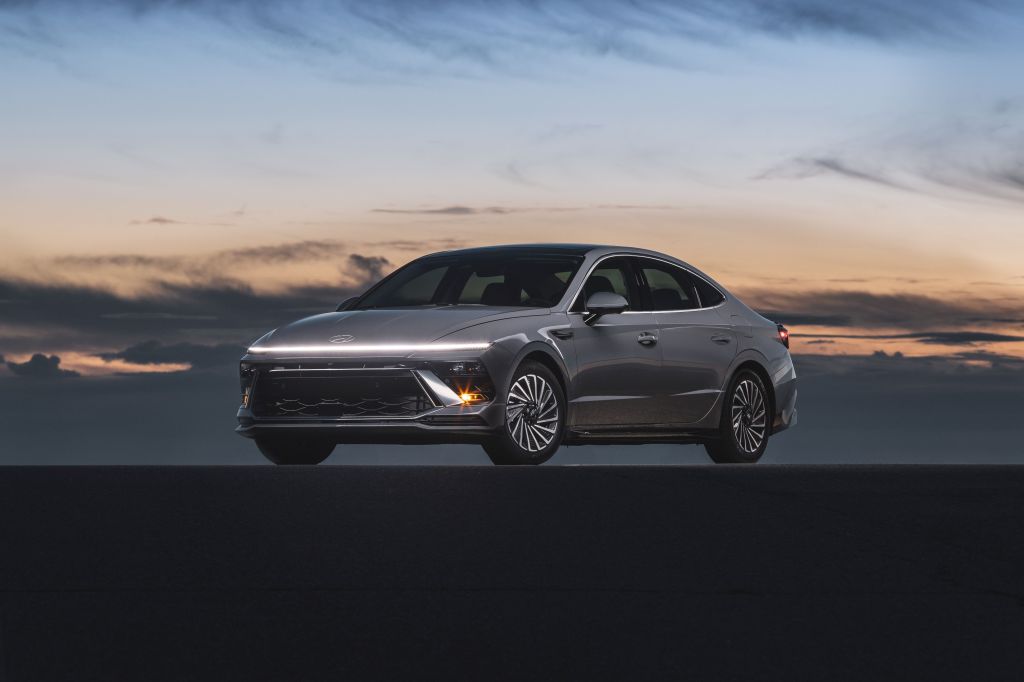
When I first saw the 2024 Hyundai Sonata Hybrid I was surprised. Quite surprised. While Hyundai—at least since the introduction of the model year 2011 Sonata with the “Fluidic Sculpture” design language—has consistently been turning out vehicles with striking designs, (1) most of those vehicles of late are crossovers and (2) I’ve always been a greater admirer of the Hyundai Elantra, the Sonata’s compact kin.
But the Sonata has undergone a serious refresh for MY 2024.
For most OEMs this would be a concept car. For Hyundai it is a midsize sedan that you can buy at a dealership near you. (Images: Hyundai)
When the vehicle was unveiled late last summer, Simon Loasby, head of the Hyundai Style Group at Hyundai Motor Company, said, “We wanted to give Sonata a more contemporary design statement,” which is an absolute understatement.
If Loasby considers that “contemporary,” then I think he must live in the future, because the lines on the vehicle, front, sides, back, and roof, contribute to a car that is striking and stylish in appearance.
Advance. Repeat.
It is almost as though the designers said to themselves, “OK, let’s design the most-advanced looking Sonata that we can.” They did that. Then started from that point and designed one that goes beyond that.
A slogan that has been around for a bit has it that “lighting is the new chrome.” If the LED lighting execution on the Sonata is chrome, it brings to mind William Gibson’s title “Burning Chrome” because it has an advanced appearance. (It also makes one wonder whether a generation raised in Suburbans and Grand Caravans might not find the Sonata aesthetic far more appealing.)
Comfort, Too.
And this innovative appearance continues into the vehicle, where there are seats that are comfortable (and I’d describe them as “contemporary” because I’m still waiting for the Aeron chair analog, and even though that was introduced in 1994, when it comes, it will be, apparently, the future), and an instrument panel that combines the digital and the analog (a.k.a., knobs and buttons) in a way that speaks to appearance and ergonomics (with too many going for the former and ignoring the latter).
According to Merriman Webster, ergonomics is “an applied science concerned with designing and arranging things people use so that the people and things interact most efficiently and safely.” Which is presumably something that Hyundai interior designers throught about when executing this interface, which includes buttons and knobs as well as the ability to have things touched and swiped.
There is a 12.3-inch screen for the driver that contains the obligatory operational information that butts up to another 12.3-inch screen for the driver and front passenger (though it is slightly curved in a bias for the driver) for purposes of infotainment. Below that second screen, in the center of the overall instrument panel, there are knobs and buttons for control of things like the audio and HVAC (few things are more annoying when driving than trying to control the temperature through a screen selection).
Drive. And Drive Some More.
But here’s the thing that I saw on the driver’s information screen that was even more striking to me that the exterior design:
585 miles
That was the estimated distance that the car could be driven prior to fill-up. And that estimation was predicated on how other people prior to me had driven the car, and I’m guessing that they weren’t exactly feathering the throttle.
It is worth noting that this is a car that is not anemic (192 hp is produced from the four-cylinder engine combined with an electric motor).
Here’s something interesting about that 585: it is what the available distance is based on getting 44.3 miles per gallon.
The Sonata Hybrid has a 13.2-gallon tank.
Now were it that people prior to me drove it in a more “normal” manner, odds are it would have been even higher: the EPA estimated numbers are 44 mpg city, 51 mpg highway, 47 mpg combined.
The range based on the combined average: 620 miles.
According to the Federal Highway Administration, the number of miles driven annually in the U.S., on average, is approximately 14,000 miles. So were you to be driving a Sonata Hybrid and getting the combined average, this would mean having to go to the gas station not more than twice a month. Which means about 10 minutes per month for a fill up.
For a car that is stylish, comfortable, and technologically up-to-date.
It may seem that the most controversial move made by Toyota for the 2025 Camry—the ninth generation of the midsize sedan—was to make all of them, be it FWD or AWD, LE, SE, XLE, or XSE trim, hybrids.
2025 Camry XLE. Stylish, well-equipped, and a hybrid. (Image: Toyota)
That’s right: Every Camry is a hybrid.
Under the hood across the board is a 2.5-liter, four-cylinder engine supplemented by electric motor generators such that the FWD version produces 225 net-combined horsepower (engine + motor) and the AWD 232 hp. This is Toyota’s fifth-generation hybrid system. Yes, they’ve been at it a while.
Depending on the drive configuration the fuel efficiency goes from a low of 44/43/44 mpg, city/highway/combined, for the XSE AWD (the top of the line) to 53/50/51 mpg for the LE FWD. To call 44 mpg combined “low” is, well, ridiculous.
Lots and lots and. . .
Realize that the Camry is the perennial best-selling car in the U.S. (22 years running), with the company delivering 290,649 units in the U.S. last year, units produced by Toyota in its manufacturing complex in Georgetown, Kentucky. (During the history of the plant, which opened in 1986, there have been more than 11 million Camrys built within those ever-growing walls. Yes, the expansion there has been notable such that today there is 9-million square feet under roof, which, according to Toyota, is equivalent to the size of 157 football fields.)
One might think that Toyota would not want to rock the proverbial boat, to make changes that might seem upsetting to what is clearly a loyal base of buyers. It’s not like there haven’t been hybrid powertrains in Camrys.
There have—since model year 2008 (calendar year 2007).
But it has always been a powertrain selection until now. You could get a Camry with or without electrification.
Yet the product planners at Toyota decided that the best thing to do was to go all in on hybrids.
Yikes! one might think.
The time is right
But broader market timing seems propitious, as there is the swerve away from full electric vehicles to electrified vehicles, a.k.a., hybrids. In 2023 Toyota Motor North America overall sales—including Lexus models, its bZ4X electric and Mirai fuel cell—included 29.2% hybrid models, up from 23.9% in 2023. One can only imagine the number when 2024 is calculated.
What I found to be surprising about the Camry XLE wasn’t under the hood but on the inside: there is trim covered with Dinamica, a microfiber, that has a quilted pattern. It is light gray. Black is available, as well.
Said another way: there is fabric covering surfaces on the door panels and dash board where you otherwise would see leather or plastic. The material is produced with recycled polyester without the use of organic solvents, so it is comparatively environmentally advantageous.
Yes, that trim is actually a fabric.
It is also surprising for those of us who are more used to seeing smooth materials that are naturally or mechanically grained.
A generational difference
However, when I showed the Camry to a Gen Z niece, she thought the interior was the most wonderful she’d ever seen. And when I explained that the car in question is a hybrid, it gained significantly more points in her book.
So what might seem like a risky move by Toyota is undoubtedly a correct one.
It is often said that a given generation doesn’t want to buy the type of vehicles that they’re parents had driven them in. In my niece’s case it was a Honda Odyssey and Ford Flex.
She and her husband presently drive a pickup for no reasons of utility.
But it seems that a sedan is on the table for her. And given what Toyota has done with the ’25 Camry, it is something that is of even greater interest.
And here’s another thing to consider: at her age she has a whole lot of vehicles in her future, so if she finds appeal in the Camry, odds are good that the company will get more business from her in the future. Given the reliability of Toyotas and given that the Camry is full of tech for purposes of entertainment and safety, it seems that the edge of style makes it all the more attractive.





 shinymetalboxes