Adjusting interest rates can be a tricky business for the Federal Reserve.
On the one hand, it wants to reduce the amount of borrowing and—consequently—spending.
That helps reduce inflation.
On the other hand, it doesn’t want to reduce the amount such that the economy falls into a recession.
Consumers don’t like inflation. That’s because things cost more.
Consumers don’t like high interest rates. That’s because they have to spend more to borrow the money to buy things.
Things like cars.
Kelley Blue Book announced the average transaction price (ATP) for new vehicles was down 1% in March compared to the ATP in February.
What’s more (or less), the March ATP was down 5.4% compared with December 2022, when ATPs were at their peak.
It’s not like new vehicles are inexpensive, even with that 1% drop.
The ATP—and remember, this is average—for March is $47,218.
Erin Keating, executive analyst at Cox Automotive, said, “It bears repeating that historically high interest rates and associated inflation combined with an ever-widening deficit of available vehicles at lower price points, will continue to challenge affordability for most car buyers.”
So there’s the interest rate-inflation situation.
The Disappearing Econo Box
Keating’s observation about “widening deficit of available vehicles at lower price points” is key.
KBB found that in March there were some 275 new-vehicle models available in the U.S.
Of the 275 only eight had ATPs of less than $25,000.
Three percent. Imagine trying to find one.
But apparently either people have lots of money or they’re willing to borrow it: in March sales of vehicles with ATPs above $75,000 were greater than those under $25,000: approximately 81,000 of the former and 52,000 of the latter.
Perhaps high interest rates are having an effect—on the lower portion of the market.
Of course, chances are OEMs are putting out vehicles with higher sticker prices because they can make more money on them than those that are more economical.
Let’s say that you are interested in buying a car.
A car as a sedan. Not a crossover. A bread-and-butter car. (Yes, maybe you want to add some spicy tomato jam to it—spoiler, alloy wheels, etc.)
You go to the local Ford dealer.
And discover that the only car is a Mustang, which doesn’t qualify (i.e., two doors).
There happens to be a Lincoln store across the parking lot.
There are no cars, only crossovers of stair-step sizes.
You visit a Chrysler dealership and learn that Stellantis has stopped production of its long-in-the-market 300 at the end of last year, but they’ve got a Pacifica minivan, if you’re interested.
Buick perhaps? Again, no. Only crossovers.
Over at Cadillac things are better: of its seven models, two are sedans, the CT4 and the CT5. Given that the Q1 2024 sales for those are down 36.1% and 34.2%, respectively, how long they’ll be around may be in some question.
Chevy? An impressive array of crossovers and trucks. And one car, the Malibu.
The point is, buying a car is not as easy as it once was.*
Which leads to a thought about electric vehicles.
What if you went into one of these dealerships and discovered that they didn’t have anything on the showroom floor that didn’t have a plug?
What if that was pretty much the case up and down the street of the auto mall?
Clearly there would be an increase in the number of EVs sold out of those dealerships.
Maybe the numbers would be that good.
But they would be better.
Just as they’ve increased the number of models that aren’t cars and so have made buying a car tough, it could be that to help recoup some of the billions being spent on EVs they make buying an ICE tough.
Something’s got to move more of that lithium-powered metal.
(Of the 593,997 vehicles GM sold to customers in Q1, 16,169 were EVs. Not much of a business case there. And it sold twice as many Malibus ((32,749).))
*Interestingly, the Asian and European brands, in general, all have cars in their lineups.
“Mercedes-Benz EVs accounted for 13% of our total group sales volume in Q1,” Dimitris Psillakis, president and CEO of Mercedes-Benz USA, said, reporting how the marque is doing so far in 2024.
Which, on a percentage basis, is quite good.
Ford, which describes itself as “America’s No. 2 electric vehicle brand,” had Q1 EV sales of 3.9%.
Mercedes has three EVs in its U.S. showrooms:
EQB, of which it sold 671
EQE, 5,113
EQS, 2,552
That is a total of 8,336 of the 66,570 passenger vehicles it sold in Q1.
(To be fair to Ford, it sold 508,083 vehicles in Q1, of which 20,233 were EVs.)
But here’s something interesting about the Mercedes sales: It sold 15,096 GLE SUVs.
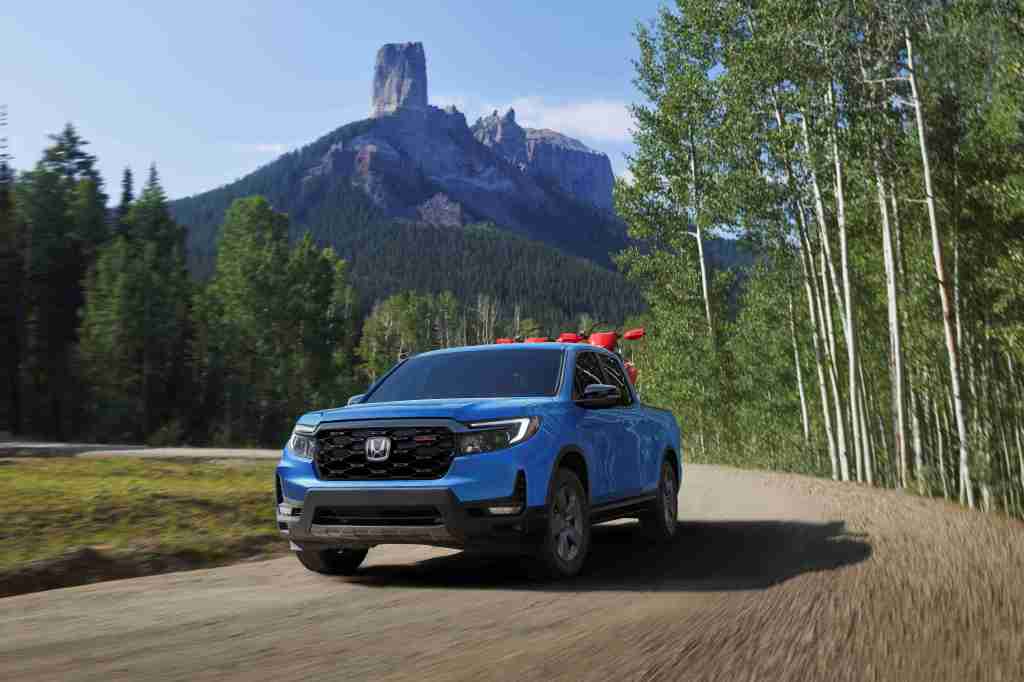
When the Honda Ridgeline was in its first year on the market, it received the 2006 North American Truck of the Year Award (it is worth noting that back then there wasn’t the Utility category, simply “Car” and “Truck,” and it was a good year for Honda, as the Civic took Car).
Then, when the second-generation Ridgeline, which is the basis for the current model, had its debut year, it took the 2017 North American Truck of the Year. The other two finalists were the Ford Super Duty (which won the NACTOY award in 2024) and the Nissan Titan (which is going out of production this summer).
The point of this is that the NACTOY jurors tend to be a picky lot (full disclosure: I am one of them), and for the Ridgeline to take its category the two times it has been eligible says a lot about the truck.
2024 Honda Ridgeline TrailSport: Yeah, it’s a truck. (Image: Honda)
One of the things that made some people dismissive about the Ridgeline being a “truck” is that doesn’t feature body-on-frame construction but is a unibody.
How dare Honda!
Clearly it was on to something because the U.S. pickup truck leader, Ford, introduced the Maverick in 2021 and it, too, is a unibody. (It took the NACTOY Truck category in 2022.)
(The Hyundai Santa Cruz is also on that type of platform.)
The Ridgeline has a box on the back: 64 inches long; 50 inches wide at the wheel wells, 51 inches wide at the D-pillar, 60 inches wide at bed walls.
The Ridgeline can tow: up to 5,000 pounds.
The TrailSport version has a total payload capacity of 1,521 pounds.
When driving the Ridgeline a friend took a look at the box on the back.
“I need a truck a few times a year.”
And it occurs to me that that is precisely the sort of person who might be inclined to get a Ridgeline rather than the other midsize trucks that are available, all of which are body-on-frame vehicles.
This is because the Ridgeline truly rides and handles like an Accord.
Let’s say for the sake of argument that my friend’s “few times” adds up to a solid month. Let’s say that he goes for one of those other midsize trucks.
That means for 11 months out of the year he’s driving something that doesn’t have anywhere near the ride and handling of the Ridgeline.
Seems to be quite a price to pay for hauling gear or gravel or whatever on occasion.
The TrailSport trim package is new for 2024. It has such things as a suspension tuned for offroad conditions and General Grabber A/T Sport tires (245/60R18), the first deployment of all-terrain tires on a Ridgeline. (Although they are big and chunky, the sort of thing you might imagine would generate all manner of road noise when not driving on a trail (which one might do “a few times a year”), somehow there isn’t a heck of a lot of noise from the tires in the cabin.)
In addition to which the TrailSport has a steal underbody protector for the oil pan.
On the inside there is the use of orange thread for the stitching on the steering wheel, door panels and seats; the front-seat headrests have “TrailSport” embroidered on them.
Just as there is capable rubber on the outside, there are serious rubber floor mats standard: if you’re going to use the truck to play in the dirt you might get dirty, so. . . .
The truck is powered by a 280-hp, 3.5-liter V6 that’s mated to a nine-speed automatic.
There is Honda’s torque-vectoring all-wheel drive system and there is “Intelligent Traction Management” for that system that allows the driver to select for sand, snow, mud, or paved roads. (Here’s betting that depending on where one lives, the last is the normal selection and the second occasional, assuming there are winter conditions.)
There are the now-obligatory infotainment features in the Ridgeline (e.g., nine-inch color touchscreen; Apple CarPlay and Android Auto), and what’s interesting is that Honda says that it has deployed a faster processor in its head-unit which means less lag.
According to Merriam-Webster, a pickup truck is “a light truck having an enclosed cab and an open body with low sides and tailgate.”
The Ridgeline certainly is that. And even more.
One more thing: Cars.com generates an “American-Made Index” each year for vehicles, taking into account assembly location, parts content, engine origin, transmission origin and U.S. manufacturing workforce.
The Ridgeline was designed and engineered in the U.S. It is manufactured in a plant in Lincoln, Alabama.
Of all vehicles—sedans, SUVs, minivans, hatchbacks, coupes, pickup trucks—there is only one truck in the top 10 of the most recent index: the Ridgeline.
Yes, according to Cars.com it is the most American of pickups.
For no reason other than the fact that it is an amazing photo, there’s this: the MINI John Cooper Works WRC, campaigned by Prodrive, a UK-based independent motorsports company, driven by Kris Meeke at Rally Italy in 2011:
Yes, a flying MINI. (Image: Classic Nostalgia)
(The reason this photo has come up is because Prodrive’s 40 years of development will be celebrated at Classic Nostalgia, an event that is being held in the UK on July 20-21.)
Cigarette advertising was banned from Formula One at the end of 2006. The Marlboro liveries that had become so visible on the circuit were to be no more.
But it is not like the companies that are purveyors of products like cigarettes aren’t interested in reaching about 1.5-billion F1 viewers (as in TV, not in the stands) per year.
Livery artist MILTZ and the McLaren MCL38. (Image: Vuse)
So BAT, which describes itself as “a leading, multi-category consumer goods business” that has as its purpose “create A Better Tomorrow by Building a Smokeless World” has announced through its Vuse brand that the livery for the McLaren Formula 1 team for the 2024 Japanese Grand Prix will be created by a Japanese artist named MILTZ and sponsored by BAT.
BAT was once known as “British American Tobacco.” Among its cigarette offerings are Lucky Strike, Dunhill and Kool. Vuse is a vape product, part of the company’s portfolio that also includes the “Heated Product brand glo; and Velo our Modern Oral (nicotine pouch) brand.”
BAT reports that the “non-combustible products”—a.k.a., things that aren’t cigarettes—provided 16.5% of its 2023 revenue and it is working to bring that number up to 50% by 2035.
This sounds like something out of a movie where scientists in an isolated lab create something that is, well. . . .
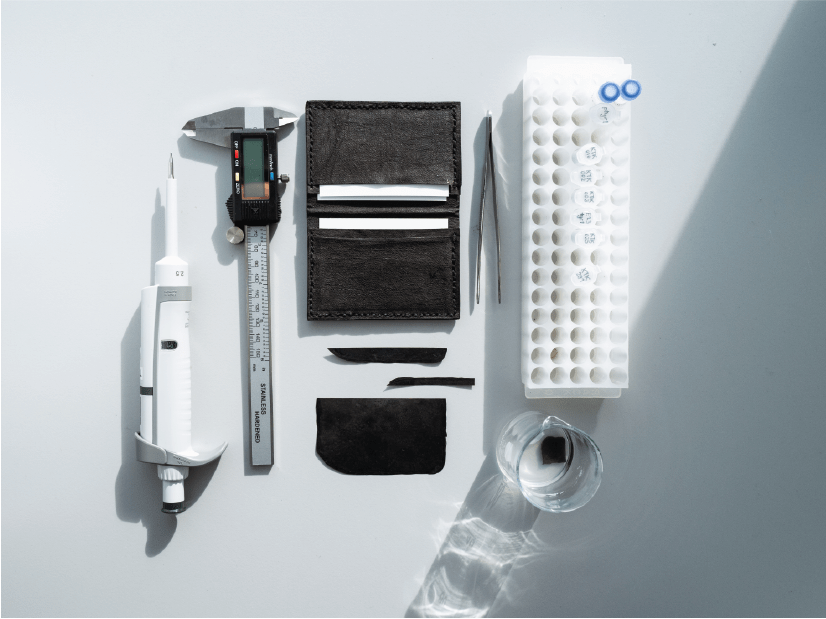
Researchers at Imperial College London have created a way that self-dyeing, vegan, plastic-free “leather” can be grown.
They’ve modified the genes of a bacteria species that produces sheets of microbial cellulose with the modification also making the bacteria produce a dark black pigment know in the lab world as “eumelanin.”
Among that scientific gear is the wallet that was grown from engineered bacteria to resemble the look and feel of leather. (Image: Imperial College London)
Beyond Black
But they’ve also found that using genes from other microbes they can produce colors. They shine blue light on the surface of the bacteria that respond by producing colored proteins. This allows the creation of logos and other patterns in the materials.
While they’ve produced a shoe and a wallet as examples, there are other applications for the material about which Professor Tom Ellis of Imperial College London’s Department of Bioengineering said:
“Bacterial cellulose is inherently vegan, and its growth requires a tiny fraction of the carbon emissions, water, land use and time of farming cows for leather.
”Unlike plastic-based leather alternatives, bacterial cellulose can also be made without petrochemicals, and will biodegrade safely and non-toxically in the environment.”
As automotive interiors become increasingly less plastic- and cow-intensive, presumably this could translate into seating surfaces and trim.
While geography isn’t necessarily destiny, there is something about the Honda Passport being built in the company’s complex in Lincoln, Alabama. It seems somehow appropriate that a vehicle that is biased toward the outdoors would come from a locale that is not full-on urban (i.e., the population of Lincoln was 6,845 in the 2020 census; it is approximately 45 miles due east of Birmingham). I’m guessing that not long after one leaves the Lincoln city limits there is access to a number of driving surfaces that are less developed than, say, compared with the situation in Detroit (where the Grand Cherokee, a Passport competitor, is produced), so those putting the vehicle together have a good sense of what’s needed, and the Honda culture is such that the people who engineer the vehicle listen.
When the 2024 Passport was launched last fall, Lance Woelfer, assistance vice president of Honda National Auto Sales, American Honda Motor Co., said, “With more rugged off-road performance than ever before, the 2024 Honda Passport builds on our legacy of engineering rugged, capable and comfortable SUVs for active, weekend adventurers.”
(Image: Honda)
Somewhat off the beaten path
To be sure, some “weekend adventurers” are inclined to go to places that are far off the unbeaten path, but this two-row midsize crossover, while certainly more robust than you might expect a vehicle from Honda to be (assuming that you associate it with Accords and Civics), probably isn’t the ute that hard-core off-roaders would opt for. (For those so inclined, know that the ground clearance is 8.1 inches and the approach and departure angles are 21.1° and 24.3°, respectively.)
However, the standard in the Passport lineup is Honda’s i-VTM4 torque-vectoring all-wheel drive system that sends torque where it is needed, as much as 70% to the rear wheels, and then 100% of that can be shifted to the wheel that needs it, based on conditions (i.e., if the left wheel is off the ground or there is a slick patch beneath it, such as when stuck in the snow, the torque will be shifted to the right wheel to get things moving).
A superb characteristic of the i-VTM4 system is that things happen automatically: no knobs, buttons or levers required. (It seems to me that those who are occasionally dealing with uncharacteristically demanding conditions, such as when doing some weekend adventuring, probably have their hands sufficiently full (e.g., trying to avoid that downed tree and working to miss the jagged rock on the other side) without needing to do something else but piloting the vehicle.)
Big on black
The trim package driven here, the Black Edition, looks sufficiently aggro, but for someone who is trail-oriented would likely opt for the TrailSport version of the Passport
But the Black Edition, with trim added to the front fascia, blackout treatments on features front and back, and painted—black—20-inch alloy wheels, has an appearance that is particularly striking.
On the inside there is—no surprise—more black, such as the seats (the fronts are ventilated; the rear heated), though there is brightly contrasting red stitching that provides a brightening accent. What I found notable is that even the door opening lever is black, something that might otherwise go untreated: they are nothing if not thorough.
And while on the inside know there are an 8-inch color touchscreen and a 540-W audio system, CarPlay and Android Auto compatibility, two USB ports in the front (an A data port and a C charging port—and it should be mentioned there is a Qi wireless charger) and two for the backseat passengers (boy C charging ports).
Performance and people
The Passport is powered by a 280-hp V6 that generates 262 lb-ft of torque at 4,700 rpm. It is mated to a nine-speed automatic that offers paddle shifters. The vehicle uses regular unleaded, which is probably a good thing as its EPA numbers are 19/24/21 mpg.
The Passport provides room for people—EPA passenger volume 114.9 cubic feet—and objects—a maximum behind the first row of 100.7 cubic feet and 50.5 cubic feet with the second row up.
And to protect the people and objects, there the Honda Sensing array (with functions ranging from adaptive cruise to collision mitigation braking).
The MSRP for the ’24 Honda Passport Black Edition is $47,970.




 shinymetalboxes