Although some people are on pins and needles and potential massive tariffs regarding Chinese vehicles coming to America, in Europe, where there is active concern on behalf of some of the OEMs on that subject, things are really not all that whelming, over- or otherwise. At least not yet.
According to Schmidt Automotive Research, during January and February, the shares of the Western European market are:
13.3% Japanese OEMs
7.8% Korean OEMs
2.9% Chinese OEMs
However. . .
When looked at from the point of battery electric vehicles, the “Chinese model volumes combined share was 3x as large.”
So clearly Chinese OEMs are gaining some traction in the Western European market when it comes to that tech.
One interesting aspect of the penetration of Chinese vehicles of all powertrain types there is which country is most interested in acquiring them:
Italy.
Of the ~52,000 Chinese vehicles sold during the first two months, Italy took some 12,000 of them.
Which probably doesn’t make the folks at Fiat feel good.
On March 22 Bentley Motors announced that Adrian Hallmark, who had been chairman and CEO of the company since 2018, was leaving the company.
Adrian Hallmark: From one lux Brit brand to aonther. (Image: Bentley)
Evidently he left under good conditions as Gernot Döllner, chairman of the executive board of Audi and responsible for the Progressive Brand Group, which includes Lamborghini, Bentley and Ducati, within the Volkswagen Group, said, “I would like to thank Adrian Hallmark for his significant commitment over the last years and wish him well in his personal and professional future.”
That professional future was defined quickly.
On March 22 Aston Martin announced that Adrian Hallmark would be joining the company as executive director and CEO, starting no later than October 1.
Generally there is a bit of a gap between the announcement of one’s departure and one’s arrival.
But that’s certainly not the case with Hallmark. Odds are he will have his stuff moved from Crewe to Gaydon in far fewer than some seven months.
Hallmark said about his departure: “Bentley has had a great influence on me. To redefine luxury mobility for the future with such a strong brand is a task that I took on with full commitment and great pleasure. The time has now come for me to turn to new challenges. I would like to express warm thanks to the entire Bentley team for all that we have achieved together in the last few years.”
And of his arrival: “The transformation of Aston Martin is one of the most exciting projects within the ultra-luxury automotive industry. I am looking forward to continuing the Company’s great momentum and utilizing my experience and passion to further unleash this iconic brand’s potential and take it to even greater success.”
Sounds like his previous gig was a bit easier than his new one will be.
When someone describes something as “most exciting” that generally means “this is going to be really hard.”
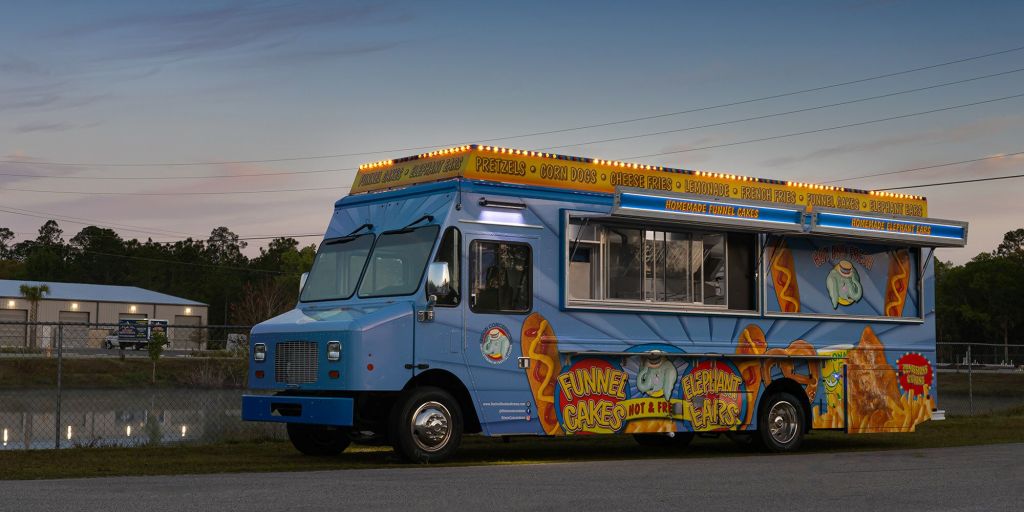
As the outdoor season is soon to breakout throughout the U.S. it the folks at Premier Food Trucks (PFT) have announced a new vehicle that’s targeted at purveyors of things like elephant ears and other carnival delicacies.
Get ready for that summer scene. (Image: Premier Food Trucks)
Brandon Williams, President of Manufacturing at PFT:
“This isn’t a typical food truck – it’s a celebration on wheels. We always have fun designing our trucks, but this one was particularly cool to make. It allowed us to really stretch our creative muscles and put some excitement into the overall look – using bright colors and flashing lights to accentuate the carnival party vibe. It’s also designed to handle the greater demands of this type of catering, making our latest build one that combines the party spirit with important practicality.”
While some people might roll their eyes like a Tilt-a-Whirl at Williams’ comments—“C’mon,” they think, “it is 2024 Ford F-59 22-foot step van with a kitchen on top”—his rhetoric is almost clinically objective compared with some of the proclamations made by automotive OEM executives about the latest variation on whatever it is that they’re introducing, even though it seems a whole lot like the one they introduced before.
Presently OEMs are in the process of cutting costs. Not only are they prone to the issues that face all of us when we go shopping for goods and services, but they are also investing big-rig quantities of cash on electrification and autonomy, two things that are not only incredibly costly, but which have yet to form an income stream, just an out-going gush.
One of the ways of cutting costs is to reduce what’s technically known as “build complexity” or more simply known as “reducing the number of options available.”
By offering, say, five packages (variations on seat materials, audio systems, shiny bits, etc.) rather than 10, this means that there has to be fewer items sourced and then stored, fewer things that have to be handled in the factory.
Which brings us to Bentley Motors.
It announced its 2023 financials this week.
It posted revenue of €2.938 billion and operating profits of €589 million.
Its return on sales was 20.1%.
The company delivered 13,560 vehicles in 2023.
Adrian Hallmark, chairman and CEO of the company, said, “We took another big step forward on our strategy to focus on customer value rather than volume.”
Which can probably be interpreted as: “Rather than trying to move a whole lot of mental, we’ll focus on providing customers with things they want and are consequently willing to pay for.”
Which brings us back to build complexity.
Bentley’s lineup consists of the Flying Spur, Continental (GT and Convertible), and Bentayga.
Yet the company, though its Mulliner division, offers 46-billion build configurations.
It found that about 75% of its customers opted for specialization, a 43% increase over the number who did in 2022.
Kevin Kang talks about how global designers looked beyond the world of COVID to the one that we’re experiencing today—when more people want to get out in the world. Which have rise to the fifth-generation of the Santa Fe SUV.
(Images: Hyundai)
By Gary S. Vasilash
One of the things that COVID gave rise to is the design—inside and out—of the fifth-generation, 2024 Hyundai Santa Fe.
As Kevin Kang, Head of Department, Design, Hyundai Design North America, explains, the work on the project (code name: MX5) began in late 2019, and within a few months the design teams in the U.S., Korea and Europe were communicating with one another via digital means, including putting on virtual reality headsets (with individuals expressed as avatars) so the design-in-becoming could be viewed and manipulated.
Because they were all aware of the varying levels of lockdown that COVID was causing, the designers thought about the future, about what people would be interested in doing post-pandemic. And so research was conducted and it was determined, Kang recalls, that people would be more interested in getting out into the world.
Kevin Kang and his colleagues thought about a vehicle that would faciliate getting people out into the world with confidence and capability.
In some instances this going out would be a visit to Costco to load up on things rather than waiting for the Amazon truck to deliver. In other cases it would be spending some time at a camp site.
So they decided that they would work to develop a three-row, midsize SUV that would blur the boundaries between the two activities, combining create comforts with capability.
This led them to start at the back.
Kang explains that what makes an SUV an SUV is not how it appears from the front or the side, but it is all about the back. About the tailgate.
They maximized the opening.
Whereas the opening in the previous generation is 44.5 inches wide and 30 inches high, the ’24 Santa Fe’s opening is 50.2 inches wide and 32 inches wide.
The design team determined that the best place to start designing an SUV is from the hatch.
(One result of going so big and working to make it fully accessible: they had to lower the position of the brake lights.)
(One result of people working during COVID and using Clorox wipes with regularity on objects they’d have to hand: they put a UV sterilization tray above the glovebox: pop in your phone, close the lid and activate.)
The Best Box
To state the obvious, the ’24 Santa Fe is boxy. Both inside and out.
Kang: “We wanted to create the best-looking box ever.”
But this isn’t something that was done purely for reasons of styling.
Kang, again: “For me, a logical design is the superior one.”
(For those who might think that boxy on the outside rather than something sleek and swoopy means it is like trying to move a brick through the air, know that the drag coefficient for the new Santa Fe is 0.294. . .and the drag coefficient for the outgoing model is 0.33. And lower is better. However, it is worth noting that part of this aero efficiency is achieved through the use of something borrowed from the company’s IONIQ electric vehicles: active air flaps in the front fascia.)
Making Models
The designers who worked on the interior of the Santa Fe thought about things like what would be involved in going from home to a campsite. This would not necessarily be an A to B undertaking, but have intermediate stops that might be picking up kids from school, stopping at a supermarket, hitting a Starbucks. . .and then making it to the great out of doors.
All of which means acquiring things along the way and, in some instances, generating trash.
To figure this out in a logical manner the designers made one-fifth scale models of the interior of the vehicle as well as the stuff that would come along for the ride. This led them to creating spaces for things.
Like a large tray space in the center console that can be used to place things a fast-food to-go bag. (The shifter has been moved to the steering column and the cupholders moved back on the console.) And a drawer readily accessible to the second-row passengers (though it can be reached from the front) that could be used to toss trash.
And they addressed ergonomics, as well. For example, Kang says that they took a lesson from the cockpit of aircraft. In planes there are ledges around the screens for the instruments that the pilot can use to steady their hands during flight.
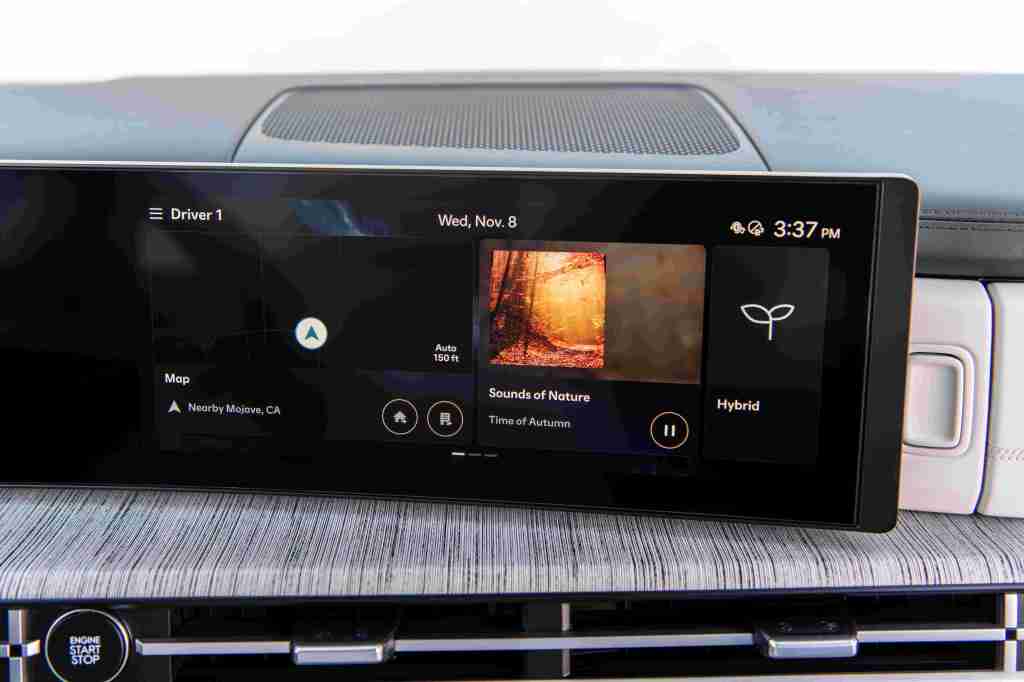
Providing a place to position one’s hand when using the touch screen.
So they designed what they call a “palm rest,” a trim piece that runs across the middle of the instrument panel with a slightly bigger surface below the infotainment screen: this allows someone to have stability when making selections from the screen.
Meanwhile, on the Exterior. . .
Going back to the exterior, Kang says that they worked to keep the greenhouse surfaces as flat as possible (again, the surface of a box). Of course, to provide a sense of ruggedness, there are fender bulges, though these are done in an interesting way: around the outer area of the flair there is a chamfer that goes into the surface of the vehicle which results in a more massive appearance of the surround as it bulges outward.
The trim in the rocker area of the Santa Fe is piano black, which is surprising on a vehicle that does have some offroad capabilities (there is an XRT trim that has a higher ground clearance than the other models—8.3 inches rather than 7.0 inches—which provides greater approach, departure and breakover angles, so for those inclined to go to campgrounds that are well off the proverbially beaten path, it is the trim to take). Kang says that while matte finishes might be preferable, consumers find that to look not particularly upscale: remember that the Santa Fe is designed for the daily suburban driver, as well.
The front of the Santa Fe has a horizontal LED lamp that stretches across the top grille, terminating in the headlamps. This forms a double “H” shape: the “H” that is formed where the horizontal bar meets the vertical lights on either side and an “H” that is formed by the headlamps that each have a pair of vertical lights.
Note the “H” shapes designed in the lighting and fascia.
Then on the fascia above the lower grille there is still another “H” formed with the body-colored material surrounded by darker trim.
While this reads as though it would be gaudy, it is actually more subtlety executed.
No Russian Dolls
Is this use of the “H” something that may show up on subsequent Hyundai vehicles?
Kang thinks not.
“We have collectively decided not to do the Russian-doll approach to design,” he says.
In the SUV lineup, for example, there is the Tucson smaller than the Santa Fe and the Palisade larger. But all three vehicles exhibit their own stylings.
Each vehicle has a design onto itself.
And this makes absolute sense. Globally, Kang points out, Hyundai has more than 60 different models.
Trying to make a family look for dozens of vehicles would probably be nothing more than an exercise in frustration.
While the first read on the ’24 Santa Fe may bring to mind the Land Rover Defender (arguably not a bad thing, especially as that vehicle starts at a price well above the sticker for the Santa Fe AWD hybrid with the top-of-the-line Calligraphy trim package), that sense quickly disperses as it is clear that given the detail outside and in, this is a vehicle that is clearly its own thing.
Those OEMs will al be using the in-vehicle computing platform that’s architected for generative AI applications, NVIDIA DRIVE Thor.
And there are:
NIO
Geely
NIO is using NVIDIA AI stacks for its in-cabin capabilities including Cabin Atmosphere Master and Vehicle Assistant.
Geely is using NVIDIA TensorRT-LLM , generative AI and large language model (LLM) tech, for personalized cabin experiences.
These were announced at the NVIDIA GTC conference this week in Silicon Valley.
What’s missing? Companies like Ford and GM.
It should be noted that other companies, including BMW and Mercedes, are using NVIDIA tech for their vehicles.
And that Danny Shapiro, NVIDIA vice president, Automotive, points out that non-listed OEMs use NVIDIA GPUs in their data centers.
NVIDIA DRIVE Thor (Image: NVIDIA)
DRIVE Thor, which will make its way into vehicles by next year, provides 1,000 teraflops of performance (with a teraflop being one trillion floating operations per second, and while that may not be meaningful in and of itself, clearly that’s a whole lot of processing capability).
To be fair, NVIDIA isn’t the only game in town, with competitors including Intel, AMD, Qualcomm, and others. They may be providing the silicon to the OEMs not on the lists.
But it surely seems to be the case that as NVIDIA holds its massive GTC global technology event in San Jose this week there would be at least some announcement of automotive companies that aren’t based in China using the company’s processors.
While there is concern in the U.S. about low-cost Chinese EVs threatening the U.S. market at some point, there ought to be similar concern with highly capable Chinese EVs that are offering all manner of AI-enhanced features and functions doing the same.
NVIDIA, incidentally, is headquartered in Santa Clara, California, so it is not like U.S.-based OEMs would have to travel far to pay it a visit.
One thing that Olabisi Boyle, senior vice president, Product Planning & Mobility Strategy, Hyundai Motor North America, points out that is probably something that many people don’t know is this:
On a global basis Hyundai Motor Group (including Genesis and Kia) is the third-largest OEM. Not General Motors. Not Stellantis. Hyundai. Behind Toyota and Volkswagen Group.
In the U.S., the company’s sales have been growing with consistency:
In 2023 it had total sales of 801,000 vehicles, up 11% over 2022 sales (724,000)
Hyundai’s Boyle is working to expand ways that customers interact with the company’s products, well beyond the drive. (Image: Hyundai)
One of the areas that Boyle is keen on is the development of the market for what she terms the “early majority” for electric vehicles, moving beyond the “early adopters.”
Hyundai has long (comparatively speaking) been in the EV space and at present the brand offers the Kona Electric, IONIQ 5 and IONIQ 6.* (It also has the Nexo—which is a fuel-cell based EV.)
Massive & Flexible
Hyundai Motor Group is constructing what it calls “Metaplant America” near Savannah, Georgia, a complex on a 2,923-acre site that includes a vehicle assembly plant as well as a battery plant. Plans call for the $7.59-billion plant to go into production early in 2025. It will build the IONIQ 5, IONIQ 6, Genesis GV60 and Electrified GV70 vehicles, as well as the XCIENT class 8 fuel-cell truck.
Boyle says that the Metaplant, which will have an annual capacity of 300,000 vehicles, is sufficiently flexible such that if the demand dictates, it can also produce combustion engine-equipped vehicles.
Beyond Vehicles
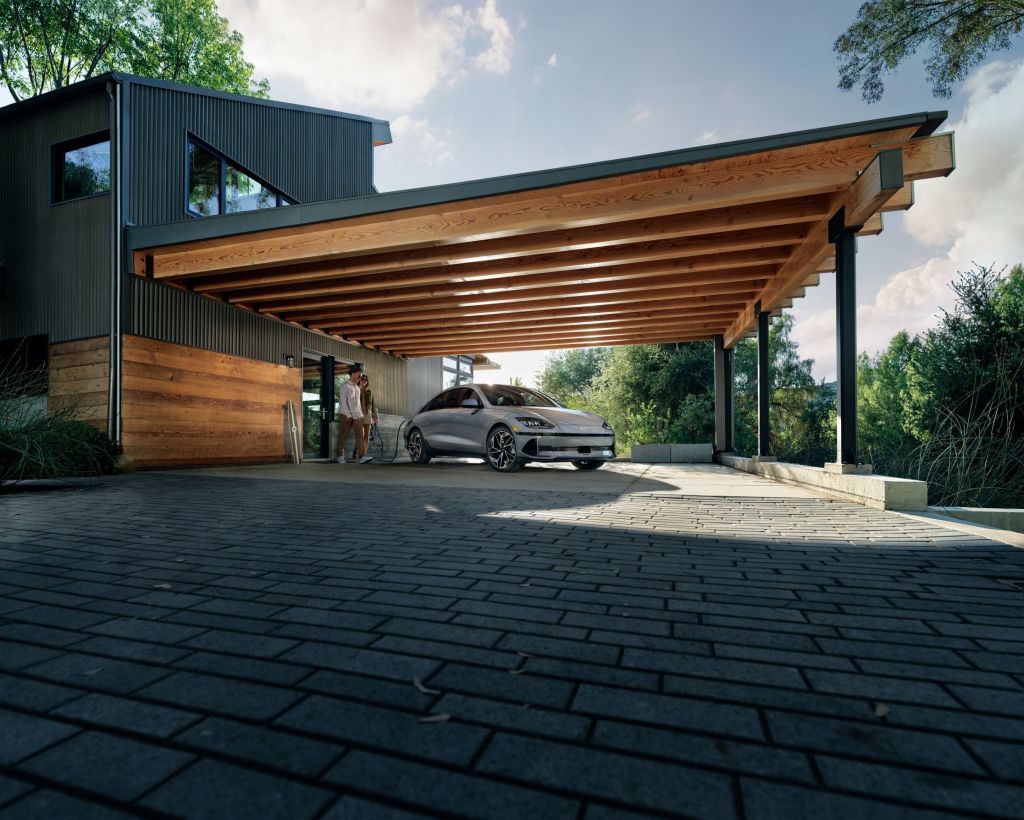
But Boyle’s view of Hyundai’s efforts in the mobility space go well beyond particular vehicles to something that can be thought of as an entire infrastructure. If it’s a gas-powered vehicle, then the ability to pay through the touchscreen of the Hyundai. If it is an electric vehicle, then the ability to work through the Hyundai Home Marketplace to get what’s needed for home charging. If it is a question of obtaining an EV for a short period (e.g., month-to-month), there is Evolve+ that makes this real. If it is a matter of finding and paying for parking, there’s an app for that.
Hyundai Home helps EV customers get what they need to equip their residences for seamless electric vehicle operation. (Image: Hyundai)
In other words Boyle and her colleagues are looking at a consumer’s engagement with Hyundai as something more than a transaction that occurs at a dealership once every few years. Rather, it is something that they are building out so that the company can provide things that are helpful, not intrusive, things that facilitate everyday activities, not complicate them.
They certainly want to grow the number of vehicles that are purchased.
But they recognize that there is a market shift going on, one that they are helping propel.
==
*And it also has “electrified” vehicles including hybrid versions of the Elantra, Sonata and Tucson, with the Tucson also as a plug-in hybrid.
U.S. dealers are not particularly keen on electric vehicles (EVs).
So indicates the Cox Automotive Dealer Sentiment Index (CADSI) released this year.
When asked how EV sales were doing in Q1, the index score was 42. That’s off from 50 in Q1 in 2023.
And while 42 may not be particularly meaningful, know that it is the lowest score since the question was included in CADSI in Q2 2021.
The outlook among dealers regarding EV sales going forward isn’t good, either.
In Q1 2023 the index score was 53. Back then, a majority of dealers saw EV sales growing.
In Q1 2024 that index score is down to 36.
That’s the lowest score for EV outlook since that question was asked.
Seems things are no longer anticipated to be growing for EVs.
It seems as though this is not simply a U.S. phenomenon, either.
While Cox was looking at new vehicle sales, over in the U.K. and outfit that specializes in used vehicles—going from consumers to dealers rather than the more conventional vice-versa—found that sales are not particularly robust.
Compared with last year, HonkHonk found 38.5% of dealers are “much less interested” in EVs and 12.3% are “a bit less interested.”
Or 50.8% of dealers are not all that keen on putting EVs in stock.
Sebastien Duval, CEO of HonkHonk, said, “Right now, dealers can’t get enough small or medium petrol cars, medium diesels and even hybrids, since the market began recovering in 2024. But less than one in ten of them want to snap up a battery EV car more than they did than a year ago.”
That’s right: Diesels are more appealing than EVs in the U.K. used market.
When you see the word challenge in any form in a financial announcement, know that this really means some variant of “we are really struggling but don’t want to make it seem as though we are anything other than in control.”
(Image: VW Group)
When Volkswagen Group announced its 2023 financial results there were:
Oliver Blume, CEO: “Volkswagen Group is entering the long-distance rate of transformation from a position of strength. At the same time, we are aware of our challenges and are tackling them consistently to leverage the enormous potential of Volkswagen Group.”
Arno Antlitz, CFO and COO: “In a challenging environment, Volkswagen Group delivered robust results in 2023.”
While the company has said that it expects 50% of sales to be electric vehicles by 2030, for the full year in 2023 Group EV sales were 8.3%. So essentially it has six years to add 41.7%.
In the release about its earnings there’s this:
“Volkswagen Group is convinced that the future of mobility is electric. While some countries continue to show an impressive pace of transformation, the ramp-up of electric mobility in other regions is unfolding less quickly than expected. Volkswagen Group’s strategy is therefore characterised by flexibility. While extensive investments are being made in the expansion of electric mobility, highly competitive, efficient, and attractive models with combustion engines will remain part of the product range during the transition phase. Improved and new plug-in hybrids complement the range in many markets.”
Which could be restated as:
“We’ve bet big on EVs and are seeing returns in some areas but not like we’d hoped overall. So we figure we’d better be sure to continue to offer things that have internal combustion engines under their hoods, with or without hybrid systems attached.”
Of course, placing bets is about the future.
If VW Group doesn’t ante up on what seems as though it will play out (i.e., at some point there will be a bona-fide acceptance of EVs by a mass market, not the level of acceptance that has been puffed up (take Tesla numbers out of the sales of EVs in the West and see how well they are doing)), then it will be in a bad situation at the point that it does.
But playing is not without a cost.
It, like other OEMs, are investing billions in electrification.
There are a couple of things that are going to make receiving a return somewhat problematic:
Tepid consumer interest
Cheap Chinese EVs
And it isn’t VW Group alone that needs to consider its play in relation to those two factors.
When you consider the on-going development of different battery chemistries (to make batteries that are less expensive or more capable or with fewer rare earths or whatever) and you then take into account the billions of dollars that OEMs have already invested in battery manufacturing equipment, a question arises about the extent to which the existing equipment can be used to produce batteries with a different chemistry than the one for which the factories are setup for.
While an imperfect analogy: Consider a factory that makes compact cars. It is decided that more capacity is needed to produce full-size SUVs. While most of the equipment in the plant can be reused, there is still a non-trivial amount of new robots and suchlike that have to be purchased as well as all manner of new tooling.
If that holds in the case of battery manufacture, than it is, to quote Carl Sagan from another context, “billions and billions.”
Lyten, a firm that describes itself as “a supermaterials application company,” has announced that it has determined that the lithium-sulfur battery that it has developed will allow something of a seamless transition from what is being done in many battery plants today.
Dan Cook, Lyten CEO and co-founder:
“Lyten now has demonstrated that lithium-sulfur can be built in standard cylindrical and pouch formats, can be scaled to automated manufacturing, and can be done on the same equipment and processes already being used around the globe to manufacture legacy lithium-ion.
“The result is a significant reduction in the manufacturing scale up risk for a locally sourced, locally manufactured battery that can leapfrog the performance and cost of existing lithium ion and future solid-state batteries.”
One of the benefits cited by the company for its alternative chemistry is that it contains no nickel, cobalt, manganese, or graphite in the cathode and anode, which means that battery materials can be locally sourced and the battery locally manufactured. (Which can mean $3,750 per vehicle tax credits for the manufacturer for local materials and another $3,750 per vehicle for local battery component manufacturing.)
And there’s that other non-trivial bonus of keeping one’s instaslled base of equipment.








 shinymetalboxes