Innovation, Static Practices, & How Tesla Has Disrupted the Industry

There are certain things that traditional OEMs care about that Elon Musk and his team will get to—after they accomplish the important things

By Gary S. Vasilash

In 1997 a book by Clayton Christensen was published that had a thesis that was not something that many people in companies really wanted to accept:

It essentially says that there are incumbent companies—think of the long-in-business vehicle manufacturers—who basically provide incremental improvements to their products. Things get better. Just a little bit better. Other companies are doing the same thing, so a given company really doesn’t need to concern itself with doing anything but slightly adjusting the dial. They may improve their existing processes to make their production more efficient, the production of their existing (though improved to some degree) product.

Then a new entrant comes into the field. A new entrant that can pretty much be ignored. (Or so it seems.) That’s because they’re in a space that isn’t particularly valuable (e.g., low margin). Or they provide a product that underperforms the existing. Or they are providing a product that no one has asked for.

The concept, and the title of the book: The Innovator’s Dilemma.

Actually, the one who has a dilemma is the one who isn’t innovating but trying to continue the existence of the status quo.

No one ever got fired to trying to improve margins on an existing product, so that’s pretty much what executives do: invest in improving the existing product. After all, there are all of those sunk costs in equipment and process and knowhow that have to be taken into account.

But then, not immediately, but eventually, the product that could otherwise be ignored, is transformed such that it becomes something to be reckoned with.

Case in point: Tesla.

When it introduced the Roadster in 2008, a essentially a Lotus Elise with an array of lithium-ion batteries that were otherwise found powering laptop computers back then, a two seater that had a price of over $100,000, Tesla was pretty much considered to be a company that was a niche of niche: after all, roadsters don’t have a whole lot of demand, and in 2008 a roadster with an electric powertrain was simply ridiculous.

As time went on, the incumbents looked at what Tesla was doing and didn’t think much. Yes, the Model S may have had remarkable performance, but what about the build? The Model X had doors that were visually impressive but functionally not up to snuff. The Model 3 was impressive, but as everyone knew, Tesla wasn’t profitable, so anyone could build unprofitable vehicles. The Model Y had interior fits that were not the sort of thing that one would expect from a vehicle with its price point.

But also as time went on, more and more OEMs began to realize that not only was Tesla immensely popular among consumers in a way that was beyond the wildest dreams of anyone in the car industry, but that it wasn’t going away.

So they began to roll out an EV here and an EV there, all of which were claimed—publicly or implicitly—to be “Tesla fighters.”

Seemingly that hasn’t worked out.

The innovator’s dilemma in action.

Jeff Stout is executive director for Yanfeng Automotive Interiors and a student of The Innovator’s Dilemma.

On this edition of “Autoline After Hours” Stout joins “Autoline’s” John McElroy, Craig Cole of Roadshow by CNET and me in a spirted discussion that largely focuses on what Tesla does and doesn’t do, which leads to a variety of related subjects including whether electric vehicles will become the dominant type on the roads and whether autonomous vehicles are going to occur in a meaningful way in a bounded amount of time.

And you can see it all here.

Two Things If You’re Going to Buy a New Vehicle

Tips to consider

By Gary S. Vasilash

Whether it is a case of pent-up demand, regular demand or necessity, it may be that you’re going to be going out to get yourself a new set of wheels.

Based on information released by Kelley Blue Book about the state of affairs that existed in the U.S. market during the month of November, here are a couple of things you should have in mind:

  1. Have lots of money or good credit. That’s because KBB found the average transaction price (ATP) of a non-luxury vehicle was $43,144. A record high. People were paying $900 over sticker (a.k.a., “MSRP”). People have been paying over MSRP for the past six months. And remember when there used to be all manner of cash incentives? Good luck. But let’s say you’re in the market for a luxury vehicle. The average price there is $61,455.
  2. While it is still going to cost a lot, you might consider the type of vehicle that you’re buying from the point of view of price. For example, KBB calculated that the ATP for a car was $41,026, $45,201 for an SUV, $46,523 for a van, and $54,462 for trucks. The least expensive vehicle is a compact car at $25,650—which is 15.7% more than it cost in November 2020. And good luck trying to find one—or any car, for that matter, as OEMs are concentrating on building vehicles with higher content and prices because, obviously, they make more money on them.

Either way: Plan to spend more than you were planning to spend.

Guess Who Made This Vehicle

Even though I know the answer already I am still surprised

By Gary S. Vasilash

OK. It is a concept. That was developed in Europe. It is 122.8 inches long, 68 inches wide and 71 inches high.  

(Image: *)

The ROV—or recreational off-highway vehicle—is powered by hydrogen. There is a one-liter hydrogen engine that “works just like a petrol engine, but with a high-pressure tank for compressed hydrogen.”

Answer: Lexus.

Explanation from Spiros Fotinos, Head of Lexus Europe, comments: “The Lexus ROV is our response to the growing passion for the outdoors and adventurous spirit of luxury consumers. As a concept, it fuses our desire to also develop lifestyle-oriented products with our ongoing research into new technologies that contribute to carbon neutrality. As well as delivering a concept that is thrilling to drive, it has near zero emissions thanks to its hydrogen powered engine.”

Near-zero? Turns out there is some oil burned during driving.

*Lexus

Audi TT RS on Its Way Out in U.S.

But if you act quickly, you might get one of 50 special editions

By Gary S. Vasilash

In the first three quarters of this year Audi has sold 825 TT models. Which in the context of, say, the Audi R8 is good (496 through the first three quarters) but as all other Audi models (with the exception of the e-tron GT, which had sales of 462, but know that it didn’t go on sale in the U.S. until July, so that number is completely understandable) are in at least the four figures, the 825 isn’t all that robust.

Model year 22 is the last for the Audi TT RS in the U.S. market, so Audi of America is offering a limited edition—the Audi TT RS Heritage Edition—of which 50 will be on offer.

There will be 50 TT RS models available, 10 each in those five colors. (Image: Audi of America)

They are emphasizing the five-cylinder engine in the vehicle, although in a way that might not be apparent to anyone other than someone buying one, as they have a selection of five color combinations–Alpine White with Ocean Blue leather and Diamond Silver stitch; Helios Blue metallic Diamond Silver leather and Ocean Blue stitch; Stone Gray metallic with Crimson Red leather and Jet Gray stitch; Tizian Red metallic with Havanna Brown leather and Jet Gray stitch; Malachite Green metallic with Cognac Brown leather and Black stitch—and they are producing 10 each.

Two numbers of interest related to the TT RS Heritage Edition:

  1. It has a 174 mph top speed limiter
  2. The MSRP is $81,450

This doesn’t mean the end of the TT in the U.S. The TT and TTS models will continue to be available.

Life Behind the Wheel

Why drive when you can shop and vice versa?

By Gary S. Vasilash

Stellantis, the company best known in the U.S. for the products that used to be under the Chrysler umbrella, then under the DaimlerChrysler umbrella, then the FCA umbrella, and now under a company with 14 brands—make that “14 iconic brands”—had announced in July that it was planning to electrify its vehicles in a big way (with more than 70% of the cars and trucks and utes in Europe and more than 40% of same in the U.S. being “low emission vehicles,” which is not quite fully electric, but a start).

Now it has announced that it is going to be focusing a lot of attention on vehicular software. Stellantis anticipates there will be approximately €4 billion in annual revenues by 2026 and ~€20 billion by 2030 generated by software-enabled product offerings and subscriptions.

And there you have it.

Or to be a bit more specific: 34 million “monetizable connected cars” by 2030.

Yes, they’ll likely be capable of “over-the-air” updates. Which simply means that you’ll be able to buy more stuff while stuck in traffic.

Here’s a somewhat frightening fact:

Stellantis is developing what it calls the “STLA SmartCockpit,” which it describes as something that “will seamlessly integrate with the digital lives of vehicle occupants to create a customizable third living space.”

Remember when Starbucks positioned itself as the “third space”?

Soon it will be your Jeep.

The importance of this—this is the scary part—is that Stellantis says a customer spends four years of their lives, on average, in their vehicles—and this is increasing.

Somehow makes walking more appealing.

They’re Probably Not Throwing in the Mats

Challenges and opportunities in the dealer model and other contentious issues

By Gary S. Vasilash

Research from Cox Automotive, which is a source that dealers find exceedingly useful in their efforts to conduct their business, found that there is an increasing interest among customers to do more of their transactions digitally.

As in 80% of consumers would like to do part of the buying transaction on line. (Who doesn’t do research on the vehicles they’re interested in on line; who doesn’t want to get some of the “paperwork” related to the transaction done in the comfort of their own home rather than under the fluorescent lights of a dealership?)

And 25% of customers would like to have the whole thing done and dusted on line.

What’s more, KPMG conducted a global survey among executives in the auto industry—OEMs, suppliers, dealers, financial services providers, etc.—and they found (again, realize this is a global survey and the Cox Automotive survey in U.S. only):

  • 78% think the majority of purchases will be on line by 2030
  • 34% think that from 60 to 79% of the vehicles delivered will be direct to the consumer by 2030
  • 84% think vehicle subscriptions will be competitive to buying and leasing by 2030 and only 22% dealers are the best channel for subscriptions (OEMs are the biggest choice, 45%)

There is some concern that due to the reduced inventories that are a result of supply chain issues dealers—not all, but some, some that get attention—are increasing prices well above the sticker price.

If consumers were thinking there might be an alternative before this occurred, then those who were subjected to or simply heard about this behavior might be thinking harder about new approaches to getting vehicles (e.g., the Tesla approach).

This is one of the topics that is discussed on this edition of “Autoline After Hours” with “Autoline’s” John McElroy, Cars.com editor-in-chief Jennifer Newman, the Wall Street Journal’s vehicle expert Dan Neil, and me.

Other topics include whether Apple is going to get into the vehicle business (Neil and Newman both think that it is a when not an if), and whether electric vehicles are going to be the end of muscle cars as we know them.

And there’s much more in one of the more animated shows in some time.

Which you can see right here.

How Important Are Trucks to Ford?

In a word: Very

By Gary S. Vasilash

Microchip shortages notwithstanding, despite dealer lots with fewer vehicles on them, Ford reported a sales increase for the month of November of 5.9% compared with November 2020.

In terms of what people bought in November, the F-Series, which will be the best-selling vehicle for its 45th consecutive year, is absolutely essential to the total U.S. sales.

(Image: Ford)

The company sold a total 158,793 vehicles (Ford and Lincoln brands).

It sold 3,767 cars. 72,795 SUVs. And 82,231 trucks.

Of the trucks, F-Series accounts for 60,418 units.

All of Lincoln had sales in November of 6,405.

All of Ford SUVs consisted of 66,390.

So there’s F-Series, with nearly 10x the sales of Lincoln and almost equal to the sales of the EcoSport, Bronco Sport, Escape, Bronco, Mustang Mach-E, Edge, Flex, Explorer, and Expedition combined.

The nameplate that is second to the F-Series in sales for November is the Explorer.

There were 18,268 Explorers sold.

Yes, the F-Series makes that much of a difference.

Without it the total November sales would have been 98,375.

Not nothing.

But not as impressive as it is.

A Box of Springs for the Holidays

Who needs another gaming console?

By Gary S. Vasilash

Let’s say that you want to give that auto enthusiast in your life something special for the holidays. Really special.

You could get that person a sweater. Which will probably be ugly.

But that won’t necessarily be really special.

Unless you opt for a sweater from Mopar, yes that source of more than 500,000 parts and accessories for your favorite Jeep, Ram, Dodge and Chrysler vehicles.

One thing to know about the people of Mopar: They are nothing if not authentic.

So this is what that sweater is all about:

Mopar ugly holiday sweater ($66.95 – see link): Custom-knit design sweater features various Mopar logos with engine and racing icons, surrounded by blue and white snowflakes. The Omega M-stacked Mopar logo is front and center and each sleeve carries the 426 Hellephant crate engine logo. Available in sizes small to 3X.  

No punches pulled there.

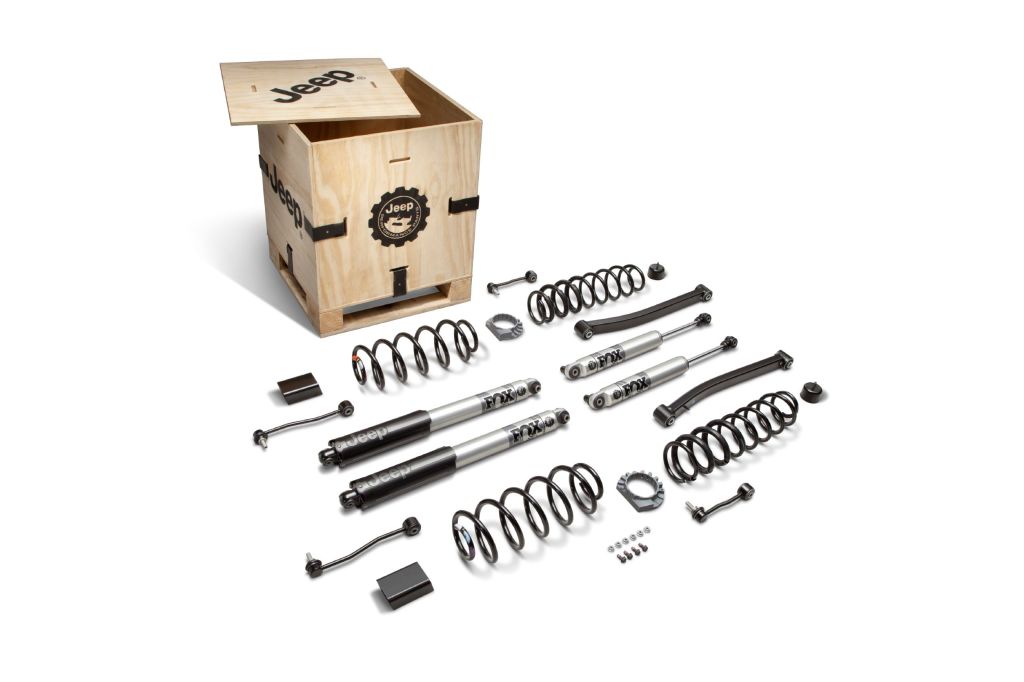
But what strikes me as being most amusing authentic is the JPP 2-inch lift kit for the Wrangler 4xe.

(Image: Mopar)

Yes, the four springs, four FOX shocks, front lower control arms, front and rear stabilizer links, front and rear bump stops, JPP badge and various fasteners, all contained in a crate, is absolutely something that the adventurous owner of the Jeep plug-in hybrid would be happy to get.

Still, it does seem odd, “Oh, this is great! A box of springs for Christmas!”

By the way, if you decide to go for the Jeep lift kit know that you can get free shipping within the continental U.S. through December 31 if you shop at store.Mopar.com and use the promo code FREEDEC75.

That’s because they’re offering free shipping on orders more than $75 and that kit will set you back $1,495.

The free shipping is also good at WearMopar.com, but you’ll have to add something to your sweater order to bump it up a few bucks.

That shouldn’t be a problem.

Major Commercial Euro EV Truck Order

This is a serious commitment to electric logistics

By Gary S. Vasilash

DB Schenker has been around since 1872, moving things first between Vienna and Paris, then, with time, around the world. Clearly the company knows what it is doing to have existed for so long.

It is not unusual for a logistics company to announce that it is buying some electric trucks. Generally the number announced is not all that large. After all, when you are being depended on by someone to get whatever from here to there within a set period of time, you don’t want to depend on some technology that is still somewhat new.

It is one thing for someone to have an electric passenger car.

It is entirely another for a company that could be moving critical goods to put it on an electric 16-tonne electric truck.

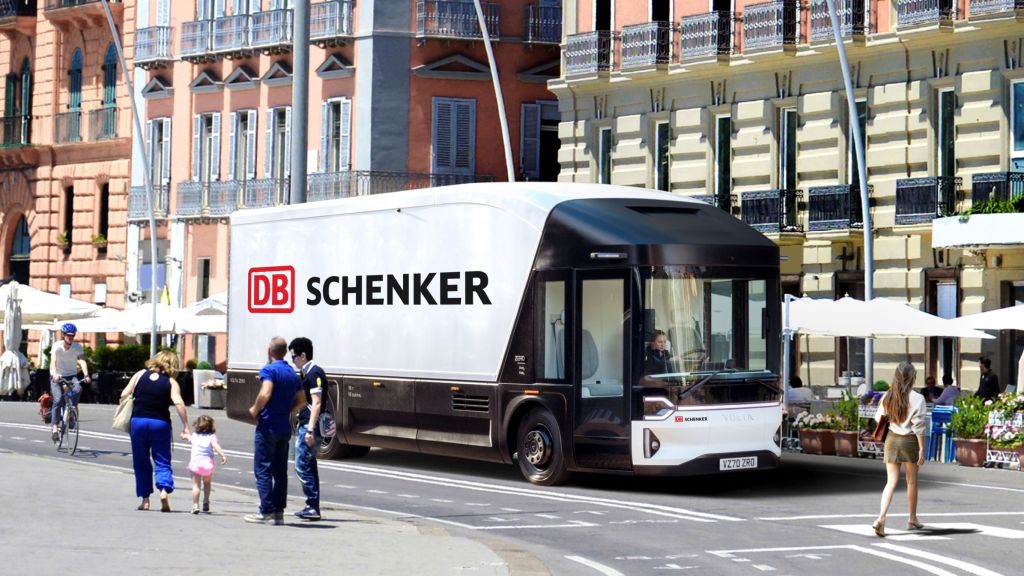
Note the clever cab design of the truck–high visibility for the driver to make driving in city centers (or “centres”) easier. (Image: Volta Trucks)

So it is notable that DB Schenker has announced that it is purchasing 1,470 such trucks to transport goods from distribution hubs to city centers from Volta Trucks.

Volta Trucks?

A Stockholm-headquartered company established in 2017. An objective of the founders is to “decarbonize last-mile logistics and to make city centre environments safer, more pleasant and sustainable places to live and work.”

And to do so with the development of commercial vehicles like the Volta Zero.

DB Schenker will be working with Volta to develop a 12-tonne variant of the Zero, as well.

The logistics company will test a prototype of the Volta Zero during the spring and summer of 2022, then the learnings from that will be rolled into the production trucks.

It will utilize the vehicles at 10 locations in five countries.

Cyrille Bonjean, executive vice president, Land Transport at DB Schenker said, “The large-scale partnership with Volta Trucks allows us to significantly increase the pace of electrification of our fleet and invest in greener transport solutions, brings us closer again to our goal of carbon neutral logistics.”

Cox Finds EV Interest Not Yet Sparking

Sure, there are lots of people who want to buy Teslas, but one brand does not a solid segment make

Cox Automotive took a look at what real people think about their likelihood when it comes to the possibility or potential of their buying an EV the next time they’re in the market for a new vehicle and it seems that they are more likely to buy an ICE-powered pickup truck or SUV.

That is:

  • 38% are considering an EV within the next 12 months. Let’s face it, all of us consider lots of things. But when it comes to actually signing the documents. . . .
  • 21% say they are >50% confident their next vehicle will be an EV. There are a couple of ways of looking at this. Is the 21% a subset of the 38%. Or are these confident people, people who are likely to buy a new vehicle. . .oh, sometime.
  • 3% are 100% confident their next vehicle will be an EV. It so happens that 3% is the share of market that EVs will have this year.

Here’s something that’s not surprising:

If an EV is available for $5,000 less than a comparable gasoline vehicle, 71% will consider the EV.

Price is the second-highest barrier to buying, at 51% citing EVs and being too expensive.

The others are:

  • 57% think there’s not enough charging stations in their local vicinity
  • 42% are worried the battery won’t hold a charge
  • 41% are concerned with the cost of potential battery replacement (shouldn’t that be 42%, or is it that 1% who are worried about the lack of a sustained charge will just live with it?)
  • 37% still have range anxiety—although the positive news for EV purveyors is that two years ago 47% cited low range as a concern

Here’s something that ought to be of concern of the marketers at Nissan (LEAF) and Chevy (Bolt EV): 63% of those surveyed don’t know that Nissan offers an EV and 69% are unaware that Chevy has one in the showroom.

Oddly enough, 21% are aware of and considering a Toyota EV. Which leads one to wonder whether this is in anticipation of the bZ4X coming next year or that there are actually people who are aware of the fact that although the Mirai is powered by a fuel cell, it actually is an EV, just not a BEV (battery electric vehicle).