Fly or Drive?

How about both?

By Gary S. Vasilash

Chinese vehicle manufacturer XPeng Inc. held a tech day at which the company displayed things like its advanced driver assistance systems (XPILOT 3.5 and XPILOT 4.0) and it “X-Power” supercharging system, which, with a 800-V capability, can provide a charging range of 200 km (124 miles) in five minutes.

That is the sort of thing that even the impatient can tolerate.

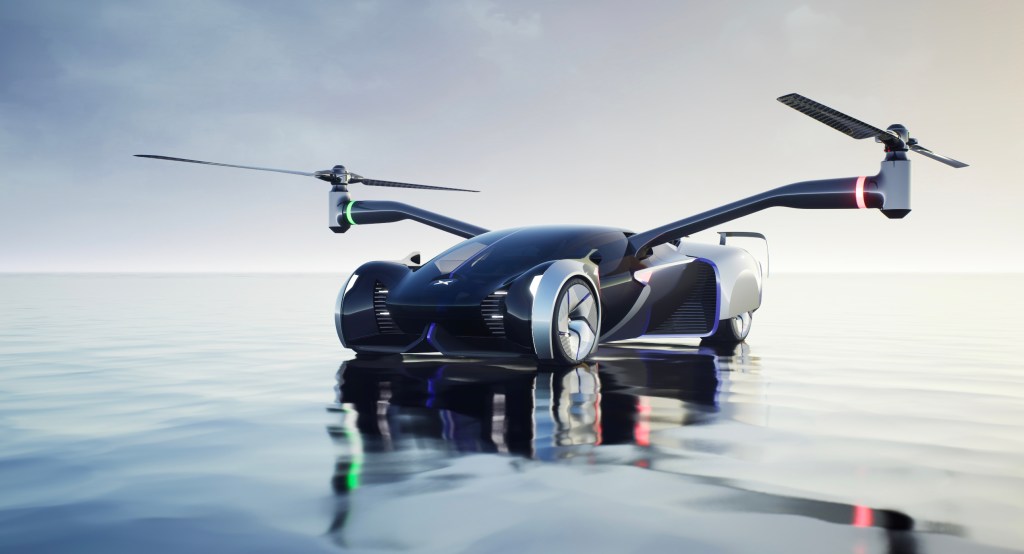
Sixth-gen flying car from HT Aero. (Image: XPeng)

But what is arguably a more interesting development is the road-capable flying car developed by affiliate company HT Aero.

The rotors adjust depending on whether the vehicle is in the air or on the highway.

The flying car is scheduled to become available in 2024.

Cadillac LYRIQ: Hitting All the Right Notes

An up-close look at the exterior and interior design of what will undoubtedly become the flagship of the Cadillac lineup (sorry, Escalade)

By Gary S. Vasilash

The Cadillac LYRIQ is certainly the most important Cadillac vehicle to be launched since the Cadillac CTS appeared in 2003. Arguably the LYRIQ, an electric vehicle, is one of the most important products that General Motors is putting on the market because it truly marks a commitment to contemporary EVs that it has announced are coming.

The 2023 LYRIQ, which will be on the market in the first half of 2022, is the real thing.

The fresh face of Cadillac. (Images: Cadillac)

Yes, it will be beaten to showrooms by the GMC HUMMER EV, but that is arguably a niche vehicle. A niche vehicle with people with deep pockets: the first edition, for which all of the reservations have been spoken for, has an MSRP of $112,595.

The LYRIQ will start at $58,795. The reservations for the first edition of the crossover were full. In 10 minutes.

The LYRIQ has an estimated range of over 300 miles from the 100.4-kWh Ultium battery pack. It is a rear-drive vehicle. The Ultium drive unit will provide ~325 hp.

On the inside there is a 33-inch diagonal screen that stretches across the instrument panel, a 19-speaker AKG Studio audio system, eight-way power driver and front passenger seats, and other accoutrements that are characteristic of a vehicle that is a showcase for the brand.

An interior so well crafted, you might not want to leave when your trip is complete.

On the exterior there is a illuminated black crystal front grille that illuminates in an orchestrated manner, a grille that is certainly a signature of not only the vehicle, but of the level of creativity, imagination and technology that may become known as what Cadillac is all about.

On this edition of “Autoline After Hours,” we learn about the LYRIQ, inside and out.

We—“Autoline’s” John McElroy, Henry Payne of The Detroit News, and me—are joined by Brian Smith, Cadillac exterior design director, and Tristan Murphy, Cadillac interior design manager.

What is notable about LYRIQ, even if you put aside that it is an EV, is that this is a vehicle that was a total clean-sheet design. They were creating something absolutely new, something that wasn’t a variation on a theme.

The charter was to create a vehicle that would not only show the world of electric vehicles that Cadillac has arrived, but the world that drivers live in too: This is meant to be a vehicle that not only will people like driving, but be one that they’ll be proud to be seen in.

Three of the words that Smith and Murphy use to characterize what the LYRIQ represents are performance, technology and craftsmanship.

The best of right now with the attention of detail that often seems to be lost.

===

Then, for the second half of the show, McElroy, Payne and I, all jurors for the North American Car, Truck & Utility of the Year (NACTOY) awards, talk about the vehicles that we had the opportunity to drive earlier in the week, all semifinalists for the 2022 awards.

The vehicles include:

  • Audi A3 and S3
  • Cadillac CT5-V Blackwing
  • Genesis G70
  • Honda Civic
  • Mercedes S Class
  • VW Golf and GTI
  • Ford Maverick
  • Hyundai Santa Cruz
  • Nissan Frontier
  • Toyota Tundra
  • GMC HUMMER EV pickup
  • Rivian R1T
  • Ford Bronco
  • Genesis GV70
  • Hyundai Tucson
  • Jeep Grand Cherokee
  • Jeep Wagoneer & Grand Wagoneer
  • Kia Carnival
  • Nissan Pathfinder
  • VW ID.4

And you can see it all here.

Top Auto Brands

How do auto brands stack up in value with other familiar companies? Turns out, pretty well.

By Gary S. Vasilash

Global brand consultancy Interbrand produces a list of the Best Global Brands each year, is out.

Not surprisingly, tech is huge.

Interbrand notes that the top three brands on the 2021 list are Apple, Amazon and Microsoft. Although they are but 30% of the top 10, they represent 62.3% of the total value of that group.

But it is worth noting that two in the top 10 are vehicle manufacturers. At #7 is Toyota. And #8 is Mercedes.

To get a sense of where they are in context, #6 is Coca-Cola and #9 is Disney.

Serious brands.

At 11 is Nike. Twelve is BMW.

Louis Vuitton is at 13.

Tesla is #14.

Facebook is at 15.

J.P. Morgan is 24.

Honda is in the 25th spot. Followed by YouTube.

Number 34 is Allianz. Number 35 is Hyundai. And Netflix is number 36.

Zara is #45. Audi is at 46 and sibling brand VW is 47. Axa is 48.

Starbucks is 51. Ford is 52. L’Oreal is 53.

Fifty-seven is Philips. Porsche is 58. Nissan is 59. Siemens is 60.

FedEx is at 75; Ferrari is 76 and Dior is 77.

At 85 there’s Huawei. Kia is at 86. Johnson & Johnson is at 87.

Finally, Hennessy is #95, MINI is #96. Burberry is #97. Land Rover is #98. And Uber is #99.

Clearly the OEMs are in solid company.

Sour Mash and Motorcycles

Yes, a special edition motorcycle predicated on a legendary whiskey

By Gary S. Vasilash

According to the National Highway Traffic Safety Administration:

“In 2019, 4,733 people operating a motorcycle were killed in traffic crashes. Of those motorcycle riders, 1,383 (29%) were drunk (BAC of .08 g/dL or higher). 

“Motorcycle operators involved in fatal crashes were found to have the highest percentage (25%) of alcohol-impaired drivers than any other vehicle types. 

“The 40-to-44 age group had the highest percent, 40%, of drunk motorcycle operators killed in 2019.”

Which leaves me mystified about this:

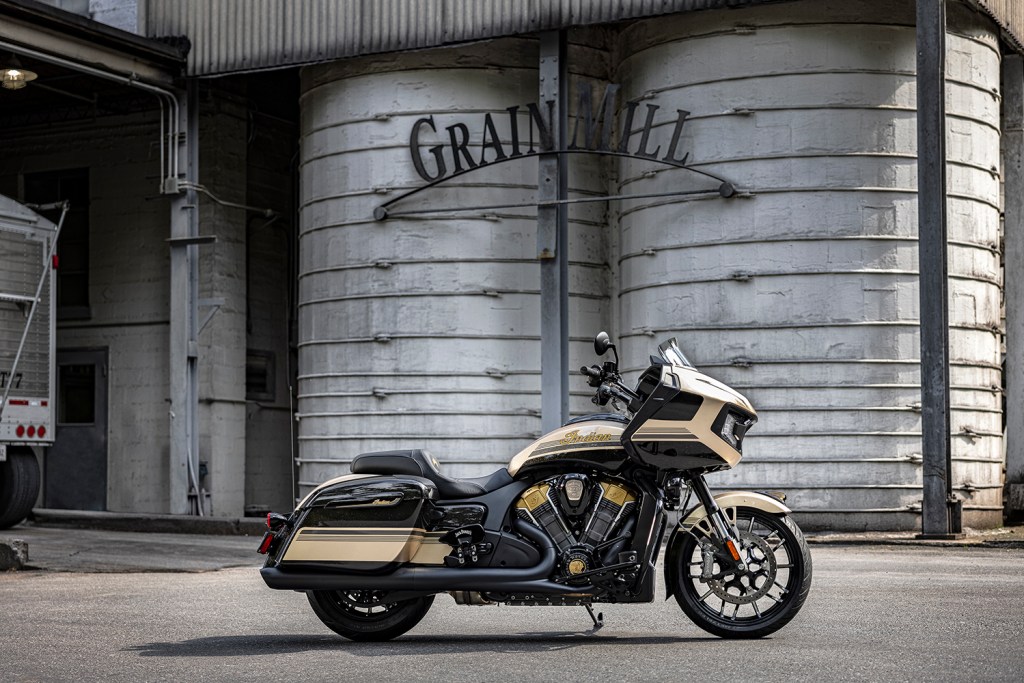
“Indian Motorcycle, America’s First Motorcycle Company, and Jack Daniel’s®, America’s first registered distillery, along with Klock Werks® Kustom Cycles have partnered to celebrate American craftsmanship with the introduction of the Jack Daniel’s® Limited Edition Indian Challenger Dark Horse. Marking the sixth year of the bold partnership and limited-edition series, the 2022 Jack Daniel’s® Limited Edition Indian Challenger Dark Horse draws inspiration from Jack Daniel’s® renowned Tennessee Rye whiskey – each product embodying the same spirit of innovation to break the mold and exemplify world-class craftsmanship.”

Somehow it would seem that there is a large separation between motorcycles and alcohol of any type.

(Image: Indian Motorcycles)

But evidently this is far from being a novelty (“Marking the six year of the bold partnership”), and something that is beneficial to the firms involved.

Whether you ride a 2022 Jack Daniel’s® Limited Edition Indian Challenger Dark Horse or a low-power Vespa:

Don’t drink and ride

Why Lexus Is in the Marvel Universe

It is still a vehicle brand, not a superhero. But it is interested in more sales, so. . .

By Gary S. Vasilash

The second biggest grossing film of all time is Avengers: Endgame (2019). It brought in about $2.8-billion.

Number five on the list is Avengers: Infinity War. It launched in 2018 and took $2-billion.

And at eight is The Avengers (2012): $1.5-billion

If we go beyond the top 10 there is Avengers: Age of Ultron (2015) at 11 and $1.4-billion, Black Panther (2018) at 12 and $1.3-billion, and Iron Man 3 (2013) at 20 and $1.2-billion.

Five movies. $10.2-billion.

No matter how you look at it, a lot of people have seen Marvel movies.

So when you hear that Lexus has created cars for all of the key characters in Marvel’s forthcoming Eternals and think, “Lexus is a luxury brand. What is it doing with a comic book movie?”

Think this: Just imagine if a small percentage of the Marvel Universe fans go out and buy Lexuses.

It would still be a big number.

(Image: Lexus)

Designing the 2022 Ford Maverick–& About Electric Pickups

A wide-ranging discussion that’s concentrated on pickups

By Gary S. Vasilash

Although “essential courage” may sound a bit exaggerated when it comes to the design theme for a vehicle, Scott Anderson, design manager at Ford, explains how that term describes what the team did in developing the design of the 2022 Ford Maverick—the interior design, in particular.

The Maverick is a compact truck. Unibody, not body-on-frame, like its sibs, the Ranger and the F-150.

While those two vehicles are designed and engineered primarily for those who are focused on, primarily, vocational uses (OK: there are plenty of people who buy pickups and never use the beds for anything beyond groceries or Christmas trees), the Maverick is designed and engineered mainly for urban dwellers who like to do recreational things (the Maverick can tow 4,000 pounds: like a small trailer) and whose recreation may include making things, not only with sheet metal and 2x4s, but also 3D printers.

It is a different proposition.

One of the things to know about the Maverick is that in the base model, which has a starting MSRP of $19,995, has a hybrid powertrain.

And as has long been the argument by some OEMs that have not gone the hybrid route, the nature of that, which combines an internal combustion engine (in this case a 162-hp 2.5-liter four) and an electric motor and battery (all in for the Maverick: 191 hp), hybrid powertrains are more expensive than, say, a 162-hp 2.5-liter four all by itself.

But the base Maverick is a hybrid and the base Maverick starts at under $20K.

And because it is a truck and because Ford has a lot riding on its reputation of building trucks (i.e., “Built Ford Tough”), there could be no skimping on the engineering of the Maverick.

So no surprise they had to do some things differently on developing and executing the interior.

Functional design and clever use of materials in the ’22 Ford Maverick. (Image: Ford)

For one thing, Anderson says, they decided that they would be honest about the use of plastic. They wouldn’t make it appear as though the material is something that it isn’t—but at the same time, they made it appear, through color and texture choice, as something both interesting and fit-for-purpose.

In addition, they did lots of observation about how people use their interiors, including storing objects of various sizes and configurations and so make the means to accommodate them, even if it meant things, as in the case of the front arm rests, are not what is typical: the front arm rests are truncated so as to make it more convenient to have large water bottles in the map pocket below.

So there is the essential part. And the guts, because when you decide that fasteners, for example, are going to be part of the design, not something hidden (often in a half-assed manner), then you’ve got to stand up for it.

Anderson talks about all this and more on this edition of “Autoline After Hours” with Rain Noe of Core77, freelance writer Mark Williams and me.

In addition, Noe, Williams and I discuss the coming onslaught of electric trucks, including the F-150 Lightning, the Rivian R1T, the HUMMER EV pickup, the Bollinger B2, the Silverado electric, the Tesla Cybertruck, and the Lordstown Endurance.

And you can see the show here.

COVID and. . .Seats?

Another consequence of the global pandemic

By Gary S. Vasilash

Apparently, when it comes to the material used for seats in vehicles, leather is the leader. However, according to the J.D. Power 2021 U.S. Seat Quality and Satisfaction Study, fake leather, which goes by a number of names depending on the OEM (hint: if you’re in the showroom and you ask what that seat is made of and the name of the material sounds like something out of an episode of the Mandalorian, know that it isn’t leather), seems to be gaining some adherents.

Thanks to COVID.

“With a heightened sense of awareness to surface cleanliness due to COVID-19, synthetic leather seats lend themselves well to cleanability, but it is ultimately about providing benefits which address notable industry challenges such as providing durability, soil resistance and, most importantly, cost-effectiveness. Our study shows that synthetic leather out-performs cloth seating in select areas while offering benefits similar to those of leather.”

That’s Brent Gruber, senior director of automotive quality at J.D. Power.

Hyundai Elantra seats. (Image: Hyundai)

Clearly, cleaning is become all the more relevant nowadays.

In case you’re wondering what the top seats (and the manufacturers of said seats) are in the survey:

  • Mass market compact: Hyundai Elantra (Hyundai Seat Div.)
  • Mass market midsize/large car: Honda Clarity (Tachi-S Co.)
  • Mass market SUV & truck/van: Nissan Rogue (NHK Spring Co.)
  • Mass market midsize/large SUV: Chevrolet Blazer (Lear Corp.)
  • Mass market truck/van: Ram 1500 (Bridgewater Interiors)
  • Premium car: Porsche 718 (Lear Corp.)
  • Premium SUV: Lexus UX (Toyota Boshoku Corp.)

A Few Things About the Acura Integra

Very few

By Gary S. Vasilash

There isn’t a heck of a lot known about the Acura Integra, a sport compact with a five-door design, which will be launched next year.

One of the things that is known is that unlike the other vehicles in the Acura lineup—the ILX, TLX, RDX, and MDX—the Integra has a name. Yes, it is a made-up name, but not sequence of three letters.

1986 Integra RS–the original (Image: Acura)

The name goes back to the model introduced in 1986 and had a run until it was renamed. . .RSX in 2001.

Remember: Alphanumeric designation, with or without one or the other, was long thought to denote luxury, and Acura has been working for decades now trying to make people understand it is a luxury brand.

(Arguably, of the Japan-based company brands, only Lexus has achieved that with Infiniti and Acura trying to make their way to that category.)

The current tagline of Acura is “Precision Crafted Performance.”

The last word in that—performance—has a lot to do, no doubt, with the fact that the Integra will be offered with a six-speed manual.

Let’s face it: people who bought sport sedans in 1986 liked to slam though the gears.

But today. . .?

Yes, there is performance cred still associated with manuals. At least for some people.

Global Light Vehicle Sales: Gulp

When it is worse than it was last year. . .

By Gary S. Vasilash

According to LMC Automotive, global light vehicle sales in September 2021 were 6,229,029 units—which is down 20.3% compared with September 2020.

Think about that.

2020, which will be forever known as the year COVID hammered the world, had higher September sales than in September 2021. (Read that again.)

In the U.S. sales were comparatively down 25.1%. Canada was off 19.9%. Western and Eastern Europe down 24.2% and 20.9%, respectively. Japan down 32.2% and Korea off 30.5%. China sales were down 16.5%. Brazil/Argentina off 26.1%. And wherever Other is, that is down 11.3%.

Essentially, this all goes to the lack of microprocessor supply the world over.

Historically, it would be something like energy prices or a lack of steel driving a diminishing of sales.

But no, silicon.

Yes, the world’s auto industry is advanced, given the evident dependence on chips.

Lucid Describes Robust Sensor Suite

Although the folks at Lucid Group probably don’t think about Elon all that often. . .

By Gary S. Vasilash

Lucid Group, which is producing its Lucid Air electric vehicles in its brand-new plant in Casa Grande, AZ, put Tesla in second place in the range department as it got a 520-mile range rating from the EPA, and the Model S Long Range is 412 miles.

(To be sure, 412 miles is nothing to sniff at, as it is the sort of thing that most OEMs would give up an engine plant to achieve.)

And now there is another numeric–and arguably functional–difference.

Elon Musk is famously sensor thrifty, as Tesla models dependi on cameras and ultrasonic sensors (it had been using radar, but evidently that went away earlier this year). Which make the nomenclature “Full Self-Driving” and “Autopilot” all the more troubling for those who actually think about the implications of those names.

Lucid announced the details of its “DreamDrive” advanced driver assistance systems, the base and Pro versions (Pro is standard on Lucid Air Dream Edition and Lucid Air Grand Touring, so the “dream” in the name goes to the model, not some sort of suggestion that one can sleep behind the wheel).

Lucid DreamDrive sensor suite provides a comprehensive scope. (Image: Lucid)

The system can utilize as many as 32 sensors, including 14 visible-light cameras, five radar units, four surround view cameras, ultrasonic sensors throughout the vehicle exterior, and, for DreamDrive Pro, solid-state lidar.

Of course, sensors are only part of an ADAS system. Processing capability is essential.

Lucid is using its proprietary “Ethernet Ring” system, which is a high-speed data network for four computer gateways to communicate at gigabit speeds so that the processors can assure that the sensor input gets translated into the steering, braking and accelerating functions as required.

When it comes to driver assistance, the more support—and sensors—the better.

Tesla’s approach notwithstanding.