Volvo: The Return to Safety

Back to a core value

By Gary S. Vasilash

Volvo cars were once widely known for two characteristics:

  1. Their boxy design
  2. The fact that they were built with safety foremost

The company essentially “owned” safety in the minds of consumers.

But in the mid- to late-90s the company wanted to be more than something that was the Official Car Builder for Tweed-Jacket-With-Suede-Elbow-Patch-Wearing and Pipe-Smoking East Coast Professors.

Style took over from safety.

The design team members were evidently given French curves to supplement the T-squares.

And while the engineers back in Gothenburg were still figuring out the materials and the structures and the systems that would make the Swedish vehicles safe, their laudable efforts were eclipsed by things like Val Kilmer’s character driving a C70 in The Saint.

But safety is back.

In 2022 Volvo will launch a fully electric SUV, the flagship model for the brand.

(Image: Volvo)

It will come standard with a LiDAR system, from Luminar, and an on-board supercomputer system, from NVIDIA.

“Volvo Cars is and always has been a leader in safety. It will now define the next level of car safety,” said Håkan Samuelsson, Volvo chief executive.

When it comes to autonomous driving, the thing is that there is little in the way of driving and a whole lot in the way of trusting.

As in trusting that the system is going to work because you are, even though behind the wheel, acting as a passenger.

Safety is huge when it comes to autonomy. Which means a need for plenty of sensors, including LiDAR, and the wherewithal to process that information so that the system will have the appropriate responses (e.g., braking, turning, accelerating).

By coming out and saying that this tech is going to be built in to its new vehicle, it seems as though that Volvo is ready to take that safety mantle back.

(Kilmer? He’ll be back this fall as Iceman in Top Gun: Maverick)
Sales Numbers Could Make One Swoon In June

J.D. Power and LMC Automotive see solid figures for June ’21 sales

By Gary S. Vasilash

J.D. Power and LMC Automotive have come out with their prediction for how June 2021 sales will come in, and the prediction is that it will be a 12.4% increase over June 2020—which isn’t all that surprising, given that in June 2020 we were still in the midst of the pandemic—and even a smidge, as in 0.3%, better than June 2019 (taking into account available selling days).

However, looking at the second quarter of 2021 in its entirety, things are rather robust, as in a 44.2% increase over Q2 2020 and a 10.7% increase over Q2 2019.

But there are some other figures that need to be taken into account.

One of those numbers is $38,088. That’s the average price of a new vehicle, which is a first half record according to the two organizations. It is a 10.1% (or $3,497) rise compared to the same period in 2019 and a 14.1% (or $4,699) increase over the number in 2019.

The average transaction price—as in what people actually pay for a vehicle from a dealer—is expected to be $40,206, a record high.

The organizations see retailer profits rise from $1,310 in the first half of 2020 and $1,457 in the first half of 2019 to $2,844.

Explains Thomas King, president of the data and analytics division at J.D. Power, “Consumers are buying more expensive vehicles despite smaller discounts, which is dramatically increasing the profitability of those sales for both manufacturers and retailers.”

Although there is evident agitation on behalf of some of an economic bent regarding the rise in inflation, recognize that here are consumers who are buying big, which means that OEMs are going to make more expensive vehicles because they’re selling, which means that there will be a continued rise. . .

Until there isn’t.

2022 Cadillac CT4-V Blackwing Aero: Definition of “Obsessive”

When you want to go very fast, you pay very close attention to how the air flows over, under and around a vehicle

By Gary S. Vasilash

The ’22 Cadillac CT4-V Blackwing has a 472-hp, 445 lb-ft of torque 3.6-liter twin-turbo V6 that propels the car at up to 186 mph.

But the car isn’t about straight-line speed as much as it is about track performance, so the engineering team took the Cadillac Racing Dpi-.R race car as a template, put the CT4-V Blackwing digital model in over 300 computational fluid dynamics simulations and put physical models in a five-belt rolling road wind tunnel at the GM Technical Center (it seems that the five-belt setup allows a more accurate assessment of what goes on beneath the vehicle than wind tunnels without five) and came up with aero packages to help its performance.

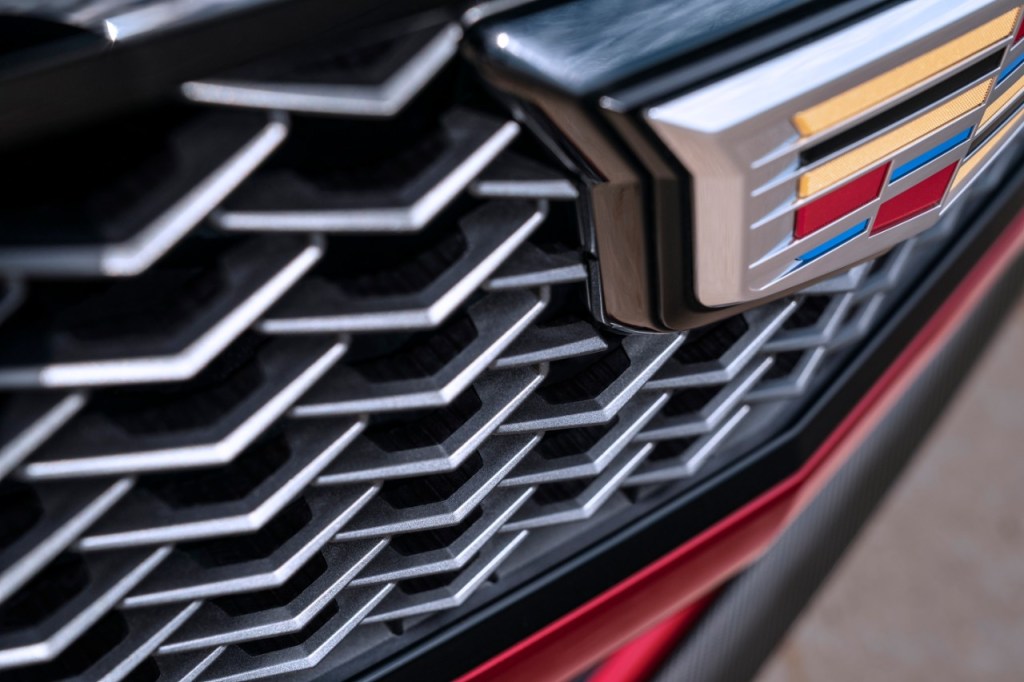
The radius of each V on the 2022 CT4-V Blackwing optimizes airflow. (Image: Cadillac)

As Tony Roma, Cadillac V-Series Blackwing chief engineer, puts it: “With the CT4-V Blackwing, we create net downforce that is incredibly rare in production vehicles. What this means is that the car gets pressed down into the road the faster you go, giving it more grip, greater stability and inspiring the driver to confidently explore its full capabilities. Not only have we produced our most track-capable sub-compact sedan ever, but we continue to work with our racing counterparts to explore the limits of physics to make better cars.”

So there is a front underwing with air strakes to control the airflow (Scott Sier, aerodynamics performance engineer at Cadillac: “Thanks to components like the underwing, we were able to work with design to generate downforce without the use of large wings that didn’t fit with the design.”).

Front dive planes to increase grip for the front tires by pushing the front down (see previous quote).

A rear spoiler with a functional 3-mm Gurney flap for more downforce.

Brake cooling ducts that are not only 3D printed (how techy is that?) but work to keep the rotors cool and direct air around the front control arms.

Front fender vents that exhaust built-up pressure in the wheel wells as well as remove hot air from the engine bay.

A front splitter, rocker moldings and extensions and a rear diffuser, all of which reduce lift and provide high-speed balance.

A flat underbody for airflow management.

Rear control arm covers, which minimize air buildup around the rear wheel wells and the control arms.

But the most remarkable one of all: the mesh on the grille has V-shaped inlets that have two different textures that work to control and direct air.

Sure, the grille makes a huge difference in air flow management, but the textures on each of those little elements?

That is serious aero.

WMC’s Innovative Electric Motorcycle

A carbon fiber bike with some clever aero design

By Gary S. Vasilash

If you look at the picture of this motorcycle—the WMC250EV from White Motorcycle Concepts (WMC), a British firm—you will notice a black spot where you might imagine a headlamp might be positioned:

(Image: WMC)

That is actually an air duct, or, in the parlance of WMC, an element of “V-Air,” one of the three “market disruptive technologies” that are being used on this electric motorcycle.

The duct channels air through the bike, not around it, thereby greatly reducing the aerodynamic resistance.

Another thing it does is keep the front wheel down, which then brings in the second disruptive tech, “D-Drive.” This is a drive motor. Turns out that generally bikes, because they are rear drive, tend to have lift in the front of the bike. D-Drive also provides regenerative braking.

Finally, there’s “F-Drive,” a final drive system. This, according to the company, is something that could actually be retrofitted onto existing motorcycle designs.

Why is any of this of interest?

WMC CEO Rob White plans to ride the WMC250EV within the next 12 months so that he will break both the British and world land speed records.

The motorcycle has a top speed in excess of 250 mph.

Some Things About the Peugeot 308 SW

A new vehicle with some interesting characteristics

By Gary S. Vasilash

Peugeot has rolled out with a new vehicle, the 308 SW with, given the profile of the vehicle, the “SW” standing for “station wagon,” although that is probably not the case given that station wagons aren’t called “station wagons” in France or other parts of Europe where the 308 SW will be sold.

All that said, it looks like a station wagon.

New Peugeot 308 SW. (Image: Peugeot)

There are several interesting things about this vehicle that Peugeot thinks is important to know.

For example, there are several places to put things on the interior of the vehicle, places that are “entirely dedicated to well-being and practicality.” That’s one way of describing those places that often end up being sticky on the bottom surface and full of random debris.

The vehicle can be purchased entirely on line (depending on the country, of course: something that wouldn’t happen in the U.S. unless a dealer is involved, the vehicle is a Tesla or it is a used car).

The 308 SW can be equipped with an array of powertrains, ranging from gasoline engines to hybrids to, yes, even diesels.

The steering wheel is, for some reason, compact. Outside of a school bus or a Class 8 truck, are there really oversized steering wheels in vehicles?

And then there’s this: the 308 SW offers a cargo volume that can accommodate “608 litres of water and up to 1634 litres of water with the seat fully folded.”

To be sure, there are many ways of measuring cargo space, from luggage to Amazon Prime boxes to jellybeans (sweepstakes use, only).

But water?

Is It About the Drive?

People are spending more on things related to their vehicles

By Gary S. Vasilash

Taken all together, automotive loan or lease payments, insurance and gas had a collective increase of 18% in May compared to the start of the year, according to Morning Consult.

What’s more, the research firm found that when faced with cutting back on car travel—including such means as using public transport—or paying more to stay in one’s own vehicle, U.S. consumers opted for the latter approach.

In its monthly survey of household finance data, Morning Consult looks at 11 categories of spending, ranging from gasoline to utilities.

While the percentage increase from January to May for medical care was 19% and 17% for restaurants, the increases for gas and car insurance were 27% and 16%, respectively.

When it comes to monthly spending averages, the car lease/loan payment in January 2021 was $140 and it saw a marginal increase of $18 through May. Car insurance was $105 and got a $17 bump. Gasoline had a notable comparative increase, from $91 in January to an add of $24 through May.

But the spending for public transportation was $59 in January. And there was a $0 marginal increase through May.

Is this an issue of people liking the drive—or simply not wanting to share transportation space with strangers?

Alfa in America

How the brand will move forward in an important market

By Gary S. Vasilash

Alfa Romeo has been around since June 24, 1910, or for 111 years (as of then).

The brand, especially in Europe, has been widely known for its performance vehicles, performance not like a Dodge Charger Hellcat, but as something that is more at home powering through twists and turns.

There are solid enthusiasts for the brand—the “Alfisti”—with some two million active on Facebook and Instragram, lauding what it stands for and what it produces.

In the U.S., however, the numbers of sales aren’t particularly large. In the bizarre pandemic year of 2020 Alfa sold a total 18,586 vehicles in the U.S., which is just a couple thousand more than the number of Chrysler 300s sold—16,653—but realize that that car is 10 years old.

Still, Alfa’s 2020 U.S. sales were up 2%–and that it the only brand in the Stellantis lineup with a plus sign in front of its sales in 2020 vs. 2019, which is saying something.

For Q1 2021 Alfa is showing considerable strength (relatively speaking, of course), which a gain of 25% compared with Q1 2020, with 4,646 sold.

Giulia Quadrifoglio (Image: Stelllantis)

So if it is a good year, and if there is availability of product, then the brand is probably looking at sales of about 20,000 vehicles, primarily the Stelvio crossover, the Giulia sedan, and a smattering of Alfa 4C sportscars.

Larry Dominique was named senior vice president, Alfa Romeo Brand – North America in March 2021. He’s the guy in charge in the U.S. (as well as Canada and Mexico).

Prior to that he was the president and CEO of PSA in North America. In that role he didn’t bring Peugeots to the streets. But he helped launch Free2Move, a carsharing service that originally launched in Washington, DC, and has expanded to Portland, Oregon.

Dominique had been the president of ALG, the company that is largely responsible for establishing residual values for vehicles. And during that same period—2011 to 2015—he was the executive vice president of OEM, Data and Analytics for TrueCar.

His most notable stint, from 1989 to 2011, was at Nissan. His last position there was as vice president for Product Planning. While at Nissan he met Carlos Tavares, who was with the Renault-Nissan Alliance at the time—and who is now the first CEO of Stellantis.

On this edition of “Autoline After Hours” Dominique spends the hour talking Alfa with “Autoline’s” John McElroy, Joe White of Reuters and me.

He talks about the challenges and opportunities of the brand.

One of the things that he emphasizes—a thing that is highly important not only for vehicle brands but for brands of any type—is that they have a clear understanding of what Alfa is—and what it isn’t.

He explains that his brief is not only to protect what “Alfa” is, but also to grow the brand without sacrificing that identity.

Dominique, who has a degree in engineering, is very methodical in his approach to boosting the brand.

But what is absolutely evident that he, too, has a passion for Alfa Romeo, which an important complement as he helps move it forward.

And you can see the show here.

NACTOY Announces Initial List

These are key cars, trucks and utilities being made available in the U.S. this year

By Gary S. Vasilash

At the risk of turning this into the non-official site of The North American Car, Truck and Utility Vehicle of the Year (NACTOY) Awards™, it is worth noting that the organization* announced its list of 38 cars, trucks and utility vehicles will be eligible for the 2022 awards.

That’s 12 cars. Eight trucks. And 18 utility vehicles.

“Utilities of all types and sizes continue as the largest and most popular vehicle category, so the large number of them comes as no surprise. However, the number of eligible pickups is the most we’ve seen in several years,” said NACTOY president Gary Witzenburg.

So, what are they?

Car of the Year

  • Audi A3
  • Cadillac CT5-V Blackwing
  • Genesis G70
  • Honda Civic Sedan
  • Karma GS-6
  • Lucid Air
  • Maserati MC20
  • Mercedes-Benz EQS
  • Mercedes-Benz S-Class
  • Subaru BRZ
  • Toyota GR 86
  • Volkswagen Golf Mk VIII (Golf R/Golf GTI)

Truck of the Year

  • Ford F-150 Raptor
  • Ford Maverick
  • GMC HUMMER EV
  • Hyundai Santa Cruz
  • Nissan Frontier
  • Rivian R1T
  • Tesla Cybertruck
  • Toyota Tundra

Utility Vehicle of the Year

  • Acura MDX
  • Buick Envision
  • Chevrolet Bolt EUV
  • Ford Bronco
  • Genesis GV70
  • Hyundai IONIQ 5
  • Hyundai Tucson (HEV/ICE/PHEV)
  • Infiniti QX60
  • Jeep Grand Cherokee (ICE, PHEV, L)
  • Jeep Wagoneer/Grand Wagoneer
  • Kia Carnival
  • Lexus NX
  • Mazda MX-30 electric
  • Mitsubishi Outlander
  • Nissan Pathfinder
  • Toyota Corolla Cross
  • VW ID.4
  • VW Taos

*The organization consists of 50 jurors from print, online, radio and broadcast media across the U.S. and Canada.

GM to Spend More Billions on EVs (and AVs)

Why spend $20 billion when you can spend $35 billion?

By Gary S. Vasilash

Yesterday General Motors announced that spending $20 billion between 2020 and 2025 on electric and autonomous vehicular tech, as it said it had intended to in March 2020, isn’t enough.

It announced that spending $27 billion during the same period, as it said it had intended to in November 2020, just doesn’t cut it.

So now GM says that it will spend $35 billion by 2025.

In other word, a 75% increase in spend from what it originally intended just 15 months ago.

Why?

Said Mary Barra, GM chair and CEO: “We are investing aggressively in a comprehensive and highly integrated plan to make sure that GM leads in all aspects of the transformation to a more sustainable future.

“GM is targeting annual global EV sales of more than 1 million by 2025, and we are increasing our investment to scale faster because we see momentum building in the United States for electrification, along with customer demand for our product portfolio.”

The Bolt EV is presently the GM electric vehicle. In the first quarter GM sold 9,025 of the compact electric vehicles.

Yes, that is a 53.7% increase over Q1 2020, but that was Q1 2020.

The increase in Corvette sales Q1 to Q1 was 73.1%. While only 6,611 of those vehicles were delivered, odds are GM makes more on each Corvette than Bolt.

GM does have more EVs coming, like the HUMMER EV pickup and the Cadillac LYRIQ crossover. And there will be an electric Silverado and other vehicles to boot.

GM will be building two EVs for Honda, one for Honda brand and one for Acura. And it is supplying Navistar with its HYDROTEC hydrogen power fuel cells for heavy trucks that are to be launched in 2024.

And while it doesn’t get a whole lot of attention compared to EVs, Cruise is continuing its efforts to achieve higher levels of autonomy. It has been given the go-ahead to provide a public service sans driver in California. It has been named the exclusive autonomous rideshare provider in the city of Dubai. It will be receiving Cruise Origin vehicles—jointly developed by GM and Honda, and scheduled for production in GM’s Factory ZERO Detroit-Hamtramck Assembly Center in 2023.

No question that GM is making a huge commitment.

A thought

Here’s something that needs to be taken into account. According to the U.S. Dept. of Energy, as of approximately right now there are 42,664 charging stations in the U.S. and 103,654 charging outlets available to the public.

People who live, say, in southeast Michigan tend to travel up I-75 to northwest Michigan every holiday in numbers that make a chain out of the vehicles, trailers, boats, etc. Somehow, unless there is access to chargers that are going to allow recharges in minutes, not large fractions of an hour (or more), it is going to take one EV-intensive holiday weekend to have some exceedingly sour people.

When people are used to spending a quick time at a gas station, sitting in a long line waiting for access to a plug may have a big effect on the overall acceptance of EVs.

That Old Vehicle Is Now. . .Older

Yes, another consequence of COVID

By Gary S. Vasilash

During 2020 probably one of the last things on anyone’s mind was buying a new car or truck unless, of course, they had a feeling of being locked in and locked down so they wanted to get out there and do something with the money that they were not spending on cruises or long weekends in Las Vegas.

Light vehicle sales went down.

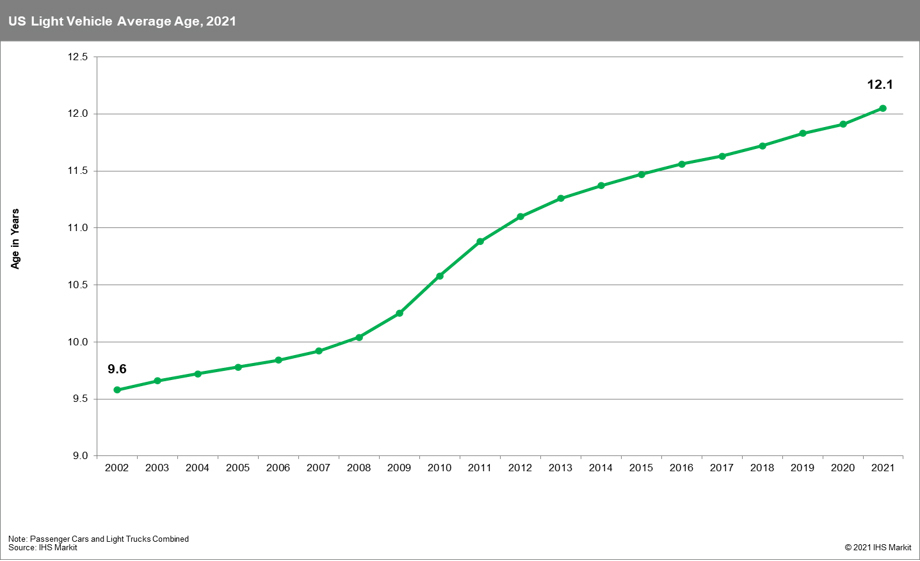
And according to research from IHS Markit, a consequence of that is that the age of vehicles in people’s driveways went up.

Up by almost two months.

According to the research firm the average age of a light vehicle is 12.1 years old.

(Image: IHS Markit)

Another thing happened, IHS found. The number of vehicles that were taken out of active service went up. Known as “scrappage,” some 15+ million vehicles—or 5.6% of all vehicles in operation—were, well, scrapped.

One would think that this would have made the average age go down, but the reduced overall sales and a drop in vehicle miles traveled caused, in the words of Todd Campau, associate director of Aftermarket Solutions at IHS Markit, “a radical departure from the norm.”

On the subject of vehicle miles traveled, they were down over 13% in 2020.

One result of that is that people may have allowed their registrations to expire because they weren’t going anywhere.

And if they kept it, they may be in for a happier 2021.

Campau: “The microchip shortage and subsequent inventory levels for new vehicles have created a situation in which used vehicle values have gotten extremely high, so a vehicle owner who may have kept a vehicle in the garage that they were not using in 2020, now instead may take advantage of the opportunity to either reduce the number of vehicles in their garage, or trade up to something newer while the demand and value is extremely high on their used vehicle.”

Of course, this means being able to find a vehicle that they may actually want if said vehicle isn’t a high-end SUV or loaded pickup, which is what OEMs are focusing on building as they meter out their silicon to vehicles that provide them with the highest margins.

IHS anticipates that the aging fleet will, however, get younger, as more people get in the market in 2021.

Not a fountain of youth. But a move in the right direction.