NACTOY and DADA Donate $40,000

Automotive organizations helping out the community

By Gary S. Vasilash*

Although automotive journalists, in some circles, have a reputation of being first in the buffet line, it is worth knowing that the 50 jurors who make the selections for the North American Car, Truck and Utility Vehicle of the Year (NACTOY) Awards™, along with the Detroit Auto Dealers Association (DADA), have just made $40,000 in charitable contributions.

$10,000 each were presented to:

Noted Gary Witzenburg, NACTOY president, “As automotive journalists, we are privileged to drive, test and evaluate the finest new cars and trucks each year, and for the second consecutive year, we have been able to give something back with these charitable donations.”

Added Rod Alberts, DADA executive director, “NACTOY has always supported the Detroit auto show by announcing its annual awards at our show. We value that partnership and are thrilled that we were able to help make these charitable donations possible once again this year.”

Alberts is referring to the North American International Auto Show (NAIAS), which, like other auto shows, has been on something of a hiatus due to the COVID-19 pandemic. The NACTOY awards were established in 1994 and the winners were first, and have been subsequently announced, in the building still widely known as “Cobo” during NAIAS events.

*Full disclosure: I am a NACTOY juror

How the Automotive Supply Base Is Being Transformed

Yes, there is still a need for some of yesterday’s tech in the auto industry today. But there is a greater need for tomorrow’s tech right now. And here’s what suppliers are doing to realize that

By Gary S. Vasilash

When people say that the auto industry is “undergoing the biggest transformation since its very beginnings,” they generally mean that the OEMs are having to vigorously change the product offerings that they are producing, putting plugs where they once had fuel filler ports, putting in drive motors where they once had engines, putting batteries in a place where there were once fuel tanks.

And that is just for the electric vehicle part of the change.

There are a variety of other factors that are driving change in automotive, such as the addition of automated driving capabilities and the need to address heightened expectations on the interiors of vehicles, whether this takes the form of things like comfort or infotainment.

By and large, the changes seem to be challenges for the OEMs.

Which is not entirely the case.

Let’s face it: most of what is assembled into a given vehicle is not produced by the OEM. It comes from suppliers.

So the transformation of the auto industry is having arguably a greater impact on the supply base as not only must it provide OEMs with what they want now, but what they will want in the future.

ZF ProAI automotive-grade supercomputer. (Image: ZF)

On this special edition of “Autoline After Hours” my colleague John McElroy and I talk with Martin Fischer, member of the Board of Management of ZF and president of ZF North America, and Phil Eyler, president and CEO of Gentherm.

ZF is one of the world’s largest automotive suppliers, and while historically—and currently—known for such products as its nine-speed transmissions, the company is undergoing a change as it focuses on domains including autonomous driving, electromobility, integrated safety, motion control, and digitalization and software.

Yes, the company has even developed an automotive supercomputer, the ProAI.

Then there’s Gentherm, which is a specialist in thermal electric devices. In 1996 the company launched its first heated and cooled car seat and in the subsequent years has taken a strong position in that market area.

Yet recently it has invested in technology for thermal management of electric vehicle batteries.

McElroy and I talk with Fischer and Eyler about how their companies are working through—and ahead of—demands—today’s and tomorrow’s—they are addressing as automotive suppliers.

Their approaches range from organizing skunkworks to create new products to taking existing technologies from other market segments, like medical, to apply to automotive applications.

You can see it all here.

Audi Race Car Sets Sales Record

It has only taken 5.5 years to achieve. . . .

By Gary S. Vasilash

The 138th GT3 model of the second-generation Audi R8 LMS has been produced.

That near-production race car (i.e., it share half of its components with the “regular” R8) has been on sale since the end of 2015.

So this means about 5.5 years.

138 cars.

(Photo: Communications Audi Sport customer racing / Bildagentur Kräling)

Audi notes that the first-gen version, which was in production from 2009 to 2015, had total sales of 137 cars.

Of all of the GT3 cars built by Audi (a total of 275 so far), there have been 13 vicoctires in 24-hour races, eight in 12-hour races, and a whole bunch more vicotires in the U.S., Europe and Asia.

Speaking of the second-generation besting the first, Chris Reinke, head of Audi Sport customer racing, said, “As we see in our competitive environment, it is by no means a matter of course that a successor is as commercially successful as the predecessor model or even surpasses it.”

Still: One car?

Fisker: Passionate About Clean Transportation

It is about engagement at Fisker. . .

By Gary S. Vasilash

“Our corporate vision is ‘A cleaner future for all,’ and one of our brand pillars is ‘Designed by people, for people.’ So this is not about just making a toaster on wheels by a computer, but we really have people here which are engaged and excited. I’m personally involved in every single design that we make, and I think that’s going to be one of the main differentiators of Fisker.”—Henrik Fisker, co-founder, president, chairman & CEO, Fisker Inc., June 8, 2021

Fisker, as in the man, is the designer of vehicles ranging from the Aston Martin DB9 to the Karma. Clearly the man knows how to pen a vehicle.

So the company apparently has a mission to make vehicles that are affordable across the board, whether this is for someone who wants something in the lux space or something that is achievable by someone who might otherwise buy something that resembles, well, a toaster.

Sometimes people talk about the importance of having a “car guy” in charge of a car company.

This is one better.

Maybe more than one better.

A Thought About the Design of the Ford Maverick

Does an urban dweller want something that is Built Ford Tough or which smacks of fashion?

By Gary S. Vasilash

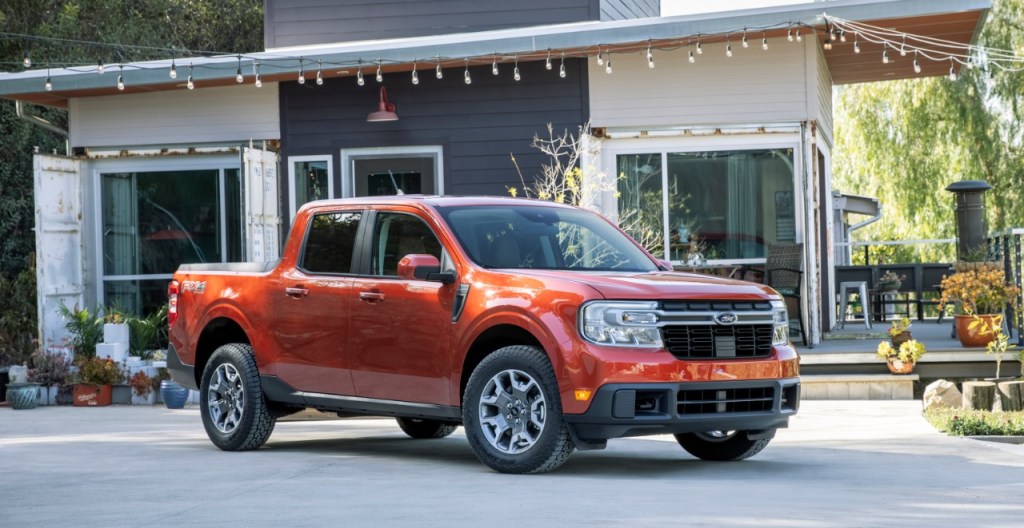
“One thing that’s non-negotiable is that Maverick is Built Ford Tough,” said Chris Mazur, chief engineer for the small pickup.

What seems a bit odd is that Ford says of the truck “The interior design is stylish and spacious, with thoughtful features and the versatility for city driving or escaping the urban life,” which seems to indicate that this is a vehicle for city dwellers.

Looks like a truck. Is a truck. (Image: Ford)

So this “Built Ford Tough” characteristic doesn’t seem to align with what would assume would be style-conscious urbanites—except for those who wear Carhartt.

As it starts under $20K and comes standard as a hybrid, there is a draw there.

But as Hyundai is coming with the Santa Cruz, a vehicle that is certainly more chic, it will be interesting to see which has greater appeal for those who want a “truck” but really don’t want a “truck.”

Lambo and LEGO

A LEGO model that looks (almost) like the real thing

By Gary S. Vasilash

When you were a kid, perhaps you had a model—or more—of a particular vehicle that you hoped to have when you “grew up.”

And maybe you had a LEGO set that allowed you to make something that was a geometric analogue of that vehicle.

For many people, a Lamborghini may have been the desired vehicle.

And Automobili Lamborghini has been working with LEGO on the production of models.

The latest is a life-size replica of the Lamborghini Sián FKP 37.

(Image: Automobili Lamborghini)

Yes, as big as the real car.

To build it they used 154 different types of LEGO elements, including 20 molded for the project. (Which goes to show you that when the OEM and the supplier are working hand-in-hand, special things can happen.)

This was no idle process of putting blocks together and seeing how they worked.

There was a team of 15 people involved. They used 8,660 hours of development and construction.

The companies say that the model is “identical” in size to the real thing: 4,980 mm long, 2,101 mm wide and 1,133 mm high.

The model was painted in the Automobili Lamborghini paint shop.

LEGO offers a 1:8-scale edition of the Sián for those looking to put something on the shelf.

Another Electric Pickup

Not everyone is going to be getting an F-150 Lightning. . .

By Gary S. Vasilash

Those who spend time on golf courses are undoubtedly familiar with the golf cars—not carts—from Club Car, the company makes a variety of other vehicles for low-speed operations.

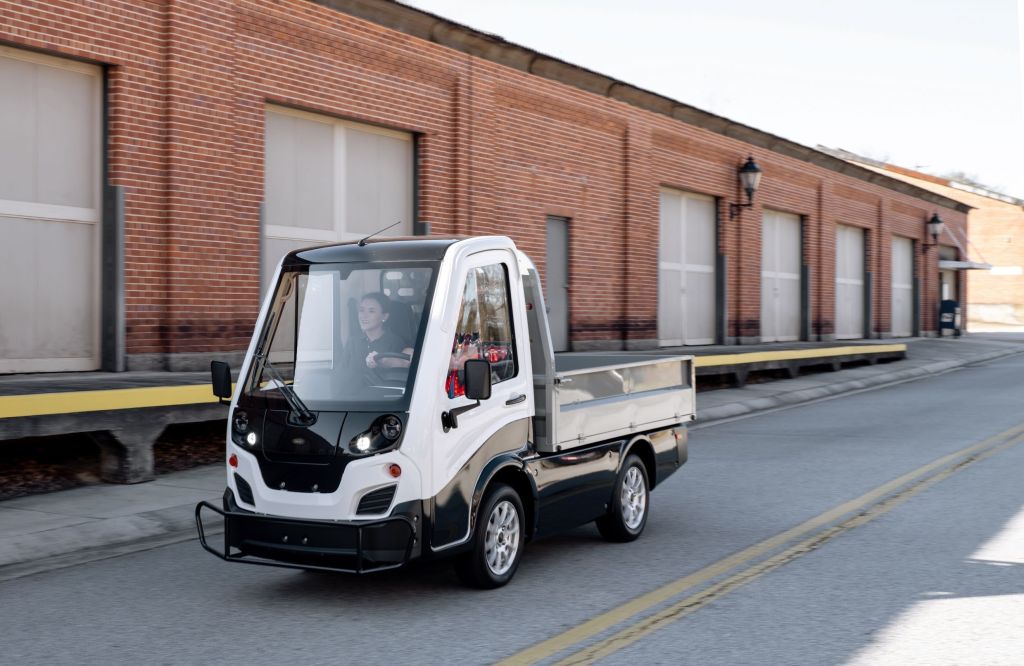
The company, working with AYRO, which produces purpose-built electric vehicles (EVs) for such things as microdistribution, has launched the Club Car Current, an EV that can be configured as a flat bed, pickup or van.

It offers a range of up to 57 miles.

(Image: Club Car)

As a certified low-speed vehicle (LSV), it operates at up to 25 mph.

It is powered by a VRLA (valve regulated lead-acid) gel battery.

It is certified as a Zero Emissions Vehicle by the California Air Resources Board.

And perhaps the most important factor for users: the cup holders are designed to accommodate larger containers.

Will Buying a Car Change?

Does Gen Z really want to kick tires?

By Gary S. Vasilash

On April 14, 2021, an “Open Letter by Academics in Favor of Direct EV Sales and Service” was published, with the signatories being current or emeritus professors at U.S. universities who “specialize in economics, competition policy, market regulation, industrial organization” and other disciplines.

The primary point:

“We write to argue that any state laws still prohibiting car companies from selling their cars directly to consumers, or opening service centers for those vehicles, be amended to permit direct sales and service of electric vehicles (‘EVs’).”

There is an acknowledgement that this has largely been a case of Tesla hitting up against franchise laws. But they go on to note: “it is equally important to a new crop of American EV start-up companies including Rivian, Lordstown, Lucid, Bollinger, and others about to enter the market. It is also important to the legacy automobile companies like General Motors, Ford, and Chrysler, which should be allowed to compete with the start-ups on a level playing field.”

The academics argue the dealer franchise laws generally go back to the mid-20th century when “car dealers were mostly ‘mom and pop’ sole proprietorships. By contrast, the ‘Big Three’ auto companies were hegemonic firms that faced relatively little domestic or foreign competition.”

So, in effect, to protect the little guy, the franchise laws were put in place. This meant that OEMs couldn’t sell (or service) vehicles directly to the consumer, as it was thought that were they able to, they would be able to undercut the small proprietorships that were selling vehicles.

The letter points out that today there are massive dealership groups responsible for moving a whole lot of vehicles, not one’s next-door neighbor who operates a dealership down the street. They write: “there are at least 15-20 major manufacturer groups selling cars in the U.S.”—which account for, they say, billions of dollars in revenue. You can buy a whole lot of jerseys for the local softball team with that kind of money.

The academics put forth a number of reasons why direct sales should be permitted for EVs (one suspects that were it permissible for EVs it would be difficult to stop this happening for vehicles with other propulsion systems). One of the salient points is: “Traditional dealerships earn low profit margins on new car sales, and make it up on service. EVs have a much smaller service component since they don’t have service needs like oil changes or engine tune-ups. Traditional dealerships therefore lack much of an incentive to sell EVs.”

In addition to arguments like that, there is the simple fact that since the franchise laws were enacted there have been an array of developments that allow people to obtain goods and services that were not even imagined back then.

Like the Internet.

Which facilitates things like Amazon.

Which has created a generation of consumers who want to get things on their schedules.

Which has given rise to things like Carvana.

And on it goes.

Dave Zuchowski is the chief strategy officer at Unite Digital. The mission of Unite Digital is “To drive significant growth for our customers by creating seamless customer experiences that Unite and differentiate a manufacturer and their distribution network.” The “customers” in that sentence are “automotive, powersports, automotive groups and other franchised industries.”

Zuchowski, who is a former president and CEO of Hyundai Motor America and senior vice president of Dealer Operations at Mazda North America, has seen the business from several perspectives.

He thinks that what will be the case going forward will be more of a “hybrid” than a case where in order for someone to get a new vehicle—EV or otherwise—they will have to go to a dealership. Rather, it will be a blend of digital and personal interactions, something more seamless than obstreperous.

On this edition of “Autoline After Hours” Zuchowski provides his insights on not only the changing face of automotive retail, but overall changes that are facing various aspects of the industry. He talks with “Autoline’s” John McElroy, automotive writer Steve Findlay, and me.

And you can see it here.

2021 Niro EV Launched

The what?, you, perhaps, wonder

By Gary S. Vasilash

When you think of an electric vehicle (EV), odds are that the first thing that comes to mind is something from Tesla.

Then, given the recent buzz, the forthcoming Ford F-150 Lightning.

Then after that maybe the Chevy Bolt EV.

And then any number of things, be it an Audi e-tron or a Porsche Taycan or something from a startup company that you’ve heard about (e.g., a Lucid Air).

K2021 Niro EV

How about the Niro EV?

(Quick: What is the name of the manufacturer who produces the Niro EV?)

The 2020 Niro EV was the number-one mass-market vehicle in the first J.D. Power Electric Vehicle Experience Ownership Study.

Number one.

The 2021 version is being launched.

The crossover from Kia has a starting MSRP of $39,090 and with its 64 kWh battery provides an estimated range of 239 miles.

It has a whole suite of standard driver assistance tech (from forward collision warning to smart cruise control with stop and go). Its got the goods, and then some.

And it is a functional compact crossover with 18.5 cubic feet behind the second row or 53 cubic feet with the second row folded. Usefulness meets technology at a very reasonable price.

Surprising how a competitive EV gets lost in the noise.

Some Sales Numbers to Consider

All things considered, the auto market in the U.S. is doing remarkably well

By Gary S. Vasilash

According to LMC Automotive, a forecasting and market intelligence firm, in the month of May there were some 1.59-million light vehicles sold in the U.S.

Which in and of itself is somewhat meaningless unless you keep track of things like that.

What may be helpful to know is that that number is a 43% increase compared to May 2020.

Of course, May 2020 was a period when we were in the thick of COVID, with not a whole lot of people going to kick tires unless those tires were on one’s vehicle in one’s garage.

Another thing that those who look at the numbers do is calculate the annualized rate of sales.

In April the annualized rate was 18.8 million vehicles, which essentially means that if things continued for the rest of the year like April there would be a total of 18.8 million vehicles sold.

In May the annualized rate fell to 17.2 million.

Given that part of LMC’s business is forecasting, that is a good thing, as it has, and continues to predict, that the 2021 light vehicle sales will be 17 million vehicles.

And the good thing for the industry about that is that if it does finish at 17 million, that is an 18% increase over 2020.

Arguably the would be more vehicles sold were it not for the semiconductor shortage.

Last year COVID.

This year the semiconductor problem (and some COVID).

Next year?

Locusts?