Mike O’Brien and the Importance of Being There

Observations about how vehicle are developed and more. . .

Genchi gembutsu is one of the principles of the Toyota Production System. It essentially means, “go and see for yourself.” Don’t depend on a report about something. Get to the source of the matter and discover what’s going on for yourself.

Mike O’Brien, who spent some 14 years at Toyota North America, with his final position there as corporate manager, Product Planning, before moving on to Hyundai Motor America, where he spent over a decade, with his last position there being vice president, Corporate Planning, Product Planning and Digital Business, uses the term genchi gembutsu in the context of how vehicles should be developed.

Mike O’Brien believes there will be a shift in the market to more cars that people want just because rather than need, a shift driven in part by how the pandemic has changed working patterns that are likely to be the norm for some time to come. (Image: Hyundai)

That is, those who are involved in the development program need to go out to where the potential customers live and work and play so as to get an up-close look at what their behaviors are vis-à-vis the vehicle that they are working on. By doing that they can obtain a grounded sense of what is missing or what could positively add to the overall experience.

But genchi gembutsu is also a good term in relation to O’Brien, as he has been there, at the places where it happens, so on this edition of “Autoline After Hours” you can get truly informed insights on the current state of the auto industry.

While you often hear people talking about creating “white space” vehicles, O’Brien says that that is the exception, not the rule, because appropriate addressing customer pain points may be solved by doing a simple thing: He notes, for example, that an issue that some older people have is loading things into the trunk of their cars, so perhaps that can be addressed by modifying the lift-over height.

He says that companies talk about benchmarking, but he suggests that it is a method that will help with the creation of something that is about five years behind the curve by the time it is launched.

One of the points that O’Brien makes in his conversation with “Autoline’s” John McElroy, Jason Fogelson, freelance journalist, and me, is that coming out of the pandemic there is likely to be a decided market shift from “need” to “want.”

That is, he explains, take a typical two-car household. One of the spouses may now be working from home. Which means that the second vehicle may not be as necessary as it once was. Consequently, there may be a decision that the one vehicle that is in the household is something that does what needs to be done, but is something “special.” It could be a Bronco, Wrangler or something that doesn’t necessarily have off-road capabilities but aspects that the customers really don’t need, but want.

O’Brien discusses a number of other topics, ranging from traditional OEMs and EVs and why he thinks that hydrogen is a great solution for vehicle applications.

And you can see it all right here. —gsv
How Fast Does a Truck Fall?

Remember expensive energy? It may return as a thing. . .

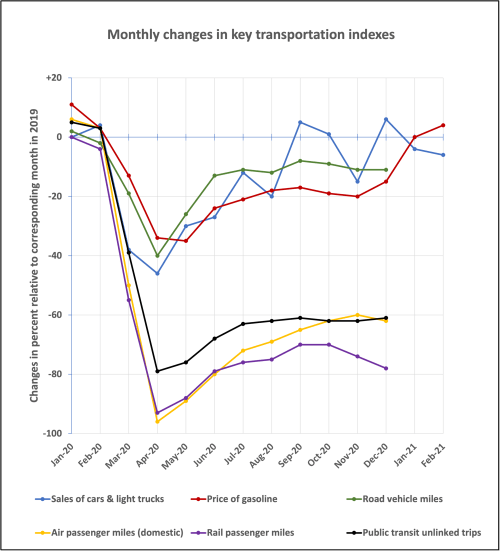
This chart complied by Michael Sivak of Sivak Applied Research clearly shows how bad things were last April—and one takeaway should be to note how quickly things can go south: we may think that major changes take a slow walk, but that’s clearly not the case.

Looks like AMTRAK is going to need a whole lot of help. (Image: Sivak Applied Research)

While there are improvements at the top of the chart, it is clear that modes of mass transportation (or at least transportation that takes more than a few people at a time, as air travel is not necessarily something everyone can afford, even if they’re opting for an airline that charges for every conceivable thing), are still languishing.

One thing that caught my eye is that red line: Gas prices. Note how there is an inexorable increase.

According to the Energy Information Agency, on March 8 the average price of regular in the U.S. was $2.771.

That is up $0.396 from a year ago.

While that is not a huge rise, take that increase, add in the dynamic of Sivak’s chart, and know that last week OPEC+ decided that it would keep a voluntary cut in oil output until at least April, and realize that the ever-rising sales numbers of pickups and full-size SUVs may resemble the left side of Sivak’s chart.

And How Do Others Compete With That?

Tesla signifies more than an electric vehicle. . .

“Many consumers perceive Tesla as a leading-edge, high tech, environmentally progressive brand driven by a charismatic leader who not only builds cars and crossovers, but also sends rockets into space and is a global industrial visionary. That combination is hard to beat and has gotten the attention of the entire global auto industry.”  –Tom Libby, associate director, automotive industry analysis, IHS Markit 

Here’s something to consider: there are about 880 Mercedes dealerships in the U.S.—and just some 130 Tesla outlets (Image: IHS Markit)

The Rich Are Different

Because they can afford expensive sedans

The starting price for the Mercedes-Maybach S-Class Sedan has been announced.

It is $184,900.

Starting price.

Other stuff extra. (E.g., heated and cooled cupholders–which is something that Chrysler had on offer years ago–a refrigerated compartment–hello, Ford Flex–and custom champagne flutes and built-in holders–OK, we’ll give that one to Merc.)

Mercedes-Maybach S-Class Sedan. (Image: Mercedes)

We’ll leave it there.

It could be noted that the destination and delivery line item adds $1,050 to the price.

But if you’d even notice that you aren’t in the market for the S-Class.

Automating Big Rigs

There’s a lot of weight being hauled by one of those things. And a whole lot of processing for autonomy

Here’s something to think about the next time you’re rolling down the highway in your compact crossover:

One of those big rigs that is on the road with you can weigh 80,000 with a full trailer.

It doesn’t take a physicist to calculate that consequently stopping and maneuvering is going to require more time than the vehicle you’re in.

Plus system (look at the top of the cab) uses lidar, radar and cameras. (Image: Plus)

As drivers of those trucks tend to be on long-distance routes, developing autonomous driving capability for them is a growing area of interest.

One such company in this space is Plus, which is developing self-driving truck tech. According to Hao Zheng, CTO and co-founder of the company, they have more than 10,000 pre-orders for its system.

Here is a number from him that is even more astonishing than the aforementioned 80,000 and 10,000—even more than 80,000 times 10,000: “Enormous computing power is needed to process the trillions of operations that our autonomous driving system runs every fraction of a second.”

Trillions of operations every fraction of a second?

Plus has opted to develop its system using the NVIDIA Orin, which, according to NVIDIA, can deliver 254 trillion operations per second.

Evidently enough.

Still, driver or no, you’ve got to show those vehicles some respect.–gsv

A Garage in Croatia

Millions of Euros for an up-and-coming EV OEM. . .

Although the classic Silicon Valley origin story has it that someone comes up with something in a garage and the rest is history, that story occurs in other parts of the world, as in Croatia.

There, a 21-year-old Mate Rimac in 2009 thought about the prospect of developing an electric supercar.

In 2011 he started Rimac Automobili.

And today Porsche announced that it was investing an additional 70-million Euro in the company so that it now owns 24% of Rimac Autmobili.

In 2019 Hyundai Group invested 80-million Euro in the company, so it, too, owns a chunk.

It is somewhat surprising to think that a small company could become important to larger OEMs.

Perhaps more surprising are comments from Lutz Meschke, deputy chairman of the executive board and member of the executive board for Finance and IT at Porsche: “Mate Rimac inspires us with his innovative ideas.”

Yes, a finance guy talking inspiration.

Meschke went on to note, however, “Our investment in the company has turned out to be absolutely right. Rimac’s value has increased many times since our initial investment.”

Porsche bought 10% in 2018.

Engineering the 2022 Acura MDX

How the flagship of the brand was made even better

The Acura MDX is certainly an important name plate in the company’s lineup. For one thing, the vehicle, which goes back to the turn of this century, has had cumulative sales of more than 1-million units. And there have been sales in excess of 50,000 for 14 of the last 21 years. And, according to Acura, it is the “best-selling three-row luxury SUV of all time.”

The first generation was from 2001 to 2006; second from 2007 to 2013; third from 2014 to 2020; and the all-new fourth generation, model year 2022, has just been launched.

Tom Nguyen, chief engineer and 2022 MDX Global Development Leader, Honda R&D Americas, said that when he was given the assignment to develop the new MDX, his mandate was easy to understand but not necessarily easy to execute: “Don’t screw it up.”

2022 MDX A-Spec: sporty, but a three-row people and cargo-hauler. (Image: Acura)

(Who hasn’t heard something like that from their boss at some point in time?)

So Nguyen and his team went at not merely improving what came before, but creating a vehicle that they hope will not only resonate with MDX loyalists, but bring in new buyers.

One of the advantages that Nguyen says he and his colleagues had during the development was that there was a concerted effort at Acura to create vehicles that are athletic and dynamic. This is evident in the RDX and the TLX.

The ‘22 MDX is based on an all-new platform, said to result in the most rigid SUV the company has had. The torsional rigidity of this MDX is 32% greater than that of its predecessor.

Why does this matter? It contributes to safety—a paramount consideration—but also to the ride and handling of the vehicle. And speaking of which, they developed both a double-wishbone front suspension and a multi-link rear suspension for the vehicle.

Nguyen talks about the development of the MDX on this edition of “Autoline After Hours” with “Autoline’s” John McElroy, freelance automotive journalist Nicole Wakelin, and me.

An interesting aspect of the new MDX is that while they were driving for sportiness, they also made the vehicle bigger than its predecessor—2.2 inches longer, 1 inch wider and with a 2.8-inch increase in wheelbase. While you’d think that bigger would mean something that is more wallowing, Nguyen says that through structural design as well as the use of things like structural adhesives—35 meters of adhesives—the vehicle keeps its wheels planted and the vehicle capable of moving where and as it should (with a belt-driven electric power steering system and available Super Handling All-Wheel Drive contributing to that).

And you can see what Nguyen has to say here.

Cars as Sanctuary

Getting away from it all without going anywhere

There’s a Lincoln TV commercial showing a woman who goes into her house and sees the ruckus that’s occurring in there among members of, presumably, her family, so she slips back out the door and into the calm cabin of her Lincoln SUV.

Turns out that that sort of thing is real. So indicates research done by Peugeot UK (yes, I know I’m mixing brands here).

Peugeot UK finds that some people are using their vehicles as spaces for relaxation. (Image: Peugeot)

The company found that 41% of those surveyed said that because of the pandemic-driven lockdown they’ve been using their vehicles for other activities.

  • 58% said it is a place of calm
  • 47% watched TV
  • 43% read books

Although lockdowns and stay-at-home orders will, one hopes, go away in the U.K. (as well as everywhere else) in the not-too-distant future, this use of vehicles for things other than transport may continue.

If they had a zero-emission vehicle (not coincidentally Peugeot has vehicles like the e-2008 electric vehicle), 37% would continue to use their vehicle as an alternative space.

Why? Because the electric motor would allow interior climate control without any exhaust.

For the Want of a Chip

GM announces more downtime at assembly plants

The GM Fairfax Assembly & Stamping plant produces the Chevy Malibu and Cadillac XT4. CAMI produces the Chevy Equinox. At the San Luis Potosi plant it’s the Equinox, Chevy Trax and GMC Terrain.

Today all three of these plants, which have been on downtime shifts, have had their downtime extended.

At San Luis Potosi through the end of March. At the other two assembly plants: “to at least mid-April.”

Why?

The shortage of semiconductors.

GM is using its available chips for its “most popular and in-demand products”—like, not surprisingly, full-size trucks and SUVs.

This is completely understandable. Well, the selection of what to build is, at least.

GM has some of the best people in any industry when it comes to dealing with suppliers. While the pandemic certainly caused a shift in priorities not only when it came to vehicle purchases but also the demand for silicon-based products for those suddenly working and learning from home, it seems as though when it comes to traditional sourced components GM (and other OEMs) are masterful.

But it seems that when it come to silicon and having to compete with consumer electronics manufacturers it is an entirely new challenge.–gsv