A couple things you should know about the things that stop you
As parts of the U.S. where people only knew snow only through repeated Disney+ viewings of Frozen are now, literally, frozen, an inclimate weather vehicle tip is in order.
The road salt or brine solutions (as in calcium chloride or magnesium chloride in a solution) applied to road surfaces can have a deleterious effect on a vehicle’s brakes. (Not that it is good for other metal parts, but that’s for another day.)
According to Goodyear Brakes (no, we didn’t know there was such a thing, either), salt can lead to corrosion on the rotors and calipers, especially on the original brakes on one’s vehicle.
The rust can have a negative consequence on performance (e.g., leading to the separation of the brake pad friction material from its backing).
So the firm (which, perhaps not surprisingly, offers rotors and calipers that have a proprietary anti-corrosion coating), offers these tips:
Wash your vehicle after driving through salted or brined areas. When the car wash offers the underbody wash for a couple bucks, take it. That area is key.
Given the choice between parking in a heated garage and outside in the cold, opt for the latter. Rust doesn’t like the cold, either. Oxidation is minimized in the freezing temps. Of course, you’ll be cold, but your brakes will be in better shape.
Lubricate all moving brake parts with a—
OK. Let’s face it. You’re probably not going to do that last bit, so let’s skip it.
How is this going to work for people who don’t have jobs or the ones they have don’t pay a whole lot?
According to the most-recent information from the Bureau of Labor Statistics, the unemployment rate in January 2021 fell by 0.4%, to 6.3%. The bureau reported, “notable job gains in professional and business services and in both public and private education were offset by losses in leisure and hospitality, in retail trade, in health care, and in transportation and warehousing.”
The categories that grew are undoubtedly those with higher-wage earners while those who have lost their jobs—the wait staff, department store workers—but healthcare?
Those who have a job are going to be paying more for a vehicle: Kelley Blue Book has calculated that the average transaction price for a light vehicle in January was $40,857. That’s right: nearly $41,000. In December 2020 it was actually above that: $41,152.
Admittedly, when you’re talking averages, number extremes can skew the results.
In the case of the January figures, high-performance cars came in at $104,929 and high-end luxury cars at $102,057.
On the other end, there is the subcompact car at $18,783.
And that’s the only vehicle that had an average transaction car under $20,000.
As more and more OEMs stop producing cars in any variety in order to concentrate on crossovers (subcompact SUV/crossover: $26,368), they are clearly leaving some potential customers behind.–gsv
One can only wonder how much sand the engineering team had to wash out of their clothes. . .
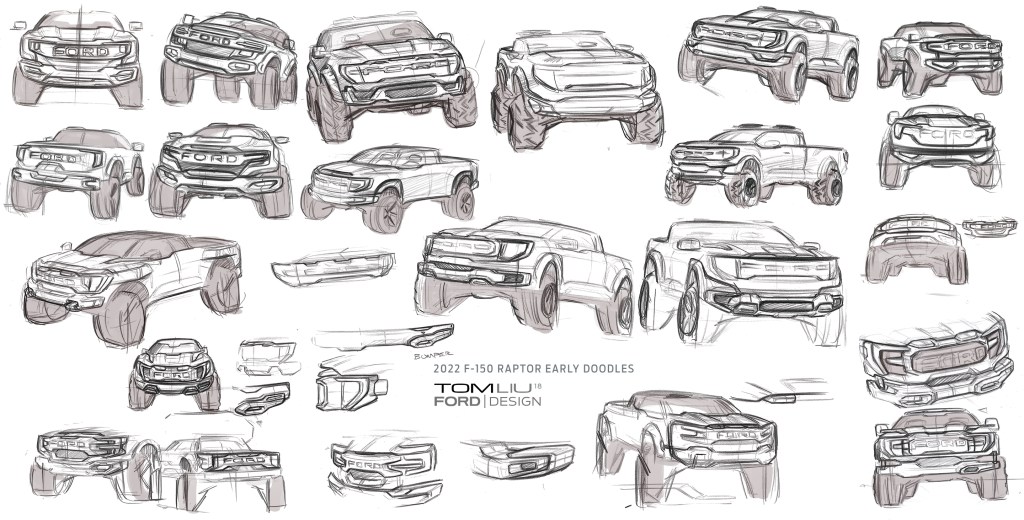
Although the official name is the “2021 F-150 Raptor,” now in its third generation, the vehicle is more commonly known as, well, “the Raptor.” While it is certainly based on the F-150, it is an extreme execution of a vehicle that is engineered to do the sorts of things that even outlier owners of conventional F-150s would never even think of.
Sketches that led to a Raptor. (Image: Ford)
Notes Tony Greco, Ford Program Manager, F-150 Raptor, “It has never been as differentiated from the F-150” as it is now.
While the team behind the development of the conventional F-150 spent a lot of time with contractors and serious DIY homeowners, and while members of that team certainly own and use trucks on a daily basis, Greco says on this edition of “Autoline After Hours,” “I work with a lot of passionate off-road guys.”
So it is not entirely surprising when Greco is asked to list the top things that he says differentiate the Raptor from other vehicles, he lists:
The suspension
The enhanced steel frame
The 37-inch tires
Fox—the supplier of the internal bypass shocks with SOA electronic control technology, the largest shocks (3.1-inch diameter) ever offered on a Raptor—becoming more than a supplier, working with the team like a partner
You may notice from the list that there is a lot about the suspension, which is what Greco says they spent a lot of time concentrating on. For example, he said that when they were looking at the rear suspension, they went through the considerable parts bins at Ford—including Ford Performance, the real home of the vehicle—and didn’t find what they were looking for. So they developed a five-link suspension with extra-long trailing arms—the better to deal with the toughest terrain.
Then there are those 37-inch tires, which required frame modifications for accommodation. Why not even larger? Simply because they wanted to make sure that a full-size spare tire could be handled under the vehicle, not put in the bed, which would take away from the ability to haul stuff. Remember—while this truck can do Baja, it can also carry things on that weekend Home Depot run.
Greco also notes that the design of the Raptor pushes things to an extreme that speaks to the capability of the truck.
While there is another truck that has come on the scene of late that challenges the Raptor—the Ram 1500 TRX—Greco says with the Raptor, which debuted in MY 2010, they created a segment and are not giving it up—to anyone. He also says that the team knew what they wanted to achieve when they started on the 2021 vehicle, and kept to it, regardless of the introduction of the new competitor.
Greco talks with “Autoline’s” John McElroy, freelance writer (and truck guy) Mark Williams, and me on the show.
In addition McElroy, Williams and I discuss a variety of other subjects, including the MY 2022 Nissan Frontier (the third generation of that midsize pickup); the acceptance of the truck community of new vehicles coming from new companies that happen to have electric motors; the California DMV automated vehicle disengagement performance in 2020 by GM Cruise and Waymo; and a whole lot more.
Watch this edition of “Autoline After Hours” right here.
Another electric vehicle from the mainstream brand, one that resembles a compact SUV. . .
Chevrolet is launching a new variant of its Bolt EV* electric vehicle—the Bolt EUV—as well as a refresh of the Bolt EV itself for model year 2022. The Bolt EUV, says Bolt chief engineer Jesse Ortega, combines an EV with design cues of an SUV.
The 2022 Chevrolet Bolt EV and Bolt EUV with Spaceship Earth in EPCOT at the Walt Disney World Resort. (Image: Chevrolet)
While the take rate of EVs is on the order of approximately 2%, Steve Majoros, vice president of Chevrolet Marketing, notes that the Bolt EV is the number-two best-selling EV in the market (in 2020 Chevy delivered 20,754 Bolt EVs, a 26.5% increase compared with 2019; the number-one selling EV in the U.S. in 2020 was the Tesla Model 3, with an estimated 158,000 deliveries), and that it attracts more people to General Motors than any other vehicle in the company’s lineup.
While both vehicles share the same underlying architecture, the Bolt EUV is six inches longer than the Bolt EV.
Both vehicles share the same propulsion system and lithium-ion battery. Ortega says the Bolt EV has 259 miles of range on a full charge and that the Bolt EUV will have an estimated 250 miles of range. Ortega notes that the Bolt EUV is taller, longer and a bit heavier than the Bolt EV, which explains the difference in range.**
Charged Up
GM is working with EVgo for a build out of public charging stations, with plans to add more than 2,700 chargers by the end of 2025.
What’s more, Chevy will cover standard installation of Level 2 charging capability for customers of the 2022 models (either of the two), working with Qmerit, a company that specializes in finding EV equipment installers.
“’Range anxiety’ is a term we have to get rid of,” Oretga says.
According to Rob Mantinan, program engineer, the Bolts can achieve about 25 miles per hour of charge.
Inside Softer
As they had to develop the interior for the Bolt EUV, the Bolt EV is getting an interior upgrade, as well. Phil Zak, executive design director, Chevrolet, says there are “tech-focused interiors, with more premium materials, which are key to our growing EV portfolio.”
There is a new instrument panel, a flat-bottom steering wheel, a gear shift that uses toggles and buttons, a 10.2-inch-diagnoal infotainment color touchscreen, and more soft-touch materials. The EUV is available with an optional sunroof.
A notable offering for the EUV is Super Cruise, the hands-free driver assistance technology that has migrated from Cadillac. It allows the driver to her to remove her hands from the steering wheel on some 200,000 miles of mapped roadways in the U.S. and Canada.
Outside Edgier
On the exterior, the EUV features a crease line that runs from the front fascia through the center of the hood, horizontal body lines and standard roof rails, which are said to signify more of an SUV approach. LED headlamps are standard.
The EV has a more upright front fasica and new front and rear lighting.
One thing that can be said about the exterior designs of both vehicles is that they look far more like 21st century EVs than the current Bolt EV or the now-out-of-production Volt (a.k.a., the “extended range electric vehicle”).
Cost Down
The base price of the 2022 Bolt EV, including destination, is $31,995. That’s $5,000 less expensive than the base 2021 model.
Majoros says that the price decrease is predicated on the build-out of a supply chain, process improvements through the past few years and economies of scale. There is an emphasis that this is not an approach of decontenting.
The Bolt EUV starts at $33,995.
A Launch Edition for the EUV is being offered. It includes Super Cruise, sunroof, unique wheels, special badging and an illuminated charge port. Its price is $43,495.
Disney Magic
To launch the Bolt EUV Chevy put the reveal at the Walt Disney World Magic Kingdom with a presentation by Nick Cho, who is known for his @YourKoreanDad on TikTok, and a special video that GM and Disney collaborated on.
Unlike the MY 2000-2003 Chevy Venture, which offered the Warner Bros. edition, which included a Bugs Bunny badge, this apparently will not include a Tinker Bell.–gsv
*The “EV” is part of the name of the “Bolt EV.” So in contexts where the type of vehicle is appended to the name, it is the “Bolt EV EV.” (The EUV avoids that with the addition of the vowel.
“With boats continuing to grow bigger and performance expectations continuing to rise, boaters have been asking for a better, more capable high‑horsepower solution to meet their needs. The V12 Verado outboard is Mercury’s answer,” said Chris Drees, Mercury Marine president.
Yes, that is “V12” as in a 7.6-liter, 600-hp V12 engine.
While OEMs are seemingly hell-bent on creating an electric transportation future, there is one Everest-sized speedbump between now and then: the lack of a robust charging infrastructure for those vehicles.
Although companies like Shell and bp talk about peak oil and changing their business models to less carbon-intensive approaches, how many of their stations provide electric chargers? Probably far fewer than offer gasoline, beef jerky and lottery tickets.
The European Automobile Manufacturers Association, the European Consumer Organisation and Transport & Environment have jointly written a letter to the commissioners responsible for the European Union’s Green Deal detailing the necessity for specific regulations rather than a nice-to-achieve directive, regulations that will “set binding national targets for all vehicle segments” vis-à-vis charging.
The authors write: “the following minimal targets should be set in stone: one million charging points in 2024 and three million in 2029 for passenger cars and vans, as well as around 1,000 hydrogen stations by 2029.”
And the boldface font is in their letter.
Apparently there are some 225,000 charging points in the EU right now. If they’re going to have one million charge points by January 1, 2024, then this means they need to install 258,000 additional chargers per year. Or 33,000 more per year than currently exist.–gsv
As people spend more and more time indoors because of the pandemic, they are doing all manner of things, from baking sourdough bread to learning how to play musical instruments that they had to pull out of the closet where they abandoned them years earlier.
But then there’s Leh Keen.
He decided to set a Guinness World Record: setting a speed record for a vehicle indoors.
The indoor space he chose was not a rec room that hadn’t been used since the kids were small.
Rather, it was Ernest N. Morial Convention Center in New Orleans, Louisiana, which has the largest contiguous-space exhibit hall, of about 1-million square feet.
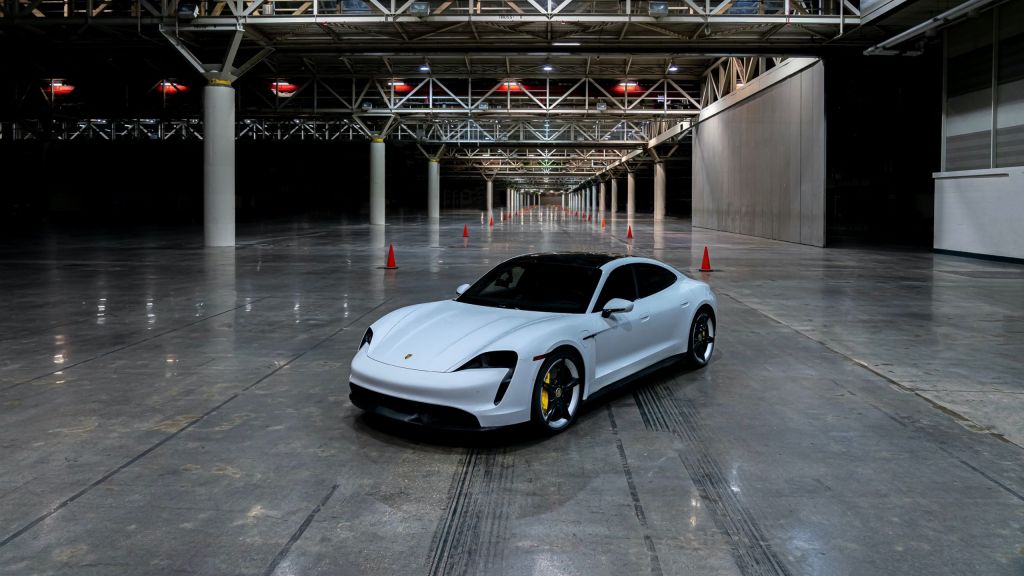
The vehicle in question Keen selected was a Porsche Taycan Turbo S, an all-electric car that provides 750 hp and has four-wheel drive. The car has the ability to accelerate from 0 to 60 in 2.6 seconds.
Porsche Taycan Turbo S driven by Leh Keen to an indoor speed record. (Image: Porsche)
Here’s something you probably didn’t think about because you’ve not driven in a convention center space.
The polished concrete floor is slippery.
Keen: “The surface is so unpredictable, so slick, that you have to have complete trust in your car. It truly was like ice – and you’re accelerating flat out, facing a really hard wall at the end. Suddenly, even in a massive space like the one we had, it seems very small.”
The requirement for the record was to start from a standstill and to come to a complete stop.
There are no safety nets. No open doors to escape through if things go badly.
The record was 86 mph. It stood for seven years.
Keen made the run—and the record—with 102 mph.
He said, “102 mph inside a building. What was I thinking?”–gsv
Americans are big. Really big. Which might explain the absence of small cars (or almost any cars) being offered by the major OEMs
The accepted wisdom seems to have it that one of the primary reasons why vehicle manufacturers are getting out of cars and pouring more resources into crossovers is because they can make better margins on the latter. Which may be true, but is likely only part of the story.
According to the Centers for Disease Control and Prevention, American adults are, well, large. The average male over 20 is 5-foot 9-inches, weighs 199.8 pounds and has a 40.5-inch waist. The average female is 5-foot 3.5-inches, tips the scales at 170.8 pounds, and has a 38.7-inch waist. According to the CDC, 73.6% of adult Americans are overweight.
Seems like a fairly compelling rationale for large vehicles.
So what’s someone who wants to buy a small car to do? Well, the answer to that is “Look for something that is not all that small.”
That is, of the U.S. Big 6 automakers—GM, Ford, Stellantis NA, Nissan, Toyota and Honda—only GM has a car that can be considered “small.”
Chevrolet still offers the Spark. This car has a 93.9-inch wheelbase, is 143.1-inches long, 62.8 inches wide, and 58.4 inches high. It has a passenger volume of 83 cubic feet, and a cargo volume behind the rear seat of 11.1 cubic feet.
2021 Chevy Spark. Small. But big. (Image: Chevrolet)
The next smallest is the Fiat 500X, although the company positions it as being a crossover rather than a car, but for the sake of argument, let’s include it since it has a design that is very much like the now-departed (and tiny) 500. The 500X is gargantuan compared to the Spark, with a 101.2-inch wheelbase and length, width and height dimensions of 167.2, 73.2 and 63.7 inches, respectively. It has a passenger volume of 91.7 cubic feet and cargo area behind the rear seat of 14.1 cubic feet.
Then there’s the Nissan Versa. It has a wheelbase of 103.1 inches—9.2 inches more than the Spark—and an overall length of 177 inches, or almost three feet longer than a Spark. Its other dimensions are 68.5 inches width, 57.3 inches height, a passenger volume of 88.9 cubic feet and a cargo volume of 14.7 cubic feet.
Whereas people might associate “Honda” with “small cars,” with the Fits remaining on dealer lots the only ones left, the smallest car in the lineup is the Civic Hatch. Which isn’t all that small. It has a 106.3-inch wheelbase, is 177.9 inches long, 70.8 inches wide and 56.5 inches high. It has a passenger volume of 97.2 cubic feet and a cargo volume of 25.7 cubic feet.
The smallest Toyota car is now the Prius, which has a wheelbase of 106.3 inches and an overall length of 180 inches—or more than three feet longer than a Spark. It is 69.3 inches wide, 57.9 inches high, and offers 93.1 cubic feet of passenger volume and 27.4 cubic feet of cargo capacity.
Finally, there’s Ford, the company that was the first mass producer of passenger cars, the company that is now shifting its offerings away from, well, passenger cars. It currently has two cars on offer, and production has stopped for the Fusion, so that leaves the Mustang. Which is a completely bizarre thing to have in the context of a Spark. But here it is. The Mustang has a 107.1-inch wheelbase and an overall length of 188.5 inches. It is 81.9 inches wide, 54.3 inches high, and has a passenger and cargo volume of 82.8 and 13.5 cubic feet, respectively.
But consider this: the Spark actually offers more passenger volume than the Mustang. Not much more (0.2 cubic feet, or about the size of a football). But more.
So it might be a reasonable choice for a big American looking for a small car.–gsv
The Lexus CT200h became available in the U.S. market in 2011. It was a global vehicle, one that was a hybrid-only vehicle, albeit not the first Lexus to be such: there was the HS 250h that had gone on sale in 2009 in the U.S. The HS didn’t work out so well in the U.S. market, having been pulled in 2012. Arguably, the issue was that the HS 250h was pretty much just a compact four-door that was Lexus-nice, but not enough. The CT200h had a better run in the U.S. market—going until 2017—and it continues to have a level of appeal as it was a compact hatchback, making it somewhat special (the CT200h wasn’t the first Lexus hatchback: there was the IS hatch, which had a run from 2002 to 2005, but it wasn’t a hybrid).
The Lexus CT 200h hybrid: A charming hybrid circa 10 years ago. (Images: Lexus)
The CT200h came to mind—not the more similarly named HS 250h—when I drove the UX 250h, a compact crossover. The charm of the CT carries over to the UX.
Realize that Lexus offers the RX as a hybrid, as well as the NX. So it is big, smaller and compact with the addition of the UX. The other two are more SUV-like than the UX. It strikes me as a, well, compact hatchback. Yes, it is designed more like a crossover than an SUV, but if you squint. . .there’s the CT200h.
And like the other two, the UX is available as a gasoline-only-powered vehicle. The hybrid version brings AWD with it.
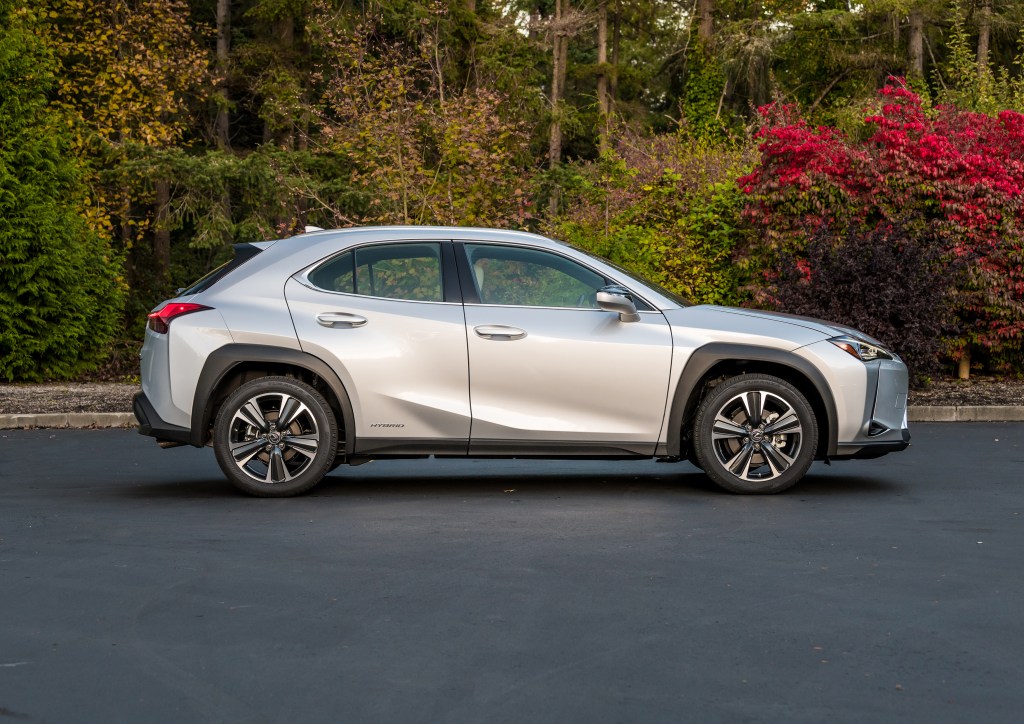
The vehicle is powered by a hybrid system that consists of a 2.0-liter inline four that is supplemented by a two-motor generator hybrid transmission—one motor serves as a generator to provide electricity that goes to the vehicle’s nickel-metal hybrid battery system (yes, NiMH) and to control engine speed while the other motor provides power to the wheels as well as performs regenerative braking. The total system horsepower is 181, which is suitable for an AWD vehicle with a 3,605-pound curb weight: You’re not going to be breaking any speed records and may not even be the first to go when the light turns green, but you’re also going to get an estimated fuel economy of 41 mpg city, 38 mpg highway and 39 mpg combined, which Lexus says makes it the most fuel-efficient crossover without a plug. (Who would have thought that Lexus would be the leader in fuel efficiency while providing a vehicle that is anything but frugal in its interior execution and amenities? This simply speaks to the proficiency that Lexus has in executing vehicles.)
Lexus UX 250h hybrid: Charm circa right now.
The vehicle “seats five.” With a moonroof the passenger volume is 88.5 cubic feet; it is 90.4 cubic feet sans. Trust me: you don’t want to be the fifth person in the vehicle regardless of the roof. The SAE cargo volume is 17.1 cubic feet: remember—this is a compact crossover, so you’re not going to be moving any fridges in it unless it is sized for a dorm room.
But the real thing about the UX is its charm. Which is something that isn’t often characteristic of vehicles nowadays. The 2020 UX 250h Luxury trim has a starting MSRP of $39,900, which makes it the most-affordable Lexus hybrid by a few hundred bucks: the NX 300h AWD starts at $40,160, and while it is a bit bigger, there is something about the UX 250h that makes it special.
If there is any company that really needs its next launch to go off well it is Mitsubishi Motors North America. The vehicle in question is the 2022 Outlander, an SUV.
For 2020 its sales were down in the U.S. by 28%–a big hit to any company—but what makes matters worse, the total number is just 87,387, or about the number of Lincoln SUVs sold in 2020 (87,893)—and let’s face it, Lincoln SUVs have better margins than the Mitsubishi models so the Mitsubishi number is less good than it might be. (Or to be more apples-to-apples, Ford sold 178,496 Escapes in 2020.)
The Outlander has a lot riding on it.
As there seems to be a growing interest in vehicles with off-road cred, Mitsubishi is in good shape given its experience in rally racing, including the Dakar. Kentaro Honda, segment chief vehicle engineer, said of the new Outlander, “We took everything we know about on- and off-road driving from the rally experiences to apply the latest Super All-Wheel Control technology in our newly developed platform. We also specifically developed a new drive mode selector to provide confident driving at all times and in all weather conditions. We hope that many customers will have great experiences with the enhanced driving performance of the all-new Outlander.”
Presumably, this means the vehicle will be off-road worthy—and yet make it simple enough for the likely intended buyer (think someone living in the snowbelt—but in the suburbs, not some mountain top) to be able to dial-in what’s needed without having had a training course at Moab.
2022 Mitsubishi Outlander to be revealed on Amazon Live February 16. But no, they won’t deliver one to your house with Prime. (Image: Mitsubishi Motors North America)
To address that demographic, the global reveal will occur on Amazon Live, Tuesday, February 16 at 6 p.m. EST.
Despite the venue, you cannot get a 2022 Outlander through Amazon Prime.
(Although I’m betting that in the not-too-distant future, Amazon will someone work its way around dealer franchise laws and. . .)






 shinymetalboxes