Polestar is a brand that you may not be familiar with at the moment. But that is likely to change, as it is dedicated to producing electric vehicles (EVs) that combine Swedish style with performance.
Polestar was established in 2017 as an independent brand by Volvo Cars and Geely Holding. (This is a little complicated because Volvo Cars in under the Geely umbrella, so the way to think about it is that it is a company that Volvo developed and that Geely is underwriting.)
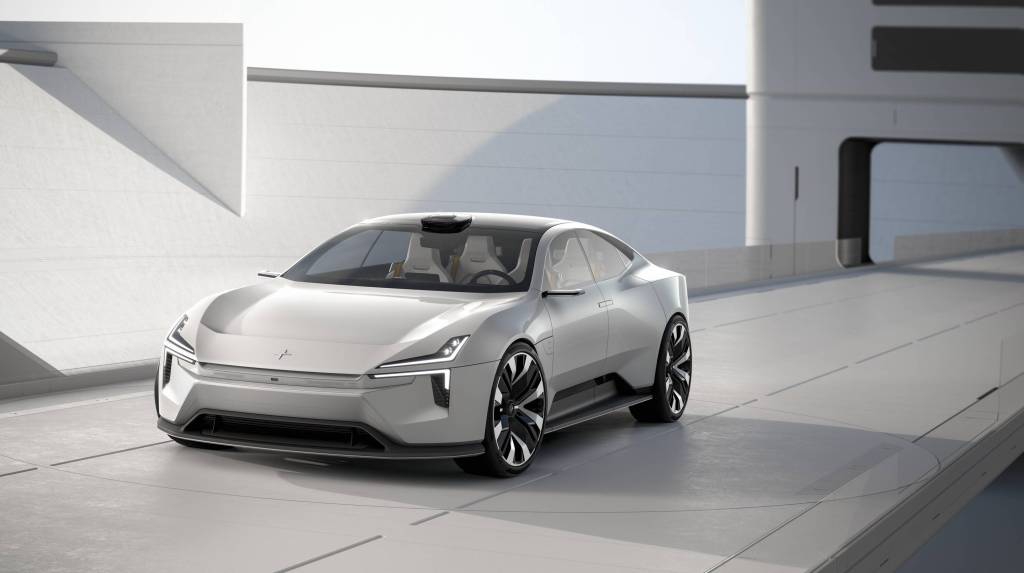
The forthcoming Polestar Precept. Stylish. Electric. (Images: Polestar)
There are presently two models, that the company has on offer, the Polestar 1, a hybrid that is exceedingly limited in production, and the Polestar 2, a 2020 model that is a high-volume sedan that offers AWD and 300 kW from the motor. There will then be the Polestar 3, an SUV, and then the Precept, a car that emphasizes three definitional aspects of the brand: sustainability, digital technology and design.
Polestar has a factory in Chengdu, China. It calls it the “Polestar Production Centre.”
Inside the Polestar factory. Yes, factory.
But there’s something interesting about what they’re doing there: operating the plant on 100% renewable electricity. Some 65% of all of the electricity powering the factory comes from hydroelectric with the balance from solar, wind and other renewables.
What’s more, there is no industrial water discharge from the plant and they are establishing a circular approach to waste handling (including carbon fiber) so as to reduce landfill demands.
The factory, designed by Norwegian architecture firm Snøhetta, has earned Gold status in the Leadership in Energy and Environmental Design (LEED) rating system, the only automobile plant in China to do so.
Said Fredrika Klarén, Head of Sustainability at Polestar, “For Polestar, sustainability is not just about the electric powertrain. It impacts everything we do. We want to promote sustainable manufacturing in China. This objective entails a relentless pursuit of circular and climate-neutral solutions, and also being a responsible employer and presence in the area.”–gsv
Alfred P. Sloan was the president, chairman and CEO of General Motors, a company that he was to come to after having been the president and owner of Hyatt Roller Bearing, which just goes to show you that even things like ball bearings can lead one to places you’d never imagine you’d go. Prior to building bearings Sloan had obtained an engineering degree from MIT, so the fact that when he was at GM he came up with an idea that changed vehicle marketing is somewhat remarkable.
That is, the accumulated portfolio that was General Motors was rationalized. The phase “a product for every purse and purpose” was the organizational approach. The “purse” portion is probably the most powerful in that line in that it led to a stair-step approach to the brand organization.
Simply put, it was about affordability and rising incomes.
One would start with a Chevy and work his or her way through to Cadillac.
Sloan figured that this approach would keep people within the GM family through their entire lives.
In this organizational approach Buick was one position below Cadillac. It offered big, comfortable sedans that were aspirational to the upper middle class. Back in the proverbial day, a model with a name like “Park Avenue” really meant that someone was (1) going places and (2) had arrived.
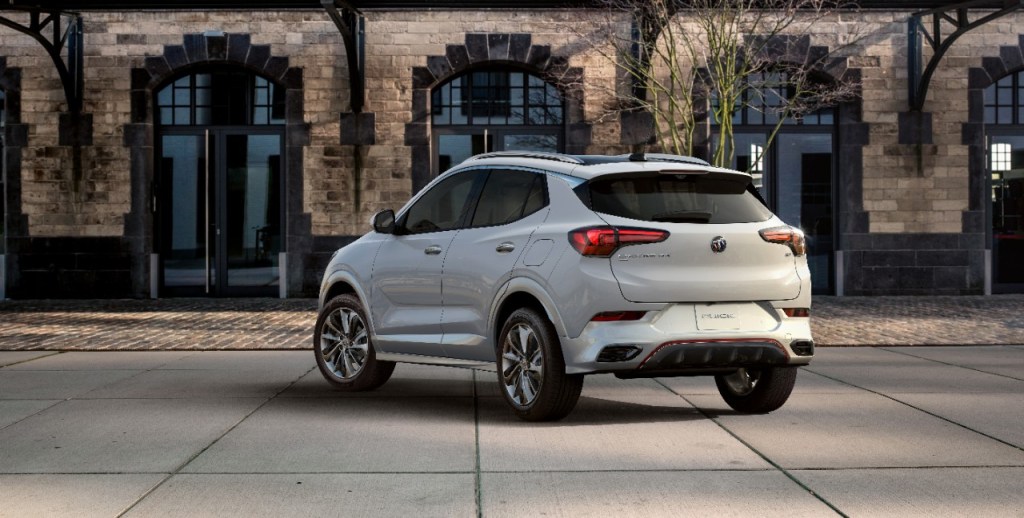
2020 Buick Encore GX. Premium small crossover with a competitive price. (Images: Buick)
Times change, and so has Buick. Whereas it was once all about plush, floaty sedans with accoutrements like seats covered with a velour-like substance and exterior bling like ventiports, it has become a brand that is all about the crossover.
Go to a Buick dealership right now and you’re faced with four vehicles, all of which are (1) crossovers and (2) begin with the letter “E.”
And these vehicles are Sloanism in action, as you start with the Encore, work up to the Encore GX, move to the Envision and arrive at the Enclave.
This all-crossover approach has a customer advantage in that it not only simplifies the shopping experience, but it allows the Buick designers and engineers to concentrate on one type of vehicle.
Focus is helpful.
What is odd about the Encore GX is that it is rather different than the Encore. This isn’t a different trim level. It is actually one of those Sloan steps within the brand.
Consider the dimensional differences between the two vehicles:
Encore GXEncore
Wheelbase 102.2 in 100.6 in
Length 171.4 in 168.4 in
Width 71.4 in 70.1 in
Height 64.1 in 65.2 in
Those are not trivial differences, especially the length and the width, as there are significant differences where it really counts: the interior.
The Encore GX offers 94.3 cubic feet of passenger room, while the Encore is at 92.8 cubic feet.
The Encore GX offers 23.5 cubic feet of cargo room behind the second row and 50.2 cubic feet if that rear seat back is folded down. The Encore is at 18.8 cubic feet behind the second row and 48.4 cubic feet max.
These are distinctively different vehicles.
(And I would argue that the fact that the Encore GX is both wider and lower made it a more attractive vehicle.)
While it shares the “Encore” with the Encore, the Encore GX is a different vehicle.
The standard powertrain for the Encore GX is a 1.2-liter turbocharged I3 that produces 137 hp; the vehicle I drove had the optional 1.3-liter turbo that produces 155 hp. It is mated to a continuously variable transmission. The vehicle as driven was FWD. Were it an AWD vehicle, then the transmission would have been a nine-speed automatic.
For a small SUV it has a lot on offer. Even with the options. . .
Convenience package (automatic parking assist with braking; wireless charging, rear camera mirror with washer; rain sensing windshield wipers)–$770
Liftgate package (hands-free power)–$520
Upgraded exterior paint–$495
Upgraded engine–$395
. . .the vehicle, including destination ($995) came in at $34,965.
On the one hand, it is a bargain. Yet on the other hand, it is a well-appointed, reasonably well handling and powered vehicle that is in a premium category.
That rear-view mirror you have in your vehicle? It was probably made by Gentex Corp., a company on the west side of Michigan that completely dominates the market
And if you have a Homelink button that is fitted within the housing of that mirror (or elsewhere, for that matter), know that Homelink is a Gentex development.
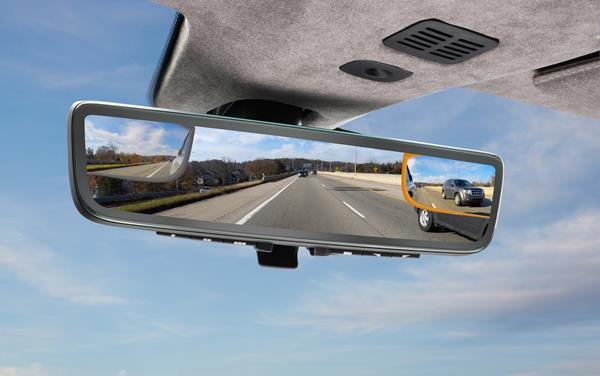
If you’ve been in a Cadillac CT6 and saw that the rear-view mirror was not just a reflective surface but through activation was transformed into a video monitor showing what is behind the car even if there happens to be members of an NBA team sitting in the backseat and consequently obstructing the view, know that that was a Gentex development.
Gentex mirror that is both a typical reflective type as well as a video screen fed by a back-mounted camera. (Image: Gentex)
The company, which started out as a provider of smoke detectors, has become an instrumental part of safe vehicle operation (if you’ve ever tried to drive without your mirrors, you know that it is a dodgy situation—at best).
One of the things that’s interesting about Gentex is that while it has expertise in glass processing (no surpsie), it has extended its range to accommodate capabilities in electronics and microelectronics, software, chemistry, sensors and more.
This, explains Neil Boehm, chief technology officer, is driving the company to develop things that go well beyond what might be expected.
For example, imagine when there are shared autonomous vehicles. Nowadays, although there is a reduced number of people who smoke (and even vaping has taken a bit of a downward turn), let’s say that there is someone in an AV—one that you might be the next in line to get—who lights up a stogie. Boehm says that they’ve taken their knowhow in the smoke detector arena and have developed a system that can be embedded in the HVAC system: Smoke is detected and—remember, there’s that electronics capability (that goes well beyond Homelink)–a message is automatically sent to the AV service provider, which then knows it may have to bring that vehicle back to the depot. And another message—possibility along with the notification of a fine—can be sent to the phone of the cigar smoker.
Boehm talks about these and other developments (e.g., electrochromatic windows; V2I toll and gas pump paying technology; nanofibers that can detect explosives [think of an AV being used as a mobile bomb—an unfortunate thing to have to consider]) on this edition of “Autoline After Hours” with “Autoline’s” John McElroy, Lindsay Brooke, editor-in-chief at SAE International, and me. Gentex is obviously a company that is leveraging its people’s imaginations as well as the developed technologies.
McElroy, Brooke and I also talk about an array of other subjects, including Microsoft’s partnership with General Motors on the Cruise AV program, whether Apple is going to get into the automobile business and what company might manufacture the vehicle, and the implications of the microchip shortage on the auto industry, which has led to the stoppage of production at plants the world over, and something that may have implications going forward for the auto industry.
Hyundai, with Bryan Herta Autosport, is going to be campaigning the new Hyundai Elantra N TCR race car in the IMSA Michelin Pilot Challenge series.
Hyundai entered the North American Touring Car racing scene in 2018, and since then it won three back-to-back TCR championships and the 2020 Manufacturers title.
Hyundai 2021 Elantra. Won the North American Car of the Year (NACTOY) award; looking to win at tracks like Daytona. (Image: Hyundai)
To mark that big win, if you look closely you can see the NACTOY badge on the hood of the Elantra N TCR vehicle, shown here at the Daytona International Speedway, flanked by Bryan Herta Autosport drivers Michael Lewis and Taylor Hagler.
The first race of the IMPC series will be held on January 29 at Daytona.–gsv
According to Duncan Aldred, vice president, Global Buick and GMC, the Buick brand has been doing an excellent job of bringing in new customers, with 72% of those opting to buy from what is now an all-crossover lineup—Enclave, Encore, Encore GX and Envision—being new to the brand.
The 2021 Envision is the launch of the second generation of the compact crossover; it is competing in what Aldred describes as “one of the industry’s most competitive segments.”
Helen Emsley, executive director, Global Buick and GMC Design, says, “The new Envision has a more athletic presence that is full of character.”
Which is sort of the thing that one would say. After all, who wants a crossover that has a couch-potato presence with an undifferentiated persona?
All-new 2021 Buick Envision, shown here in Avenir trim. (Image: Buick)
That said, the designers took what is become a familiar shape (“most competitive segments” means that one hell of a lot of vehicles of this type are being sold) and put in some nice character lines on the bodyside as well created a highly styled but not fussy front fascia that provides differentiation.
What’s more, Emsley points out that the new Envision is lower and wider than the model it replaces, and while that, again, is the sort of thing that is often said, she really means it.
The first generation Envision is 72.4 inches wide and 66.8 inches high. The new one is 74.1 inches wide and 64.6 inches high, which is a visible, and substantial, difference, making the new vehicle look much more planted than its predecessor.
The vehicle is being offered in three trims: Preferred, Essence and Avenir, with the latter being the most luxe of the three and the preceding two being offered with a Sport Touring package.
The Avenir variant brings 20-inch wheels that have a Pearl Nickel finish. The Sport Touring versions of the other trims have darkened 20 inch wheels. That is a telegraphing cue of the approach. (There are also grille differences, but let’s face it: the wheels are a clear statement.)
The Envision comes with one powertrain choice: a 228-hp, turbocharged I4 mated to a nine-speed automatic. There are both FWD and AWD.
On the inside, there is Buick’s first 10.2-inch-diagonal color touch screen because, well, this is a new model and it would be unthinkable to go with something smaller.
One dimension is probably more notable to people who are going to take their Envision on a road trip, which is that for the cargo space. If the second row is in use, then there’s 25.2 cubic feet behind it. If the second row seatback is folded, then there’s 52.7 cubic feet. Nicely utile.
Here’s a feature that seems most timely: an air ionizer that includes an “air quality indicator.” It is standard on Essence and Avenir and available on Preferred. Here’s guessing it will be more engaging for Envision drivers than the Buick-exclusive Reese’s Book Club app. Were this, say, January 2020, it would probably be just the opposite.
When Marc Lichte, head of Audi Design, unveiled the Audi e-tron GT concept at the 2018 LA Auto Show, he described it as “The most beautiful car I have ever drawn.”
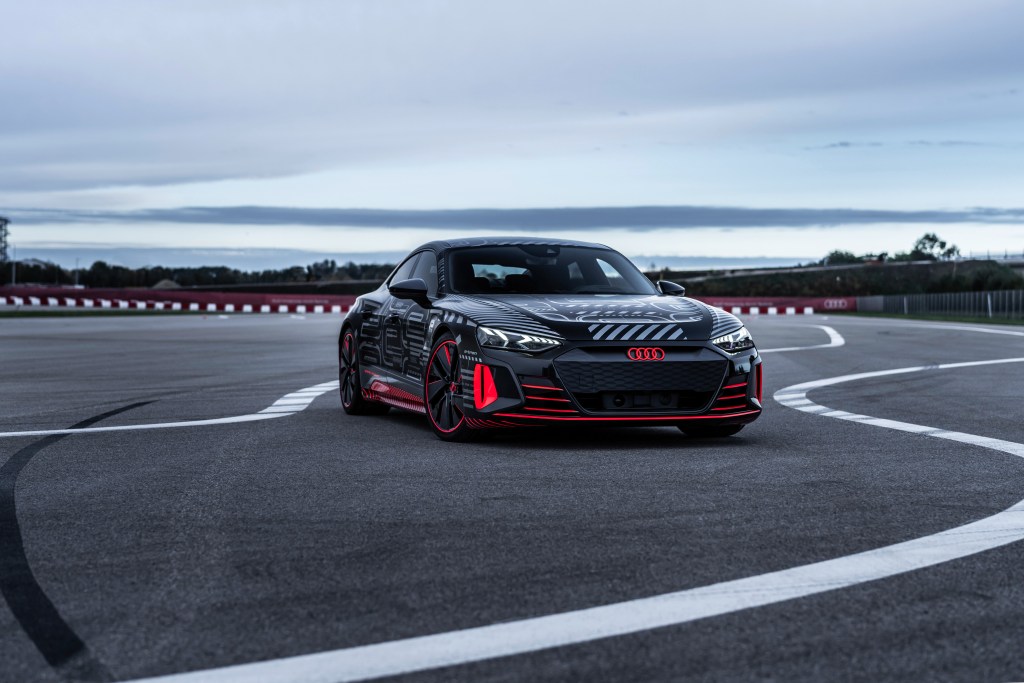
Audi RS e-tron GT prototype (Images: Audi)
Lichte even thinks that this vehicle—which will be unveiled in its production version on February 9—will become a new design icon for the brand, answering a question whether that is the case by saying, “Yes, without a doubt.” But he acknowledges, “A car must acquire this reputation on the road—in an overstimulated environment that creates the will to strive for orientation.”
Which presumably means: cars may look great in studios or on turntables at auto shows (remember auto shows?), but you’ve got to get them out in the real world where they exist in relation to other vehicles.
Lichte went on to day: “True design icons have something that is unmistakably clear: For example, it takes only three lines to characterize a VW Beetle or a Porsche 911. They stand for a clear attitude.”
Given that all of the brands are under the Volkswagen Group umbrella, Lichte is undoubtedly well aware of the vehicles like the Beetle and the 911, which are certainly good bars to work to equal or exceed.–gsv
The rumored Apple car notwithstanding, there are evident efforts being taken by OEMs to make their user interfaces large, icon-intensive and swipeable, just like a smartphone. Since Tesla rolled out with the 17-inch screen in the Model S, there has been an on-going effort to make screens big and familiar, perhaps with the most exaggerated example the 56-inch Mercedes MBUX Hyperscreen.
Whereas it was once said that a “car is a computer on wheels,” it seems to have transitioned to a “car is a smartphone on wheels.”
After all, OEMs are not only aggressively integrating apps that they can mine for data and otherwise monetize, but the ability to have over-the-air updates (OTAs) is becoming as de rigueur as standard Android Auto and Apple CarPlay.
Tamara Snow of Continental. The complexity of vehicle compute, control and communications networks shouldn’t be underestimated. (Image: Continental)
But Tamara Snow, head of Research and Advanced Engineering, North America, Continental Automotive, points out that there are some substantial differences between that high-powered processing and communications device you carry around and that high-powered processing and transportation device you have carry you around when it comes to the compute architecture and application.
Snow notes that a smartphone has:
1 microprocessor
1 display
1 operating system
7 sensors
6.1-ounce mass
And the smartphone has a top speed of 0 mph.
A vehicle has:
100 microcontrollers
4 displays
4 operating systems
100s of sensors
2.5-ton mass
The vehicle has a top speed of 155 mph.
Snow says that when it comes to a smartphone, a software glitch can be “annoying.”
But the same for a motor vehicle can be “fatal.”
Making cars–and the systems that go into them–is hard.–gsv
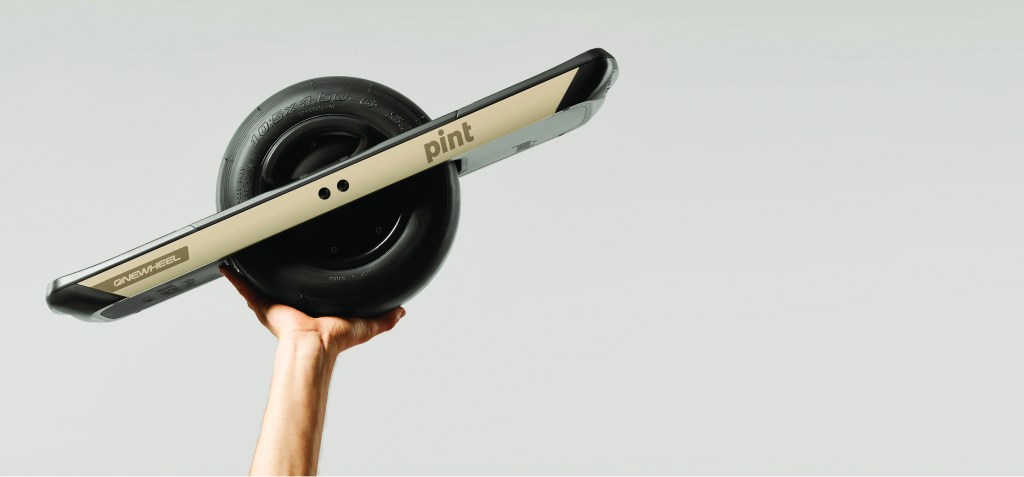
The one-wheel electric scooter market—yes, there is such a thing—is expected to undergo a compound annual growth rate of 5% between 2019 and 2027, according to research performed by Allied Market Research.
However, it is worth noting that the market was valued at $110.2-million in 2019 and is expected to grow to $146.7-million by ’27, so it is not like there are going to be huge numbers.
Of that 2019 number, $38.7-million was spent in North America, making it the biggest revenue contributor to the one-wheel market.
The Onewheel Pint from Future Motion. It is a one-wheel “board” rather than “unicycle.” The Pint reaches speeds up to 16 mph and has a range of 6 to 8 miles. It is being assembled in a plant in San Jose, California. (Image: Future Motion)
Although the research firm says growth is being driven by urban transportation needs, it anticipates that off-road use for the devices will be a major growth area, which seems a bit odd given that it also points out that the scooters are somewhat tricky to ride, requiring “well-trained” and “skilled operators,” as there are “high chances of accidents.”
There is sometimes a question of authenticity when it comes to where a vehicle is built. As in the source is considered to be better.
Once it was the case that people in the U.S. wanted a Honda Civic built in Suzuka or a Lexus RX from Kyushu.
Doesn’t it seem that Volvos ought to be built in Sweden rather than China or. . .South Carolina?
So it comes as more than a bit of surprise to learn that Rolls-Royce produced 2,946 vehicles from 1921 to 1931 in a manufacturing facility in Springfield, Massachusetts.
Made in Massachusetts: Yes, Rolls-Royce vehicles. (Image: Rolls-Royce)
Springfield. About 100 miles due west of where the Boston Tea Party was held. (Imagine.)
The hand-building operation was shuttered as a result of the Depression.
Today Rolls-Royce models are only produced at the company’s facility in Goodwood, England.
From a functional and executional standpoint, there is probably no one who is more well versed in Tesla than Sandy Munro, who established the lean design, engineering and manufacturing consultancy, Munro & Associates in 1988. The teardowns and analyses that he and his colleagues have performed on Tesla models have become the stuff of grist for the never-stopping mill that is a phenomenon since the vehicles started rolling out of the Fremont, California factory. Has there been an auto company’s products that has garnered more attention? It seems unlikely.
Obviously, once a vehicle has been completely disassembled and assessed, it isn’t the sort of thing in which it is possible to take for a ride.
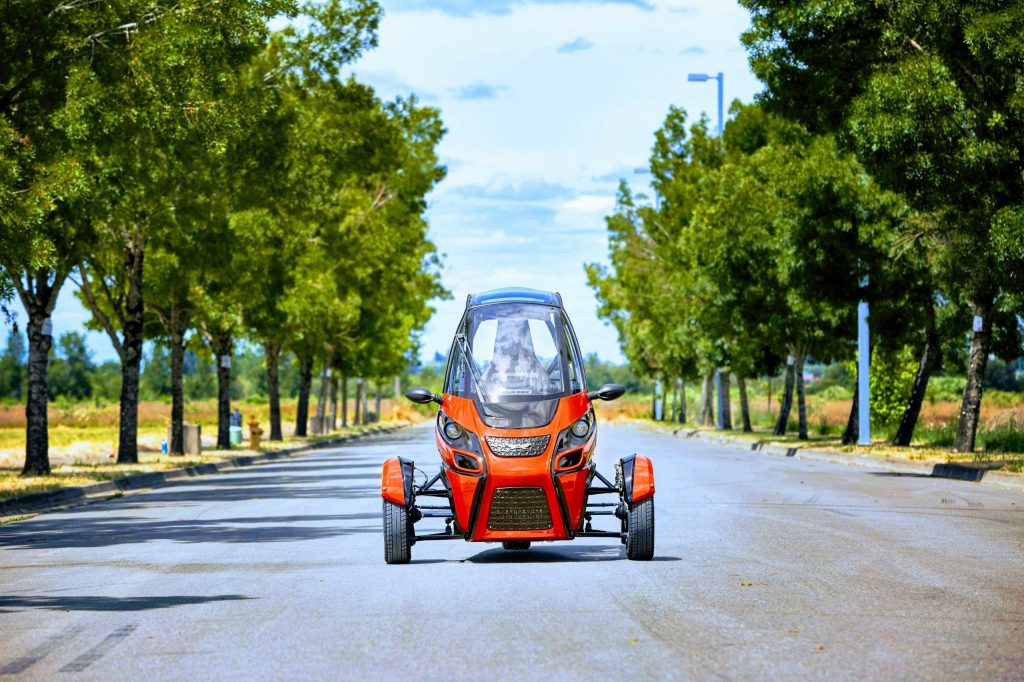
Arcimoto three-wheeler. (Image: Arcimoto)
So on this edition of “Autolline After Hours” Munro talks about how he has acquired another Model 3. . .and this time he and company president Cory Steuben are going to take it on a road trip, where they will make a determination of everything from how the battery works in the winter of the upper Midwest to the heat of the southwest to how hands-off the Tesla FSD (full-self driving computer system) actually is.
In addition to which, Munro talks to “Autoline’s” John McElroy, “Autoline’s” West Coast correspondent Chase Drum and me about what he sees as what is likely to become a growing automotive trend: three-wheel vehicles, like the products developed by Aptera Motors and Arcimoto. Munro explains that these electric vehicles are highly efficient and enjoyable to drive.
What’s more, a couple days before the show GM’s Mary Barra, in a presentation for CES, revealed a concept, the Cadillac Halo, an electric powered, four-rotor VTOL craft. Munro, who has also done extensive work on aircraft, thinks that there is likely to be a proliferation of personal aircraft for commuting.
While this might seem to be something that will be happening in the Jetson’s future, Munro anticipates such transformations in transportation in a matter of years—a few, not many.
And about that Tesla test drive: Munro says that he’ll also take the opportunity to. . .eat a lot of hamburgers.
And you can see it—the show, not the burgers—here.–gsv








 shinymetalboxes