One of the ways that Rivian hasn’t become one of those EV companies that has either gone out of business, is teetering on the edge of going out of business, or is in some weird statis that has people wondering how the heck it seems to exist, is through support of Amazon.
Back in 2019 Amazon invested $1.3 billion in the EV company and ordered 100,000 delivery vans.
And now companies of all sizes can get their own Rivian Commercial Van.
Rivian cargo vehicle: You, too, can get one for your delivery needs. (Image: Rivian)
The vehicle comes in two sizes.
The 500 measures 248.5 inches long, 114.7 inches tall, and 96.4 inches wide (with mirrors).
The 700 is 278 inches long, 114.7 inches high, and 103.5 inches wide (with mirrors).
The 500 has a cargo volume of 487 cubic feet and a payload capacity of 2,663 pounds.
The 700 has a volume of 652 cubic feet and capacity of 2,258 pounds.
The 500 has an estimated range of 161 miles.
The 700’s is 160 miles.
The starting price for the 500: $79,900.
The starting price for the 700: $83,900.
Tom Solomon, senior director, Business Development, Rivian, said:
“Amazon currently has more than 20,000 in its fleet and delivered over a billion packages from its Electric Delivery Vans in 2024 alone.”
He added: “We’re excited to now be able to open sales to fleets of all sizes in the US, whether they want one van or thousands.”
Clearly they’d be happy were a fleet to go for the latter.
Of course, business being business, one would be helpful, too.
The announcement that Hyundai and Amazon have entered into a partnership agreement which will have Hyundai models sold through the Amazon interface will have repercussions in automotive retail the likes of which have probably never been experienced before— perhaps those inflatable gorillas and floppy men had a fairly big effect, or so the traditional car-buying model might have it.
Now this doesn’t mean that the dealership model is kaput. Well, at least not in 2024, when the availability of Sonatas and Tucsons can be configured on the site.
Dealers are still part of the picture.
Customers can search on Amazon for the Hyundai of interest, configure it, and even select their method of financing. The vehicle will then go through a dealership for delivery.
And it is likely that individual dealerships will be able to establish their own storefronts on Amazon the way the purveyors of an array of products do.
A Change Is Coming. Fast.
One of the arguments that is made regarding people purchasing cars on the internet and why it isn’t going to make a difference is that people like to take test drives. People like to see the sheet metal. People like physically see what it is that they’re going to be spending tens of thousands of dollars for over a few years.
True.
But consider this: one of the things that nearly knocked out Best Buy was “showrooming”: People would go to a store to check out that big-screen TV and then go home and buy it on Amazon.
They’d, essentially, kick the tires, and then complete the transaction elsewhere. Best Buy did the work. It didn’t get the reveune.
The incredibly friendly Amazon interface will undoubtedly make it all the easier for Dealer A to promote better deals than Dealer B, so if the Dealer B is where the customer did their showrooming, then A may come out on top. While people can check on individual dealer websites to see what’s available, this setup with Amazon will undoubtedly facilitate that.
And what of the salespeople? Will any given dealership need as many going forward?
Dealership value is undoubtedly going to change profoundly—and not necessarily for the better.
Something like this was bound to happen.
And now it has.
(One of the things that must be considered vis-à-vis this partnership is that Hyundai is clearly positioned as a company that sees how the world works. People buy lots of stuff online. People want convenience. So Hyundai is facilitating that. Many other OEMs are busy perpetuating past practices despite their pronouncements about the future. Those OEMs are like Nokia. Hyundai is like Samsung.)
If there is any company that really needs its next launch to go off well it is Mitsubishi Motors North America. The vehicle in question is the 2022 Outlander, an SUV.
For 2020 its sales were down in the U.S. by 28%–a big hit to any company—but what makes matters worse, the total number is just 87,387, or about the number of Lincoln SUVs sold in 2020 (87,893)—and let’s face it, Lincoln SUVs have better margins than the Mitsubishi models so the Mitsubishi number is less good than it might be. (Or to be more apples-to-apples, Ford sold 178,496 Escapes in 2020.)
The Outlander has a lot riding on it.
As there seems to be a growing interest in vehicles with off-road cred, Mitsubishi is in good shape given its experience in rally racing, including the Dakar. Kentaro Honda, segment chief vehicle engineer, said of the new Outlander, “We took everything we know about on- and off-road driving from the rally experiences to apply the latest Super All-Wheel Control technology in our newly developed platform. We also specifically developed a new drive mode selector to provide confident driving at all times and in all weather conditions. We hope that many customers will have great experiences with the enhanced driving performance of the all-new Outlander.”
Presumably, this means the vehicle will be off-road worthy—and yet make it simple enough for the likely intended buyer (think someone living in the snowbelt—but in the suburbs, not some mountain top) to be able to dial-in what’s needed without having had a training course at Moab.
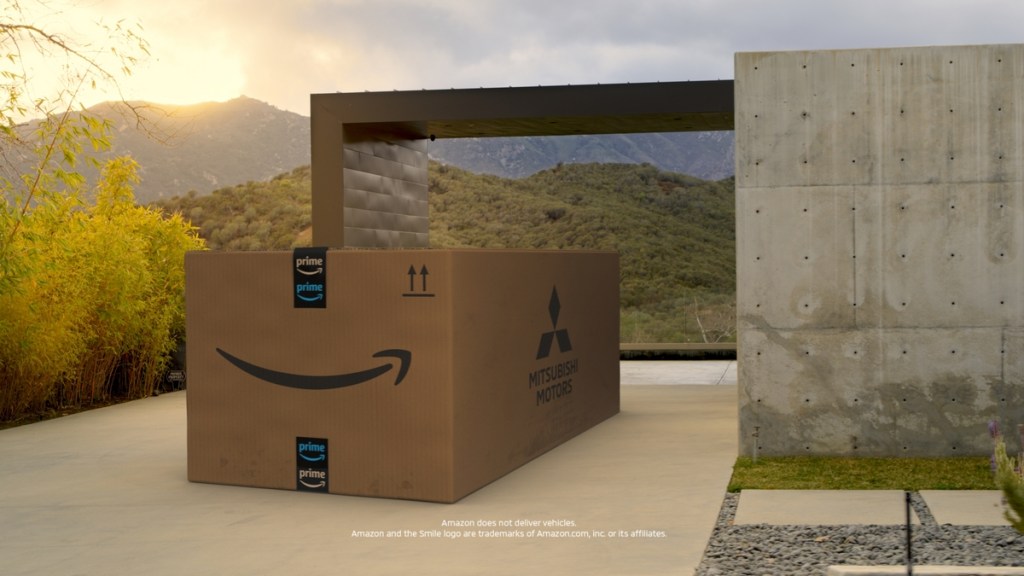
2022 Mitsubishi Outlander to be revealed on Amazon Live February 16. But no, they won’t deliver one to your house with Prime. (Image: Mitsubishi Motors North America)
To address that demographic, the global reveal will occur on Amazon Live, Tuesday, February 16 at 6 p.m. EST.
Despite the venue, you cannot get a 2022 Outlander through Amazon Prime.
(Although I’m betting that in the not-too-distant future, Amazon will someone work its way around dealer franchise laws and. . .)
The Cadillac LYRIQ, which is to become available in the first half of 2022, certainly looks promising as an electric, luxury SUV, one that may help the brand, which, let’s face it, has been struggling in the market for the past few years—here’s something that is not well known: although Acura is generally considered to be having a tough time of it in the U.S. market, in 2020 it outsold Cadillac, 136,983 vehicles to 129,495 vehicles; Acura also outsold Cadillac in 2019.
The Cadillac CELESTIQ, an electric sedan that takes luxury to levels that Cadillac hasn’t had on offer for, arguably, ever, combining hand-crafted materials with technology, such as a four-quadrant glass roof that allows individual selection of the level of transparency, is another arrow in the quiver of a transforming brand. Although it is still a concept vehicle, it is unlikely that General Motors would draw as much attention to it as it has (it was part of Mary Barra’s CES 2021 keynote) were it—or something damn close to it—not going into production.
That said, even though General Motors is investing $27-billion in vehicle electrification and automation, the most important launch, revealed during Barra’s presentation, is of a vehicle that none of us will individually own:
The EV600, an all-electric, purpose-built light commercial vehicle.
The LYRIQ and the CELESTIQ may be sexy, but logistics is where it is at and will drive the proliferation of electric vehicles in a way that it will take the consumer market a long time to catch up to.
The GM EV600, a purpose-built electric delivery van. The company has even started a logistics support business, BrightDrop. (Image: GM)
The owners of fleets of commercial vehicles—like FedEx, which GM worked with on the development of the EV600 (and the EP1, an electric rectangle on wheels that has a capacity of 200 pounds and a top speed of 3 mph)—do the math when it comes to vehicle acquisition. If it is going to be to their financial advantage to get EVs, then they’re not going to worry about things like available infrastructure, because they’ll build their own. They’re not going to have range anxiety, because they know precisely where their trucks are going and when.
(And it probably doesn’t hurt that it provides a green sheen to their brands by going EV.)
Consider:
–Amazon, which owns a piece of it, is having Rivian build electric delivery vans that are to be on the road next year at a number of about 10,000, perhaps going to 100,000 by 2030.
–Ford has announced the 2022 E-Transit delivery van that is going to be available later this year, and emphasized the benefits of the electric propulsion system vs. its own internal combustion offerings (with the scheduled maintenance of the E-Transit being an estimated 40% less over eight years/100,000 miles).
–And there are start-ups like Arrival, which companies including Hyundai and UPS have invested in.
Sure, we pay attention to LYRIQs and CELESTIQs.
But consider this: in an industry that seems to be shedding operations, General Motors has established a new business, BrightDrop, that is dedicated to delivery, not only vehicles like the EV600 and EP1, but even logistical software services.
This is a non-trivial commitment—and likely to be a prosperous one, as Mary Barra and her colleagues know that commercial companies do the math and need a whole lot less persuading to go electric.–gsv



 shinymetalboxes