Who doesn’t like predictions? Especially after the year we’ve all just been through.
So here are six from Kayla Reynolds, Industry Intelligence Analyst at Cox Automotive, regarding the vehicle market in the U.S.
Things won’t return to “normal” in 2021, even with the vaccines rolling out. Seems that social distancing and mask-wearing are going to become the way of the life. Comment: Well, at least in some geographies and demographics. Depending on where you live, you might want to bring some Clorox wipes should you be taking a test drive anytime soon.
The auto industry will emerge stronger from the pandemic. Reynolds said that dealers anticipate improved profits on lower volumes. Comment: Odds are you’re not going to be seeing as many giant inflatable animals in front of dealerships because there is evidently lots of demand.
Inventory will remain tight through the year. New and used vehicles are both in shorter supply—by a lot. Comment: Unless it is really something no one wants, deals are going to be few and far in between. Better get ready to spend that stimulus check.
This year will be a tipping point for digital retailing. Consumers discovered that they could spend lots of time on line in preparing to buy, which meant less time being in a showroom, which was a good thing with a raging pandemic. Comment: No, Amazon Prime isn’t going to deliver your new set of wheels this year.
New competition will slow Tesla’s growth. Reynolds said, “We’ve said this before, but we mean it this time.” Comment: The fact that Tesla is the only company to get its own prediction says a lot about that brand. Yes, at some point Tesla sales are likely to suffer. Some point.
Vehicle ownership increases as ride-sharing and ride-hailing decrease. This is predicated on the first prediction, a consequence of the pandemic. Comment: According to the TSA, there were 1,574,228 air travelers processed on March 28, 2021. On February 28, 2021, there were 1,190,682 passengers processed. That is a 25% increase in a month. How long until people are fine climbing into Lyfts and Ubers? Probably a lot sooner than the Cox prognosticators think.
Were it not for things like blizzards, probably even better
Although it seems that new vehicle sales are an unstoppable force now that more people have become bored with COVID been vaccinated, according to Cox Automotive, in February there were 2.82-million cars, trucks and utilities on dealer lots—and in January that number was 2.79-million.
Turns out that things like winter storms not only knock out power grids but keep people from showrooms.
While 2.82-million may seem like a lot, back in normal times (remember those), the number was bigger: a year ago it was 3.41-million.
That’s for new. What about used?
Well, that part of the business is evidently better. There was an unsold supply of 2.59-million units on lots at the end of February. The number was 2.66-million in January, or a 70-million-unit difference.
And the difference between now and last year is notable: 12%. There were 2.97-million used vehicles ready to go in February 2020.
Still, whether it is one of the 2.82-million or 2.59-million, there is probably a vehicle that could have your name on it.–gsv
Tesla signifies more than an electric vehicle. . .
“Many consumers perceive Tesla as a leading-edge, high tech, environmentally progressive brand driven by a charismatic leader who not only builds cars and crossovers, but also sends rockets into space and is a global industrial visionary. That combination is hard to beat and has gotten the attention of the entire global auto industry.” –Tom Libby, associate director, automotive industry analysis, IHS Markit
Here’s something to consider: there are about 880 Mercedes dealerships in the U.S.—and just some 130 Tesla outlets (Image: IHS Markit)
And it isn’t whether or not there’s free coffee at the dealership
“The future of Volvo Cars is defined by three pillars: electric, online and growth. We want to offer our customers peace of mind and a care-free way of having a Volvo, by taking away complexity while getting and driving the car. Simplification and convenience are key to everything we do.” That’s Lex Kerssemakers, head of global commercial operations, for Volvo Cars.
Volvo announced it will be all-electric by 2030. And that it is launching a line of electric vehicles that will be available online only.
This doesn’t mean that Volvo dealers are going to be looking for something else to do come 2030.
It does mean, however, that there will be some offerings tailored to the ever-increasing number of people who can’t figure why you need to go to a special place to buy something when they have a perfectly good digital device at hand.
“Online and off-line need to be fully and seamlessly integrated. Wherever the customer is in their journey – online, in a showroom, in a Volvo Studio, or driving the car – the customer experience needs to be top-notch,” Kerssemakers added.
How is this going to work for people who don’t have jobs or the ones they have don’t pay a whole lot?
According to the most-recent information from the Bureau of Labor Statistics, the unemployment rate in January 2021 fell by 0.4%, to 6.3%. The bureau reported, “notable job gains in professional and business services and in both public and private education were offset by losses in leisure and hospitality, in retail trade, in health care, and in transportation and warehousing.”
The categories that grew are undoubtedly those with higher-wage earners while those who have lost their jobs—the wait staff, department store workers—but healthcare?
Those who have a job are going to be paying more for a vehicle: Kelley Blue Book has calculated that the average transaction price for a light vehicle in January was $40,857. That’s right: nearly $41,000. In December 2020 it was actually above that: $41,152.
Admittedly, when you’re talking averages, number extremes can skew the results.
In the case of the January figures, high-performance cars came in at $104,929 and high-end luxury cars at $102,057.
On the other end, there is the subcompact car at $18,783.
And that’s the only vehicle that had an average transaction car under $20,000.
As more and more OEMs stop producing cars in any variety in order to concentrate on crossovers (subcompact SUV/crossover: $26,368), they are clearly leaving some potential customers behind.–gsv
Auto sales plummeted by one-third in the second quarter of last year, according to S&P Global Market Intelligence, and at the time it felt the like tip of disaster for the car business. The global pandemic stifled demand as the supply side was strangled by shuttered factories and parts and components that couldn’t be shipped to automakers.
General Motors had to shut its Chevrolet Corvette assembly plant for several weeks, but this turned out to be more a supply problem for the automaker than a demand problem, as consumers on the $60,000-plus end of the sports car market generally weren’t the people losing jobs and income.
This gets to a drum I’ve been beating for years. The idea of building brand-new cars and light trucks for working class and middle-class Americans, the very model incubated by the Curved-Dash Oldsmobile and brought to life by the automated assembly lines of Henry Ford’s Model T, the car that put America on wheels, is over.
Latest proof is the comeback of new vehicle sales from those dark days at the end of the first quarter in 2020 and through the second quarter, into much healthier third and fourth quarters. Calendar year 2020 vehicle sales in the U.S. dropped 14.4% from 2019, to 14,645,049 cars and light trucks says Automotive News, but that’s far better than anyone expected from that second quarter drop.
Even with a pandemic that most economists say created our most severe economic crisis since the Great Depression 90 years ago, the 14.6-million sales number is far more palatable to the industry than the 2008-2009 Great Recession, when sales dipped below 11 million at its nadir. With the current pandemic, the auto industry mirrors the economy in general, in which college-educated professionals, management and executive-level employees and their employers spend their workdays in home offices, seeing their colleagues and clients on Zoom rather than in person.
Presently, of Americans who can work at home, unemployment is 3.9%, but for those who have to report to a work site, the rate is 8.9%, KMPG chief economist Constance Hunter told The Washington Post. (Jan. 28, 2021).
About the same time that auto sales fell by one-third, the April 2020 U.S. unemployment rate reached 14.8%. By December 2020, auto sales climbed to near-pre-pandemic levels, but the U.S. unemployment rate was still high at 6.7%, compared with just 3.5% for January and February 2020, according to tradingeconomics.com. The rate for Black and Hispanic Americans is significantly higher, and the Congressional Research Service singles out heavy job loss in the leisure, hospitality industry and restaurants. Your favorite waiter or waitress at the local Olive Garden isn’t shopping for a new Kia, let alone a new Cadillac these days.
Meanwhile, tech barons and big-time investors in tech stocks like Amazon, Facebook and Apple are buying new cars, if the strength of the luxury market is any guide.
In its sales report issued the first week in January, General Motors boasts the all-new 2021 Cadillac Escalade that launched in the middle of the ’20 calendar year—when shutdowns and job losses were growing–“retook market leadership” in the fourth quarter, meaning it began to outsell the Lincoln Navigator again. And here’s the kicker: GM noted that 43% of the new Escalades have “a transaction price of more than $100,000.”
Clearly it was more supply problem and less demand accounting for the 14.4% dip for the year which included phase-out sales of the last of the old model as well as the new, ’21 ‘Slade. Before the pandemic, the average new car transaction price hovered around $38,000, already up significantly from the low-$30s earlier in the ‘10s. The current average is now $40,573, according to Edmunds. Meanwhile, the U.S. Census Bureau estimates the median household income was $68703 (latest figures). Yikes.
BMW was one of the few leading luxury marques that suffered a sales drop worse than the industry average in 2020, of 17.5%. Archrival Mercedes-Benz also had a sales decline, 8.9%, but that was better than the overall industry 14.4% decrease. Tesla was up 20.3%. Jaguar sales dropped 29.8% to 18,586 vehicles; its sister brand, Land Rover was down just—comparatively speaking–15.5%, to 80,034.
The boom in the SUV and truck market plays a big role in making luxury items of brand-new vehicles, even among the commodity brands. Small sedans and hatchbacks that many brands have cut from their lineups in the last few years were entry-level models. Small sport/utilities and crossovers generally are priced a size category up from their sedan counterparts. One surviving commodity compact sedan, the 2021 Honda Civic LX, starts at $22,425 (including destination charge), while the CR-V LX, a compact SUV sharing many of the Civic’s bits, starts at $26,525, and that’s with front-wheel-drive. Good luck finding a FWD compact SUV of virtually any brand on a dealer’s lot in the north. If you want an AWD CR-V, you must move up to the EX trim level, and that starts at $29,035 before adding floor mats, $6,610 more than the Civic LX sedan.
Toyota’s CR-V rival is the RAV4, America’s bestselling vehicle after full-size Ford, Chevy and Ram pickup trucks. Last year’s RAV4 sales were down just 3.9% to 430,387. Toyota’s luxury division undoubtedly more than made up for that dip with much higher profit margins on the 2,574-unit increase in Lexus GXes sold last year, up 9.9% to 28,519, a sport-utility that starts at $54,275. The Lexus GX was the only model among Toyota’s two North American-market brands to post a sales increase last year. The full Lexus lineup is off just 7.7%, compared with the Toyota brand’s 11.9% drop.
So what’s the average Joe to do? There’s always the used market, but even that is become a bit rich. According to Edmunds, in Q4 2020 the average monthly payment for a used car was $ 437, and that for a 68.1-month loan.—Todd Lassa
According to Automotive News, for 2020 there were 14,645,049 light vehicles sold. This is down 14.4% compared with the total number for 2019, 17,104,792. Which is to say that while COVID-19 had an impact on overall sales, it wasn’t as substantial as it had been feared to be.
China, too, was affected by the pandemic. And its sales were affected, as well.
That said, numbers for the first 11 months of 2020 have it, according to LMC Automotive, that there were 21.64 million light vehicles sold in China. About a third more than U.S. sales.
And there is still an additional month to go in the Chinese market.
In November there were 2,710,957 vehicles delivered in China. So if that number was repeated in December, that would be a total of 24.35 million units, or nearly 10 million more than were sold in the U.S.
One thing that is interesting about the China market is that the top-selling brands are probably not what you’d expect.
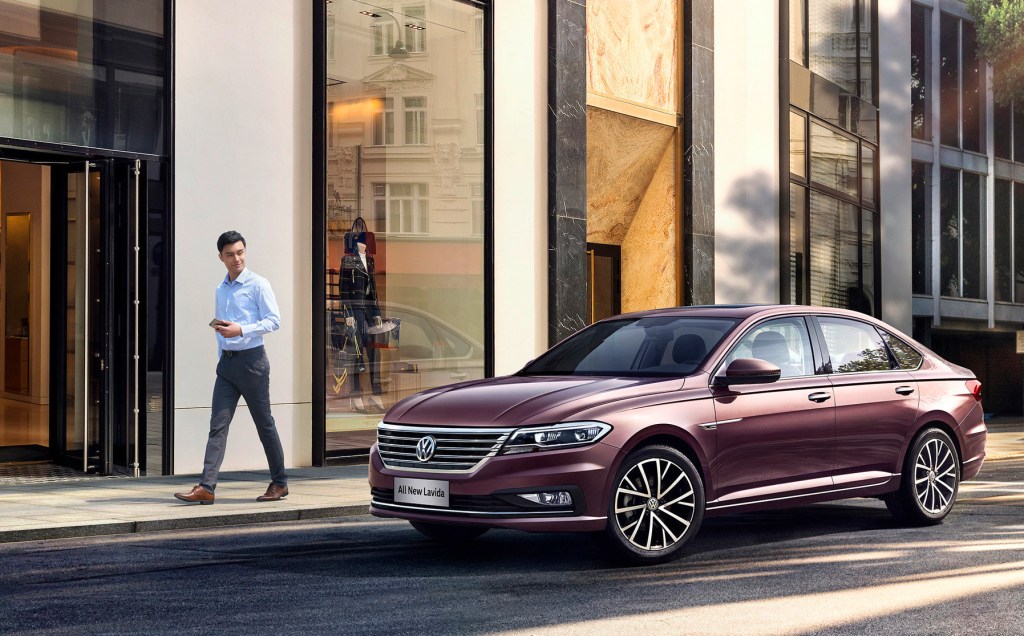
Volkswagen Lavida–number-one in China. (Image: Volkswagen)
The number-one brand in terms of sales and production is Volkswagen. What’s more, the top-selling vehicle is the Volkswagen Lavida, a Passat-like sedan that is available only in China. The car was the best-selling model in China in 2019, and even the folks at Volkswagen acknowledge, “but hardly anyone in Germany has ever heard of it.”–gsv



 shinymetalboxes