One is making money. One is making progress. Slight progress.
By Gary S. Vasilash
In her Q2 2024 earnings letter to shareholders released yesterday, GM CEO listed the “four key drivers” of the company’s performance—and that performance includes record revenue in both Q1 and Q2—and it is interesting what the first item on the list of four is:
In North America, we have a consistently high performing portfolio of ICE trucks and SUVs on a volume, share and margin basis.
Now because the company is in the process of spending billions of dollars on EV technology, the second point on the list goes to EVs, although it doesn’t exactly sound robust:
Our EV portfolio is scaling well, and we’re encouraged by the early sales results, including record second-quarter deliveries and improving market share.
To put some data to that “scaling well,” in Q2 the company delivered:
7,294 Cadillac LYRIQs
6,634 Blazer EVs
1,374 Bolt EV/Bolt EUVs
1,013 Equinox EVs
2,196 Silverado EVs
2,926 HUMMER EVs
and to throw in for good measure a commercial product:
490 BrightDrop Zevo 400/600s
That is a total of 21,927 EVs sold in Q2.
Yes, there are increases in numbers.
The GMC HUMMER EV SUV (Image: GMC)
The LYRIQ was at 1,348 units in Q2 2023. And the HUMMER was at a mere 47 in Q2 2023.
But to put things into some context: the Chevrolet Malibu, which is going out of production later this year, had Q2 2024 deliveries of 36,360 units, or 14,433 more than all the EVs combined.
And isn’t the accepted wisdom that “Nobody buys sedans anymore?”
If we look at ICE truck or SUV numbers. . . well at this point it isn’t even a fair comparison.
But Barra goes on to write:
“To unleash the next cycle of EV growth, we’re scaling production of the Chevrolet Equinox EV. . . . Then over the next several months, GMC will launch the Sierra EV and the Cadillac LYRIQ will be joined by the OPTIQ, Escalade IQ and CELESTIQ.”
On the one hand, this is completely understandable for at least a couple reasons.
For one, there are those billions spent on getting capacity, so they need to use it.
For another, regulations are going to require the sale of more EVs, especially to offset the sales of things like trucks and large SUVs (e.g., in Q2 there were 151,112 Silverados sold).
That said, one wonders: Given the increasing popularity of hybrids, why is there no discussion of that in the forthcoming product portfolio?
Porsche Cars North America reported its sales for the first half of 2024, including, of course, the second quarter.
And in Q2 the sales of the 911 being nothing short of impressive.
Porsche 911 Turbo S (Image: Porsche)
That is, for the year it has delivered 6,720 911s, of which 4,790, or about 71%, were delivered in Q2.
Which means that in Q1 dealers had a bit of time on their hands as there were 1,930 911s delivered.
OK. They had other vehicles to sell, but still that number of 911s is notable.
The best-selling Porsche in the U.S. during the first half of 2024?
The Macan, at 12,004 vehicles (though that is down from the 14,306 sold in H1 2023).
Second best-selling?
The Cayenne, at 10,168 vehicles (which is up from the 8,911 in H1 2023).
Together, those two SUV models, with a combined 22,172 vehicles, are some 64% of Porsche’s total 34,733 delivered in H1 2024.
Which sort of begs the question of when there is going to be a Corvette SUV. After all, the car can be an alternative to a 911, but it is highly unlikely that anyone is going to cross-shop a Chevy Equinox or Traverse with a Porsche SUV.
Isn’t this a case of the proverbial “money left on the table”?
While you’ve undoubtedly heard about some of the people in the European Union (EU) being rather agitated by Chinese electric vehicles showing up on the streets of Rome and Paris and elsewhere, French research firm Inovev provides some interesting statistics regarding those vehicles.
Notably, within the EU, the United Kingdom, Switzerland, and Norway, during the first quarter of 2024 Chinese EVs accounted for 8.5% of all the EVs sold during that period—approximately 50,000 out of 594,000 EVs.
But then there’s more.
For example, taking into account “European models imported from China”—as in Smart (a joint venture between Mercedes and Geely) and Dacia (part of Renault)—that 8.5% share grows to about 11%.
Then there are vehicles that are built in China by non-Chinese brands that are brought in, like the BMW iX3 and the Tesla Model 3.
Add them into the mix and the number rises to 17%.
And while some might think that European exports to China might offset some of this, Inovev, using Germany as an example, points out that German vehicle exports to China peaked in 2018 and have been declining since.
Part of this is because German brands are building vehicles in China that are sold there so there is no need to export.
But then there is this observation, which ought to make people in Wolfsburg, Stuttgart and Munich nervous: “Chinese customers are increasingly moving towards Chinese brand cars and are gradually losing interest in imported foreign cars, especially with the development of the BEV market.”
While “ICE vehicle” sales may decline, this doesn’t mean the number of engines necessarily is going down
By Gary S. Vasilash
It seems that when people think about types of vehicles there are:
Electric vehicles
Hybrid vehicles
Plug-in hybrid vehicles
ICE vehicles
The categorization seems to overlook one big thing:
With the exception of the EVs, all of the other types include an internal combustion engine.
So when you hear that hybrids are up, this means ICE vehicles are up.
In providing his assessment of the vehicle market in Western Europe, Matthias Schmidt noted:
“12-month trailing data shows that new models featuring an internal combustion engine under the bonnet, be that a pure ICE petrol or diesel model, a mild (MHEV) or full (HEV) hybrid, or plug-in hybrid (PHEV), saw their combined share of the new car market rise upwards once again.”
He also pointed out that EVs have been losing their spark in the Western European market, with, through May, three months of decline in a row.
According to Schmidt, “the most recent 12-month period data shows that between June 2023 and May 2024, the number of BEVs fell back to 1.97 million new units compared to 9.8 million other models.”
So my neighbor, a guy in is mid-20s said: “I really like that car a lot. I quite nearly bought one.”
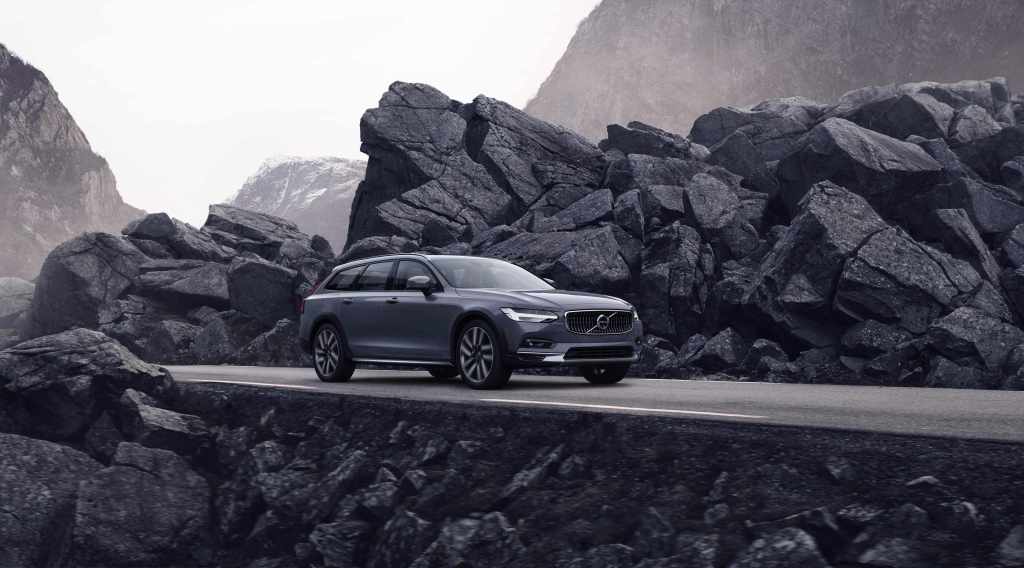
He was talking about the 2024 Volvo V90 Cross Country B6 AWD.
Volvo V90 Cross Country. OK. Maybe this doesn’t look like your neighborhood. But it takes a good-looking vehicle to hold its own with that impressive setting. (Image: Volvo)
Which is surprising for two reasons:
He is in his mid-20s
The car in question is a station wagon
He said that not only does he like the styling of the Volvo, but he’d taken one for a spin and thought it drove well.
To fill out this little vignette, know that he bought an Alfa Romeo Giula sedan instead.
He had had another Giulia, a Quadrifoglio, that he’d leased. He purchased the one now in his driveway.
He said he bought the Alfa because he likes the way it handles.
It is worth noting that in the first quarter of 2024 Alfa sold 640 Giulas in the U.S., so perhaps my neighbor is something of an outlier.
Style vs. Utility
The station wagon body style—more puzzling referred to in other markets as a “shooting brake” (not that “station wagon” isn’t odd: the “wagon” bit makes sense because it can carry goods, but the “station” part seems to indicate that it is something that is static, like a train station—has gone out of favor for the sport utility vehicle.
In part, this goes to the notion that the sport utility vehicle configuration provides utility. Presumably that means the ability to contain a lot of stuff, whether it is golf clubs or hockey gear, suitcases or Costco-sized personal paper items.
The V90 Cross Country provides 25.2 cubic feet of cargo capacity with the second-row seat back up and 69 cubic feet if that is folded down.
So let’s say someone opts for a Jeep Grand Cherokee. Let’s face it: that vehicle is the absolute poster child for an SUV with comfort and style. The Jeep, of course, has four-wheel drive, which makes it incredibly capable when the pavement has given way to an undeveloped surface.
The Volvo has all-wheel drive, which means that it is configured to handle things like snow (after all, Volvo HQ is in Sweden, so they know more than a little something about that).
For what most people are likely to encounter in their driving, AWD is the ticket.
Anyway. . .the Grand Cherokee offers 37.7 cubic feet behind the second row, which is significantly greater than what the Volvo provides, but the Grand Cherokee has 70.8 cubic feet of space with the second row back folded, so it is pretty much a wash.
The V90 Cross Country is longer than the Grand Cherokee—195.2 inches vs. 193.5 inches—but with mirrors folded narrower—74 inches vs. 77.5 inches—and a lot lower: a height of 60.5 inches vs. 70.8 inches. All of which is to say that doing a bit of geometry explains the differences in capacity.
Looks Right. Drives Right.
But let’s get back to my neighbor.
He said he finds the styling of the Volvo appealing, which goes to show that the company has gone a long way from when it seemed as though the designers were kitted with a T-square and right-triangle. It could also go to the point that it very well may be that given the endless proliferation of SUVs and crossovers there may be a small-but-growing group of people who are looking for alternatives.
Yes, he didn’t buy the Volvo, but he did buy a sedan.
Also, he said that he thought the Cross Country handled well. Presumably this has something to do with the vehicle having a lower center of gravity than, say, an SUV.
The Volvo is a mild hybrid. Which means that there is, in addition to the regular 12-Volt battery, a 48-Volt battery that recovers some of the energy produced by braking and stores it until it is used when it works through an integrated starter-generator to provide assistance when starting from a stop.
The vehicle has a 2-liter turbocharged four-cylinder engine. It is mated to an eight-speed automatic. There are 295 hp and 310 lb-ft of torque. All of which is to say that it comports itself as you would expect something like a station wagon to. What’s more, it has a maximum towing capacity of 3,500 pounds. Combined fuel economy is 25 mpg.
Volvo has gone all-in with Google, so there are Google Maps, Google Assistant and Google Play. (Yes, it does support CarPlay.)
Will the Era End?
Swinging back to the Giulia, as previously mentioned, there weren’t a whole lot sold in the U.S. in Q1 2024.
But there were fewer V90 Cross Country models sold during that same period: 164.
At some point, perhaps, more people are going to want to get something that they don’t see in every other driveway on their block. On mine there is an array of F-150s.
And a Giulia.
But I suspect that car makers—Alfa and Volvo alike—are going to have to phase out things that are not gaining traction.
Ever wonder why Western governments are concerned about their domestic auto manufacturers?
By Gary S. Vasilash
The U.S. is applying big tariffs on electric vehicles from China (as in 100%), and the European Union, moderately big (38%). (Apparently the Chinese are doing a bit of retaliation, as it has opened an investigation into pork products exported from the EU.)
Some numbers from GlobalData provide a sense of the sort of numbers associated with Chinese vehicle manufacture that are concerning to those in the U.S. and Europe.
Looking at sales of passenger vehicles in China from January to through April, there was an increase of 5.5% year-over-year to 6.3 million units.
But the red flag is this number: a rise in production by 9%, or 7.6 million units.
Simply: 1.3 million more passenger vehicles made than sold.
This means overcapacity. Which also means that companies are probably interested in finding markets where they can offload those excess vehicles.
And while the 7.6 million number is all passenger vehicles, not just those with batteries in addition to the 12-V battery under the hood, in April there were 424,0000 vehicles exported from China, a year-over-year increase of 36.9%.
And those joint ventures. . .
Once, Western brands were almost giddy when it came to the opportunity to create joint ventures in China with Chinese companies. The market size was (and is) nothing short of amazing.
GlobalData finds that when it comes to NEVs—or “New Energy Vehicles,” which are the hybrids and full EVs—the penetration rate of Chinese local brands was close to 60% of the market, up 7% from the same period last year, while the joint venture brands have a penetration rate of 12%–still up from last year’s number. But only 1%.
So one can expect the Chinese OEMs that produce NEVs to up the production of those vehicles, which will undoubtedly lead to overcapacity there, too, which means they’ll have to do something to do with those vehicles.
When you think of the quintessential full-size pickup truck, the sort of thing that you imagine farmers loading with bales or hay or contractors carrying loads of gravel, it is probably the Ford F-Series.
With good reason, given Ford sells those trucks the way McDonald’s sells hamburgers. The numbers are staggering.
But odds are, those images of the F-Series are probably not entirely accurate.
BMW 5 Series. Or you could consider a pickup truck. (Image: BMW)
Listen to Erin Keating, executive analyst for Cox Automotive, talking about vehicle transaction prices in May.
First she notes: “The popularity of fully loaded, full-size pickup trucks that are more luxurious than many luxury vehicles is unique to the U.S. market.”
Which can be understood that (1) there aren’t a lot of full-size pickup trucks sold in other markets around the world* and (2) those trucks are probably used as utility vehicles (e.g., the opening examples).
Keating does on: “The Ford F-Series outsold BMW 2-to-1 in May, and BMW’s ATP [average transaction price] was only marginally higher than the F-Series.”
Whereas the average transaction price for a BMW in May was $72,946, the ATP for an F-Series was $67,837.
Now that’s about a five-grand difference, which isn’t exactly trivial.
But somehow a Bimmer seems as though it is in another category all together compared with something that you probably once saw with a decal of Calvin relieving himself on a Chevy bowtie on the back window of the truck.
Of course, not a $68,000 truck, but nonetheless. . . .
//
*That full-size pickups are pretty much indigenous to the U.S. market is something that makes the development of EV versions of the trucks somewhat problematic in the long run. That is, on a global basis something like the Ford Mustang Mach-E has more applicability than an F-150 Lightning. While it seems to have been thought by some OEM execs that because customers in the U.S. buy lots and lots of trucks, then if a somewhat sizable percentage of them buy electric versions then everything will be great. For reasons including cost and/or performance, that is not proving to be the case. This means that scale isn’t being achieved, and if there is something that is necessary for an OEM, it’s that. So by spending lots of engineering and manufacturing resources on making a type of vehicle that has a limited domestic market and a nearly non-existent global market, achieving scale is anywhere is not particularly likely.
Although the number of vehicles sold in a given month in the UK isn’t particularly large, from a percentage standpoint there are undoubtedly some people at US OEMs who wish they’d have the kind of EV registration numbers that exist in the UK:
According to the Society of Motor Manufacturers and Traders (SMMT), in May EVs have 17.6% of the market.
While the whole market was up 1.7% in May, SMMT figures show that EV sales were up 6.2%. Clearly, EVs in the UK are doing rather well.
Do British consumers know something that American consumers don’t?
Well, maybe not.
Turns out that consumer retail EV sales were actually down 2%.
The uptick in the EV market came from fleets.
In the UK there is something called the “Vehicle Emissions Trading Scheme” that mandates zero-emissions vehicles represent 22% of a manufacturers’ annual sales.
Apparently there are incentives available to businesses for getting EVs that are not open to consumers. The SMMT believes that it is necessary for “the next government to provide consumers with meaningful purchase incentives.”
Conservative leader Rishi Sunak, current UK prime minister, will square off against Labour leader Keir Starmer on July 4.
Mike Hawes, SMMT Chief Executive:
“As Britain prepares for next month’s general election, the new car market continues to hold steady as large fleets sustain growth, offsetting weakened private retail demand. Consumers enjoy a plethora of new electric models and some very attractive offers, but manufacturers can’t sustain this scale of support on their own indefinitely. Their success so far should be a signpost for the next government that a faster and fairer transition requires carrots, not just sticks.”
While of the subject of incentives and such, it should be noted that in May plug-in hybrids were up 31.5% are regular hybrids up 9.6%, both handily outperforming EVs.
And while the May ’24 market share for plug-ins is 8% and hybrids 13.2%, each below the EV’s 17.6%, combined they represent 21.2% of the market.
Evidently consumers aren’t against reduced emissions but are in favor (favour?) of the convenience and range provided by hybrids.
For the past few years it seems like there hasn’t been a Hyundai the exterior design of which I haven’t been most impressed by. Sedan or crossover, ICE or electric, the design team at Hyundai has been delivering in a way that I’m sure there are some at other OEM studios can only shake their heads at in wonder, admiration and jealousy.
Former head of Ford design J. Mays used to say, in effect, that it cost as much to stamp a boring body panel as it does an intriguing one. So given that. . . .
It does seem to be the case, however, that Hyundai’s competitors have watched the way the company is gaining market share, going from a brand that didn’t seem to be having much of an effect on the market* (in effect, just getting buyers on the margin) to one that is growing, step by step (i.e., in pre-pandemic 2019 Hyundai sold 668,771 vehicles in the U.S.; in 2023 that number was up to 801,195; 2024 sales through May show a 2% increase over 2023, not a big number by any means, but one that is still on the plus side). And what those competitors see is that people in non-trivial numbers like non-boring sheet metal, so they have, in an increasing number of instances, elevated their games.
Which is good for consumers.
That said, Hyundai design has persistently produced vehicles that are striking.
Which led me to fear that I was becoming too enamored with the marque.
A shift (and it has a single-speed reduction gear transmission). . .
But then I saw the rear of the 2024 Kona Electric and that fear became unfounded.
Rear of the 2024 Kona Electric (Images: Hyundai)
It strikes me—yes, yes, entirely subjective—as simply too slabby.
The rear of the original Kona, model year 2018, is something that I think is far more interesting. And as I spend time looking at photos of the earlier iteration of the Kona, I think its design is superior to the current one. The forms are much tighter.
Rear of the original, 2018, Hyundai Kona. I like this one better. Much, much better.
Of course, OEMs are interested in moving their current models, not ones from the past. (Interestingly, in terms of purchasing, the Cox Automotive 2023 Automotive Car Buyer Journey Study found that 68% of buyers considered both new and used vehicles and it is worth noting that there some 36 million used vehicles sold in 2023, more than double the number of new. For the consumer, used matters.)
OK. Now completely objective info.
Just the facts. . .
The Kona Electric is, well, an electric vehicle. It is powered by a permanent magnet synchronous motor that produces 150 kW (a.k.a., 201 hp). The motor powers the front axle. There is a 64.8 kWh lithium-ion battery. According to the EPA this setup provides a range of 261 miles.
With DC fast charging the battery can go from 10% to 80% in approximately 43 minutes. With a Level II charger, using the 11 kW onboard charger, it can go from 10% to 100% in 6 hours, 14 minutes. (This is the sort of thing that can happen at home.)
The Kona Electric’s outside measurements are: wheelbase, 104.7 inches; length, 171.5 inches; width, 71.9 inches; and height, with roof rails, 62.2 inches.
The Kona Electric’s inside measurements are: passenger interior volume with sunroof, 96.8 cubic feet.
The Kona Electric’s cargo capacities are: behind the second row, 25.5 cubic feet; second row folded, 63.7 cubic feet.
The Kona Electric’s frunk capacity: 0.95 cubic feet. (Think of a place to store the charging cable.)
Not just the facts. . .
On the inside (now going back to the subjective mode with some numbers thrown in) there is the clean, contemporary look that Hyundai is bringing to all of its vehicles.
There is a 12.3 driver information screen and a 12.3-inch infotainment screen. While it doesn’t fake being one screen, for practical purposes this is 24.6 inches of screen, which is quite impressive. (Plus the visual appearance is first-rate.)
There is an eight-way power driver seat; the passenger has to adjust their own, xix ways. But both front seats are heated and ventilated and are trimmed out with “H-Tex” leatherette (a.k.a., pleather).
There are wireless Apple CarPlay and Android Auto and Bose premium audio.
There is Hyundai Digital Key, which means you can use your phone in lieu of the fob; the fob has proximity capability which means you can approach the locked vehicle and it will open when you tug the handle.
There is an array of safety tech (e.g., blind-spot collision warning; parking distance warning; navigation-based smart cruise control with stop and go; lane-keep assist). There is also something that is useful in regular driving: use the turn signal and there is a camera view in the driver information screen showing what’s along side the vehicle (yes, the sort of thing you can see in the side-view mirrors—but better).
So. . .
Drives well. (Somewhat) reasonable range (I am in the 300-mile club). Good tech and nice interior. Excellent MSRP for this loaded (Limted) model: $41,045.
Of the 100% of people who are planning to purchase a new or used vehicle in the next two years, Cox Automotive finds that 55% are “Considerers,” as in considering an electric vehicle and the remaining 45% are “Skeptics,” as in interested only in internal combustion engines.
From a demographic point of view, the Considerers are probably more appealing to dealers in that they have a higher average income than the Skeptics ($71,756 v. $60,625) and are younger (42 v. 46), which means they may have more vehicles in their future.
However, speaking of the future, Cox Automotive personnel expect that within the next three to five years 54% of the Skeptics will become Considerers, then an additional 26% in 10 years, meaning there will just be 20% remaining dedicated to combustion.
It is interesting to note that as for now, when it comes to barriers to EV adoption Considerers rank as 1 and 2 “Too expensive” and “Lack of charging stations,” while Skeptics flip the order of those two.
What is an interesting difference in barrier rankings is that for the Skeptics “Inability to charge EV at home” is in third place (tied with “Concern about battery losing charge”) while it is in fifth (or last) place for the Considerers.
Which presumably means home charging is acutely important for EV sales.
There are some potentially concerning numbers regarding the Considerers, however.
For example, in 2023 the EV Buyer was 41 years old, had an average household income of $139,00 and 84% of them had excellent/very good credit.
In 2024 the Considerer is 42, has an average household income of $72,000 and 53% of them have excellent/very good credit.
Still, according to Isabelle Helms, vice president of Research and Market Intelligence at Cox Automotive, “We remain bullish on the long-term future of EV sales in America, as many Skeptics today will be carefully considering an EV by the end of the decade. With more infrastructure, education, and technological innovation and improvements, we believe electric vehicle sales will continue to grow in the long term.”
One thinks about Keynes’ quote regarding the long run. . . .





 shinymetalboxes