Let’s face it, as things age they need more work. . .
By Gary S. Vasilash
Although there is considerable attention paid by the industry and industry observers on new vehicle sales—for the former it is simply because that is where their money is made (or not) and for the latter, new things tend to be more interesting than things that have been around the block more than a few times—turns out that so far as the public is concerned, the vehicle they’ve had in their garage is probably going to continue to serve them for some time to come.
S&P Global Mobility has run the numbers based on registration information and discovered that the average age of cars and light trucks is at an all-time high: 12.6 years.
This means that the new-car smell that was wafting through the interior in 2011 may be gone but the set of wheels isn’t.
As of this past January, according to S&P Global Mobility, there were 286 million vehicles on the roads of the U.S. They term it “vehicles in operation” (VIO).
Of that, some 70% are between 6 and 14 years old. And that percentage will hold, it is calculated, for about the next five years.
And no vehicle analysis would be complete without looking at electric vehicles.
S&P Global Mobility says the average age of EVs in the U.S. is 3.5 years.
However, there is still some bullishness:
“We started to see headwinds in EV sales growth in late 2023, and though there will be some challenges on the road to EV adoption that could drive EV average age up, we still expect significant growth in share of electric vehicles in operation over the next decade.”– Todd Campau, aftermarket practice lead at S&P Global Mobility
But there is something that provides some perspective about the number of EVs on the road vis-à-vis the total VIO.
There are 3.2 million EVs in operation in the U.S.
That means 1.1% of the total VIO.
Given the amount of attention garnered you’d think that at the very least the decimal point would be shifted one place to the right.
This time, it requires a little more effort from the driver. . .
By Gary S. Vasilash
The bicycle industry is in some ways like the auto industry in the context of electrification.
On the one hand, there are the traditional human-powered bicycles, which are analogous to vehicles with internal combustion engine.
On the other, there are electric bikes, just as there are electric cars.
In both bikes and autos the traditional dominates by a considerable amount.
And in both there is growth in the sales of electrified versions.
But what seems to be a bit of a difference is that electric bikes are still moving upwards on the sales charts while in autos there is a considerable moderation.
Audi EVs in Q1
Audi, like any good European luxury brand, has a full suite of EVs.
Audi of America announced that its Q1 2024 sales were down 16% year over year, but its EV sales were up 29%.
However, the combined sales of the e-tron GT, Q4 e-tron, Q4 Sportback e-tron, Q8 e-tron, and Q8 Sportback e-tron is 5,714 vehicles.
While sales of the Q5 were down 33% year-over-year, it still sold 11,473 of them, considerably more than the five EV models.
Two-Wheelin’
Ride electric with Audi. (Image: Audi of America)
Audi has added a new model to its lineup: the Audi eMTB.
It is an electric mountain bike.
Audi worked with Italian motorcycle and e-bike manufacturer Fantic on the bike, which features an aluminum frame, full suspension (Öhlins shocks in the back and fork up front), off-road tires, Sunstar Braking’s F.I.R.S.T. calipers and S3 Batfly rotors, and other elements.
There is a 720-Wh, 36-volt lithium-ion battery pack that powers a Brose S-MAG 250-watt motor, which delivers up to 90 Nm of torque.
The electrical setup provides four levels of assistance at speeds up to 20 mph.
The battery range is between 12 and 90 miles. Yes, quite a spread there, but how far one will go depends on such things as the terrain, amount of assistance used and rider weight.
Like an Audi with four tires, the engineering comes at a price: MSRP for the eMTB is $9,795.
The bike is being sold through Audi Genuine Accessories.
Maybe if the EVs aren’t moving at the dealership the eMTB will.
One of the things that gets far less attention than it deserves is the family vehicle, the type of transportation that provides three rows of seats and room to accommodate plenty of stuff when just two of the rows are needed.
Consider the Chevy Traverse. During the first quarter of this year–as the current generation of the crossover was being sold down as it is now being replaced by a reengineered model, the 2024 third-gen that is rolling out to dealers–there were 17,475 units delivered. Or alternatively calculated as a 44.6% decline from Q1 2023.
That may be a cause for gasps, but it shouldn’t be: let’s realize that when an existing vehicle is being replaced by a new one, the switchover means there are fewer of the current one being built, so a large decline is simply a natural consequence.
But keep that 17,475 figure in mind.
However, staying within the Chevy showroom, it is interesting that the models that seem to garner the most attention are not those that are powered by a new 2.5-liter four-cylinder engine that produces 328 hp and 326 lb-ft of torque mated to an eight-speed transmission, like the new Traverse, but those with electric propulsion systems.
Vehicles including the Chevy Blazer EV, the Bolt EV/Bolt EUV, and Silverado EV.
While those all have their roles, it should be pointed out that in Q1 2024 the sales of those models were, respectively, 600, 7,040 and 1,061.
That’s a total of 8,701 vehicles, or almost precisely half of the Traverse sales.
So even with the changeover, the Traverse racks up solid numbers, which means solid interest. And should absolutely be more interesting with the new model.
Spatially Aware
The 2024 Traverse is a vehicle that should be top-of-mind, particularly for those who are looking for something that is capacious without being as maneuverable as an ocean liner.
(As we will get to in a moment, the Traverse can be precisely controlled.)
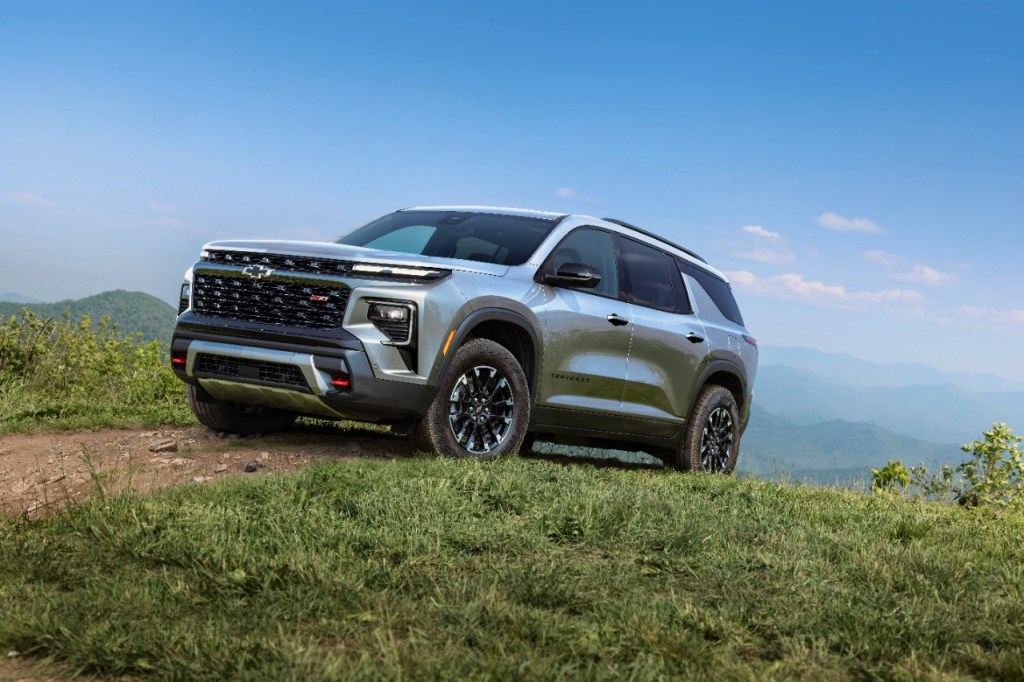
2024 Chevrolet Traverse Z71–you can take it off-roadish. (Images: Chevrolet)
Here’s something to know about the third row in the Traverse, which makes it a bona-fide vehicle for the fam. In far too many three-row vehicles, the third row is something that would make toddlers feel uncomfortable due to the limited space. But the Traverse offers 32.13 inches of legroom, 38.27 inches of headroom, 57.72 inches of shoulder room, and 48.62 inches of hip room.
Or said another way: It offers reasonable room for those who sit way in the back, so the claim that it seats up to eight is real, not a statement that is factual but lacking in actual functionality.
And as previously mentioned, if you fold that third row down, there’s 56.6 cubic feet to accommodate all of that stuff you picked up at Costco, and if you fold the second row, too, then there’s a massive 97.6 cubic feet of cargo room, which means you can stop at Home Depot on the way back from Costco, too.
“Roughing” It
One of the things that has become increasingly popular as Covid led people to wanting to do partake of activities in the great out-of-doors is adventuring off of paved roads. So to that end, the ’24 Traverse is available with Z71 trim, which makes it more capable of handling those sorts of dirty, gravelly conditions.
Going that route brings features including 1.2 inches of increase ground clearance (although this in not something that will have you reaching for purchase to climb into the vehicle), 18-inch wheels wrapped with all-terrain tires, specific tuned shocks from ZF, skid plates below (both steel and aluminum protectors), a Terrain mode that modulates performance for the conditions, and a twin-clutch AWD system that allows torque distribution to where it is needed.
Having taken a Z71 Traverse on route that merely suggested being drivable, I can attest to its ability to (a) not only go there but (b) do so in a way that provided considerable comfort (I know that the shocks were doing their job, but I must say that I found the driver’s seat excellent in all conditions).
One of the things that made maneuvering through trees far more manageable is a 360-degree camera system that provided an image on the 17.7-inch display so that it was clear where not to go. (To describe this as “threading a needle” would be a bit of an exaggeration for something that is 204.5 inches long and 87.87 inches wide (with mirrors extended).)
And a shout-out to the electric steering system is deserved, as well, because it could do the work at low speeds—which people are more likely to commonly experience in the parking lots of the aforementioned shopping centers—while not requiring constant adjustment at higher speeds. Let’s not kid ourselves: manuevering large vehicles can be trying. The Traverse setup makes it easier.
Sleek Look
For those who are looking for something that looks sportier and premium, the 2024 Traverse is also available in the RS trim. This puts the ute on 22s (black high-gloss aluminum) and even provides a flat-bottomed steering wheel (yes, the sort of thing you’d find in a Corvette). Black and red accents both inside and out telegraph the sporty style of the RS. And from the ride and handling standpoint, the engineers tuned the shocks to accommodate what one can experience while on road (paved) that are other than rectilinear.
2024 Chevrolet Traverse RS: Sizeable, but looks sleek.
Regardless of the trim, the styling of the ’24 has a contemporary look that echoes the sheet metal found on the Chevy pickups—the Silverado and the Canyon.
While that might seem questionable, consider that—to go back to where this began—in Q1 ’24 Chevy delivered 129,987 Silverados (including the 1,061 EVs) and 14,922 Canyons, so clearly people find the design language appealing.
But a good vehicle is more than the sum of its parts, more than the styling of the sheet metal, more than the available technologies.
It is an entire package. And the 2024 Traverse wraps it all together and delivers.
Think of it as validation of what everyone seems to know about the electric vehicle market in the U.S.:
The AlixPartners 2024 International Electric Vehicle Consumer-Sentiment Survey found that compared to a similar survey it ran in 2021 U.S. interest in EVs is flat.
Yes, despite the additional years of Tesla, Tesla, Tesla. Despite products like the Chevy Bolt and the Ford Lightning, which have increased familiarity with EVs, AlixPartners found that the number of respondents who said they are “very” or “moderately” interested in acquiring an EV is 35%. The same number as back in 2021.
Growth? What growth?
(While the 35% number seems robust, know that the share of market in the U.S. for EVs is 7.6%. . .and may hit 10% this year.)
What are people in the U.S. turning to?
Arun Kumar, global co-leader of the Advanced Mobility Practice at AlixPartners: “In the U.S. and Europe, BEV-intentioned buyers are turning their interest to PHEVs, seeing them as a completely legitimate substitute for meeting near-term needs and addressing charging and range concerns.
“This shift in preference presents a monumental challenge for traditional automakers, suppliers and dealers as they deploy resources to compete in the BEV transition.”
Or said differently: the OEMs and suppliers have been shoveling money into the BEV transition and are now discovering that returns seem exceedingly elusive.
Sticking with the Euro theme, the European Automobile Manufacturers’ Association (ACEA) released its figures for March 2024—and there’s a decline.
The EU car market was down 5.2%.
A factor?
The Easter Bunny.
That’s right. According to the ACEA, “The timing of the Easter holidays negatively impacted last month’s sales across most EU markets.”
Oddly enough, last year Easter was in April and EU car sales were up 17.2%.
As is the case in the U.S. EV sales were down (now 13% of the market there, or nearly double of what they are here (OK: less than double as EV sales in Q1 in the U.S. are 7.3%, per Kelley Blue Book)) and hybrid sales up, now at 29% of the total market.
One interesting thing about the 13% EV market share.
It is 0.6% greater than. . .diesels.
That’s right. Diesel passenger vehicle registrations in the EU are 12.4% of the market.
In March diesel registrations fell an overall 18.5%, with major drops in France (-32.1%), Spain (-38%) and Italy (-27.6%).
In Germany, however, sales were down only 0.5%. (No, that’s not because it is the home of Rudolf Diesel. He was born in Paris.)
Adjusting interest rates can be a tricky business for the Federal Reserve.
On the one hand, it wants to reduce the amount of borrowing and—consequently—spending.
That helps reduce inflation.
On the other hand, it doesn’t want to reduce the amount such that the economy falls into a recession.
Consumers don’t like inflation. That’s because things cost more.
Consumers don’t like high interest rates. That’s because they have to spend more to borrow the money to buy things.
Things like cars.
Kelley Blue Book announced the average transaction price (ATP) for new vehicles was down 1% in March compared to the ATP in February.
What’s more (or less), the March ATP was down 5.4% compared with December 2022, when ATPs were at their peak.
It’s not like new vehicles are inexpensive, even with that 1% drop.
The ATP—and remember, this is average—for March is $47,218.
Erin Keating, executive analyst at Cox Automotive, said, “It bears repeating that historically high interest rates and associated inflation combined with an ever-widening deficit of available vehicles at lower price points, will continue to challenge affordability for most car buyers.”
So there’s the interest rate-inflation situation.
The Disappearing Econo Box
Keating’s observation about “widening deficit of available vehicles at lower price points” is key.
KBB found that in March there were some 275 new-vehicle models available in the U.S.
Of the 275 only eight had ATPs of less than $25,000.
Three percent. Imagine trying to find one.
But apparently either people have lots of money or they’re willing to borrow it: in March sales of vehicles with ATPs above $75,000 were greater than those under $25,000: approximately 81,000 of the former and 52,000 of the latter.
Perhaps high interest rates are having an effect—on the lower portion of the market.
Of course, chances are OEMs are putting out vehicles with higher sticker prices because they can make more money on them than those that are more economical.
Let’s say that you are interested in buying a car.
A car as a sedan. Not a crossover. A bread-and-butter car. (Yes, maybe you want to add some spicy tomato jam to it—spoiler, alloy wheels, etc.)
You go to the local Ford dealer.
And discover that the only car is a Mustang, which doesn’t qualify (i.e., two doors).
There happens to be a Lincoln store across the parking lot.
There are no cars, only crossovers of stair-step sizes.
You visit a Chrysler dealership and learn that Stellantis has stopped production of its long-in-the-market 300 at the end of last year, but they’ve got a Pacifica minivan, if you’re interested.
Buick perhaps? Again, no. Only crossovers.
Over at Cadillac things are better: of its seven models, two are sedans, the CT4 and the CT5. Given that the Q1 2024 sales for those are down 36.1% and 34.2%, respectively, how long they’ll be around may be in some question.
Chevy? An impressive array of crossovers and trucks. And one car, the Malibu.
The point is, buying a car is not as easy as it once was.*
Which leads to a thought about electric vehicles.
What if you went into one of these dealerships and discovered that they didn’t have anything on the showroom floor that didn’t have a plug?
What if that was pretty much the case up and down the street of the auto mall?
Clearly there would be an increase in the number of EVs sold out of those dealerships.
Maybe the numbers would be that good.
But they would be better.
Just as they’ve increased the number of models that aren’t cars and so have made buying a car tough, it could be that to help recoup some of the billions being spent on EVs they make buying an ICE tough.
Something’s got to move more of that lithium-powered metal.
(Of the 593,997 vehicles GM sold to customers in Q1, 16,169 were EVs. Not much of a business case there. And it sold twice as many Malibus ((32,749).))
*Interestingly, the Asian and European brands, in general, all have cars in their lineups.
“Mercedes-Benz EVs accounted for 13% of our total group sales volume in Q1,” Dimitris Psillakis, president and CEO of Mercedes-Benz USA, said, reporting how the marque is doing so far in 2024.
Which, on a percentage basis, is quite good.
Ford, which describes itself as “America’s No. 2 electric vehicle brand,” had Q1 EV sales of 3.9%.
Mercedes has three EVs in its U.S. showrooms:
EQB, of which it sold 671
EQE, 5,113
EQS, 2,552
That is a total of 8,336 of the 66,570 passenger vehicles it sold in Q1.
(To be fair to Ford, it sold 508,083 vehicles in Q1, of which 20,233 were EVs.)
But here’s something interesting about the Mercedes sales: It sold 15,096 GLE SUVs.



 shinymetalboxes