U.S. dealers are not particularly keen on electric vehicles (EVs).
So indicates the Cox Automotive Dealer Sentiment Index (CADSI) released this year.
When asked how EV sales were doing in Q1, the index score was 42. That’s off from 50 in Q1 in 2023.
And while 42 may not be particularly meaningful, know that it is the lowest score since the question was included in CADSI in Q2 2021.
The outlook among dealers regarding EV sales going forward isn’t good, either.
In Q1 2023 the index score was 53. Back then, a majority of dealers saw EV sales growing.
In Q1 2024 that index score is down to 36.
That’s the lowest score for EV outlook since that question was asked.
Seems things are no longer anticipated to be growing for EVs.
It seems as though this is not simply a U.S. phenomenon, either.
While Cox was looking at new vehicle sales, over in the U.K. and outfit that specializes in used vehicles—going from consumers to dealers rather than the more conventional vice-versa—found that sales are not particularly robust.
Compared with last year, HonkHonk found 38.5% of dealers are “much less interested” in EVs and 12.3% are “a bit less interested.”
Or 50.8% of dealers are not all that keen on putting EVs in stock.
Sebastien Duval, CEO of HonkHonk, said, “Right now, dealers can’t get enough small or medium petrol cars, medium diesels and even hybrids, since the market began recovering in 2024. But less than one in ten of them want to snap up a battery EV car more than they did than a year ago.”
That’s right: Diesels are more appealing than EVs in the U.K. used market.
“While technologically advanced, the extent that BEVs can contribute to GDP growth is limited by the maturity of the motor vehicle industry, with passenger car sales having peaked in 2017. This is a restraining factor as BEVs do not represent an innovation that creates new demand, like the introduction of personal computers or cell phones. Instead, they’re a new version of a familiar product whose sales may not grow much beyond current levels.”—Thomas Klitgaard, Federal Reserve Bank of New York
In other words, electric vehicles are not a disruptive tech that is going to bring in new buyers who otherwise wouldn’t buy an SUV, car or truck.
So even if we get to 100% EV buyers (not likely anytime soon), this is simply replacement, not buyers who would otherwise not buy a means of transportation.
Which is not what vehicle manufacturers want to think about.
78.81% of vehicle purchases in the U.S. in 2023 were for vehicles with gasoline engines, according to Experian’s “State of the Automotive Finance Market, Q4 2023.”
The number that will is:
8.55% of the vehicles purchased were electric vehicles.
But of that “purchase,” 30.7% of the EVs were leased, which is essentially renting with the option to buy, not outright obtaining (i.e., according to the Oxford English Dictionary, the verb purchase means “To acquire in exchange for payment in money or any equivalent; to buy.” And the way the Inflation Reduction Act is constructed, for many OEMs leases are the only way that consumers can get a $7,500 purchase incentive).
A number that also won’t get large type:
9.83% were hybrids.
That number alone is about 13% greater than the EV number.
But arguably the 2.02% of vehicles purchased in 2023 that were plug-in hybrids could be added to the hybrid number, which would go to 11.85%.
Odds are that hybrid number is going to continue to grow, as will the EV number, but even though it will continue to be higher than the EV number for the next several years, you can bet every rise in EV sales will continue to get outsized attention—until the novelty passes.
J.D. Power and GlobalData project that February sales will come in a smidge—1.4%–more than they were in February 2023, or 1,214,600 vehicles
Taking out non-retail transactions, the number is 981,300, which is the important number because that reflects individual consumers.
So using that as the basis of comparison, there is an increase of 3.8% compared to the same month last year.
One of the reasons for the rise this year is something that happens once every four years: an additional day of sales, February 29.
According to Thomas King, president of the data and analytics division at J.D. Power, the increase in sales is facilitated by:
Higher inventory levels (when there are cars on the lot, then there is less pressure to have to select whatever is available from a paltry number)
Higher manufacturer incentives (turns out that there is a need to provide a boost to get the sheet metal moving)
Lower dealer profit margins (seems that the profits that were rolling in when choice was minimal so prices were maximal are now trending back to normal—but it is worth noting that about 17% of vehicles are still selling above MSRP, although last year it was nearly 32%)
What this means is that people are getting bullishly back in the market.
King:
“Transaction prices in February are trending towards $44,045, down $1,919 or 4.2%—from February 2023. However, despite the significant decline in average transaction prices, higher sales volumes mean consumers are on track to spend nearly $40.8 billion on new vehicles this month—the highest on record for the month of February, and 4.1% higher than February 2023.”
Could be a case of the proverbial “making it up on volume.”
Nowadays, it is impossible not to look at how things are going in terms of EV sales.
Elizabeth Krear, vice president, electric vehicle practice at J.D. Power, said, “In 2023, EV sales and leases accounted for a larger percentage of retail auto industry growth than gas-powered vehicles.”
Presumably that has something to do with the fact that there is a stable number of gas-powered vehicles so the growth would not be as big as that of EVs, which start from a comparatively smaller number.”
She acknowledged what is now frequently heard: EV sales are slowing.
Putting some numbers to it:
“In January, battery electric vehicle sales fell 1.6 percentage points from 9.2% in December 2023. Further, upper-funnel EV shopper interest declined for a fourth consecutive month. New-vehicle shoppers who are ‘very likely’ to consider purchasing an EV for their next vehicle dropped to 25.6%, a full percentage point lower than in December.”
Krear said that a big blockage for EV buyers: charging access.
While she noted that the opening of the Tesla Supercharger network will go a long way toward addressing that issue, she added, “But this alone is not enough to move the needle. Improvement is needed in terms of the availability of affordable EVs for mainstream customers.”
In 2023 Nissan sold 343,891 vehicles in Europe, a 20.1% increase over its sales there in 2022, according to Inovev.
In 2023 Chinese brands sold 353,276 vehicles—“mainly based on BEVs”—in Europe, more than double their sales there in 2022.
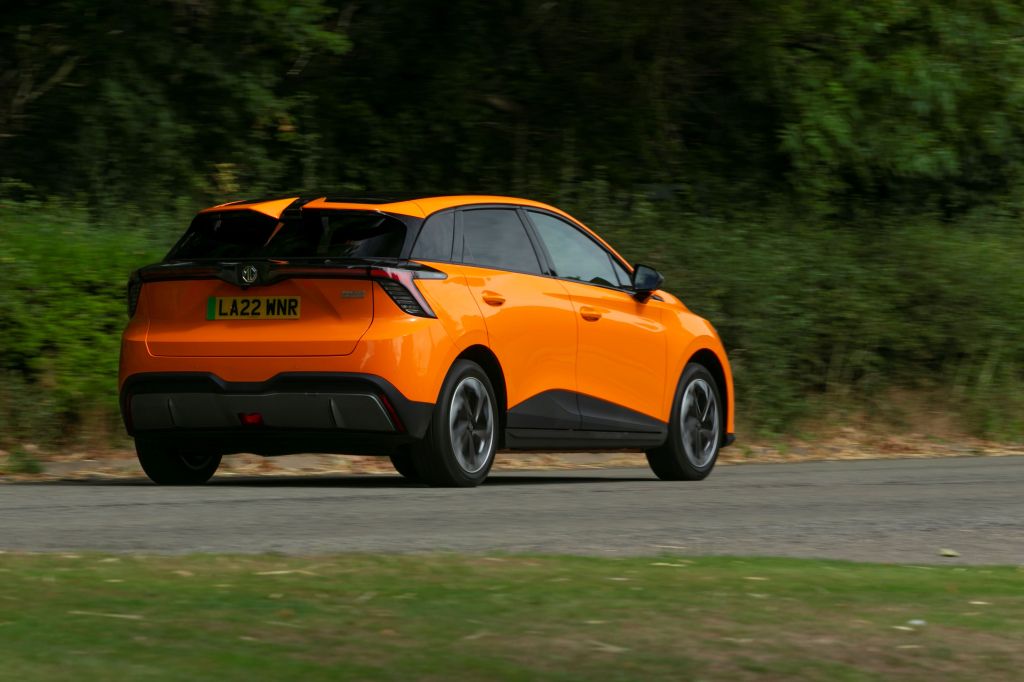
The MG MG4 EV: second only to the Tesla Model Y in U.K. 2023 sales. MG is owned by Shanghai-based SAIC Motor. (Image: MG)
Nissan, which has been around in the European market for a while (and had been affiliated with Renault until last year), is already surpassed by a phalanx of Chinese OEMs. (Yes, this is one company vs. several, but looked at from the point of view of sheet metal moved, it is still worth pondering.)
Maybe if you’re Stellantis or Renault or Volkswagen this isn’t a particularly fun fact.
And maybe this will portend things happening at some point in the U.S., as well.
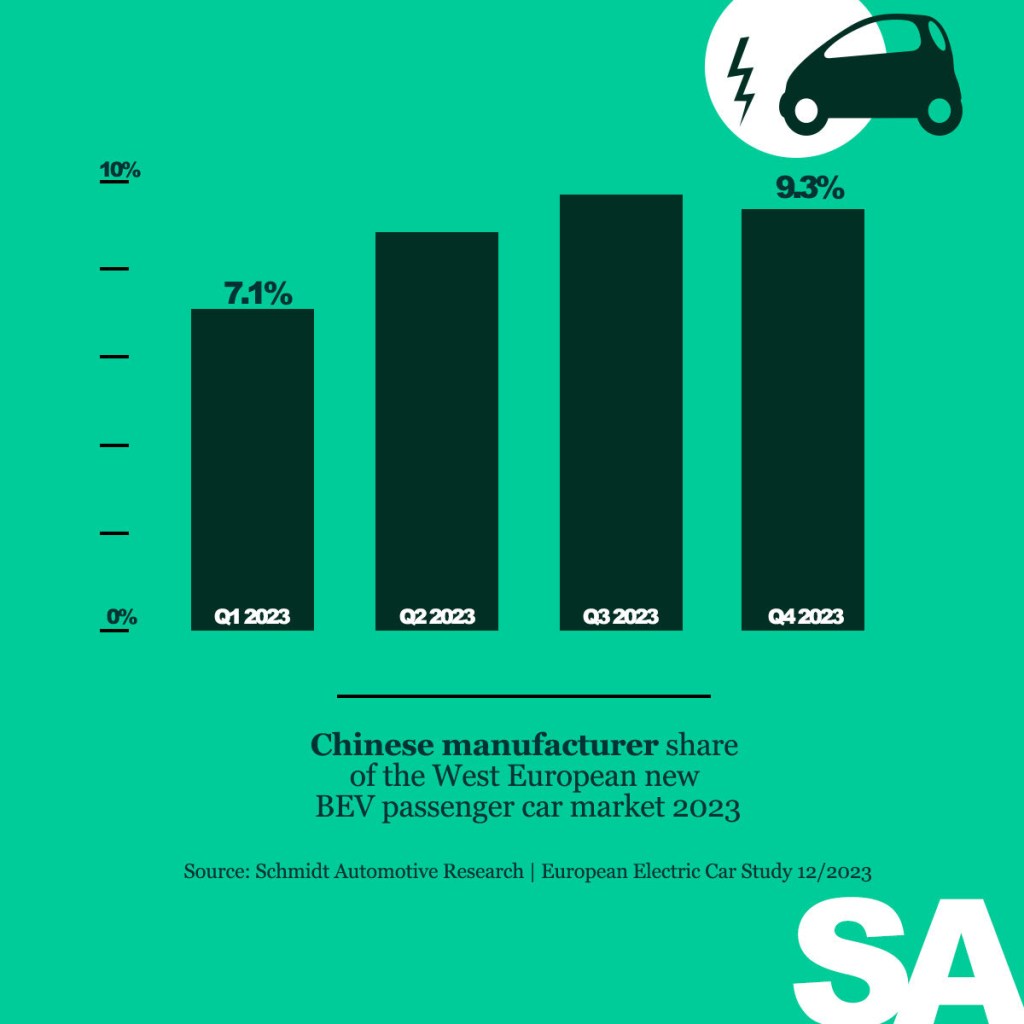
Although there was a seeming step-by-step, vehicle-by-vehicle increase in the under of Chinese battery electric vehicles registered in Western Europe last year, there was a bit of a stumble at the end, and Schmidt Automotive Research wonders whether there will be a cap of under 10% of the EV market in Western Europe for the Sino mobiles.
(Image: Schmidt Automotive Research)
As the chart shows, there was a noticeable decline in registrations in Q4. . .but then there are some reasons why this could be the case, including the increase in the amount of time it takes to ship vehicles from China to Europe while avoiding the Red Sea.
But the Schmidt study also points out some brands are offering discounts of up to €12,000, so you’d imagine that European consumers would be most interested in savings like that. . .especially as there may be higher import tariffs applied to Chinese vehicles coming into Europe this year.
Still, the fact that the Chinese OEMs have managed to gain that much of the European market in a comparatively short period of time says something about the appeal of their products.
The biggest surprise about the Lincoln Aviator—and as a three-row vehicle that offers 140.6 cubic feet of passenger room or a maximum 78.6 cubic feet of cargo capacity (with the second and third rows folded) it is itself fairly big—is that there aren’t more of them sold.
That is, in all of 2023 there were just 15,551 Aviators sold in the U.S., putting it in last place in the four SUV Lincoln lineup.
Actually, that goes to an even bigger point, which is that Lincoln, for some reason, has become one of the best-kept secrets in the luxury market.
Lincoln, which positioned itself using the design philosophy “Quiet Flight” over the past several years and which uses the term “sanctuary” to describe the interior experience of its cabins, perhaps did too good a job of being stealthy.
Perhaps they should have made more noise.
The exterior designs of the Lincoln vehicles are sophisticated and unostentatious; the interior executions—particularly in the higher trim Black Label variants—are absolutely first rate. Anyone who sits in a vehicle from its crosstown rival and then gets into a Lincoln will be surprised at how well done the Lincoln interior is.
It is nothing short of striking.
Lincoln has done a refresh for the 2025 Aviator.
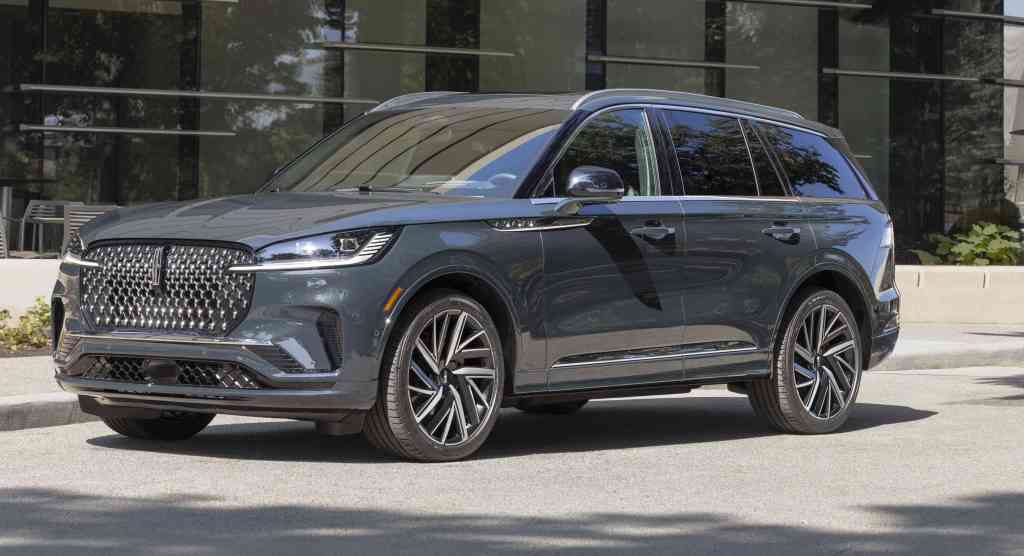
Fresher for MY 25: the Lincoln Aviator. (Image: Lincoln)
While there are some exterior modifications—
“The new Aviator looks more planted with a more dynamic presence than ever before. The changes we made to our signature grille shows our laser-focus on details and design that pulls you in. And with our new lighting features which we call ‘jewelry,’ the Lincoln star comes to life and immediately catches your attention.” – Kemal Curic, design director, Lincoln
–the real story for this model is upping the ante on the interior tech—
“With the new Aviator, technology takes an even larger role in helping create a relaxing, luxurious space that our clients have come to appreciate and expect from Lincoln. With advanced, connected features like the Lincoln Digital Experience and BlueCruise hands-free driving technology, we are creating a new, digital sanctuary on the road.” – Heidi Shaffer, director, Lincoln
The Lincoln Digital Experience is accessed through a 13.2-inch touchscreen or via voice, using Google Assistance or Alexa. For those who are part of the Apple ecosystem, there is CarPlay, as well. (An available Revel Ultima 3D audio system, with 28 speakers, makes the SiriusXM or Spotify or other music sound all the better.)
There is a leaning towards Google, however, as there is the ability to download apps from the Google Play store.
The BlueCruise feature, standard, allows hands-free driving on some 130,000 miles of roads in North America. There is Lane Change Assist—which allows the Aviator to switch lanes when safe to do so by simply using the turn signal indicator—and In-Lane Repositioning—which determines where the SUV is in relation to vehicles on either side of it and makes steering adjustments to provide the most room.
The midsize lux SUV category has a number of competitors, many of which (e.g., Genesis, Lexus, BMW) have solid options.
But sit in a Lincoln with a 30-position driver’s seat and then think about what your daily drive will be like.
Even if it is a two-year lease, you’re going to be spending a considerable amount of time in an interior, so it is best to get the one that you’ll be most comfortable with–and it could very likely be in a Lincoln.
As John McElroy points out at the top of this edition of “Autoline After Hours,” in 2023 Chevy sold 71,081 Colorados, GMC 22,458 Canyons, Ford 32,334 Rangers, and Nissan 58,135 Frontiers.*
That is a total of 184,008 midsize trucks.
And another number: 234,768.
That’s the number of Toyota Tacomas sold in 2023.
There were 50,760 more Tacomas sold than all of the others on the market combined.
Clearly a popular truck.
Now there is a new generation Tacoma, one designed, engineered and manufactured in the North American market because that’s where the preponderance—and it is clearly quite a preponderance—of vehicles sold.
2024 Tacoma. Badass. (Image: Toyota)
During the development of the ’24 Tacoma an objective was to create a “Badass adventure machine.”
It was configured to be capable.
It was configured with several trims—SR, SR5, TRD Off-Road, TRD PreRunner, TRD Sport, Limited—so there would be a bandwidth available for buyers.
Because Toyota is committed to providing electrified variants of all of its vehicles, the Tacoma was fitted with an optional hybrid powertrain, a propulsion system that provides 326 hp and 465 lb-ft of torque.
Because Toyota is still interested in providing something for those off-road enthusiasts (and to the economy buyers) who are interested in a third pedal, there is a six-speed manual available.
Sheldon Brown, chief engineer for the new Tacoma, talks with McElroy, Richard Truett of Automotive News, and me on this show for an entire hour.
If you’re interested in Tacomas specifically or trucks in general, it is worth your time.
==
*Who would have thought that Nissan outsold Ford in trucks?
Today Fisker is holding a meeting at its HQ in Manhattan Beach, California, for prospective dealers.
Sort of like someone going into a dealership thinking about buying a given vehicle. Kicking the tires, as it were.
Fisker has had a direct sales approach, which seems to be de rigueur for new energy vehicle companies.
But it has decided that it might be more efficient—or effective—to go the old-school route and sign up some dealers.
However, as part of its “Dealer Partnership” model, it will ask that its dealers offer no-haggle pricing, where that is permitted. And it will allow dealers to have larger chunks of geography than is typically the case with dealerships, particularly in urban areas.
The first element is presumably good for customers—as in customers who don’t want to treat their buying experience as some sort of swap-meet event.
The second element provides a dealer with greater odds of moving some metal without having to compete with the dealer down the street.
According to Fisker chairman and CEO Henrik Fisker, “Over 120 dealers in North America and Europe have expressed interest in our new Dealer Partnership model.”
Of course, there is interest and there is signing on the bottom line.
So far, Fisker has gotten one dealer to sign on. It is in Europe.
In GM CEO Mary Barra’s letter to shareholders for the Q4 2023 results it reads, in part:
“In our EV business, we expect our U.S. portfolio will become variable profit positive in the second half of the year based on our current expectations for EV demand and production growth, strong interest in our vehicles, lower commodity prices and other factors.
“It’s true the pace of EV growth has slowed, which has created some uncertainty. But many third-party forecasts have U.S. EV deliveries rising from about 7% of the industry in 2023 to at least 10% in 2024, which would mean another year of record EV sales.
“We believe our competitive position will improve throughout the year, based on higher production of the Cadillac LYRIQ, GMC HUMMER EV, Chevrolet Blazer EV and Silverado EV Work Truck. We’re also excited to have the Chevrolet Equinox EV and Silverado EV RST, the GMC Sierra EV Denali and the Cadillac Escalade IQ arriving in showrooms over the course of the year.”
There is something to be said for optimism. And given that GM is investing billions in EV development and production, optimism is better than the alternative.
In her Q4 2022 letter to shareholders Barra wrote:
“By leveraging U.S.-made battery cells produced by our Ultium Cells joint venture and the scalability and flexibility of the Ultium Platform, we are accelerating production of the Cadillac LYRIQ, GMC HUMMER EV and BrightDrop Zevo 600, and we will launch exciting vehicles like the Chevrolet Silverado EV, Blazer EV and Equinox EV. This keeps us on track to produce 400,000 EVs in North America from 2022 through the first half of next year.”
For the full year of 2023, rather than just the first half, GM sold 75,883 EVs. About 19% of that 400,000. Even if we add in the 2022 EV sales, 39,096, to the full year ’23 sales, that is 114,979, or about 29% of that 400,000.
Yes, GM will sell more EVs in 2024 than it did in 2023.
And it will be a good thing if the EVs it sells are “variable profit positive” by the second half of the year.
But consider: in 2023 GM’s total U.S. sales were 2,594,698 units. That means the 75,883 EVs represented about 3% of total sales.
If industry sales of EVs this year are “at least 10%,” what is the likelihood that GM will come close to reaching that number?


 shinymetalboxes