2025 Mazda CX-5 2.5 S Carbon Edition

Don’t just consider the top-of-mind when thinking “compact crossover”. . .

By Gary S. Vasilash

During a recent “Autoline After Hours” co-host John McElroy, talking about a Mazda CX-90 he was driving, said, “I don’t know why more people don’t buy Mazdas.”

Which is a solid observation.

First, however, it should be noted that Mazda’s fortunes in the U.S. market considerably improved in 2024 compared with 2023.

In ’24 it sold 424,382 vehicles. The previous year it was just 363,354. That’s nearly a 17% improvement.

Compare that with the overall U.S. market being up a mere 2.2% and you can see that Mazda’s bump is impressive.

But then there is what Mazda is up against.

In 2024 Ford sold 124,701 Bronco Sports, 146,859 Escapes and 194,094 Explorers, for a total of 450,125 vehicles.

Of course, Mazda has about 550 dealerships in the U.S. and Ford 3,000, so there is something to be said for access and availability.

The 2024 sales for the CX-5 were 134,088 vehicles. That is a drop of 12.8% compared with 2023 sales.

Mazda CX-5: Ripe for consideration. (Image: Mazda)

However, one might argue that the Mazda CX-50, another compact SUV that is approximately the same size as the CX-5 but which has a bit more of a rugged execution (sort of like the Bronco Sport and the Ford Escape, but (a) the Bronco Sport is far more rugged overall than the Escape and (b) the two Mazdas are on different platforms, so there is that difference). CX-50 sales in 2024, at 81,441, were up 82.6%.

Of course, someone looking at a new vehicle is looking now, not last year, so. . . .

The comparison with the Ford Escape isn’t coincidental. The vehicles are quite similar with a few notable differences.

For example, the CX-5 comes standard with all-wheel-drive. The Escape has that as an option.

The engine in a CX-5 is a 2.5-liter four that produces 187 hp and 186 lb-ft of torque. The base engine in the Escape is a 1.5-liter in-line three cylinder engine that produces 180 hp and 199 lb-ft of torque.

The Ford has an eight-speed automatic. It is six for the Mazda.

For those who are interested in cargo capacity the Escape clearly has the advantage with 37.5 cubic feet versus 30.8 cubic feet for the CX-5.

But to get back to McElroy’s original question, it goes to the point of why there are probably far more people who had a default thought to an Escape (or an Equinox or RAV4 or CR-V) and not the CX-5: good as they are, Mazdas are largely invisible in the market.

With a base MSRP of $32,600 the 2.5 S Carbon Edition brings such things as leather seating and a power moonroof; a 10.25-inch center display and wireless charging, Apple CarPlay and Android Auto.

It is competent and contemporary.  And because of that, the CX-5 needs to be considered.

Which Vehicles Might Take NACTOY Trophies for 2025?

Four North American Car, Truck and Utility Vehicle of the Year jurors talk about the semifinalists for the awards in a lively discussion. . .

By Gary S. Vasilash

The North American Car, Truck and Utility Vehicle of the Year (NACTOY) Award has been around since 1994. Back then, of course, utility vehicles, by and large, weren’t what they are now, vehicles, to borrow a phrase from Alfred Sloan, for every purse and purpose. So there was no category for CUVs/SUVs at the start.

But in 2017 the decision was made to add the Utility category.

That year there were three finalists:

  • Chrysler Pacifica
  • Jaguar F-Pace
  • Mazda CX-90

Oddly, the Pacifica won. (Not that it didn’t deserve an award and it is not like minivans aren’t the most package-efficient architectures, but if were to run the elementary school test, wherein you’d show a picture of a Pacifica and a Wrangler to a 10-year-old and say, “Which is the sport utility vehicle,” odds are the Pacifica wouldn’t get the nod.)

Nowadays, the Utility category is the most-contested, by far.

The Jurors

You might be wondering just who picks the winners.

Obviously, the MotorTrend Car of the Year is selected by that publication. And there is no mistake the Car and Driver 10 Best are selected by the journalists for Car and Driver.

In the case of NACTOY, there are 50 journalists from the U.S. and Canada, a mix of people working in all types of media, from ink-on-paper to YouTube to radio.

Clearly there is an array of opinions generated by this group.

Three of the current NACTOY jurors are Henry Payne, car critic for the Detroit News (yes, he reviews trucks and utilities, too), Mark Phelan, who reviews vehicles for the Detroit Free Press, and auto writer Greg Migliore.

Oh, and I am a juror, too.

I brought the three of them together to talk about the “NACTOY Best of 2025,” a.k.a., the semifinalists, on “Autoline After Hours.”

That group of vehicles will be winnowed down to three finalists in each category. The finalists will be announced in LA on November 21, and the winners at the Detroit Auto Show on January 10, 2025.

The Vehicles

The vehicles in question at the moment are:

Cars

  • BMW 3 Series
  • BMW M5
  • Cadillac Celestiq
  • Dodge Charger EV
  • Fiat 500e
  • Honda Civic Hybrid
  • Kia K4
  • Mercedes-AMG E Class
  • Porsche Panamera
  • Toyota Camry

Trucks

  • Ford Ranger
  • GMC Sierra EV
  • Ram 1500
  • Rivian R1T
  • Toyota Tacoma

Utilities

  • Chevrolet Equinox EV
  • Honda Prologue*
  • Volvo EX90
  • Hyundai Ioniq 5 N
  • Hyundai Santa Fe
  • Jeep Wagoneer S
  • Lincoln Nautilus
  • Porsche Macan EV
  • Toyota Land Cruiser
  • VW ID. Buzz

So if you’re thinking about getting a new vehicle, you might want to watch the show.

If you’re interested in a lively discussion of the offerings made by the auto industry, you certainly want to watch it.

And you can see it here.

By the way: Henry Payne goes out on the proverbial limb and names the vehicles that he thinks will win the awards. While you could simply slide that fast-forward dot on YouTube and bring it toward the end of the show to see Henry’s predictions, you’ll want to watch the whole thing to see his reasoning to get to those conclusions.

Lots and Lots of Tacomas

By Gary S. Vasilash

As John McElroy points out at the top of this edition of “Autoline After Hours,” in 2023 Chevy sold 71,081 Colorados, GMC 22,458 Canyons, Ford 32,334 Rangers, and Nissan 58,135 Frontiers.*

That is a total of 184,008 midsize trucks.

And another number: 234,768.

That’s the number of Toyota Tacomas sold in 2023.

There were 50,760 more Tacomas sold than all of the others on the market combined.

Clearly a popular truck.

Now there is a new generation Tacoma, one designed, engineered and manufactured in the North American market because that’s where the preponderance—and it is clearly quite a preponderance—of vehicles sold.

2024 Tacoma. Badass. (Image: Toyota)

During the development of the ’24 Tacoma an objective was to create a “Badass adventure machine.”

It was configured to be capable.

It was configured with several trims—SR, SR5, TRD Off-Road, TRD PreRunner, TRD Sport, Limited—so there would be a bandwidth available for buyers.

Because Toyota is committed to providing electrified variants of all of its vehicles, the Tacoma was fitted with an optional hybrid powertrain, a propulsion system that provides 326 hp and 465 lb-ft of torque.

Because Toyota is still interested in providing something for those off-road enthusiasts (and to the economy buyers) who are interested in a third pedal, there is a six-speed manual available.

Sheldon Brown, chief engineer for the new Tacoma, talks with McElroy, Richard Truett of Automotive News, and me on this show for an entire hour.

If you’re interested in Tacomas specifically or trucks in general, it is worth your time.

==

*Who would have thought that Nissan outsold Ford in trucks?

Tesla, Tesla, Tesla

By Gary S. Vasilash

Sandy Munro and Cory Steuben of Munro & Associates have, through a comprehensive tear-down analysis of Tesla models as well as EVs from other OEMs (as well as a vast array of ICE vehicles over the years), achieved a special POV regarding the means and methods that are used by Tesla to produce its vehicles. Using the context they have acquired from the analyses of both Teslas and other vehicles (as well as from working in other industries, which provides different perspectives on product and process), they are able to make assessments about how Tesla is developing and producing its vehicles.

And they are, putting it mildly, damned impressed, such that Sandy Munro expresses a concern that traditional domestic OEMs are likely to find themselves trumped by Tesla in terms of sales—before the decade is out. (Globally, Tesla says that it plans to build 20 million vehicles by 2030. By any measure a lot of cars.)

Tesla recently held an investor day at its plant in Austin, Texas. The attendees were from various big and bigger money firms that can direct investors’ funds into firms like Tesla. So the objective on Tesla’s part is to make sure that the best foot is put forward so that it can get some of that cash.

But Munro and Steuben scored valuable laminated credentials to be part of the audience during with the “Master Plan 3” was revealed—everything from new manufacturing methods to a home-grown operating system that combines ERP, MES, and even more.

And on this edition of “Autoline After Hours” Munro and Steuben talk to “Autoline’s” John McElroy and me about what they learned at the event, particularly focusing on the operational developments that Tesla is making.

For example, there is a new method Tesla will be using for vehicle assembly.

During his presentation at the Tesla program Drew Baglino, senior vp, Powertrain & Energy engineering, explained:

“We build the sides of the car independently, we only paint what we need to, and then we assemble the parts once, only once.”

That, Munro points out, is a non-trivial change, as paint shops in factories are typically large, complex and very expensive. This changes that.

That rethinking of the industry status quo and others are examined in a deep-dive into what Tesla is doing—and what other OEMs ought to be thinking about regarding their futures.

And you can see it here.

The EV Outlook: How Many People Taking Buyouts Are Likely to Buy One?

By Gary S. Vasilash

Last week GM announced that in its efforts to “permanently bring down structured costs” it would request that its salaried employees in the U.S. seriously consider taking a buyout. In January GM execs said that their goal is to reduce $2-billion in spending. By taking a number of its 58,000 of salaried employees off the books, it reckons it will get closer to its goal.

Given that in 2022 its full-year revenue was $156.7 billion, net income attributable to stockholders $9.9-billion and EBIT-adjusted was a record $14.5 billion, it would seem to be in good shape.

But there is something that GM and all other OEMs are grappling with, and that’s the billions of dollars that need to be invested in developing electric vehicles as well as creating the means by which the vehicles and the batteries used to store the energy for those vehicles can be produced.

It is a huge—and expensive—undertaking.

And so when they look at their books and see that one non-trivial number is salaries, product trumps people in order to maintain profit.

(To be sure there are a number of people who probably have a skillset that is not particularly relevant to automobility going forward and it would probably be tenuous from a legal standpoint to single them out, which may make casting a larger net better from a corporate point of view.)

But the point is: EVs are (1) costly to develop and (2) not making money for corporations the way that gasoline-powered vehicles are (yet).

So, in order to keep earnings up and costs down, there will be people who will have to find something else to do with their working hours.

The state of EVs is the topic on this edition of “Autoline After Hours.” Joining me are Greg Migliore, editor of Autoblog and the newly launched Autoblog Electric; Chris Paukert, director of Video for Edmunds; and Matt DeLorenzo, long-time auto journalist and author of How To Buy an Affordable Electric Car.

The discussion delves into an array of EV-related topics, from affordability to charging to how long it will be until EVs are the norm and internal combustion engines are the exception.

And as for that last topic, it may be longer than you might think.

You can see the show here.

Tesla Dominates S&P Global Mobility Loyalty Awards: How Come?

By Gary S. Vasilash

Tesla is a phenomenal company in many respects, not the least of which are captured in the most recent S&P Global Mobility Loyalty Award assessment. The firm has been doing this for 27 years, so it has a good handle on what’s going on.

Based on 11.7-million new vehicle registrations in 2022, the loyalty determination is made on whether a household with a particular make, model or manufacturer in the garage goes out and buys a new vehicle that repeats the same. So a Tesla loyalist might have a Model 3 in the garage and gets (additive or replacement) another Model 3 or a Model Y or S or X.

Of the eight overall categories, Tesla took five:

  • Overall Loyalty to Make
  • Ethnic Market Loyalty to Make
  • Most Improved Make Loyalty
  • Highest Conquest Percentage
  • Alternative Powertrain Loyalty to Make

The other three are:

  • Overall Loyalty to Manufacturer: General Motors
  • Overall Loyalty to Dealer: Subaru
  • Most Improved Alternative Powertrain Loyalty to Make: Mercedes-Benz

As for those three: Tesla couldn’t have won the Manufacturer award because that goes to a firm with multiple brands, and Tesla just has one. It doesn’t have dealers, so that’s out. And the “Most Improved” goes to a brand that has historically had one type of powertrain (e.g., ICE) and is now adding EVs to the mix.

All of which is to say that Tesla is dominant.

On this edition of “Autoline After Hours,” Vince Palomarez, who manages and develops the Loyalty tools at S&P Global Mobility, talks with “Autoline’s” John McElroy, Jeff Gilbert of WWJ-950, and me about Tesla’s performance as well as how other companies did in this latest assessment.

Realize that, for example, GM has taken the Manufacturing award for eight years running and has taken it 19 times out of the possible 27, so it isn’t like it is withering from the Tesla onslaught.

That said, when you think of the OEMs spending literally billions of dollars on advertising (according to Statista, Ford spent $1.98-billion in 2021 on advertising in the U.S. to persuade people to buy its vehicles—those who already own a Ford or Lincoln and those it hoped to conquest) and Tesla spent $0, how it is accomplishing its domination of the Loyalty awards is something that is essential for some to know and just fascinating for the rest of us.

And you can see it here.

What the IRA Means to the Auto Industry

By Gary S. Vasilash

According to the U.S. Energy Dept., the Inflation Reduction Act of 2022 is “the single largest investment in climate and energy in American history.”

And in the automotive space, the IRA means a continuation of tax credits for consumers who buy electric vehicles (up to $7,500, though the math gets tricky) and even for OEMs and other companies that get into the business of making batteries.

Blue Oval City, the $5.6-billion, 3,600-acre campus for EV and battery production Ford is building in Stanton, Tennessee. (Image: Ford)

As for that battery money:

It provides tax credits of $35 per kWh for the cells. And if another company organizes those cells into battery modules, it gets $10 per kWh. So if there are two companies involved and they each produce portions for a 100-kWh battery for an EV, then the cell manufacturer would get $3,500 and the module maker $1,000. And if a single company did both, then that’s $4,500.

So if you wonder why vehicle manufacturers are investing billions in battery plants (like Ford’s recent $3.5-billion announcement) perhaps that makes it even more understandable.

Not only do they make money by selling vehicles, but they also make money by producing the batteries that go into those vehicles.

On this edition of “Autoline After Hours” we’re joined by Devin Lindsay, who is responsible for Alternative Propulsion forecasting at S&P Global Mobility, Mark Barrott, principal with Plante Moran’s strategy and automotive practice, and Mike Martinez, who covers Ford for Automotive News.

The topic is the multi-billion dollar effect of the IRA on the automotive industry.

The IRA is essentially industrial policy. The aforementioned tax credits that consumers can receive are only possible if the vehicle in question not only falls below a price cap, but if the vehicle’s manufacturing—including the batteries—has sufficient domestic content. This puts companies that do make electric vehicles but don’t make them in the U.S. (think Audi, for example) at a competitive disadvantage.

While an objective is to make EVs more accessible to more people—right now EVs account for 5.6% of the market—it isn’t entirely clear that the 50% mark that the Biden Administration hopes to achieve by 2030 (and that several OEMs seem to be capacitizing themselves to provide) will happen: Do consumers really want EVs?

These and other questions are explored on the show.

And you can see it here.

The Expanding Growth of the Chinese Auto Industry Examined

By Gary S. Vasilash

Tu Le grew up in metro Detroit. He made his way out to Silicon Valley, where he lived and worked. Then made a move to Beijing.

He recalls that when in China he recognized that there was a massive shift going on in the auto industry, one largely predicated on the digitalization borne of on-board electronics. Then there was the electrification of the powertrain.

This led him to found a consulting firm, Sino Auto Insights, which has a perspective on what’s going on in the industry—which he refers to as the “mobility industry”—from the perspectives he’s gained from living in Detroit, working in Silicon Valley, then spending serious time in China.

Tu thinks that one of the things that is happening that is going to have profound effects on the traditional OEMs—be they based in the U.S., Europe or Japan—is that Chinese companies are working at a clock speed that can make efforts undertaken by those traditional seem to be in slow motion.

The technology transition is not in the least bit minor.

What’s more, not only is the competitiveness of Western companies operating in China waning, but Chinese OEMs are now selling their vehicles—which have, he says, surprising levels of tech and capability—in markets around the world, which puts pressure on OEMs in their home markets.

And while this hasn’t happened in a notable way in the U.S., it is a matter of when, not if, Tu says.

On this edition of “Autoline After Hours” John McElroy, Lindsay Brooke of SAE International and I talk with Tu about these developments.

Not only is the growth and expansion of the Chinese auto industry a technology story, but given the tensions that are increasing between the U.S. and China (think only of the recent spate of balloons), there is a political aspect to this, as well.

And you can see the show here.

Start of an EV Price War?

By Gary S. Vasilash

Last month Tesla did something that OEMs almost never do. (And in its history, Tesla has done lots of things that traditional OEMs almost never do, so at least in this regard it is being consistent.)

It cut the price of its vehicles in China, Germany, and the U.S.

These weren’t slight, either. In the U.S., for example, the Model Y Performance was cut by 19% and the Long Range version by 20%.

There were all manner of assessments as to why this happened. Some suggested that Elon Musk’s Twitter distraction was causing the company to lose sales. Others were pointing out that there is increased competition from some of the traditional OEMs. (Who, to be frank, are bigger on rhetoric about their electric scale today and tomorrow than they are in putting EVs in customer’s driveways.)

Tesla has some 2/3 of the U.S. EV market.

Mustang Mach-E: When does a popular vehicle–and it is popular–get a price reduction? (Image: Ford)

Consider: while the Ford F Series seems like a force of nature when it comes to sales, in 2022 there were 653,957 of those trucks sold—and GM sold 764,771 Silverados and Sierras combined, so it isn’t like either of the primary players have anything near 2/3. Yet a company that wasn’t taken all that seriously 10 years ago now dominates a category.

Shortly after Tesla made its announced cuts, the folks at Ford joined in on reducing the prices of its 2023 Mustang Mach-E models. The reductions ranged from $600 on the Select eAWD Standard Range model to $5,900 for the GT Extended Range.

Ford clearly wants to move metal. What’s curious, though, is that in 2022 it sold 39,458 Mach-Es, which is a 45.4% increase over the number it sold in 2021. It’s not like things were lagging. (Ford execs may have noticed that in July of last year GM cut the prices of the Bolt EV and Bolt EUV by $5,900 and $6,300, respectively, and those vehicles ended the year at 38,120 deliveries, not only close to that Mach-E number, but a 53.5% increase over 2021–greater than the Mach-E rise. Although it is hard to imagine the vehicles being cross-shopped..)

Everyone knows that EVs are more expensive than vehicles with internal combustion engines for a wide array of reasons. And while the overall percentage of EVs sold in the U.S. is still small—5.8%–it is growing, not declining.

So why were the cuts to prices made and will other OEMs follow suit?

Those are the primary questions raised and discussed on this edition of “Autoline After Hours.” Charlie Chesbrough, Cox Automotive Senior Economist, and Joe White, Reuters Global Automotive Correspondent, join “Autoline’s” John McElroy and me to talk about those topics and more.

And you can see the show here.

About Accelerating Product Development & the Corvette E-Ray

By Gary S. Vasilash

One of the things that all vehicle manufacturers seek to do is to decrease development time.

This is not only so they can get new, more competitive models on the street more quickly than there competition—though there is that—but because developing a new vehicle is really, really expensive, so if they can reduce the amount of time required, ideally this means the amount of resources are similarly reduced, which means reduced costs.

And the first rule of the auto industry is to make money.

Making sure that all of the elements go toward providing the kind of ride and handling that is expected for a given model (i.e., a plush sedan will have different characteristics than a sports coupe) is an expensive and time-intensive undertaking.

Consider, for example, a test vehicle is assembled then put out on a ride and handling course and it is determined that there is something off in the steering or suspension.

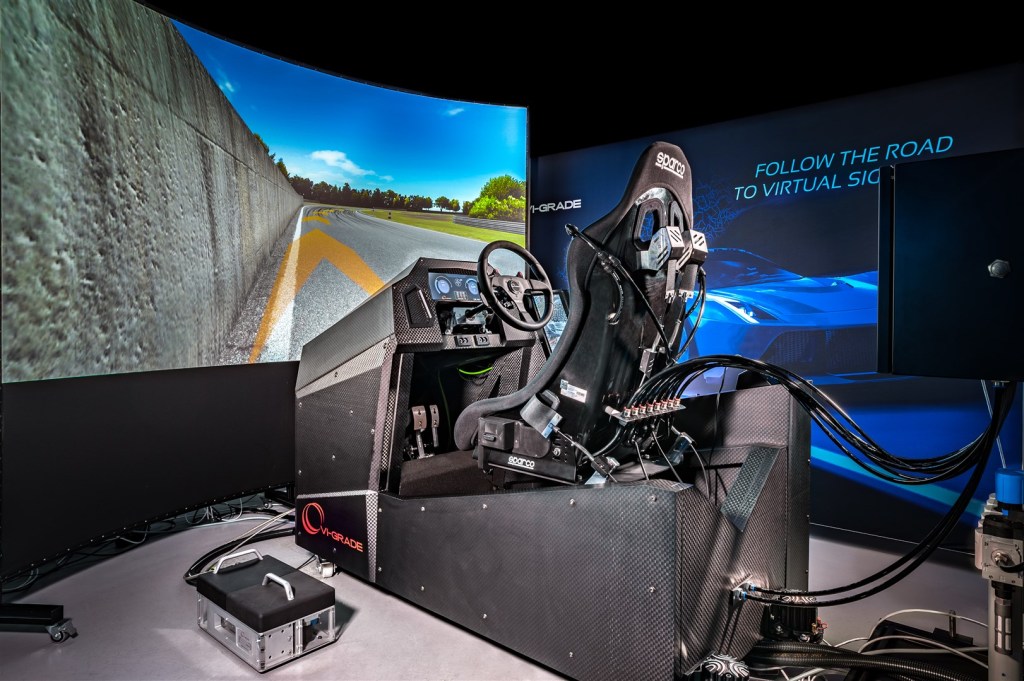
VI-grade simulation system for product development. (Image: VI-grade)

Once it is determined what the issue is (shocks? tires? something else?) there is a replacement made and the test is run again. Making that replacement can require manufacturing of new components. As those components are being made as one-off prototypes, they are certainly not cheap. And it is likely that it takes weeks for them to be ready.

None of which contributes to quick product development.

VI-grade, a company based in Darmstadt, Germany, has an alternative: a simulation-based approach.

This is a sophisticated combination of hardware and software: Yes, it is like a driving simulation game rig but one that has much, much, much more fidelity to reality. After all, the elements are taken from the CAD and CAE files that describe the various elements that go into making the vehicle and there are sophisticated visuals and haptics involved in a VI-grade system.

On this edition of “Autoline After Hours” VI-grade’s Michael Hoffman talks with “Autoline’s” John McElroy, freelance writer Don Sherman, and me about how the tech works (in a way that non-engineers can understand).

Also, Sherman, who is more than a minor expert on all-things Corvette, shares what he’s recently learned about the E-Ray hybrid from the Corvette engineering team.

And you can see it all here.