There’s Something About Mazda Design

By Gary S. Vasilash

Several years ago I met Derek Jenkins, who was heading up Design at Mazda North America.

Then Derek introduced me to one of his colleagues on the team, Julien Montousse.

Both of those guys were doing extraordinary work. Although Mazda sales numbers are low when you put them into context of most other marques, arguably if the vehicles lacked the superb execution of design—inside and out—that they exhibit (and have had for the past several years), then those numbers would likely be microscopic and business-wise it would be catastrophic.

Jenkins moved on to Lucid, where he is leading the design efforts. The Lucid Air is both extraordinary and exquisite from the styling perspective. Simply an amazing vehicle and would be even if it didn’t have its propulsion system.

Montousse moved on, as well, but in his case to Archer Aviation, the company that is creating electric vertical takeoff and landing (eVTOL) aircraft, which Archer plans to have its aircraft in commercial service by 2025.

The Archer Midnight. No, not a car. (Image: Archer Aviation)

Montousse and colleagues just won a MUSE Design Award for the Archer Midnight eVTOL.

Montousse: “After spending most of my life designing cars, I saw from a distance that technology breakthroughs were happening in aerospace and that they would unlock new aircraft architectures. When developing a product in a completely new space like eVTOL aircraft, it’s important to instill confidence and earn the trust of consumers.”

Then, sounding much like a car guy, he went on: “When setting out to design Midnight, we focused on creating a powerful aircraft design that forged an emotional connection between passenger and aircraft. Midnight combines high function with high emotion delivering a travel experience unlike any other.”

Swap out some of those nouns with automotive terms.

Seems like there must be something in the water at Mazda for two extraordinary talents to have come from there.

Fisker: Emotional or Updateable?

By Gary S. Vasilash

Henrik Fisker is an automotive designer whose work includes the BMW Z8 and the Aston Martin DB9. And, of course, there was the Fisker Karma, the car that continued long after the Fisker Automotive ceased to exist. In 2016 Fisker Inc. was established.

Fisker Inc. says of itself: “Passionately driven by a vision of a clean future for all, the company is on a mission to create the world’s most sustainable and emotional electric vehicles.”

Fisker Inc.’s first vehicle, the Fisker Ocean, is an electric SUV. (The Karma was part of the way to clean: a hybrid.)

Fisker Ocean (Image: Fisker Inc.)

Henrik Fisker recently said something interesting (well, he’s probably said plenty of interesting things of late, but this one, in particular):

“In the 21st century, our vehicles are more like rolling computers than the cars of the past, so we need to ensure that our customers are seeing frequent improvements and updates to software.”

He was talking about having over-the-air (OTA) update capability for the Ocean.

When one thinks of a computer, the word emotional probably doesn’t come to mind (unless something has just gone seriously awry and there is a thought about throwing it against a wall).

Although Apple once designed computers that had form factors that were far more appealing (or off-putting) than the run-of-the-mill IBM or Dell—think of the colorful iMac G3, iMac G4, PowerMac G4 Cube—today the products are well-designed, but not particularly emotional.

Henrik Fisker is a chairman and a CEO as well as being a designer.

Consequently, he has to be concerned with what sells.

Which seems to be things that are OTA-capable.

Let’s hope the design doesn’t become an occasional afterthought.

Bob Boniface on Automotive Design

By Gary S. Vasilash

Here’s something that you probably don’t know about Bob Boniface, director of Global Buick Design, even if you know Bob Boniface.

He began his career. . .working at a mutual fund in Boston after receiving his undergraduate degree. . .in psychology and economics.

Boniface did go to the College of Creative Studies in Detroit and while there was hired as an intern to work at Chrysler which led to a job offer from then-head of Chrysler Design, Tom Gale.

Buick Wildcat EV concept. If Buicks look like this, then the brand has a bright, electric future. (Image: Buick)

Boniface was to work at Chrysler for 12 years, during which time he worked on a variety of projects including the second-generation Dodge Intrepid, the Dodge Intrepid ESX (a diesel hybrid with wheel motors), the Stow ‘n Go seating for the minivans, the 300C, and the Jeep Liberty.

In 2004 Boniface moved across town to General Motors. The first thing he worked on was the GM Sequel—a fuel cell-powered vehicle. Then the gen-five Camaro.

Boniface says, on this edition of “Autoline After Hours,” that he was, in effect, employee #1 on the Chevrolet Volt.

Then he moved to Cadillac for six years. He worked on XT4, XT5, CTS, CT6 and. . .he says the best part was working on the V-Series, the CTS-V and the ATS-V. (He says one of the engaging parts of the V programs was the level of commitment across all the functions involved: by having everyone working toward making something special, the results is–something special.)

Boniface moved to Buick in 2016 and has worked on vehicles including the Enclave and the Envision.

He points out that a lot of his work involves overseeing the studios in Korea and China. The China market is huge for Buick—roughly four times that of the U.S. market, so that part of the world is important. He notes that a lot of developments in the interior space are occurring in that part of the world, and interiors are part of his portfolio.

But then there’s the Wildcat EV Concept.

Realize that Buick arguably gave rise to the whole notion of the concept vehicle with the 1938 Buick Y-Job. The brand has had a number of vehicles with striking designs since then, such as the Wildcat I and II of the 1950s to the Velite in 2004 to the Avenir in 2016.

Back in 2018 Boniface says that they went to work on developing not so much a new vehicle as a new design language. But that exercise gave rise to the Wildcat EV Concept, a 2+2 coupe that is an expression of the electric future of Buick and that expression includes a new face—although being new, it also includes a nod to the brand’s design paste (e.g., high lamps, body-mounted badge).

Again: it is the language that they created and the vehicles to come will be spelled with those words.

If you have any interest in automotive design over the past 30 years, then this edition of “Autoline After Hours” is must viewing.

Joining the discussion are Greg Migliore of Autoblog and Joe DeMatio of Hagerty Media.

And you can see it here.

Does Clay Modeling Matter in the Age of the Metaverse?

By Gary S. Vasilash

The metaverse notwithstanding, when it comes to developing the designs of most vehicles—particularly when those vehicles are intended to be things that are duplicated thousands of times over several years—there is something to be said for physical objects.

To be sure, there are software design packages that designers use to create designs to a degree that are not merely photorealistic, but which can be manipulated in VR space.

These designs seem real. But those designs aren’t real.

Crossovers, cars and trucks, unlike digital models, exist in real reality, not virtual reality.

The sun shines on them. Clouds occlude the sun. Shadows form. Surfaces pop or fade.

Vehicle designs will exist in the tangible world.

So while there are vehicles that are completely designed in math (after all, that’s what software is), there are more vehicles designed with the aid of clay.

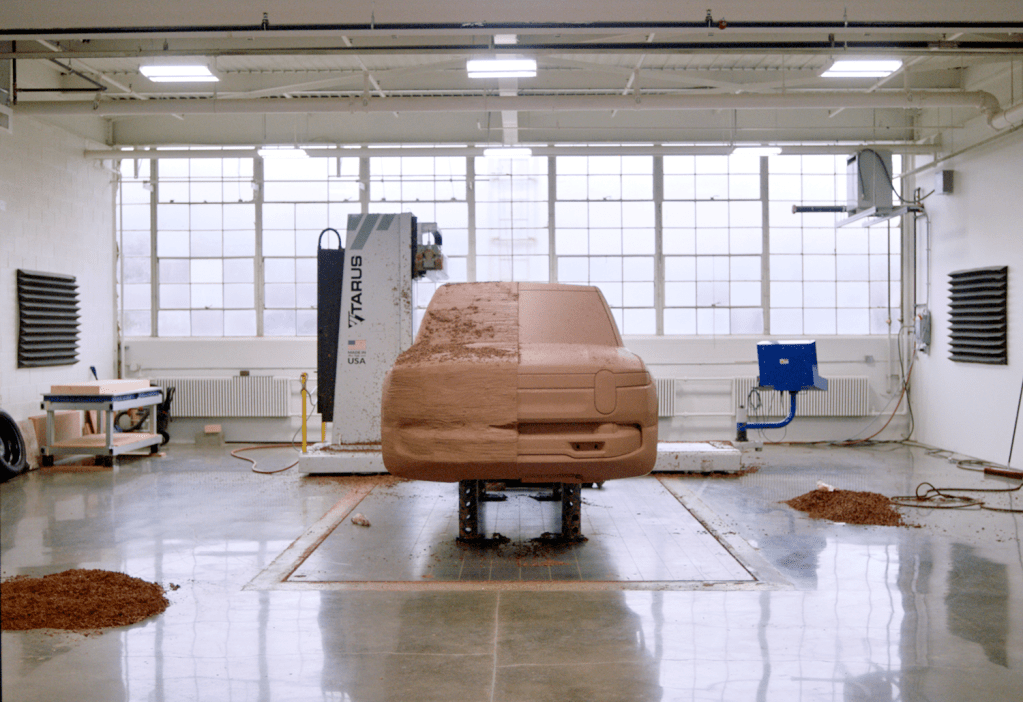
Clay milling a Rivian. (Image: Rivian)

Yes, that substance that you may remember playing with as a child.

Well, not exactly that, as there is a variant of the material that is formulated to be used in automotive design studios.

But substantially the same.

The material is used to create full-size models of vehicles.

In order to make one of these models in a reasonable amount of time the clay is milled with cutting tools.

The producer of clay milling machines (as well as a number of other machine tools that are used on metals) is TARUS. In fact, the company invented the clay mill in response to a request from General Motors.

Does the clay mill still matter?

On this edition of “Autoline After Hours” we decided to find out. So we asked Doug Grieg, Jr., co-owner of TARUS. To get some good perspective, “Autoline’s” John McElroy and I are joined by John Manoogian II, who had spent 35 years at GM Design, with his last position being director of Exterior design for Cadillac.

Anyone who wants to know the ground truth about automotive design cannot miss this show, which you can see right here.

Kemal Curic Talks Lincoln Star Concept

By Gary S. Vasilash

Lincoln, like other brands, is working to redefine itself by developing electrified vehicles. One of the advantages that Lincoln has in this regard is that (1) it is the luxury brand of the Ford Motor Company, which is devoting serious resources to creating vehicles of this type so it gets a big lift from its parent company and (2) as it is a luxury brand, there is more headroom vis-à-vis pricing because let’s face it: electric vehicle technology is still expensive, so putting it in vehicles that appeal to customers (or “clients” as Lincoln people may refer to them) that can afford more is the right move.

Lincoln plans to have three electric vehicles in its showrooms by 2025. Odds are all or some will be variants on what exist there right now (which makes sense: the Nautilus actually had a 7.5% sales increase in 2021, a year that otherwise was rife with minus signs).

But Lincoln has unveiled what Kemal Curic, global design director, Lincoln, refers to as a “moonshot,” the Lincoln Star Concept.

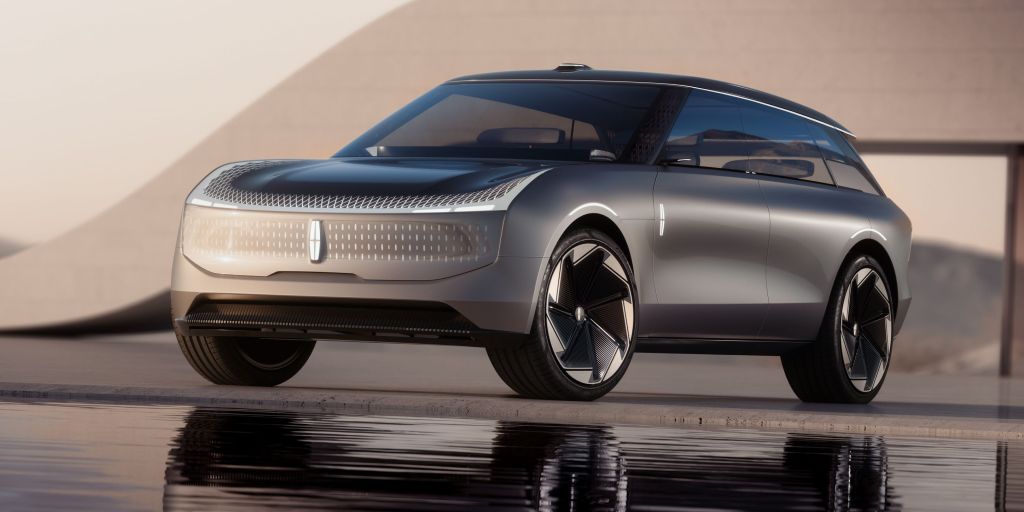
The Lincoln Star Concept: the essence of electric luxury. (Image: Lincoln)

The “star” refers to the graphic logo that Lincoln uses. Picture the basically rectangular badge with the cross in its center more square-like and extend the arms of the cross out beyond the square with pointed ends: It then becomes something that is like a North Star image. The North Star (a.k.a., Polaris) is the brightest star in the night sky and as such has long been used as a point of navigation: the Lincoln Star Concept is the direction that Lincoln is heading toward.

What’s more, a star is about light, and if there is something striking about the Lincoln Star Concept is that whether it is on the front fascia or in the cosseting cabin, animated light is an absolute key feature.

In this edition of “Autoline After Hours” Curic talks to John McElroy and me about the Lincoln Star Concept: the whys, the hows and the wherefores, about how they are using advanced technology (e.g., using 3D metal printing to create the A- and D-pillars that have an organic form that allows the driver to have less-obstructed views), to imagine what could be in Lincoln’s future.

An interesting point that Curic makes about developing the vehicle, which is certainly applicable to other things, not just vehicles, is that they worked to subtract things, to create something more essential in the context of revealing the essence of luxury rather than obscuring it with what are superfluous features.

You can learn about this and other aspects of the Lincoln Star Concept from Kemal Curic by going here.

David Woodhouse of Nissan Design America on Nissan Design

By Gary S. Vasilash

David Woodhouse is Nissan Design America vice president of Design, a position that he’s held since June 2019. Prior to joining Nissan Woodhouse held a number of senior design positions at Ford, including as director of Design at Lincoln and design director for its Global Strategic Design function.

Put simply, Woodhouse is well versed in automotive design. (He also races, so this is more than theoretical to him: he knows what makes something good.)

He began his professional design career in 1994 (at BMW), so he’s been around long enough to know what’s going on without having been around so long that he isn’t resistant to what’s going on.

Nissan—including Infiniti—is an interesting place to be as it is a full-line manufacturer with utes, pickups, sedans, sports cars, and EVs in its portfolio. There’s the Nissan Versa at one end of the spectrum and the Infiniti QX80 at the other.

2023 Nissan Ariya interior (Image: Nissan)

On this edition of “Autoline After Hours” Woodhouse talks with “Autoline’s” John McElroy, Eric Noble, founder and president of automotive consultancy The CARLAB, and me about some of the new developments at Nissan—like the electric Ariya and the forthcoming Z—and his view in a more macro sense of what’s going on in car design.

In something of a departure from other interviews, Woodhouse also answers a couple questions from transportation design students at ArtCollege School of Design (Noble is on the faculty there).

One of the intriguing things about Nissan’s design approach is that they are embracing the heritage of the company, using what Woodhouse calls “J DNA,” with the single letter standing for “Japanese.” For example, the interior of the Ariya is meant to be comfortable like the room of a house, so the Japanese Omotenashi approach to hospitality was taken into account when executing the interior design.

During the second half of the show, McElroy, Noble and I discuss a variety of topics, including Ford’s separating its ICE and EV operations, the February vehicle sales (a SAAR of 14 million: not good), the consequences of rising petroleum prices due to the Russian invasion of Ukraine, and the competitive space in electric vehicles (with this last bit being somewhat. . .lively).

And you can see the whole show right here.

Cadillac LYRIQ: Hitting All the Right Notes

An up-close look at the exterior and interior design of what will undoubtedly become the flagship of the Cadillac lineup (sorry, Escalade)

By Gary S. Vasilash

The Cadillac LYRIQ is certainly the most important Cadillac vehicle to be launched since the Cadillac CTS appeared in 2003. Arguably the LYRIQ, an electric vehicle, is one of the most important products that General Motors is putting on the market because it truly marks a commitment to contemporary EVs that it has announced are coming.

The 2023 LYRIQ, which will be on the market in the first half of 2022, is the real thing.

The fresh face of Cadillac. (Images: Cadillac)

Yes, it will be beaten to showrooms by the GMC HUMMER EV, but that is arguably a niche vehicle. A niche vehicle with people with deep pockets: the first edition, for which all of the reservations have been spoken for, has an MSRP of $112,595.

The LYRIQ will start at $58,795. The reservations for the first edition of the crossover were full. In 10 minutes.

The LYRIQ has an estimated range of over 300 miles from the 100.4-kWh Ultium battery pack. It is a rear-drive vehicle. The Ultium drive unit will provide ~325 hp.

On the inside there is a 33-inch diagonal screen that stretches across the instrument panel, a 19-speaker AKG Studio audio system, eight-way power driver and front passenger seats, and other accoutrements that are characteristic of a vehicle that is a showcase for the brand.

An interior so well crafted, you might not want to leave when your trip is complete.

On the exterior there is a illuminated black crystal front grille that illuminates in an orchestrated manner, a grille that is certainly a signature of not only the vehicle, but of the level of creativity, imagination and technology that may become known as what Cadillac is all about.

On this edition of “Autoline After Hours,” we learn about the LYRIQ, inside and out.

We—“Autoline’s” John McElroy, Henry Payne of The Detroit News, and me—are joined by Brian Smith, Cadillac exterior design director, and Tristan Murphy, Cadillac interior design manager.

What is notable about LYRIQ, even if you put aside that it is an EV, is that this is a vehicle that was a total clean-sheet design. They were creating something absolutely new, something that wasn’t a variation on a theme.

The charter was to create a vehicle that would not only show the world of electric vehicles that Cadillac has arrived, but the world that drivers live in too: This is meant to be a vehicle that not only will people like driving, but be one that they’ll be proud to be seen in.

Three of the words that Smith and Murphy use to characterize what the LYRIQ represents are performance, technology and craftsmanship.

The best of right now with the attention of detail that often seems to be lost.

===

Then, for the second half of the show, McElroy, Payne and I, all jurors for the North American Car, Truck & Utility of the Year (NACTOY) awards, talk about the vehicles that we had the opportunity to drive earlier in the week, all semifinalists for the 2022 awards.

The vehicles include:

  • Audi A3 and S3
  • Cadillac CT5-V Blackwing
  • Genesis G70
  • Honda Civic
  • Mercedes S Class
  • VW Golf and GTI
  • Ford Maverick
  • Hyundai Santa Cruz
  • Nissan Frontier
  • Toyota Tundra
  • GMC HUMMER EV pickup
  • Rivian R1T
  • Ford Bronco
  • Genesis GV70
  • Hyundai Tucson
  • Jeep Grand Cherokee
  • Jeep Wagoneer & Grand Wagoneer
  • Kia Carnival
  • Nissan Pathfinder
  • VW ID.4

And you can see it all here.

Designing the 2022 Ford Maverick–& About Electric Pickups

A wide-ranging discussion that’s concentrated on pickups

By Gary S. Vasilash

Although “essential courage” may sound a bit exaggerated when it comes to the design theme for a vehicle, Scott Anderson, design manager at Ford, explains how that term describes what the team did in developing the design of the 2022 Ford Maverick—the interior design, in particular.

The Maverick is a compact truck. Unibody, not body-on-frame, like its sibs, the Ranger and the F-150.

While those two vehicles are designed and engineered primarily for those who are focused on, primarily, vocational uses (OK: there are plenty of people who buy pickups and never use the beds for anything beyond groceries or Christmas trees), the Maverick is designed and engineered mainly for urban dwellers who like to do recreational things (the Maverick can tow 4,000 pounds: like a small trailer) and whose recreation may include making things, not only with sheet metal and 2x4s, but also 3D printers.

It is a different proposition.

One of the things to know about the Maverick is that in the base model, which has a starting MSRP of $19,995, has a hybrid powertrain.

And as has long been the argument by some OEMs that have not gone the hybrid route, the nature of that, which combines an internal combustion engine (in this case a 162-hp 2.5-liter four) and an electric motor and battery (all in for the Maverick: 191 hp), hybrid powertrains are more expensive than, say, a 162-hp 2.5-liter four all by itself.

But the base Maverick is a hybrid and the base Maverick starts at under $20K.

And because it is a truck and because Ford has a lot riding on its reputation of building trucks (i.e., “Built Ford Tough”), there could be no skimping on the engineering of the Maverick.

So no surprise they had to do some things differently on developing and executing the interior.

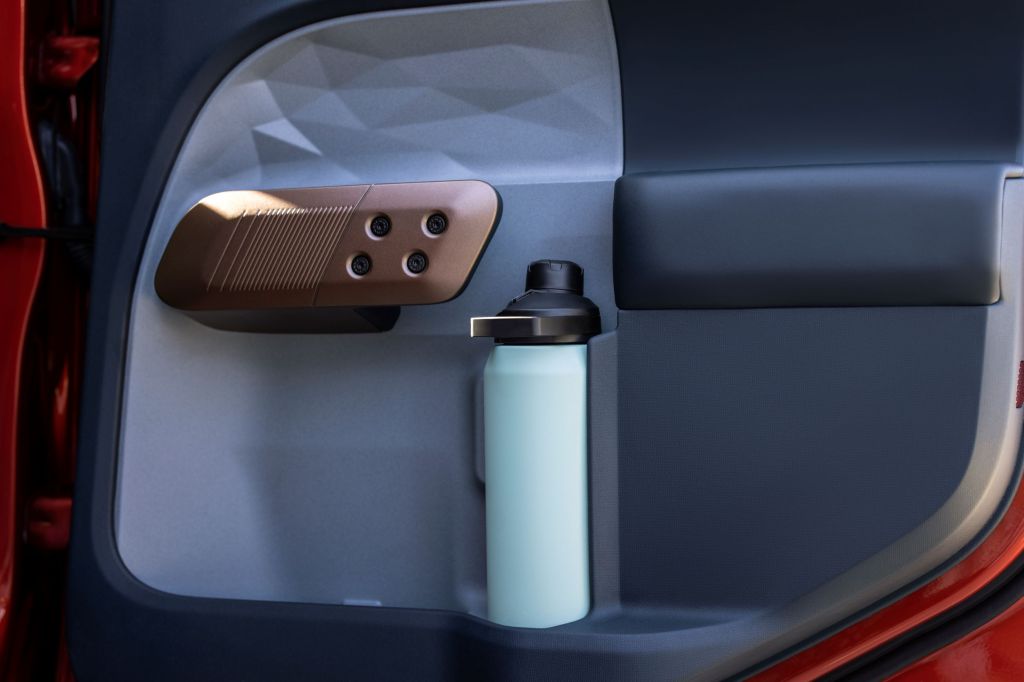
Functional design and clever use of materials in the ’22 Ford Maverick. (Image: Ford)

For one thing, Anderson says, they decided that they would be honest about the use of plastic. They wouldn’t make it appear as though the material is something that it isn’t—but at the same time, they made it appear, through color and texture choice, as something both interesting and fit-for-purpose.

In addition, they did lots of observation about how people use their interiors, including storing objects of various sizes and configurations and so make the means to accommodate them, even if it meant things, as in the case of the front arm rests, are not what is typical: the front arm rests are truncated so as to make it more convenient to have large water bottles in the map pocket below.

So there is the essential part. And the guts, because when you decide that fasteners, for example, are going to be part of the design, not something hidden (often in a half-assed manner), then you’ve got to stand up for it.

Anderson talks about all this and more on this edition of “Autoline After Hours” with Rain Noe of Core77, freelance writer Mark Williams and me.

In addition, Noe, Williams and I discuss the coming onslaught of electric trucks, including the F-150 Lightning, the Rivian R1T, the HUMMER EV pickup, the Bollinger B2, the Silverado electric, the Tesla Cybertruck, and the Lordstown Endurance.

And you can see the show here.

2022 Toyota Tundra, Briefly

There hasn’t been an all-new Tundra since 2007. So given that they’ve been working on it for a while. . .

By Gary S. Vasilash

The specs speak for themselves. Especially for the 2022 Toyota Tundra with the i-FORCE MAX powertrain, which takes the standard 3.5-liter twin-turbo V6 (389 hp; 479 lb-ft of torque) and hybridizes it so that it produces 437 hp and 583 lb-ft of torque.

Yes, another full-size pickup truck with a hybrid.

But what is different about this approach being taken by Toyota is, explains Mike Sweers, senior vice president, Product Development Office and F1 Platform (i.e., what the new Tundra is based on) engineer, is that rather than trying to boost the fuel efficiency of the truck, the objective is to provide what he says most serious truck users are looking for, which is more power. (There is a 10-speed automatic for both engines.)

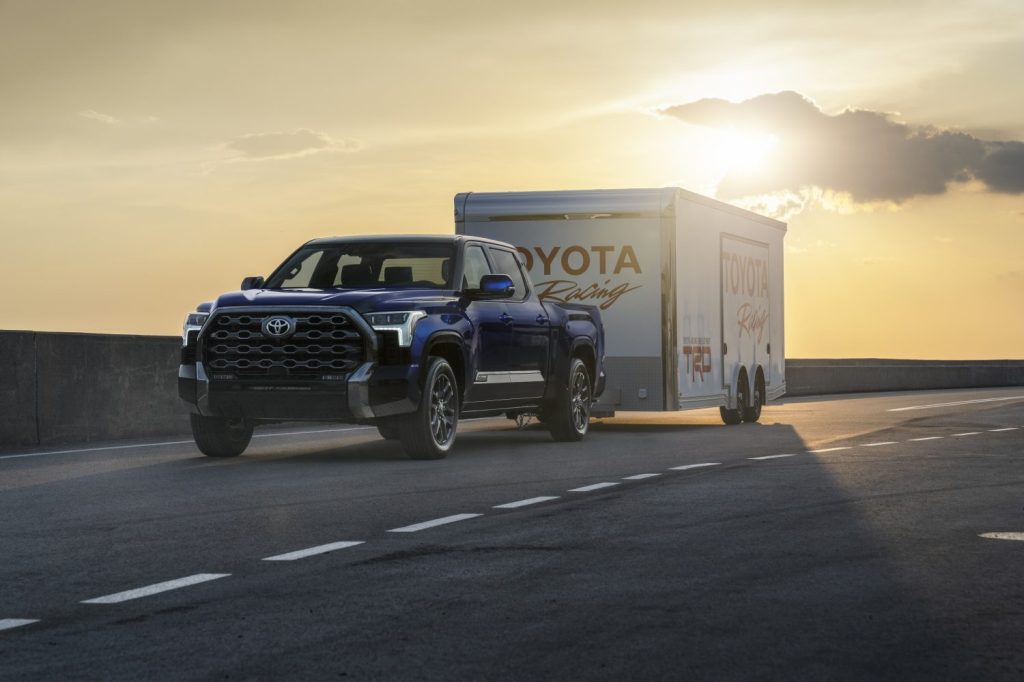
While the Tundra can certainly tow–as in up to 12,000 pounds–the vehicle is meant more for those who do recreational towing than commercial–which is more about the nature of the Toyota brand than anything having to do with the capability of the truck, because it is engineered to be fully capable–and then some. (Image: Toyota)

Framed

The thing about the ’22 Tundra is that there is a focus on overall robustness. They went from C-channel frame cross members to boxed, for example. While that improved stiffness, there was consideration taken for those who ride on a regular basis—loaded or unloaded—so there is a multilink rear suspension with the shocks mounted outside the frame rails to help improve the handling and ride comfort. (Even more comfort is provided by the available air suspension system that provides both manual and automatic leveling.)

The new Tundra can tow up to 12,000 pounds—which is an increase of 17.6% compared with the previous generation—and the load in the bed, which is based on sheet molding compound, which has been used on the Toyota Tacoma with excellent results, is 1,940 pounds, or an 11% increase.

Tugged

While on the subject of towing, it is worth knowing that there are two Tow/Haul modes. Activate the standard mode and the throttle response in increased. Activate the Tow/Haul+ mode and that response is amped up even more—and speaking of amps, the trucks with the hybrid powertrains have the electric motor constantly in operation during Tow/Haul+ and the engine Stop-Start function is deactivated.

And there is another towing-related aspect to the ’22 Tundra: Its design.

According to Adam Rabinowitz, chief designer at Calty who led the exterior design team for the truck, “We wanted to make it look like a premium towing machine.”

Toughened

Rabinowitz explained that the truck design is meant to deliver on it being more recreational than commercial—as in people with boats and trailers rather than people with tool trailers or earth movers.

And while they worked to show that it is tough enough to take it (e.g., there is a beam shape on the body side that is meant to convey the image of the truck’s frame), they also worked to assure that it looked sufficiently high-tech, such as through the use of the slim, high-mounted headlights.

Locked In

Benjamin Jimenez, studio chief designer at Calty, who led the interior design, echoed that “this is more of a recreational truck, so our approach was different than that of our competitors,” said that unlike the competitors, who generally use a vertical layout to the elements of the interior, they opted to go horizontal with all elements of the interior interlocking (e.g., doors with IP and trim) to provide a strong look: “We didn’t want this to feel weak in any way,” Jimenez sad.

Another way of indicating that the ’22 Tundra is more for adventure than work: upon startup, there is an image of one of five national parks indicated on the gauge cluster.

What Is an Automobile?

A brilliant take written because of the Automania exhibit at MoMA

“There are few consumables that have been designed since their inception to capture every sense and sensibility that humans have more than the car. It is the most practical yet mythic of inventions. It is machine and art. It is the product of genius and object of desire. Yet it is also a tool, and as such promotes good and destroys worlds.”—Steven Heller, Print