Stellantis Advancing Factory Tech

Investigating and installing new technologies to improve production operations

By Gary S. Vasilash

Chances are, when you think of a corporate venture startup fund focused on early and later-stage startup companies, a multi-million fund, you probably don’t think “auto industry.”

Yet they exist. While like those firms you think about they invest in AI, new battery chemistries and other advances, at Stellantis Ventures the team is looking for ways for the parent company’s factories to work more efficiently and effectively.

Realize that in North America alone Stellantis has 31 manufacturing operations, 18 in the U.S., seven in Mexico and six in Canada, so making improvements can have significant effects on the bottom line.

Inside Detroit Assembly Complex–Jefferson. (Image: Stellantis)

To say nothing of the fact that the company also operates plants in France, Italy, Spain, Germany, UK, Poland, Portugal, Serbia, Slovakia, etc.

Tim Fallon, Senior Vice President, Global Head of Stellantis Production Way, said that an objective that he and his team have is to assure that production systems around the world are setup so that benefits realized in one facility can be shared with others so the whole system is continuously improved. Among the areas focused on are quality, efficiency and sustainability.

And one of the ways there is improvement is through the implementation of new technologies. One of the ways this is being achieved is through the discovery of new tech, something that Anna Valeria Anllo, Head of Global Innovation for Vehicle Process Engineering, said Stellantis Ventures helps the manufacturing team discover.

In addition, there is an on-going compilation of a list of potential suppliers that can help advance the manufacturing process.

Stellantis recently held what it calls its “Factory Booster Day,” an annual event that is attended by Stellantis personnel as well as 80 suppliers—traditional suppliers and startups.

The event was held at the company’s Conner Center in Detroit.

Fallon said there were some 700 people on site as well as an additional 1,200 on-line.

While there is an abundance of advanced technology showcased, the objective is to make this tech operational in Stellantis factories.

For example, at the 2024 Factory Booster Day a firm named KCF Technologies worked with Stellantis personnel on an AI-powered predictive maintenance (PM) system that is being used in North American paint shops. The system collects sensor data from various systems within the paint shop (e.g., pumps, fans, exhaust systems) and then makes a determination as to when PM is necessary.

Fallon said that unlike systems identify problems, this AI system learns and, as a result, uptime is maximized in the paint shops, which are a highly critical part of any assembly plant.

Another example is a camera system that uses AI to perform 100 inspections per vehicle at the Detroit Assembly Complex—Jefferson (where the Jeep Grand Cherokee and Dodge Durango are produced). The KEYENCE IV4 camera system—it features built-in lighting, lenses, and AI-powered inspection functions—provides real-time feedback to operators and automated repair alerts.

Supplementing this is a Stellantis-developed AI Agent Tracker that provides daily performance analytics.

Although the Factory Booster Days are annual events, Anllo said they are consistently looking for the ways and means to improve operations: “We believe in the fast and the furious.”

Toyota’s Templin Talks Tariffs

The long and short of it is this: affordability is challenging without the tariffs, so for consumers (and companies) they’re not going to be advantageous. . .

By Gary S. Vasilash

“First, let’s start with the ‘T’ word,” Mark Templin, executive vice president and chief operating officer, Toyota Motor North America (TMNA), began in a presentation to a couple hundred journalists at TMNA headquarters in Plano, Texas, today.

“No, not Toyota. I’m talking tariffs.”

And Templin began a measured explanation as to why tariffs are not going to be good for Toyota and other OEMs and will certainly not be good for the consumer.

“A 25% tariff on all imported vehicles is not sustainable longer term without significant price increases,” Templin said, adding, “And the industry already has an affordability problem.”

Affordability?

According to Kelley Blue Book, the new vehicle average transaction price in April was $48,699.

Were that 25% added to the average transaction price, that number would grow to $60,874.

Average.

Is anyone going to be getting a 25% raise anytime soon?

The Whole & the Parts

In addition to which, there are, Templin pointed out, tariffs on imported auto parts.

“It’s important to understand,” he said, “that supply chains are global, they’re complex, and they’re very fragile. Many of the suppliers”—which make things like parts that are used in shops and garages for purposes of repair—“are not capitalized for an abrupt tariff.”

Bottom line: the tariffs “will make servicing and repairing vehicles more expensive for customers.”

So for those who realize they’re not going to be able to afford a new vehicle and so will hold on to their existing one will discover that taking Old Reliable into the shop isn’t going to be an inexpensive operation.

Auto Is Really Important to the Economy

Templin pointed out that the auto industry added more than $1.2-trillion to the U.S. economy last year, nearly 5% of GDP.

Not only does the industry directly employ 10.1 million people in the U.S., there is a multiplier effect whereby each auto job creates nine more jobs.

Hobbling the industry with tariffs is probably not a good economic decision.

Templin pointed out that Toyota has 14 plants in North America, 11 of which are in the U.S.

“Nearly 80% of what we sell in the U.S. is built in North America, and over half is built here in the U.S.”

So, some might think, why not simply move more production into the U.S. and thereby avoid the tariffs?

Toyota Motor Manufacturing Kentucky—better known as the “Georgetown Plant”—has been in operation since May 1988. Since then they’ve produced more than 14 million vehicles. Last year alone the people at the plant manufactured 435,631 vehicles and 714,400 engines. The Camry, which was the best-selling sedan in the U.S. last year for 23 straight years running, is built at Georgetown. So far Toyota has invested more than $11-billion in the facility. Yes, they know more than a little something about domestic manufacturing. (Image: Toyota)

It Takes More Than a Moment

“Contrary to what some may think,” Templin said, “the auto industry has long product life cycles, and we can’t simply move production facilities overnight.”

And if a world-class manufacturer like Toyota can’t do it quickly, odds are those that are less adept are going to take a whole lot longer—assuming any companies are going to go down that road.

“Right now,” Templin said, “we are in a wait-and-see mode.”

Toyota execs are working to provide as much stability as they can for employees, dealers and suppliers.

“Our message to all of them continues to be: ‘Stay calm and stay focused on the customer.”

“At Toyota, we make decisions based on consumer and market needs rather than the policy direction of the moment. So our thinking is long-term,” Templin said.

The company has invested some $50 billion in the U.S. over the past 68 years. Yes, they think long-term about their operations here. Of that there can be no doubt.

Templin said that he’s met with policy makers in Washington and that he believes they understand the importance of the auto industry to the U.S. economy and the consequences of tariffs.

Let’s hope he’s right.

Advanced Automotive Manufacturing—in Georgia

The Hyundai Metaplant America is the kind of manufacturing facility that other OEM manufacturing execs probably dream about. . .

By Gary S. Vasilash

I have seen the future of automotive manufacturing and it is in Savannah, Georgia. More specifically, it is in Ellabell, GA, but it is proximate (20 miles) to the more well-known locale.

The Hyundai Motor Group Metaplant America (HMGMA), which had its grand opening in late March, has been building Hyundai EVs since early October 2024. The first product is the IONIQ 5. It has since added the IONIQ 9.

The complex consists of 11 buildings with 7.5-million square feet under roof.

Hyundai has invested $12.6 billion in HMGMA as well as two battery joint ventures, one with LG Energy Solution and one with SK On.

The initial announced capacity was 300,000 vehicles per year.

Even before the launch is fully ramped the company announced it is going to increase capacity to 500,000 units.

HMGMA will not only be producing EVs for Hyundai, but products for sibling brands Genesis and Kia. And in addition to EVs, the plant will manufacture hybrid vehicles.

Shiny & Bright

To be sure there is something to be said for a new plant the way there is for a new car. Everything is bright and clean.

But HMGMA is exceptionally bright and clean—there are even skylights in the vaulted roof of the General Assembly building.

The epoxied floors shine with nary a smudge.

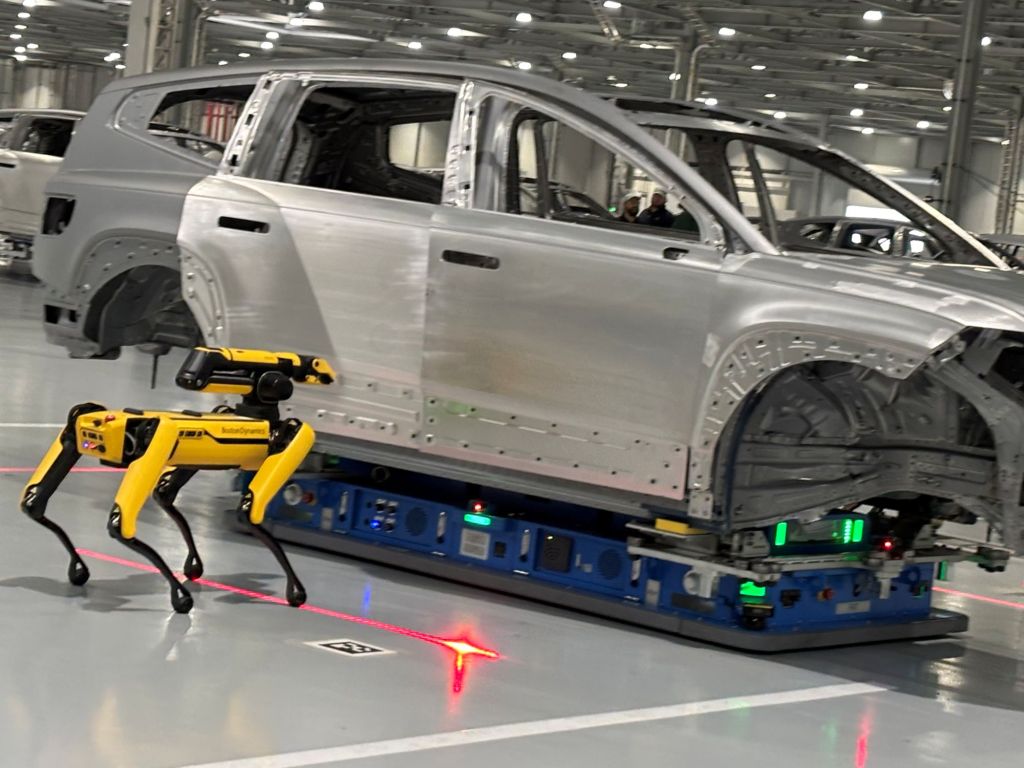
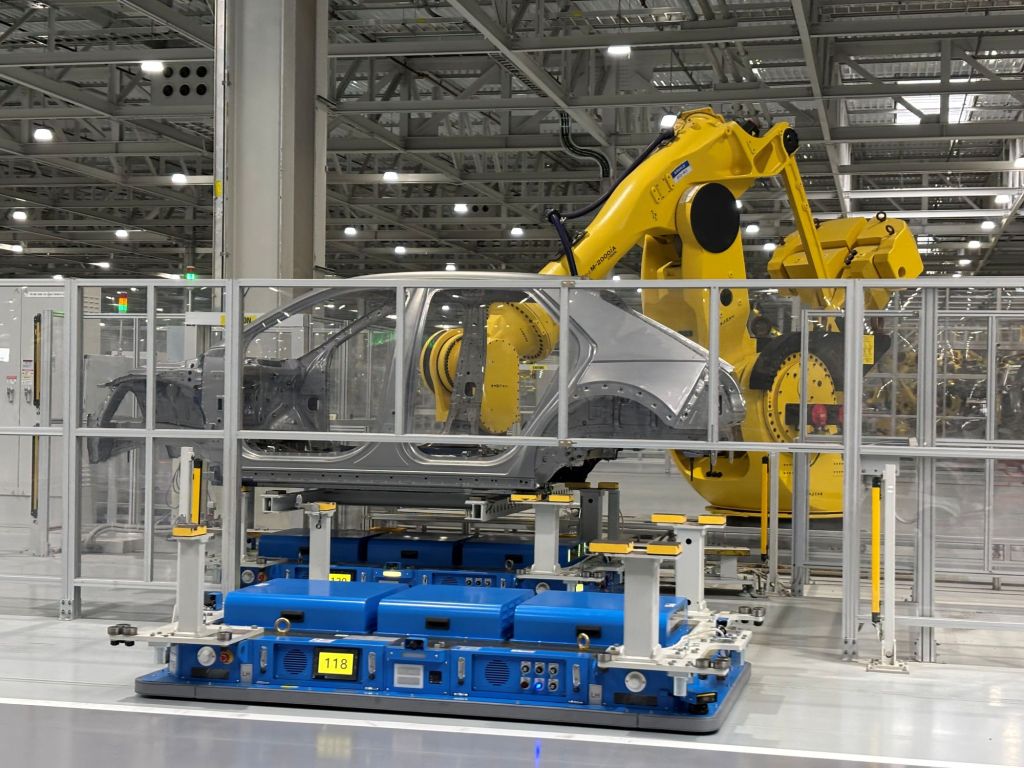
There are AGVs and robots throughout the HMGMA complex. (Images: Vasilash)

Advanced Manufacturing Tech

Hyundai operates the Hyundai Motor Group Innovation Center Singapore, where the company is developing smart manufacturing systems as well as producing vehicles with the hardware and software developed there (it has an annual capacity of 30,000 EVs).

The Singapore site is the testbed for the tech that is deployed in HMGMA.

While there is a significant number of robots working in the Weld shop—475—what is more impressive is the number of automated guided vehicles (AGVs) of various types, sizes and configurations that are autonomously running throughout the plant. These units are doing tasks ranging from parts delivery to actually lifting the finished vehicles at the end of the line and positioning them for subsequent inspection and tests.

The people working on the line—called “Meta Pros”—are not only walking on wood surfaces to make it easier on the legs during a shift, but tasks that might otherwise have them climb into a vehicle-in-process—such as installing a center console—are automated so as to relieve them of what might be ergonomically awkward conditions.

Hyundai owns Boston Dynamics, the producer of Spot, the four-legged robot shown here, performing an inspection task.

Investing Even More

Hyundai has announced that between 2025 and 2028 it will be investing $21 billion in the U.S. Part of that funding—as in $9 billion—will be to increase the total production capacity it has to 1.2 million vehicles. (It also has a plant in Montgomery, Alabama, Hyundai Motor Manufacturing Alabama, which builds the Santa Fe, Tucson, Santa Cruz, and Genesis GV70.)

When HMGMA is fully staffed there will be approximately 8,500 people working there.

The average salary for a Meta Pro is $58,105, not including benefits. Other workers in Bryan County, where the plant is sited, have an average wage of $47,000.

A good job in a modern facility for a good salary. That’s what bringing manufacturing to the U.S. is really about.

Equipment Utilization Matters

One thing that doesn’t get a whole lot of attention in discussions about EVs are the volumes in the factories where they are built. . . .

By Gary S. Vasilash

In announcing its Q3 performance, General Motors did the typical approach of accentuating the positive. As the company’s sales were down 2.2% in the quarter compared with Q3 ’23 and are down 1% year-to-date compared with ’23, that wasn’t going to be it.

Rather, as Rory Harvey, GM executive vice president and president of Global Markets is quoted:

“GM’s EV portfolio is growing faster than the market because we have an all-electric vehicle for just about everybody, no matter what they like to drive.”

While in Q1 ’24 GM’s U.S. share of the EV market was 6.5%. It reached 9.5% in Q3.

Clearly its EV sales are on an upward trajectory. But multiple models can drive up production costs.

The Models

Taking BrightDrop commercial vehicles out of the picture, since January GM has sold 70,450 EVs.

Specifically:

  • 20,318 Cadillac LYRIQs
  • 15,232 Chevy Blazer EVs
  • 8,582 Bolt EV/Bolt EUVs
  • 10,785 Equinox EVs
  • 5,252 Silverado EVs
  • 8,902 GMC HUMMER EVs
  • 387 Sierra EVs

The LYRIQ is built in Spring Hill, Tennessee.

The Blazer EV is built in Ramos Arizpe, Mexico.

The Bolts are built in Orion, Michigan.

The Equinox EV is built in Ramos Arizpe.

The Silverado EV, HUMMER EV and Sierra EV are made in Detroit-Hamtramck.

Seven vehicles.

Three factories.

And some 70,450 have been built over a nine-month period.

While there is certainly some sharing of components, there are things like body stamping that aren’t common, which means dies. And the interiors of the three vehicles built at the Factory ZERO plant are different executions, though, again, there are some common parts.

But the point is, there are different costs associated with these vehicles’ production.

Capacity Utilization

Let’s say that the production capacity of an assembly plant is 250,000 vehicles per year.

A rule of thumb is that such a plant must operate at 80% capacity in order to be profitable, so that would be 200,000 units.

Even if the production of EVs doubles from the end of Q3 to the end of Q4, that’s 140,900 vehicles, or 70.45% of a 250,000-unit-capacity plant.

Now in the case of the Ramos Arizpe plant, in addition to the Chevy EVs it is producing the ICE Blazer and the Honda Prologue EV. The former has sales through Q3 of 40,545 vehicles and the latter 14,179.

So with all four of the vehicles being built there, there is an output through Q3 of 80,741.

If that number is doubled by the end of the year to 161,482 (which, of course, won’t happen), that would be about 65% capacity utilization of a 250,000-vehicle plant.

But let’s go back to the 70,450 units of GM EVs sold through Q3.

It is worth noting that during the same period there were 70,710 Chevy Colorados sold.

One model. One plant.

And it shares Wentzville Assembly with the GMC Canyon (26,956 sold through Q3, or 6,638 more vehicles than the best-selling GM EV. In fact, you could add the sales of the Silverado EV and the Sierra EV onto that LYRIQ number and it would still be short of the Canyon: 25,957.)

Profitability in EVs is going to take GM and some of its competitors a bit more than reduced battery costs.

Honda: EVs and Beyond

How it is going to leverage manufacturing to advantage

By Gary S. Vasilash

Ostensibly the briefing was to see up-close-and-personal the Acura Performance EV Concept which had only otherwise been shown during Monterey Car Week.

Who doesn’t want to see what is likely to be very similar to the electric vehicle that is going to go into production in Ohio in late 2025?

Acura Performance EV Concept. (Image: gsv)

Two points about the concept:

  1. It is a concept vehicle, something that is becoming less and less common in the industry today—because of the time, effort, energy, and investment made in these full-scale models. Sure, there could be the argument made that this can all be done digitally. But Honda and Acura have those digital tools, too, and there is something to be said for a physical model.
  2. Dave Marek, who is executive advisor for Design for Honda R&D and Global Honda (which essentially means he’s the go-to guy for design considerations across the company), points out that Honda and Acura typically hew rather closely to their concepts when it comes to production vehicles, so the Acura Performance EV Concept, which he says features “hydrodynamic design” principles—think “superyacht”—may be something rolling off the line at what is being called the “Honda EV Hub.”

Which brings us to the second part of this, which is an explanation of the strategy and the tactics of the EV Hub by Mike Fischer, who is the lead on the project and an executive chief engineer to boot.

First of all, the “Hub” is not a singular place.

Rather, Honda is retooling the Marysville Auto Plant, the East Liberty Auto Plant, and the Anna Engine plant to have the capabilities to produce EVs in a highly efficient manner that produces high quality, consumer-valuable products, processes that are both human- and environmentally-friendly.

But here’s the thing, and not something that Fischer and his colleagues just came up with during the past few months when EV sales softened.

Fischer explains that this “reimagining of Honda manufacturing” is something that is predicated on flexibility.

So they are developing production capability that will allow them to build EVs, hybrids, and ICE-vehicles all on the same line.

(One way this will be accommodated is by having feeder lines that will do the subassemblies for the varying types of vehicles that then feed into the main line.)

Yes, they are developing a dedicated EV platform that will allow various models to be derived from it.

Yes, they are installing 6,000-ton high-pressure diecasting machines—there will be six of them—in the Anna plant to perform “megacasting” of the Intelligent Power Unit (IPU) case; the case houses the battery and associated electronics and functions as part of the vehicle platform.

But what’s notable is that in this undertaking, which the company is investing more than $5-billion and which will serve as a model for Honda facilities around the world, Honda is getting back to its manufacturing roots in essentially taking a clean-sheet approach to the way things are done.

While product certainly matters, the ability to produce those products so that they meet customer demands—cost, quality, availability—is something that Honda has shown itself to be superb at over the years, so while some argue that it is comparatively late to the game in terms of EVs, the flexible manufacturing capability Fischer and his team are developing will more than make up for any delay—and will provide Honda and Acura with the powertrain options that its customers are looking for.

That will put it not merely in the game, but quite possibly ahead of it.

McLaren Automotive & Atlas Copco

Yes, even supercars must be assembled. . . .

By Gary S. Vasilash

When you think of McLaren Automotive, you probably think of supercars like the Artura Spider shown here:

It’s a hybrid that combines a 3.0-liter twin-turbocharged V6 and an axial flux electric motor to produce 690 hp.

Or thought of in action: 0 to 60 mph in three seconds.

A convertible.

When you think of McLaren Automotive, you probably don’t think of nut-runners and other assembly tools.

But at the McLaren HQ in Woking, Surrey, England there is the McLaren Production Centre, where the cars are built.

Of course, they’re built more like a fine mechanical watch than a run-of-the-road motorcar.

But they are still manufactured.

The McLaren announced that Atlas Copco is the company’s “Official Smart Tooling Supplier.”

The builder is deploying Atlas Copco battery-powered, digitally enabled nut-runners and other tools throughout its manufacturing operation. It is leveraging the Atlas Copco Smart Integrated Assembly tools and system for machine learning to improve production operations.

Matt Walton, Chief Manufacturing Officer, McLaren Automotive:

“In addition to our commitment to embracing cutting-edge technologies, we remain dedicated to preserving the essence of our hand-built approach.”

Maybe its from the racing ethos where you get as many suppliers and even tangentially related companies to become sponsors.

Still, an “Official Smart Tooling Supplier” for a manufacturing operation certainly seems like a novel approach.

Wonder if the line workers have Atlas Copco patches on their shirts. . . .

Electric. Autonomous. Useful.

This is a vehicle that makes absolute sense.

By Gary S. Vasilash

If you’ve ever been in an automotive plant you’ve undoubtedly been surprised by the number of forklift trucks zipping around that are transporting parts, equipment and various other things that go into building things.

An autonomous vehicle operating in a BMW plant–capable of handling 55 tonnes. (Image: BMW)

The BMW Group Plant Regensburg is quite similar to other state-of-the-art factories. . .but then there’s this, which apparently is something that doesn’t exist elsewhere: Its uses of an electric lidar-equipped transport vehicle.

What’s notable is not only that this is an autonomous vehicle, but that it transports payloads up to 55 tonnes.

It operates at speeds up to 2.5 mph.

“Not fast,” you think. But (1) it is inside a facility where people are working, so speed is relative, and (2) it is carrying up to 55 tonnes of steel—not the sort of thing you want to bump into.

The autonomous vehicle operates in the factory’s stamping operation. It is used to transport tools for the presses—there are four press lines that turn some 1,100 tonnes of steel into approximately 131,000 stamped parts (e.g., side frames, door outers, hoods) per day—as well as steel blanks that are turned into those parts.

Bentley and Build Complexity

By Gary S. Vasilash

Presently OEMs are in the process of cutting costs. Not only are they prone to the issues that face all of us when we go shopping for goods and services, but they are also investing big-rig quantities of cash on electrification and autonomy, two things that are not only incredibly costly, but which have yet to form an income stream, just an out-going gush.

One of the ways of cutting costs is to reduce what’s technically known as “build complexity” or more simply known as “reducing the number of options available.”

By offering, say, five packages (variations on seat materials, audio systems, shiny bits, etc.) rather than 10, this means that there has to be fewer items sourced and then stored, fewer things that have to be handled in the factory.

Which brings us to Bentley Motors.

It announced its 2023 financials this week.

It posted revenue of €2.938 billion and operating profits of €589 million.

Its return on sales was 20.1%.

The company delivered 13,560 vehicles in 2023.

Adrian Hallmark, chairman and CEO of the company, said, “We took another big step forward on our strategy to focus on customer value rather than volume.”

Which can probably be interpreted as: “Rather than trying to move a whole lot of mental, we’ll focus on providing customers with things they want and are consequently willing to pay for.”

Which brings us back to build complexity.

Bentley’s lineup consists of the Flying Spur, Continental (GT and Convertible), and Bentayga.

Yet the company, though its Mulliner division, offers 46-billion build configurations.

It found that about 75% of its customers opted for specialization, a 43% increase over the number who did in 2022.

Seems like complexity can be profitable.

Rivian and Capacity Utilization

By Gary S. Vasilash

Last year Rivian produced 57,232 vehicles in its assembly plant in Normal, Illinois.

Which made it somewhat curious when it announced last year that it was planning to break ground for a new factory this year for a plant in Georgia that would have the capacity to build 400,000 units.

The Rivian plant in Illinois began its production existence in 1988 when it was the Diamond-Star Motors factory.

Diamond-Star? It was a joint venture between Chrysler and Mitsubishi.

Chrysler had had a bit of a financial fix in 1991, so it sold its half of what was the Diamond-Star plant to Mitsubishi.

Being the sole owner, it changed the name of the plant to “Mitsubishi Motor Manufacturing of America” (MMMA). Things didn’t work out so well, so Mitsubishi stopped making cars there in 2015, when 38,186 vehicles were built.

Here’s the thing: As originally configured the plant had a production capacity of 240,000 vehicles.

The highest number of vehicles produced at MMMA was 222,414. Nearly full production.

Rivian bought the then-2.6-million square-foot plant in January 2017. And set about on an expansion.

But according to Rivian, the annual capacity at the factory is 150,000 vehicles. Presumably making R1Ts, R1Ss and EDVs is somewhat more complicated than iMEVs (which are arguably much smaller than any of those Rivians).

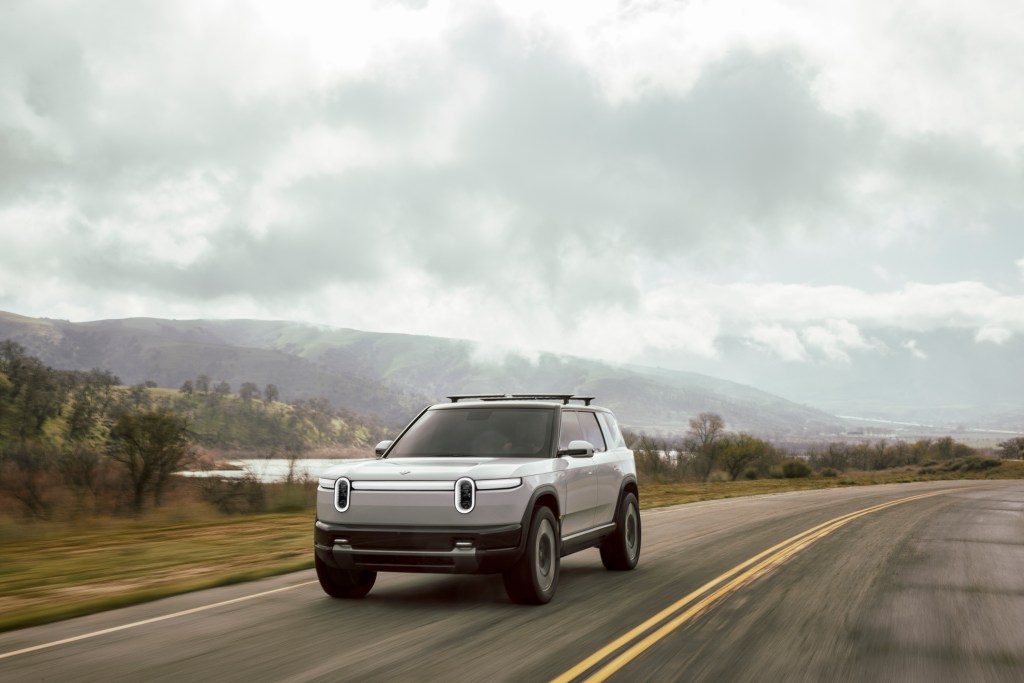
Rivian R2 is supposed to go into production in Illinois in 2026. (Image: Rivian)

When it announced the R2 and R3 models yesterday it was announced that rather than waiting for the factory to be built in Georgia for the production of the new models, it is putting the R2 into the Normal plant which will have, by R2 launch time in 2026, an expansion of capacity to 215,000 vehicles.

Here’s the thing. Whether the capacity is 150,000 units or 215,000, that’s an awfully big delta between either and ~60,000 vehicles.

It is a rule of thumb in automotive manufacturing facilities capacity utilization has to be at from 70% to 80% to be cost effective.

Seventy percent of 215,000 is 150,500.

Rivian has a long way to go to get there and not a whole lot of time.

Building Cars Is Hard

“The market is under-investing now, as a reaction to over-investing. There were a lot of bullshit ideas that got funded during that speculative boom around new ways to manufacture vehicles, forgetting the last 100 years of lessons on how hard it is to build a car company. People will look at Tesla, forget how hard it was for them, and assume everybody else can also do this really quickly.”– Olaf Sakkers – Partner and Co-Founder at mobility venture investment firm RedBlue Capital in Zag Daily

Yes, creating a new automotive company—advanced battery chemistry, digital twins, asset-light approaches, and other advantages that legacy  OEMs didn’t start with—is difficult.

To understate the case by a magnitude of scale.