AV in the UK

This makes more sense than Tesla in Austin

By Gary S. Vasilash

While there is a lot of attention being paid to Tesla’s rollout of some 10 vehicles in Austin that are operating autonomously—with a safety driver on board and apparently people back in Tesla HQ monitoring the fleet, ready to kick in with teleoperation help if needed—there is virtually no attention being paid to what is happening in Cambridge, UK.

This week an autonomous Mellor Orion E electric midi bus—a low-floor transporter that can be configured to accommodate a maximum 16 passengers—equipped with a CAVStar Automated Drive System started rolling through the streets of the university town.
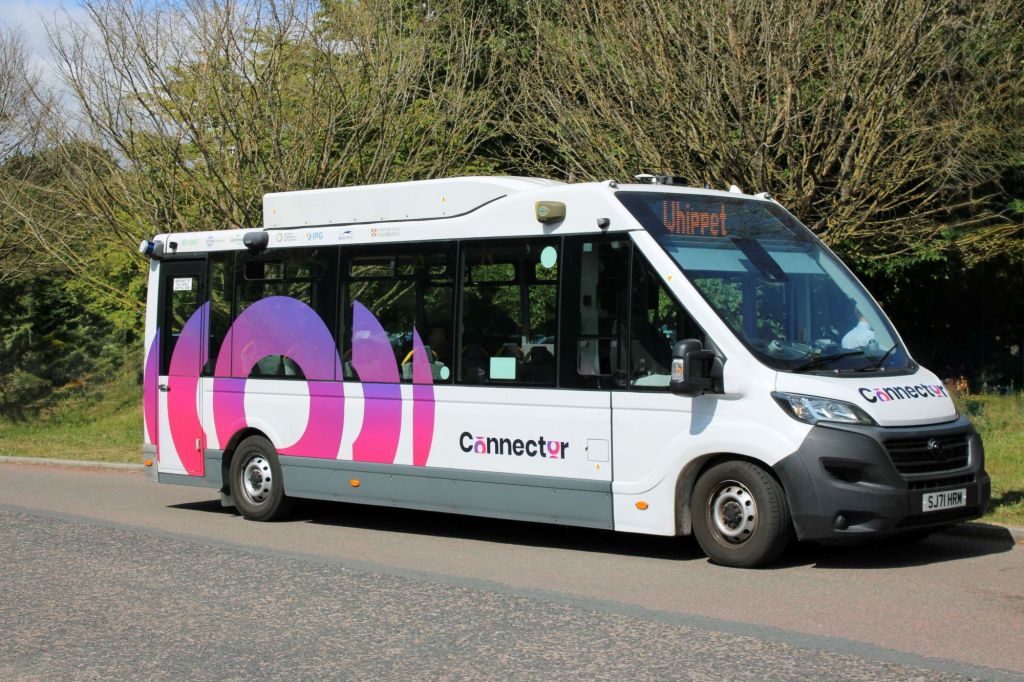
Bus is operating autonomously in the streets of Cambridge, England. (Image: Fusion Processing)

The CAVStar system is engineered by Fusion Processing. It comprises an AI processing unit, radar, LIDAR, optical cameras, and ultrasonic sensors.

The Cambridge vehicle is said to meet the requirements of SAE Level 4 autonomy.

The bus is running as part of the Connector project, which is led by the Greater Cambridge Partnership, which is supported by Innovate UK and the Centre for Connected & Autonomous Vehicles.

The bus initially ran though the areas in Cambridge where it is now operating without passengers to determine fitness for use.

Dan Clarke, head of Innovation and Technology at the Greater Cambridge Partnership:

“People may have already seen the bus going around Eddington and Cambridge West from Madingley Park & Ride recently, as, after the extensive on-track training with the drivers, we’ve been running the bus on the road without passengers to learn more about how other road-users people interact with the technology. We’re now moving gradually to the next stage of this trial by inviting passengers to use Connector.

“As with all new things, our aim is to introduce this new technology in a phased way that balances the trialling of these new systems with safety and the passenger experience. This will ensure we can learn more about this technology and showcase the potential for self-driving vehicles to support sustainable, reliable public transport across Cambridge.”

Somehow this seems more substantial than the reports out of Austin about the performance of some of those Tesla vehicles.

In addition to which: if, as Musk has proclaimed in his various “Master Plans,” his goal is to reduce overall energy use (yes, targeting fossil fuels, but even renewable energy systems are far from being zero-emissions), then doesn’t a mass transit vehicle that can transport plenty of people make more sense than autonomous passenger cars?
Toyota: Steady and Slow. . .

. . .well, maybe it won’t outright win the race, but its approach to technology sure seems like the right one. . . .

By Gary S. Vasilash

You may recall that not long ago Toyota was being chastised for being insufficiently aggressive in pursuing an electric vehicle strategy. It seemed as though Toyota would be like a vehicle abandoned by the side of the road, striped and desolate.

It isn’t that it wasn’t putting EVs on the road. Just not enough of them. And not just with the sort of capability that would be expected of Toyota. So went part of the criticism.

Akio Toyoda was considered backward for taking an approach that would have powertrains suited to varying needs, whether it is a straight ICE, a hybrid, a plug-in hybrid, a battery electric, or even—in exceedingly limited quantities at least—a hydrogen electric setup.

Turns out that this steady approach is actually one that is winning in the market.

According to Kelley Blue Book in Q1 2025 there were 296,227 EVs sold in the U.S.

That’s from 25 brands.

In Q1 2025 Toyota (including Lexus) sold 110,225 hybrids. That’s about 37% of the number of all the EVs sold by all of those other companies. And while those brands are struggling to make money from EVs, presumably Toyota isn’t putting hybrids under the hoods of a mulitude of vehicles because it isn’t making money selling them.

So doing what it is doing powertrain-wise is probably not a bad decision on Toyoda’s part.

Another area where Toyota wasn’t as visibly bullish as some other companies is in autonomous driving.

No real analogue to Cruise Automation or Argo AI.

There was (and is) the Toyota Research Institute, but they were doing other things, too.

And now there is no Cruise Automation. No Argo AI.

And this week Waymo and Toyota announced they’ve “reached a preliminary agreement to explore a collaboration focused on accelerating the development and deployment of autonomous driving technologies.”

Waymo is clearly the leader in the U.S. in autonomous driving tech, with the company offering rides in the San Francisco Bay Area, Los Angeles, Phoenix, and Austin.

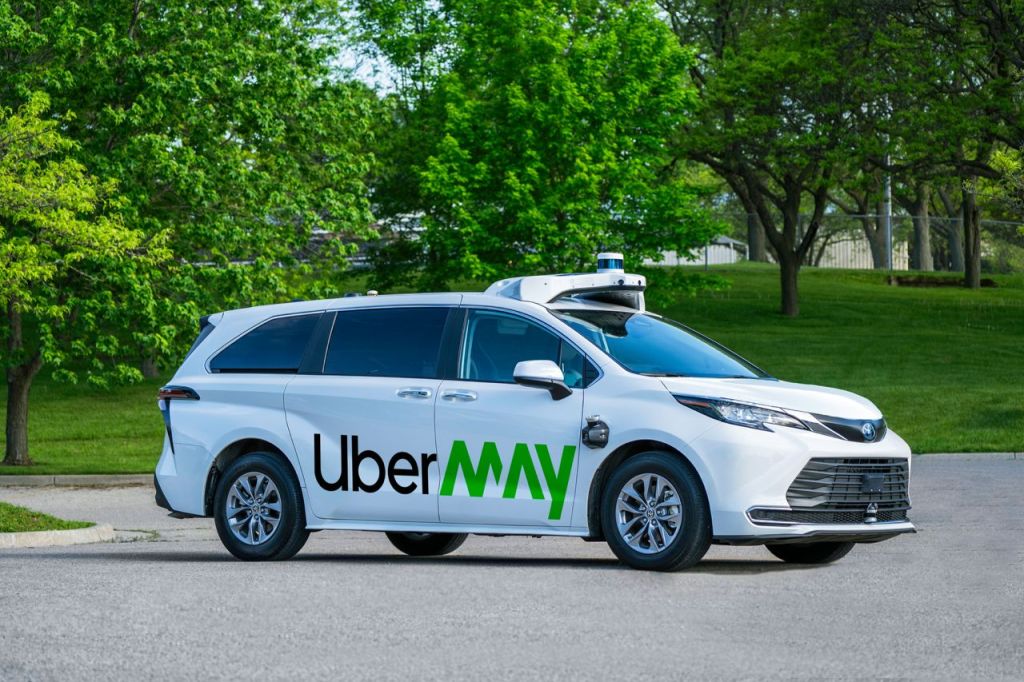
Also this week May Mobility, an autonomous vehicle tech company, and Uber announced a partnership that will have autonomous vehicles available for ride-hail in Arlington, Texas, by the end of the year.

The vehicles for the Arlington program?

Toyota Sienna minivans. (They’re hybrids.)

Toyota is a strategic partner in May Mobility.

Toyota Sienna hybrid minivans will be used in the Uber/May Mobility deployment in Arlington, Texas. (Image: Uber/May Mobility)

Autonomous Driving Tech: Too Hard

The difficulty of developing self-driving vehicle capabilities can’t be underestimated. . .

By Gary S. Vasilash

Something you may have missed over the holidays. . .

In 2015 a company was founded in San Diego with the objective of developing autonomous technology for commercial trucking applications.

It was named “TuSimple.”

Nothing if not optimistic.

Certainly there is something to be said for focusing on trucking as there are a number of factors that somewhat simplify things.

For one thing, there are fewer Class 8 trucks produced than there are passenger vehicles. In 2023 (’24 numbers are yet to be established) there were some 310,000 Class 8 trucks produced in the U.S. There were some 1.7 million passenger vehicles. So fewer means a greater ability to concentrate one’s efforts.

For another, whereas passenger vehicles go here, there and everywhere, the big rigs generally have a point A to point B routing, often on interstates. Yes, there is the need to get on and off the interstates, but arguably that could be handled by a human driver, who could then have the autonomous driver take over.

And what’s more, there is undoubtedly a better economic argument to be made for autonomous vehicles in commercial applications than there is for hopping in one’s vehicle to make a Target run.

TuSimple was, like other companies in that space, on something of a roll, with things like UPS buying a minority share in the company and partnerships with ZF and Navistar.

TuSimple had a facility in China and worked with truck companies there.

In 2021 TuSimple had an IPO that valued the company at some $8.5 billion.

But in December 2023 it announced it was moving its main operations to China.

And in December 2024, on the 19th, Reuters reported this:

“TuSimple Holdings said on Thursday it would rebrand as CreateAI and pivot from autonomous trucking to AI gaming technology.”

Enough said.

Tesla Q1 Quotes Considered

By Gary S. Vasilash

During its Q1 2024 earnings call, there were some interesting comments made by Elon Musk, CEO and Product Architect (previously Technoking).

So here are some of Musk’s remarks prefaced with some thoughts.

Of course he thinks they’re doing the right thing because otherwise, why are they doing it?

Musk: “As we all have seen, the EV adoption rate globally is under pressure and a lot of other order manufacturers are pulling back on EVs and pursuing plug-in hybrids instead. We believe this is not the right strategy and electric vehicles will ultimately dominate the market.”

In vaguely describing the more-accessible models that will be coming, he described what sounds to be like some sort of kluge, possibly because they want to do something new while using the equipment already installed—something that traditional OEMs have been doing for years.

Musk: “These new vehicles, including more affordable models, will use aspects of the next-generation platform as well as aspects of our current platforms, and we’ll be able to produce on the same manufacturing lines as our current vehicle lineup.”

This leads to a question of what gasoline cars that are autonomous will be analogous to:

Musk: “And I go back to something I said several years ago that in the future, gasoline cars that are not autonomous will be like riding a horse and using a flip phone.”

If an autonomous car has half the accident rate of a human-driven car, while that is safer, is it safe enough for regulatory change or should that accident reduction be less than 50%?

Musk: “I think if you’ve got at scale, a statistically significant amount of data that shows conclusively that the autonomous car has, let’s say, half the accident rate of a human-driven car, I think that’s difficult to ignore because at that point, stopping autonomy means killing people. So, I actually do not think that there will be significant regulatory barriers provided, there was conclusive data that the autonomous car is safer than a human-driven car.”

The key phrase in the following is “when that day happens” because he’s been talking about that day, in effect, since 2016 or, to be generous, 2019, when he said: “We expect to have the first operating robotaxis next year.”

Musk: “But really, the way to think of Tesla is almost entirely in terms of solving autonomy and being able to turn on that autonomy for a gigantic fleet. And I think it might be the biggest asset value appreciation history when that day happens when you can do unsupervised full self-driving.”

Yes, he earlier discovered that making cars is hard, but he managed to get through and is making EVs at a rate other OEMs can only dream of. But this seems to indicate that those who have invested in the company because they figure that their will be an ROI predicated on vehicles are making a mistake. Huh? What’s more, also during the call Vaibhav Taneja, Tesla CFO, said: “We are also getting hyper-focused on capex efficiency and utilizing our installed capacity in a more efficient manner. The savings from these initiatives, including our cost reductions will help improve our overall profitability,” which is all about making solid objects that will carry the promised autonomy.

Musk: “If you value Tesla as just like an auto company, you just have to–fundamentally, it’s just the wrong framework and if you ask the wrong question, then the right answer is impossible. So, I mean, if somebody doesn’t believe Tesla is going to solve autonomy, I think they should not be an investor in the company.”

Here he comes up with a notion that could be useful in a future advertising campaign—yes, Tesla doesn’t advertise like traditional OEMs do, but it seems that of late—with price cuts and dictates to its analogue to “dealers” that they work to upsell people on FSD—it seems that the company is on the road to the traditional. In addition to which, why the regular references to horses?

Musk: “I mean, we’re putting the actual auto in automobile. So, sort of we go like, well, sort of like tell us about future horse carriages you’re making. I’m like, well, actually, it doesn’t need a horse that’s the whole point.”

Here he is talking about not only the self-driving tech that will (someday) be in Teslas but in achieving another revenue stream by licensing it to other OEMs. What he doesn’t seem to address is the cost of making a car a smart car. Which is in line, perhaps, with the $25,000 Tesla that seems to be taken off the table.

Musk: “The people don’t understand all cars will need to be smart cars, or you will not sell, or the car will not–nobody would buy it. Once that becomes obvious, I think licensing becomes not optional.”

Robo Woes

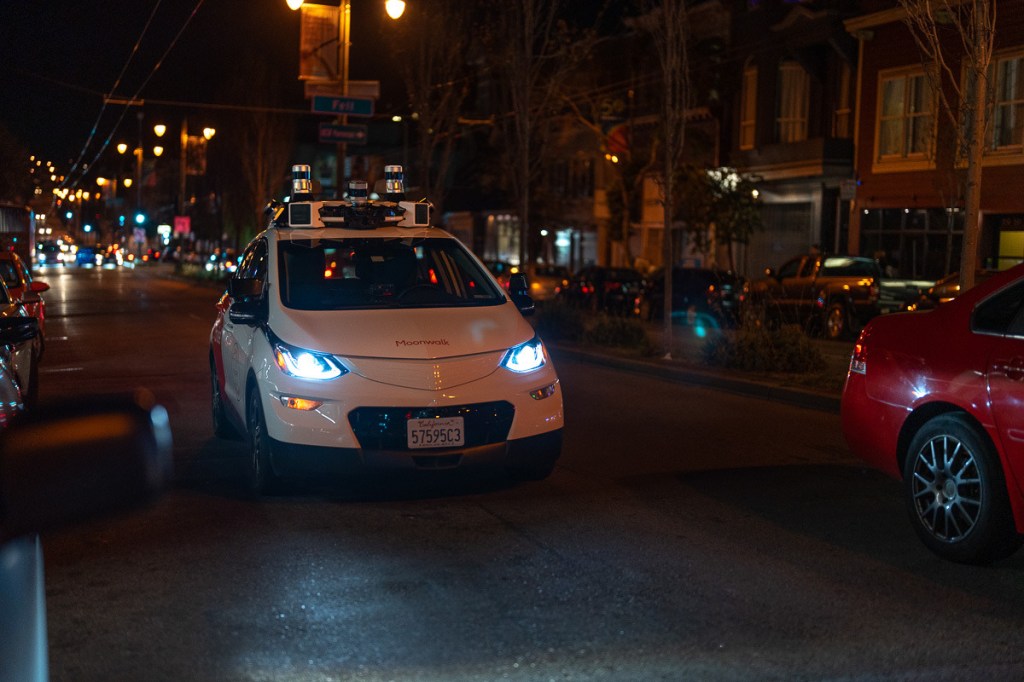
As the National Highway Traffic Safety Administration (NHTSA) begins an investigation into Cruise based on a couple of incidents regarding the self-driving vehicles and their protocols (behaviors?) around pedestrians, there is more not-so-good news for the purveyor of driverless taxis rides.

Cruise driverless vehicle at night. (Image: Cruise)

J.D. Power has released results of a survey, the J.D. Power U.S. Robotaxi Experience Study, the indicates consumers are not all that chuffed with the prospect of driverless rides and aren’t all that keen on having the vehicles rolling around in their neighborhoods.

As in:

  • Only 20% of all consumers are comfortable with automated vehicle tech being tested on the streets and highways in their locale.

What’s more, although Cruise never fails to point out that it maintains its vehicles are safer than humans, J.D. Power found that “nearly 60% of both riders and non-riders say they don’t think a robotaxi drives any better than a human.”

While those who have never taken a ride can be dismissed (e.g., would you believe someone who never ate chocolate ice cream who said it isn’t as good as vanilla?), that even riders are in that cohort isn’t good from a PR point of view.

Kathleen Rizk, senior director of user experience benchmarking and technology, J.D. Power:

“Automated vehicle technology is built on the promise of alleviating distracted driving, impaired driving and collisions attributed to human error.

“However, the benefits result from consumer acceptance, which is why it’s imperative to ensure these first deployments are flawless—not only for the riders but also especially for those who are not early adopters, including non-riders who are experiencing AVs in their community and those learning from a distance through social media and other news outlets.”

When people are learning about things like NTHSA investigations, that can’t be good for Cruise (and to be fair, Waymo).

Toyota, GM, Ford; EVs, AVs and ADAS

By Gary S. Vasilash

Last week Norihiko Shirouzu of Reuters reported “Toyota is considering a reboot of its electric-car strategy to better compete in a booming market it has been slow to enter.”

Toyota’s Prius is synonymous with “hybrid.” The company has pretty much hybridized everything. It argues—or maybe that would be “argued”—that it is better to build a whole bunch of affordable hybrids than a comparatively few electric vehicles that are comparatively more expensive: according to Kelley Blue Book, the average price of an electric vehicle in the U.S. in September was $65,291. The average transaction price for vehicles overall, KBB calculated, was $48,094. Which is roughly a 27% delta, which is certainly non-trivial.

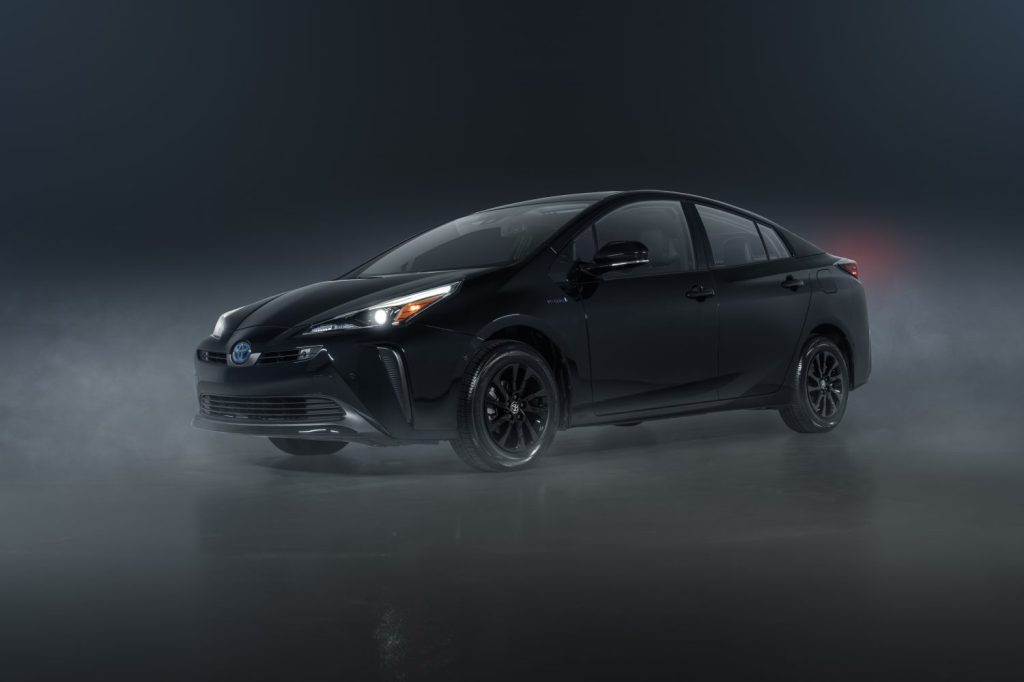
Yes, this is a Prius. (Image: Toyota)

Be that as it may, Shirouzu’s sources indicated that “Toyota’s planning had assumed demand for EVs would not take off for several decades.” Which is decidedly not the case.

So is Toyota making a pivot? That is one of the subjects discussed on this edition of “Autoline After Hours.” Joining “Autoline’s” John McElroy and me are automotive consultant/analyst Jack Keebler and long-time auto journalist, currently freelancing at Autoweek, Todd Lassa.

Other topics discussed are the Q3 earnings of both General Motors and Ford, as well as those companies positions on autonomous driving: GM continues to be bullish on the prospects for Cruise, still anticipating revenue of $1-billion from the operation by 2025; Ford is far more conservative, as it announced that Argo AI, the AV company that was owned primarily by it and Volkswagen (each had 39%), was closing. Ford going forward would focus more on Level 2+ and Level 3 ADAS. (Ford CEO Jim Farley: “It’s mission-critical for Ford to develop great and differentiated L2+ and L3 applications that at the same time make transportation even safer.”)

The conversation is wide ranging and lively. And you can see it here.

Mike Ramsey on Autonomy and Electrification

By Gary S. Vasilash

Mike Ramsey, as a vp and analyst for Gartner on the topics of Automotive and Smart Mobility, spends his time researching and thinking about those two topics and consulting with a wide array of people in the auto industry on the subjects. And on this edition of “Autoline After Hours” Ramsey talks to “Autoline’s” John McElroy and me about, primarily the subjects of autonomous vehicles (AVs) and electric vehicles (EVs).

Although AVs are getting far less attention than EVs, Ramsey suggests that work continues apace on the development of the technology. One of the factors that is going to play a big difference for the greater availability of AVs, Ramsey says, is a decrease in the cost of sensor technology (e.g., lidar). This will help make the calculations for the function more in line with what are automotive economics.

Ramsey suggests that with the amount of data that Tesla is collecting from its vehicles it may be in a prime position to make the move to actual full self-driving capability—but Ramsey underscores that it is probably not going to be with the present setup of sensors that are currently used for the various Tesla models.

EVs are going to be more widely accepted, Ramsey says—but this will require that the price points of the vehicles have to go down in order for people to be able to get into the vehicles, with most of the models out there being in the luxury pricing strata.

Another thing that needs to be addressed vis-à-vis EVs is the charging infrastructure, which many consumers have found to be quite disappointing. Ramsey thinks that automotive OEMs are going to have to think long(er) and hard(er) about what their role in charging needs to be because no matter how good the product is, if the charging experience is a negative one (a recent J.D. Power study on charging found that people are not exactly pleased with their experiences), then that will reflect poorly on the whole undertaking.

You can see the show here.

Talking Tech With NVIDIA

By Gary S. Vasilash

NVIDIA is a company that was once familiar primarily to gamers because of the GPU chips that it had developed that made rendering both fast and highly detailed.

Now NVIDIA is as familiar to those in the auto world, as it is working with Jaguar Land Rover, Mercedes, Volvo and more.

Lucid Motors is using NVIDIA tech in its Air. BYD has announced it is working with the company, as well.

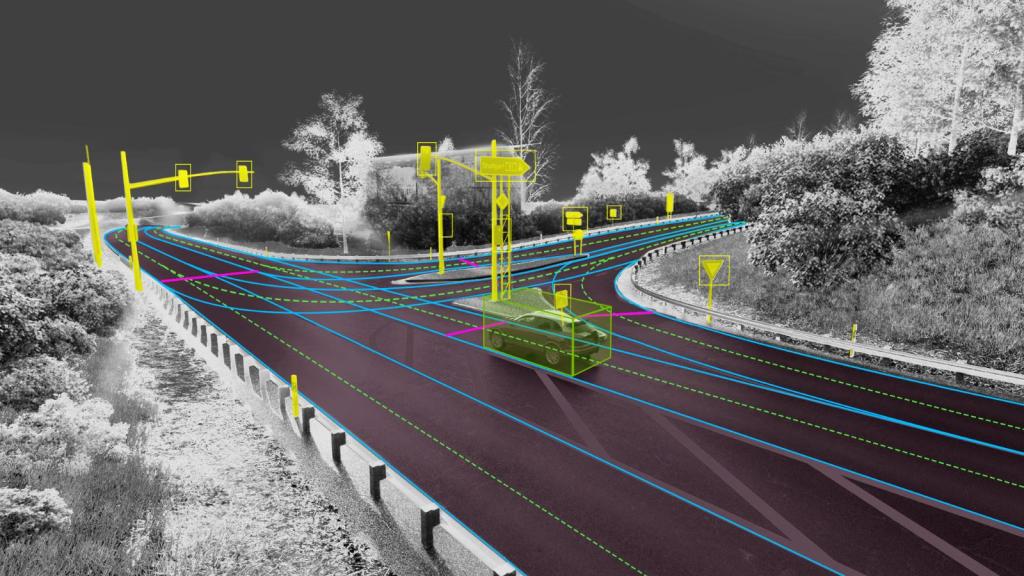
NVIDIA developing maps for autonomous driving operations. (Image: NVIDIA)

What’s interesting is that these companies are using NVIDIA tech to build systems that provide the characteristics that they are looking for to make their vehicles distinctive.

NVIDIA is not merely producing processors that have massive processing capability—the Jetson Orion operates at up to 275 TOPS—that’s trillion operations per second—but it is developing software that will help facilitate autonomous driving operations.

The company has developed a mapping system that not only features information collected by specific vehicles, but which takes in crowdsourced information so that there is an accurate representation of what is going on: say a construction zone has popped up since that information was collected. The system has it.

On this edition of “Autoline After Hours” NVIDIA vice president of Automotive Danny Shapiro discusses what the company is doing and how it is doing it.

Arguably NVIDIA is at the forefront of developing the technology that will change transportation in many ways.

He talks with “Autoline’s” John McElroy, Joe White of Reuters and me.

And during the second half of the show McElroy, White and I discuss a variety of topics, including the opening of the Tesla plant in Berlin, the speculation that Porsche might build the long-rumored Apple car, the announced range of the Ford F-150 Lighting, and a variety of other subjects.

And you can see it all here.

Purpose-Built for Delivery

Although electric vehicles are generally thought of in the context of, say, a Tesla, and while autonomous vehicles (AVs) are something that will allow drivers to become passengers, there is a whole realm of other electric AVs that are being developed.

One is going into trials later this year, the Faction D1.

Driverless EV for deliveries. (Image: Faction)

Faction Technology focuses on the development of driverless tech for logistics applications.

It teamed with Arcimoto, which builds small, three-wheeled electric vehicles.

Ain McKendrick, CEO of Faction, said of the Faction D1 development, “Scalable driverless vehicle systems require engineering from the chassis up, and by leveraging the revolutionary Arcimoto Platform, we’re able to develop our driverless system much faster than using legacy vehicle designs. The end result will be a rightsized, ultra-efficient driverless delivery vehicle that reduces pollution and drives down costs for local and last-mile delivery fleets.”

The vehicle has a top speed of 75 mph and a range of about 100 miles. It can handle 500 pounds of cargo.

That 75 mph seems a bit, well, quick for even pizza delivery.

What Happened to Local Motors?

By Gary S. Vasilash

Justin Fishkin was the chief strategy officer at Local Motors for seven years (2011 to 2018), then senior advisor for the firm for two years after that.

Local Motors seemed to have it all going for it in terms of what it was doing and how it was doing it.

It was crowd sourcing design. It was using 3D printing to the extent that others were only dreaming about. It was developing vehicles fast. It was putting autonomy into application. It was creating mobility systems.

Olli: Electric. Autonomous. Built in a microfactory. (Image: Local Motors)

From Wired to IMTS Today and an array of media outlets in between, Local Motors was the “it” company in the transportation field.

And a few weeks ago word leaked out that Local Motors was closing up shop.

So on this edition of “Autoline After Hours” Fishkin talks with “Autoline’s” John McElroy, Chris Paukert of Roadshow by CNET and me about what the company set out to do and what conceivably happened.

One of the primary factors, Fishkin suggests, is that there was a case of mission creep in that the company found itself stretching in different directions as different constituents became involved in the company.

They went from crowdsourcing designs that led to vehicles like the Rally Fighter, 3D printing an entire vehicle (the Strati) then creating Olli, a compact people-mover with autonomous capabilities, and along the way created fans and attracted companies that wanted to get some of the “stuff” that was allowing the company to do what it was doing.

An early intention was to have micromanufacturing capabilities set up as a network such that there would be the development of vehicles that would lend themselves to specific markets. The company ended up having two, in Chandler, Arizona and Knoxville, Tennessee

It also built a demo microfactory in National Harbor; GE Firstbuild built a microfactory in Louisville, Kentucky, with Local Motors’ assistance.

In addition to GE, Local Motors worked with companies including Airbus and Siemens. All of which is to get to the point that this was something real, not speculative.

Its Olli had deployments in Buffalo, New York; Turin, Italy; Sacramento, California; Arlington, Virginia; Holdfast Bay, Australia; Akron, Ohio; Dunedin, Florida; Jacksonville, Florida; Clarksburg, Maryland; Yellowstone, Wyoming; Thuwal, Saudi Arabia; Durham, Florida; Marysville, Ohio; Neustadt, Germany; Jacksonville, Florida; Palo Alto, California; Concord, California; Ghent, Belgium; Lake Nona, Florida; Peachtree Corners, Georgia; Peoria, Arizona; Whitby, Canada; Toronto, Canada; and Crozet, Virginia, yet in the broader scheme of things, that is but a handful of places.

Fishkin also talks about his current activities with a startup Future/Of, which is helping, well, startups. One of the companies Fishkin is working with is Biliti, Inc., a company that is producing electric three-wheelers for last-mile transport.

But not just startups, he notes. As he puts it, “Future/Of works with organizations to scale disruptive business models and frontier technologies.” Which established companies can benefit from. And NGOs.

Still, in the context of Local Motors and where it came to, the question becomes where will micromobility and distributed microfactories go? This is a question that Fishkin help provide some solid perspective on.

And you can see it right here.