
The Cost of Tariffs on Auto

“By means of glasses, hotbeds, and hotwalls, very good grapes can be raised in Scotland, and very good wine too can be made of them at about thirty times the expense for which at least equally good can be brought from foreign countries. Would it be a reasonable law to prohibit the importation of all foreign wines, merely to encourage the making of claret and burgundy in Scotland?”—Adam Smith, The Wealth of Nations

Here’s something to think about regarding the possibility of tariffs and how they will affect vehicle pricing and/or availability.


David Christ, group vice president, general manager-Toyota Division, Toyota Motor North America, pointed out yesterday (the day after the election) at a meeting of the Automotive Press Association, that Toyota has 10 manufacturing plants in the U.S. It is building its 11th in North Carolina that will open in 2025 for the production of batteries for electrified vehicles. A $13.9-billion plant.

Certainly a solid U.S. footprint. It employs some 49,000 in the U.S.


Christ said an issue with tariffs is that things not necessarily visible to the end consumer—like parts—can have a big effect.


He said, for example, that the Camry is about 90% U.S. by content. But that means 10% comes from out of the country.


That’s because Toyota, like other manufacturers, has a global supply chain.


OEMs don’t make everything that goes into their vehicles. And suppliers of components not only have to find the lowest-cost places to produce their products, but they need a sufficient number of customers for a given part to be produced in a given plant, so with those two factors they are likely to be located somewhere that isn’t necessarily the U.S.


So regardless of the high level of domestic content, that 10% will drive up the cost of the car.

Who benefits from that?


For customers, this makes the vehicle less affordable.


A costlier vehicle might mean fewer of them are purchased.


Fewer cars purchased means fewer cars built.


Fewer cars being built means fewer hours are necessary for people to work.


The trail of consequences continues. Makes you want to reach for a domestic claret or burgundy.


And while it might be thought that this is something that is not an issue for the traditional domestic manufacturers like Ford and General Motors, it is worth noting that in the 2024 Cars.com American-Made Index, which takes into account assembly location, parts content, engine origin, transmission origin and U.S. manufacturing workforce, the top-10 most-American vehicles are:

  1. Tesla Model Y
  2. Honda Passport
  3. VW ID.4
  4. Tesla Model S
  5. Honda Odyssey
  6. Honda Ridgeline
  7. Toyota Camry
  8. Jeep Gladiator
  9. Telsa Model X
  10. Lexus TX

What you don’t see is either Ford or General Motors. And as Jeep is owned by Stellantis and as Stellantis is headquartered in Hoofddorp, Netherlands, it can no longer be considered a “traditional domestic.” But the folks that build the Gladiator in Toledo, Ohio, still certainly are.


(In case you are wondering: the highest-ranking vehicle from GM is the Chevy Colorado, at #23. Ford makes it at #29 with the Lincoln Corsair. Which means the cost of tariffs would be higher for them.)


“Free and fair trade is the best way to go,” Christ said.


Adam Smith wrote The Wealth of Nations in 1776. That idea has been kicking around for quite some time.
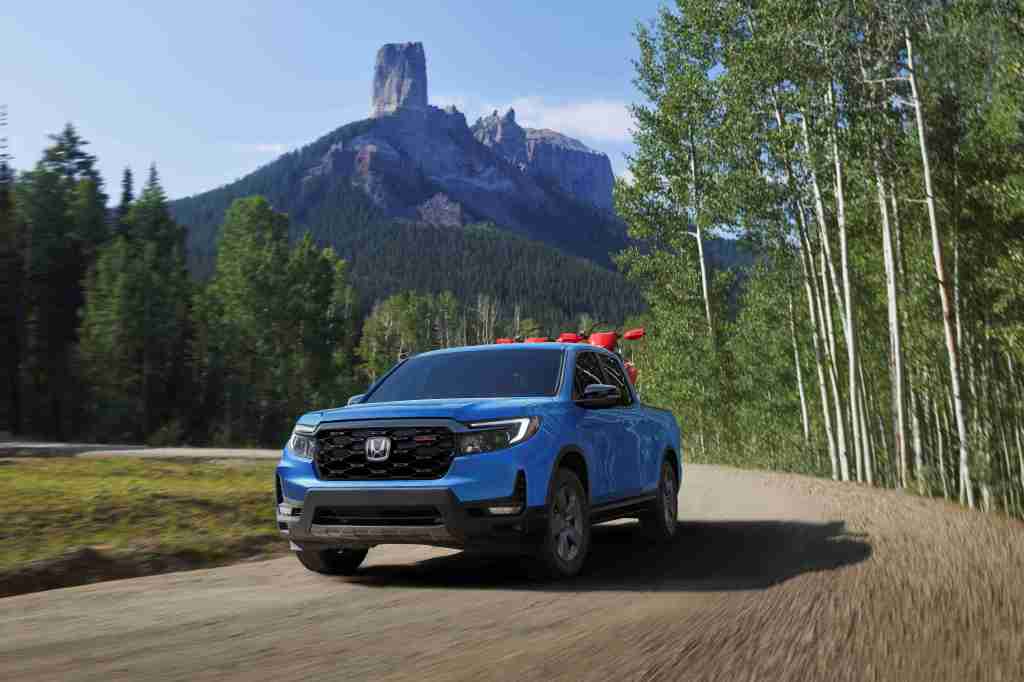
2024 Honda Ridgeline TrailSport

By Gary S. Vasilash

When the Honda Ridgeline was in its first year on the market, it received the 2006 North American Truck of the Year Award (it is worth noting that back then there wasn’t the Utility category, simply “Car” and “Truck,” and it was a good year for Honda, as the Civic took Car).

Then, when the second-generation Ridgeline, which is the basis for the current model, had its debut year, it took the 2017 North American Truck of the Year. The other two finalists were the Ford Super Duty (which won the NACTOY award in 2024) and the Nissan Titan (which is going out of production this summer).

The point of this is that the NACTOY jurors tend to be a picky lot (full disclosure: I am one of them), and for the Ridgeline to take its category the two times it has been eligible says a lot about the truck.

2024 Honda Ridgeline TrailSport: Yeah, it’s a truck. (Image: Honda)

One of the things that made some people dismissive about the Ridgeline being a “truck” is that doesn’t feature body-on-frame construction but is a unibody.

How dare Honda!

Clearly it was on to something because the U.S. pickup truck leader, Ford, introduced the Maverick in 2021 and it, too, is a unibody. (It took the NACTOY Truck category in 2022.)

(The Hyundai Santa Cruz is also on that type of platform.)

The Ridgeline has a box on the back: 64 inches long; 50 inches wide at the wheel wells, 51 inches wide at the D-pillar, 60 inches wide at bed walls.

The Ridgeline can tow: up to 5,000 pounds.

The TrailSport version has a total payload capacity of 1,521 pounds.

When driving the Ridgeline a friend took a look at the box on the back.

“I need a truck a few times a year.”

And it occurs to me that that is precisely the sort of person who might be inclined to get a Ridgeline rather than the other midsize trucks that are available, all of which are body-on-frame vehicles.

This is because the Ridgeline truly rides and handles like an Accord.

Let’s say for the sake of argument that my friend’s “few times” adds up to a solid month. Let’s say that he goes for one of those other midsize trucks.

That means for 11 months out of the year he’s driving something that doesn’t have anywhere near the ride and handling of the Ridgeline.

Seems to be quite a price to pay for hauling gear or gravel or whatever on occasion.

The TrailSport trim package is new for 2024. It has such things as a suspension tuned for offroad conditions and General Grabber A/T Sport tires (245/60R18), the first deployment of all-terrain tires on a Ridgeline. (Although they are big and chunky, the sort of thing you might imagine would generate all manner of road noise when not driving on a trail (which one might do “a few times a year”), somehow there isn’t a heck of a lot of noise from the tires in the cabin.)

In addition to which the TrailSport has a steal underbody protector for the oil pan.

On the inside there is the use of orange thread for the stitching on the steering wheel, door panels and seats; the front-seat headrests have “TrailSport” embroidered on them.

Just as there is capable rubber on the outside, there are serious rubber floor mats standard: if you’re going to use the truck to play in the dirt you might get dirty, so. . . .

The truck is powered by a 280-hp, 3.5-liter V6 that’s mated to a nine-speed automatic.

There is Honda’s torque-vectoring all-wheel drive system and there is “Intelligent Traction Management” for that system that allows the driver to select for sand, snow, mud, or paved roads. (Here’s betting that depending on where one lives, the last is the normal selection and the second occasional, assuming there are winter conditions.)

There are the now-obligatory infotainment features in the Ridgeline (e.g., nine-inch color touchscreen; Apple CarPlay and Android Auto), and what’s interesting is that Honda says that it has deployed a faster processor in its head-unit which means less lag.

According to Merriam-Webster, a pickup truck is “a light truck having an enclosed cab and an open body with low sides and tailgate.”

The Ridgeline certainly is that. And even more.

One more thing: Cars.com generates an “American-Made Index” each year for vehicles, taking into account assembly location, parts content, engine origin, transmission origin and U.S. manufacturing workforce.

The Ridgeline was designed and engineered in the U.S. It is manufactured in a plant in Lincoln, Alabama.

Of all vehicles—sedans, SUVs, minivans, hatchbacks, coupes, pickup trucks—there is only one truck in the top 10 of the most recent index: the Ridgeline.

Yes, according to Cars.com it is the most American of pickups.

So there’s that, too.

They’re Probably Not Throwing in the Mats

Challenges and opportunities in the dealer model and other contentious issues

By Gary S. Vasilash

Research from Cox Automotive, which is a source that dealers find exceedingly useful in their efforts to conduct their business, found that there is an increasing interest among customers to do more of their transactions digitally.

As in 80% of consumers would like to do part of the buying transaction on line. (Who doesn’t do research on the vehicles they’re interested in on line; who doesn’t want to get some of the “paperwork” related to the transaction done in the comfort of their own home rather than under the fluorescent lights of a dealership?)

And 25% of customers would like to have the whole thing done and dusted on line.

What’s more, KPMG conducted a global survey among executives in the auto industry—OEMs, suppliers, dealers, financial services providers, etc.—and they found (again, realize this is a global survey and the Cox Automotive survey in U.S. only):

  • 78% think the majority of purchases will be on line by 2030
  • 34% think that from 60 to 79% of the vehicles delivered will be direct to the consumer by 2030
  • 84% think vehicle subscriptions will be competitive to buying and leasing by 2030 and only 22% dealers are the best channel for subscriptions (OEMs are the biggest choice, 45%)

There is some concern that due to the reduced inventories that are a result of supply chain issues dealers—not all, but some, some that get attention—are increasing prices well above the sticker price.

If consumers were thinking there might be an alternative before this occurred, then those who were subjected to or simply heard about this behavior might be thinking harder about new approaches to getting vehicles (e.g., the Tesla approach).

This is one of the topics that is discussed on this edition of “Autoline After Hours” with “Autoline’s” John McElroy, Cars.com editor-in-chief Jennifer Newman, the Wall Street Journal’s vehicle expert Dan Neil, and me.

Other topics include whether Apple is going to get into the vehicle business (Neil and Newman both think that it is a when not an if), and whether electric vehicles are going to be the end of muscle cars as we know them.

And there’s much more in one of the more animated shows in some time.

Which you can see right here.

Why 2030 Isn’t Going to Be All That Different from 2020

Yes, there will be more electric vehicles. But not all EVs. So internal combustion engines need improvement.

By Gary S. Vasilash

Bosch, Sujit Jain, president, Powertrain Solutions for Passenger Cars, Commercial & Off-Road, and Electric Vehicles at the company’s North American operations, points out, has been advancing—and producing—technologies for the auto industry essentially for as long as there has been an auto industry.

And today isn’t any different.

The company is not only making massive investments for developing and utilizing Industry 4.0 capabilities, but it is investing heavily in the development and production of everything from microprocessors and fuel cells in order to advance the functionalities and performance in the auto industry.

It is committed to the electrification of vehicles, whether this makes the form of hybrids, full battery electrics or fuel cell powered vehicles.

But while Jain says company projections have it that the number of battery electric vehicles in the U.S. will grow from about 2% of the market in 2020 to 30% by 2030, that still leaves 70%, the large percentage of being combustion engines. Yes, they may be hybrids, but there is still gasoline or diesel being burned.

So one of the things that Jain and his colleagues are doing is developing the ways and means to increase the efficiency of those engines, both in terms of performance and emissions reduction.

Some of the things that they are pursing, Jain says on this edition of “Autoline After Hours,” include synthetic fuels, electrically heated catalysts to reduce cold-start emissions, and hydrogen fuel injection (i.e., instead of a hydrogen fuel cell, this would be a combustion engine running on hydrogen).

Jain talks with “Autoline’s” John McElroy, Kelsey Mays of Cars.com, and me on this show.

After Jain’s segment, the three of us talk about a variety of subjects, including former Nikola head Trevor Milton being charged with three counts of criminal fraud related to the company he founded; Tesla’s Q2 financials ($1.14-billion in GAAP net income), the possible consequences of it opening up its charging network to other brands, and the move from upscale-shopping districts for its stores and galleries to lower-end real estate; Magna’s growth and technological breadth; and more.

And you can see it all here.