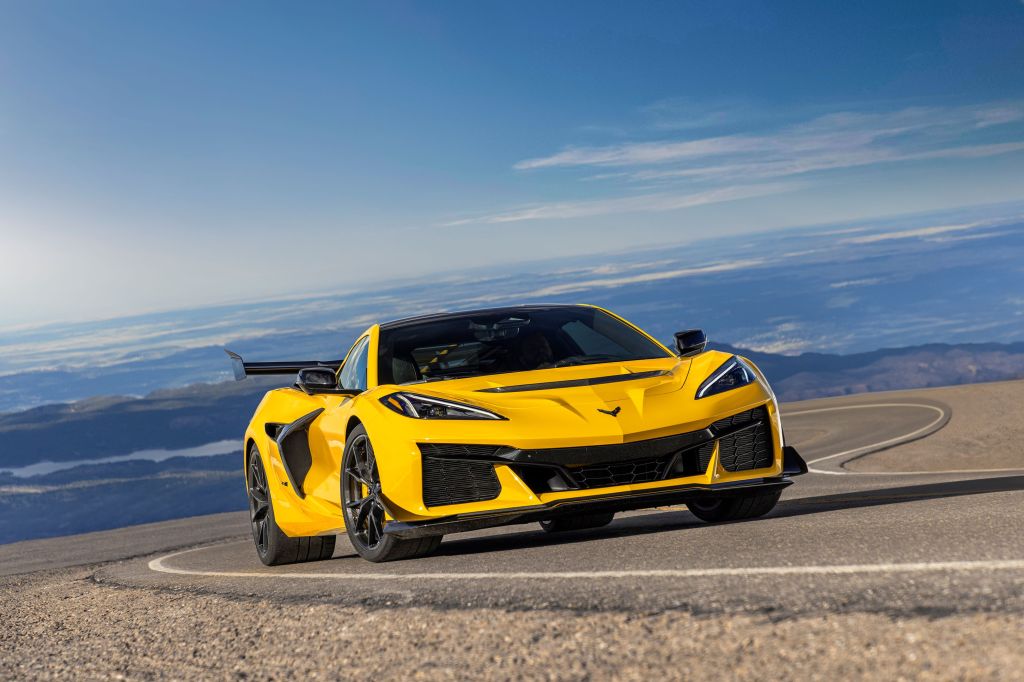
And while it won’t be launched until next year—and “launched” is a good word for this vehicle, the ’25 Corvette ZR1, while undoubtedly something that will be produced in limited numbers, will likely drive interest in the more readily available Corvettes.
The ZR1 is a special model, with its 1,064-hp 5.5-liter, twin turbocharged, DOHC flat-plane crank V8.
The car will have a top speed of over 215 mph.
And while it looks and certainly is fast, it won’t launch to the sky as there is a carbon fiber aero package that produces in excess of 1,200 pounds of downforce when the ZR1 hits top speed.
Now there are electric vehicles that have higher top speeds, though not many, and not readily accessible as at a Chevy dealer.
And the instant torque of an EV may be more impressive than the impressive 828 lb-ft that the ZR1 LT7 generates—at 6,000 rpm.
But the ZR1 will provide a visceral experience as well as the one predicated purely on acceleration.
This sensory suite of sound and vibration is simply something that cannot be as genuinely obtained in an electric vehicle.
At some point, after a sufficient number of enthusiasts, the type of people who would consider paying what is estimated to be on the order of >$180,000 for a car, haven’t driven combustion-powered vehicles, things like the ZR1 will fall out of fashion, undoubtedly being perceived as having insufficient refinement because of the very characteristics that make it so exhilarating to drive.
Let’s say that you are interested in buying a car.
A car as a sedan. Not a crossover. A bread-and-butter car. (Yes, maybe you want to add some spicy tomato jam to it—spoiler, alloy wheels, etc.)
You go to the local Ford dealer.
And discover that the only car is a Mustang, which doesn’t qualify (i.e., two doors).
There happens to be a Lincoln store across the parking lot.
There are no cars, only crossovers of stair-step sizes.
You visit a Chrysler dealership and learn that Stellantis has stopped production of its long-in-the-market 300 at the end of last year, but they’ve got a Pacifica minivan, if you’re interested.
Buick perhaps? Again, no. Only crossovers.
Over at Cadillac things are better: of its seven models, two are sedans, the CT4 and the CT5. Given that the Q1 2024 sales for those are down 36.1% and 34.2%, respectively, how long they’ll be around may be in some question.
Chevy? An impressive array of crossovers and trucks. And one car, the Malibu.
The point is, buying a car is not as easy as it once was.*
Which leads to a thought about electric vehicles.
What if you went into one of these dealerships and discovered that they didn’t have anything on the showroom floor that didn’t have a plug?
What if that was pretty much the case up and down the street of the auto mall?
Clearly there would be an increase in the number of EVs sold out of those dealerships.
Maybe the numbers would be that good.
But they would be better.
Just as they’ve increased the number of models that aren’t cars and so have made buying a car tough, it could be that to help recoup some of the billions being spent on EVs they make buying an ICE tough.
Something’s got to move more of that lithium-powered metal.
(Of the 593,997 vehicles GM sold to customers in Q1, 16,169 were EVs. Not much of a business case there. And it sold twice as many Malibus ((32,749).))
*Interestingly, the Asian and European brands, in general, all have cars in their lineups.
One of the things that isn’t talked about much is the fact that electric vehicles really aren’t that popular unless they come from Tesla.
Flying in the face of that is a finding of Kelley Blue Book that in Q3 2023 EV sales in the U.S. hit 313,086 units, a 49.8% increase over Q3 2022. Such a jump means interest, right?
Well, the total number of EVs sold in Q3 represents 7.9% of total industry sales.
In other words, 92.1% of the vehicles people bought in Q3 weren’t electric.
And to the point of Tesla’s sway over the market—even though KBB saysTesla’s share of market tumbled to 50%–is that KBB acknowledges“Tesla’s price cuts have moved the market, pushing electric vehicle prices down more than 22% year over year, from $65,295.”
That’s right: a single company moves the entire segment.
(And in case you’re wondering, in October, according to KBB, the average transaction price for an EV was $51,762 while the ATP for a non-lux vehicle was $44,331.)
Drilling down a bit more, it is bracing to discover that in terms of share of the EV segment, the mainstream brands really don’t have much in Q3.
Chevrolet, 5.1%
Ford, 6.7%
GMC, 0.4%
Hyundai, 6.3%
Kia, 3%
Nissan, 1.9%
Subaru, 0.9%
Toyota, 0.9%
VW, 3.4%
And know that the 6.7% for Q3 Ford racked up represents 20,926 vehicles: 14,842 Mach-Es, 3,503 F-150 Lightnings and 2,617 E-Transits.
Ford sold 23,931 Mavericks in Q3, of which 56.5% were hybrids. Somehow that 20,926 EVs sold—encompassing three models, one of which is based on the best-selling pickup Since Time Began—seems more than anemic.
So even before Ford started talking about having to make adjustments as a result of the salary and benefit increases in the proposed agreement with the UAW, the auto company suddenly found things like the F-150 Hybrid more interesting.
When I ask knowledgeable people about the subject, they point out that much of the EV development and promotion is predicated on government regulations, more than organic customer demand. Look at those puny percentages up there, slices of the 313,086 vehicles sold by companies ranging from Audi to Volkswagen.
There’s not much there there.
Yes, there will be more EVs offered. More EVs sold.
But—again, absent Tesla—the market demand isn’t at all what it sounds like it should be.
Another example of this not-big demand is something that some point to as a real success story: the Chevrolet Bolt EV.
Here are the sales figures for the past five years:
2018: 18,019
2019: 16,418
2020: 20,754
2021: 24,828
2022: 38,120
Whoa! you might think. From 2018 to 2022 the sales of the Bolt EV doubled! Remarkable.
But there are a couple of elements that need to be considered.
For one thing, Chevy added a (slightly) different body style, the more ute-like Bolt EUV in 2021, which certainly added some interest to the model(s).
And in June 2022 General Motors cut the price of the Bolt to persuade customers to buy one—sort of like what Elon has been doing.
Had Dodge made a substantial price reduction to the SRT Hellcat Redeye Widebody, the Brotherhood of Muscle would exponentially increase its membership of all genders and municipalities throughout the country would have a sharp uptick in revenues from speeding tickets.
If there is a change in the political situation, those regulations that are driving EV development and sales and those incentives that do the same (what if the government offered $7,500 tax credits for the purchase of a Hellcat?), the question of actual market demand is really going to matter.
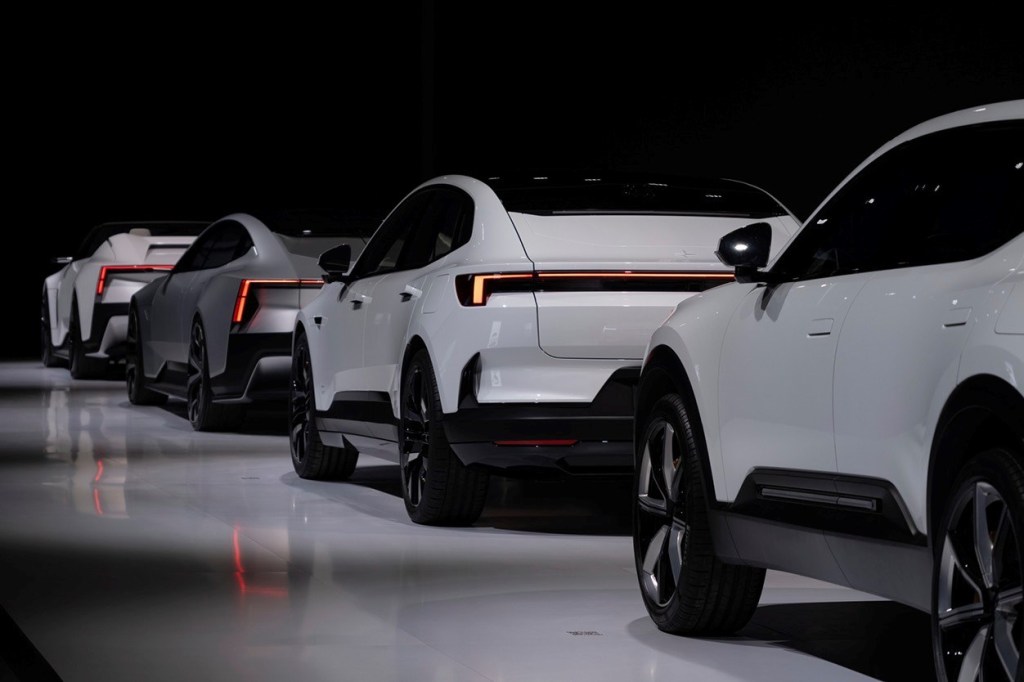
Polestar is an electric vehicle company that, in effect, spun out of Volvo, but Volvo is owned by Geely, but is traded on NASDAQ (as PSNY), so let’s not even try to sort out where the Gothenburg, Sweden-headquartered company exists. (It has announced it will build the forthcoming Polestar 3 in a plant in South Carolina next year. . .the Volvo plant in South Carolina.)
Anyway, yesterday as part of its Q3 earnings presentation it announced a “strengthened business plan.”
Which is notable because the company has stated it is going to put margins ahead of volume.
(Image: Polestar)
Thomas Ingenlath, Polestar CEO, stated, “Margin over volume is our way forward, supported by a gorgeous line-up of four exclusive performance cars.”
Meaning that Polestar is going to focus on the premium end of the EV market.
It figures that as of 2025, when it has four models in production, it will have an annual volume of 155,000 to 165,000 cars, which in and of itself is a rather small number and is smaller when you take into account it is selling globally.
Consider This
According to Kelley Blue Book, in September the average transaction price of a luxury vehicle in the U.S. was $62,342, down 6.2% from September 2022.
Here’s the key to that: “Luxury price declines in 2023 are primarily driven by aggressive price cuts at Tesla, the luxury market leader.” The Model 3 price was down 26% compared to the previous year.
And in the EV space, the average transaction price in September was $50,683, or down about 22% from the previous year “led again by market leader Tesla.”
(Tesla, because of its margins, is really the only OEM that can build mass volumes of EVs and afford to cut its prices.)
The point is, the EV market in the U.S. is pretty much a premium market.
And in the U.S., EVs are pretty much a premium proposition.
When Chevy announced the Equinox EV it made much of the fact that it was going to be a $30,000 vehicle, but it covered itself with “about” and announced a starting price of $34,995. While that is below the average price of an EV, what are the odds there will be many $35,000 Equinox EVs available?
When Chevy announced the Silverado EV work truck earlier this year, pricing was to be just below $40,000, but as reality set in, the price is now above $70,000.
EVs are an expensive proposition.
Let’s face it: until there is some massive change in battery technology (batteries are where most of the cost of an EV is found), the EV market is going to be characterized by prices higher than the ICE market—KBB found that the average transaction price for compact cars in September was below $30,000.
Credit to Polestar for saying it is going to put its profit ahead of volume, something other OEM execs don’t seem to want to say out loud.
Kelley Blue Book puts together an interesting study on what people are interested in by examining what they are searching for automotive-wise both on desktops and mobile.
For Q1 22 in the non-luxury space the number-one brand is Toyota, with 34% brand consideration. In Q4 21 it was Ford on top. They’ve switched places. Ford is at 32%. Chevy is on the rise because in Q4 it was at 25% but has risen by five percentage points.
What is somewhat sad is Fiat, which was at 0% in Q4 and is at 0% in Q1.
And just above it are Mitsubishi and MINI, both at 1%, which is where they were last quarter, too.
Perhaps people just know all they need to about those brands.
Ram Laramie 1500: Imposing and comfortable. (Image: Ram)
KBB slices, dices and rices data in various ways. Like looking at four categories: SUVs, Cars, Pickups, and Minivans.
The top SUV is the Honda CR-V (besting the Tahoe, Durango, RAV4 and Highlander).
The #1 car is the Honda Accord, edging out the Civic (sibling rivalry). The Camry, Charger and Challenger follow.
In Pickups it is the Silverado 1500, followed by the F-150, F-250/F-350/F-450, the Silverado 2500/3500 HD, and the Tacoma.
In Minivans it is the Sienna followed by the Odyssey, Pacifica, Pacifica Hybrid and Voyager.
Of those categories, 66% looked at SUVs, 37% Cars, 35% Pickups, and 5% Minivans.
Perhaps there is some life in Cars, although the considerations were down 31% in the last quarter and 33% in the last year, so clearly things aren’t moving in the right direction.
Another potentially encouraging sign for Cars is that in the top 10 models considered, there are three Cars on the list (Accord, Civic and Camry), which is the number of SUVs on the list (CR-V, Tahoe, Durango).
What are the top three factors driving consideration?
Durability/reliability is in the top spot, which is not a surprise, nor is the fact that Toyota is the one that takes it.
Second is safety, and while you might imagine that would be Volvo, Subaru is actually in that position.
And third is driving comfort. This is taken by Ram. Who would have thought that a pickup truck would win the comfort honors?
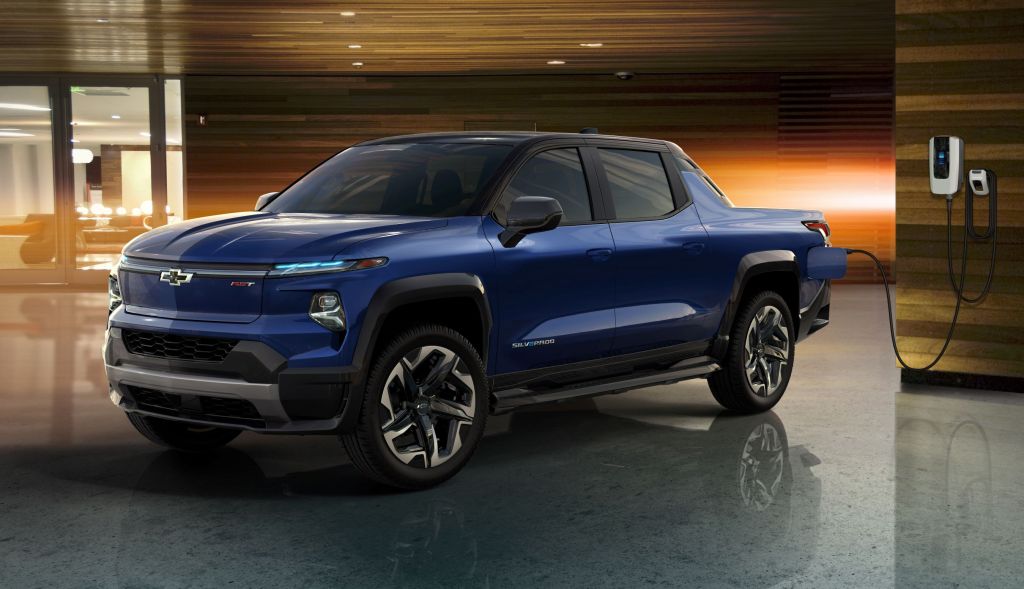
When Chevrolet introduced the 2024 Silverado EV today, there was an interesting quote made by Steve Hill, vp of Chevy.
Hill said: “The Ultium Platform”—the thing that General Motors is using to underpin all of its post-Bolt EV models—“is a critical enabler of next-level pickup truck performance for both fleet and retail customers, whether they are currently driving a Silverado or are considering a pickup for the first time.”
The interesting bit is that Hill said “fleet and retail customers,” with the first being fleet.
The Silverado EV, when launched, will come in two versions, both in Crew Cab configurations.
There is the flagship RST First Edition:
(Images: Chevrolet)
And there is the WT:
The RST First Edition brings such things as four-wheel steering and automatic adaptive air suspension. There’s a 17-inch diagonal LCD infotainment screen.
Simply, inside and out this looks like a very cool pickup truck that anyone who is interested in such things would be chuffed to have in her or his driveway.
The WT is a bit more, well, pragmatic. Chevy points out that it offers 510 hp and 615 lb-ft of torque; 8,000 pounds of towing and 1,200 pounds of payload. The a bit later after launch there will be a model with 20,000 pounds of trailering capability.
RST owners will be able to access Ultium Charge 360, which is what consumers of other GM EV crossovers and cars will undoubtedly use. WT owners will have the opportunity go to a variant, Ultium Charge 360 Fleet Service. When that was announced in July 2021, Ed Peper, U.S. vice president, GM Fleet said, “Fleets have a significant impact on the transition to EVs and by expanding Ultium Charge 360 to our fleet customers, GM aims to be a significant industry leader to advance fleet EV adoption at scale and accelerate our goal of reaching 1 million EV sales globally by 2025.
“Fleet electrification is an important element of our growth strategy, and we will leverage our leadership and expertise in this space to support customers at home, at depots and in public with our suite of providers.”
The first models to be built at the GM Factory ZERO (Detroit-Hamtramck Assembly Center) will be the WT. It will be available in the spring of 2023. It will have a base MSRP of $39,900.
Then the RST First Edition vehicles—the fully loaded Silverado EV—will follow in the fall of that year. The base MSRP of that model is $105,000.
Other variants—with price points of some $50K, $60K, $70K and $80K—are planned.
Two points:
The $105,000 RST First Edition might seem a bit pricy for, well, a pickup truck, but this is an electric pickup that is not only tricked out with all manner of tech, but it will come with a battery capable of, GM says, an estimated range of over 400 miles. Typically, EV models (e.g., the GMC HUMMER EV) start out at a high price point and then go down from there. . . .
. . .which brings us to the point that GM is actually starting out with a much more modest price for the WT before going to the RST First Edition. There is a clear understanding that if they want to move lots of EV pickups, then the sweet spot is with contractors and other commercial service providers. Sure, the RST First Edition will probably have its reservation bank fully subscribed by the time you read this. But that will be a limited number of trucks. Although the margins on the RST First Edition will probably make the WT look like some sort of Dickensian orphan, the WT is going to be the thing that is going to make EV pickups a mass market phenomenon, not the RST First Edition.
It is a purpose-built pickup. The purpose is not only to have an offering in the segment, not only to provide style and functionality, but to expand the number of EVs on the road.
And when you enter a school zone, slow the hell down
By Gary S. Vasilash
You may have noticed that Chevy ads of late are focusing on how their new vehicles can help keep kids safe.
So as to underscore that with some data, Chevrolet contracted the Harris Poll to survey 1,204 adults who have at least one child from 3 to 18 about their concerns vis-à-vis their offspring and driving, which is likely to be more prevalent this year as many kids will actually be going back to school in person rather than via Zoom.
The survey shows that 68% of the adults think that getting back on the road this year every day is a troubling concern.
One of the issues: 61% say that their teen driver had less time behind the wheel last year and therefore the driving skills may be less than what regular practice could provide.
And then there is the issue of other drivers.
Seventy-eight percent of parents say that other drivers seem more unsafe than they were before the pandemic. Perhaps they lost practice time, too.
And 73% say that there seem to be more aggravated drivers on the road now than there were pre-pandemic, which is certainly a non-trivial issue.
Let’s face it: there is nothing funny about an agitated person who is rusty in their skills piloting a two-ton object at speed.
Drive safely.
Regardless of what you’re driving, physics are physics and accidents do happen—with incredibly unfortunate consequences ensuing.
Toyota leads in SUV sales in the U.S.–by a non-trivial amount
By Gary S. Vasilash
Although it might seem that when it comes to trucks and SUVs, “trucky” things, that Ford, General Motors and the company formerly known as FCA which was formerly known as Chrysler, would be dominant.
When it comes to pickups, yes. The numbers of F-150s, Silverados and Rams is truly extraordinary. Who knew that so many people were in need of boxes on the back of their vehicles? (Yes, people who actually do work with their trucks, do, but somehow that guy down the street who uses the bed to carry mulch once a year. . . .)
According to analysis firm Inovev, SUVs represented 53.5% of the U.S. market during the first quarter.
Toyota RAV4: best selling SUV in the U.S. (Image: Toyota)
And of them, most carried the Toyota “T.”
Inovev notes that Toyota has outsold both Chevy and Ford by about 50,000 units, with Toyota sales being just shy of 250,000 units and the other two slightly below 200,000 for Q1.
Inovev points out that Toyota also leads the Big Three in the sedan category (Camry, Corolla).
So if there are three big categories–trucks, SUVs and cars–the Big Three is now only dominant in one.
Yes, they are selling in the U.S. and Canada in great numbers, but the Mexican market still likes cars, LMC finds
By Gary S. Vasilash
Although SUVs (yes, including crossovers under that omnibus name) continue to proliferate in the U.S. and Canadian markets, turns out that things aren’t quite the same in the other USMCA country, Mexico.
According to LMC Automotive, while SUV sales surpassed those of cars in Canada in 2015 and in the U.S. in 2016, in 2020 cars outsold SUVs in Mexico. And not just by a little.
Nissan still sells cars in Mexico. (Image: Nissan)
The LMC data show that cars outsold SUVs by more than 2:1.
That said, there is growth in SUV sales in Mexico notes LMC Americas Vehicle Sales Forecasts analyst David Oakley, but there is an issue: “The overarching obstacle is cost, with SUVs still carrying a larger price tag than many high volume cars.”
Complicating matters for Mexican consumers is the fact that Ford and Chevrolet have pretty much given up on cars, about which Oakley says, “these brands seem to have jumped the gun with regard to Mexico’s readiness for such a shift.”
Although it is estimated that cars and SUVs will reach parity in sales by 2030 in Mexico, there are still several years of sales between now and then, sales that will probably go to brands like Hyundai and Nissan.
Although General Motors is bullish on the whole notion of people driving around in electric vehicles (EVs), for the most part that’s something that is off into the future because there aren’t a whole lot of EVs out there for people to drive—vehicles from GM or any other OEM, for that matter.
GM has had the Bolt EV in dealerships since 2017, a compact car. Compact cars of any type aren’t exactly high on the lists of consumer gotta-haves, and let’s face it: GM’s offering in this space hasn’t been such that people are likely to think when they go out shopping, “Hmm. . . I think I’ll go check out GM compact models.”
Which is to say that the company needs to modify its approach, and with the Bolt EUV it has done that—a bit.
2022 Chevrolet Bolt EUV: Second EV in the Chevy lineup. (Image: Chevrolet)
According to program engineer Rob Manitian, the Bolt EUV shares no sheet metal with the Bolt EV. That said, the Bolt EV has undergone a midcycle refresh so in its new execution, it has a different look, as well.
The rationale for the Bolt EUV is to make the vehicle have more of a “utility” appearance, because if there is something that market wants—and that Chevy has on offer from small to medium to large—its something that seems “utile.”
Seems is pretty much the operative word for the Bolt EUV when it comes to utility vis-à-vis its stable mate.
That is, the Bolt EUV is bigger than the Bolt EV:
The EV has a wheelbase of 102.4 inches; the EUV 105.3.
The EV has an overall length of 163.2 inches; the EUV 169.5.
The height difference is just 0.2 inches.
The size difference is manifest in the rear legroom:
The EV offers 36 inches; the EUV 39.1.
But here is where the seems kicks in: Cargo volume.
The cargo volume behind the rear seat in the EV is 16.6 cubic feet and it is 57 cubic feet with the rear seat folded.
The cargo volume behind the rear seat in the EUV is 16.3 cubic feet and it is 56.9 cubic feet with the rear seat folded.
While those numbers are not significantly different—especially that 0.1 cubic foot difference—one might imagine that the EUV might offer a significant difference when it comes to accommodating stuff, which it clearly doesn’t. (OK. It has standard roof rails. But. . . .)
If you’re not putting someone in that rear seat, then one could say that the choice between the two is pretty much a wash, given that the vehicles have the same platform and propulsion system.
The vehicle is powered by a 150-kW permanent magnet motor. (A.k.a., 200 hp) There is a 65-kWh lithium-ion battery pack that provides an estimated range of 250 miles on a full charge. With a Level 2 charger (240 V) the battery goes to a full charge in 7 hours; with a DC fast charge system, up to 95 miles in 30 minutes.
Because of the increase in the wheelbase, there is a different driving dynamic, one that is appreciated when using. . . Super Cruise.
That’s right: the hands-free driver assistance technology that has been heretofore available only in Cadillac models has moved to the Bolt EUV.
The Super Cruise system makes use of sensors—radar, cameras, on-board—and a LiDAR map. (No, it doesn’t have LiDAR but the mapping of some 200,000 miles of roads—like freeways—that has been done with a LiDAR system. What does that mean? Simply that it is really accurate. In addition to which, GM has a contract with a company that is out there right now, scanning more roadways and updating existing ones, information that goes to Super Cruise via over-the-air updates.)
You activate the system, set speed for adaptive cruise, and assuming you’re on roadway that is good to go, you center the car in the lane, it then gives you a lightbar on the steering wheel indication that it is ready, so you push the button a second time. . .and remove your hands from the steering wheel.
The Bolt EUV then maintains speed—adjusted based on the set spacing via the adaptive cruise—and maintains the lane. The road curves; the steering wheel makes the adjustment.
You are not permitted to take a nap or read a newspaper because there is an unobtrusive “Driver Attention System” that uses infrared lighting and a small camera on top of the steering column that keeps an eye on your eyes (even through sunglasses) so that if you’re paying insufficient attention to what’s going on, the system let’s you know that’s not acceptable behavior.
But to return to the wheelbase for a moment. When driving at freeway speeds in the adjacency to big rigs, unless you’re in a full-size SUV or pickup truck, you’re going to feel buffeting. The addition six inches of wheelbase undoubtedly helps keep things from feeling too unsettling when the Bolt EUV is, essentially, driving itself (I suppose that this point I ought to have in big red letters something that says YOU ARE RESPONSIBLE FOR BEING IN CONTROL OF THE VEHICLE because as modern as it is, you’re still in charge).
The interior of the vehicle is fresh and contemporary without being too overtly “futuristic” in execution. I actually wish it did seem to be a bit more advanced because let’s face it: this is still leading-edge technology compared to about 95% of everything else on the road, so those who are adopting it ought to get a nod that they’re participating in the creation of the future. (It is worth noting that the front end of a white Bolt EUV does resemble a Star Wars stormtrooper, however.)
But perhaps the biggest takeaway of the Bolt EUV is that while it is a technologically sophisticated vehicle, it is a normal vehicle. It is a vehicle that anyone can drive without feeling as though they’re in something that is uncomfortably different (“Uh, how do I ________________”).
Which is what will really matter in order to get more people behind the wheels of EVs.–gsv




 shinymetalboxes