VW Group Isn’t the Only OEM “Challenged”

By Gary S. Vasilash

When you see the word challenge in any form in a financial announcement, know that this really means some variant of “we are really struggling but don’t want to make it seem as though we are anything other than in control.”

(Image: VW Group)

When Volkswagen Group announced its 2023 financial results there were:

Oliver Blume, CEO: “Volkswagen Group is entering the long-distance rate of transformation from a position of strength. At the same time, we are aware of our challenges and are tackling them consistently to leverage the enormous potential of Volkswagen Group.”

Arno Antlitz, CFO and COO: “In a challenging environment, Volkswagen Group delivered robust results in 2023.”

While the company has said that it expects 50% of sales to be electric vehicles by 2030, for the full year in 2023 Group EV sales were 8.3%. So essentially it has six years to add 41.7%.

In the release about its earnings there’s this:

“Volkswagen Group is convinced that the future of mobility is electric. While some countries continue to show an impressive pace of transformation, the ramp-up of electric mobility in other regions is unfolding less quickly than expected. Volkswagen Group’s strategy is therefore characterised by flexibility. While extensive investments are being made in the expansion of electric mobility, highly competitive, efficient, and attractive models with combustion engines will remain part of the product range during the transition phase. Improved and new plug-in hybrids complement the range in many markets.”

Which could be restated as:

“We’ve bet big on EVs and are seeing returns in some areas but not like we’d hoped overall. So we figure we’d better be sure to continue to offer things that have internal combustion engines under their hoods, with or without hybrid systems attached.”

Of course, placing bets is about the future.

If VW Group doesn’t ante up on what seems as though it will play out (i.e., at some point there will be a bona-fide acceptance of EVs by a mass market, not the level of acceptance that has been puffed up (take Tesla numbers out of the sales of EVs in the West and see how well they are doing)), then it will be in a bad situation at the point that it does.

But playing is not without a cost.

It, like other OEMs, are investing billions in electrification.

There are a couple of things that are going to make receiving a return somewhat problematic:

  1. Tepid consumer interest
  2. Cheap Chinese EVs

And it isn’t VW Group alone that needs to consider its play in relation to those two factors.

Which makes it all the more. . .challenging.

Rivian and Capacity Utilization

By Gary S. Vasilash

Last year Rivian produced 57,232 vehicles in its assembly plant in Normal, Illinois.

Which made it somewhat curious when it announced last year that it was planning to break ground for a new factory this year for a plant in Georgia that would have the capacity to build 400,000 units.

The Rivian plant in Illinois began its production existence in 1988 when it was the Diamond-Star Motors factory.

Diamond-Star? It was a joint venture between Chrysler and Mitsubishi.

Chrysler had had a bit of a financial fix in 1991, so it sold its half of what was the Diamond-Star plant to Mitsubishi.

Being the sole owner, it changed the name of the plant to “Mitsubishi Motor Manufacturing of America” (MMMA). Things didn’t work out so well, so Mitsubishi stopped making cars there in 2015, when 38,186 vehicles were built.

Here’s the thing: As originally configured the plant had a production capacity of 240,000 vehicles.

The highest number of vehicles produced at MMMA was 222,414. Nearly full production.

Rivian bought the then-2.6-million square-foot plant in January 2017. And set about on an expansion.

But according to Rivian, the annual capacity at the factory is 150,000 vehicles. Presumably making R1Ts, R1Ss and EDVs is somewhat more complicated than iMEVs (which are arguably much smaller than any of those Rivians).

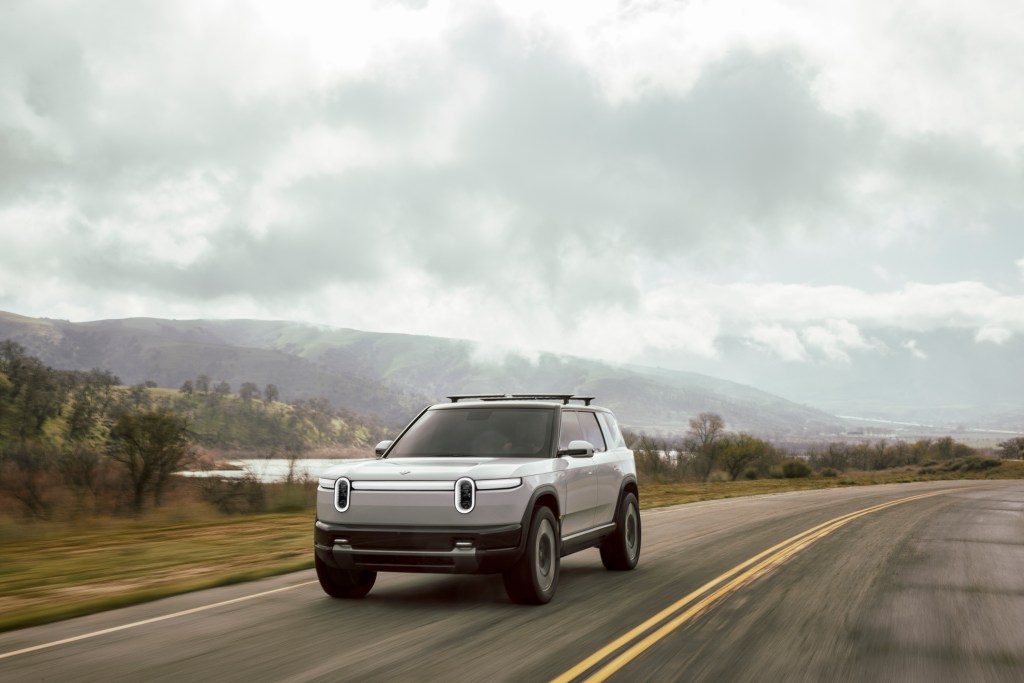
Rivian R2 is supposed to go into production in Illinois in 2026. (Image: Rivian)

When it announced the R2 and R3 models yesterday it was announced that rather than waiting for the factory to be built in Georgia for the production of the new models, it is putting the R2 into the Normal plant which will have, by R2 launch time in 2026, an expansion of capacity to 215,000 vehicles.

Here’s the thing. Whether the capacity is 150,000 units or 215,000, that’s an awfully big delta between either and ~60,000 vehicles.

It is a rule of thumb in automotive manufacturing facilities capacity utilization has to be at from 70% to 80% to be cost effective.

Seventy percent of 215,000 is 150,500.

Rivian has a long way to go to get there and not a whole lot of time.

The EV Bump That Won’t Be

By Gary S. Vasilash

“While technologically advanced, the extent that BEVs can contribute to GDP growth is limited by the maturity of the motor vehicle industry, with passenger car sales having peaked in 2017. This is a restraining factor as BEVs do not represent an innovation that creates new demand, like the introduction of personal computers or cell phones. Instead, they’re a new version of a familiar product whose sales may not grow much beyond current levels.”—Thomas Klitgaard, Federal Reserve Bank of New York

In other words, electric vehicles are not a disruptive tech that is going to bring in new buyers who otherwise wouldn’t buy an SUV, car or truck.

So even if we get to 100% EV buyers (not likely anytime soon), this is simply replacement, not buyers who would otherwise not buy a means of transportation.

Which is not what vehicle manufacturers want to think about.

Kia Going Big

By Gary S. Vasilash

While some people may continue to associate Kia with small(ish) vehicles—sedans and CUVs—the company has not only transformed itself into a leader when it comes to styling, but it has increased the size of what it has on offer.

An excellent example of this change is its EV9, which is not merely an electric vehicle, but a three-row EV. While you can find three-row crossovers at your local Ford (Explorer) and Chevy (Traverse), you can’t find a model with an electric propulsion system.

(And it is worth noting that the EV9, in its debut year, bested an array of other crossovers to be named the North American Utility Vehicle of the Year by NACTOY, no small feat.)

Kia PV5 in a ride-hailing configuration. (Image: Kia)

But even those who are familiar with the Kia lineup were undoubtedly taken by surprise at this year’s CES when the company introduced its “Platform Beyond Vehicle” (PBV) strategy, which is predicated on purpose-built EVs that are essentially commercial vehicles. (Which explains why it is showing off two of its PBV concepts—the PV5 and the PV7—at the Work Truck Week event that is occurring this week in Indianapolis.)

While commercial vehicles of the configuration of the Kias are common (though the styling of the Kias are uncommon), what’s interesting is that the company is proposing that there is a driver’s fixed cab on a platform and behind it a flat surface upon which upper bodies can be attached, depending on the use case.

Again, putting different boxes on the back of truck chassis is common, but Kia is proposing the “life modules” are attached with hybrid electromagnetic and mechanical coupling such that they can be readily replaced to take on different tasks.

Steve Center, COO and EVP of Kia America, said of the PBV approach: “Kia’s exciting foray into this important segment of the overall industry represents our steadfast commitment to the electrification of transportation and aligns perfectly with our Plan S strategy to become a global leader in sustainable mobility.”

Mobility that goes beyond moving people.

While still concepts, the company says the PV5 could hit the U.S. market in 2026.

Watch this brand.

Are There Enough Exclamation Points for EV Sales?

By Gary S. Vasilash

This won’t garner any headlines:

78.81% of vehicle purchases in the U.S. in 2023 were for vehicles with gasoline engines, according to Experian’s “State of the Automotive Finance Market, Q4 2023.”

The number that will is:

8.55% of the vehicles purchased were electric vehicles.

But of that “purchase,” 30.7% of the EVs were leased, which is essentially renting with the option to buy, not outright obtaining (i.e., according to the Oxford English Dictionary, the verb purchase means “To acquire in exchange for payment in money or any equivalent; to buy.” And the way the Inflation Reduction Act is constructed, for many OEMs leases are the only way that consumers can get a $7,500 purchase incentive).

A number that also won’t get large type:

9.83% were hybrids.

That number alone is about 13% greater than the EV number.

But arguably the 2.02% of vehicles purchased in 2023 that were plug-in hybrids could be added to the hybrid number, which would go to 11.85%.

Odds are that hybrid number is going to continue to grow, as will the EV number, but even though it will continue to be higher than the EV number for the next several years, you can bet every rise in EV sales will continue to get outsized attention—until the novelty passes.

‘Consumer Reports’ on Top Models & PHEVs

By Gary S. Vasilash

Although the folks at Consumer Reports are finding increased interest in and performance of electric vehicles (EV), it seems as though plug-in hybrids (PHEVs) are really something of a sweet spot based on its annual top-10 vehicle list.

CR’s Jake Fisher, senior director of Auto Testing, points out that there are four key elements that go into the determination of what vehicles make the list—and make it to the top of the list, which are:

  • Road testing
  • Active safety and crash testing
  • Owner satisfaction
  • Predicted reliability

While the first two are objective and the last two are subjective, know that the nonprofit consumer organization bases the last two on more than 300,000 member surveys, so there are solid metrics behind them.

The Results

So here are the top 10:

  • Subcompact SUV: Subaru Crosstrek
  • Compact SUV: Subaru Forester
  • Small car: Mazda3
  • Midsize car: Toyota Camry Hybrid
  • Small pickup: Ford Maverick/Maverick Hybrid
  • Midsize SUV: Toyota Highlander Hybrid
  • Luxury SUV: BMW X5/X5 PHEV
  • Hybrid/PHEV car: Toyota Prius/Prius Prime
  • PHEV SUV: Toyota RAV4 Prime
  • Electric vehicle: Tesla Model Y

The PHEV Challenge

One of the challenges vis-à-vis people going to a PHEV rather than a conventional hybrid (HEV) or a full EV is, Fisher explains, their understanding of what a PHEV is and how it would fit into their driving regime.

RAV4 Prime: hybrid with a plug. (Image: Toyota)

To simplify things, CR has modified the way it provides information about fuel economy for PHEVs by treating the all-electric range provided as a “bonus” added to the results when the vehicle is operating in its “charge-sustaining mode” (a.k.a., simply driving on its engine).

A fascinating comparison that CR made is to put like-to-like vehicles up against one another with the differences being in their propulsion system—PHEV vs. ICE, HEV and full EV—and then how much it will cost the consumer based on both the vehicle price and the cost of energy. The assumptions are that the owners will plug in their vehicles that have plugs, drive 40 miles per day, and take four 500-mile trips annually.

While it may not be a surprise that the PHEV version of the BMW 330 is more cost-effective than the gasoline-only version, there are a couple of surprises:

The Hyundai Tucson HEV saves more money than the PHEV version.

And while it seems to be accepted wisdom that owning an EV means far less cost for energy, the Kia Niro PHEV is actually better for the pocketbook than the Niro EV.

How Will February Look Sales-Wise?

By Gary S. Vasilash

J.D. Power and GlobalData project that February sales will come in a smidge—1.4%–more than they were in February 2023, or 1,214,600 vehicles

Taking out non-retail transactions, the number is 981,300, which is the important number because that reflects individual consumers.

So using that as the basis of comparison, there is an increase of 3.8% compared to the same month last year.

One of the reasons for the rise this year is something that happens once every four years: an additional day of sales, February 29.

According to Thomas King, president of the data and analytics division at J.D. Power, the increase in sales is facilitated by:

  • Higher inventory levels (when there are cars on the lot, then there is less pressure to have to select whatever is available from a paltry number)
  • Higher manufacturer incentives (turns out that there is a need to provide a boost to get the sheet metal moving)
  • Lower dealer profit margins (seems that the profits that were rolling in when choice was minimal so prices were maximal are now trending back to normal—but it is worth noting that about 17% of vehicles are still selling above MSRP, although last year it was nearly 32%)

What this means is that people are getting bullishly back in the market.

King:

“Transaction prices in February are trending towards $44,045, down $1,919 or 4.2%—from February 2023. However, despite the significant decline in average transaction prices, higher sales volumes mean consumers are on track to spend nearly $40.8 billion on new vehicles this month—the highest on record for the month of February, and 4.1% higher than February 2023.”

Could be a case of the proverbial “making it up on volume.”

Nowadays, it is impossible not to look at how things are going in terms of EV sales.

Elizabeth Krear, vice president, electric vehicle practice at J.D. Power, said, “In 2023, EV sales and leases accounted for a larger percentage of retail auto industry growth than gas-powered vehicles.”

Presumably that has something to do with the fact that there is a stable number of gas-powered vehicles so the growth would not be as big as that of EVs, which start from a comparatively smaller number.”

She acknowledged what is now frequently heard: EV sales are slowing.

Putting some numbers to it:

“In January, battery electric vehicle sales fell 1.6 percentage points from 9.2% in December 2023. Further, upper-funnel EV shopper interest declined for a fourth consecutive month. New-vehicle shoppers who are ‘very likely’ to consider purchasing an EV for their next vehicle dropped to 25.6%, a full percentage point lower than in December.

Krear said that a big blockage for EV buyers: charging access.

While she noted that the opening of the Tesla Supercharger network will go a long way toward addressing that issue, she added, “But this alone is not enough to move the needle. Improvement is needed in terms of the availability of affordable EVs for mainstream customers.”

Yes, it all comes down to an affordable MSRP.

The EV Market and the Necessity of Time (and Money)

By Gary S. Vasilash

While John Heywood’s A Dialogue Conteinyng the Nomber in Effect of all the Prouerbes in the Englishe Tongue (c. 1538) isn’t the sort of thing that is likely read outside the walls of Oxford or Cambridge, there is one phrase from that source that is if not commonly used, certainly familiar:

“Rome wasn’t built in a day.”

This came to mind in relation to a comment made by Rivian CEO RJ Scaringe during the announcement of the EV company’s 2023 earnings—or lack thereof (it had net losses of $5.4 billion—which it at least better than 2022’s $6.8 billion).

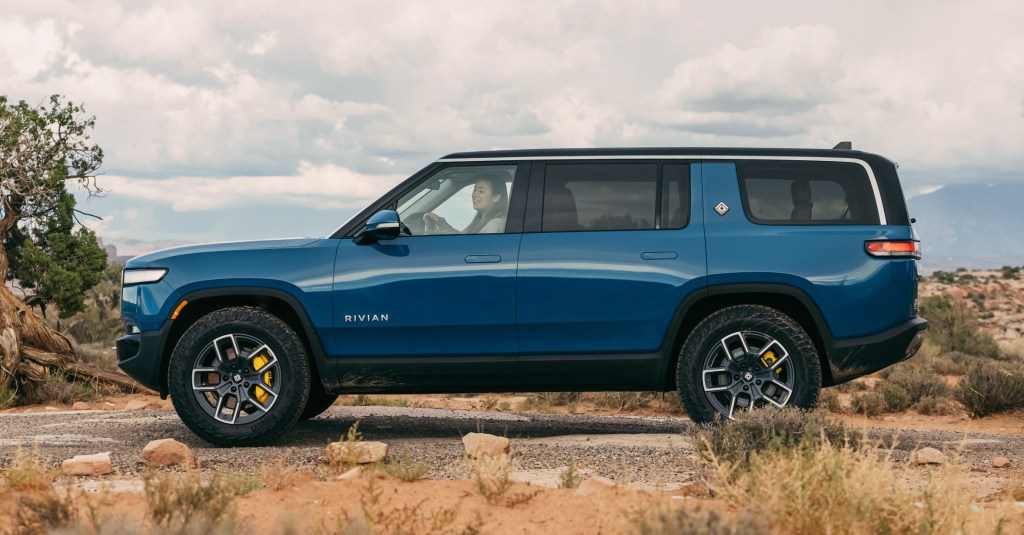
Rivian R1S (Image: Rivian)

Scaringe:

“We firmly believe in the full electrification of the automotive industry, but recognize in the short-term, the challenging macro-economic conditions.”

This in relation to the announcement that approximately 10% of its salaried workers are going to be let go.

Wall Street thinks short term. Technology change can take longer. Much longer.

According to History.com:

“The number of active automobile manufacturers dropped from 253 in 1908 to only 44 in 1929, with about 80 percent of the industry’s output accounted for by Ford, General Motors, and Chrysler.”

That means that 41 manufacturers had 20% of the market.

Unfortunately for them, on October 29, 1929 there was Black Tuesday, a.k.a., the Stock Market Crash.

And the number of vehicle manufacturers crashed, accordingly.

We are now in a period that is somewhat analogous to 1908 on its way to 1929, with there being a number of start ups—including Rivian—in the EV market space.

A difference is that Ford, General Motors and Chrysler (yes, yes, Stellantis) don’t have a huge scale advantage in EVs, as they have single-digit shares of the EV market (yes, 0 is a single digit; Stellantis will soon bump that up).

Let’s face it: EVs are still costly to produce, not only because they are a comparatively new thing, but because the things that go into them are more expensive to make (while this is admittedly a trivial example: it is a hell of a lot cheaper to blow mold a gas tank than it is to manufacture an EV battery case).

And because of that, it is going to take time for manufacturers to make money on making vehicles (according to Electrek, Rivian lost $43,372 for every vehicle it delivered in Q4 2023—which is certainly better than the $124,162 per vehicle it lost in Q4 2022).

For some the time will run out because the money will have.

Going Rare Earth-Free for Magnets

By Gary S. Vasilash

The rare earth elements—of which there are 17, and since there are 118 elements on the Periodic Table, that number of rare earth elements is certainly not rare—are of increasing interest with the growth of electric vehicles.

EV motors use permanent magnets and permanent magnets are made with elements including neodymium and dysprosium.

There are at least a couple issues related to rare earths:

  1. They may be mined in places that are socially and politically unstable
  2. While there are things like neodymium found in the U.S., much of the processing capacity for the rare earths is located in China, so for OEMs to be able to get the full federal tax credit for EVs, sourcing from China is a no-go
(Image: Niron Magnetics)

Niron Magnetics, based in Minnesota, has developed what it claims are “the world’s first high-performance, rare earth-free permanent magnets” is drawing investments from automotive companies like, well, magnets draw iron filings.

It has obtained investments from GM Ventures, Stellantis Ventures, Volvo Cars Tech Fund, and most recently Allison Ventures (the venture capital arm of Allison Transmission) and automotive supplier Magna.

To produce its “Clean Earth Magnet,” which is based on iron nitride—a combination of iron and nitrogen, of which there is an abundance in the world—it uses nanomaterial engineering to carefully manipulate the crystals in the iron nitride.

According to Niron, the magnets provide such high magnetization that it is possible to design EV motors that use 15 to 30% less magnetic material, which can mean smaller, more efficient motors.

Smaller, lighter motors can then have a knock-on effect of reducing the size and mass of other elements in the EV.

So this is a win on many fronts, from economic to performance.

Fisker Faces NYSE Issue

By Gary S. Vasilash

On February 17, 2023, Fisker’s stock closed at $6.98. (For unrealistic comparison purposes, Tesla, that day: $208.31.)

On February 16, 2024, Fisker’s stock closed at $0.73. (Tesla: $199.95. Certainly not the halcyon number of days of yore, but still pretty damn good.)

On February 15, 2024, Fisker received a notice from the New York Stock Exchange.

In it, the NYSE pointed out that because Fisker’s common stock had traded at less than $1.00 per share for a consecutive 30 trading-day period, it is out of compliance with the rules of the exchange and could be delisted as a result.

This doesn’t mean that that is going to happen.

Fisker will tell the NYSE within 10 business days what its plan is is to get back into compliance.

There is a six-month “cure period” that the company has to get things in order (a.k.a., getting its stock price to at least an average of $1.00 per share for 30 consecutive trading days).

According to Fisker:

“The Company intends to remain listed on the NYSE and is considering all available options to regain compliance with the NYSE’s continued listing standards, including, but not limited to, a reverse stock split, subject to stockholder approval no later than at the Company’s next annual meeting of stockholders.”

It didn’t seem all that long ago that EVs were going to be a market—as in both the consumer and financial variants—winner for those involved.

Things are clearly not what they seemed.