EVs and Pricing Parity

By Gary S. Vasilash

In December 2023 18 of the 35 brands that Kelley Blue Book analyzed had year-over-year price declines.

This is understandable, given that it was the end of the year, and there is a tendency for product manufacturers of all types, not just vehicles, to want to move out as much inventory at the end of a period as possible (e.g., the classic recommendation about buying a car at the end of the month when the dealer wants to move just one more to make a quota and consequently provides a better deal).

So there was Volvo, which reduced its price by 6.7% and Land Rover, with a 10.2% reduction.

It should be noted, however, that both of those brands have a very minimal (<1%) share of the U.S. market, so it is not like their combined numbers have much of a consequence on the overall average retail price for vehicles in 2023.

KBB calculated that in December the average transaction price (ATP) for vehicles was $48,759.

Notably, the ATP was $50,798 for electric vehicles.

Said Stephanie Valdez Streaty, director of Industry Insights at Cox Automotive, “2023 was a milestone year with 1,189,051 pure battery electric vehicles sold, accounting for 7.6% of all new-vehicle sales.”

So that is good for the EV producers.

What’s more, the point at which price parity between vehicles with combustion engines and those with electric motors is reached is something considered by industry to be the point at which there will be a huge rise in the number of EVs purchased.*

An ATP difference of $2,039 for an EV is almost that, and certainly just a few bucks per month on a lengthy load.

But going back to the companies that had price cuts in December, there’s the company that accounts for 55.1% of the EV market, Telsa. (Tesla has, per Cox Automotive, 4.2% of the entire vehicle market, which is more than Mercedes, Volvo, Jaguar-Land Rover, Rivian, and Lucid combined.)

According to KBB it cut its prices an average 25.1%.

Let’s see: a price reduction of that magnitude, the possibility of getting as much as a $7,500 tax credit for a Model X or Y—well, were Chevy capable of providing those kinds of benefits to customers Malibus would be flying off lots.

People read books about negotiation strategies in order to get a few percent taken off the price of the vehicle they want to buy, coming in ready to take on the dealer by being wise to its tactics, and there was Tesla, slashing prices, presto-change-o. And the Feds offering serious money, too.

Amazing!

No other OEM can afford to make—or take—the kind of cut that Tesla made.

At some point (let’s not forget about the presidential election in a few months) those tax cuts are going to go away. And Tesla may simply being to ratchet its prices back up.

What then?

Perhaps that parity may be fleeting.

==

*Of course, given the continued issue regarding infrastructure, which an increased number of EVs would only exacerbate. . . well, people who have to drive around looking for available, working chargers are not likely to want to repeat that experience when they look for a new vehicle.

What Do EV Drivers Want?

By Gary S. Vasilash

Maybe it is listed in no particular order, but on a page headlined “Electric Vehicle Benefits and Considerations” on the U.S. Dept. of Energy’s Energy Efficiency & Renewable Energy, Alternative Fuels Data Center (whew!) site, those benefits and considerations are listed  as follows:

  • Energy Security
  • Costs
  • Fuel Economy
  • Infrastructure Availability
  • Emissions
  • Batteries

It would seem that there are more in the way of “considerations” than benefits here.

I suspect not a whole lot of people think “geopolitics” when they buy a new vehicle.

In the “Costs” section it explains:

“Although energy costs for EVs are generally lower than for similar conventional vehicles, purchase prices can be significantly higher. Prices are likely to equalize with conventional vehicles, as production volumes increase and battery technologies continue to mature. Also, initial costs can be offset by fuel cost savings, a federal tax credit, and state and utility incentives.”

The “purchase prices can be significantly higher” is probably a red flag for many people. And that costs will go down with greater volume doesn’t help someone who is buying an EV today. The free money from the government is certainly something that is a bonus compared to buying an ICE vehicle. And the fuel cost savings go to the next two points on the list, with fuel economy being better for light-duty vehicles, although there is the issue of charging, with the acknowledgement that “Public charging stations are not as ubiquitous as gas stations,” something of a massive understatement.

While people generally consider batteries in the context of the range provided, the folks at the Alternative Fuels Data Center acknowledge “The advanced batteries in electric vehicles are designed for extended life but will wear out eventually.” And it points out that should a battery need to be replaced outside of warranty “it may be a significant expense.”

And then there’s the “Emissions” item. Presumably the one that is of most interest to people who are concerned about the environment. According to the Center, “Electric and hybrid vehicles can have significant emissions benefits over conventional vehicles.” Note the can. The outfit goes on to note the life cycle emissions for EVs in areas where the electricity is generated with “low-polluting energy sources” have better performance than those that are operated “In regions that depend heavily on conventional electricity generation, electric vehicles may not demonstrate a strong life cycle emissions benefit.” Note the conventional.

A question that arises is that of how many people—regular everyday people—consider buying an EV because of its environmental benefits versus other characteristics, like its generally peppy off-the-line performance or the opportunity to forego visiting gas stations or because it is a Tesla and that’s considered cool?

Goodyear tire specifically for EVs. (Image: Goodyear)

This week Goodyear introduced a replacement tire for EVs, a tire that is available in sizes to fit an array of EVs from The Model Y to the Mustang Mach-E to the Audi Q4 e-tron.

About the tire, David Reese, vice president, Product Development, Goodyear Americas, said: “We know EV drivers prioritize performance and a more-sustainable tire. The ElectricDrive 2 was designed with at least 50% sustainable materials, a focus on providing greater traction and maintaining a quiet ride.”

Tires are a big concern for EVs because (a) the propulsion system is much quieter than a vehicle with combustion propelling it and (b) they are comparatively heavy:

While not an apples-to-apples comparison, the heaviest Mustang Mach-E EV has a curb weight of 4,838 pounds; the heaviest ICE ’23 Mustang is 3,932 pounds.

Heavier vehicles have an effect on tire wear.

While it is absolutely laudable of Goodyear to be using sustainable materials in its new tire, arguably people who drive vehicles that aren’t EVs could benefit from the fitment of such tires.

And it gets back to the question of whether performance, traction and a quiet ride are really what EV drivers are looking for in a tire rather than its environmental characteristics.

BMW and EVs

By Gary S. Vasilash

When it comes to discussions of electric vehicles, the topics seem to be, in order of frequency:

  1. Tesla. Anything. Mileage recalculations. Musk’s recreational habits. Labor issues. Massive number of vehicles being sold (which actually doesn’t get the attention that it should: when you subtract Tesla vehicle sales from electric vehicle sales, things don’t look quite as bullish as one might think).
  2. GM. Mainly its failure to produce notable volumes. For 2023 it delivered 9,154 Cadillac LYRIQs, 483 Chevy Blazer EVs, 461 Silverado EVs, 3,244 HUMMER EVs, 14 Zevo 400s, and 483 Zevo 600s (the last two are commercial vehicles). That is a total 13,838 vehicles. Out of 2,594,698 sold.
  3. Ford. One thing is the refocus on hybrids. The other thing is the changing prices for the F-150 Lightning, with the recent notable rise in MSRP. You might have imagined that when the vehicle launched the perceived demand was such that they would have quickly hit economies of scale that would cause prices to, well, not rise. For 2023 it sold 24,165 Lightnings, which is excellent in the context of GM. But when you take into account the total 750,789 F-Series trucks sold, that’s about 3%.

A company that gets little attention is BMW when it comes to EVs.

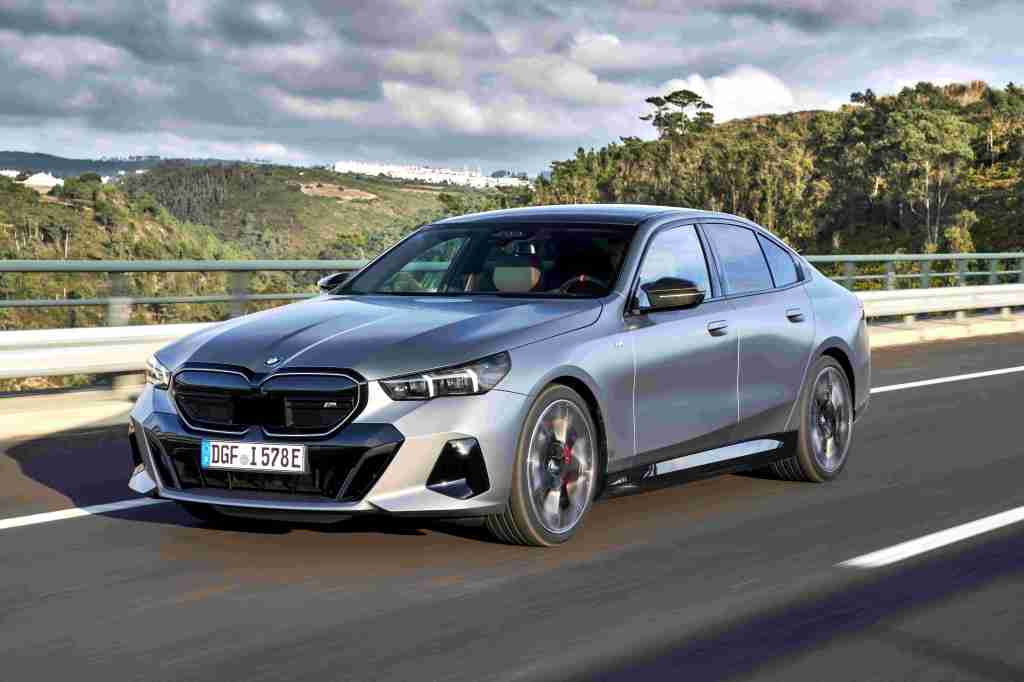
BMW i5: one of the electric vehicles in the company’s offerings–there are also the i4, i7 and iX. (Image: BMW)

Which is surprising given that in 2023 it delivered 45,417 EVs into the U.S. market.

That’s more than the GM EV sales and the Ford Lightning sales combined (38,003).

BMW 2023 EV sales account for 12.5% of its total sales.

If the number of plug-in hybrids BMW sold in 2023 (25,318) are added in to the EV number (so the number of “electrified vehicles”), it is 70,735 or 19.5% of BMW’s total sales in the U.S.

Those are some big numbers for BMW.

Seems like the lack of discussion isn’t keeping people from buying the company’s EVs.

2024 NACTOY Winners Examined

By Gary S. Vasilash

This morning the 2024 North American Car, Truck and Utility Vehicle of the Year (NACTOY) awards were announced.

And with no further ado. . .

  • North American Car of the Year: Toyota Prius & Prius Prime
  • North American Truck of the Year: Ford Super Duty
  • North American Utility Vehicle of the Year: Kia EV9
Kia EV9: 2024 NACTOY Utility of the Year. In 2023 Kia also took that NACTOY category with the EV6. Seems that company really has it going on with electric utes. (Image: Kia)

To look at this a more closely:

The Car category also included the Hyundai IONIQ 6 EV and the Honda Accord. Several people whom I’ve talked with (full disclosure: I am one of the 50 jurors for the awards) thought it would more likely be the Accord than the Prius.

While all three are excellent cars, the transformation of the Prius from something that was somewhat awkward to an object of desire (with really good gas mileage) undoubtedly pushed it over the top.

In trucks, the Ford Super Duty was up against the Chevrolet Colorado midsize pickup and the Chevrolet Silverado EV. The NACTOY awards are consumer-centric, not commercial-centric. Which led me to wonder about the Super Duty being a finalist. Then two things happened:

  1. I talked with Detroit Free Press car reviewer Mark Phelan (also a juror) who pointed out that plenty of people buy Super Duty trucks as daily drivers
  2. I spent time behind the wheel of a Super Duty and discovered that in terms of the tech and the amenities it gave nothing up compared with cars or utilities

That the Silverado EV didn’t take the trophy probably surprised some people at GM HQ because this is their Ultium-based offering in the full-size truck segment and it betters the specs of the Ford F-150 Lightning, the EV pickup that won the NACTOY award in 2023. Perhaps the $74,800 price for a work truck kept Chevy from winning.

And in utilities, the finalists that the Kia EV9 faced were the Genesis Electrified GV70 and the Hyundai Kona/Kona EV. In mid-November when the finalists were announced the Kona wasn’t on the list and the Volvo EX30, a small electric crossover, was. But Volvo had to pull the vehicle from consideration because it wasn’t going to have vehicles in-market before the end of 2023.

Two things about the utility situation:

  1. Kia also won the category last year with the EV6
  2. As Genesis is a sibling company with Hyundai and Kia, it is clear that the three companies have remarkable capabilities in the utility space—including the electric utility space

And that second point raises another consideration:

The traditional domestics had the Truck category. But nothing in the other two categories.

Is that a model for long-term success?

Ford Sells a Lot of Trucks. Again.

By Gary S. Vasilash

For those of you still humming Mariah Carey’s “All I Want For Christmas Is You,” here’s a bit of context for an announcement Ford made this morning:

The year that the Ford F-Series started making its consecutive run as the best-selling truck in the U.S., Ms. Carey was seven.

The F-Series has taken the lead for 47 years in a row.* They’re looking at more than 700,000 of them driven off of dealer lots in 2023.

2024 Ford F-150 Platinum. So nice that you probably wouldn’t want to use it as. . .a truck (Image: Ford)

And underscoring the curious popularity of trucks in suburban driveways as well as on work sites (curious because I rarely see my pickup truck-owning neighbors doing anything with the boxes on the back of those vehicles that they couldn’t manage with a trunk), the F-Series has been the best-selling vehicle in the U.S. for 42 years running.*

There is, of course, the question of whether “the most” means “the best.”

After all, McDonald’s has sold more hamburgers than any other company in the world and there is probably no one who doesn’t know whether they can get a better burger.

But one thing it certainly means is that the F-Series provides an unparalleled level of value for more people than any other pickup.

While there may be specific attributes of trucks from other OEMs that are more appealing or necessary for some purchasers, which means those trucks are more valuable for those people, on an overall basis Ford is consistently delivering.

Credit where credit is due. (And you’ll probably need good credit to get a full-size pickup: according to Kelley Blue Book, the average transaction price (ATP) for one in November 2023 was $66,590. You could get an entry-level luxury car for an ATP of $57,889.)

(On a related-unrelated subject, the tremendous number of trucks sold by Ford—closely followed by GM and Ram—in the context of vocational or functional (i.e., towing, hauling) uses of the vehicles might indicate that people are less environmentally keen than might be expected. After all, light-duty pickups aren’t exactly fuel-economy leaders, so were people concerned about carbon, they’d be buying more efficient vehicles for their daily drives. Yes, there are an electric F-150 and Chevy Silverado and one coming from Ram, but from the point of view of resource utilization, as in the massive batteries that have to be constructed, if those trucks aren’t being used as, well, trucks, then that isn’t exactly the most-environmental choice.)

*As the announcement was made a couple days before the actual end of the year, it is a bit of estimation on behalf of Ford. A small bit.

Don’t Be Fuelish

When I think “fuel economy” I think of, well, fuel. Liquid fuel. Gasoline. Things measured in miles per gallon, not miles per kilowatt hour.

So when I looked that the just-released “Model Year 2024 Fuel Economy Guide” from the U.S. Dept. of Energy I was more interested in seeing what the fuel economy ratings are for various vehicles, ignoring the full electric vehicles*, but giving attention to the plug-in and standard hybrids because in some cases, like minivans, there really is no option when consulting the “Fuel Economy Leaders”:

Minivans

  • Chrysler Pacifica Hybrid (PHEV): 48 mpg combined
  • Toyota Sienna 2WD (hybrid): 36 mpg combined
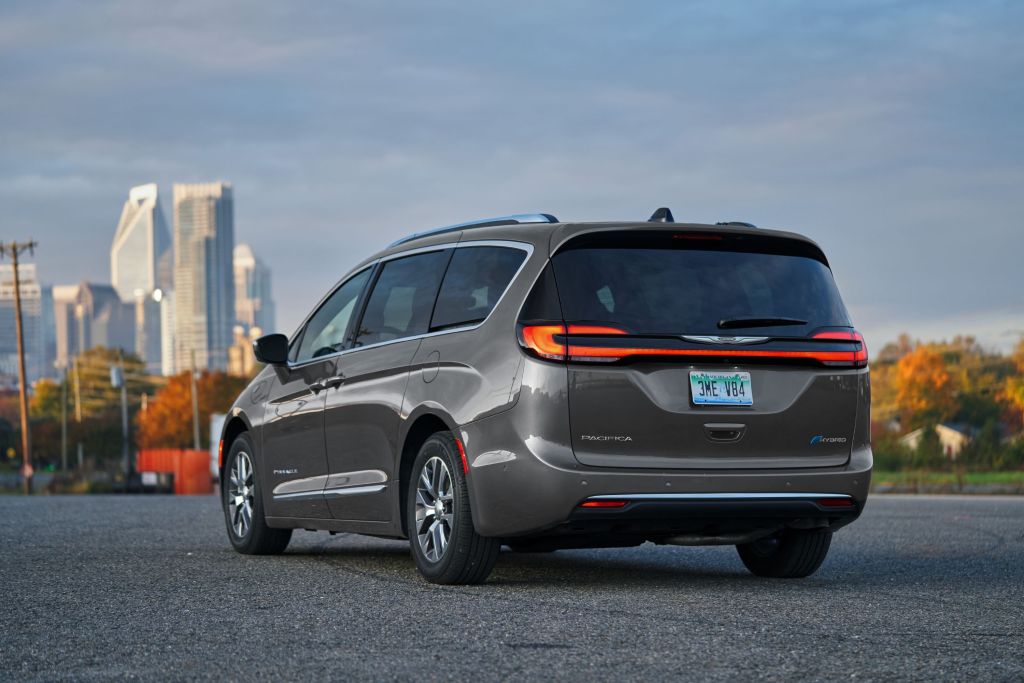
Pacifica PHEV gets a combined 48 mpg rating. Impressive. (Image: Chrysler)

Other top performers:

Subcompact cars

  • Audi A3 (hybrid): 32 mpg combined
  • MINI Cooper Hardtop (2 and 4 door): 32 mpg combined

Compact car

  • Toyota Corolla Hybrid: 50 mpg combined

Midsize car

  • Toyota Prius (hybrid): 57 mpg combined

Large car

  • Honda Accord Hybrid: 48 mpg combined

Small pickup truck

  • Ford Maverick HEV FWD (hybrid): 37 mpg

Standard pickup truck

  • Chevrolet Silverado 2WD (diesel): 26 mpg combined

Small SUV

  • Kia Nio FE (hybrid): 53 mpg combined

Standard SUV

  • Toyota Grand Highlander Hybrid: 36 mpg combined

Something for everyone—especially those who don’t like to pay a lot at the pump.

*The whole MPGe ranking strikes me as being almost meaningless. While one could say the same for the mpg rating, I think that there is a notion that if a car gets 25 mpg and the average size of a fuel tank is at least 10 gallons (actually it is more on the order of 12.5, but that’s trickier math-wise), then 25 mpg means 250 miles. But unless someone knows the capacity of the battery and is able to do the math, the MPGe is a cipher.

Hybrids Still Matter

By Gary S. Vasilash

Japanese car shoppers are going to buy more hybrids in 2024—more than half of all sales will be the electrified powertrains—than any other type of propulsion system, according to Bloomberg Intelligence.

Tatsuo Yoshida, Bloomberg Intelligence senior auto analyst, said:

“In Japan, hybrids are popular because they’re affordable and reliable, since they don’t rely on the existence of strong charging infrastructure.”

Arguably, those same characteristics—affordability, reliability, and no dependence on the availability of electric chargers (at home or out in the world)—are important to consumers everywhere.

2024 Toyota Prius: Looks good. Travels far. (Image: Toyota)

Although Honda had a hybrid in the U.S. market, the Insight, before Toyota brought the Prius, it was literally just a matter of months—Insight December 1999; Prius June 2000—and Toyota has really become more associated with hybrid technology thanks to its persistence in bringing out hybrids, both as powertrain options to vehicles (e.g., the hybrid RAV4) and as hybrid-only offerings (e.g., the Toyota Venza).

In Japan Toyota has had the Prius available since 1997, so the vehicle, and hybrid tech, are certainly familiar to consumers there.

While the Prius design over the years transitioned from something frumpy to something that looked like the designers were spending too much time watching anime, the 2024 Prius, the fifth generation of the model, is absolutely stunning in looks and certainly not lacking in its efficient performance: the top-of-the-line XLE and Limited models with AWD offer fuel economy of 49 mpg city, 50 mpg highway, and 49 mpg combined. For those who have more frugality, there’s the LE FWD version which is rated at 57/56/57 mpg, which means that given its 11.3-gallon fuel tank (and it takes regular gasoline) it can travel some 640 miles on a tank. That is the definition of “convenience.”

(The 2024 Prius was named the MotorTrend Car of the Year and it is a finalist for the North American Car of the Year, which will be announced January 4.)

Hybrids are garnering more attention in the U.S. market. Not as much as in Japan, but more.

The Ford Maverick Hybrid continues to be a massive hit.

And when Ram brings out its Ramcharger Ram 1500 variant next year, although it will probably emphasize that it is an “electric vehicle,” it is really a hybrid (a series hybrid: there is a battery that powers the electric motor; when the battery gets close to depletion, the gasoline engine operates as a generator to recharge the battery, to keep the propulsion going).

And at an Automotive Press Association Q&A late last month, GM CEO Mary Barra acknowledged that the company has hybrid tech in its portfolio, even though it has no hybrids on offer in the U.S. market.

Arguably, if more Americans knew about the ease of using a hybrid and the efficiency the vehicles provide, they, too, would buy more of them.

Perhaps this will happen when the 2025 Toyota Camry is launched.

The Camry, the perennial best-selling car in the U.S., will be available only with a hybrid powertrain. Clearly, Toyota is that confident in the tech. (Of course, having been putting hybrids under hoods for more than a quarter of a century, it ought to be.)

Affordability, reliability, and no dependence on the availability of electric chargers.

This may cause consumers to pay more attention to hybrids in the U.S., too.

You Can Reserve an Acura MDX EV Right Now

By Gary S. Vasilash

Although it is widely known that Acura is late to the proverbial electric vehicle party, it announced today that reservations are now open for its forthcoming ZDX crossover, which is available as an A-Spec (single-motor, RWD; dual-motor AWD) or as a Type S (dual-motor, AWD, ~500 hp) vehicle.

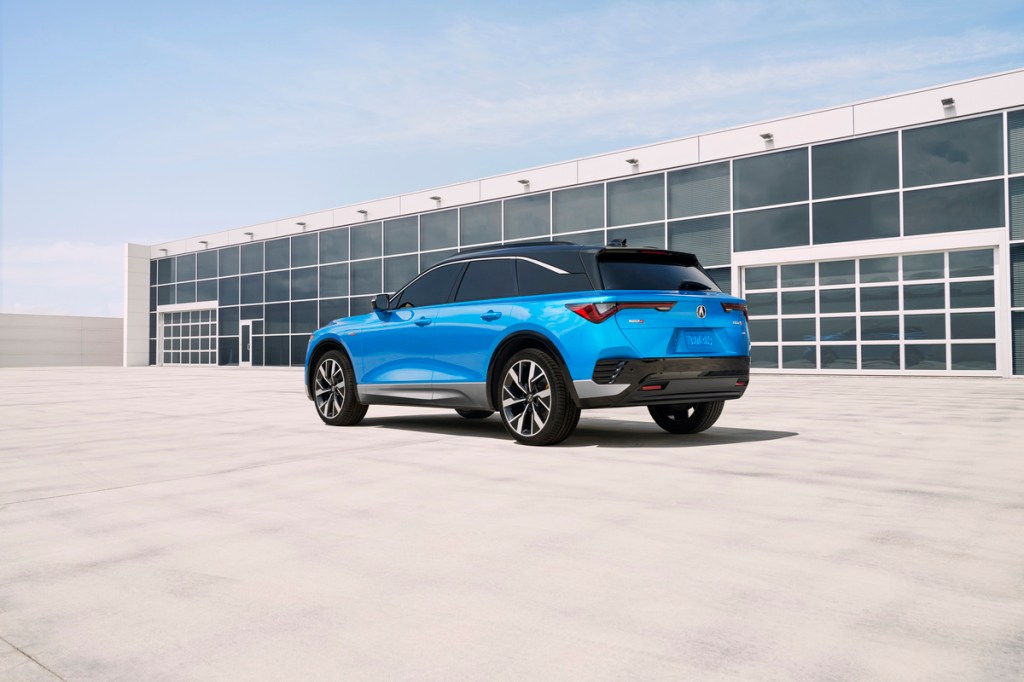
The 2024 Acura ZDX: coming to a dealership near you (well, assuming you know where an Acura dealership is) sometime next Spring. They say. (Image: Acura)

So it is getting closer, as close as Spring 2024 for those who put down a $1,000 reservation fee. . .but given that the ZDX is based on the GM Ultium platform, there could be some minor or major delivery delays, given that the Ultium track record to date is not exactly confidence-inspiring.

The A-Spec models are said to be “Starting in the range of $60,000” and the Type S offering “Starting in the range of $70,000,” so the vehicles both of which are offered with a 102 kWh battery, don’t have particularly surprising price points.

That is, the Acura MDX has a starting MSRP of $49,850 and makes its way to $73,500.

Acura has always been premium, so for the money it tends to be a good value.

Often better than good.

So maybe it will be late, but it has the right body style for selling EVs, and a handsome body style out of its LA studio (which is undoubtedly surrounded by EVs from various and sundry OEMs, established, burgeoning, trying, and Tesla).

Let’s just hope the ZDX isn’t really late.

It’s not that the party will be over. It will be that people will have all selected their party hats vehicles and so the number Acura will be able to move will be less than it might be thought and there won’t be a whole lot of popping the cork.

Tesla and the Rental Fleets

By Gary S. Vasilash

One of the things that rental companies do—besides trying to get you to buy all manner of insurance and making you feel marginally criminal and totally liable if you don’t—is sell vehicles from their fleets in order to get an even better ROI.

Hertz, back in 2021, announced that it was going to make a massive investment in electrifying its fleet, with the purchase of some 100,000 Teslas. A few months later it upped the amperage and further announced 65,000 Polestars would be included in lots at airports around the country.

But it seems that the company is rethinking its approach for a couple of reasons.

One of which has to do with the price reductions that Tesla made in order to boost its sales volumes, which had the consequence of putting downward pressure on the residual values of its vehicles. That is, if you buy something for one price and then the same thing is available for a lower price, even before you try to sell your object as used it is worth less than it otherwise would have been.

Hertz CEO Stephen Scherr told The Verge, “The MSRP declines in EVs over the course of 2023, driven primarily by Tesla, have driven the fair market value of our EVs lower compared to last year, such that a salvage creates a larger loss and, therefore, greater burden.”

In addition to which, Hertz discovered that it was costing about twice as much to repair damaged EVs compared to vehicles with internal combustion engines.

“We nonetheless remain committed to our long-term strategy to electrify the fleet,” Scherr also said, which undoubtedly has something to do with the company (1) justifying its initial tranche of EVs and (2) simply positioning itself as a good corporate citizen.

But Hertz isn’t the only rental company rethinking its EV strategy.

Sixt, the German rental company (#2 in Europe; #4 in the U.S.) has decided that as it is electrifying its fleet it is moving away from Tesla and moving toward Chinese OEM BYD.

Again: the residual values and the costly repairs are factors that have played into this move.

While this doesn’t mean that either of these companies are any less interested in electrification, it seems to indicate that their interest in Tesla is waning or disappearing.

EV (Dis)interest

By Gary S. Vasilash

One of the things that isn’t talked about much is the fact that electric vehicles really aren’t that popular unless they come from Tesla.

Flying in the face of that is a finding of Kelley Blue Book that in Q3 2023 EV sales in the U.S. hit 313,086 units, a 49.8% increase over Q3 2022. Such a jump means interest, right?

Well, the total number of EVs sold in Q3 represents 7.9% of total industry sales.

In other words, 92.1% of the vehicles people bought in Q3 weren’t electric.

And to the point of Tesla’s sway over the market—even though KBB saysTesla’s share of market tumbled to 50%–is that KBB acknowledges“Tesla’s price cuts have moved the market, pushing electric vehicle prices down more than 22% year over year, from $65,295.”

That’s right: a single company moves the entire segment.

(And in case you’re wondering, in October, according to KBB, the average transaction price for an EV was $51,762 while the ATP for a non-lux vehicle was $44,331.)

Drilling down a bit more, it is bracing to discover that in terms of share of the EV segment, the mainstream brands really don’t have much in Q3.

  • Chevrolet, 5.1%
  • Ford, 6.7%
  • GMC, 0.4%
  • Hyundai, 6.3%
  • Kia, 3%
  • Nissan, 1.9%
  • Subaru, 0.9%
  • Toyota, 0.9%
  • VW, 3.4%

And know that the 6.7% for Q3 Ford racked up represents 20,926 vehicles: 14,842 Mach-Es, 3,503 F-150 Lightnings and 2,617 E-Transits.

Ford sold 23,931 Mavericks in Q3, of which 56.5% were hybrids. Somehow that 20,926 EVs sold—encompassing three models, one of which is based on the best-selling pickup Since Time Began—seems more than anemic.

So even before Ford started talking about having to make adjustments as a result of the salary and benefit increases in the proposed agreement with the UAW, the auto company suddenly found things like the F-150 Hybrid more interesting.

When I ask knowledgeable people about the subject, they point out that much of the EV development and promotion is predicated on government regulations, more than organic customer demand. Look at those puny percentages up there, slices of the 313,086 vehicles sold by companies ranging from Audi to Volkswagen.

There’s not much there there.

Yes, there will be more EVs offered. More EVs sold.

But—again, absent Tesla—the market demand isn’t at all what it sounds like it should be.

Another example of this not-big demand is something that some point to as a real success story: the Chevrolet Bolt EV.

Here are the sales figures for the past five years:

  • 2018: 18,019
  • 2019: 16,418
  • 2020: 20,754
  • 2021: 24,828
  • 2022: 38,120

Whoa! you might think. From 2018 to 2022 the sales of the Bolt EV doubled! Remarkable.

But there are a couple of elements that need to be considered.

For one thing, Chevy added a (slightly) different body style, the more ute-like Bolt EUV in 2021, which certainly added some interest to the model(s).

And in June 2022 General Motors cut the price of the Bolt to persuade customers to buy one—sort of like what Elon has been doing.

Had Dodge made a substantial price reduction to the SRT Hellcat Redeye Widebody, the Brotherhood of Muscle would exponentially increase its membership of all genders and municipalities throughout the country would have a sharp uptick in revenues from speeding tickets.

If there is a change in the political situation, those regulations that are driving EV development and sales and those incentives that do the same (what if the government offered $7,500 tax credits for the purchase of a Hellcat?), the question of actual market demand is really going to matter.