Will Minivans Make It Once Again?

By Gary S. Vasilash

One of the things that isn’t often cited with regard to the forthcoming VW ID. Buzz is that it is a minivan. Yes, an electric minivan. But nonetheless the type of vehicle that has more than its share of people who say they’d never be caught driving one.

In the U.S. market, the brand that really brought the minivan to the market back in 1983, Chrysler, is still there with the Pacifica. There is a plug-in hybrid option available for the Pacifica.

Toyota has the Sienna as a hybrid-only minivan.

And there are the Honda Odyssey and the Kia Carnival, although these are ICE-only (for now, anyway).

Which brings us to what they’re calling an “MVP,” or “multi-purpose vehicle,” but which one glance at its configuration says “minivan”: the Volvo EM90.

Volvo EM90: A minivan by any other name is still. . .a minivan. (Image: Volvo)

Volvo describes it as having an interior design that makes it “your living room on the move.”

For years (hard to imagine that the architecture is 40 years on) minivans have always had the most versatile and capacious interiors among light vehicles.

Will electrification make them more appealing to customers such that people will be boastful, not sheepish, about that comparatively boxy three-row vehicle in the driveway?

One thing about the Volvo EM90, however.

It is being launched in China and there has been no announcement it is going to be available elsewhere.

Perhaps if the ID. Buzz becomes a hit in the U.S. market Volvo may offer the EM90 there, as well.

Perhaps.

The Coming EV Cost Challenge

By Gary S. Vasilash

B-segment cars are not big in the U.S. Of course, these cars, which are under compacts (e.g., Honda Civic, Toyota Corolla, Hyundai Elantra), are physically small, as in things like the Honda Fit, Toyota Yaris and Hyundai Accent, all of which have departed the scene in the U.S.

However, the B-segment has a solid following in Europe probably not because Europeans just like to wedge themselves into smaller vehicles but because of things like high gasoline prices and parking challenges.

The Boston Consulting Group (BCG) recently performed an analysis of the costs of producing B-segment electric vehicles (EVs) for the European market.

This is apparently quite a challenge, as they found:

“the price difference between a B-segment EV and a similar ICE vehicle is greater than the price differential for other EV and ICE vehicle segments. An analysis of recent French price data found that the average retail price premium on a B-segment EV compared to its ICE counterpart is around 75% (€36,800 vs. €20,900). In the C- and D-segments, the premium is 47% and 11%, respectively.”

People who might be inclined to buy a B-segment EV would likely be disinclined once that price delta is seen at a dealership.

BCG finds that material costs are a big driver, with the material costs for an EV being about 65% higher than the materials for an ICE vehicle.

Batteries play a big role in this.

So as the BCG analysts looked at how prices can be managed, they pointed out, of course, that reduction in battery costs through things like using lithium iron phosphate batteries (LFP) instead of nickel-manganese-cobalt are beneficial.

But there needs to be more done, from reducing the number of vehicle variants to sharing parts across models.

And then there is the manufacturing cost input that must be managed.

The BCG analysts note:

“In the manufacturing realm, restructuring assembly lines to focus solely on producing EVs will automatically lower assembly costs. In both greenfield and brownfield EV plants there are 75% fewer engine preparation and 25% fewer mechanical preparation steps per vehicle compared to ICE factories. This, in turn, improves productivity and factory output while decreasing the number of full-time employees.”

Again, this is about B-segment EVs in Europe.

But it makes one wonder about the recent tentative agreements between the UAW, Ford, GM and Stellantis.

In the BCG model, “decreasing the number of full-time employees” is arguably a positive in that it would reduce costs.

In the new model created by the UAW-OEM negotiators, that is something that is not likely to be realized.

Which could prove to be challenging to the OEMs in the U.S., even when producing much larger EVs.

Faced with competitors who can, this could be rather problematic when pricing those new domestic EV models.

Biden and Belvidere

“Congratulations to Stellantis and the UAW for their dedication and focus in coming together to reach a hard-won tentative agreement. The significance of this historic achievement coming just days after the UAW and Ford reached an agreement cannot be overstated.

 “This tentative agreement includes a number of important provisions including a commitment to reopen the Belvidere plant in Illinois, which will bring good, union jobs back that community. The parties are also charting a future of good middle-class jobs in battery manufacturing, consistent with the President’s vision for a just transition where building a clean economy and creating good union jobs go hand-in-hand.

 “Today’s agreement demonstrates what is possible when workers have a voice and a seat at the table. On behalf of the most pro-worker, pro-union administration in history, we applaud the parties on what they have achieved.”—Julie A. Su, U.S. Acting Secretary of Labor

A couple of considerations.

  1. What does it matter that there is the self-proclaimed “pro-worker, pro-union administration in history”? Wasn’t this contract worked out by the UAW and Stellantis? How was the Biden Administration involved? One of the points that the UAW used in bargaining was that the Administration is shoveling money into battery plants and while the OEMs can take advantage of that, there was no certainty that the workers would benefit from it, as that wasn’t written into the language of the Fed’s largess, only geography and material sourcing, not worker representation. Pro-labor?
  2. That plant in northern Illinois had been closed earlier this year because the Jeep Cherokee that was built there wasn’t selling. Obviously, making something that someone doesn’t want to buy is not a good idea. (OK: that only a few people want to buy.) According to UAW vice president Rich Boyer, the plant will build a midsize pickup and there will also be jobs at a battery plant in Belvidere. Should that midsize pickup be an electric pickup, given what’s happening in the market right now, that may put the workers back in the situation that had occurred with the Cherokee. EVs are not selling at the rate that had been anticipated, which is causing Ford to cut a shift from its F-150 Lightning production and GM to push back the construction of an EV assembly plant. Seems like more EVs isn’t what’s required at present. However, UAW president Shawn Fain pointed out: “We not only won the right to strike over plant closure, we won the right to strike over product and investment. That means if the company goes back on their word over any of these plans, we can strike the hell out of them.” Stellantis better hope its product planning is on target for Belvidere as well as its other U.S. plants.

Underwhelming Domestic OEM EV Sales

If you listen to the pronouncements of traditional OEMs about their EV efforts, you’d think that there is probably some sort of parity vis-à-vis their internal combustion engine business.

As in GM (remember: “All in” on EVs) selling plenty of EVs, and the Ford F-150 Lightning being in demand the same way the ICE versions of the truck are.*

So it comes as a surprise how few EVs the traditional OEMs are selling in the U.S.

According to the just-released Kelley Blue Book “Electric Vehicle Sales Report” for Q3, when it comes to General Motors, year-to-date it has sold:

  • 49,531 Chevrolet EVs
  • 5,334 Cadillacs
  • 1,216 GMCs

That’s a total of 56,081 EVs over nine months. If we include Brightdrop commercial vehicle sales, it boosts the number to 56,414.

The GMC HUMMER EV was introduced in October 2020. During the past three years, there have been 2,071 of them sold. (Image: GMC)

GM sold 65,255 Chevy Trax models, or 15,761 more units than sales of the Bolt EV/Bolt EUV sold through Q3.

Meanwhile, over at Ford:

  • 46,671

To put that in perspective: during the first three quarters of 2023 it sold 56,427 of its giant Expedition SUVs. So the Mustang Mach-E, Lightning and E-Transit commercial van summed are nearly 10,000 fewer.

And while adding things together: GM and Ford combined sold 103,085 electric vehicles.

Meanwhile, according to KBB Tesla sold 493,513 EVs.

Think about that: two of the biggest, most legendary OEMs in the U.S. together sold about a fifth of a company that was established 20 years ago.

*To be fair, Stellantis brands (Chrysler, Dodge, Jeep) sold 0 EVs.

What Do Potential EV Pickup Buyers Think?

By Gary S. Vasilash

It is always interesting to see surveys that ask about how people perceive autonomous vehicles because most people have only seen an AV on TV.

Things are a bit better with electric vehicles. But still, if you take Tesla out of the calculations (in the first half of 2023 Kelley Blue Book calculates that there were 556,707 EVs sold in the U.S., of which 336,892, or 60% of the total were Teslas), there aren’t all that many EVs out there for people to buy.

Cox Automotive (which, incidentally, owns KBB) recently ran a study of pickup shoppers who are planning to buy a truck within the next two years.

The information related to those considering EV pickups is interesting.

For example, consideration for an EV from a brand that one already owns is solid, which perhaps help explain why the Ford F-150 Lightning has the highest level of consideration.

What’s more, Cox found Lightning is clearly the most appealing to people.

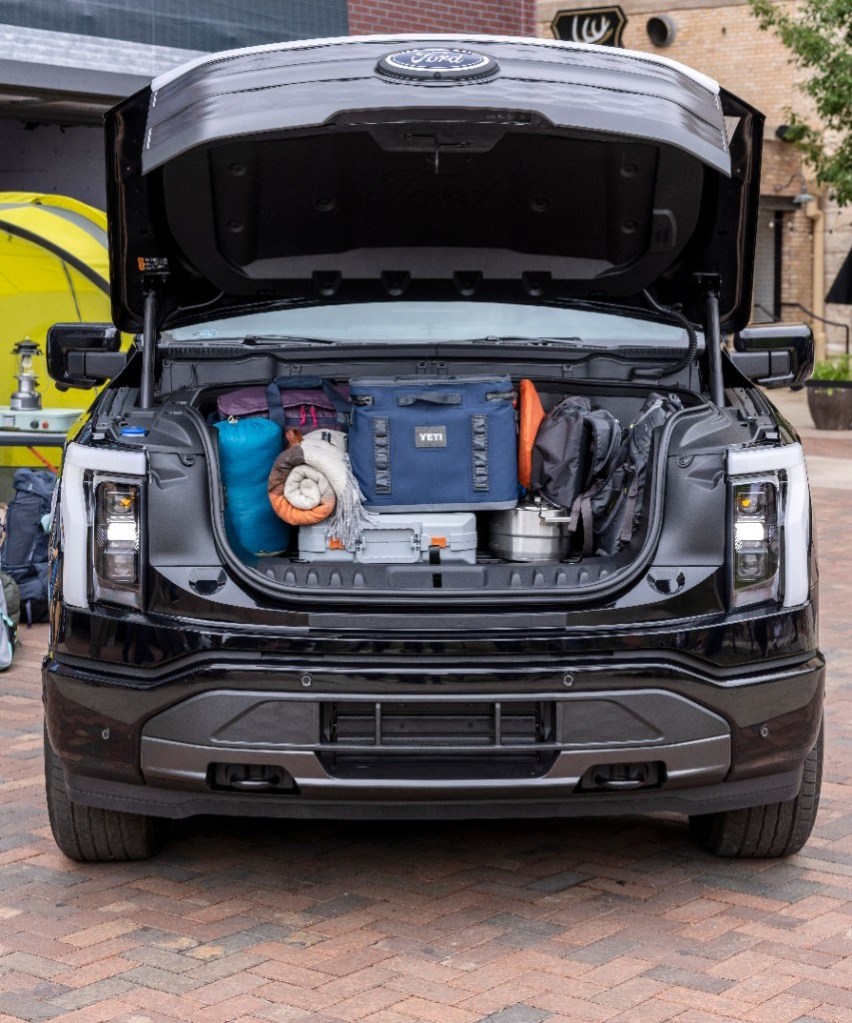
Ford F-150 Lightning frunk. (Image: Ford)

When asked about appeal before a truck was revealed and consideration after the reveal, of the Ram 1500 REV, Chevy Silverado EV, GMC Hummer EV pickup, Rivian R1T, and Tesla Cybertruck, and the Lightning, only the Lightning had a higher post-reveal consideration number.

And when looked at from the perspective of the following metrics, the Lightning got the top score in all of them:

  • Mileage range/fuel efficiency
  • Driving performance
  • Price
  • Overall look/styling
  • Technologically advanced

Which brings us back to the aforementioned survey about AVs.

Of the vehicles on the list, only the Lightning, Rivian R1T, and Hummer EV pickup are out there, and the number of Hummers is capable of being parked in a strip mall lot with spaces to spare.

How do people know about driving performance?

And how does the Lightning, with a top range of 320 miles, out score the Silverado EV, which has an estimated range of 450 miles?

When it comes to technology, it is hard to figure how the Lightning is more advanced than the R1T—unless it is that the Lightning has a 14.1-cubic foot frunk and the R1T’s is just 11.

Return of the Acura ZDX: Why Bring Back That Name?

By Gary S. Vasilash

One of the things that Japanese OEMs do that American OEMs tend not to is to recognize when something isn’t working and then moving on.

There isn’t a tendency to say, “Gee, maybe if we add some exterior trim and increase the amount of stitching on the seats people will buy it.”

Rather, the vehicle goes out of production.

Case in point is the Acura ZDX. It lasted from model years 2010 to 2013.

The vehicle design was something of an amalgam of a car and an SUV. It has a fast sloping roofline such that people who were trying to get into the back seat could get a nice bump on the head. And there is a sharp backward-angled cutline for the rear door which helped with the awkwardness.

Acura had made much of the vehicle prior to launch, given that it was something that it hoped would have the success of something like the MDX, which is was then and is now unmistakably an SUV.

But the so-called “Luxury Four-Door Sports Coupe” simply didn’t appeal to anyone, so it went away.

Oddly, Acura has brought back the ZDX moniker for the electric SUV that was officially debuted today at Monterey Car Week.

2024 Acura ZDX Type S. (Image: Acura)

It will be available with a standard single motor in the entry A-Spec and with a dual motor setup in the sportier Type S. The former will produce an estimated 340 hp, a 325-mile range and a starting price of around $60K. The latter will produce 500 hp, have a 288-mile range and start at some $70K.

On the subject of the “increased styling and packaging freedom EVs offer,” Dave Marek, Acura Executive Creative Director, said, “Embracing that creative liberation, our team was energized designing ZDX, Acura’s new modern expression of performance.”

To be sure, the vehicle is far more fetching than the other vehicle that carried the name.

Which makes one wonder why the previous name was brought back.

Sure, Acura reselected the name “Integra.” But unlike the original ZDX, the Integra was a success in the market.

Cadillac Escalade IQ and Places You Can Go

By Gary S. Vasilash

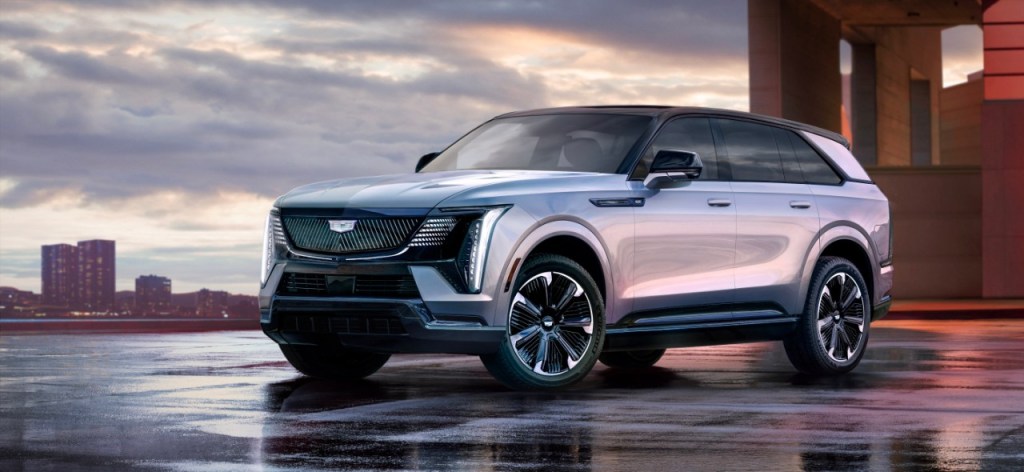
The most obvious thing about the forthcoming 2025 Cadillac Escalade IQ is that it is big—224.3 inches long, 94.1 inches wide (including mirrors), and 76.1 inches high—bad—here’s a vehicle rolling, out of the factory, on 24s—and in-your-face—people were enchanted with the lighting orchestration of the front fascia during the startup sequence of the Cadillac LYRIQ, which is like an iPhone screen to the Escalade IQ’s LED billboard.

2025 Cadillac ESCALADE IQ Sport: There’s no missing this. (Image: Cadillac)

This is monumental in scale. But unlike monuments that just sit there, this 750-hp, three-row vehicle can travel up to an estimated 450 miles on a single charge, which means you could possibly drive it from New York to Boston and back. This is largely predicated on the 200 kWh lithium-ion Ultium battery system.

But there’s one thing that needs to be taken into account.

For those who are using a Level 2 charger—the 240-Volt system that people are having installed in their garages—know that when the Escalade IQ is plugged in, it is getting 14.8 miles of range per hour. Which would get you from Boston to Walden Pond.

On one of those Level 2 chargers that you’ll find in the parking lot of many malls, it is 37 miles of range per hour, which means you could almost go from Boston to Gillette Stadium and back.

A DC fast charger gets up to 100 miles of range in 10 minutes, so in fairly short order you could get up to Manchester, New Hampshire, and make the return having spent 10 minutes of charging.

But here’s one thing to keep in mind.

Say you got a 682-hp, gasoline-powered Escalade-V. It has a 24-gallon tank. It gets 13 mpg combined.

So in less than 10 minutes, you could fill up the tank and drive from Boston to Woodstock (perhaps because you’re an aging Boomer who (1) can afford that vehicle and (2) often feel nostalgic for the festival you missed) and back in that similarly sumptuous vehicle.

While it isn’t the 450 miles of the fully charged Escalade IQ, there’s still something to be said for the cost of time, which plays to the Escalade-V’s favor.

Maybe Electric Big Rigs Are a Good Idea

By Gary S. Vasilash

In 2021 (OK, not the greatest of years to use for data about anything, but still available info for this point) trucks moved approximately 12 billion tons of freight in the U.S.

Although it might be thought that there is a whole lot of long-haul trucking going on, making the run across the I-80 or down I-75—it turns out that there is comparatively little of that.

Rather, shipments of below 100 miles handled 44% of the tonnage carried by trucks.

And 44% of the tonnage was on runs from 100 to 249 miles.

That from the U.S. Department of Transportation, Bureau of Transportation Statistics and Federal Highway Administration.

So with 87% of the tonnage being carried by trucks 249 miles or less, and much of that under 100 miles, perhaps electric trucks make more sense than some might think.

What’s more, even ranges that would be laughably low for passenger vehicles might make economic sense for the trucking industry.

Fisker: Still Small Numbers But Really Big Plans

By Gary S. Vasilash

The folks at Fisker are nothing if not plucky.

Although it had expected—as recently as May—to produce 32,000 to 36,000 vehicles this year (actually, have those vehicles produced for it by supplier Magna at its now-legendary plant [given the array of vehicles it has built for various OEMs there, it is absolutely special] in Graz, Austria), it now predicts the build of its Ocean EV will be more on the order of 20,000 to 23,000 vehicles. A non-trivial drop.

Realize that the Ocean is a global vehicle, not just one destined for the U.S. market, so the distribution of 23,000 vehicles is sparse, to understate the case.

But last night in Huntington Beach, California, chairman and CEO Henrik Fisker announced, “Fisker isn’t standing still,” and announced two new vehicles, to supplement the Ocean and the PEAR, which is to be available in mid-2025, an EV that has—for now—an MSRP of $29,900, before incentives. (If they pull that rabbit out of the hat, it will be truly remarkable.)

There are the Ronin, a four-door sports car with a starting price of. . .$385,000, and the Alaska, a four-door pickup based on the Ocean platform. Both, of course, are EVs.

(There was also the Force E, an off-road variant of the Ocean, because, well, nowadays lots of people like to make it seem as though they crawl rocks in their spare time.)

The Alaska is expected to launch in 2025. And the Ronin—well were you to place a $2,000 deposit on one, you’d know that “More information regarding availability and estimated production timelines for Ronin will be shared in the future.”

All of which is to say that even though Fisker is making almost imperceptible moves in the market, it has huge plans moving forward.

On the one hand laudable. On the other, a big bet on an uncertain future.

The Silverado EV Range (Non) Issue

By Gary S. Vasilash

There is some consternation regarding the size of the battery required to propel the 2024 Silverado 4WT some 450 miles on a charge. Although GM hasn’t revealed the stats for the Ultium battery pack (200 kWh?), one can only assume that it is sizeable.

This is, after all, a work truck version of the Silverado.

There is the RST which offers a 400-mile range. It also offers the ability to go from 0 to 60 in <4.5 seconds.

Either way, there is the requirement for a lot of lithium and associated battery materials.

So some people are concerned that the battery is just too big.

But here’s the thing:

A 2023 Silverado with a 6.2-liter V8, 4WD and either a double cab or crew cab gets a combined average of 18 mpg. As the truck has a 24-gallon fuel tank, this means a range of 432 miles.

This is what truck buyers expect. Capability. Which includes not only the ability to carry cargo and to tow equipment on the hitch, but to be able to operate without worrying about refueling, whether in the form of liquid or electrons.

Chevrolet is addressing needs and expectations.

Somehow offering a vastly decreased range predicated on how many miles the average driver actually goes in a day would not be be acceptable, 10.7-cubic-foot frunk notwithstanding.