The company just keeps refining it year after year, making it all the better for truck buyers
By Gary S. Vasilash
You’ve got to hand it to the men and women at Ford who have been mightily working for 48 years, dedicated to making the F-Series trucks the best-selling truck models in the U.S. for all those years running.
Ford F-Series: It climbs to the top and stays there. (Image: Ford)
Realize that of all of the segments in the showroom the pickup is the one where there is absolutely intense competition, especially with General Motors in the form of the Silverado and Sierra pickups and Stellantis with the Ram offerings.
Toyota keeps hanging in with its Tundra full-size, which racks up about a quarter of what a Ford or Chevy does in a given quarter.
Nissan realized its Titan wasn’t as mighty as it had hoped, so it has left the scene.
GM, in particular, has been working hard to take some of the luster off of the Ford crown. It often sums the Silverado and Sierra sales so that it can show as a corporation it is selling more pickups. But when someone goes into a showroom to buy a truck, they probably don’t want to have to go to visit the store of another brand to check its offerings (i.e., going from a Chevy dealer to a GMC outlet).
Ford with the F-Series simply checks more of the boxes on the needs and wants lists.
In addition to being the best-selling truck for 48 years in a row, the F-Series sets another record: It is the best-selling vehicle of any type in the U.S. and has been since the Gerald Ford administration (43 years running).
One of the interesting things about the F-Series is that while the F-150, the truck that you probably imagine when someone uses the term “F-Series” (I do), seems to have been around for approximately forever, is actually celebrating its 50th year in 2025.
For those of you still humming Mariah Carey’s “All I Want For Christmas Is You,” here’s a bit of context for an announcement Ford made this morning:
The year that the Ford F-Series started making its consecutive run as the best-selling truck in the U.S., Ms. Carey was seven.
The F-Series has taken the lead for 47 years in a row.* They’re looking at more than 700,000 of them driven off of dealer lots in 2023.
2024 Ford F-150 Platinum. So nice that you probably wouldn’t want to use it as. . .a truck (Image: Ford)
And underscoring the curious popularity of trucks in suburban driveways as well as on work sites (curious because I rarely see my pickup truck-owning neighbors doing anything with the boxes on the back of those vehicles that they couldn’t manage with a trunk), the F-Series has been the best-selling vehicle in the U.S. for 42 years running.*
There is, of course, the question of whether “the most” means “the best.”
After all, McDonald’s has sold more hamburgers than any other company in the world and there is probably no one who doesn’t know whether they can get a better burger.
But one thing it certainly means is that the F-Series provides an unparalleled level of value for more people than any other pickup.
While there may be specific attributes of trucks from other OEMs that are more appealing or necessary for some purchasers, which means those trucks are more valuable for those people, on an overall basis Ford is consistently delivering.
Credit where credit is due. (And you’ll probably need good credit to get a full-size pickup: according to Kelley Blue Book, the average transaction price (ATP) for one in November 2023 was $66,590. You could get an entry-level luxury car for an ATP of $57,889.)
(On a related-unrelated subject, the tremendous number of trucks sold by Ford—closely followed by GM and Ram—in the context of vocational or functional (i.e., towing, hauling) uses of the vehicles might indicate that people are less environmentally keen than might be expected. After all, light-duty pickups aren’t exactly fuel-economy leaders, so were people concerned about carbon, they’d be buying more efficient vehicles for their daily drives. Yes, there are an electric F-150 and Chevy Silverado and one coming from Ram, but from the point of view of resource utilization, as in the massive batteries that have to be constructed, if those trucks aren’t being used as, well, trucks, then that isn’t exactly the most-environmental choice.)
*As the announcement was made a couple days before the actual end of the year, it is a bit of estimation on behalf of Ford. A small bit.
The EPA-estimated range of a Ford F-150 Lightning XLT SR is 230 miles. Ford had been targeting 230 miles and nailed it.
The EPA-estimated range of a Ford F-150 Lightning XLT ER is 320 miles. Ford had been targeting 300 miles, so that extra 20 miles is a positive accomplishment.
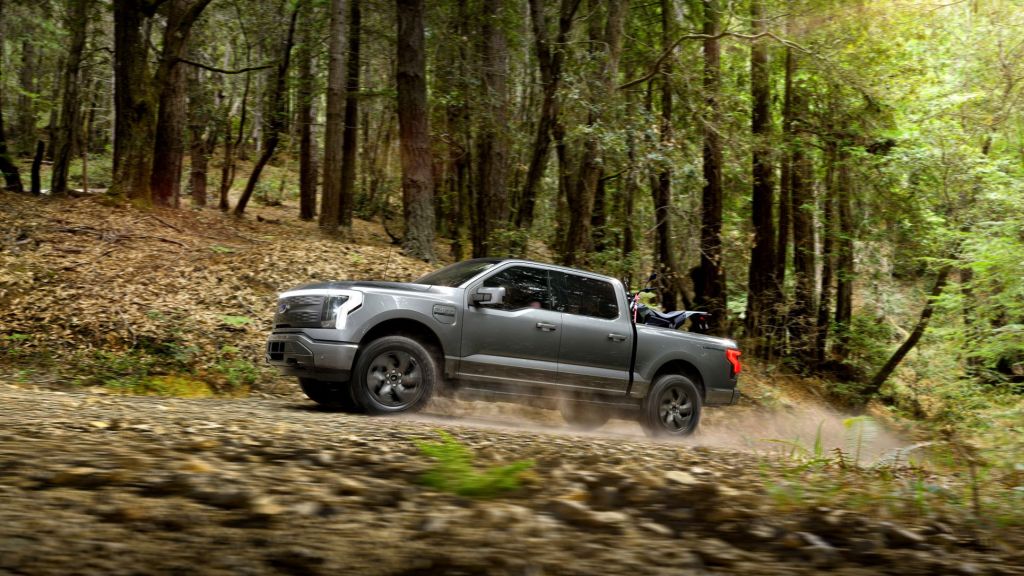
F-150 Lightning. Gets you there. Just not too far away. (Image: Ford)
Still, some people look at those number and are, well, underwhelmed.
Of course, take into account that this is a pickup truck, so that means it is big and heavy, which doesn’t do wonders for electric vehicle range.
Ford offers a 5-liter V8 for the F-150.
A 4×4 with the engine returns a combined 19 mpg.
The truck can be specified with gas tank size. The smallest is 23 gallons. The largest is 36 gallons.
A V8 F-150 with the 23-gallon tank has a range of 437 miles.
A V8 F-150 with the 36-gallon tank has a range of 684 miles.
Somehow really makes those Lightning numbers seem, well, underwhelming.
Microchip shortages notwithstanding, despite dealer lots with fewer vehicles on them, Ford reported a sales increase for the month of November of 5.9% compared with November 2020.
In terms of what people bought in November, the F-Series, which will be the best-selling vehicle for its 45th consecutive year, is absolutely essential to the total U.S. sales.
(Image: Ford)
The company sold a total 158,793 vehicles (Ford and Lincoln brands).
It sold 3,767 cars. 72,795 SUVs. And 82,231 trucks.
Of the trucks, F-Series accounts for 60,418 units.
All of Lincoln had sales in November of 6,405.
All of Ford SUVs consisted of 66,390.
So there’s F-Series, with nearly 10x the sales of Lincoln and almost equal to the sales of the EcoSport, Bronco Sport, Escape, Bronco, Mustang Mach-E, Edge, Flex, Explorer, and Expedition combined.
The nameplate that is second to the F-Series in sales for November is the Explorer.
There were 18,268 Explorers sold.
Yes, the F-Series makes that much of a difference.
Without it the total November sales would have been 98,375.
The first versions of the F-150 model are being built at the Rouge Electric Vehicle Center in Michigan
By Gary S. Vasilash
Ford is increasing its investment—to the tune of $250-million—at its operations at the Rouge Electric Vehicle Center, Van Dyke Electric Powertrain Center and Rawsonville Components Plant.
The reason?
The F-150 Lightning.
It also means 450 more jobs spread across the plants, all of which are in Michigan (Dearborn, Sterling Heights and Ypsilanti).
“We knew the F-150 Lightning was special,” said Ford executive chair Bill Ford, “but the interest from the public has surpassed our highest expectations and changed the conversation around electric vehicles.
“So we are doubling down, adding jobs and investment to increase production,” Ford added.
“This truck and the Ford-UAW workers who are assembling it in Michigan have a chance to make history and lead the electric vehicle movement in America.”
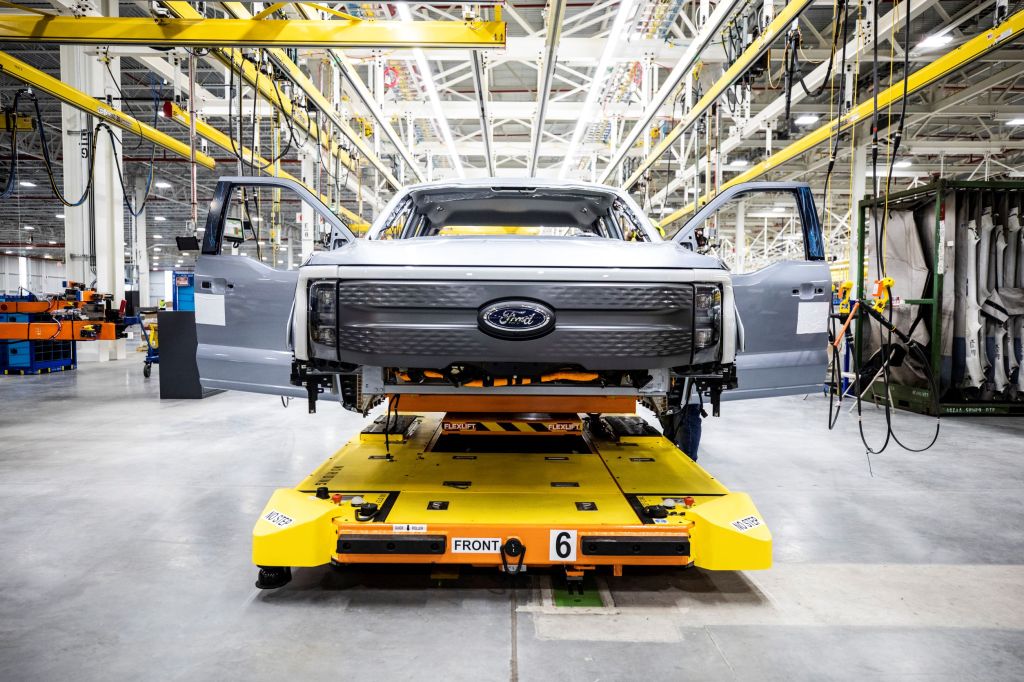
Pre-production underway for the all-electric F-150 Lightning. (Image: Ford)
Ford has taken more than 150,000 reservations for the full-size electric pickup that has an estimated range of 300 miles and a starting MSRP of $40,000. (It is worth noting that the reservations require $100—which is refundable.)
The Lightning is another in the F-150 offerings, which has been the best-seller in the U.S. for 44 years running.
Pre-production is underway for the Lightning, with consumer vehicles planned for availability in the spring of 2022.
Turns out that police pursuit pickups are really quite quick
By Gary S. Vasilash
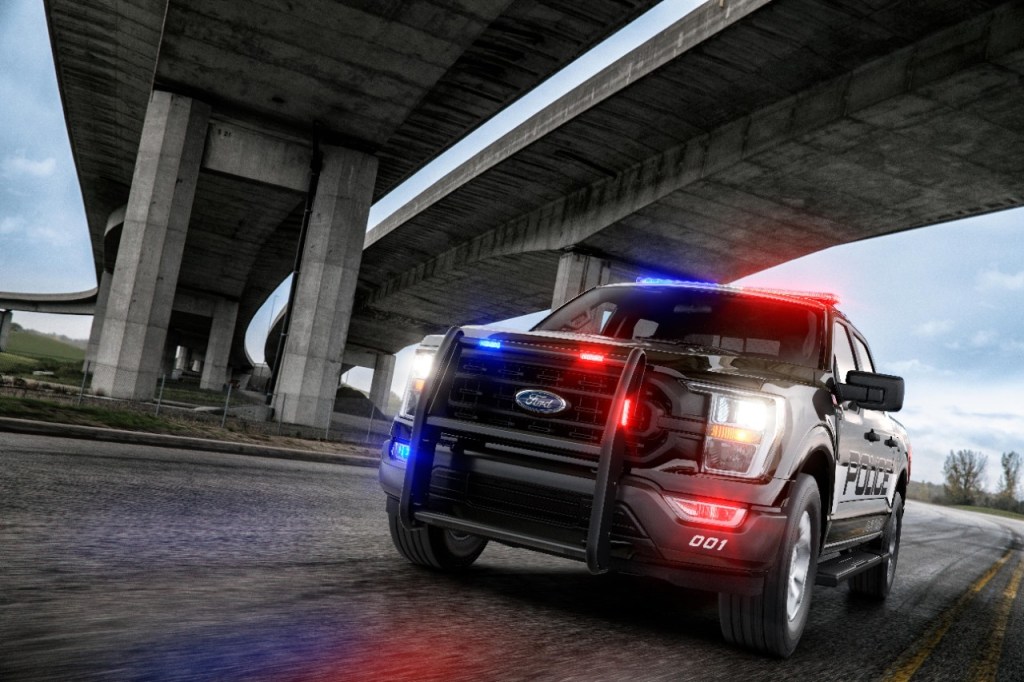
According to test data from the Los Angeles County Sheriff’s Department, the 2021 Ford F-150 Police Responder has the best acceleration of any pursuit-rated police vehicle tested.
You don’t want to see this in your rearview mirror, do you? (Image: Ford)
The tests show that the vehicle does a quarter mile in 14.4 seconds. That 0.4 is important because that is how much faster it is than its closest competitor.
The Michigan State Police are also running tests on the pickup. So far it has measured a 0 to 60 mph time of 5.4 seconds. Again, number-two is 0.4 seconds slower.
However, they’ve found the F-150 going from 0 to 100 mph in 13.1 seconds, which is 0.8 seconds faster than the runner up.
The top speed? The Michigan State Police say 120 mph, which is 15 mph faster than the 2020 model of the truck.
A big contributor to the performance?
A new torque-on-demand 4×4 transfer case.
This is the case because it gets the torque to the wheels faster.
It is also beneficial when cornering.
Both police departments run 32-lap vehicle dynamics test.
The improvements in cornering capability resulted in a 5.8-second reduction in the average lap time in Michigan and a 3.6-second reduction in LA.
No, it’s not that the LA cops are slower drivers than those in Michigan: They put 400 additional pounds of payload into the trucks during testing to simulate cargo.
A lively discussion of things from why Americans don’t buy small, cheap cars and why OEMs aren’t likely to get a big revenue stream from sending data to vehicle head-units
By Gary S. Vasilash
Although there is a whole lot of development going on in the electric vehicle (EV) space, as OEMs announce products and plans with what seems to border on giddiness, maybe things aren’t what they seem.
Consider, for one example, the F-150 Lightning reveal. While it might seem as though every person on your street is likely to replace their gasoline-powered F-150 with an electric one as soon as is practical (even though there is a starting MSRP of $40,000, and even though $40,000 is pretty much the average cost of a vehicle, it is still $40,000), even though people are touting the frunk that will allow them to fill it up with ice and beverages and the power outlets that will permit the audio equipment to be plugged in for parties and picnics, when you listen to Eric Noble, founder and president of The Car Lab, what seems to be the case may not be the case.
The F-150 Lightning in what is a natural environment: a work site. (Image: Ford)
That is, Noble points out that largely because of EV batteries—“They are expensive, huge, very heavy and don’t store very much energy”—especially the cost part, OEMs don’t make money on EVs unless these EVs are priced so highly that the cost of the battery can be buried in the MSRP.
Noble argues that because of the zero-emissions mandate of California and the other states that follow California’s lead in emissions regulations, OEMs that want to sell vehicles in those states—including vehicles with a 5.0-liter V8 under the hood—need to sell zero-emissions vehicles: EVs.
What is the number on the sales forecasts that OEMs have for EVs, he rhetorically asks.
Pretty much what the number of EVs required by the ZEV states are for that particular OEM.
However, he points out that there could be some real business for OEMs when it comes to selling to fleets. (“Ford is good at fleets,” Noble says.)
In other words, Teslas and Mustang Mach Es notwithstanding (and I don’t know whether the champagne need be busted out for the Mach E quite yet because in April Ford sold 1,951 Mach Es and 8,000 regular Mustangs), things like the Lightning are likely to be more oriented toward places where they can do the OEM the most good, which very well may be in fleet applications.
Noble talks about this on this edition of “Autoline After Hours.” And many of his arguments are bolstered by observations by Sam Fiorani, vice president of Global Vehicle Forecasting, AutoForecast Solutions.
Also on the table are other subjects of the moment, like over-the-air updates (not likely to be a revenue stream for OEMs because customers don’t want to have a monthly charge to their credit cards, why tech companies won’t become auto companies and vice versa, and a whole lot more.
Per usual, “Autoline’s” John McElroy and I are engaged in the conversation with these guests, and it is one of the livelier discussions you are like to see about the state of the industry—the reality versus the proclamations.
One can only wonder how much sand the engineering team had to wash out of their clothes. . .
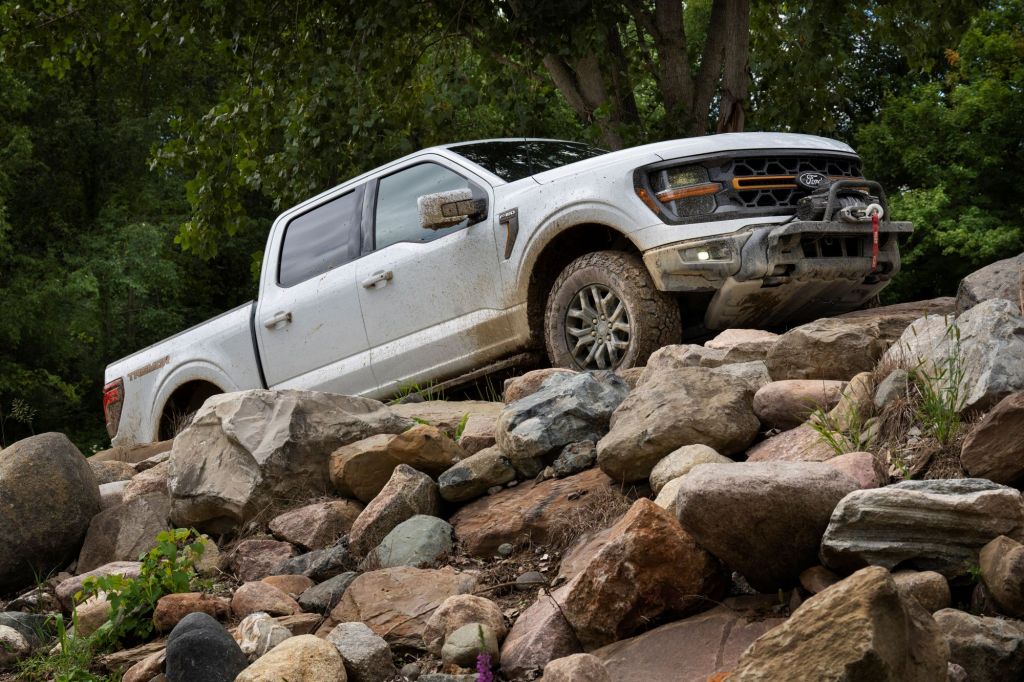
Although the official name is the “2021 F-150 Raptor,” now in its third generation, the vehicle is more commonly known as, well, “the Raptor.” While it is certainly based on the F-150, it is an extreme execution of a vehicle that is engineered to do the sorts of things that even outlier owners of conventional F-150s would never even think of.
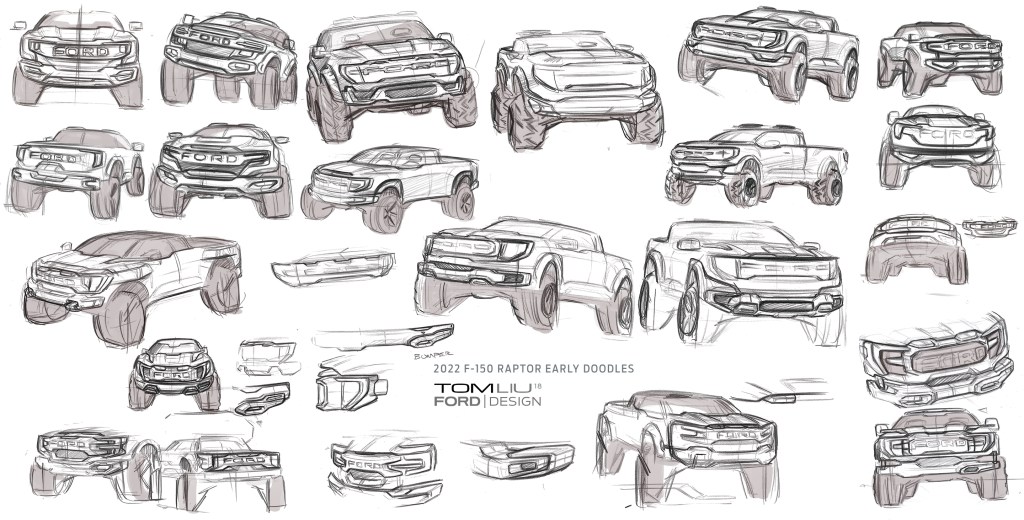
Sketches that led to a Raptor. (Image: Ford)
Notes Tony Greco, Ford Program Manager, F-150 Raptor, “It has never been as differentiated from the F-150” as it is now.
While the team behind the development of the conventional F-150 spent a lot of time with contractors and serious DIY homeowners, and while members of that team certainly own and use trucks on a daily basis, Greco says on this edition of “Autoline After Hours,” “I work with a lot of passionate off-road guys.”
So it is not entirely surprising when Greco is asked to list the top things that he says differentiate the Raptor from other vehicles, he lists:
The suspension
The enhanced steel frame
The 37-inch tires
Fox—the supplier of the internal bypass shocks with SOA electronic control technology, the largest shocks (3.1-inch diameter) ever offered on a Raptor—becoming more than a supplier, working with the team like a partner
You may notice from the list that there is a lot about the suspension, which is what Greco says they spent a lot of time concentrating on. For example, he said that when they were looking at the rear suspension, they went through the considerable parts bins at Ford—including Ford Performance, the real home of the vehicle—and didn’t find what they were looking for. So they developed a five-link suspension with extra-long trailing arms—the better to deal with the toughest terrain.
Then there are those 37-inch tires, which required frame modifications for accommodation. Why not even larger? Simply because they wanted to make sure that a full-size spare tire could be handled under the vehicle, not put in the bed, which would take away from the ability to haul stuff. Remember—while this truck can do Baja, it can also carry things on that weekend Home Depot run.
Greco also notes that the design of the Raptor pushes things to an extreme that speaks to the capability of the truck.
While there is another truck that has come on the scene of late that challenges the Raptor—the Ram 1500 TRX—Greco says with the Raptor, which debuted in MY 2010, they created a segment and are not giving it up—to anyone. He also says that the team knew what they wanted to achieve when they started on the 2021 vehicle, and kept to it, regardless of the introduction of the new competitor.
Greco talks with “Autoline’s” John McElroy, freelance writer (and truck guy) Mark Williams, and me on the show.
In addition McElroy, Williams and I discuss a variety of other subjects, including the MY 2022 Nissan Frontier (the third generation of that midsize pickup); the acceptance of the truck community of new vehicles coming from new companies that happen to have electric motors; the California DMV automated vehicle disengagement performance in 2020 by GM Cruise and Waymo; and a whole lot more.
Watch this edition of “Autoline After Hours” right here.
Tom Liu said it had to be “instantly recognizable.” He also said that he was influenced in the exterior design of the vehicle, which he helped create, by the F-22 Raptor, which, ironically enough, is a stealth fighter, which is, by its design, not to be seen (OK, at least not by sensors).
There was also a convenience to this: Liu was talking about the design of the 2021 Ford F-150 Raptor, the third generation of the vehicle that is built to be able to perform off road and fast—desert racing, in particular, as Carl Widmann, Ford Performance chief engineer, said, “Raptor is rooted in Baja 1000 racing,” and added, “And like a trophy truck, every aspect of Raptor has been engineered to deliver precision capability when your foot is flat on the floor, way out in the middle of nowhere roaring across the desert.”
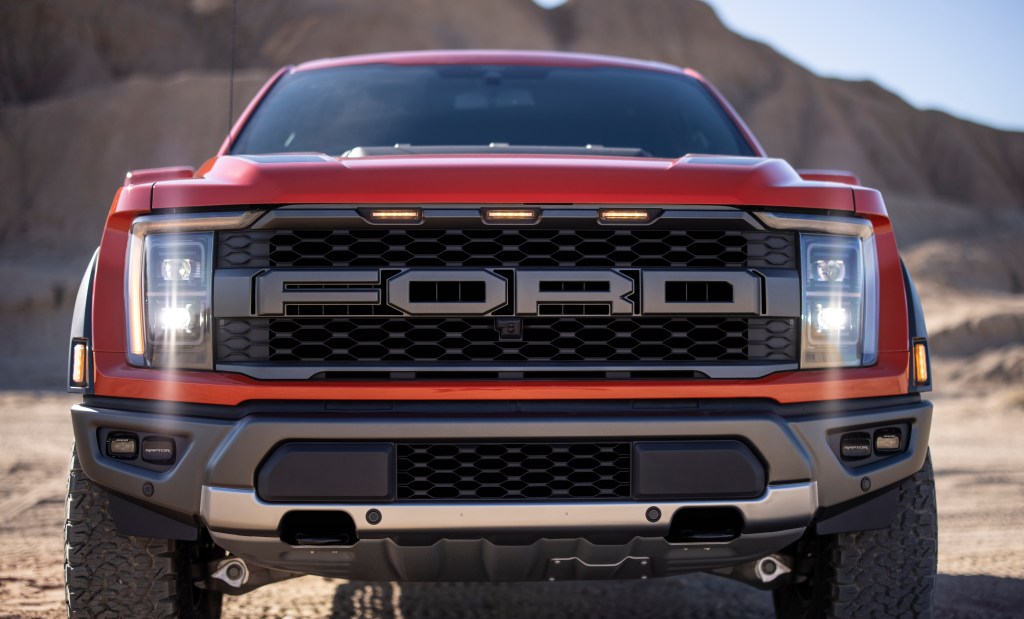
What “menacing” looks like. (Images: Ford)
To the point of Liu and the Raptor the fighter jet and Raptor the truck that is literally engineered to catch air during some of its off-road exploits, he said that like the aircraft, the truck is “Fast, nimble and technologically advanced. It is American power and performance. It is packed with technology—and it looks menacing.”
So there are things like a heat extractor on the power dome hood and functional side vents at the top trailing edges of the front fenders that are to provide a visual nod to the air intakes on the F-22. There are shear surfaces that are stealth-like. And adding to the menace are aspects including the blacked-out grille, blacked-out taillights, massive steel front and rear bumpers, and a massive front skid plate.
It looks fit for purpose and its purpose probably isn’t making a run to the store for a gallon of milk. (Not that you couldn’t, of course.)
///
The F-150 Raptor is based on the F-150 that contractors and others who are not likely to do much in the way of rock crawling in. It is built on the same assembly line at the Dearborn Truck Plant in Dearborn, Michigan (or about 2,400 miles from Ensenada, where the Baja 1000 starts: there isn’t a whole lot of desert around Dearborn).
But it is an F-150 that has been built to take a whole different set of parameters in terms of what it is likely to encounter: for example, while they start with the heavy payload, fully boxed steel frame from the “regular” truck, Jack Cooper, architecture engineer for Ford Performance, said that they’ve modified and reinforced it.
A notable difference truck-wise is the chassis. There is a newly developed five-link rear suspension that features extra-long trailing arms, a Panhard rod, and 24-inch coil springs. “We couldn’t find it in the parts bin,” program manager Tony Greco says of why they had to devise a new rear suspension. The front suspension has been redesigned, as well. One of the key aspects of the suspension for a vehicle like a Raptor is wheel travel. The suspension for this third-generation vehicle is 14 inches in the front and 15 inches in the rear.
The shocks are FOX Live Valves. These internal bypass shocks feature electronic control technology that permits damping rate adjustments at a rate of 500 times per second; the shocks, which have 3.1-inch diameter anodized aluminum bodies, feature base valves that provide 1,000 pounds of damping per corner at racing speeds.
While the standard Raptor runs on 35-inch tires, it can be equipped with a package that brings it up to 37 inches, or what Ford says are the largest factory-fitted tires on a light-duty full size pickup.
///
Among the tech aspects of the new Raptor are:
Terrain Management System: dial in adjustments that change the steering feel, transfer case behavior, stability control, active valve exhaust, active damping, throttle mapping, shift points, and digital display. There are seven modes: Slippery, Tow/Haul, Sport, Normal, Off-Road, Baja and Rock Crawl.
Trail 1-Pedal Drive: In situations that call for two-pedal driving like crawling rocks or negotiating trying trails, this function allows throttle and brake modulation through the brake pedal. The driver gets acceleration by pushing down on the throttle and braking by lifting.
360-degree camera package: This option, in addition to providing an all-around view, provides a real-time tire track overlay for the front view, which means that the path ahead of the wheels can be seen such that a spotter may not be necessary.
///
The Raptor has a 3.5-liter EcoBoost V6 engine with twin turbos. While the horsepower and torque numbers aren’t released as of this writing, Ford describes it as a “high-output engine delivering torque low in the rev range where it counts,” so presumably it has the stuff to deal with the sand as well as that to skim over it. And on the subject of driving hard, it has high-power fans built into the cooling system. The compression ratio is 10.5:1.
What to do with a Raptor.
The engine is mated to a 10-speed automatic which, in turn, is attached to a torque-on-demand transfer case.
There are standard electronic locking rear diff and an available Torson front limited-slip differential. They are fitted with 4:10 final drive ratios.
There is something that seems a bit odd about the powertrain system. There is a 36-gallon gas tank. It is recommended that it be filled with premium unleaded.
The NACTOY jury presented its awards this morning:
Car of the Year: 2021 Hyundai Elantra
Truck of the Year: 2021 Ford F-150
Utility of the Year: 2021 Mustang Mach-E
Yes, Ford takes two Ed Welburn-designed trophies.
2021 Hyundai Elantra: Look only at the care taken on the exterior sheet metal. (Image: Hyundai)
And on the subject of two: this is the second time the Elantra has taken the NACTOY Car of the Year, with the first being in 2012.
Briefly: there are 50 jurors who work for a range of publications—physical and digital—and broadcast outlets. Vehicles selected were those which were available for sale during CY 2020.
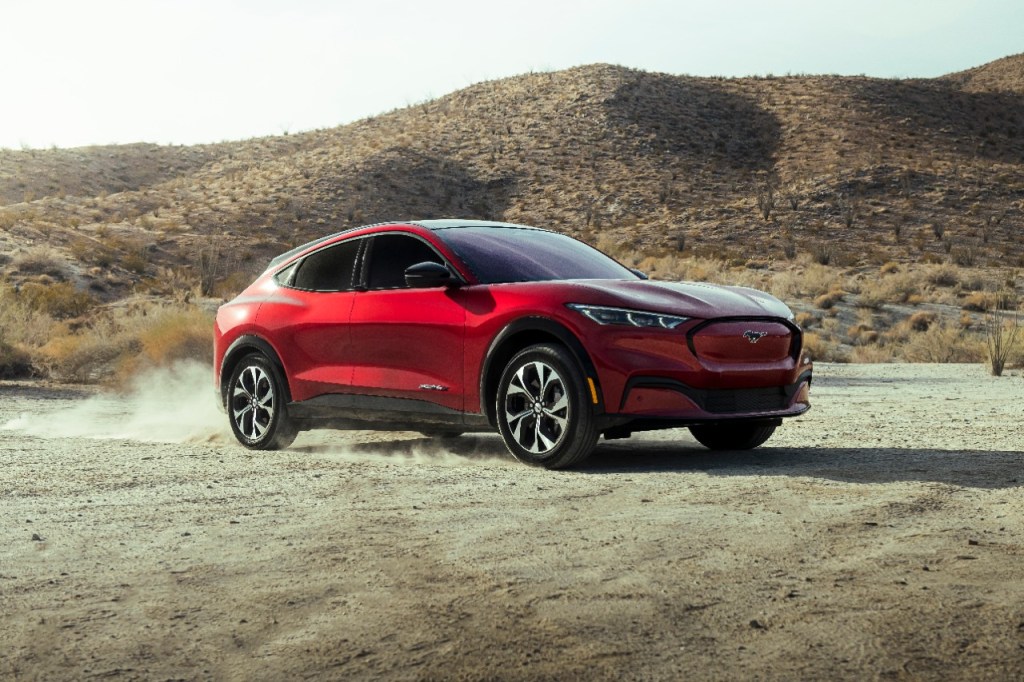
The Mustang Mach-E: Ford gets electric right with this model. (Image: Ford)
Thoughts:
Elantra: The seventh generation of a sedan has gotten a lot more attention and investment—even as other OEMs are retreating from the segment. Hyundai didn’t stint. What’s more, the company has rolled out three versions—the everyday driver, a hybrid and a performance variant from the start.
F-150: The F-Series has been the best-selling pickup in the U.S. for 44 years running, so (1) the team that built this new one knows a whole lot about how to put together trucks and (2) they surely don’t want to be the ones who break that streak. Odds are more than good that this new F-150 will handily rack up the 45th year.
Mustang Mach-E: Not only does this vehicle make us rethink what a ‘Mustang’ is, but it also reminds us that the company that made the automobile accessible to everybody in 1908 is doing the same thing for electric vehicles in 2021. And what’s more, it is a damn good execution.–gsv







 shinymetalboxes