Another List With Some Missing Names

By Gary S. Vasilash

Kelley Blue Book, an outfit with plenty of folks who know a whole lot about vehicles, their value and what consumers like or don’t about those vehicles, has come up with its list of “Best Buy Awards.”

In other words, the vehicles that were launched last year (or which underwent a redesign) that, based on a variety of criteria, KBB thinks people will be happier to acquire than competitive vehicles not on the list.
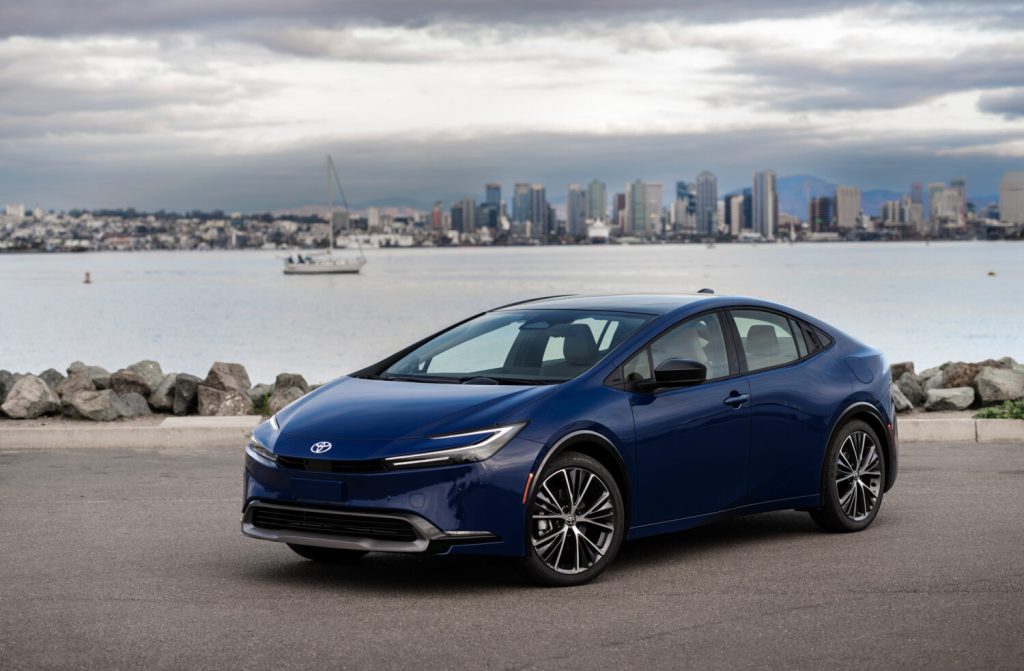
2024 Toyota Prius (Image: Toyota)

So without further ado, here are the winners of the 2024 Kelley Blue Book Best Buy Awards (all model year 2024 vehicles):

  • Best New Model: Toyota Prius
  • Best Compact Car: Honda Civic
  • Best Midsize Car: Honda Accord
  • Best Subcompact SUV: Hyundai Kona
  • Best Compact SUV: Honda CR-V
  • Best Midsize SUV: Kia Telluride
  • Best Full-Size SUV: Ford Expedition
  • Best Compact Truck: Ford Maverick
  • Best Midsize Truck: Toyota Tacoma
  • Best Full-Size Truck: Ford F-150
  • Best Minivan: Toyota Sienna
  • Best Electric Vehicle: Hyundai Ioniq 5
  • Best 3-Row Electric Vehicle: EV9
  • Best Electric Truck: Ford F-150 Lightning

One of the things that is evident from this list is that Ford is a superlative truck company.

Which leads to a question: Where’s anything from General Motors? No Cadillac? Chevy? Buick? GMC? Not one?

Or the company formerly known as Chrysler? Nothing from the Stellantis cadre (Chrysler, Jeep, Dodge, Ram, Alfa Romeo, Fiat)? The company that invented the minivan doesn’t make the Best Buy minivan?

And there is also the noticeable lack of anything with a European pedigree.

Looking into the Ford wins, in the Compact Truck category, there is really only the Maverick, so Ford gets a bonus there because it competes with nothing.

And the only other electric full-size truck that would qualify would be the Chevrolet Silverado EV, though it probably came out too late in the year to be assessed by KBB, so Ford Lightning by default (although it is a bit odd, given that the Lightning was launched in April 2022, not 2023).

But credit where credit is due.
EV (Dis)interest

By Gary S. Vasilash

One of the things that isn’t talked about much is the fact that electric vehicles really aren’t that popular unless they come from Tesla.

Flying in the face of that is a finding of Kelley Blue Book that in Q3 2023 EV sales in the U.S. hit 313,086 units, a 49.8% increase over Q3 2022. Such a jump means interest, right?

Well, the total number of EVs sold in Q3 represents 7.9% of total industry sales.

In other words, 92.1% of the vehicles people bought in Q3 weren’t electric.

And to the point of Tesla’s sway over the market—even though KBB saysTesla’s share of market tumbled to 50%–is that KBB acknowledges“Tesla’s price cuts have moved the market, pushing electric vehicle prices down more than 22% year over year, from $65,295.”

That’s right: a single company moves the entire segment.

(And in case you’re wondering, in October, according to KBB, the average transaction price for an EV was $51,762 while the ATP for a non-lux vehicle was $44,331.)

Drilling down a bit more, it is bracing to discover that in terms of share of the EV segment, the mainstream brands really don’t have much in Q3.

  • Chevrolet, 5.1%
  • Ford, 6.7%
  • GMC, 0.4%
  • Hyundai, 6.3%
  • Kia, 3%
  • Nissan, 1.9%
  • Subaru, 0.9%
  • Toyota, 0.9%
  • VW, 3.4%

And know that the 6.7% for Q3 Ford racked up represents 20,926 vehicles: 14,842 Mach-Es, 3,503 F-150 Lightnings and 2,617 E-Transits.

Ford sold 23,931 Mavericks in Q3, of which 56.5% were hybrids. Somehow that 20,926 EVs sold—encompassing three models, one of which is based on the best-selling pickup Since Time Began—seems more than anemic.

So even before Ford started talking about having to make adjustments as a result of the salary and benefit increases in the proposed agreement with the UAW, the auto company suddenly found things like the F-150 Hybrid more interesting.

When I ask knowledgeable people about the subject, they point out that much of the EV development and promotion is predicated on government regulations, more than organic customer demand. Look at those puny percentages up there, slices of the 313,086 vehicles sold by companies ranging from Audi to Volkswagen.

There’s not much there there.

Yes, there will be more EVs offered. More EVs sold.

But—again, absent Tesla—the market demand isn’t at all what it sounds like it should be.

Another example of this not-big demand is something that some point to as a real success story: the Chevrolet Bolt EV.

Here are the sales figures for the past five years:

  • 2018: 18,019
  • 2019: 16,418
  • 2020: 20,754
  • 2021: 24,828
  • 2022: 38,120

Whoa! you might think. From 2018 to 2022 the sales of the Bolt EV doubled! Remarkable.

But there are a couple of elements that need to be considered.

For one thing, Chevy added a (slightly) different body style, the more ute-like Bolt EUV in 2021, which certainly added some interest to the model(s).

And in June 2022 General Motors cut the price of the Bolt to persuade customers to buy one—sort of like what Elon has been doing.

Had Dodge made a substantial price reduction to the SRT Hellcat Redeye Widebody, the Brotherhood of Muscle would exponentially increase its membership of all genders and municipalities throughout the country would have a sharp uptick in revenues from speeding tickets.

If there is a change in the political situation, those regulations that are driving EV development and sales and those incentives that do the same (what if the government offered $7,500 tax credits for the purchase of a Hellcat?), the question of actual market demand is really going to matter.

What Do Potential EV Pickup Buyers Think?

By Gary S. Vasilash

It is always interesting to see surveys that ask about how people perceive autonomous vehicles because most people have only seen an AV on TV.

Things are a bit better with electric vehicles. But still, if you take Tesla out of the calculations (in the first half of 2023 Kelley Blue Book calculates that there were 556,707 EVs sold in the U.S., of which 336,892, or 60% of the total were Teslas), there aren’t all that many EVs out there for people to buy.

Cox Automotive (which, incidentally, owns KBB) recently ran a study of pickup shoppers who are planning to buy a truck within the next two years.

The information related to those considering EV pickups is interesting.

For example, consideration for an EV from a brand that one already owns is solid, which perhaps help explain why the Ford F-150 Lightning has the highest level of consideration.

What’s more, Cox found Lightning is clearly the most appealing to people.

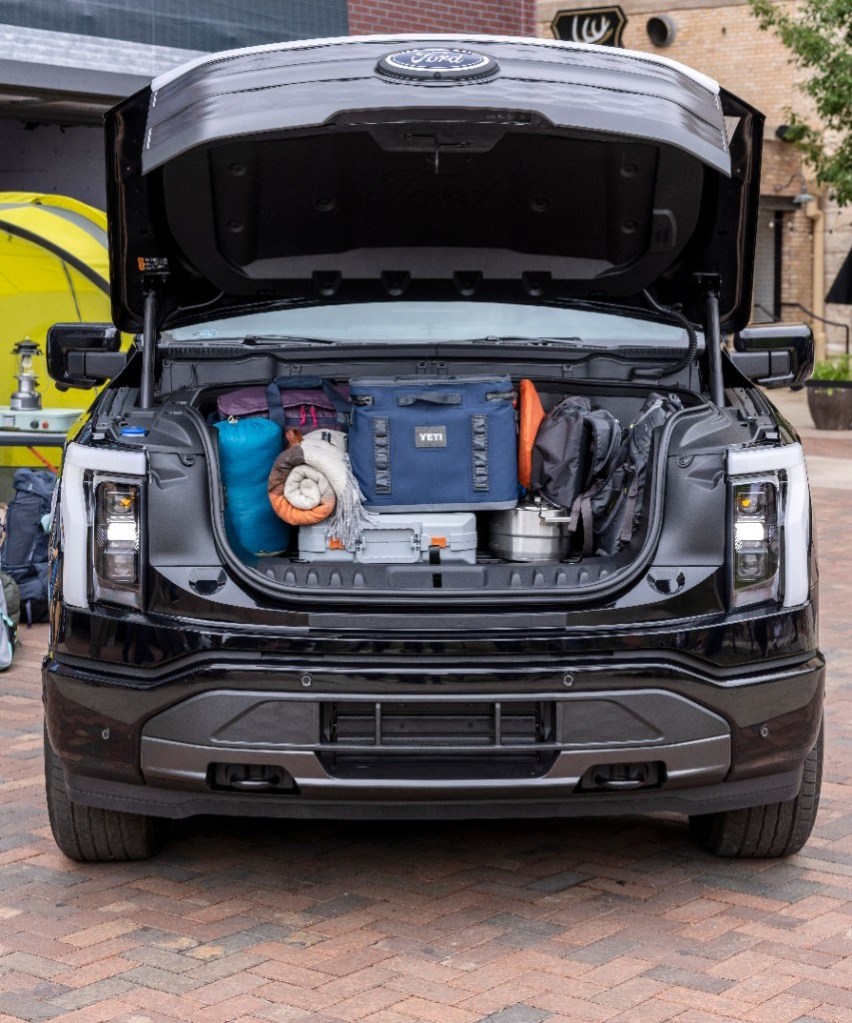
Ford F-150 Lightning frunk. (Image: Ford)

When asked about appeal before a truck was revealed and consideration after the reveal, of the Ram 1500 REV, Chevy Silverado EV, GMC Hummer EV pickup, Rivian R1T, and Tesla Cybertruck, and the Lightning, only the Lightning had a higher post-reveal consideration number.

And when looked at from the perspective of the following metrics, the Lightning got the top score in all of them:

  • Mileage range/fuel efficiency
  • Driving performance
  • Price
  • Overall look/styling
  • Technologically advanced

Which brings us back to the aforementioned survey about AVs.

Of the vehicles on the list, only the Lightning, Rivian R1T, and Hummer EV pickup are out there, and the number of Hummers is capable of being parked in a strip mall lot with spaces to spare.

How do people know about driving performance?

And how does the Lightning, with a top range of 320 miles, out score the Silverado EV, which has an estimated range of 450 miles?

When it comes to technology, it is hard to figure how the Lightning is more advanced than the R1T—unless it is that the Lightning has a 14.1-cubic foot frunk and the R1T’s is just 11.

Ford F-150 Lightning & the Potential of Scale

By Gary S. Vasilash

As is widely known, there is a pricing benefit when lots of something is made.

The technical term is “economies of scale.”

Companies get to buy components in bulk and, like a giant pack of paper towel or a vat of peanut butter from Costco, the prices are consequently reduced.

That said, Ford announced today that it is cutting the prices for F-150 Lightning models. The Pro model on Saturday had an MSRP of $59,974. Now it is $49,995. A reduction of $9,979. Some 16% off.

And probably figuring those who would buy a Platinum Extended Range wouldn’t need to have as great a reduction, today the MSRP is $91,995, or $6,079 less than it was Saturday.

In announcing the price reductions, Marin Gjaja, chief customer officer, Ford Model e (the electric vehicle part of the company), said, “Shortly after launching the F-150 Lightning, rapidly rising material costs, supply constraints and other factors drove up the cost of the EV truck for Ford and our customers.”

That was a situation where economies of scale were not working.

Gjaja continued, “We’ve continued to work in the background to improve accessibility and affordability to help to lower prices for our customers and shorten the wait times for their new F-150 Lightning.”

Arguably they are getting better scale.

But there could be something else at play here.

Through the first half, Ford delivered 8,757 Lightnings.

As of this fall it will have the ability at the Rouge Electric Vehicle Center to produce 150,000 per year.

At the current rate, it would take a long time to get to 150,000.

EV Trucks & Three-Card Monte

By Gary S. Vasilash

When Chevrolet announced the Silverado EV last year, it said that the price for the initial work truck version would have an “Estimated MSRP staring around $39,900.”

That was for the work truck version. Get the contractors in and those who are simply looking to look cool will follow. Possibly in droves.

What does the Silverado EV 4WT work truck, which is presently in production, cost?

$79,800.

There is a forthcoming 3WT version with a decreased range from the 4WT. The 4WT has an EPA rating of 450 miles per charge.

The 3WT will be tagged at $74,800.

What is shocking is that people aren’t more shocked by this estimation being off by some 50%.

When the 2024 Chevy Equinox EV was introduced last fall, the claim Chevy made was “a starting price of around $30,000.”

Mary Barra, GM chair and CEO, said, “With the flexibility of GM’s Ultium Platform, we are bringing to market vehicles at nearly every price point and for every purpose.”

Really?

The Cadillac Lyriq is on the Ultium platform. It starts at $58,590.

The GMC Hummer EV uses it, too, and good luck finding a price for it on gmc.com. The 2022 Edition 1 model started at $112,595, and while the subsequent models are less expensive, odds are that’s a relative reduction.

Every price point for Thurston Howell III, perhaps.

Kelley Blue Book has it that the average transaction price for an electric vehicle in May was down $9,370 from the price paid in May 2022. Now it is $55,488, or a 14% decrease.

There’s the Silverado EV 4WT 50% increase.

And what expectation should there be that there will be a $30K Equinox, and if there is a $30,000 Equinox will there be a sufficient number such that it won’t be like sightings of the Loch Ness Monster (“I think I saw one. . .”)?

This just isn’t a GM phenomenon.

Ford launched the F-150 Lightning Pro in May 2022 with a starting MSRP of $39,975. By August it was $55,974. At ford.com right now it starts at $59,974.

Of course, at the top of the page for the Lightning it says in a bright blue box:

“Select Models Currently Eligible for $7,500 in Potential Federal Tax Credits.”

Let Uncle Sam mitigate the price increases.

(Not) On the Road

Events like airport runways in the UK melting and Hawaii getting some unseasonably sizable waves, to go to two poles on the planet—presumably both indicators that the climate is undergoing something of a change that isn’t exactly beneficial—it would seem that things like 700-hp engines would be a thing of the past. Yet Ford, a company that has actual street cred in the environmental community (e.g., it has committed to reducing emissions in like with the Paris Climate Agreement), a company that is investing billions of dollars in developing the ability to produce electric vehicles, realizes that there is a good market for those who not only want power and performance (e.g., a 5.2-liter supercharged V8 under the hood) but who want to drive in places like the desert.

Ford Raptor R. Who needs a road? (Image: Ford)

So on the one hand Ford puts out an environmentally appropriate F-150 Lightning, a full-EV pickup truck that has a special price point for contractors (a starting MSRP of $39,974) in order to make it clear that EVs can get the job done, and on the other hand it has developed the F-150 Raptor R, specifically engineered for going off road in desert conditions: Carl Widmann, Ford Performance chief engineer: “Raptor R is our ultimate Raptor. When customer experience Raptor R in the desert and beyond, it will make the hairs on the back of their necks stand up—and they’ll love every second of it.”

Guess it is spreading its bets on what it offers to the market.

While Ford isn’t responsible for the behaviors of people who buy things like the Raptor R, it does seem curious that they’ve built it for “the desert and beyond,” and that “beyond” may be places that people aren’t supposed to drive.

According to the U.S. National Park Service, in Death Valley, for example, there are thousands of miles of road, paved and otherwise, yet the park rangers are finding that year after year there are off-road “disturbances”: people driving off the designated routes.

Why does this matter? Well, those who get caught can get sentenced to six months in the slam or a $5,000 fine.

But then there’s this: “The fragile landscape and ecosystem is impacted by illegal off-road driving in many damaging ways”:

  1. Leaves Lasting Scars
  2. Damages Vegetation
  3. Endangers Wildlife
  4. Disrupts and Compacts Soil
  5. Pollutes Water Sources
  6. Destroys Designated Wilderness
  7. Threatens Sensitive Cultural and Historic Sites

Some of those things, when broken, simply can’t be fixed. While the vast majority of desert drivers undoubtedly are responsible, those who aren’t can cause tremendous damage. . .which they’ll likely drive away from. (The National Park Service says that if one gets stuck having gone on an unauthorized excursion that person is responsible for paying the towing fees, which can cost thousands. One suspects, however, that it would really be tough to get the Raptor R stuck.)

Here’s hoping that when the dealers hand over the fobs for Raptor Rs they remind the new owners to Tread Lightly!

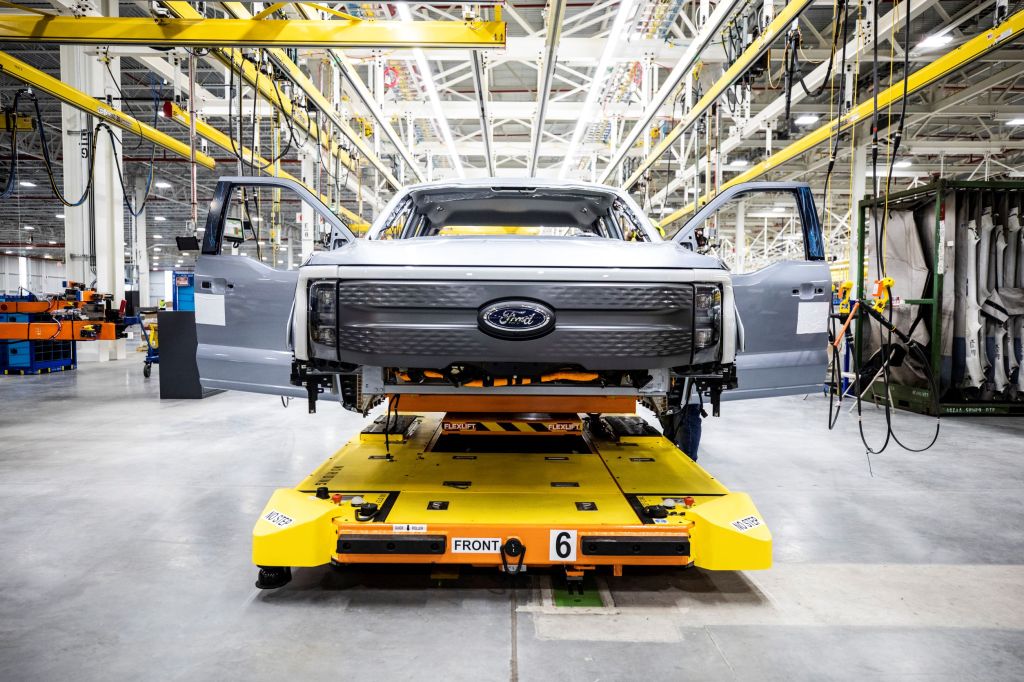
Ford Lightning Pre-Production Underway

The first versions of the F-150 model are being built at the Rouge Electric Vehicle Center in Michigan

By Gary S. Vasilash

Ford is increasing its investment—to the tune of $250-million—at its operations at the Rouge Electric Vehicle Center, Van Dyke Electric Powertrain Center and Rawsonville Components Plant.

The reason?

The F-150 Lightning.

It also means 450 more jobs spread across the plants, all of which are in Michigan (Dearborn, Sterling Heights and Ypsilanti).

“We knew the F-150 Lightning was special,” said Ford executive chair Bill Ford, “but the interest from the public has surpassed our highest expectations and changed the conversation around electric vehicles.

“So we are doubling down, adding jobs and investment to increase production,” Ford added.

“This truck and the Ford-UAW workers who are assembling it in Michigan have a chance to make history and lead the electric vehicle movement in America.”

Pre-production underway for the all-electric F-150 Lightning. (Image: Ford)

Ford has taken more than 150,000 reservations for the full-size electric pickup that has an estimated range of 300 miles and a starting MSRP of $40,000. (It is worth noting that the reservations require $100—which is refundable.)

The Lightning is another in the F-150 offerings, which has been the best-seller in the U.S. for 44 years running.

Pre-production is underway for the Lightning, with consumer vehicles planned for availability in the spring of 2022.