Most people are probably familiar with ammonia in its addition to household cleaning products—the ones that really smell, well, like something.
The biggest use on ammonia is not to help keep surfaces clean but in fertilizers, which accounts for about 90% of its use.
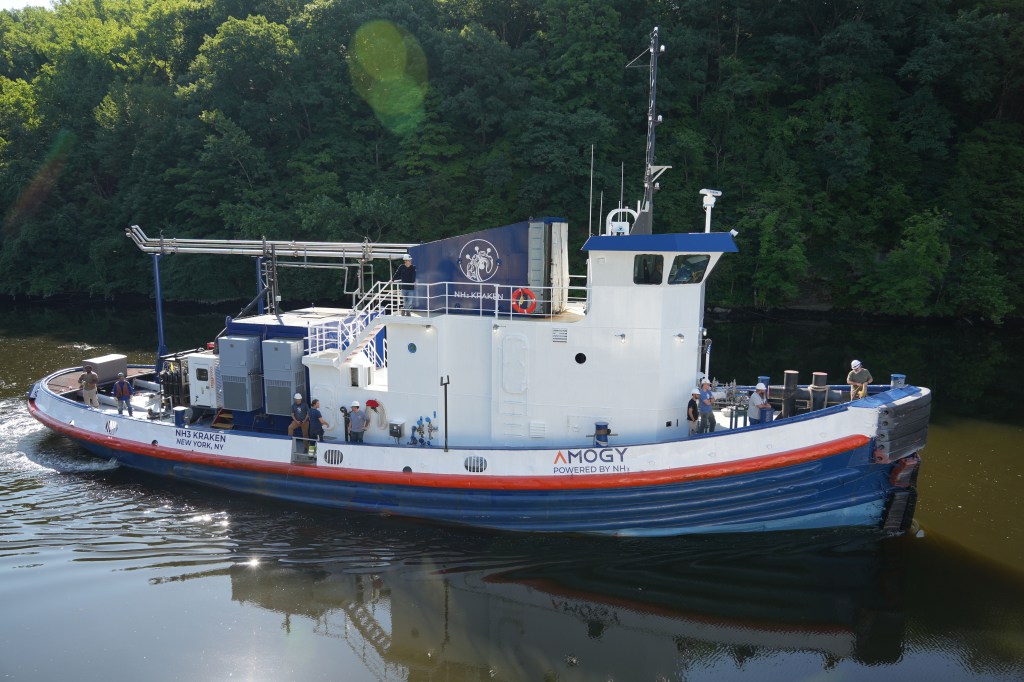
Tugboat powered by ammonia. (There is a little chemistry involved, of course.) (Image: Amogy)
But a company named Amogy, headquartered in Brooklyn, New York has another idea for where ammonia can be used: as a marine fuel.
But not as just any marine fuel, but one that is carbon-free.
To prove its viability Amogy retrofitted a tugboat built in 1957 with it ammonia-to-electrical power system.
The tugboat, renamed the NH3 Kraken, was then sent out on a voyage on a tributary of the Hudson River.
The name of the vessel, incidentally, is predicated on the chemical formula of ammonia.
The way its system works is that it cracks the nitrogen from the hydrogen, with the latter then being used in a fuel cell that generates electricity that powers the boat.
Further underscoring its environmental correctitude, green ammonia—made with renewable energy—was used on the NH3 Kraken.
According to Seonghoon Woo, CEO and co-founder of Amogy, “Ammonia is the world’s second most produced chemical, with around 20 million tons moving around the globe through 200 ports per year.”
Which sounds as though there is something of a nautical infrastructure, or at least one that could probably be brought up fairly quickly.
That said, the International Maritime Organization is targeting net-zero emissions by 2050, so there’s evidently some time.
You might recognize the building in the background. BMW headquarters in Munich. The four cylindrical towers (partially obscured here) that are meant to resemble the four cylinders in a combustion engine.
Then you look at the vehicles. The one on the left and the center are from Toyota, a Hilux and a Mirai; the one on the right a BMW iX5.
All of these vehicles are powered by hydrogen.
The two gents are Oliver Zipse, Chairman of the Board of Management of BMW AG (left) and Koji Sato, President and Member of the Board of Management (Representative Director) Toyota Motor Corporation.
The two are shaking on their further partnership in the development of fuel cell electric vehicle (FCEV) technology.
Toyota has had FCEVs available to consumers.
Soon—or at least by 2028—the same will be said of BMW.
Zipse:
“This is a milestone in automotive history: the first-ever series production fuel cell vehicle to be offered by a global premium manufacturer. Powered by hydrogen and driven by the spirit of our cooperation, it will underscore how technological progress is shaping future mobility. And it will herald an era of significant demand for fuel cell electric vehicles.”
Whether that demand is going to become real remains to be seen.
Sato makes a solid point, one that other OEM execs probably wish they could make, even though they were probably feeling really good when Toyota was being criticized for not going all-in on battery electric vehicles:
“In our long history of partnership, we have confirmed that BMW and Toyota share the same passion for cars and belief in ‘technology openness’ and a ‘multi-pathway’ approach to carbon neutrality.”
For the foreseeable future, there isn’t going to be one approach to reducing carbon and those legacy OEMs that recognize that will be the market leaders.
If you live in SoCal or NoCal, you’ve got a chance to lease a piece of what could be the automotive future. Could be.
By Gary S. Vasilash
Honda has announced its three lease options for Californians—who can access one of the 12 approved dealerships—interested in the 2025 CR-V e:FCEV, a fuel-cell electric version of its popular crossover.
Looks like a Honda CR-V because it is one. What makes this one—which is manufactured at the Honda Performance Manufacturing Center in Ohio—uses a second-generation fuel cell module produced by a Honda-GM joint venture in Michigan. Some people in California can lease the CR-V e:FCEV. (Image; Honda)
Honda thinks that the most popular option will be 3 years/36,000 miles. This will require $2,959 at signing, then monthly payments of $459.
The least expensive is a 6-year/72,000-mile program that requires $2,889 at signing and $389 per month.
The most expensive is 2 years/60,000 miles, which requires $2,989 at signing and $489 per month.
However, given that mileage allowance, perhaps it pencils well for those who drive a lot: 30,000 miles per year vs. 12,000 miles for the other two lease deals.
Honda is adding an incentive for the lease packages in the form of hydrogen fuel credits: $15,000 for the 3-year lease, $30,000 for the 6-year lease and $25,000 for the 2-year lease.
While that appears to be exceedingly serious money, it is worth knowing that the average cost of a kilogram of hydrogen, which is comparable from an energy standpoint to a gallon of gas, is about $33 in California.
So that means for $15,000 one will get ~455 kg (again, think “gallons”) at the pump.
With gas at about $5.40 per gallon in California, were one to have that deal it would translate into 2,778 gallons.
The CR-V e:FCEV, which has a battery that provides up to 29 miles of range (this is charged via a plug), has a total range of 270 miles. It has a 4.3-kg fuel tank.
Some good news is that to fill one of the vehicles it is pretty much just like fueling a gasoline CR-V both in terms of procedure and time, something that can’t be said for battery-powered electric vehicles.
Still, with that cost of hydrogen, one really has to be dedicated to an environmental vehicle regardless of the fuel credits.
California wants carbon neutrality by 2045. This could help. . .
By Gary S. Vasilash
Symbio is an interesting company that you’ve probably not heard of, interesting for two reasons:
It is developing vehicles like hydrogen-powered trucks
It is jointly owned by Forvia, Michelin and Stellantis. Forvia produces a number of products, from automotive interiors to containment cylinders for hydrogen. Michelin is heavily involved in developing green mobility solutions, such as low rolling-resistance tires. And Stellantis, of course, is in the business of vehicle manufacture.
Big rig. Zero emissions. (Image: Symbio)
Symbio has developed a Class 8 truck that is powered by hydrogen, a demonstrator vehicle called the “H2 Central Valley Express.”
The name of the vehicle relates to where the truck will operate in California: a route between the Inland Empire and Northern San Joaquin Valley in California.
The truck’s 400-kW StackPack fuel cell system is said to be comparable to a 15-liter diesel engine.
There is a 70-kg hydrogen tank onboard. It gives the truck a range of 450-miles.
And unlike a diesel, there are no emissions.
The truck will go into operation later this week on a 400-mile route. On the route there are four different operating conditions, such as urban, high-speed, and hill climb and descent. The demonstration period is to last 12 months.
This isn’t some sort of engineering undertaking: the truck will be in revenue service for Total Transportation Services.
Odds are that things like the Tesla Semi notwithstanding, when it comes to commercial freight operations hydrogen is going to be the way to go to zero emissions.
Fuel cells are having their moment again for various vehicle applications, from light-duty to big rigs.
How big a moment?
Seems not trivial according to a report by MarketsandMarkets, which products the automotive fuel cell market will grow from $200 million this year to $2.1 billion by 2030. It will have a compound annual growth rate of 48%.
Where will the largest market be?
Asia Oceana.
Given that the geographies covered in the firm’s report also includes Europe, North America and Rest of the World, presumably that Asia Oceana includes China, which could explain the biggest market.
(Image: Toyota)
That said, with companies including Toyota, Honda and Hyundai continuing their hydrogen fuel cell development efforts, Japan and South Korea can’t be counted out as players, and consumers, in this field.
However. . .the global battery electric vehicle market size right now is on the order of $500 billion and it is estimated to be about $1.5 trillion by 2030, so even with the impressive growth of fuel cells, they’re still approximately the size of a dandelion in a redwood forest.
Last year at the Honda Performance Manufacturing Center (PMC) in Marysville, Ohio, there were 124 Acura NSX sports cars produced. That was a smidge off the volume built in 2020, which was 128.
Perhaps because it was the proverbial and actual end-of-the-line for the NSX, through October 2022 there were 236 built.
These numbers are probably useful to keep in mind regarding an announcement that Honda made today:
It will produce a hydrogen fuel cell vehicle (FCEV) at the PMC starting in 2024.
The vehicle will be based on the current Honda CR-V crossover.
In addition to hydrogen for fuel, it will also have plug-in capability.
Gail May, who is the PMC plant leader, said, “This facility is perfect for the production of a new Honda fuel cell electric vehicle, as our small-volume capability enables us to really leverage the skill and expertise of our team to produce quality zero-emissions vehicles here in North America.”
No doubt, there is superb craftsmanship.
But doesn’t the mention of small volume and the numbers of NSXes built give you the feeling that there aren’t going to be a whole lot of FCEV crossovers?
To be fair, however, according to stats from the U.S. Dept. of Energy’s Alternative Fuels Data Center, if you’re looking for a public hydrogen refueling station and you don’t live in the proximity of either San Francisco or Los Angeles, you might wand to find an alternative mode of transportation.
One of the fuels that doesn’t get a whole lot of attention—despite it being the most-abundant element in the universe (yes, universe)—is hydrogen. There are a few hydrogen cars out there—like the Toyota Mirai and the Hyundai Nexo—and a few commercial trucks running tests (e.g., Toyota with the Port of Long Beach; Nikola with Anheuser-Busch).
While electrical outlets are seemingly everywhere and access to hydrogen fueling facilities is challenging at best, the idea of electrifying the fleet has become the norm and hydrogen is something of an afterthought.
Bosch is “all in” on hydrogen. (Image: Bosch)
However, Mike Mansuetti, president of Bosch in North America, announced, “We are all in for the hydrogen economy.”
Bosch on a global basis is investing $1-billion between 2021 and 2024 on the development of mobile fuel cells.
What’s more, in order to produce hydrogen (although there’s lots of hydrogen out there, hydrogen tends to bond with other things like oxygen, as in water), Bosch is investing some $600 million by 2030 in developing hydrogen electrolysis (the means by which water can be transformed back into its constituent elements).
Will these efforts result in more crossovers and cars with fuel cell stacks within the next few years?
It’s not likely.
According to Bosch’s Paul Thomas, executive vp of Mobility Solutions, America, the commercial applications, where there is a regular, defined route, and where there can be refueling stations built and regularly used (no company is going to want to build out a hydrogen refueling facility that gets used only once in a great while), are more likely to be where hydrogen will gain traction.
That said, there’s something that Bosch is doing that is quite interesting: the company, long known for its prowess in fuel injection technology, is, Mansuetti said, experimenting with hydrogen injection in internal combustion engines.
Think of all of the engine plants that OEMs have right now.
Were it that they could use that capacity to produce engines that burn hydrogen (no emissions) rather than gasoline, that might be a really compelling reason to make hydrogen a viable alternative to electricity. After all, they’ve already paid for all of that machinery and equipment, so if hydrogen would help them reduce their carbon footprint and meet regulatory requirements, why not?
Probably not because they seem so committed to battery electric vehicles and fuel cell electric vehicles would be too much to deal with.
Unless you drive a big rig or a locomotive, there probably isn’t a whole lot you need to know
By Gary S. Vasilash
According to the Alternative Fuels Data Center of the U.S. Department of Energy, “In mid-2020, there were about 43 retail stations available nationwide.” Those are retail stations where there is hydrogen refueling. The sentence went on, “mostly concentrated in California.”
The good news is that the AFDC accumulated more data on the retail hydrogen fueling infrastructure in the U.S. And what’s more, there is actually an increase in the number of stations.
But there is still that concentration in California.
The total is 49 retail stations.
Forty-eight of those are in California.
There is one in Hawaii.
Meanwhile, over in the European Union there are more stations, although the numbers from the ACEA don’t indicate whether these are retail-only or whether the number also includes private refueling stations.
When it comes to the EU Germany is almost like California.
That is, there are 83 hydrogen refueling stations there, which accounts for 66.9% of the total 124 stations in all of the EU.
All of this goes to the point that you are not likely to be rolling around in a hydrogen-powered vehicle any time soon—even if you live in California.
The infrastructure for refueling simply isn’t there.
Notes Charlie Freese, “It is a difficult infrastructure play if you have a station and are refueling one vehicle per week.”
In a record published earlier this year for the Department of Energy about plans for 111 new hydrogen refueling stations in California, “Hydrogen Fueling Stations Cost,” “Capital equipment cost estimates for 111 new fueling stations. . .varied between approximately $1,200 and $3,000 per kilogram hydrogen dispensed per day.”
According to Freese, you can think of a kilogram of hydrogen as a gallon of gasoline.
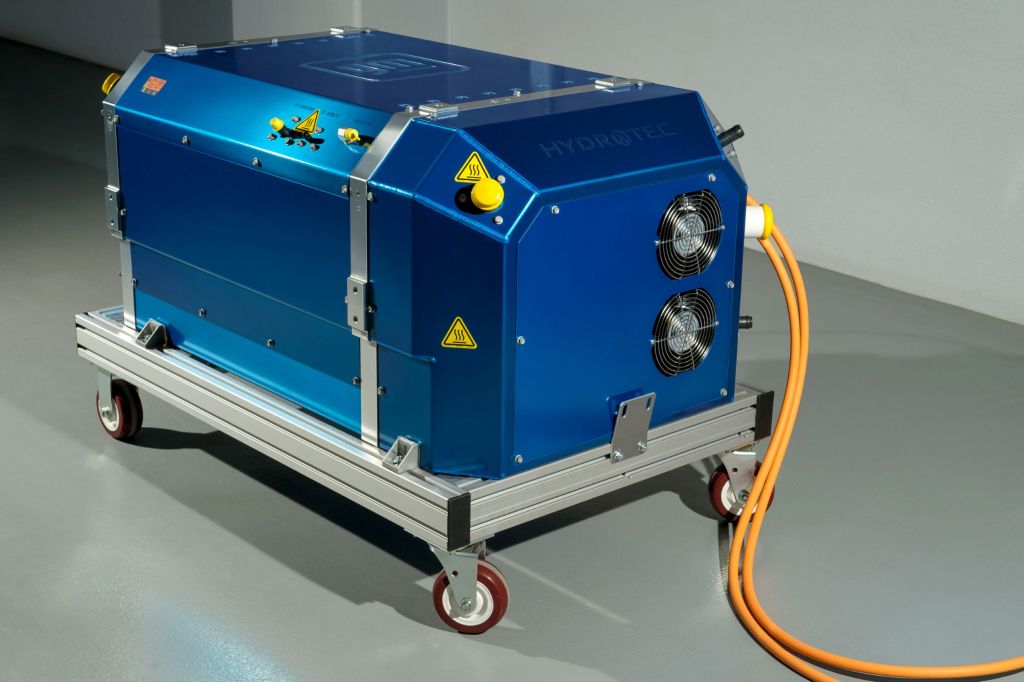
This is a fuel cell. Actually a HYDROTEC fuel cell module that contains fuel cells. (Image: Steve Fecht for General Motors)
Yes, a very difficult infrastructure play.
But Freese is a proponent of hydrogen. He is the executive director of General Motors’ global fuel cell business which uses the name HYDROTEC.
HYDROTEC fuel cell modules have a variety of applications in transportation—applications that you might not expect.
That is, it has announced activities with:
Liebherr-Aerospace: Yes, fuel cells for aircraft
Wabtec: A producer of locomotives
Navistar: Two HYDROTEC fuel cell cubes will be used to power Navistar’s International RH Series
Freese points out that there are extensive opportunities in applications like these because there is a lot that is “known”:
Planes fly on specific routes and land at airports. Locomotive routes are literally on rails. And trucking goes from the depot to the point of delivery—and at the point of delivery (e.g., a warehouse or factory) there are likely to be pieces of material handling equipment—powered by hydrogen.
For individual drivers where one might go is not known. So there can be refueling stations that accumulate proverbial—if not actual—cobwebs.
But for commercial transport, there is the opportunity to have a calculated number of fuel users, which is an absolute advantage.
On this edition of “Autoline After Hours” Freese talks with “Autoline’s” John McElroy, Lindsay Brooke of SAE’s Automotive Engineering and me on a variety of hydrogen-related subjects.
In addition to which, John, Lindsay and I talk about a variety of other subjects, including VW’s commitment to EVs, the European Commission’s tentative plan to stop sale of new vehicles powered with internal combustion engines in the region by 2035, the right to repair, and more.
Although the bullishness of Hyundai is something that yesterday’s piece on the XCIENT big-rig noted, we didn’t realize the magnitude of that commitment until we saw this pie chart from a research firm, Information Trends :
(Image: Information Trends)
Yes, that’s right, Hyundai has about 75% of the entire pie.
However, the pie needs to be put into some context:
According to the firm, approximately 8,500 passenger fuel cell vehicles (not big-rigs) were sold in 2020.
To put that into some context: Toyota sells more Camrys in a week in the U.S. than that total number of global fuel cell sales, so there is a way to go. Quite a way.
“With 2021 XCIENT Fuel Cell, Hyundai will contribute to the widespread adoption of commercial vehicles powered by hydrogen.”– Jaehoon (Jay) Chang, CEO and President of Commercial Vehicle Division at Hyundai Motor Company
By Gary S. Vasilash
When people think about “electric vehicles” it tends to be in the context of a car like a Tesla Model 3 or if it is a truck it is the Rivian R1T. These are electric vehicles that are powered by electricity that is stored in a battery.
Fuel cell-powered vehicles are electric vehicles, too. The difference is essentially that instead of batteries there are high-pressure cylinders full of hydrogen that is then transformed on board—through the fuel cell—into electricity.
Using hydrogen to propel big rigs. (Image: Hyundai)
Both the traditional EV and the fuel cell vehicle then have electric motors that are used to propel the vehicle.
While most people, naturally, think of something that they might drive, a big impact both technologically and ecologically is going to be trucks—not F-150 Lightnings, but big rigs.
Batteries are heavy for sedans. They are even more massively heavy to move Class 7 and 8 trucks.
So hydrogen becomes a good alternative, especially as the amount of fuel that can be stored on board provides sufficient range, and the hydrogen tanks can be refilled within minutes, not hours as can be the case for battery recharging.
Hyundai has announced that it will begin production of its 2021 XCIENT Fuel Cell heavy-duty truck in August.
The vehicle has a 180-kW hydrogen fuel cell system and two 90-kW fuel cell stacks. There are seven hydrogen storage tanks that hold about 31 kg of fuel. That goes to power a 350-kW e-motor. The range is estimated to be about 400 km. Refueling time is from 8 to 20 minutes.
At present there are 46 XCIENTs rolling around Switzerland right now and Hyundai plans to ship an additional 140 to the country by the end of the year. It intends to have some 1,600 heavy-duty fuel cell electric trucks in Europe by 2025.
Yes, Hyundai is going to bring the model to the U.S. this year.





 shinymetalboxes