There could be a big problem for GM if there are 25% tariffs on vehicles coming into the U.S. from Mexico
By Gary S. Vasilash
There is, of course, a whole lot of unknowns regarding what the forthcoming Trump administration is going to do vis-à-vis the auto industry.
This is not just a question of the elimination of the tax credit for EVs, which would undoubtedly have a huge negative effect on EV sales in the U.S. in 2025, but more troubling, the possibility of 25% tariffs on products from Mexico and Canada.
John Murphy, senior North American automotive equity research analyst at Bank of America, thinks that the 25% may be something of a negotiating tactic, not a hard-and-fast decision.
In a recent interview with Yahoo Finance, Murphy said the 25% tariff on parts and products is “unlikely to come through.”
But “unlikely” isn’t a definitive “no.”
So there could be a problem, especially for General Motors.
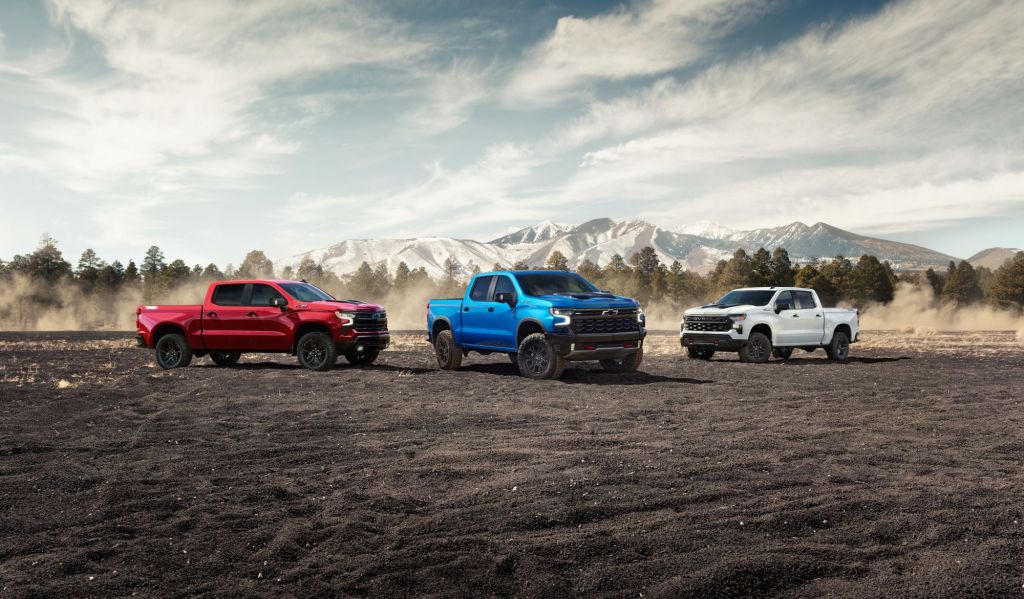
Mexcio is an important source of pickup trucks, including the Chevy Silverado, for General Motors. (Image: Chevrolet)
Murphy points out that nearly a third of GM products for sale in the U.S. come from outside the U.S., mainly Mexico.
Notably, there are Chevy Silverado and GMC Sierra pickups built south of the border.
“That creates real problems,” Murphy said.
“The question is how fast you”—or in this case, “GM”—“can react to that.”
After all, it is not as though there is some GM truck plant sitting idle in the U.S.
“They just can’t pick up and move.”
Which may be something that isn’t fully understood by politicians.
Murphy suggested that if the tariffs block the import of Chinese parts and vehicles into the U.S. that will be a “net positive” for the domestics, as well the Japanese and Korean manufacturers with an existing U.S. manufacturing footprint.
Honda and Acura Go Electric with Ultium and Then Some. . .
By Gary S. Vasilash
As is widely known, when it comes to the contemporary electric vehicle, Honda was a bit late to the party. Given that the company has extensive experience in electrified vehicles. It is often forgotten (or unknown), for example, that the first hybrid on the U.S. market wasn’t the Toyota Prius, but the Honda Insight, which was launched in December 1999, edging out the Prius by a few months.
(This gives rise to another consideration. Toyota has also been criticized for its approach to the EV market, being tagged as a laggard. One could argue that this isn’t a mistake, given the still rather small number of EVs being sold in the U.S. market. According to Kelley Blue Book, for Q3 2024 there were 346,309 EVs sold, a number that will undoubtedly help the number of EVs sold in the U.S. to exceed the 1.2-million sold in 2023. But here’s something to think about: if you take away the Tesla sales from the Q3 numbers this means that 27 brands cumulatively sold 179,386 vehicles. That would be 6,644 if the number was evenly distributed. But no matter how you look at it, there is a long way to go in order to achieve the necessary scale to have a profitable production operation.)
Anyway, I’ve just been driving the Honda Prologue and the Acura ZDX, the two contemporary EVs from the company.
A sign of the times is that in order to get these vehicles on the market, Honda worked with a company that it has been collaborating on for some time (on things ranging from the engine for the Saturn Vue Red Line to hydrogen fuel cells).
The two vehicles are based on the GM Ultium platform (yes, even though GM is going to stop calling them “Ultium,” the platforms were Ultium when the Prologue and the ZDX were developed).
Just as the Saturn Vue Red Line was a Saturn through and through, not a Honda, the Prologue isn’t a Chevy Blazer EV, which it shares the platform with, just as the ZDX isn’t a Cadillac LYRIQ.
In the case of the Prologue—which is available with a single-motor (212 hp) front-drive setup that provides a range of up to 296 miles or as a dual motor (288 hp) with a 281-mile range (although there is the Elite trim package that goes 273 miles); all have an 85-kWh battery pack—the design inside and out are characteristic of the brand.
The design-speak for the exterior design—which was executed in L.A.—is “Neo Rugged.” It is, after all, an crossover. Arguably, it is a simple, straightforward design with a sufficient number of creases in the sheet metal to keep it from looking innocuous or as something that it isn’t (i.e., like something you’d take on the Rubicon).
Inside there is the clean, straight-forward Honda approach to ergonomic instrumentation. However, I have two quibbles with the interior design:
An excessive use of piano black plastic on the IP. Whereas the Civic Hybrid (a hatchback was recently released) has an interior that looks of the moment, the piano black in the Prologue is dated.
The distance from the top front edge of the instrument panel to the bottom of the windshield is a tremendous amount of real estate. Someone had better have a Swiffer on a long handle to be able to keep that surface clear because it is a reach.
But while on the inside it should be noted that there is as much as 57.7 cubic feet of cargo space, so it can handle a reasonable haul.
Of the two cars, the ZDX is the one that I find to be most impressive. (Of course, the starting MSRP for the Prologue is $47,400 and it is $64,500, so there has to be some bandwidth there.)
The ZDX comes as a rear-drive vehicle with 358 hp and a range of 313 miles from its 102-kWh battery. Or there is an all-wheel drive version (A-Spec) that provides 490 hp and 304 miles of range from the same battery pack. Or there is another AWD version (Type S) that generates 499 hp and will take you 278 miles with some alacrity.
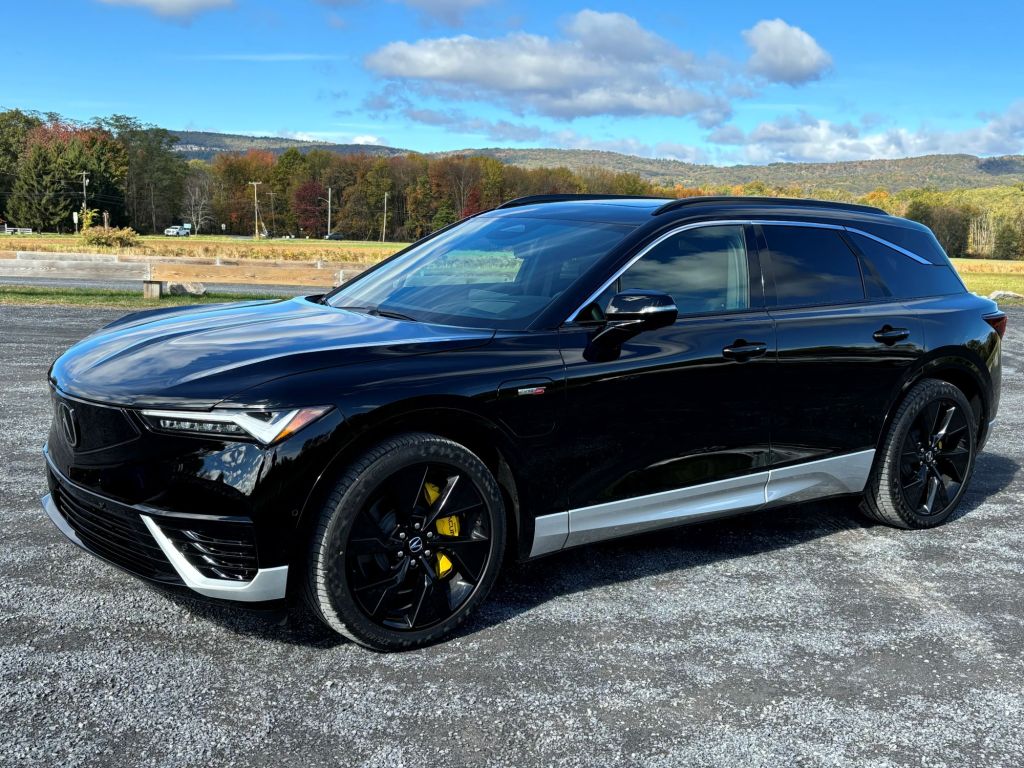
2024 Acura ZDX Type S. Wicked quick. And you can shop for groceries with it, too. (Image: gsv)
Although Acura does have two cars in its lineup—the TLX and Integra—its two crossovers—the MDX and RDX—are focal points. In terms of powertrain performance, the ZDX smokes the other crossovers (or maybe that should be it “ozones the other crossovers”).
It, too, was styled in LA. And although it is a crossover, its exterior body style resembles for me more of a contemporary station wagon, with a lower, longer, more angular sideview than many other crossovers.
While it seems as though all vehicles today have some sort of light signature up front, credit should be given to the Acura designers for the sharp styling they’ve brought to the lighting of this vehicle.
On the inside the seats in the front are bolstered in keeping with the type of vehicle it is, and the layout of the instruments and gauges are intuitive. A cowl over the gauge screen provides something of a cockpit feeling when sitting behind the wheel.
Both are solidly engineered vehicles that go well beyond the propulsion systems.
The Prologue seems like a Honda (presumably because it is) and the response from the market is good: According to numbers from KBB, through the third quarter there have been 12,644 Prologues sold—more than the 7,998 Blazer EVs sold, and closing in on the popular Mustang Mach-E, which had sales of 13,392.
The ZDX, which is essentially a new nameplate (yes, Acura built a ZDX until 2013, but its sales were so tiny that it isn’t likely remembered by many (outside those who smacked their heads getting into or out of the rear seat on the C-pillar)) has had sales through Q3 of 2,647—which is not far from the Lexus RZ’s 2,742, which has been available for longer.
In 2026 Honda will roll out its 0 Series, which it is developing sans GM.
But neither the Prologue nor ZDX are placeholders until then.
One thing that doesn’t get a whole lot of attention in discussions about EVs are the volumes in the factories where they are built. . . .
By Gary S. Vasilash
In announcing its Q3 performance, General Motors did the typical approach of accentuating the positive. As the company’s sales were down 2.2% in the quarter compared with Q3 ’23 and are down 1% year-to-date compared with ’23, that wasn’t going to be it.
Rather, as Rory Harvey, GM executive vice president and president of Global Markets is quoted:
“GM’s EV portfolio is growing faster than the market because we have an all-electric vehicle for just about everybody, no matter what they like to drive.”
While in Q1 ’24 GM’s U.S. share of the EV market was 6.5%. It reached 9.5% in Q3.
Clearly its EV sales are on an upward trajectory. But multiple models can drive up production costs.
The Models
Taking BrightDrop commercial vehicles out of the picture, since January GM has sold 70,450 EVs.
Specifically:
20,318 Cadillac LYRIQs
15,232 Chevy Blazer EVs
8,582 Bolt EV/Bolt EUVs
10,785 Equinox EVs
5,252 Silverado EVs
8,902 GMC HUMMER EVs
387 Sierra EVs
The LYRIQ is built in Spring Hill, Tennessee.
The Blazer EV is built in Ramos Arizpe, Mexico.
The Bolts are built in Orion, Michigan.
The Equinox EV is built in Ramos Arizpe.
The Silverado EV, HUMMER EV and Sierra EV are made in Detroit-Hamtramck.
Seven vehicles.
Three factories.
And some 70,450 have been built over a nine-month period.
While there is certainly some sharing of components, there are things like body stamping that aren’t common, which means dies. And the interiors of the three vehicles built at the Factory ZERO plant are different executions, though, again, there are some common parts.
But the point is, there are different costs associated with these vehicles’ production.
Capacity Utilization
Let’s say that the production capacity of an assembly plant is 250,000 vehicles per year.
A rule of thumb is that such a plant must operate at 80% capacity in order to be profitable, so that would be 200,000 units.
Even if the production of EVs doubles from the end of Q3 to the end of Q4, that’s 140,900 vehicles, or 70.45% of a 250,000-unit-capacity plant.
Now in the case of the Ramos Arizpe plant, in addition to the Chevy EVs it is producing the ICE Blazer and the Honda Prologue EV. The former has sales through Q3 of 40,545 vehicles and the latter 14,179.
So with all four of the vehicles being built there, there is an output through Q3 of 80,741.
If that number is doubled by the end of the year to 161,482 (which, of course, won’t happen), that would be about 65% capacity utilization of a 250,000-vehicle plant.
But let’s go back to the 70,450 units of GM EVs sold through Q3.
It is worth noting that during the same period there were 70,710 Chevy Colorados sold.
One model. One plant.
And it shares Wentzville Assembly with the GMC Canyon (26,956 sold through Q3, or 6,638 more vehicles than the best-selling GM EV. In fact, you could add the sales of the Silverado EV and the Sierra EV onto that LYRIQ number and it would still be short of the Canyon: 25,957.)
Profitability in EVs is going to take GM and some of its competitors a bit more than reduced battery costs.
Because factories have a large carbon footprint. . .
By Gary S. Vasilash
Although the public-facing efforts vehicle manufacturers are making with regard to their environmental credentials are mainly focused on the electrification of vehicles, if the total lifecycle assessment (LCA) of a given light vehicle is assessed, there is an element of that vehicle that is responsible for a considerable amount of emissions: manufacturing.
For a gasoline vehicle, production can account for 23% of its LCA.
Solar in Arkansas will be used to power GM factories in Michigan and Missouri. (Image: GM)
For an electric vehicle, which has, of course, no tailpipe, the factory accounts for as much as 46% of its carbon footprint.
To address factory-related emissions, GM has signed an agreement to source solar power generated electricity for three of its assembly plants.
Electricity will be provided to the Lansing Delta Township Assembly, Lansing Grand River Assembly, and Wentzville Assembly plants via a 15-year renewable energy purchase agreement with NorthStar Clean Energy.
NorthStar’s solar facility in Newport, Arkansas, will be generating the renewable energy that will be sent up to Michigan (for the two Lansing plants) and Missouri (Wentzville).
According to GM, as it has sourcing agreements with 17 renewable energy plants it is the auto industry’s largest buyer of renewable power by capacity, based on BloombergNEF stats.
The vehicle manufacturer plans to have all of its U.S. factories powered by renewables by the end of 2025.
Odds are, unlike predictions of when a given lineup will be full EV, that 2025 plan is undoubtedly going to happen.
One is making money. One is making progress. Slight progress.
By Gary S. Vasilash
In her Q2 2024 earnings letter to shareholders released yesterday, GM CEO listed the “four key drivers” of the company’s performance—and that performance includes record revenue in both Q1 and Q2—and it is interesting what the first item on the list of four is:
In North America, we have a consistently high performing portfolio of ICE trucks and SUVs on a volume, share and margin basis.
Now because the company is in the process of spending billions of dollars on EV technology, the second point on the list goes to EVs, although it doesn’t exactly sound robust:
Our EV portfolio is scaling well, and we’re encouraged by the early sales results, including record second-quarter deliveries and improving market share.
To put some data to that “scaling well,” in Q2 the company delivered:
7,294 Cadillac LYRIQs
6,634 Blazer EVs
1,374 Bolt EV/Bolt EUVs
1,013 Equinox EVs
2,196 Silverado EVs
2,926 HUMMER EVs
and to throw in for good measure a commercial product:
490 BrightDrop Zevo 400/600s
That is a total of 21,927 EVs sold in Q2.
Yes, there are increases in numbers.
The GMC HUMMER EV SUV (Image: GMC)
The LYRIQ was at 1,348 units in Q2 2023. And the HUMMER was at a mere 47 in Q2 2023.
But to put things into some context: the Chevrolet Malibu, which is going out of production later this year, had Q2 2024 deliveries of 36,360 units, or 14,433 more than all the EVs combined.
And isn’t the accepted wisdom that “Nobody buys sedans anymore?”
If we look at ICE truck or SUV numbers. . . well at this point it isn’t even a fair comparison.
But Barra goes on to write:
“To unleash the next cycle of EV growth, we’re scaling production of the Chevrolet Equinox EV. . . . Then over the next several months, GMC will launch the Sierra EV and the Cadillac LYRIQ will be joined by the OPTIQ, Escalade IQ and CELESTIQ.”
On the one hand, this is completely understandable for at least a couple reasons.
For one, there are those billions spent on getting capacity, so they need to use it.
For another, regulations are going to require the sale of more EVs, especially to offset the sales of things like trucks and large SUVs (e.g., in Q2 there were 151,112 Silverados sold).
That said, one wonders: Given the increasing popularity of hybrids, why is there no discussion of that in the forthcoming product portfolio?
First time I saw Detroit’s Renaissance Center was 1982, when my friend Tom Cesarz and I borrowed my dad’s 1980 Mazda RX-7 to drive the 375 miles from Milwaukee (Dad always was generous about letting me drive it) to attend our first-ever live Formula 1 race.
We showed up early Saturday evening, too late to watch qualifying, but in time to get a lay of the land and to be somewhere in the vicinity of Alain Prost, Keke Rosberg, Niki Lauda, Nigel Mansell, and the like. After we parked near the RenCen and its massive concrete sidewalk barriers, three locals walking by spotted the Wisconsin vanity plate, HMMMM7, on the RX-7. One of them said, presumably having seen the “America’s Dairyland” slogan on the plate, “Ya bring your cow?”
In retrospect, we should have jumped back in the sports car to quickly drive away lest some local assembly line workers carrying tire irons walk by the Japanese two-seater. Remember this was 1982. But we instead tried to find our way into the RenCen. Built by Henry Ford II some five years earlier as a “city within a city” (locals called it “The Deuce’s Last Erection”) the one car we found on-display inside among the European-ish throng of F1 fans was one of the Ford GT40s that ran the 24 Hours of Le Mans.
Wouldn’t one of Jim Clark’s Lotus Ford DFVs have been more appropriate?
We couldn’t afford to stay at the RenCen Westin and instead returned to the RX-7 to find it apparently untouched, and drove off to a Holiday Inn near Ann Arbor.
Our $30 seats, cheapest available for the first-ever Detroit Grand Prix, allowed us the largely walled-off view of a first-gear corner at what was then named Cobo Hall (now Huntington Place), where we watched John Watson’s McLaren-Ford (another potential display car) lead a parade of downshifting F1 cars to the win.
Fourteen years later I moved to Detroit to take a staffer job at Autoweek and a year after that, 1997, I moved to a turn-of-the-century warehouse converted to apartments about a mile east of the RenCen. Offices of Crain Communications, which owned AW at the time, weren’t far from the RenCen, so I went there with colleagues once or twice a week for lunch.
The maze inside the seven connected cylinders was as confusing as its walled-off exterior was intimidating. Finding my way to the appropriate corporate office for an interview or press conference held within the structure was not unlike making my way between the U.S. Capitol and the Rayburn House or Dirksen Senate office buildings via their connected basements, as I had for four years prior editing Capitol Hill newsletters.
Wikipedia says Ford sold the RenCen to General Motors in 1996, the year I moved to Detroite, though my faulty memory placed the sale later in the ‘90s. Ford had trouble keeping the complex filled with retail stores and services, and while GM managed to sign a couple of decent restaurants over the years, there were still more than a few vacant storefronts. The RenCen multiplex movie theater closed—and in that part of Detroit there weren’t a lot of screens. The raised People Mover monorail, which has a stop at the RenCen, was never much more of a tourist novelty, except when shuttling fans from parking garages to Red Wings, Tigers or Lions games, or me, some times, to the North American International Auto Show.
My best memories of the place involve attending the Detroit Jazz Festival and Electronic Music Festival held outdoors on the plaza west of the seven cylinders.
Another close friend, Tim Bailey, was an assistant comptroller for the RenCen Intercontinental Hotel in the mid-‘80s. He told me hotel rooms were difficult and expensive to keep warm because of their rounded outer walls. Not exactly beneficial for the hotel’s utility bill.
The good news is after GM’s 2009 bankruptcy, the automaker undertook a renovation on the seven cylinders that included knocking down those exterior concrete barriers. It was no longer a “city within a city,” a fortress you had to drive to, designed to keep out the locals who didn’t have business there (with all the racism that implies). Now it was a place you could walk or bike to, and around. The grand southern entrance faces downtown Windsor, Ontario, and leads to a walkway along the Detroit River.
I’m not sure what more can be done to turn the seven-cylinder fortress into a more welcoming place that can attract tenants who in turn would attract locals and visitors alike, but that’s the plan. GM has announced it will move out of the RenCen in 2025 and into a new office building at the landmark site of the downtown Hudson’s department store, which was imploded in 1999.
GM, along with the Bedrock real estate firm (which almost singlehandedly rebuilt Detroit’s downtown during the last 15 or 20 years) and the city will develop “ideas to remake the seven-building Renaissance Center,” according to The Associated Press. GM is not selling the RenCen and instead plans to return someday — after it is “remade.”
I have to wonder why, or if, GM really will return. The location it is moving to is on a conventional, easily accessible city block and there are probably bike lanes on Woodward Avenue, which it faces, by now. And from the renderings released of the new building, it looks something like a giant fuel-cell stack. Now that’s a future.
And the still-under-construction Hudson’s Tower will be the second-tallest building in Detroit.
Henry Ford II’s structure remains the tallest.
*Todd Lassa is editor-in-chief of The Hustings and contributing editor to Autoweek.
Let’s say that you are interested in buying a car.
A car as a sedan. Not a crossover. A bread-and-butter car. (Yes, maybe you want to add some spicy tomato jam to it—spoiler, alloy wheels, etc.)
You go to the local Ford dealer.
And discover that the only car is a Mustang, which doesn’t qualify (i.e., two doors).
There happens to be a Lincoln store across the parking lot.
There are no cars, only crossovers of stair-step sizes.
You visit a Chrysler dealership and learn that Stellantis has stopped production of its long-in-the-market 300 at the end of last year, but they’ve got a Pacifica minivan, if you’re interested.
Buick perhaps? Again, no. Only crossovers.
Over at Cadillac things are better: of its seven models, two are sedans, the CT4 and the CT5. Given that the Q1 2024 sales for those are down 36.1% and 34.2%, respectively, how long they’ll be around may be in some question.
Chevy? An impressive array of crossovers and trucks. And one car, the Malibu.
The point is, buying a car is not as easy as it once was.*
Which leads to a thought about electric vehicles.
What if you went into one of these dealerships and discovered that they didn’t have anything on the showroom floor that didn’t have a plug?
What if that was pretty much the case up and down the street of the auto mall?
Clearly there would be an increase in the number of EVs sold out of those dealerships.
Maybe the numbers would be that good.
But they would be better.
Just as they’ve increased the number of models that aren’t cars and so have made buying a car tough, it could be that to help recoup some of the billions being spent on EVs they make buying an ICE tough.
Something’s got to move more of that lithium-powered metal.
(Of the 593,997 vehicles GM sold to customers in Q1, 16,169 were EVs. Not much of a business case there. And it sold twice as many Malibus ((32,749).))
*Interestingly, the Asian and European brands, in general, all have cars in their lineups.
As you’ve probably noticed, when you look at the Moon overhead, it generally appears to be about the size of a dime. When you look at it near the horizon, it appears massive. Which might lead you to believe that the Moon radically changes its distance with the Earth.
It doesn’t.
The Moon is 238,855 miles from the Earth whether it appears so close that you think you could drive to it or not.
Walking on the Moon. (Image: NASA)
This astronomical moment leads to General Motors’ announcement that it has increased the capability of its Super Cruise advanced driver assistance system that permits hands-free driving to 750,000 miles of roadways in the U.S. and Canada.
It claims that it is nearly six times the capability of any other hands-free driver assistance system available in North America.
It also says, “750,000 miles is like traveling one way from Earth to the Moon three times” [emphasis not added, its GM’s].
GM is adding the capability to handle the new roads via over-the-air updates to Super Cruise vehicles that are currently roaming the road except for three: the Cadillac CT6, Chevrolet Bolt EUV and Cadillac XT6.
Why are those three left out?
A GM spokesperson tells us that it is because those three vehicles have an older electrical system that’s incapable of handling the update.
Still, they are capable of providing some 400,000 miles of roads, so that’s a trip to the Moon and about 70% of the way back.
Much of the attention given to Ford’s Q4 2023 earnings call last week has been focused on CEO Jim Farley’s comment:
“[W]e made a bet in silence two years ago. We developed a super-talented skunk works team to create a low-cost EV platform. It was a small group, small team, some of the best EV engineers in the world, and it was separate from the Ford mothership. It was a start-up.
“And they’ve developed a flexible platform that will not only deploy to several types of vehicles but will be a large installed base for software and services that we’re now seeing at Pro.”
Somehow the inherent mystery of a “skunk works” has gotten people all excited.
Would they be so excited to know that the skunkworks methodology goes back to 1943 in the aircraft industry?
Yes, an 80-year-old approach.
Well, You’ve Got to Build It. . .
The other thing about this is that it is one thing for an R&D team operating independently to develop something and a whole other thing for that development to be engineered for and launched in production.
Launches have been something that Ford has been finding a bit troubling, so there’s that.
And it should be noted that the company also announced last week that its Ford e operation—as in the electric vehicles—lost $4.7 billion last year and the company anticipates losing $5 to 5.5 billion this year on Ford e.
The excitement of the skunk works project was certainly helpful from diverting some attention to that red ink.
What About This?
But what was largely overlooked was Farley’s comments on hybrids.
As in,
“Our global hybrid sales were up 20% last year, and we expect them to be up 40% this year.”
And:
“We now have the No. 1 and No. 2 best-selling hybrid trucks in the U.S. Maverick is No. 1. And we’re the No. 3 hybrid brand in the U.S. behind Toyota and Honda. But unlike them, our hybrids really sell best on trucks for our side.”
Given that Farley said “And margins on hybrids are closer to ICE, much higher than EV margins,” you’d think hybrids would be the headline going forward if for no other reason than the company can make money on them, something that it is not going to see on the EV side of the business until. . . . Well, that remains to be seen.
Maverick hybrid: Fuel efficiency and the energy to bust out the beats. (Image: Ford)
Not Exactly a Strong Third
While it is nice that Farley is so bullish about the company’s hybrid performance, it is worth really putting that into context.
Of course its hybrids “really sell best on trucks” because with the only hybrid Ford has without a box on the back is the Escape.
And as for it being number three, know that these are the number of hybrid sales for the three companies in 2023:
Toyota: 523,664
Honda: 293,640
Ford: 133,748
In other words, it sold less than half of what Honda did and about a quarter of what Toyota did.*
So while the claim is factually true, one should perhaps not be too chuffed about the Ford hybrid performance.
About a quarter of Toyota and Honda sales are hybrids.
About 7% of Ford’s sales are hybrids.
Did I mention the skunk works. . .?
==
*It is worth noting that until recently Toyota was treated like some technological troglodyte for its continued support of hybrids and its not all-in approach to EVs. Not only do we see that Ford is reconsidering its positioning vis-à-vis hybrids and full EVs, but General Motors, which doesn’t have much of a record in the hybrid space, has announced that it, too, is going to bring hybrids to the U.S. market. Farley pointed out on the earnings call that consumers can quickly do the math on the fuel efficiency benefits of hybrids and, perhaps the most important factor: “they don’t have to change their behaviors.” It is surprising that there seems to be so many auto execs who ignore the long public charging time required for EVs compared with pumping gas: perhaps this is a case that when they get behind the wheel of their company vehicles someone else has done the charging.
In GM CEO Mary Barra’s letter to shareholders for the Q4 2023 results it reads, in part:
“In our EV business, we expect our U.S. portfolio will become variable profit positive in the second half of the year based on our current expectations for EV demand and production growth, strong interest in our vehicles, lower commodity prices and other factors.
“It’s true the pace of EV growth has slowed, which has created some uncertainty. But many third-party forecasts have U.S. EV deliveries rising from about 7% of the industry in 2023 to at least 10% in 2024, which would mean another year of record EV sales.
“We believe our competitive position will improve throughout the year, based on higher production of the Cadillac LYRIQ, GMC HUMMER EV, Chevrolet Blazer EV and Silverado EV Work Truck. We’re also excited to have the Chevrolet Equinox EV and Silverado EV RST, the GMC Sierra EV Denali and the Cadillac Escalade IQ arriving in showrooms over the course of the year.”
There is something to be said for optimism. And given that GM is investing billions in EV development and production, optimism is better than the alternative.
In her Q4 2022 letter to shareholders Barra wrote:
“By leveraging U.S.-made battery cells produced by our Ultium Cells joint venture and the scalability and flexibility of the Ultium Platform, we are accelerating production of the Cadillac LYRIQ, GMC HUMMER EV and BrightDrop Zevo 600, and we will launch exciting vehicles like the Chevrolet Silverado EV, Blazer EV and Equinox EV. This keeps us on track to produce 400,000 EVs in North America from 2022 through the first half of next year.”
For the full year of 2023, rather than just the first half, GM sold 75,883 EVs. About 19% of that 400,000. Even if we add in the 2022 EV sales, 39,096, to the full year ’23 sales, that is 114,979, or about 29% of that 400,000.
Yes, GM will sell more EVs in 2024 than it did in 2023.
And it will be a good thing if the EVs it sells are “variable profit positive” by the second half of the year.
But consider: in 2023 GM’s total U.S. sales were 2,594,698 units. That means the 75,883 EVs represented about 3% of total sales.
If industry sales of EVs this year are “at least 10%,” what is the likelihood that GM will come close to reaching that number?





 shinymetalboxes