The Honda Prelude, which first arrived in the U.S. in 1979, has always been a sporty coupe.
Since its introduction there have been five generations:
1979-82
1983-87
1988-91
1992-96
1997-2001
Yes, the run ended near the turn of the century.
An issue is simply that sport coupes are pretty much confined to a niche market.
The biggest sales year for the Prelude was back in 1986, when some 80,000 were sold.
Put that number against the number of Accords or Civics sold in a given year, and one might argue that Honda management was nothing if not supportive of the approach to spirited driving provided by the Prelude.
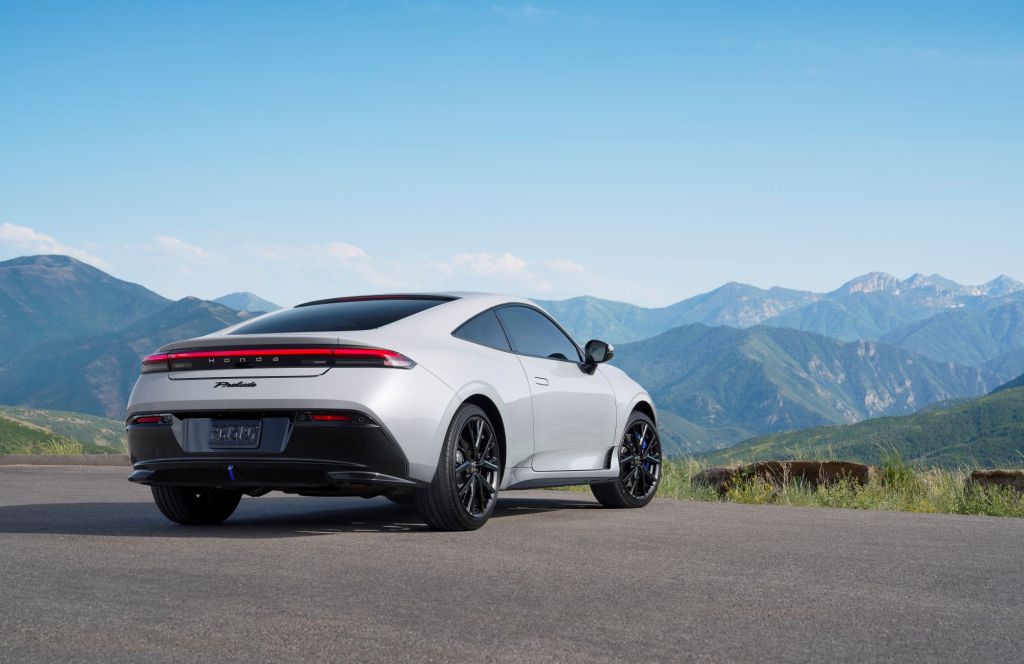
And that spirit will soon be back, as Honda has announced that later this fall the sixth-generation Prelude will go on sale in the U.S.
(Images: Honda)
Yes, it is still a sports coupe.
But what makes this one different is what’s found under the hood:
A 2.0-liter Atkinson cycle direct-injected engine that is supplemented by two electric motors. The result is a system output of 200 hp and 232 lb-ft of torque.
To help assure the kind of driving performance the Prelude has been known for:
A new development called “Honda S+ Shift.” This manages the coordination between the engine and the motors, including rev matching and gear holding, that is accessible through the paddle shifters.
The use of chassis hardware from the Civic Type R, including dual-axis strut front suspension and larger brakes 13.8-inch front rotors with Brembo monobloc four-piston aluminum calipers; 12.0-inch rotors in the back)
Enhanced Honda Agile Handling Assist, which integrates the powertrain, braking and steering for better control
Of course, sometimes people just want to have a pleasant drive, so there are three drive modes, including Comfort.
No surprise: the other two are GT and Sport.
To simplify things, the two-motor hybrid will be available in one trim.
Not only does this simplify the consumer buying experience, but it also means there is a single model to produce, thereby improving the scale of production, important when it comes to vehicles that aren’t likely to have Civic/Accord-type numbers.
Yes, this goes on tough terrain but is still quite pleasant during the daily drive
By Gary S. Vasilash
I was recently watching a TV program set in New Zealand. A detective who was not familiar with the area, asked a local how to get there. She was told it would take a couple days walking. Or she could get a 4×4.
In the next scene she’s driving a Suzuki Jimny—known in the U.S. as the Samurai—through the terrain. It was striking because the Samurai hasn’t been sold in the U.S. since 1995.
If you think about off-roading or at least hard-condition driving Japanese marques, the Nissan Patrol and the Toyota Hilux might come to mind.
Honda Passport TrailSport Elite: tougher than you might expect from Honda. (Images: gsv)
But Honda has always seemed more of an urban/suburban brand, more about Accords and Civics than anything that you’re going to drive over or among boulders.
The first-generation Honda Passport, which was on the market starting in 1993, had off-road credentials. It was a body-on-frame vehicle, some of which were available with a Dana Spicer 44 rear axle. The original Passport was a rebadged Isuzu Rodeo.
With time the Passport has undergone changes, including switching to the type of unibody construction that is used by its other products—not just Accords and Civics, but Ridgelines and Pilots.
While it may seem well behind us—or something we’d rather forget—COVID had consequences far beyond masks and Purell.
As people wanted to spend less time close to other people (e.g., think of an airplane), they took to trips by wheels. And as a percentage of those people figured there weren’t enough Lysol Wipes to assure that a hotel room would be sufficiently sanitized, they went to REI and bought gear so they could go to the great out of doors.
As an Accord or Civic wouldn’t necessarily cut it, they went looking for more robust vehicles. There were always various Jeeps. And Ford cleverly brought back the Bronco after 25 years and had a hit on its hands. Other OEMs have followed suit with vehicles that either can or that appear to be able to take to the Great Outdoors.
Honda has seriously entered this space with the 2026 Passport TrailSport.
All you need to do is walk up to the TrailSport and glance at the chunky tires Honda developed with General Tire, 275/60R18s. These tires—the widest and tallest tires on any Honda—clearly are built to take terrain. Cleverly, the valve stems on the wheels are embedded in the wheel structure to protect them.
Overall, the design, with more angles that bring to mind a rectangular shape, which is, as you may not know, good for load distribution and therefore good for strength. Of course the angles are smoothed, so it looks more stylish than structural.
Speaking of structure, they’ve made it substantive in many ways:
Compared to the last-gen model, this has a 72% increase in front lateral rigidity
A 50% increase in rear torsional rigidity
A new front suspension with a 7% increase in lateral stiffness
A new rear suspension with an increase in lateral stiffness of 21%
There is a hood scoop on the front which is non-functional. There is a 285-hp V6 under that hood which is fully functional, providing 262 lb-ft of torque at 5,000 rpm.
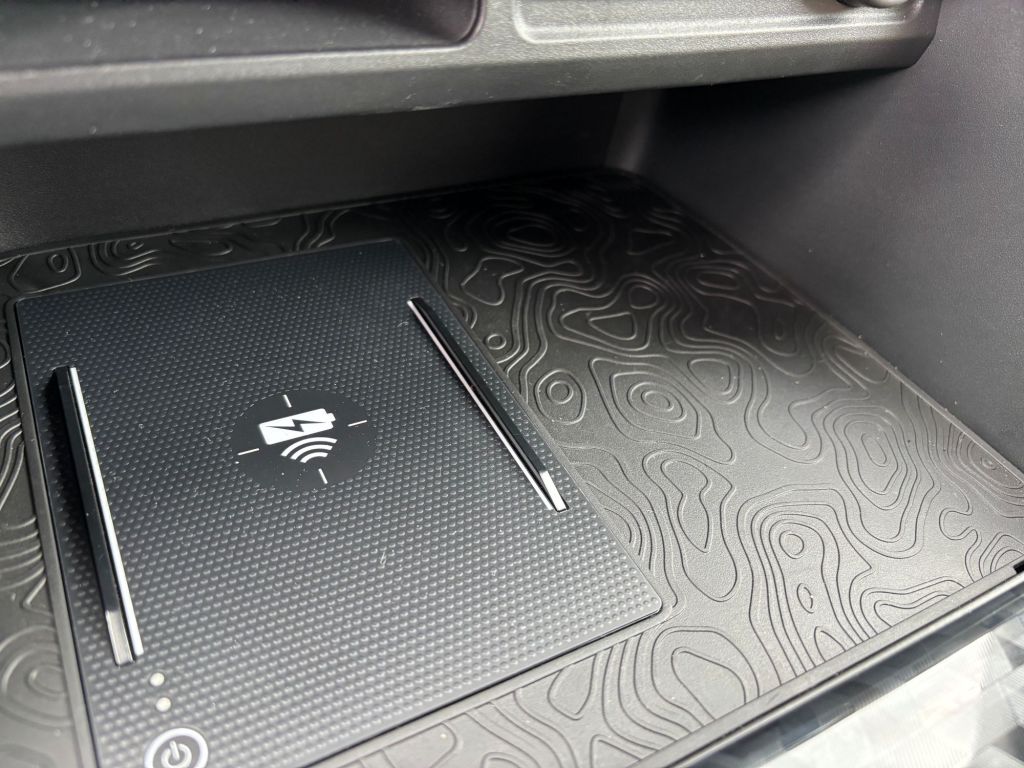
Note the attention to detail on this pad in the center console.
There is a new all-wheel drive system that includes a rear drive system that provides 40% more torque at launch. This is a torque-vectoring system that can provide up to 70% of the power to the rear and up to 100% left to right.
In addition to the Normal, Econ, Snow, and Sand drive modes that have been available, the 26 TrailSport adds Trail, Sport and Tow modes.
And while on the subject of towing it is worth noting that the vehicle comes with the first factory tow hitch on a Passport, and this is a substantial hitch: it is made with 12.7-mm thick high-strength steel. The hitch is designed with rear recovery points. Front recovery points are integrated into the front skid plate, which is made of 4-mm thick high strength steel, and which protects the engine and 10-speed transmission. There is also a fuel tank skid plate, which is made of 2.8-mm thick high strength steel.
(Geek observation: You might be thinking, “Hmm. . .that hitch is made of 12.7-mm thick high-strength steel and the front skid plate is 4-mm thick and the fuel tank plate 2.8 mm. What gives?” Well, for one thing, the hitch has to take a lot if there’s a trailer on the back. But for the other thing, the high-strength steel for the hitch is measured at 345 MPa and the two skid plates with 590 MPa material—and higher is stronger. This is an example of how Honda engineers put the right material with the right strength in the right places, something that is engineered throughout the vehicle.)
The new Passport is bigger than the pervious model:
Wheelbase: 113.6 in. (+2.7 in.)
Length: 191.5 in. (+2.4 in.)
Width: 79.4 in. (+0.8 in.)
Height: 73.1 in. (+0.9 in.)
To accommodate the trails the front overhang is 3.1 inches shorter, and the approach angle is increased, now at 23 degrees. The departure angle is 27.1 degrees.
One of the places the additional length provides a nice benefit is for the second row passengers: the rear seat leg room is 40.9 inches, a 1.3-inch increase.
And speaking of space, doing things in the outdoors requires plenty of equipment. The Passport provides 44 cubic-feet of cargo capacity with the second row up; 83.8 cubic feet if folded down.
While this is a feature that is undoubtedly good for everyone who is going off-road, it is particularly good for those who only occasionally go off road: the TrailWatch system. Put the vehicle in Trail mode, and when under 15 mph there is a forward-view camera that shows what is ahead and is angled such that it shows a section of space the driver otherwise can’t see. (If you’ve ever crested a hill and not known what’s on the other side you know that there is a certain associated anxiety.) There are also TrailWatch top and side views.
But let’s face it: Most Passport TrailSport drivers are going to spend most of their time driving on paved surfaces, in parking lots and through neighborhoods, on surface streets and freeways.
And this brings me back to the Accord and Civic, two vehicles that are absolutely engineered for those environments.
And the TrailSport feels like one of those vehicles when simply going about your daily drives. The Elite trim, with leather all around and a 12-speaker Bose system, and a 12.3-inch center touch screen, and an array of other amenities is something that makes that daily drive as pleasant as all of that aforementioned engineering makes the off-road driving thoroughly manageable.
Maybe a few years from now I will watch a TV show set in New Zealand and the detective will be behind the wheel of a Passport TrailSport.
Here is a Google Map, which, as you can see, is rather busy. (This is not just an issue in Hondas using Google Maps.) The good news is, as you’ll notice, there is Apple CarPlay availability.
Acura, the premium division of Honda, had its start in 1986 in the U.S.
That was before Toyota launched Lexus and Nissan Infiniti.
Both of those arrived in 1989.
When Acura started, there were two vehicles on the showroom floor:
The Legend. This sedan, with a rather ostentatious name (c’mon: somebodies else decide whether something is a legend or not), was actually developed by Honda and the now-non-existent Austin Rover Group.
The Integra. This was something of a polar opposite of the Legend. It was a sporty three- or five-door. A more affordable vehicle.
The Legend went into the history books after the 1995 model year. In 2001 the Integra was replaced by the RSX. The RSX had a short run: until model year 2006. There was a bit of a hiatus in this car space: the ILX replaced the RSX in 2012. It had a run until model year 2022, when it was replaced by the current-generation Integra.
The point of this is that Acura has consistently maintained what can be considered an affordable, entry-way vehicle in its lineup. Of late it has been the Integra. That car has a starting price of $33,000.
And Now This
But the interest in cars has cooled*, and Acura has stocked the showroom floor with an array of SUVs. Until lately, the least-expensive Acura SUV was the RDX, with a starting price of $44,700. (In case you’re wondering; the starting price of the most-expensive is the ZDX, an electric vehicle, that begins at $64,500.)
So in order to, in part, get people into an affordable SUV Acura, the company has launched the ADX.
Acura’s new entry: the ADX. (Image: Acura)
It has an entry price of $35,000.
The top-of-the-line ADX A-Spec Advance AWD takes the MSRP to $44,000.
But the ADX has a bit of a problem. The problem is a good one for American Honda (the overall company). But not a good one if your job is moving Acuras.
Too Good for Its Own Good
The problem is the Honda CR-V.
The 2026 CR-V LX FWD starts at $30,920. The top-of-the-line CR-V AWD Sport Touring Hybrid starts at $42,250.
Yes, there is a difference between a “Honda” and an “Acura” badge.
But there are some similarities between the two models.
Like in the ADX there is a 1.5-liter, turbocharged four that produces 190 hp. In that CR-V LX there is a 1.5-liter, turbocharged four that produces 190 hp.
Whether it is the entry ADX or the top model, there’s the same engine.
In the top-of-the-line CR-V AWD Sport Touring the powertrain produces 204 hp. And not only is it more powerful than the ADX powertrain, it gets better fuel efficiency (40 mpg city/34 mpg highway/37 mpg combined vs. 25 mpg city/30 mpg highway/27 mpg combined).
But one might point out that when it comes to that powertrain, there’s less mass to move: the AWD ADX has a mass of 3,611 pounds and the AWD hybrid CR-V is at 3,926 pounds. But there is that additional horsepower in the CR-V, so at the very least it is a wash.
Sized Right
It should also be pointed out that dimensionally the two vehicles are fairly similar, with the ADX being 185.8 inches long and the CR-V at 184.8 inches; the ADX 72.5 inches wide and the CR-V at 73.5 inches wide. The big difference is in the height, with the ADX at 63.8 inches and the CR-V at 66.5 inches, which I suppose goes to the point of the ADX being a sport utility vehicle and the CR-V a sport utility vehicle. (And on the subject of utility, the ADX A-Spec Advance offers 23.2 cubic feet behind the second row and 53.9 cubic feet with the second row folded; the CR-V Sport Touring has 34.7 cubic feet behind the second row and 76.5 cubic feet with it folded.)
Of course, comparisons are not typically made of vehicles from the same company so perhaps the above is inappropriate (though not if you’re in the market for a new vehicle).
So just to look at the ADX A-Spec Advance driven here, it provides:
A 10.2-inch digital gauge cluster
9-inch touchscreen
A 15-W wireless charger
15-speaker Bang & Olufsen audio system
Built-in Google and Alexa
Adaptive cruise control
Ventilated front seats (i.e., cooled as well as heated)
Leather for seating surfaces and wrapping the steering wheel
Sport pedals (i.e., metal)
Powered liftgate
19-inch alloy wheels
Panoramic moonroof
And more
And it has that stylized “A” on the Diamond Pentagon grille.
But still, even if there wasn’t economic uncertainty in the world at large at the moment due to everything from tariffs to roiling in the Middle East, anyone who is looking to get the most for their money would be hard pressed not to consider the Honda rather than the Acura.
The company that encompasses Acura and Honda simply makes great products.
==
*In addition to the Integra, Acura still offers the TLX. It seems as though that model may not be long for this world.
Honda knows more than a little something about internal combustion engines that are smooth, quiet and low-emissions. These are used for new generators.
By Gary S. Vasilash
When power goes out—or you need power in places where a plug isn’t readily available—some companies are suggesting that the solution is using one’s vehicle to power whatever.
This, of course, is an electric or a hybrid vehicle.
Which is a reasonable idea. Except in cases where someone might actually need to go somewhere in that vehicle. That would result in no power.
So an alternative is a gas generator.
However, there are a couple of issues related to these.
One is that they can be rather noisy.
Another, for those living in California, is that emissions regulations can make gas generators unobtainable.
You could buy an electric pickup truck and use it when your power goes out, or you could simply buy one of these and get whatever vehicle you want–and can afford. (Image: Honda)
Honda Power Sports & Products has cleverly engineered two generators that meet both U.S. EPA Phase 3 emissions standards and California Air Resources Board (CARB) Tier 4 compliance requirements.
Consequently, those in California can go to a local retailer and pickup the Honda EU33200i Super Quiet Series and/or the EU7000is Super Quiet Series.
The names indicate the noise attenuation.
The first-named produces 3,200 watts of power and the latter 7,000 watts.
Although it is Fall in the Northern Hemisphere, now’s the time when new lawn and garden equipment debuts for the following Spring. . .
By Gary S. Vasilash
A few years ago I had a Honda push mower in my garage collecting cobwebs. Circumstantial changes had caused me to engage a service to get the lawn clipped.
After many years that included many mowers, from Snapper to John Deere, the Honda was both my ultimate and final mower. (Let’s face it: they weren’t inexpensive—when you could go to the local hardware store and get one from about two hundred bucks and there was quite a comparative premium for the Honda, that was a tough choice. And I’d opted for a non-self-propelled model to keep the cost down.)
But in the garage it sat. Neglected.
A nephew bought a house in the spring. It was on a somewhat large lot.
As I knew that his finances were stretched, I offered him the Honda, pointing out that I hadn’t done the recommended procedures for maintain a mower in storage (i.e., one day, after a cut, I put it in the garage, and that was that). I didn’t know if it would even turn over.
I cleaned it off with a rag and he picked it up.
Later that day he texted me a video showing him mowing.
Money well spent.
Honda started producing gas-powered lawn mowers in 1978. It stopped in producing its “award-winning HRX, HRN and HRC gas-powered lawn mowers due to multiple factors, including stricter environmental regulations, shifting customer preferences and the need to align local manufacturing resources around other products in high demand.”
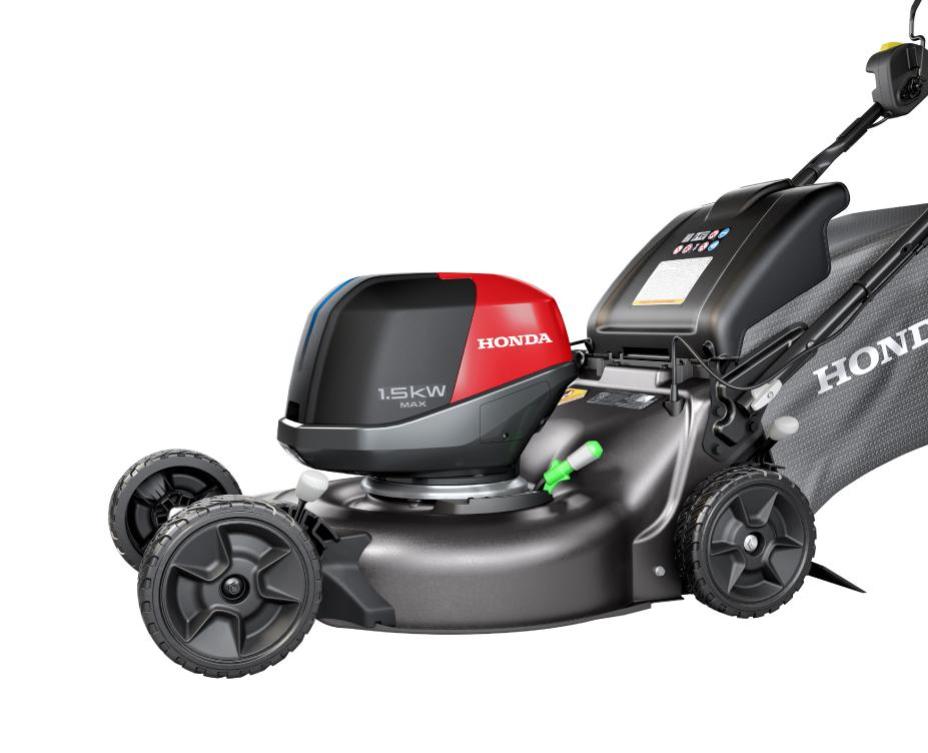
Honda goes electric for the lawan. (Image: Honda)
Given what’s going on in the weather, odds are the “other products in high demand” in the Honda Power Sports & Products portfolio are its generators.
And it is worth noting that Honda is working toward having 100% of its auto sales in the U.S. be battery- or fuel cell-electric vehicles by 2040. While Honda mower engines do go beyond CARB/EPA emissions standards, somehow a loud power mower cutting the lawn next to a Prologue or ZDX in the driveway would seem off-brand for that goal.
This week Honda introduced the HRX-BV, HRX-BE, and HRN-BV electric mowers for residential use.
Said Mark Kohls, vice president of Honda Power Sports & Products, American Honda Motor Co., Inc., about the development of the new mowers (and there is a commercial model, too) “Reducing greenhouse gas emissions is only part of the challenge, as battery-powered power products must meet Honda standards for rugged performance, ease of use and comfortable operation to meet the high expectations of our residential and commercial customers.”
I wonder: Years from now my nephew will undoubtedly move to an electric mower.
And if he does, and the mower goes into his garage for a few years unused, will he be able to gift it to his nephew who will get the same results that were achieved with the mower that had been mine?
Honda and Acura Go Electric with Ultium and Then Some. . .
By Gary S. Vasilash
As is widely known, when it comes to the contemporary electric vehicle, Honda was a bit late to the party. Given that the company has extensive experience in electrified vehicles. It is often forgotten (or unknown), for example, that the first hybrid on the U.S. market wasn’t the Toyota Prius, but the Honda Insight, which was launched in December 1999, edging out the Prius by a few months.
(This gives rise to another consideration. Toyota has also been criticized for its approach to the EV market, being tagged as a laggard. One could argue that this isn’t a mistake, given the still rather small number of EVs being sold in the U.S. market. According to Kelley Blue Book, for Q3 2024 there were 346,309 EVs sold, a number that will undoubtedly help the number of EVs sold in the U.S. to exceed the 1.2-million sold in 2023. But here’s something to think about: if you take away the Tesla sales from the Q3 numbers this means that 27 brands cumulatively sold 179,386 vehicles. That would be 6,644 if the number was evenly distributed. But no matter how you look at it, there is a long way to go in order to achieve the necessary scale to have a profitable production operation.)
Anyway, I’ve just been driving the Honda Prologue and the Acura ZDX, the two contemporary EVs from the company.
A sign of the times is that in order to get these vehicles on the market, Honda worked with a company that it has been collaborating on for some time (on things ranging from the engine for the Saturn Vue Red Line to hydrogen fuel cells).
The two vehicles are based on the GM Ultium platform (yes, even though GM is going to stop calling them “Ultium,” the platforms were Ultium when the Prologue and the ZDX were developed).
Just as the Saturn Vue Red Line was a Saturn through and through, not a Honda, the Prologue isn’t a Chevy Blazer EV, which it shares the platform with, just as the ZDX isn’t a Cadillac LYRIQ.
In the case of the Prologue—which is available with a single-motor (212 hp) front-drive setup that provides a range of up to 296 miles or as a dual motor (288 hp) with a 281-mile range (although there is the Elite trim package that goes 273 miles); all have an 85-kWh battery pack—the design inside and out are characteristic of the brand.
The design-speak for the exterior design—which was executed in L.A.—is “Neo Rugged.” It is, after all, an crossover. Arguably, it is a simple, straightforward design with a sufficient number of creases in the sheet metal to keep it from looking innocuous or as something that it isn’t (i.e., like something you’d take on the Rubicon).
Inside there is the clean, straight-forward Honda approach to ergonomic instrumentation. However, I have two quibbles with the interior design:
An excessive use of piano black plastic on the IP. Whereas the Civic Hybrid (a hatchback was recently released) has an interior that looks of the moment, the piano black in the Prologue is dated.
The distance from the top front edge of the instrument panel to the bottom of the windshield is a tremendous amount of real estate. Someone had better have a Swiffer on a long handle to be able to keep that surface clear because it is a reach.
But while on the inside it should be noted that there is as much as 57.7 cubic feet of cargo space, so it can handle a reasonable haul.
Of the two cars, the ZDX is the one that I find to be most impressive. (Of course, the starting MSRP for the Prologue is $47,400 and it is $64,500, so there has to be some bandwidth there.)
The ZDX comes as a rear-drive vehicle with 358 hp and a range of 313 miles from its 102-kWh battery. Or there is an all-wheel drive version (A-Spec) that provides 490 hp and 304 miles of range from the same battery pack. Or there is another AWD version (Type S) that generates 499 hp and will take you 278 miles with some alacrity.
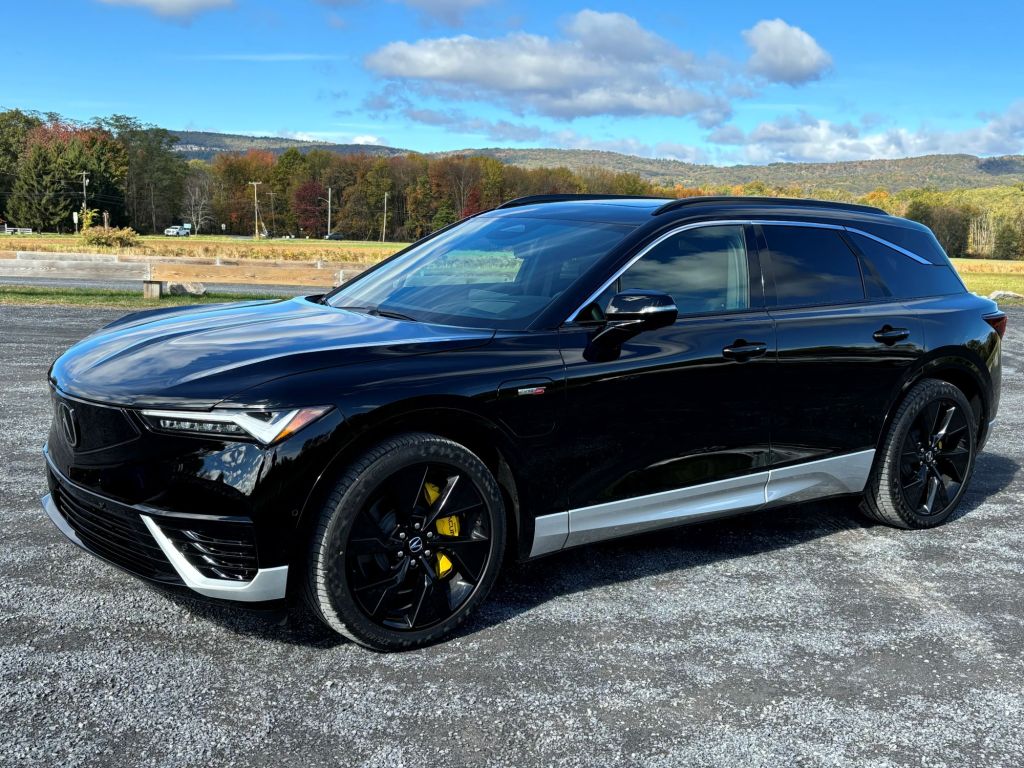
2024 Acura ZDX Type S. Wicked quick. And you can shop for groceries with it, too. (Image: gsv)
Although Acura does have two cars in its lineup—the TLX and Integra—its two crossovers—the MDX and RDX—are focal points. In terms of powertrain performance, the ZDX smokes the other crossovers (or maybe that should be it “ozones the other crossovers”).
It, too, was styled in LA. And although it is a crossover, its exterior body style resembles for me more of a contemporary station wagon, with a lower, longer, more angular sideview than many other crossovers.
While it seems as though all vehicles today have some sort of light signature up front, credit should be given to the Acura designers for the sharp styling they’ve brought to the lighting of this vehicle.
On the inside the seats in the front are bolstered in keeping with the type of vehicle it is, and the layout of the instruments and gauges are intuitive. A cowl over the gauge screen provides something of a cockpit feeling when sitting behind the wheel.
Both are solidly engineered vehicles that go well beyond the propulsion systems.
The Prologue seems like a Honda (presumably because it is) and the response from the market is good: According to numbers from KBB, through the third quarter there have been 12,644 Prologues sold—more than the 7,998 Blazer EVs sold, and closing in on the popular Mustang Mach-E, which had sales of 13,392.
The ZDX, which is essentially a new nameplate (yes, Acura built a ZDX until 2013, but its sales were so tiny that it isn’t likely remembered by many (outside those who smacked their heads getting into or out of the rear seat on the C-pillar)) has had sales through Q3 of 2,647—which is not far from the Lexus RZ’s 2,742, which has been available for longer.
In 2026 Honda will roll out its 0 Series, which it is developing sans GM.
But neither the Prologue nor ZDX are placeholders until then.
No, not for an Accord. It’s for the boating enthusiasts. . .
By Gary S. Vasilash
Back in the day when the Honda Accord was about the size of the current-generation Civic, Honda put a four-cylinder engine in the car, which did the job that needed to be done.
When a new Accord was launched, there was always praise among the motoring press that had a seemingly obligatory, “But only if it had a V8.”
After all, sedans were meant to have those things and it just seemed odd that Honda was more concerned with things like efficiency.
By 1995 the company gave in and put a V6 in the Accord.
But it never put in a V8.
Had it, it would probably been one heck of a V8 because Honda Marine has launched a new outboard motor, the BF350, which is a V8.
The award-winning Honda BF350—a V8 outboard. (Image: Honda Marine)
The new engine has garnered several awards already, including the National Marine Manufacturers Association and Boating Writers International 2024 Innovation Award and a Red Dot Award for Product Design (Red Dot awards, if you’re not familiar with them, are prestigious in the design community).
The Honda Marine description of the engine rings with familiarity for those who are more interested in powertrains for things with four wheels:
“a broader, flatter torque curve; smoother power delivery throughout the engine’s operating range. . .excellent fuel efficiency. . .superior reliability, ease-of-use, maintenance and ownership. A fully balanced, 60° offset precision crankshaft eliminates the need for a harmonic balancer—saving weight and seamlessly integrating with 60° engine design and nonlinear engine mount to provide exceptional operation with minimal vibration.”
And there’s this:
“VTEC (Variable Valve Timing & Lift Electronic Control), the BLAST (Boosted Low Speed Torque) System, Lean Burn Control, Programmed Fuel Injection (PGM-FI), a new Friction Reduction Technology, and Honda Intelligent Shift & Throttle (iST).”
Sounds like it has all of the characteristics that automotive V8 enthusiasts of yore were seeking from Honda.
How it is going to leverage manufacturing to advantage
By Gary S. Vasilash
Ostensibly the briefing was to see up-close-and-personal the Acura Performance EV Concept which had only otherwise been shown during Monterey Car Week.
Who doesn’t want to see what is likely to be very similar to the electric vehicle that is going to go into production in Ohio in late 2025?
Acura Performance EV Concept. (Image: gsv)
Two points about the concept:
It is a concept vehicle, something that is becoming less and less common in the industry today—because of the time, effort, energy, and investment made in these full-scale models. Sure, there could be the argument made that this can all be done digitally. But Honda and Acura have those digital tools, too, and there is something to be said for a physical model.
Dave Marek, who is executive advisor for Design for Honda R&D and Global Honda (which essentially means he’s the go-to guy for design considerations across the company), points out that Honda and Acura typically hew rather closely to their concepts when it comes to production vehicles, so the Acura Performance EV Concept, which he says features “hydrodynamic design” principles—think “superyacht”—may be something rolling off the line at what is being called the “Honda EV Hub.”
Which brings us to the second part of this, which is an explanation of the strategy and the tactics of the EV Hub by Mike Fischer, who is the lead on the project and an executive chief engineer to boot.
First of all, the “Hub” is not a singular place.
Rather, Honda is retooling the Marysville Auto Plant, the East Liberty Auto Plant, and the Anna Engine plant to have the capabilities to produce EVs in a highly efficient manner that produces high quality, consumer-valuable products, processes that are both human- and environmentally-friendly.
But here’s the thing, and not something that Fischer and his colleagues just came up with during the past few months when EV sales softened.
Fischer explains that this “reimagining of Honda manufacturing” is something that is predicated on flexibility.
So they are developing production capability that will allow them to build EVs, hybrids, and ICE-vehicles all on the same line.
(One way this will be accommodated is by having feeder lines that will do the subassemblies for the varying types of vehicles that then feed into the main line.)
Yes, they are developing a dedicated EV platform that will allow various models to be derived from it.
Yes, they are installing 6,000-ton high-pressure diecasting machines—there will be six of them—in the Anna plant to perform “megacasting” of the Intelligent Power Unit (IPU) case; the case houses the battery and associated electronics and functions as part of the vehicle platform.
But what’s notable is that in this undertaking, which the company is investing more than $5-billion and which will serve as a model for Honda facilities around the world, Honda is getting back to its manufacturing roots in essentially taking a clean-sheet approach to the way things are done.
While product certainly matters, the ability to produce those products so that they meet customer demands—cost, quality, availability—is something that Honda has shown itself to be superb at over the years, so while some argue that it is comparatively late to the game in terms of EVs, the flexible manufacturing capability Fischer and his team are developing will more than make up for any delay—and will provide Honda and Acura with the powertrain options that its customers are looking for.
That will put it not merely in the game, but quite possibly ahead of it.
The 2025 Grom is part of the miniMOTO model lineup that American Honda has on offer.
The “mini” is absolutely spot-on.
You’ll meet the nicest–and possibily thriftiest–people on a Grom. (Image: Amercan Honda)
The bike has a 47.2-inch wheelbase and a seat height of 30 inches. It weighs just 224 pounds.
The Grom has a 124-cc, single-cylinder, four-stroke engine. (It meets current EPA and even CARB standards.) It has a five-speed transmission. Hydraulic disc brakes.
There is a 1.6-gallon fuel tank.
If you go to Home Depot for a gas-powered push mower, odds are the engine is going to be bigger than the one on the Grom (though the fuel tank will be smaller).
But here’s something very cool about the Grom:
Its fuel economy is an estimated 166.5 miles per gallon.
Consider: If the average American’s commute is a total 40 miles, then the Grom, with a single tank of gas, would allow five days of commuting and still leave gas in the tank for weekend errands.
And when you go to the gas station to fill the Grom, the price will be so low you’ll have plenty of money left for snacks.
(And speaking of spending, the starting MSRP for the ’25 Grom is $3,599.)








 shinymetalboxes