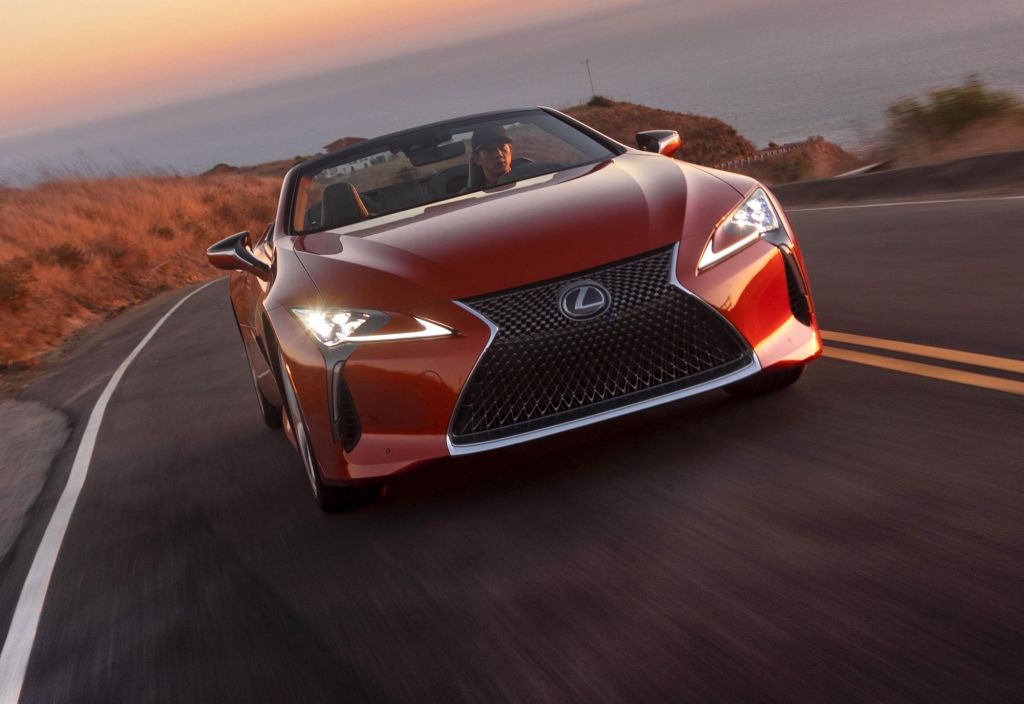
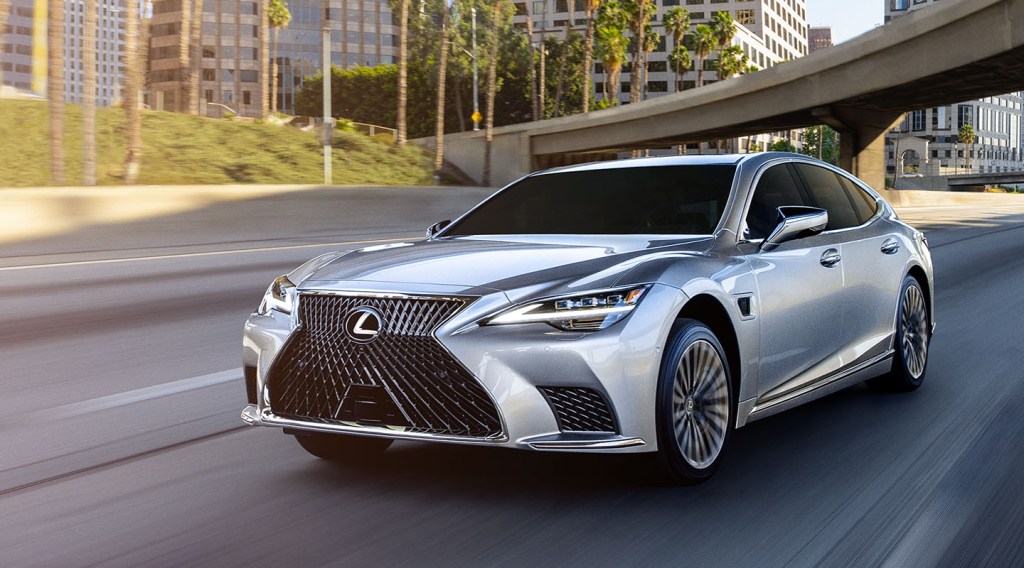
2025 Lexus LC 500 Convertible

Something special with impressive mechanisms but limited space. . .

By Gary S. Vasilash

There are some cars you get into. There are some cars you put on.

The Lexus LC 500 Convertible is one of the latter. You just don’t get into it, but you essentially wrap yourself in the driver’s seat—which, of course, is a sumptuous, buttery leather surface with heating and ventilation.

The vehicle is undoubtedly designed and engineered for those who like to take weekend road trips on roads that are not freeways but those with curves through forests or along beaches below.

After all, you want that top down so you can smell the pine or the sea breezes. Sitting in traffic going nowhere slowly is not what you want to be doing with the soft-top retracted.

Swish

One thing about the retraction that you might now intuitively know: Its movement is predicated on Japanese calligraphy with a brush: inked brush is applied to paper; the brush stroke is to the right; the ink brush stops. I am not making this up.

Something that is notable about that top, too, is that it can be opened in 15 seconds or closed in 16, and you can do that at speeds up to 31 mph. The quick closing is the more important of the two because who wants to be caught in a sudden cloudburst?

Materials Matter

Another thing notable about the top—something that could provide a bit of bragging rights of a somewhat technical—and therefore cool—nature is that components for it are made with magnesium and aluminum, not your run-of-the-mill ferrous materials. If that doesn’t impress whomever, perhaps the fact that the top consists of four layers—three fabric and one sound-insulating—may do the trick. And I won’t even get into the hydraulic actuation controlled by an electromagnetic valve. All of this is serious stuff.

Speaking of the top down and climatic conditions:  The HVAC system is engineered so that it keeps the cabin occupants comfortable. It has something called the “Lexus Climate Concierge with Upper Body Heating.” So the air conditioner, seat heaters, neck heaters (yes, neck), and steering wheel heater are activated as necessary.

Vroom

Of course, one of the real features that someone who is interested in a sport convertible is probably more interested in than a top-folding mechanism or a neck heater is what is under the hood.

And here the vehicle also has quite an impressive mechanism: an all-aluminum 471-hp V8 that’s mated to a 10-speed automatic. This 5.0-liter engine is naturally aspirated (i.e., no turbo).

According to Lexus, the car goes from 0 to 60 mph in 4.6 seconds and the top speed—on a track, because you don’t want to do this where you’d get a massive moving violation—is an electronically limited 168 mph.

Now some people might look at that 4.6 seconds and think that an electric car like a Hyundai Ioniq 5—and I’m not talking the “N” version, but a standard AWD—and beat it.

But what no electric car can do is provide the audible sound of a V8 engine, which is part of the experience of driving a vehicle like the LC 500. Recognizing that, the Lexus engineers plumbed a pipe that takes the engine intake sounds that have been fed into a diaphragm, then, though the pipe, into the cabin. This is not artificial noise but the real rumble. And because they evidently figured that’s not enough, they include a computer-controlled vale that adjusts exhaust back-pressure, exhaust tone and volume at higher engine speed to, in effect, turn the sound of the engine up to 11.

Tighten Up

According to Lexus, the LC 500 Convertible seats four. Which is something of an exaggeration by two. Sure, there is a rear seat and the front seats fold forward to allow access to the rear. But it is hard to imagine anyone being comfortable in the front seats while there is anyone—even small children—in the back. (The front legroom is 42.6 inches and the rear 28 inches.)

Then there is the aforementioned weekend road trip.

The cargo space is 3.4 cubic feet. You’d need to pack with care as that space can handle two small carry-ons—and you might opt for luggage that isn’t hard-sided to assure that it is going to fit.

Exclusivity

And there is another number that needs to be considered: $115,705. That’s the MSRP for the LC 500 Convertible with the optional Bespoke Build Package, which includes the option to select from nine exterior colors, four interior color schemes, three 21-inch forged wheel styles, and chrome or dark chrome interior accents. There is also badging on the center console that proves you’ve got it.

Add the red soft top, the 10-spoke alloys, Mark Levinson audio, .premium paint, carbon fiber door scuff plates, and a carpeted trunk mat.

Add the $1,350 for delivery, processing and handling, and you’ve reached $117,055.

But you’ve also got something special. Through the first half of 2025 there were 790 LCs sold in the U.S.

You will not see these vehicles—especially the Convertible—going and coming.

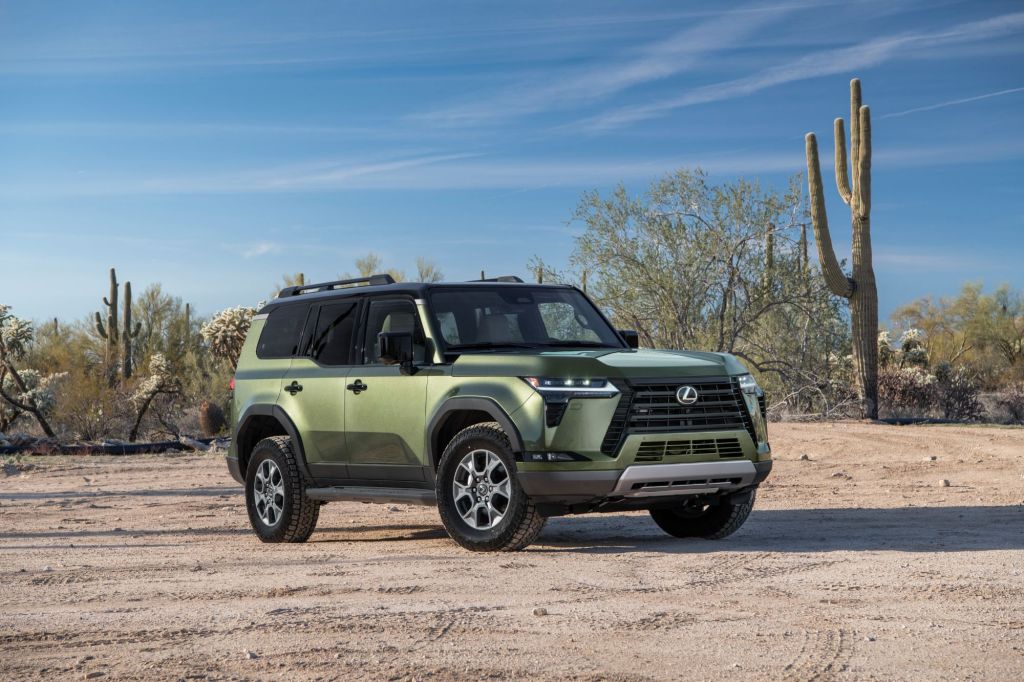
2025 Lexus LX 700h Overtrail

Yes, it is built to take it. But how many are going to take it to places where that matters?

By Gary S. Vasilash

One of the consequences of the COVID pandemic, when people didn’t get on airplanes and go places and pretty much avoided people to the extent the could, was the “overlanding” phenomenon. The point of this was to climb into one’s vehicle and drive someplace where the odds of encountering other people up close was minimal at most. And if you did encounter them, you were outside, which meant wind was your friend, blowing the stuff away.

This gave the rise to more people buying vehicles that could take them places where their conventional SUVs wouldn’t take them because their SUVs were based on platforms that also underpinned cars, so they were insufficiently robust.

Solid Base

The Lexus LX 700h (as well as the other LX variants in the lineup) is based on the global Toyota GA-F platform. It has frame. It isn’t a unibody like those aforementioned SUVs.

The GA-F platform is also used for the Toyota Land Cruiser 300, Tundra, Sequoia, Tacoma, and 4Runner.

Those vehicles—especially the Tacoma and 4Runner—are often used in driving situations where even trails are left behind. And they take it.

Off-Road Enablers

So the LX has some fundamental bona fides when it comes to the ability to drive on surfaces that aren’t leading to the valet stand at the country club.

It has some 8.07 inches of ground clearance, an approach angle of 23 degrees and a departure angle of 21 degrees.

There are front and rear locking differentials.

There are Active Height Control and Adaptive Variable Suspension. Multi-Terrain Select (four modes when driving in four low (Auto, Sand, Mud, Rock) and five modes in four high (Deep Snow in addition to the others). There are Crawl Control—which is essentially like Cruise Control but when in four low—and Turn Assist, which facilitates a reduction in the turning circle of the vehicle when Crawl Control is on (though the driver does the turning).

There is a clever Multi-Terrain Monitor, that uses four cameras, the images from which are stitched together so that there is an image on the 12.3-inch display in the center console that allows the driver to “see” beneath the front of the vehicle, which is very handy when traversing terrain that is tough.

The vehicle rides on 33-inch tires and 18-inch wheels.

Hybrid Setup

The “h” in the nomenclature of the vehicle signifies that it is a hybrid.

There the powertrain uses a twin-turbocharged 3.4-liter V6 supplemented by motors so the system output is a stalwart 459 hp and 583 lb-ft of torque.

One of the benefits of the hybrid system for those doing overlanding (in addition to the stickered 19 mpg city/22 mpg highway/20 mpg combined) is that when Multi-Terrain Select is engaged the vehicle can be powered by the electric motors alone, sans engine, for more precise control of speed.

The nickel-metal hydride battery is packaged in a waterproof container that allows water fording of up to 27.5 inches.

What’s more, in the event that there is something awry with the hybrid system, the LX, unlike other Lexus hybrids, features an alternator and starter so the V6 can be operated on its own.

And they even addressed the Shore hardness of the foam used for the seats for the Overtrail, making it easier on the occupants when traversing trying terrain.

All of which is to say it is engineered to be considerably capable.

Design Cues

Arguably the exterior design of the vehicle was executed during the pandemic, taking into account the seeking of vehicles that have a stout appearance.

A special color, Earth, was developed for the Overtrail.

On the interior there are either Black or Stone Brown leather trim and Black open-pore wood accents.

All of that said. . .in this execution, the LX 700h Overtrail doesn’t seem like a Lexus.

There is something about the brand, with its vehicles generally combining luxury, technology and style. In this case it seems to be more about the mechanical from a technical point of view. The luxury is overwhelmed (sure the materials are first-rate on the inside) by what I found to be oppressive darkness.

The style of the exterior seems too much like a truck and the style of the interior seems somewhat pedestrian.

On the one hand, this is probably a means by which Lexus can garner a few more global customers for something with off-road credentials.

But on the other, Toyota has things like the Land Cruiser which is meant for those circumstances.

Sometimes extensions aren’t a good idea, but as they have the makings on hand, it probably won’t matter much, either way.

Lexus LX 700h Overtrail: You can play in the dirt with it. But would you? (Image: Lexus)

2025 Lexus ES 350 F Sport Handling

Looks quick and has a really, really comfortable driver’s seat. . .

By Gary S. Vasilash

“(My woody’s outside) covered with snow

(Nowhere to go now) New York’s a lonely town

When you’re the only surfer boy around”—The Trade Winds (1967)

That lyric comes from a song about a guy whose parents moved from California to New York.

Evidently, the surfer recognizes that the Hudson isn’t exactly a place to catch waves. But he still has his woody; he hasn’t traded it in for something that might have been more locale-and-time appropriate, like a beater VW Beetle.

Last year Lexus became the “Official Automotive Partner of the World Surf League.”

Earlier this week it expanded its partnership and will be the title sponsor of the 2025 WSL Awards, Pipe Pro, Trestle Pro, US Open of Surfing, and WSL Finals.

“Let’s go surfin’ now. . . .” (Images: Lexus)

In addition to which, at the Lexus Pipe Pro on Oahu the company revealed a concept car*, the Lexus Surf LX, a tricked-out SUV with surfers in mind, such as even having a board waxing table in the storage area.

While I must confess that my knowledge of surfing is limited to watching Bruce Brown’s The Endless Summer and its sequel, somehow a Lexus isn’t what I associate with surfers.

After all, a standard Lexus LX starts at $105,500. (But then I learn from a piece in Surfer Magazine that there are 10 surfers in the world (circa 2023) who are making a million-plus, so perhaps there is more association than I thought.)

Which brings me to the Lexus ES 350 F Sport Handling.

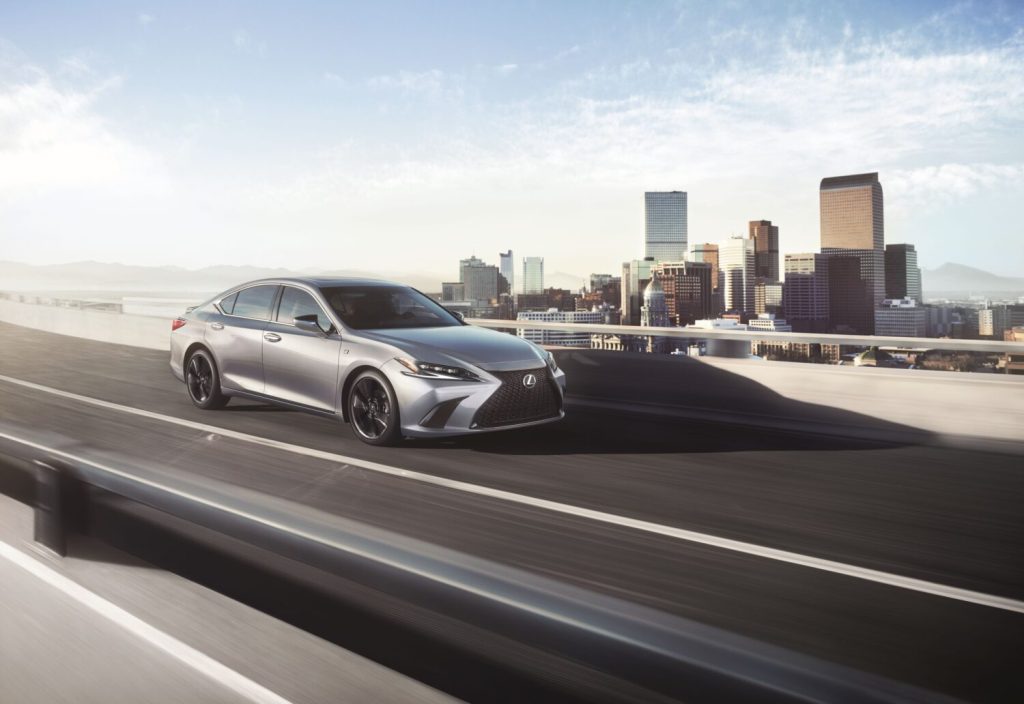
The ES 350 is a four-door sedan. It is powered by a 302-hp six-cylinder engine. It has an eight-speed automatic with sport shifting capability. It is a front-wheel drive vehicle.

ES 350. Comfort and quick(sih).

According to Lexus it goes from 0 to 60 in 6.6 seconds and has a top speed of 131 mph.

Lexus has another sedan in its lineup. The IS. The IS 350 features a V6, but one that produces 311 hp. It has a 0 to 60 time of 5.6 seconds and a top speed of 143 mph.

Seems that that’s the quick one.

The F Sport trim for the ES is the “go-fast” trim. The F Sport Handling adds an extra bit of capability.

So there are gloss-black 19-inch wheels, special grille inserts and a specific front bumper. There is a spoiler on the decklid.

On the inside there are sport seats not found in the non-F Sport models. These seats have enhanced bolsters and are among the most comfortable seats I’ve ever experienced in any car. (Sometimes when you are in a German car with “enhanced bolsters” you think that they didn’t realize that foam exists.)

The model driven here included the Black Line Special Edition package ($1,500) that makes more of the trim bits black—which really looks great with the car painted Matador Red Mica. There is also an F Sport puddle lamp, which seems more amusing than anything else: Validation that you got the cool trim?

Now the F Sport Handling isn’t entirely about cosmetic modifications. There is the Lexus Adaptive Variable Suspension system that really kicks in should you throw the car into a turn. That’s not likely to happen, but if you do. . . .

At the end of the day the ES 350 F Sport is a Lexus with all of the comfort and quality associated with the brand.

But to curl back to the Surf LX: how many surfers would actually buy one were it available, versus, say, a Lexus GX that they could mod the hell out of? And how many people who really want to go fast would opt for the F Sport Handling versus, say, an IS F Sport AWD that they could really throw around with some abandon?

==

*This brings to mind the issue of auto shows, where concepts used to be revealed. Given the choice between a beach on Oahu and some carpeted convention center floor in a city center for an intro, there is really no competition.

2024 Lexus GX 550 Luxury+

Capable and comfortable. And you’ll probably recognize the latter more than the former

By Gary S. Vasilash

One of the most-memorable new vehicle drive programs I ever participated in was for the Lexus GX. It was held in Park City, Utah. Yes, an appropriately swanky venue for what was, in 2002, the third SUV entry in the Lexus lineup, with the LX and the RX preceding it (although some may say that because the RX is a unibody and the LX and GX are body-on-frame, the RX is a crossover not a bona-fide SUV, but whatever it is, the RX has, year after year, dominated its category, so the people at Lexus probably don’t mind whatever it is categorized as).

Now, near Park City is the Wasatch range, part of the Rocky Mountains.

That was deliberate, too.

Because the chief engineer of the original GX wanted to show that the vehicle is as capable off road as it is comfortable on road.

So we drove the GX on terrain that then, as now, seemed an absurd place to find a brand-new Lexus.

I mean, there was a brand-new vehicle with nary a door ding on the paint being driven over rocks and through flora, and it was a Lexus. Admittedly, I’d driven brand-new Jeep models in similar (and more demanding) situations which had always made me wonder why someone would buy a brand-new vehicle and put it through paces that would end up making it look less-than brand-new. I guess it has something to do with a variation on George Mallory’s quote about Everest: “Because you can.”

Underpinnings: Solid

Yes, the GX, has a ladder frame (the GA-F platform, which is also used for the LX), which is engineered to handle the twists, turns and torques that are encountered while driving in places where people ordinarily don’t.

But because no one (slight exaggeration) buys a Lexus because they want to go banging over fallen trees and through washes (there are things like the Toyota 4Runner for that) but because they spend time cruising on the road, there is a double-wishbone front suspension and a multi-link rear that provides a Lexus-like ride for that daily drive.

Lexus GX 550 Luxury+: Looks good. And you could readily drive off that tarmac onto the unpaved terrain. (Image: Lexus)

Capable: Well, You Could. . .

But for those who are interested in that off-road ability, know there are such things as a Torsen limited-slip locking center differential and full-time 4WD.

(In effect, the GX capabilities are like those of the Omega Speedmaster wrist watch, which is associated with U.S. astronauts: the watch is made with the ability to deal with far more than a typical terrestrial wearer will ever realize or recognize, but were you suddenly required to leave Earth. . . . Because you can.)

Power: Oomph!

The GX is powered by a 349-hp twin-turbocharged 3.4-liter V6 that produces 479 lb-ft of torque, which is handy to have in a variety of situations, including when starting from a stop and towing something—yes, there is up to 7,800 pound of towing capacity for the Luxury+ trim; other variants can bring that to 9,063 pounds. The GX has a 10-speed automatic.

Inside: Styled

Considering both types of driving (on and off), it should be noted that in the interior there is a combination of technology with functionality, something that is too often ignored in high-end vehicles as OEMs work to be perceived as tech companies, failing, it seems, to take into account that the interfaces that the driver is dealing with tend to be engaged while the driver is piloting a vehicle that weighs over 2.5 tons.

There are knobs and buttons. There is, of course, a 14-inch touchscreen.

The arrangement of things on the instrument panel combines a sense of style and purposefulness. Which is the point of a luxury SUV.

Outside: Sharp

In terms of its exterior styling, the GX now has more of a sharp-edged, truck-oriented geometry to it, especially evident on its faceted face. The long controversial spindle grille becomes a supportive element in the overall look; one might argue that this is the best implementation of the grille.

The GX as driven is fitted with 22-inch alloy wheels; while some vehicles with 22s look as though they are on stilts, on the GX they contribute to its presence.

Assessment: Elevated

As OEMs across the board have upped their games when it comes to vehicles it almost seemed as though Lexus didn’t lose its luster but that others began to shine brighter than they had.

But for those who are either unfamiliar with what a “Lexus” is or have become somewhat indifferent to what it has on offer because of what the others are bringing, the GX is something that needs to be experienced.

It is a Lexus.

2024 Lexus RX 450h+

A plug-in hybrid version of the CUV that just keeps getting better

By Gary S. Vasilash

Lexus has been putting the RX on the road since 1998. Arguably, this was the first-available luxury crossover. Inarguably it has been a stalwart in the Lexus lineup.

Through the third quarter of 2024 the RX has been sold 83,341 times in the U.S. And to put that number in context, know that during the same period Lincoln—which now is an all-crossover brand (though the Navigator has a body-on-frame architecture, so it is a bona-fide SUV)—had sales of 74,530.

One model outsold four.

The RX is now in its fifth generation.

I am more than passingly familiar with all of them.

And I make that observation for one reason:

It could be thought at Lexus HQ “We’ve been building the RX for more than 25 years, the consumers keep buying them, so let’s not spend too much time worrying about it because it is in a solid place that it is not likely to lose.”

Consequently, while the RX would be good, it would be good with an accompanying shrug.

Lexus RX 450h+ plug-in hybrid. (Image Lexus)

Yet this RX simply exceeds expectations in its attention to detail and execution.

While this might seem to be a trivial example (trivial unless you drive one of these vehicles regularly, at which point the trivial can make a major difference), note how the bottom of the doors are curved and robustly sealed over the rockers. This not only helps provide a stout structure but it attenuates noise intrusion, especially road noise (as that is the closest thing down there).

It helps provide vault-like silence. Which is what one wants in a luxury vehicle, right?

The interior—from semi-aniline leather and materials including open-pore wood, to the audiophile Mark Levinson system—combines function with comfort with useability (e.g., if you want to adjust the temperature there is a knob at hand and if you want to activate the heated and cooled front seats, then buttons are available).

The powertrain consists of a 2.5-liter inline four-cylinder engine that is supplemented by permanent magnet motors front and rear (which provides the vehicle with all-wheel drive capability). The total system horsepower is 304, which does the job for a vehicle that has a curb weight of 4,810 pounds and measures 192.52 inches long, 75.59 inches wide, 67.32 inches high, and has a wheelbase of 112.2 inches.

Of course, the reason one buys a plug-in hybrid (there are RX versions that are straight ICE as well as two non-plug-in hybrid variants) is for the fuel efficiency that is provided.

In the case of the RX 450h+ there is the ability to drive up to 35 miles on electric power only. (The vehicle can be charged on a typical 120-V outlet in about 11.5 hours or, when a 240-V system is used with the standard 6.6 kW onboard charger it is done in about 2.5 hours.)

Then when operating as a hybrid alone, it has an estimated combined miles per gallon rating of 35 mpg, so with its 14.53-gallon fuel tank it provides a range of over 500 miles.

(Note: the vehicle has an 83 MPGe rating. I will not try to explain it and I think it is something that the EPA needs to do away with on the sticker because it simply doesn’t make a whole lot of difference to the consumer who isn’t an electrical engineer.)

Here’s something interesting about Lexus: in the J.D. Power 2025 U.S. ALG Residual Value Awards—which determine the value that a vehicle holds following a three-year period of ownership—Lexus took the top spot in the premium brand segment for the fourth year in a row.

And among the vehicles on the most-recent list: the RX.

Enjoy it today. Appreciate it tomorrow.

The So-So Sales Experience

You may be surprised at brands that aren’t making new-vehicle buyers all that chuffed. . . .

By Gary S. Vasilash

Maybe it has something to do with comparatively low numbers.

The J.D. Power 2024 U.S. Sales Satisfaction Index (SSI) Study ranks Porsche, for the second year in a row, as having the most satisfying sales experience. It has a score of 851 out of 1,000.

Industry average is 818.

In the first nine months of 2024 Porsche delivered 61,471 vehicles in North America (so this is the U.S. and Canada and Mexico).

The brand that arguably built itself on customer satisfaction, Lexus, is below average in SSI, at 812 (putting it in a tie with Mercedes, and putting those two above only Alfa Romeo at 810 and Genesis at 781).

In the first nine months of 2024 Lexus delivered 248,200 vehicles in the U.S. (just U.S.)

(And Mercedes sold 264,600 in North America.)

There are 202 Porsche dealers in the U.S.

There are 244 Lexus dealers in the U.S.

So, assuming (unrealistically, of course) that each dealership sold the same number of vehicles during the first nine months:

• Porsche dealer: 304 vehicles
• Lexus dealer: 1,017 vehicles

Needless to say, the people working at the Lexus dealership is a whole lot busier.

According to J.D. Power: “Buyer satisfaction is based on six factors (in order of importance): delivery process; dealer personnel; working out the deal; paperwork completion; dealership facility; and dealership website.”

You know: the regular routine of going in to buy a car, which is often not unlike going to an endodontist for some serious work.

Now certainly there probably isn’t a tremendous amount of cross-shopping between a Lexus store and a Porsche facility: the least expensive Lexus is a UX, which starts at $37,515 and the least expensive Porsche is a Macan, starting at $62,900.

But the SSI puts Lexus behind (in order): Infiniti, Jaguar, Acura, Land Rover, Lincoln, Volvo, Cadillac, BMW, and Audi, which are cross-shoppable.

What is also surprising is that Toyota brand, which competes in the “Mass Market” SSI category, is also third from the bottom, above only Mitsubishi and Chrysler—and with 777 points, it is well below the segment average of 798 and remarkably below the leading marque, MINI at 829.

Of course, MINI had sales of just 17,552 in the first nine months of 2024, which is a fraction of Toyota’s 1,481,319. Still, that puts Toyota well behind other mass market brands like Ford (805 points), which sold 1,473,642 vehicles through Q3.

Product, which Lexus and Toyota certainly have, is one thing.

Getting people to buy those products while feeling good about the experience is another thing entirely.

Seems like the folks in the sales department of Toyota Motor North America have some work on their hands.

2025 Lexus UX300h F Sport Handling

Lexus brings a small hybrid. But the styling could use some help. . .?

By Gary S. Vasilash

The good news about the Lexus UX300h F Sport is that it is a hybrid. And not just any hybrid system but the fifth-generation Lexus Hybrid System. Which doesn’t necessarily mean all that much at first. I mean, does anyone remember the second- or third-generation Lexus Hybrid System?

I didn’t think so.

But what this does mean is that the UX300h has a system that has been refined multiple times, more times than probably any competitive hybrid vehicle out there.

As for what that system consists of: it is a 2.0-liter four-cylinder engine that is supplemented by two motor generators via a planetary-type continuously variable transmission. There are front and rear motors and a 60-cell lithium-ion battery.

All of which means that there is a total horsepower of 196.

And a combined fuel economy of 43 mpg.

Which is a nice thing to have.

The thing to know about the hybrid system in this vehicle is probably this: you can simply ignore it. It just works. There is nothing that makes you think, “Hmm. . .I wonder what’s going on in there?”

In a word: seamless.

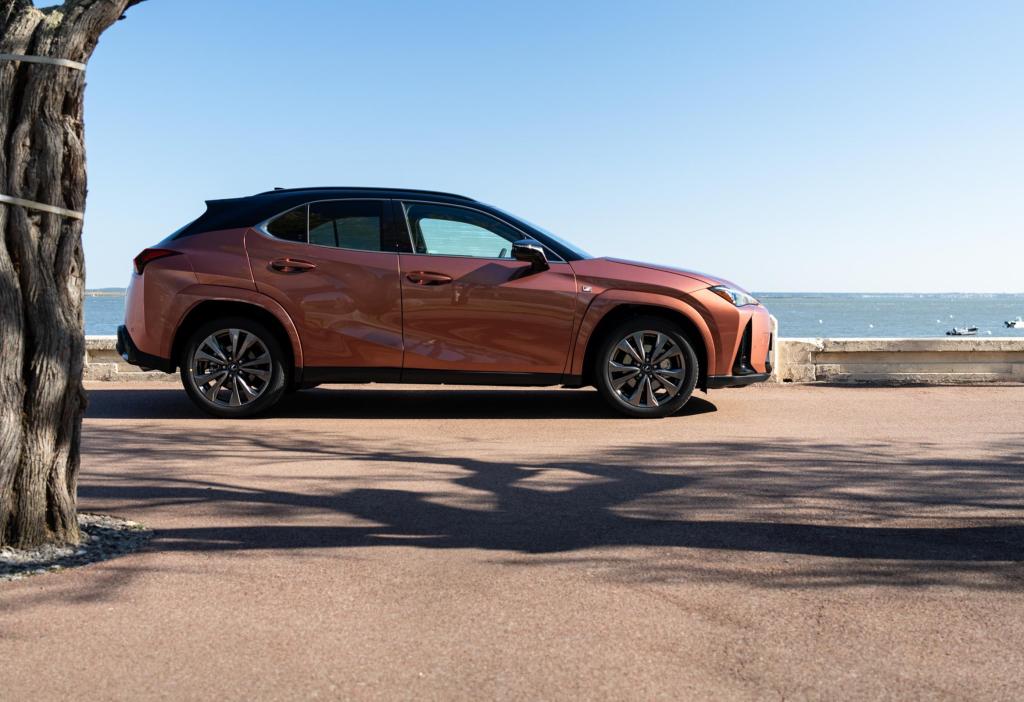
Lexus UX300h. The plus is that it is a hybrid. The minus is in that styling. (Image: Lexus)

The model driven here features the F Sport Handling package. Which means there is active variable suspension from a mechanical standpoint and an aluminum pedals and sport seats (among other things) from an aesthetic and functional perspective.

Regardless of the active variable suspension—as well as active cornering assist—the UX300h is not exactly the sort of thing you’re going to take to the local gymkhana and crush it.

Lexus says there is “the higher seating position and versatility experienced in a crossover.”

I suppose there is a higher seating position compared with, say, a Lexus RC, but while this is supposed to be a “crossover,” it is a diminutive one (176.97 inches long, 72.49 inches wide, 60.63 inches high, and a 103.94-inch wheelbase) and with a 6.3-inch ground clearance, this isn’t exactly something you’ll wonder about a running board for ingress and egress.

There is a 12.3-inch color touchscreen. There is the Lexus Safety System+ 3.0, which includes various collision prevention/mitigation technologies as well as driving enhancements.

The tech isn’t overwhelming in the UX.

But then there is the styling.

And this is something that I think is not only underwhelming for a Lexus, but underwhelming, period.

The cladding around the wheels doesn’t make the vehicle look robust. The creases in the body side unnecessarily break up the surface (i.e., this is a small vehicle, so it’s not like there is a giant slab that would require some sort of visual relief).

About the only thing it has going for it is the spindle grille, and that’s something that many people find to be off-putting.

The base UX300h MSRP is $36,340.

The one driven here has base MSRP of $47,647.

And that’s a problem, I think.

One could select the top-of-the-line Toyota RAV4 Hybrid and get a bigger, more powerful vehicle with a slightly smaller touchscreen (10.5 inches) and a bit less in the way of fuel economy (40 mpg combined)—and have a base price of $40,205 for the loaded-trim.

“But it’s not a Lexus.”

Yes.

Still. . . .

2024 Lexus LS 500h AWD

Dependable luxury. . .

By Gary S. Vasilash

One would assume that when buying a vehicle in the >$100,000 vicinity it will have a full suite of amenities, both infotainment and safety-oriented (a.k.a., “stuff,” albeit that being a somewhat plebian term), as well as comfortable (e.g., seats that could be utilized in an upscale house) and capable (as in all-wheel drive).

One thing that may not has as top-of-mind consideration as it probably should, something that may be taken for granted, is the level of dependability of the vehicle.

It is one thing to feel a bit of quiet satisfaction of dropping off one’s luxury vehicle with the valet at the front of the club. It is something else entirely to be waiting for the valet to return said vehicle because there happens to be a glitch in the lot.

Or it could be simply the issue of getting something to work (e.g., perhaps if you want to open the glove box you should simply, well, use the pushbutton-style mechanism to open the glove box, not have to find a button or something on a screen to do it—otherwise, it could be frustrating/annoying).

Which is to say that all luxury vehicles aren’t built with the same levels of quality and dependability as others.

And there is information to back this claim up.

The J.D. Power 2024 U.S. Initial Quality Study (IQS), which surveys owners 90 days after they’ve owned their vehicles. Presumably that is sufficiently long to get a sense of one’s vehicle and if something is going to break early, it has.

Lexus comes in second in the Premium category of the survey, behind Porsche (174 for Lexus and 172 for Porsche, with lower being better). Although one might argue that Lexus models and those from Porsche are largely different (but both are big in the SUV space), the most Porsche-like Lexus model, the LC, had the highest initial quality of any vehicle surveyed.

But there is another study that J.D. Power does, one that is more about the long run. It is the J.D. Power Vehicle Dependability Study (VDS). While IQS is after three months, VDS is after three years.

The categories VDS asks about include climate, driving assistance, driving experience, exterior, features/controls/displays, infotainment, interior, powertrain, and seats.

In the 2024 VDS Lexus comes out on top—by a considerable margin.

That is, the metric is “problems per 100 vehicles,” or PP100. A lower number is better.

Lexus has a score of 135 PP100.

Porsche came in second. It scored 175 PP100.

(Oddly enough, whereas Porsche came in first in the IQS but a Lexus was the overall highest in initial quality, in the VDS Porsche, second overall to Lexus, has the vehicle with the highest dependability, the 718.)

So one can feel confident that the LS 500h is something that is built with quality and dependability.

LS 500h AWD: Looks good. Drives well. Brings the amenities. And is built to be a quality vehicle. (Image: Lexus)

The Look

The sedan is low and lean. Specifically, 206.1 inches long, 57.5 inches high, and with a 5.8-inch ground clearance. It rides on 20-inch wheels. And the other obligatory specs are that it has a 123-inch wheel base and is 78.8 inches wide.

The Power

This is a big sedan, one might feel environmentally awkward driving it.

But this is a hybrid. There is a twin-turbo 3.5-liter V6 engine that is supplemented by electric motors so the total system horsepower is 354. This may not be the stuff of being pushed back in your semi-aniline leather seat when you push down on the accelerator (there are other LS trim levels for that), but it is something that results in a combined fuel economy number of 25 mpg, which is certainly outstanding for something of this scale.

(And going back to the issue of dependability, know that Toyota started building the Prius in October 1997, so it is undoubtedly the most capable producer of automotive hybrid powertrains by a long shot.)

The Interior

Luxurious. Sumptuous. Like that.

Leather is leather. Wood is wood. Metal is metal.

You’d think that’s, well, normal.

It’s not.

But it is normal in the LS.

Which is impressive.

(Although I must confess that when there’s white leather seating surfaces, I have some, well, concern. . . .)

The Tech

There is Lexus Teammate, a Level 2 advanced driver assistance system that provides the means for hands-off driving predicated on both a sensor suite (radar, lidar and camera sensors) and GPU processors. Eyes must be kept on the road and it works on highways that have been digitally mapped. Arguably, this type of system de rigueur for vehicles in this category, and in the case of Teammate, it provides the hands- and feet-free capability as would be expected.

A Thought

LS 500h AWD: All that is expected—and then some—in a reliable package.

2024 Lexus NX 450h+ AWD

This is not something that was designed in Cupertino. . .

By Gary S. Vasilash

“Apple design” isn’t as often in the conversation today as it once was.

While for some people it was essentially just a matter of using a clean, simple white surface and a name that had the letter “i” stuck on its front, that really misses the fundamental nature of Apple design.

It came down to something that someone could use without having to read a user’s guide or manual.

What is astonishing about this is that no matter what product Apple designed—from computer to phone—it was a highly technical product, something that in the pre-Jobs period necessitated study to use.

A subtle proof that Jobs wanted people to use products right after they were unboxed is that there is a charge in that iPhone (as there had been in iPods) so that it isn’t necessary to plug it in and wait.

Its use would be both intuitive and immediate.

All of which might make you wonder what this has to do with the 2024 Lexus NX 450h+ F Sport luxury compact crossover.

It’s this:

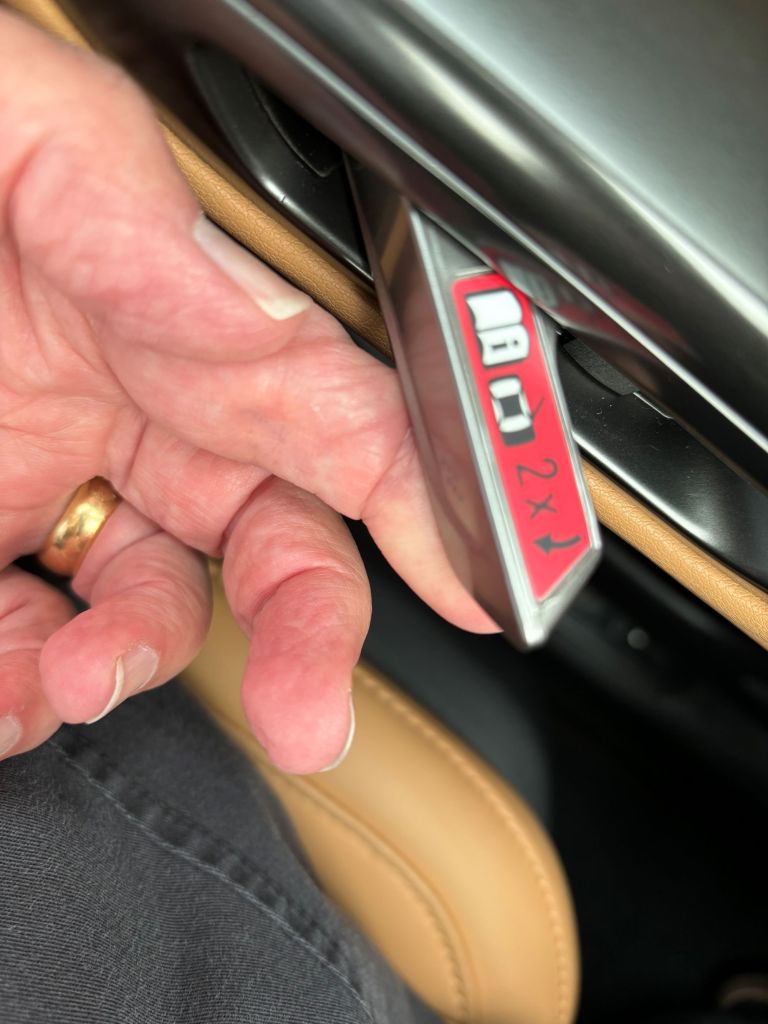
The inside door handle is confusingly absurd. (While it would be grammatically appropriate to just use the word absurd and leave it at that, this handle takes it up a notch.)

It is a metal component that is flush with the surface of the arm rest it is embedded in. To use it it is a matter of inserting your finger into a space between the plastic housing and the handle.

But the is not just pulled once. It is necessary to pull it twice.

And to use what is ordinarily a simple lever of some sort, Lexus has added small iconic instructions on both the plastic housing (an arrow with points on each end indicating the intended movement to be achieved) and on the door pull’s top surface, a red label.

I’m sorry, but this is a horrible execution.

Is it a deal-breaker for those who might be interested in getting a nice, well-handling plug-in hybrid that features sumptuous seats and an array of safety tech and infotainment tech, a vehicle that provides an approximate 36-mile electric-only range before it reverts to a conventional series-parallel hybrid that has an EPA-estimated 36 mpg combined?

Probably not.

Although the thing is, this is something that the buyer will have to live with. Certainly it is something that she’d get used to. Certainly something that would be highly annoying were a freshly manicured fingernail to be fractured by working the handle. Certainly something that would come to mind every time the owner was in a model with a more-utile actuator.

And maybe the folks in the Lexus Handle Department got an atypical assignment and assiduously went at it.

On the outside there are what appear to be conventional door handles that you reach in from the top or bottom and pull toward you.

In the case of the NX there is a rubberized surface on the interior surface of the handle that covers an electronic button. By pulling the button is activated and the door opens.

Is this a “luxury” feature or, well, a solution to a non-existent problem?

Again, overall—from the exterior styling to the cargo capacity (22.7 cubic feet with the rear seat up; 46.9 cubic feet when folded down)—this is a nice vehicle.

It is based on the GA-K platform that it shares with the hybrid-only Toyota Venza and the Toyota RAV4—in all of its powertrain configurations—so one can have not only Lexus-level amenities with the NX, but Toyota-level reliability.

Still, this would be a better vehicle if some of the designers and engineers asked themselves, “What would Steve do?”

(Image: Lexus)

Toyota Rolls Out Plenty of Products

By Gary S. Vasilash

Let’s face it: As much as people would like to think that the pandemic is something that is talked about in the past tense, the direction of those arrows showing cases and hospitalizations and deaths related to Covid are going in the wrong direction.

This means that OEMs have to consider the ways and means that they announce product to the press, and in turn, the public, because this ain’t 2019 anymore.

Toyota has announced a tranche of products and developments that would usually be metered out drip by drip.

Instead, it has essentially said, “Get ready, here we come!”

GR Corolla MORIZO Edition. Yes, you could go to Costco in it. But you’d probably have a whole lot more fun at a track. (Image: Toyota)

As in:

  • 2023 Corolla Hybrid with optional AWD–What makes this different is that there is a separate electric motor mounted on the rear axle to switch from what is ordinarily a FWD vehicle to AWD.
  • Corolla Cross Hybrid—The SUV-ish vehicle now (1) is available as an AWD vehicle and (2) uses Toyotas Fifth Generation Hybrid system. Oddly, Toyota touts that the vehicle has a 0 to 60 time of 8 seconds. No one—probably not even a rogue valet—is going to pin the accelerator on a Corolla Cross, hybrid or otherwise.
  • GR Corolla MORIZO Edition—“GR” stands for “Gazoo Racing.” It was established as something of a skunkworks for running at the 2007 Nürburgring—but as it was established by Akio Toyoda. . .  . Anyway, GR is both a racing team as well as an operation that provides performance to production vehicles. This vehicle, limited to 200 cars, is designed for the track (but is street-legal), as the engineers worked at taking out weight (they removed some 100 pounds from the GR Corolla Circuit Edition), added a close-ratio manual transmission, and increased overall rigidity. Here’s something you don’t necessarily associate with a turbocharged three-cylinder engine: 300 hp and 295 lb-ft of torque.
  • 2023 GR86 Special Edition—Last year Toyota introduced the GR86 sports car, and the vehicle has been doing well. In Q1 ’22 there were 3,257 GR86s sold, which may not seem like a big number, but is an increase over Q1 2021 of 326.3%. The Special Edition will be limited to 860 vehicles. The vehicle features a cat-back performance exhaust to make the 228-hp 2.4-liter engine sound, well, more bad-ass. There are forged matte black 18-inch alloys. And there are various trim mods inside and out.

Meanwhile, over at Lexus:

  • 2023 RX—The fifth generation of the vehicle that, arguably, made Lexus. Were it not for the luxury crossover, a segment that the RX pioneered, odds are that Lexus might have been like those other two brands that launched around the same time that are now pretty much footnotes. The new RX is on a new platform (GA-K), which is important because it allows a weight reduction (always good for performance) and increased rigidity (ditto). The RX has been available as a hybrid since 2005 (!). That continues with the new model. But there is a second hybrid, the RX 450h+ that will be coming, which is a plug-in hybrid.

And there’s this:

  • Cabin Awareness concept—This is a development from Toyota Connected North America, an operation that focuses on things of a digital nature. This concept is based on a 4D imaging radar sensor—and it has absolutely nothing to do with autonomous driving. Rather, the sensor, mounted in the headliner of a vehicle, determines whether there are life forms in the vehicle (adults, kids, infants, pets). This is useful to make sure that no one is left inside a vehicle. And because this will be important in the autonomous world (e.g., say someone books a ride for himself and pet and upon arrival at the destination, gets out but leaves the pet behind), Toyota is working with autonomous vehicle company May Mobility on testing it out in autonomous Toyota Siennas (back to that parenthetical scenario: the Cabin Awareness sensor finds the pet is still there and a signal is sent to the vehicle system such that it won’t move on until the situation is resolved).

Yes, lots of things from Toyota in a compact amount of time.