On the 2026 Nissan Sentra

What a concept: a good-looking, well-equipped new car with an affordable price tag. Something important in today’s market

By Gary S. Vasilash

Although when you are buying a new car you are (likely) buying the newest version of that car available. What it currently is and what it currently has is what matters.

Still, there is something to be said for legacy.

The Nissan Sentra has been around since 1982. Nine generations. There have been more than 6.5-million sold in the U.S. during this period.

So for someone who is looking to buy a new, 2026 Sentra, there should be confidence that there’s more than a little something right about the car as it has endured.

///

And on the subject of timing, Nissan is nothing if not timely.

Among the competitors for the compact sedan are the Toyota Corolla and the Honda Civic.

The current-generation Corolla (and credit to it: it is now in its 12th generation) was launched as a sedan in early 2019 (model year 2020).

The current-generation Civic (and points to it, too: 11 generations) was launched in mid-2021 as a 2022 model.

So the Sentra is the freshest of the three.

///

While the conventional wisdom has it that sedans are pretty much dead, Gauthier Bayard, Nissan senior planner, Chief Marketing Manager, said that they have numbers showing that in the next five years there’s going to be some incremental growth in the category.

And things aren’t as sad for sedans as you might think.

Through Q3 Honda sold 185,225 Civics, Toyota 179,983 Corollas, and Nissan 125,741 Sentras.

And while you probably think that crossovers crush those sorts of numbers, that’s not necessarily so.

Again: Sentra 125,741 through Q3 2025.

Ford Bronco Sport: 103,261.

Ford Escape: 114,728.

Bronco: 109,921.

Somehow that compact sedan number doesn’t look too bad.

///

And now the Sentra is better.

There is one thing to know before we look at some of that.

Another thing that everyone knows—and knows far too well if they’ve been actively in the market of late—is that vehicles are breathtakingly expensive.

The Sentra S is the starting trim. It has an MSRP of $22,400.

The SV, $23,170.

The SR, $25,000.

The SL, $27,990.

The sort of prices that regular people can afford without having to take out a loan with a length that would be so long the car would qualify for a driver’s license by the time its paid off. (Slight exaggeration. According to LendingTree.com the average auto loan term is 68.9 months.)
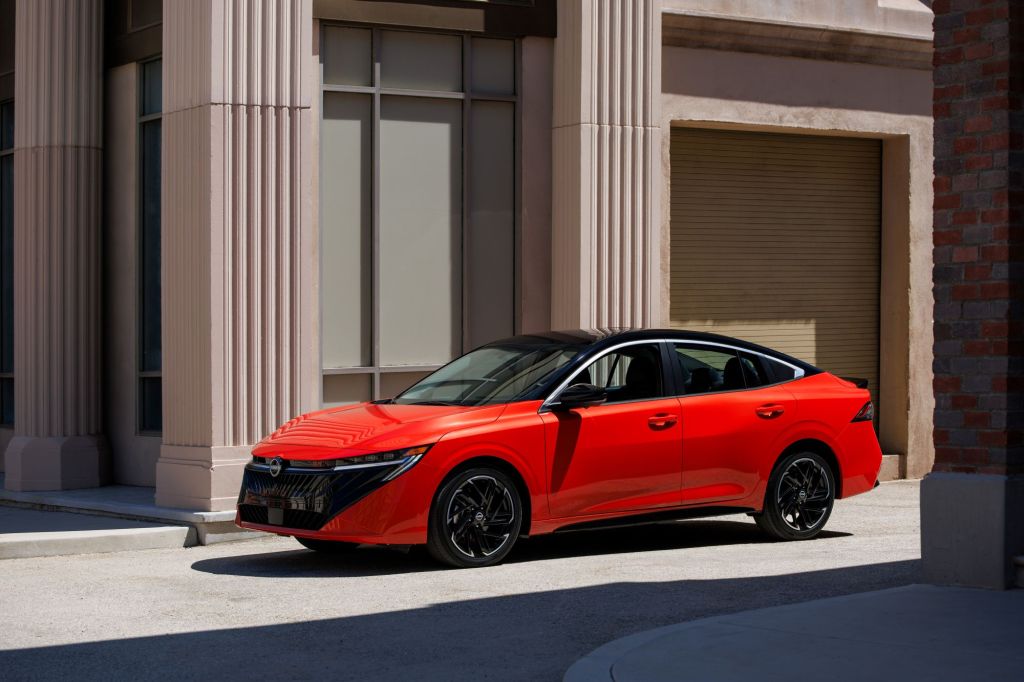
2026 Nissan Sentra SR. Handsome, sporty styling wraps an array of useful tech. Notably the entire package comes in at less than $30,000. (Images: Nissan)

///

The old saw has it that the styling of a vehicle gets people into a car and the interior (if done right) keeps them there.

According to Lihao Yu, design director at the Nissan Global Design Center, the exterior styling is characterized by the Japanese word shun, which means agile, yet effortless.

Through the clever use of colors and execution of the front fascia, there is a sporty appearance for the SR Sentra and a more sophisticated look for the SL.

And they continue to pay that off on the interior, with the SR having red accent stitching on the seats and the SL quilted seating surfaces.

///

And then, of course, there’s the tech, both outside and in.

That is, on the outside there are LED headlamps that have more than 70% greater light dispersion than the previous headlamps. When approaching at night there is a minor light show that commences, welcoming you to the car.

And the outside is seen from the inside with the Intelligent Around View Monitor that makes use of a front camera that provides a wider view than the previous one.

While approaching the vehicle the key fob is detected and the doors unlocked.

Inside there’s a 12.3-inch screen for the gauges and another 12.3-inch screen for infotainment (at least on all trims with the exception of the entry S. It has a 7-inch gauge info display but the 12.3-inch infotainment screen). There’s available Bose premium audio. And there are things including automatic emergency braking with pedestrian detection, intelligent forward collision warning, lane departure prevention, high beam assist, traffic sign recognition, and more.

///

The powertrain is a 149-hp, 146 lb-ft of torque inline four mated to a continuously variable transmission. This is familiar from the last-generation Sentra. The rationale is simple: it works well, so use it. To be sure they’ve tuned it for improved operations.
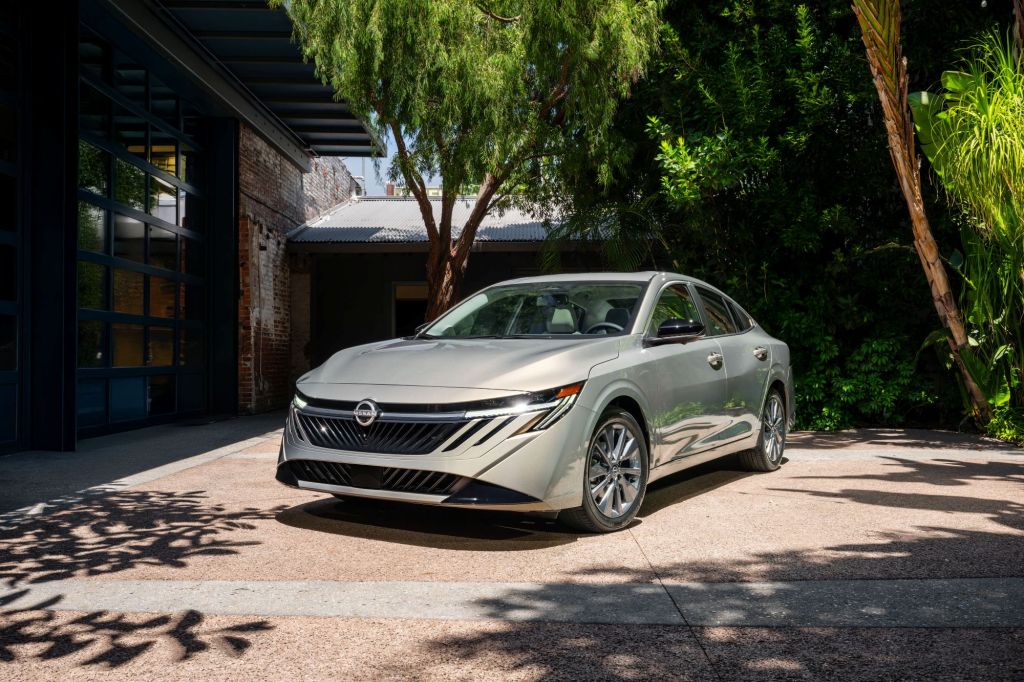
The SL trim has an upscale look on both the outside and in the cabin.

///

When considering the customer, Bayard said they project it will be gender balanced and aged between 25 and 54. The household income will have a fairly wide range, from $50,000 to $150,000 (this latter figure may be a bit generous: according to the US Bureau of Labor Statistics, median weekly earnings in Q2 2025 were $1,196, which translates to $62,192 per year, so even if there were two wage earners in the household. . .$150K is unattainable.)

What they have developed is what plenty of people need: a well-equipped, affordable, reliable car. And as for that reliability, it is worth noting that in the J.D. Power 2025 US Initial Quality Study, the Senta takes the Compact Car category, besting the Kia K4 and the Hyundai Elantra, two non-trivial competitors.

So if we assume the new one is even better. . .then they really have something special.

Nissan Knife: The Wrong Thing

Shouldn’t everyone at Nissan be focused on appealing vehicles, not sharp knives?

By Gary S. Vasilash

Somehow this doesn’t seem. . .right.

Nissan, as is well known, is having some overall market difficulties.

Nissan Design America has taken this moment to collaborate with Chef Hiroyuki Terada and knifemaker Kiryu.

The collaboration has created the Z NISMO Precision Sushi Knife.

Sure, it is sharp, but. . . . (Image: Nissan)

According to Nissan, this execution was performed because Precision, Performance and Expertise are qualities that the Nissan Z car and Japanese knife-making share.

Last year in the U.S. Nissan sold 3,164 Z models in the U.S.

That is a small number. But it is a 78.7% increase over the previous year.

It is two more vehicles that Alfa Romeo Stelvios sold in the U.S. in 2024. Not exactly a vehicle that is top of mind.

The point is: Nissan needs to move more metal.

And not the kind used to produce knife blades.

The company ought to be 100% focused on products of a vehicular type.

Sure, the Z NISMO Precision Sushi Knife may be a bit of a diversion.

But it really can’t afford people paying attention to anything else than vehicles.

Nissan Expands Mobility Partnership

Expanding the availability of micro-vehicles in Europe. . .

By Gary S. Vasilash

While lots of OEMs talk about being a “mobility provider” rather an ancient “car company,” Nissan is proving itself to be one.

It has announced it is expanding its partnership with a company that makes micromobility vehicles, such as a small EV and electric motorcycle, ACCIONA.

Nissan has added the UK to countries that it has distribution and service rights to the ACCIONA Silence product line. The other countries are Italy, France and Germany.

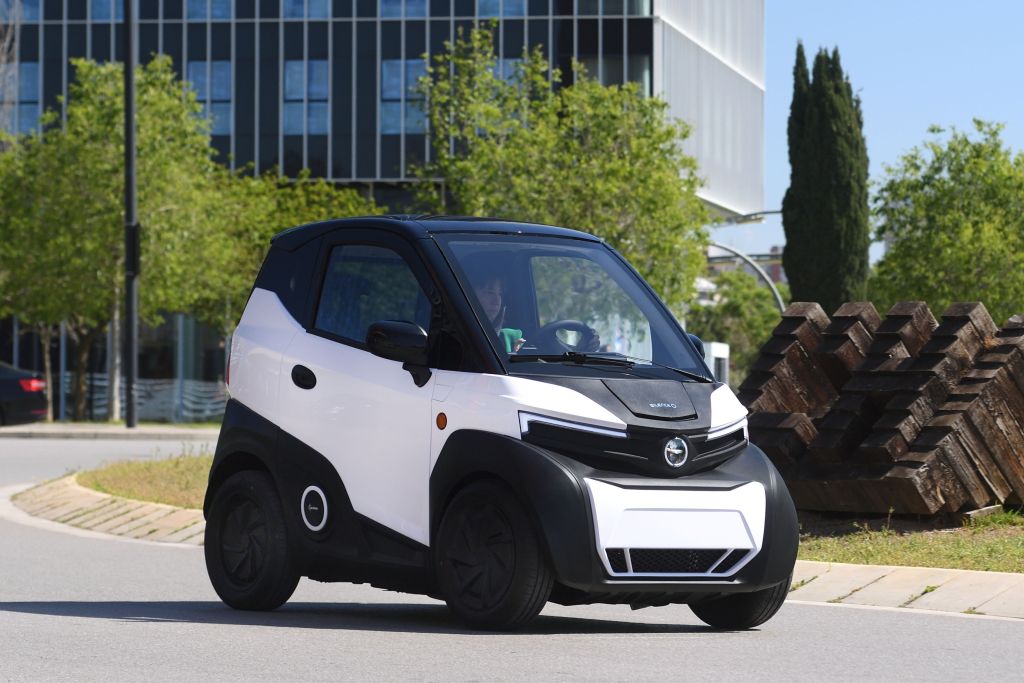
S04 EV micro-vehicle will be available in Nissan UK dealerships this Fall. (Image: Nissan)

Gareth Dunsmore, Managing Director e-Micro Mobility at Nissan AMIEO, said, “By opening access to Silence’s diverse range of alternative products, we are easing the EV transition by combining clean mobility with cutting-edge technology, in functional and flexible vehicles.”

The S04 Nanocar is designed for city use.

It measures 90 inches long, 50 inches high, and 62 inches wide. The S04 seats two. It is powered by a 14-kW motor. It is said to have a top speed of 53 mph, which is arguably something that will only be reached by some daredevils given the diminutive size of the vehicle.

It is powered by two batteries that provide 5.6-kW and can be readily removed and transported with a hand truck to a place where they can be replaced with charged batteries.

There is also a battery subscription service, so rather than buying the vehicle with the batteries are swapped on an as-needed basis, which is said to reduce the overall price of an S04 by up to 40%. (The base model has an MSRP of £14,614.)

What’s notable—and laudable—about this is that Nissan could have undoubtedly made its own micro-vehicles.

Yet there is evidently a recognition that there are already companies like ACCIONA making these vehicles so a partnership can provide mutual benefit between the two companies, as well as for the consumer.

Planning the Work, Working the Plan

By Gary S. Vasilash

Automotive business plans nowadays tend to have a title, perhaps in order to make investors think that the OEMs really have something going on because of their naming method.

Nissan has been running its Nissan NEXT business plan from FY 2020 to FY 2023.

It has its long-term Nissan Ambition 2030 waiting in the wings.

This past week it announced The Arc, which is a bridge between the two.

In announcing it, Makoto Uchida, Nissan president and CEO, said, “This plan will enable us to go further and faster in driving value and competitiveness. Faced with extreme market volatility, Nissan is taking decisive actions guided by the new plan to ensure sustainable growth and profitability.”

At its basis it is about selling more vehicles. Vehicles that are more profitable for the company.

Which is pretty much what any OEM wants to do.

So it is going to roll out 30 new models—16 electrified (which means they can be hybrids) and 14 ICE—during the next three years, then from FY 2024 to 2030 there are plans for a total 34 electrified vehicles.

On a global basis Nissan anticipates that 40% of its global sales will be electrified vehicles, then 60% by 2030.

A few days after The Arc was announced Nissan made another announcement, which is that it is going to continue in the ABB FIA Formula E World Championship racing series “until at least 2030, reinforcing its Ambition 2030 electrification plans”

Presumably the thought is that if it is seen as a leader in electric vehicle racing customers will figure that it has the chops when it comes to consumer EVs, too.

And, of course, there is the obligatory comment about how there is technology transfer from the race track to the street, which a high-level powertrain engineer at a competitive company recently told me is more rhetoric than reality, given the difference in what the requirements are for the types of vehicles.

Maybe what companies really need to do is come out with a plan called “The Best,” and simply say “We are going to make the best damn vehicles for our customers, period.”

That might focus their efforts on what really matters.

Socially Popular

Since social media attention is one of the most important metrics for those in the automotive industry, some findings from Zutobi.com* are undoubtedly of interest.

According to its research, the most popular vehicles in terms of social media mention are:

  1. Nissan GT-R
  2. Honda Civic
  3. Ford Mustang

Here’s how they made the assessment:

The GT-R gets 8,623 weekly Twitter mentions, 9.5 million Instagram posts and 9,890 articles on Reddit.

The Civic’s respective numbers are: 7,863, 8.2 million and 16,500.

And for Mustang: 9,827, 14.7 million and 6,610.

Nissan GT-R: as popular as it is quick. (Image: Nissan)

One could argue that the Nissan GT-R is by far the most popular.

Why? Well, in 2019, the last “normal” pre-COVID year, Nissan sold 331 GT-Rs in the U.S. market. Last year it sold 227.

The Civic and even Mustang sales dwarf those of the GT-R.

So given its share of market its share of attention is massive.

//

*Zuboti is an on-line driver’s ed course. Presumably it did this research because it figured it would get picked up on social media.

Developing the 2022 Nissan Frontier

It was a long time coming. Here’s how they delivered

By Gary S. Vasilash

If you go way back in time—to 1959—Nissan (a.k.a., Datsun) introduced its first compact pickup truck in the U.S., the Datsun 220.

Which is to say that the company isn’t a stranger to the segment or the market.

1997 saw the first-generation Nissan Frontier pickup, which was offered as a 1998 model year truck.

The second-generation Frontier, a MY 2005 unit, was introduced in 2004.

And while there have been modifications and improvements over the years, there wasn’t a third-generation Frontier until now, the MY 2022 Frontier.

Third-generation, 2022 Nissan Frontier. (Image: Nissan)

The Frontier is in a segment that has certainly changed during its history. Both GM and Ford had midsize products, which they both removed from the market before re-entering it.

Toyota, with its Tacoma, has just kept at it, year after year, leading the segment in sales.

As this is an important segment for all involved, Melaina Vasko, Vehicle Performance Manager, Nissan Frontier, says that as they developed the 2022 model they were certainly cognizant of the competition, but, at the same time, they were not going to overlook the fact that during its run to date there have been more than four million Frontiers sold in the U.S.

So she and her development team spent time learning from customers, learning what they wanted and thinking about what they could bring them.

One of the things people are absolutely interested in is a truck that can fit into a garage. The Frontier with a short wheelbase is 210.2 inches long; the long-wheelbase version is 224.1 inches. The vehichle is either 73 or 74.7 inches wide (the more rugged trims have brawnier shoulders); the height variations range from 71.6 to 72.9 inches. There are two bed sizes: 59.5 inches for the standard version and a 72.7-inch long bed.

Vasko explains on this edition of “Autoline After Hours” how the 22 Frontier was developed with an eye toward providing capability, drivability, comfort, technology, and style, and how these are addressed with the new vehicle.

She talks to “Autoline’s” John McElroy, Brett Smith of the Center for Automotive Research, and me.

It is notable that this is a vehicle that was a long time coming, longer than most vehicles that you can probably think of.

Consequently, the amount of attention to the execution is certainly something that is different than, say, a model that is turned over every five years.

One of the things that Vasko told her team, one of the things that should be important to anyone in any endeavor, is simply this: “Try.”

When things seemed more than difficult, perhaps teetering on the edge of what might be considered impossibility, they were encouraged to try.

Without trying, they wouldn’t have been able to deliver on the 2022 Frontier.

And you can see the show right here.

Remember When Nissan Was Noticeable?

Not all that long ago the Japanese Big Three were Toyota, Honda and Nissan. Nowadays the last-named seems to have lost its momentum in the market while the other two keep driving forward. Why?

By Gary S. Vasilash

“Remember when driving was fun?” actress Brie Larson opens a new Nissan commercial rhetorically asking before she blitzes her way through the array of new vehicles that Nissan has launched, or is about to.

At one point she’s being the wheel of the Z Proto and acknowledges that there are three pedals down there. Enthusiasts will get it. Others may be confused.

Will Brie boost Nissan? (Image: Nissan)

Nissan is rolling out 10 new or improved products over 20 months, so its showrooms will be fresh with sheet metal.

For those who are interested in one-pedal driving, Larson drives in a Nissan Ariya, the new EV that is anticipated to launch this year. (EV drivers will get it. Others may be confused.)

Although Nissan showed improvement in the first quarter, with its sales up 14.8% from Q1 2020, it really isn’t a good reflection of what it has on offer right now.

Consider: the Nissan Division had sales of 266,482 units. That’s Versa, Sentra, Altima, Maxima, LEAF, 370Z, GT-R, Kicks, Frontier, Titan, Pathfinder, Armada, Rogue, Murano, NV, and NV200.

Ford sold 277,233 trucks. F-Series, Ranger, E-Series, Transit, Transit Connect, and Heavy Trucks. 203,797 of those were F-Series.

What accounts for Nissan’s lack of traction in the market is certainly mystifying.

The question is whether Captain Marvel will save the day.

Q1 Sales Surprises

Yes, customers are back. But some of what they’re buying is surprising.

By Gary S. Vasilash

Although it was April Fool’s Day when the first quarter 2021 numbers for U.S. sales were announced by OEMs, the smiles were real in offices across the land as the SAAR (seasonally adjusted annual rate) rose to approximately 16.5-million units, or about a 12% sales increase compared to Q1 2020, which, of course, contained the first month of the pandemic in America.

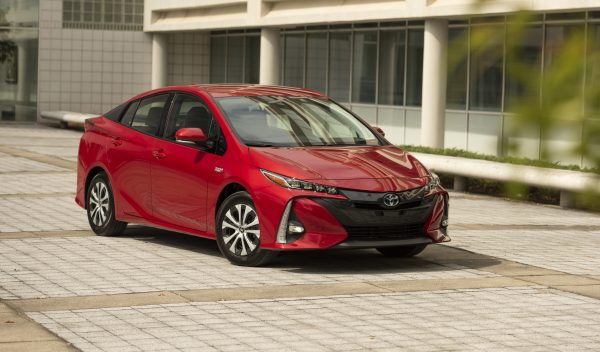
2021 Toyota Prius Prime. There was a 70.6% sales increase for the model in Q1 2021. Who saw that coming? (Image: Toyota)

This wasn’t supposed to happen

Plenty of people who seem to have a particular affection for liking the use of fossil fuel and has therefore been gloating over the fact that Toyota Prius sales have been dropping must have gotten a surprise. Despite that fact gasoline prices have been low for the past several months and still under $3.00 per gallon ($2.85 in the U.S. as of now, according to the Energy Information Agency), Prius sales rose 22.4% in Q1, to 14,050 units. (For a not apples-to-apples comparison: Chevy sold 7,089 Camaros during Q1.)

What is more striking is that all Toyota hybrids had a combined 152% increase, to 125,318 units. (“Thank you, RAV4,” they must be saying down in Plano.)

***

The Big Three?

Remember when that was General Motors, Ford and Chrysler?

GM is still big. Overall sales of 642,250 vehicles.

The other Two, however:

Ford, including Lincoln, had sales of 521,334.

FCA, including Chrysler, Jeep, Dodge, Fiat, Alfa Romeo, had sales of 469,651.

Toyota, including Lexus, 603,066. That’s a lot more than either Ford or FCA.

***

This wasn’t supposed to happen, 2

Everyone knows that (1) sedans are nearly dead in the market and (2) economical vehicles are so 2010.

Nissan, including Infiniti, had a good first quarter, with overall sales of 285,553 vehicles, which is a 10.8% increase over Q1 2020.

But there are two absolute standout vehicles in the Nissan lineup:

  • Versa: 22,394 vehicles, or an 83.9% increase
  • Sentra: 37,238 vehicles, or a 55.9% increase

Admittedly, crossovers like the Kicks (24,421 units) and the Rogue (86,720) were big contributors, the fact that the Versa and the Sentra did so well ought to make some analysts reconsider that whole “Cars are on life support” position.

***

This puts March 21 vs. March 20 in perspective

In March 2020 Hyundai delivered 35,118 vehicles.

In March 2021 Hyundai delivered 75,403 vehicles.

That is a 115% increase.

Still: Wear a mask.

Why the Big 6 (But One) Abandoned Small Cars: It’s Not Just the Margins

Americans are big. Really big. Which might explain the absence of small cars (or almost any cars) being offered by the major OEMs

The accepted wisdom seems to have it that one of the primary reasons why vehicle manufacturers are getting out of cars and pouring more resources into crossovers is because they can make better margins on the latter. Which may be true, but is likely only part of the story.

According to the Centers for Disease Control and Prevention, American adults are, well, large. The average male over 20 is 5-foot 9-inches, weighs 199.8 pounds and has a 40.5-inch waist. The average female is 5-foot 3.5-inches, tips the scales at 170.8 pounds, and has a 38.7-inch waist. According to the CDC, 73.6% of adult Americans are overweight.

Seems like a fairly compelling rationale for large vehicles.

So what’s someone who wants to buy a small car to do? Well, the answer to that is “Look for something that is not all that small.”

That is, of the U.S. Big 6 automakers—GM, Ford, Stellantis NA, Nissan, Toyota and Honda—only GM has a car that can be considered “small.”

Chevrolet still offers the Spark. This car has a 93.9-inch wheelbase, is 143.1-inches long, 62.8 inches wide, and 58.4 inches high. It has a passenger volume of 83 cubic feet, and a cargo volume behind the rear seat of 11.1 cubic feet.

2021 Chevy Spark. Small. But big. (Image: Chevrolet)

The next smallest is the Fiat 500X, although the company positions it as being a crossover rather than a car, but for the sake of argument, let’s include it since it has a design that is very much like the now-departed (and tiny) 500. The 500X is gargantuan compared to the Spark, with a 101.2-inch wheelbase and length, width and height dimensions of 167.2, 73.2 and 63.7 inches, respectively. It has a passenger volume of 91.7 cubic feet and cargo area behind the rear seat of 14.1 cubic feet.

Then there’s the Nissan Versa. It has a wheelbase of 103.1 inches—9.2 inches more than the Spark—and an overall length of 177 inches, or almost three feet longer than a Spark. Its other dimensions are 68.5 inches width, 57.3 inches height, a passenger volume of 88.9 cubic feet and a cargo volume of 14.7 cubic feet.

Whereas people might associate “Honda” with “small cars,” with the Fits remaining on dealer lots the only ones left, the smallest car in the lineup is the Civic Hatch. Which isn’t all that small. It has a 106.3-inch wheelbase, is 177.9 inches long, 70.8 inches wide and 56.5 inches high. It has a passenger volume of 97.2 cubic feet and a cargo volume of 25.7 cubic feet.

The smallest Toyota car is now the Prius, which has a wheelbase of 106.3 inches and an overall length of 180 inches—or more than three feet longer than a Spark. It is 69.3 inches wide, 57.9 inches high, and offers 93.1 cubic feet of passenger volume and 27.4 cubic feet of cargo capacity.

Finally, there’s Ford, the company that was the first mass producer of passenger cars, the company that is now shifting its offerings away from, well, passenger cars. It currently has two cars on offer, and production has stopped for the Fusion, so that leaves the Mustang. Which is a completely bizarre thing to have in the context of a Spark. But here it is. The Mustang has a 107.1-inch wheelbase and an overall length of 188.5 inches. It is 81.9 inches wide, 54.3 inches high, and has a passenger and cargo volume of 82.8 and 13.5 cubic feet, respectively.

But consider this: the Spark actually offers more passenger volume than the Mustang. Not much more (0.2 cubic feet, or about the size of a football). But more.

So it might be a reasonable choice for a big American looking for a small car.–gsv