
2024 Lexus RX 450h+

A plug-in hybrid version of the CUV that just keeps getting better

By Gary S. Vasilash

Lexus has been putting the RX on the road since 1998. Arguably, this was the first-available luxury crossover. Inarguably it has been a stalwart in the Lexus lineup.

Through the third quarter of 2024 the RX has been sold 83,341 times in the U.S. And to put that number in context, know that during the same period Lincoln—which now is an all-crossover brand (though the Navigator has a body-on-frame architecture, so it is a bona-fide SUV)—had sales of 74,530.

One model outsold four.

The RX is now in its fifth generation.

I am more than passingly familiar with all of them.

And I make that observation for one reason:

It could be thought at Lexus HQ “We’ve been building the RX for more than 25 years, the consumers keep buying them, so let’s not spend too much time worrying about it because it is in a solid place that it is not likely to lose.”

Consequently, while the RX would be good, it would be good with an accompanying shrug.

Lexus RX 450h+ plug-in hybrid. (Image Lexus)

Yet this RX simply exceeds expectations in its attention to detail and execution.

While this might seem to be a trivial example (trivial unless you drive one of these vehicles regularly, at which point the trivial can make a major difference), note how the bottom of the doors are curved and robustly sealed over the rockers. This not only helps provide a stout structure but it attenuates noise intrusion, especially road noise (as that is the closest thing down there).

It helps provide vault-like silence. Which is what one wants in a luxury vehicle, right?

The interior—from semi-aniline leather and materials including open-pore wood, to the audiophile Mark Levinson system—combines function with comfort with useability (e.g., if you want to adjust the temperature there is a knob at hand and if you want to activate the heated and cooled front seats, then buttons are available).

The powertrain consists of a 2.5-liter inline four-cylinder engine that is supplemented by permanent magnet motors front and rear (which provides the vehicle with all-wheel drive capability). The total system horsepower is 304, which does the job for a vehicle that has a curb weight of 4,810 pounds and measures 192.52 inches long, 75.59 inches wide, 67.32 inches high, and has a wheelbase of 112.2 inches.

Of course, the reason one buys a plug-in hybrid (there are RX versions that are straight ICE as well as two non-plug-in hybrid variants) is for the fuel efficiency that is provided.

In the case of the RX 450h+ there is the ability to drive up to 35 miles on electric power only. (The vehicle can be charged on a typical 120-V outlet in about 11.5 hours or, when a 240-V system is used with the standard 6.6 kW onboard charger it is done in about 2.5 hours.)

Then when operating as a hybrid alone, it has an estimated combined miles per gallon rating of 35 mpg, so with its 14.53-gallon fuel tank it provides a range of over 500 miles.

(Note: the vehicle has an 83 MPGe rating. I will not try to explain it and I think it is something that the EPA needs to do away with on the sticker because it simply doesn’t make a whole lot of difference to the consumer who isn’t an electrical engineer.)

Here’s something interesting about Lexus: in the J.D. Power 2025 U.S. ALG Residual Value Awards—which determine the value that a vehicle holds following a three-year period of ownership—Lexus took the top spot in the premium brand segment for the fourth year in a row.

And among the vehicles on the most-recent list: the RX.

Enjoy it today. Appreciate it tomorrow.
2024 Lexus NX 450h+ AWD

This is not something that was designed in Cupertino. . .

By Gary S. Vasilash

“Apple design” isn’t as often in the conversation today as it once was.

While for some people it was essentially just a matter of using a clean, simple white surface and a name that had the letter “i” stuck on its front, that really misses the fundamental nature of Apple design.

It came down to something that someone could use without having to read a user’s guide or manual.

What is astonishing about this is that no matter what product Apple designed—from computer to phone—it was a highly technical product, something that in the pre-Jobs period necessitated study to use.

A subtle proof that Jobs wanted people to use products right after they were unboxed is that there is a charge in that iPhone (as there had been in iPods) so that it isn’t necessary to plug it in and wait.

Its use would be both intuitive and immediate.

All of which might make you wonder what this has to do with the 2024 Lexus NX 450h+ F Sport luxury compact crossover.

It’s this:

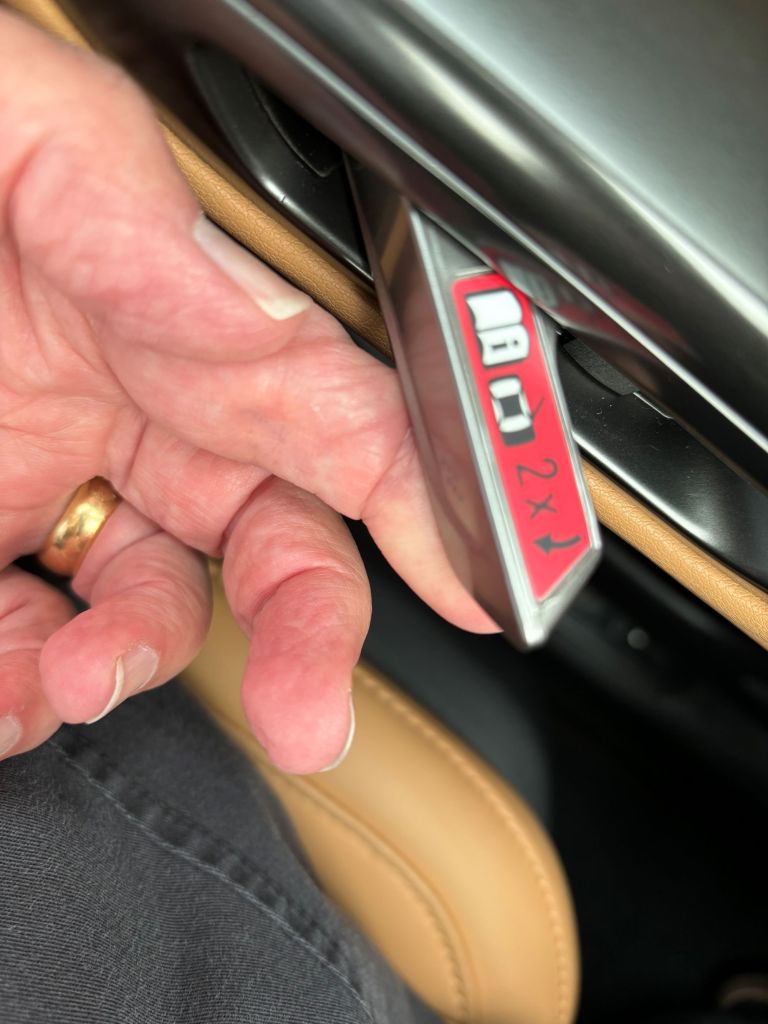
The inside door handle is confusingly absurd. (While it would be grammatically appropriate to just use the word absurd and leave it at that, this handle takes it up a notch.)

It is a metal component that is flush with the surface of the arm rest it is embedded in. To use it it is a matter of inserting your finger into a space between the plastic housing and the handle.

But the is not just pulled once. It is necessary to pull it twice.

And to use what is ordinarily a simple lever of some sort, Lexus has added small iconic instructions on both the plastic housing (an arrow with points on each end indicating the intended movement to be achieved) and on the door pull’s top surface, a red label.

I’m sorry, but this is a horrible execution.

Is it a deal-breaker for those who might be interested in getting a nice, well-handling plug-in hybrid that features sumptuous seats and an array of safety tech and infotainment tech, a vehicle that provides an approximate 36-mile electric-only range before it reverts to a conventional series-parallel hybrid that has an EPA-estimated 36 mpg combined?

Probably not.

Although the thing is, this is something that the buyer will have to live with. Certainly it is something that she’d get used to. Certainly something that would be highly annoying were a freshly manicured fingernail to be fractured by working the handle. Certainly something that would come to mind every time the owner was in a model with a more-utile actuator.

And maybe the folks in the Lexus Handle Department got an atypical assignment and assiduously went at it.

On the outside there are what appear to be conventional door handles that you reach in from the top or bottom and pull toward you.

In the case of the NX there is a rubberized surface on the interior surface of the handle that covers an electronic button. By pulling the button is activated and the door opens.

Is this a “luxury” feature or, well, a solution to a non-existent problem?

Again, overall—from the exterior styling to the cargo capacity (22.7 cubic feet with the rear seat up; 46.9 cubic feet when folded down)—this is a nice vehicle.

It is based on the GA-K platform that it shares with the hybrid-only Toyota Venza and the Toyota RAV4—in all of its powertrain configurations—so one can have not only Lexus-level amenities with the NX, but Toyota-level reliability.

Still, this would be a better vehicle if some of the designers and engineers asked themselves, “What would Steve do?”

(Image: Lexus)

2024 Volvo XC90 Recharge Ultra

What a wonderful SUV. . .

By Gary S. Vasilash

Several years ago, when I was covering advanced automotive manufacturing technologies, Volvo invariably came to the fore in one area: Laser welding.

I can’t think of a conference where there were presenters from other companies talking about that subject.

While you might be thinking, “Erm, ah, good for Volvo. Good for laser manufacturers,” it really is significant in terms of the product.

Typically, vehicles are assembled with spot welds.

And the spot welds go along a seam like this:

•   •    •   •   •   •   •

Laser welds go like this:

______________________________________________

Or sometimes there are spaces:

______________   _______________   _______________

The point being that the long(er) laser welds are superior to the spots make with resistance welders.

And again you’re thinking, “Gee, that’s just swell for manufacturers, but I’m not a builder or a welder, so. . . .”

Why I bring this up is because lasers provide a better build.

One of the consequences of this is encompassed in statements like this:

“Safety is at the core of everything we do at Volvo Cars. As part of our company’s longstanding commitment to safety, we constantly strive to raise safety levels. The Volvo XC90 reflects our safety legacy, and we are proud it was recognized by the IIHS given our shared dedication to the advancement of automotive safety with the goal of reducing traffic related deaths and injuries.”

That’s Mike Cottone, Head of USA and Canada at Volvo Cars, this past August after the XC90 received a 2024 TOP SAFETY PICK+ award from the Insurance Institute for Highway Safety.

Volvo XC90 Recharge: A PHEV SUV with lots to like. (Image: Volvo)

Among the reasons why the vehicle did well are:

  • Solid structural performance in the updated moderate overlap test
  • Excellent passenger protection for the driver
  • Good ratings in the small overlap front and updated side tests

All of this goes to the point of how the vehicle is put together.

Of course, it isn’t just about the welding (and I don’t know the extent to which lasers are used), but the types of materials used in construction. And again, I recall Volvo presenters being ahead of the curve when it came to discussions of things like boron steels.

To be sure, a stronger structure is a safer structure. And using the right materials can help assure that the structure is stronger where it needs to be.

Yes, but. . .

No one likely buys a premium midsize SUV thinking, “Yes, I think I’ll get this because when I get into an accident I’ll be safer.”

But that safety is an advantage, even if it isn’t thought about.

There is a characteristic that all of this leads to that is experienced each time you’re behind the wheel of an XC90, one that is highly satisfying: It feels solid. Substantial.

And going back to the “right materials,” it doesn’t feel like something that is overbuilt and wallowing.

It feels right.

Hush

What’s more, there is something that the structure brings that’s less: noise.

Think of the silent solidity of a vault and compare it to something like a mobile home.

A huge difference.

And when in this trim level, that structural silence makes the 1410-Watt, 19-speaker Bowers & Wilkins audio system sound all the better.

Power & economy

The XC90 Recharge, which has seating for six or seven (depending on the type of seats selected), is a plug-in hybrid. Which essentially means that when the battery is charged up the SUV has the ability to travel up to 32 miles on electricity alone. But once that’s depleted, then the vehicle operates as a hybrid, meaning the turbocharged four-cylinder engine works in concert with an AC motor: together there is a system horsepower of 455.

Yes, this vehicle moves with alacrity when needed.

A word about fuel economy. Because it can go on electricity alone, there is an EPA rating of 58 MPGe. Then there is the gasoline-alone rating, which the EPA has at 27 mpg combined. Conceivably you could go 530 miles with a full lithium-ion battery and a full fuel tank. Unless you are fairly diligent you’re probably going to let that battery run down and simply operate the vehicle as a hybrid most of the time.

In a Detroit-Chicago round trip I got an average of 25 mpg, lower than the EPA estimation, but given factors like the air conditioner working hard to deal with the ambient temperatures and the wildly fluctuating speeds predicated on extensive I-94 construction, I was more than pleased, premium gasoline notwithstanding.

To the point of several hours behind the wheel I found the seat (heated (didn’t need) and ventilated (did)) to be both supportive and comfortable. While there is Google built-in and accessed through a nine-inch touchscreen well integrated into the IP, I used CarPlay for Waze rather than Google Maps and listened to Spotify.

Sizable

While I was on a quick trip and certainly didn’t need it, there is a cargo capacity of up to 85.7 cubic feet.

The vehicle is 195 inches long, 69.9 inches high, 84.3 inches wide (with mirrors), and has a 117.5-inch wheelbase, which means it is sizable, yet it was easy to drive in congested Chicago traffic and in comparatively compact parking structures. (The blind-spot information system helps with the former and a four camera system for a 360-degree view around the vehicle the latter.)

The long run

The starting MSRP for the top-of-the-line Ultra trim is $80,895.

Which brings me back to some of those manufacturing conferences.

Another topic that was frequently discussed was the “life-cycle assessment.” When it came to investment in things—say laser welding equipment—while the upfront cost might be more, when considered over the life of the system, it very well could be more economical than something that was less expensive at the start.

I suspect that someone investing in the XC90 Recharge is going to have it for a long time. Consequently, spread out over a number of years, that initial price is more than made up for—especially when the attributes of the vehicle are taken into account.

‘Consumer Reports’ on Top Models & PHEVs

By Gary S. Vasilash

Although the folks at Consumer Reports are finding increased interest in and performance of electric vehicles (EV), it seems as though plug-in hybrids (PHEVs) are really something of a sweet spot based on its annual top-10 vehicle list.

CR’s Jake Fisher, senior director of Auto Testing, points out that there are four key elements that go into the determination of what vehicles make the list—and make it to the top of the list, which are:

  • Road testing
  • Active safety and crash testing
  • Owner satisfaction
  • Predicted reliability

While the first two are objective and the last two are subjective, know that the nonprofit consumer organization bases the last two on more than 300,000 member surveys, so there are solid metrics behind them.

The Results

So here are the top 10:

  • Subcompact SUV: Subaru Crosstrek
  • Compact SUV: Subaru Forester
  • Small car: Mazda3
  • Midsize car: Toyota Camry Hybrid
  • Small pickup: Ford Maverick/Maverick Hybrid
  • Midsize SUV: Toyota Highlander Hybrid
  • Luxury SUV: BMW X5/X5 PHEV
  • Hybrid/PHEV car: Toyota Prius/Prius Prime
  • PHEV SUV: Toyota RAV4 Prime
  • Electric vehicle: Tesla Model Y

The PHEV Challenge

One of the challenges vis-à-vis people going to a PHEV rather than a conventional hybrid (HEV) or a full EV is, Fisher explains, their understanding of what a PHEV is and how it would fit into their driving regime.

RAV4 Prime: hybrid with a plug. (Image: Toyota)

To simplify things, CR has modified the way it provides information about fuel economy for PHEVs by treating the all-electric range provided as a “bonus” added to the results when the vehicle is operating in its “charge-sustaining mode” (a.k.a., simply driving on its engine).

A fascinating comparison that CR made is to put like-to-like vehicles up against one another with the differences being in their propulsion system—PHEV vs. ICE, HEV and full EV—and then how much it will cost the consumer based on both the vehicle price and the cost of energy. The assumptions are that the owners will plug in their vehicles that have plugs, drive 40 miles per day, and take four 500-mile trips annually.

While it may not be a surprise that the PHEV version of the BMW 330 is more cost-effective than the gasoline-only version, there are a couple of surprises:

The Hyundai Tucson HEV saves more money than the PHEV version.

And while it seems to be accepted wisdom that owning an EV means far less cost for energy, the Kia Niro PHEV is actually better for the pocketbook than the Niro EV.

New Bentayga: Big Hopes for the Hybrid

Although full electric vehicles garner lots of attention, there is still something to be said for non-full-electric vehicles: plug-in hybrids, which have bigger batteries than non-plug-in hybrids, so they can go farther on full electric power. (Yes, conventional hybrids have an EV button that allows them to creep along without the engine running, but you surely can’t depend on that range being much, especially if you do something crazy like turning on the HVAC system.)

New Bentley Hybrid. Cruise through the city center on electricity. (Images: Bentley)

And the latest to be said about plug-in hybrids (PHEVs) comes from Bentley, which is launching the Bentayga Hybrid.

Not only does Bentley proclaim that it is “the only electrified true-luxury SUV in the world”—presumably things like the Audi Q5 PHEV aren’t sufficiently “true”—but makes a very bold prediction: the PHEV Bentayga “will become the best-selling member of the new Bentayga family.”

Other family members are the Bentayga V8 and the Bentayga Speed. Neither of which, obviously, is focused on ecological motoring.

The Bentayga Hybrid provides “up to 31 miles of electric-only range” measured on the NDEC protocol. So one could roll through London on electricity alone, then take advantage of the 3.0-liter twin turbocharged V6 that provides 443 bhp and 516 lb-ft of torque and open it up on the motorway.

The hybrid features a 17.3-kWh lithium battery and a 94-kW motor. The motor is housed in the transmission case, between the engine and the transmission proper.

Like a Ford Explorer.

Bentley first offered a Bentayga Hybrid in 2018. One of the key features of that vehicle was the Power Dock, which was co-designed and developed along with Philippe Starck: it was designed as a home charging station and is described as “a functional piece of art that will enhance any home.”

Charging device designed, in part, by Phillipe Starck.

Buy a car. Get an artwork.

According to Bentley stats, over 90% of the customers used their first-gen Bentayga “a daily basis or several times a week.” Imagine. You buy an SUV that costs ~$160,000 and you drive it regularly.

Here’s a quote from Adrian Hallmark, chairman and CEO of Bentley Motors, that is worth pondering: “The Bentayga Hybrid is the next step on our journey to becoming the world’s leading sustainable luxury mobility company. Bentley will transform from a 100-year-old luxury car company to a new, sustainable, wholly ethical role model for luxury, and the Bentayga Hybrid is the first model to pioneer our company’s recently announced Beyond100 strategy.”

Surely, this one vehicle has a heavy load.