2025 Toyota Corolla FX: Who Knew There Are So Many Corollas Out There?

An accessible vehicle that happens to be a car. . .

By Gary S. Vasilash

The Ford Model T was in production from 1908 to 1927. During that time there was an array of variants. Touring cars and coupes. Four doors. Two doors. No doors. Sedans and convertibles and wagons.

In all, an impressive >15 million were sold.

The Volkswagen Beetle is another car that had an impressive run. Between 1938 and 2019 there were some 22 million Bugs of various types sold on a global basis.

But those cars pale in comparison to the Toyota Corolla.

The Corollas was introduced in 1966. Since then, more than 50 million have been sold globally.

Yes, add all the Model Ts and Beetles and it is still considerably less than the Corolla.

Last year in the U.S. there were 232,908 Corollas sold.

If you take the F-Series out of the picture, there was no Ford brand model that came close in terms of 2024 sales. There was the Explorer at 194,094, but that’s 17% fewer than the Corolla.

And it is a similar situation at GM. Again, absent the pickups, the best-selling model in 2024 was the Chevy Equinox, at 207,730 vehicles. Closer, but no cigar.

(If we want to go down the SUV road: there were 475,193 Toyota RAV4s sold in the U.S. in 2024. . . .)

So far, the Corolla continues to perform:

Through Q1 2025 there have been 55,456 sold.

The Explorer is inching closer at 47,314 and the Equinox exceeds it with 71,002, but again, both of those vehicles are SUVs, so that would bring us to the RAV4’s Q1 sales of 115,402.

If you combine the Explorer and Equinox sales, that’s 118,316, or 2,914 more than the RAV4, to put things into some sort of perspective.

Chevy, Ford and Toyota are all, essentially, bread-and-butter brands. They’re making vehicles for most of us.

But what is surprising, given the Corolla’s clear consistently large sales—globally and in the U.S. market—is that you can’t buy a car from Chevy and the only car that Ford has in its lineup is the Mustang. That’s not exactly a mainstream model. (And to put its sales into perspective: in 2024 there were 44,003 Mustangs sold, which means that in the first quarter of ‘25 Ford moved more Explorers than Mustangs in all of ’24.)

(Another thing to be noted about Toyota and cars: last year in the U.S. it sold 309,876 Camrys. It has sold 70,308 through Q1 of ’25. Yes, a lot of cars.)

The thing about the Corolla is that like the aforementioned Model T and Beetle, it is primarily an accessible vehicle.

About the FX

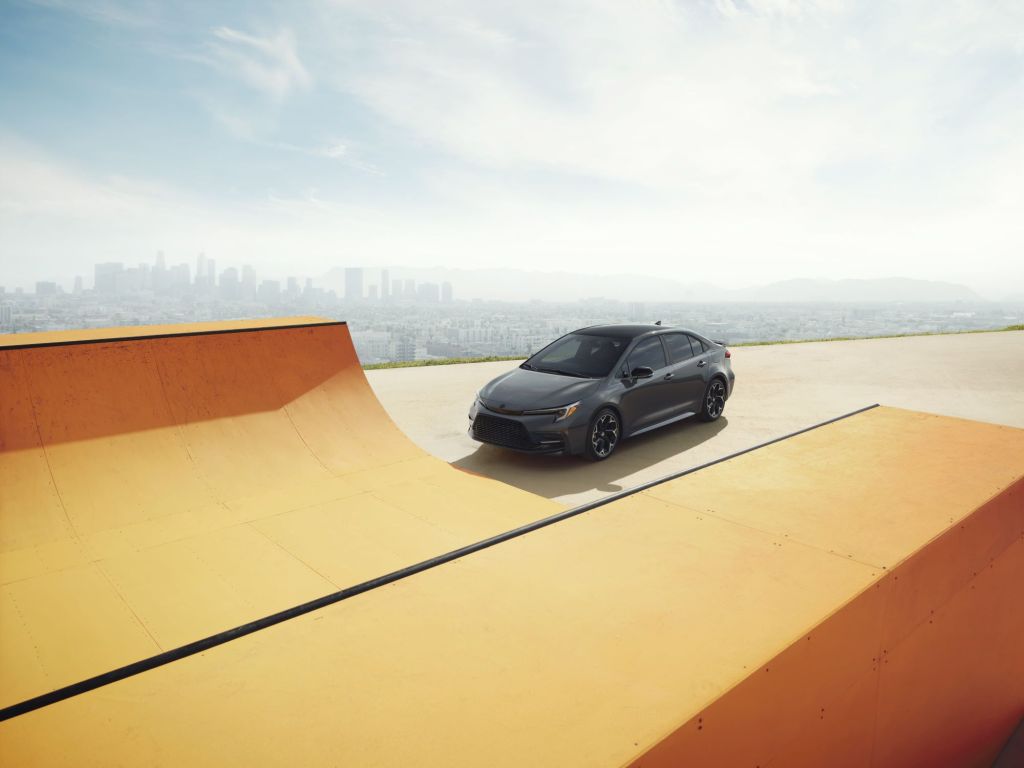
The vehicle driven here, the FX, is based on the Corolla SE grade, but has been amped up a bit for a sportier look.

Corolla FX: Accessible style. (Images: Toyota)

Achieving that look includes a sizeable spoiler, satin-black 18-inch alloy wheels with black lug nuts, and a blacked-out roof.

Powering the car is a 169-hp four-cylinder engine. There are three drive modes: Eco, Normal and Sport. This car isn’t going to win any races. But hundreds of thousands of people who have bought Corollas over the past few years likely don’t even know where a racetrack is located, and probably don’t have any points on their licenses for speeding.

On the inside things are, as they might say, “jazzed-up” a bit with the use of orange stitching on the seats and trim.

There is a 10.5-inch infotainment screen. Where there are knobs for HVAC settings, curiously no volume or tuning knobs for the audio system. You adjust the volume either with a steering wheel button or a diminutive rocker button just below the screen, which is a bit tricky to use unless you’re sitting at a light.

It’s got the goods on the inside. (But if only one of those knobs on the IP was Volume for the audio.)

Affordability

One of the reasons—in addition to the reliability, durability and quality Toyota vehicles are known for—people buy Corollas is because they’re affordable.

The MSRP prices range from $22,325 for an LE to $28,190 for a Hybrid XLE. (These numbers are pre-Liberation Day, so who knows what anything will cost going forward.)

This FX Edition has a starting MSRP of $26,500. Throw in a few options ranging from a blind-spot monitor with rear cross-traffic alter to an LED trunk light, adding $1,644, put in the handling fee of $1,135, and it is out the door for under $30,000: $29,279.

And there aren’t a whole lot of other cars you can say that about—unless, of course, you’re talking about Corollas, and then there are a whole lot of them.

In Addition

A couple other things to know about the Corolla.

One is that it is based on the Toyota TNGA-C platform, which doesn’t mean much in and of itself. What is important to know is that it is a global platform. Which means that it is being used as the basis of vehicles all around the world. Consequently, because of economies of scale it can be engineered and built with more robustness than a platform with a more limited scale—well, that limited-scale platform can certainly be produced with desired characteristics but it will be a whole lot more costly.

The point about the platform is that it is solid, not tinny.

Second, the Corolla driven here was built. . .in Huntsville, Alabama, at the Mazda Toyota Manufacturing plant. Yes, a compact car built in the U.S.

2025 Toyota RAV4 XSE Hybrid

An increasingly popular vehicle. . .

By Gary S. Vasilash

When it comes to compact crossovers, the Toyota RAV4 is a pioneer, having made its way to U.S. showrooms in January 1996.

The acronymic designator is said to stand for “Recreation Active Vehicle with 4-wheel drive.”

That “4” bit has morphed somewhat as (1) you can get a RAV4 with “all-drive,” not four-wheel drive (a primary difference being a transfer case, which the ute doesn’t have) and (2) the vehicle is available with front-wheel drive (though all-wheel is an option).

The vehicle is now in its fifth generation.

What is somewhat astonishing is the vehicle’s market performance in the U.S. in 2024. It became the best-selling vehicle in the U.S. To get to the top it had to supplant the Ford F-150 pickup, which had been #1 for so long that were someone to have an oversized foam finger with the Ford logo on it from when the F-150 got there it would now be crumbly.

Who would have thought that a compact SUV would supplant a full-size pickup in the U.S. market? Not me.

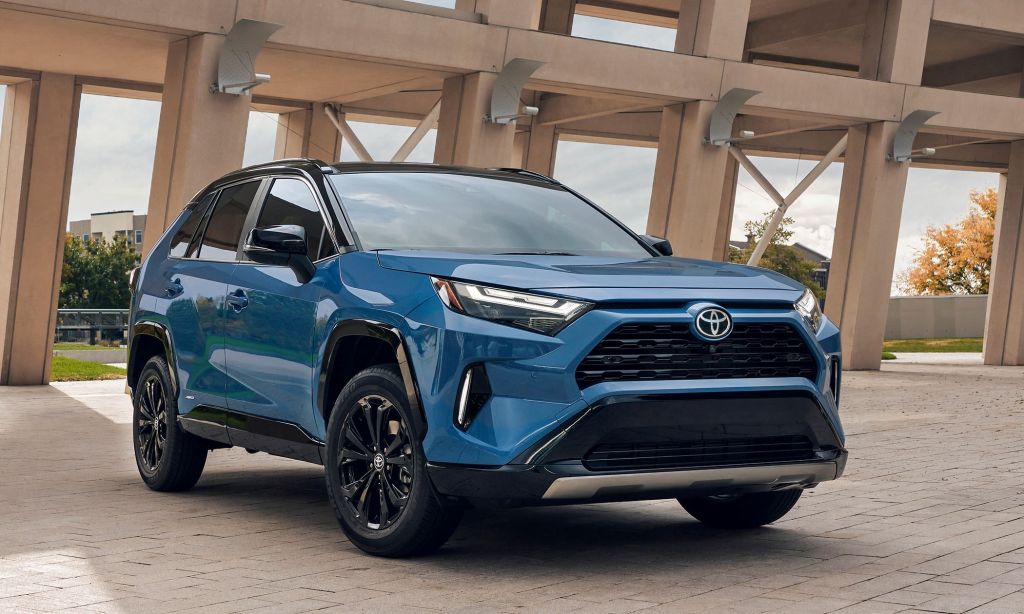
Through the years the exterior design of the vehicle has gone from boxy and functional (presumably as in “utility”) to softer to sharper to where it is now, which is fairly truck-influenced.

Maybe this is why it is doing so well in the market against trucks.

Even on the inside there are things like rubber-wrapped knobs that allow good grip and there are even buttons that are used, for example, to activate the heated steering wheel (this is an upper grade XSE model, incidentally). It has a wonderful simplicity compared to so many vehicles in this category (and others) that are focusing on doing things through screens and capacitive interfaces rather than, well, knobs and buttons.

Look: Real knobs and buttons!

(“But wait!” you say. “There aren’t any knobs or buttons on my phone, and that works just fine, thank you very much.” Yes, that is true, but consider this: you are holding your phone and staring at it in order to do something. A vehicle that weighs nearly two tons (in this case 3,775 pounds) and is traveling at, say, 70 mph is not the same thing: you’re eyes need to be on the road not trying to get to the right position on a surface to adjust the temperature.)

Oh, there is a 10.5 inch screen for infotainment. Toyota offers “Connected Services Drive Connect” that includes an “Intelligent Assistant” that is accessed via a “Hey Toyota.” Using that you don’t need to use any knobs or buttons or screens or surfaces. Just your voice.

The vehicle driven here is powered by a 2.5-liter four-cylinder engine that is orchestrated with two motor generators and a continuously variable transmission. There is one motor in the front and one in the rear which provides the all-wheel drive capability. The rear motor operates as needed and without a torque distribution system. Otherwise, the vehicle operates as a front-wheel drive vehicle, thereby helping optimize fuel economy.

And on that subject, the estimated fuel economy is 41/38/39 mpg (city, highway, combined). So with a 14.5-gallon fuel tank, you’ve got a considerable range.

The vehicle isn’t going to throw you back into your seat when you mash the accelerator—but then why would you? This is not engineered for that.

As for the “utility” aspect, there’s 37.5 cubic feet of cargo volume with the second row in position and 69.8 cubic feet when that seat is folded.

Seems like people who don’t haul things like gravel or equipment on a regular basis and so need a pickup have figured that that is enough volume to make that Costco run with a RAV4.

Fifth-gen RAV4. Exterior design is biased toward the “utility” rather than the “sport” in the SUV. (Image: Toyota)

2024 Toyota Prius Prime SE

The Prius just keeps going. . . .

By Gary S. Vasilash

I suspect there is really nothing that “sells itself.” Sure, there are things that someone might need and go out and buy because of current conditions—like the people who make a run on snowblowers at Home Depot both before and after storms: no one needs to sell that equipment to the buyers.

But when it comes to things like automobiles, the number of people who have a sudden need and are capable of dropping a few grand to accommodate that need is probably quite small.

As is often pointed out, a vehicle is generally the second biggest purchase that someone makes, so consideration is involved in the process.

Still, if there is any type of vehicle that “sells itself” today, it is a hybrid.

Even though there is massive attention paid to electric vehicles, in 2024 hybrids (including the plug-in versions) had 11.9% of the total US light-duty market while EVs accounted for 8.1%.

And when is the last time you heard anything about a new hybrid? And compare that with the paid-for advertising or earned media (coverage in various outlets, including this one, often predicated on the loan of a vehicle by an OEM for assessment) for electric vehicles.

If not “selling themselves,” then people are becoming more interested in going hybrid.

The first Prius was available in the US market in July 2000. Which means it is coming up on its 25th anniversary.

Through the years the Prius has been both lauded and chastised. And it seems more the latter than the former.

There has always been the claim that because there are two powertrains (the internal combustion engine and the electric motor(s)) in a hybrid, it is too expensive for regular consumers—and the knock is often made by companies that were rolling out with electric vehicles that were significantly expensive, far more than the price of a Prius.

Consistently, Prius sales have been by mass manufacturing metrics “meh.”

Last year 44,711 were sold, and 38,052 the year before.

But it should be noted that in 2024 Toyota brand sold 546,738 hybrid vehicles in the US as the company now offers vehicles ranging from the Corolla to the Sienna to the Tundra with a hybrid powertrain.

Toyota seriously has the hybrid power and the consumers have a lot of choice.

The Prius, while having styling that has ranged from the dowdy to the bizarre, currently has an appealing look.

Looks good and you can drive and drive and drive before you need a fill-up. (Image: Toyota)

When the current body style was launched in 2023 in the US it was so striking that it was named the 2024 North American Car of the Year by the jury of the North American Car, Truck and Utility of the Year Awards, besting both the Honda Accord and the Hyundai Ioniq 6.

The last time the Prius won was in 2004, besting the Mazda RX-8 and Cadillac XLR, neither of which exist in contemporary production.

People have consistently wanted to get a Prius, and Toyota has consistently provided them.

The vehicle driven here is a plug-in hybrid. (The “Prime” moniker goes away for MY 2025 vehicles, at which point it simply is Prius Plug-in.)

If you’re not familiar with what that means, know that in the case of the Prius, on the rear quarter panel on the driver’s side you pop the door to fill the car with gas and on the opposite side there is an outlet to plug the car in either at home or at a Level 2 charging station.

This means there is full-electric range for the vehicle—up to 44 miles (based on ideal conditions).

It should be noted, however, that if you’re plugging it in on a standard 120-V outlet at home, it is going to take 11 hours to fully charge the battery. If you stop at a commercial Level 2 charger, then it will take about four hours.

When you go to the gas station, it will take you about five minutes to fill the tank.  The Monroney sticker says you’ll get 52 mpg city/highway combined, so with about 11 gallons in the tank that means over 500 miles from the liquid fuel.

But perhaps (1) you have a daily commute that is 40 miles or under and you don’t like visiting gas stations and you do have an outlet in your garage or (2) you are exceedingly environmentally conscious and don’t like combusting gasoline if you don’t have to. Which would make the plug-in version right for you.

The Prius (powertrain notwithstanding) now has a sporty look on the outside and a low seating position signifying sportiness on the inside. While this is appealing to some people, it will probably turn off others. But Toyota has more than a dozen other hybrids to choose from, so that’s covered.

There is a Prius with FWD, a Prius with AWD and the plug-in with FWD.

The first provides system (i.e., engine and motor(s)) horsepower of 194. The AWD version delivers 196 hp. And the plug-in has 220 hp.

There is a discernable difference with the +20 hp for those who are so inclined.

The SE is the base model. Cloth. Eight-inch screen. Manual seats. But a sticker under $33K.

But were you to go for the less powerful but base non-plug-in FWD Prius, you’d get 5 mpg more and spend a few grand less.

While the increased horsepower is nice, I think the 57 mpg is nicer.

However, some people want an EV but don’t have the money to buy one.

The Prius plug-in could be the answer. If the average American drives 40 miles per day and the plug-in provides approximately that range, there you go.

What’s more, when you need to drive from, say, Detroit to Chicago, you can do that, too, without having to think about making a long stop along the way for recharging because the gasoline engine will get the job done—in fact, you could drive there and more than three quarters of the way back without needing to stop for any kind of fuel.

Yes, California Is Different

Here’s what the dealers sold in the state in 2024. It may surprise you

By Gary S. Vasilash

If someone asked what the best-selling automotive brand was in California in 2024, odds are “Tesla” would leap to mind as the leader.

Close, but no whatever the alternative to a cigar is.

Tesla, which has 3.9% of the total U.S. market, with 11.6% in California, is in second place.

Toyota is the top seller in California according to the California New Car Dealers Association (CNCDA).

In 2024 it had 16.4% of the California market. 12.8% in the U.S.

Coming in third in the Golden State is Honda, with 10.9% of the market. Nationally it is at 8.1%.

So far as California numbers go, after third place the rest of the brands have single-digit (not including the bit to the right of the decimal) shares of the market:

• Ford 7.4%
• Chevy 6.2%
• Kia 4.8%
• Hyundai 4.5%
• Nissan 3.9%
• Mercedes 3.9%
• BMW 3.7%
• Lexus 3.6%
• Subaru 3.4%
• Mazda 2.3%
• GMC 2.1%
• Audi 1.9%

Although some have chastised Toyota for its limited EV offering, odds are Toyota dealers are happy with the approach.

Note how Toyota has a 4.8% advantage over Tesla. Tesla has just a 0.7% advantage over Honda.

You may note what’s missing from the top 15 brands: any Stellantis brand.

They didn’t do particularly well in the California market in 2024.

Compared to 2023 new car registrations in the state:

• Ram -21.5%
• Jeep -28.6%
• Chrysler -32.1%

The good news is that apparently people like muscle cars in California because Dodge registrations were up 6.9%. (What’s interesting is that on the list of those in the positive territory, Toyota’s increase was just 4.4%, which indicates that having 16% of the total market is probably about as good as you can get.)

What is notable is how Ford and Chevy play so very well on the national level.

While Ford, as mentioned, has 7.4% of the California market, it has 11.8% of the U.S. market.

And Chevy, with 6.2% in California, is at 10.9% nationally.

While it probably has a lot to do with pickups, Californias do buy a number of those, too: 37,655 Chevy Silverados and 36,546 F-Series trucks were registered in 2024.

Here’s something to consider:

According to the CNCDA:

“New light vehicle registrations in California declined a slim 0.3 percent from 2023 to 2024. The U.S. market improved by 3.4 percent last year.

“All of the decrease in the state market last year was attributable to Tesla, which had an 11.6 percent decline. Registrations for all other brands increased 1.4 percent.”

If Musk didn’t seem to be so occupied elsewhere you might think he be thinking long and hard about that non-trivial decline in California.

California has some 1.1-million EVs registered. If you take the next four states with high levels of EV registrations—Florida, Texas, Washington, and Arizona—combined they have 520,000 EVs rolling around.

One part of the decline for Tesla in California could be saturation and aging models. Another could be politics, but if that’s an issue, it will really come to the fore in the results for 2025.

//

Incidentally: if you want more shinymetalboxes, check out the Substack at https://shinymetalboxes.substack.com

2025 Mazda CX-50 Hybrid Premium Plus

A Mazda built in a somewhat unexpected place. . .

By Gary S. Vasilash

Madison, Alabama, is a city southwest of Huntsville, about 12 miles away, a quick trip on the I-565. It has a population of some 60,854, a nice bump up from the 56,933 in 2020.

The median household income in Madison is $118,132, compared with the national average of $75,149. Sixty-four percent of the population has a bachelor’s degree or higher, compared with the national average of 34%.

Madison, Alabama, is a place you’ve not heard of, as there are about 200 cities in the U.S. with a population of about 60,000.

But there’s something else about Madison that you may not be aware of:

It is the home of Mazda Toyota Manufacturing, a $2.3-billion factory where some 4,000 people work at producing 300,000 vehicle per year.

The first vehicle produced in the plant was the 2022 Toyota Corolla Cross. Assembly commenced in September 2021. A few months later, the Mazda CX-50 build began.

(Fun fact: Huntsville is the home of the legendary Marshall Space Flight Center. There are two assembly lines in the MTM plant: Apollo and Discovery.)

Timing is everything, so it seems rather propitious for Mazda that it decided to put a hybrid under the hood of the CX-50.

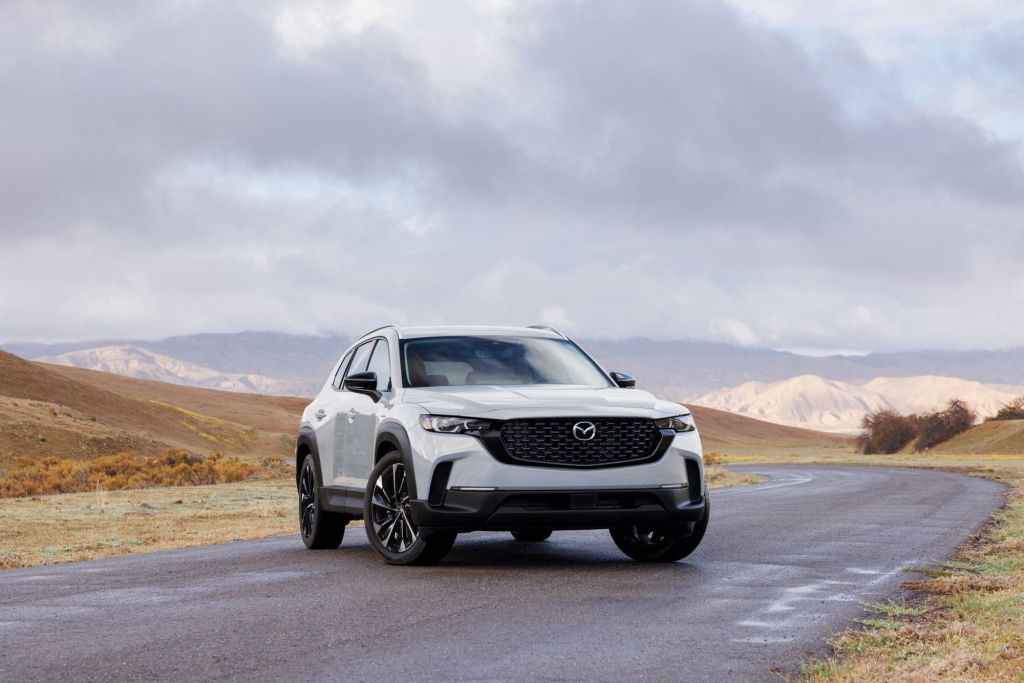
Mazda CX-50 compact crossover with a hybrid powertrain. (Image: Mazda)

And it would hard to believe that it is just a coincidence that the hybrid system—which includes a 176-hp 2.5-liter four-cylinder engine supplemented by three AC motors, so that there is a total system output of 219 hp—is one that is spec-wise just like the hybrid in the Toyota RAV-4.

(Curiously, the Corolla Cross is available as a hybrid, too, yet its system is different than the one that is used in the CX-50. The RAV-4 is built in the Toyota plant in Georgetown, Kentucky. Although one might think that it would be closer to go from Apollo to Discovery (or vice versa), turns out the hybrid system isn’t sourced from Kentucky but is sourced from Japan.)

It has a continuously variable transmission. It is all-wheel drive.

The vehicle is stickered at 39 mpg city, 37 mpg highway and 38 mpg combined.

Style

From the standpoint of the exterior, the compact crossover has the Mazda sheet metal styling that shows skill in creasing sheet metal, but perhaps because Mazda has been using this approach for a while on its range of vehicles, it isn’t as visually striking as it once was. Or maybe it has something to do with the fact that the Hyundai Tucson and Kia Sportage have become more visually striking and so the Mazda doesn’t have the standout looks it once had.

On the inside, especially as this is the top-of-the-line Premium Plus trim, there are things like leather for the seats and steering wheel. The instrumentation is laid out in a stylish and useful manner. There is a 10.25-inch display that is controlled by a large horizontally oriented knob in the center console. I would strongly recommend that if you’re interested in this vehicle and take it out for a test drive that you test drive that setup because some find it to be somewhat unwieldy.

Size

The CX-50 has a 110.8-inch wheelbase. It is 186.1 inches long, 75.6 inches wide and 65.8 inches wide.

So far as cargo: fold the second row and get 56 cubic feet. Behind the second row there are 29 cubic feet. As that is probably hard to visualize, simply know that there is plenty of room back there without folding the seats.

Assessment

The people in Mazda marketing probably cringe when people bring up the old “Zoom-Zoom” line.

If you’re interested in that, this isn’t the place to find it.

But if you want to get an efficient compact crossover, this is something that should be considered.

2024 Toyota Tacoma Trailhunter

This Tacoma variant is one bad-ass machine. . .

By Gary S. Vasilash

With the 2024 Tacoma, the reengineering of what has long been the most popular—by a lot—truck in its midsize segment* Toyota product planners decided to make the market for the pickup as broad as possible by providing versions of the truck that cover the terrain in terms of price point and in terms of the way the truck is fitted out, be it someone who is looking for something they can drive to the supermarket or someone whose drive to the supermarket takes them over the valley and through the woods.

There are 11 variants, six with a 2.4-liter, four-cylinder turbocharged engine and five with the 2.4-liter supplemented with a hybrid system. The non-hybrid versions have either up to 228 hp and 243 lb-ft of torque or 278 hp and 317 lb-ft of torque. The hybrid version adds a 48-hp electric motor so that the combined horsepower in 326 and 465 lb-ft of torque. There are models with an eight-speed automatic transmission and models with a six-speed manual.

There are the SR, SR5, TRD PreRunner, TRD Sport, TRD Off-Road, Limited, TRD Sport i-FORCE MAX, TRD Off-Road i-FORCE MAX, Limited i-FORCE MAX, Trailhunter, and TRD Pro.

Sheldon Brown, Tacoma chief engineer, on these variants: “Each one has a distinct focus on the core purpose of the grade and uses hardware-, spec- and performance-based turning to deliver that unique experience more so than in the past.”

Common Elements

Having visited the Toyota Technical Center in Michigan during the development of the vehicle I can testify to the extent to which the development team did benchmarking and performed careful consideration of making each of the variants more than some trim modifications here and there.

What is consistent across the board is that the truck uses a boxed, steel-ladder frame. The Tacoma is based on the Toyota TNGA-F global truck platform, which means that it has the same underpinnings as the Land Cruiser, Sequoia, and Tundra, and forthcoming 4Runner.

Styled at the Toyota CALTY Design Research studio in California, Kevin Hunter, who heads that facility, said the design theme for the truck is “badass adventure machine.”

Again, yes, you can use it to pick up some cereal, yes, you can use it to traverse some rocks and logs, and either way, regardless of what model you pick, this is still something that looks like a truck, not something styled to be soft and silky.

The Trailhunter

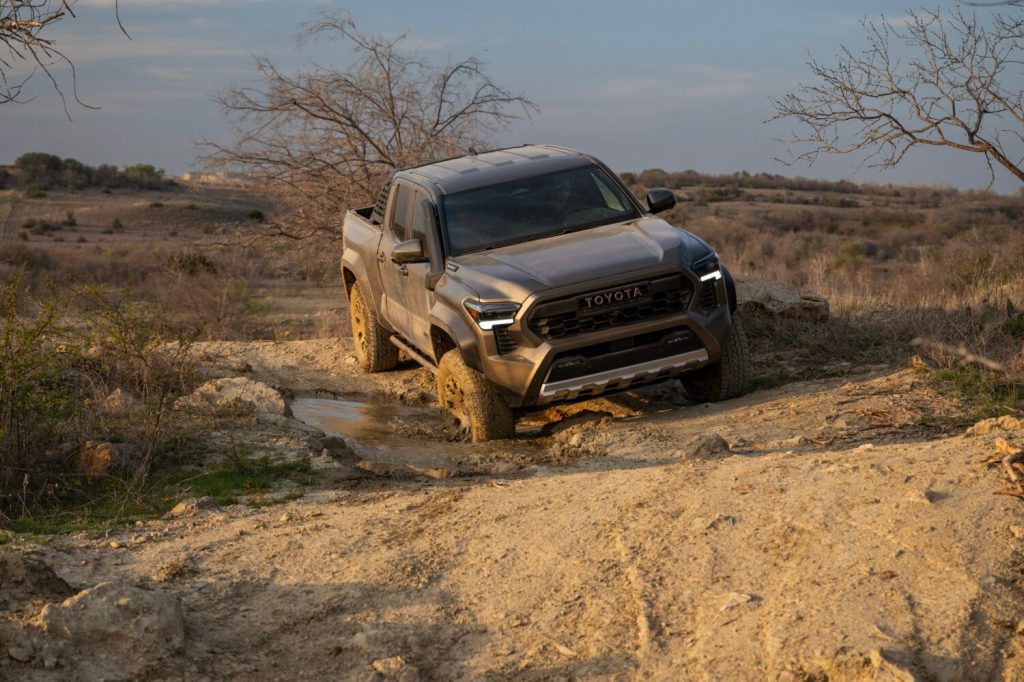
2024 Toyota Tacoma Trailhunter: Engineered to get dirty. (Image: Toyota)

Of the lineup, the Trailhunter is certainly one that not only has the style but the stuff for, well, trail hunting, assuming that that activity requires driving places that are otherwise places were people don’t usually find themselves.

This model is a double cab configuration with a five-foot, aluminum reinforced composite bed.

ARB & Toyota

The vehicle comes with ARB high-performance Old Man Emu 2.5-inch forged monotube shocks. (Evidently the shocks are named after the large, flightless, Australian bird that can traverse difficult terrain at considerable speed. No, I don’t get it.)

Those shocks aren’t the only thing that ARB and Toyota collaborated on for the Trailhunter. The rear bumper is another, constructed with 2.5-mm thick steel that’s powder coated for durability. There are two red recovery points, two jack points for an off-road jack, and non-slip step pads.

Also, there are MOLLE sail panels that are attached to the truck so that there can be a variety of overlanding gear can be attached to them.

There are 33-inch Goodyear Territory Rugged Terrain tires wrapped around 18-inch bronze-finished alloy wheels. The bronze theme is also picked up on the heritage-style grille, although the integrated LED light bar is certainly not vintage, nor are the RIGID Industries LED fog lamps.

Also on the exterior are rock rails and, should you look under the truck, high-strength steel skid plates.

Selectable Settings

The Trailhunter has a push-button Stabilizer Disconnect Mechanism that increases the suspension articulation front and back.

There is also Multi-Terrain Selection which operates in 4WD High and 4WD Low. Depending on terrain selection (mud, dirt, sand) the system helps control wheel spin. There is an electronically activated locking read differential.

The Trailhunter also offers CRAWL Control: set a (slow) speed and it works as a cruise control system so you can concentrate of maneuvering the vehicle. And on the subject of maneuvering, there is the Multi-Terrain Monitor that shows what’s ahead of the truck on a 14-inch touchscreen.

One of the most-striking things about the interior design of the Trailhunter is found on the dashboard and center console. Yes, this is a completely technologically up-to-date vehicle.

But rather than having the driver needing to select things on the screen or via what seem to be rather paltry buttons, the knobs, switches and buttons in the Trailhunter are rugged and robust: You know that you are in a highly capable machine.

Which, presumably, is the point.

One More Thing

The Trailhunter is a hybrid. And only a hybrid. Toyota knows it can get the job done.

==

*In 2023 in the U.S. Ford sold 39,364 Rangers, Chevy 45,562 Colorados, GMC 14,831 Canyons, and Toyota 234,768 Tacomas.

The So-So Sales Experience

You may be surprised at brands that aren’t making new-vehicle buyers all that chuffed. . . .

By Gary S. Vasilash

Maybe it has something to do with comparatively low numbers.

The J.D. Power 2024 U.S. Sales Satisfaction Index (SSI) Study ranks Porsche, for the second year in a row, as having the most satisfying sales experience. It has a score of 851 out of 1,000.

Industry average is 818.

In the first nine months of 2024 Porsche delivered 61,471 vehicles in North America (so this is the U.S. and Canada and Mexico).

The brand that arguably built itself on customer satisfaction, Lexus, is below average in SSI, at 812 (putting it in a tie with Mercedes, and putting those two above only Alfa Romeo at 810 and Genesis at 781).

In the first nine months of 2024 Lexus delivered 248,200 vehicles in the U.S. (just U.S.)

(And Mercedes sold 264,600 in North America.)

There are 202 Porsche dealers in the U.S.

There are 244 Lexus dealers in the U.S.

So, assuming (unrealistically, of course) that each dealership sold the same number of vehicles during the first nine months:

• Porsche dealer: 304 vehicles
• Lexus dealer: 1,017 vehicles

Needless to say, the people working at the Lexus dealership is a whole lot busier.

According to J.D. Power: “Buyer satisfaction is based on six factors (in order of importance): delivery process; dealer personnel; working out the deal; paperwork completion; dealership facility; and dealership website.”

You know: the regular routine of going in to buy a car, which is often not unlike going to an endodontist for some serious work.

Now certainly there probably isn’t a tremendous amount of cross-shopping between a Lexus store and a Porsche facility: the least expensive Lexus is a UX, which starts at $37,515 and the least expensive Porsche is a Macan, starting at $62,900.

But the SSI puts Lexus behind (in order): Infiniti, Jaguar, Acura, Land Rover, Lincoln, Volvo, Cadillac, BMW, and Audi, which are cross-shoppable.

What is also surprising is that Toyota brand, which competes in the “Mass Market” SSI category, is also third from the bottom, above only Mitsubishi and Chrysler—and with 777 points, it is well below the segment average of 798 and remarkably below the leading marque, MINI at 829.

Of course, MINI had sales of just 17,552 in the first nine months of 2024, which is a fraction of Toyota’s 1,481,319. Still, that puts Toyota well behind other mass market brands like Ford (805 points), which sold 1,473,642 vehicles through Q3.

Product, which Lexus and Toyota certainly have, is one thing.

Getting people to buy those products while feeling good about the experience is another thing entirely.

Seems like the folks in the sales department of Toyota Motor North America have some work on their hands.

2025 Toyota Crown Signia Limited

Crown is taking the place of other Toyota nameplates and is doing a good job at doing so. . .


By Gary S. Vasilash


There are probably more people who are familiar with the Roxy Music album of the same name than the Avalon, Toyota’s former top-of-the-line sedan in the U.S. market.


Which is a shame because the Avalon, which was introduced in model year 1995 and had a five-generation run until it became unavailable in the U.S. market, was, year in and year out, generation after generation, a fine automobile.


Perhaps a problem for the flagship that it was simply eclipsed by the Toyota Camry which, year in and year out, generation after generation (it is now the ninth), simply sold in tremendous numbers.


Someone would walk into a Toyota dealership and likely drive out in a Camry because it probably took little in the way of convincing. But for another car that cost a few thousand more, nice as it was, the persuasion would have been more challenging. So if you were a commissioned salesperson, wouldn’t you take the path of least resistance? (It has been the best-selling sedan in the U.S. for 22 years running, and this year it will likely notch 23.)


The product planners at Toyota know they need to have something at the top of the line. Something that isn’t the Camry XSE AWD (the highest trim level of the eight available).


For model year 2023 Toyota introduced the Crown to the U.S. market, the top-of-the-line that was the Avalon replacement.


Initially the Crown was positioned as a sort-of hybrid crossover, with the “sort-of” predicated on what it called a “lift-up” design.


As Toyota put it: “Crown has a raised overall height that’s nearly four inches higher than Camry. The unique height of this sedan offers increased road visibility, along with easy entry and exit.”


But sort-of isn’t enough.


So for model year 2025 Toyota is adding the Crown Signia to it lineup. This vehicle is categorized as an SUV.


And just as the Crown replaced the Avalon, the Signia Crown replaces the second-generation (the all-hybrid one that had a run from model years 2021 to 2024) Venza.
Clearly the “Crown” moniker, which has been a fixture in the Toyota Japan lineup since it went into production in 1955, is taking its place in the U.S. market in a notable way.
The Crown Signia is quite an impressive vehicle.

If there is any problem that the Crown Signia may have (though not for me) it is that the roofline resembles a small wagon more than an SUV. (Image: Toyota)


No, this is not because its hybrid powertrain’s 240 combined net horsepower (188 hp from the four-cylinder engines and the balance from its 134 kW front and 40 kW rear permanent magnet synchronous electric motors) or from its standard electronic on-demand all-wheel drive (it works when it needs to; the driver need not engage buttons or knobs or tap a selection of the 12.3-inch infotainment screen).


It’s not because it has the capability of towing 2,700 pounds or, with the second row seats folded, a 6.5-foot long cargo area.


It is because it is clear that the level of attention to detail executed in both the exterior and interior designs bring to mind the style and sophistication that had been characteristic of the Avalon.


For example, the leather-trimmed seats that are in the Limited grade have double-stitching, quilting and fillet piping. While leather seats can provoke a shrug, it is the fact that there is the double-stitching, quilting and fillet piping that takes them to a level that is not characteristic of an offering from a mass-market brand.


The vehicle as-driven has an MSRP of $51,799. That’s $47,990 for the vehicle and the remainder for the options. (There is also an addition of $1,450 on top of the $51,799 for delivery and handling.)


The options include things like premium paint ($425) and mudguards ($155). The biggest one if the advanced technology package ($1,865), which includes things like various sensors and monitors and associated functions.


So it comes to $53,249, certainly a reasonable sticker for what is a premium hybrid.

The Cost of Tariffs on Auto

“By means of glasses, hotbeds, and hotwalls, very good grapes can be raised in Scotland, and very good wine too can be made of them at about thirty times the expense for which at least equally good can be brought from foreign countries. Would it be a reasonable law to prohibit the importation of all foreign wines, merely to encourage the making of claret and burgundy in Scotland?”—Adam Smith, The Wealth of Nations

Here’s something to think about regarding the possibility of tariffs and how they will affect vehicle pricing and/or availability.


David Christ, group vice president, general manager-Toyota Division, Toyota Motor North America, pointed out yesterday (the day after the election) at a meeting of the Automotive Press Association, that Toyota has 10 manufacturing plants in the U.S. It is building its 11th in North Carolina that will open in 2025 for the production of batteries for electrified vehicles. A $13.9-billion plant.

Certainly a solid U.S. footprint. It employs some 49,000 in the U.S.


Christ said an issue with tariffs is that things not necessarily visible to the end consumer—like parts—can have a big effect.


He said, for example, that the Camry is about 90% U.S. by content. But that means 10% comes from out of the country.


That’s because Toyota, like other manufacturers, has a global supply chain.


OEMs don’t make everything that goes into their vehicles. And suppliers of components not only have to find the lowest-cost places to produce their products, but they need a sufficient number of customers for a given part to be produced in a given plant, so with those two factors they are likely to be located somewhere that isn’t necessarily the U.S.


So regardless of the high level of domestic content, that 10% will drive up the cost of the car.

Who benefits from that?


For customers, this makes the vehicle less affordable.


A costlier vehicle might mean fewer of them are purchased.


Fewer cars purchased means fewer cars built.


Fewer cars being built means fewer hours are necessary for people to work.


The trail of consequences continues. Makes you want to reach for a domestic claret or burgundy.


And while it might be thought that this is something that is not an issue for the traditional domestic manufacturers like Ford and General Motors, it is worth noting that in the 2024 Cars.com American-Made Index, which takes into account assembly location, parts content, engine origin, transmission origin and U.S. manufacturing workforce, the top-10 most-American vehicles are:

  1. Tesla Model Y
  2. Honda Passport
  3. VW ID.4
  4. Tesla Model S
  5. Honda Odyssey
  6. Honda Ridgeline
  7. Toyota Camry
  8. Jeep Gladiator
  9. Telsa Model X
  10. Lexus TX

What you don’t see is either Ford or General Motors. And as Jeep is owned by Stellantis and as Stellantis is headquartered in Hoofddorp, Netherlands, it can no longer be considered a “traditional domestic.” But the folks that build the Gladiator in Toledo, Ohio, still certainly are.


(In case you are wondering: the highest-ranking vehicle from GM is the Chevy Colorado, at #23. Ford makes it at #29 with the Lincoln Corsair. Which means the cost of tariffs would be higher for them.)


“Free and fair trade is the best way to go,” Christ said.


Adam Smith wrote The Wealth of Nations in 1776. That idea has been kicking around for quite some time.

About Automotive Loyalty

Put out good products, and people will come back and buy. . .

By Gary S. Vasilash

J.D. Power has a simple way to calculate customer loyalty to a brand.

Not easy.

But simple.

That is, it gets information from some 16,000 dealers about sales.

Then it creates a subset of those sales: Those that included a customer replacing an existing vehicle with a new one.

Then it creates a subset of that: Those transactions in which the old and new are the same brand.

And so it has released its “J.D. Power 2024 U.S. Automotive Brand Loyalty Study” based on sales between September 2023 through August 2024.

The study includes some things that might be expected and some surprises.

As for the expected: Porsche is the highest-ranked Premium Car and Ford has the high-ranked Truck.

But then things get interesting.

As in the top brand for loyalty in the Premium SUV category: Lexus.

And the Mass Market SUV isn’t something from Ford or GM but Honda.

When it comes to Mass Market Car, the top two are Toyota and Honda.

Of course, when it comes to Mass Market Cars you can’t get one from Ford or GM, as they have abandoned the segment.

Here’s the thing: in the first half of 2024

  • Toyota sold 277,233 Camrys and Corollas
  • Honda sold 210,509 Accords and Civics

I suspect that both companies are making some money on those vehicles.

What’s more, as Lexus is a Toyota brand and as Honda is, well, Honda, they are doing well loyalty-wise when it comes to their SUV offerings, too.