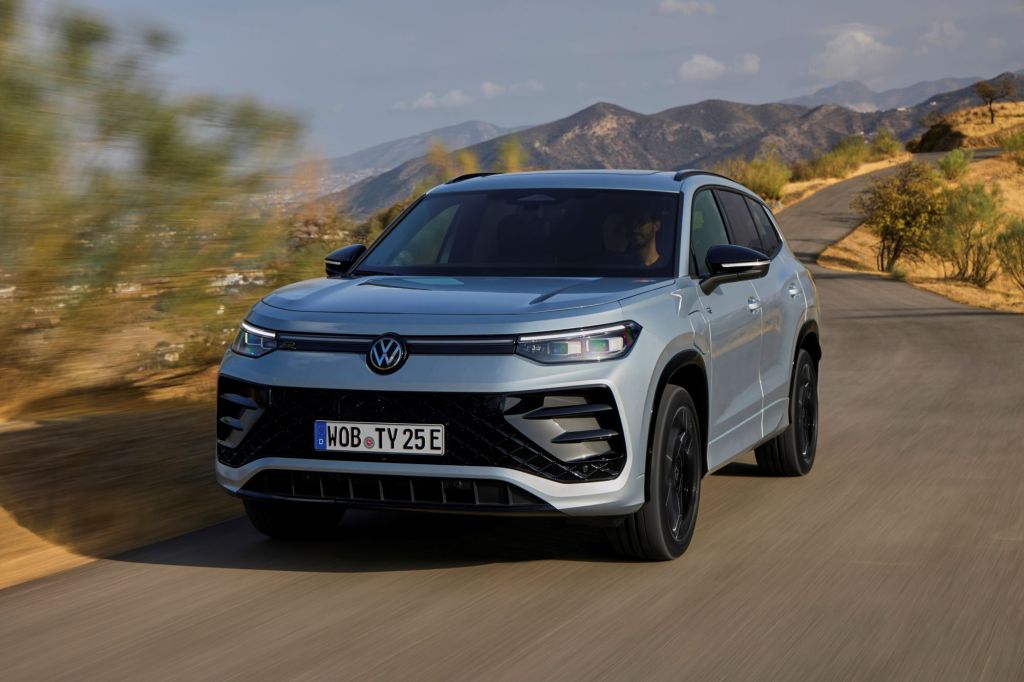
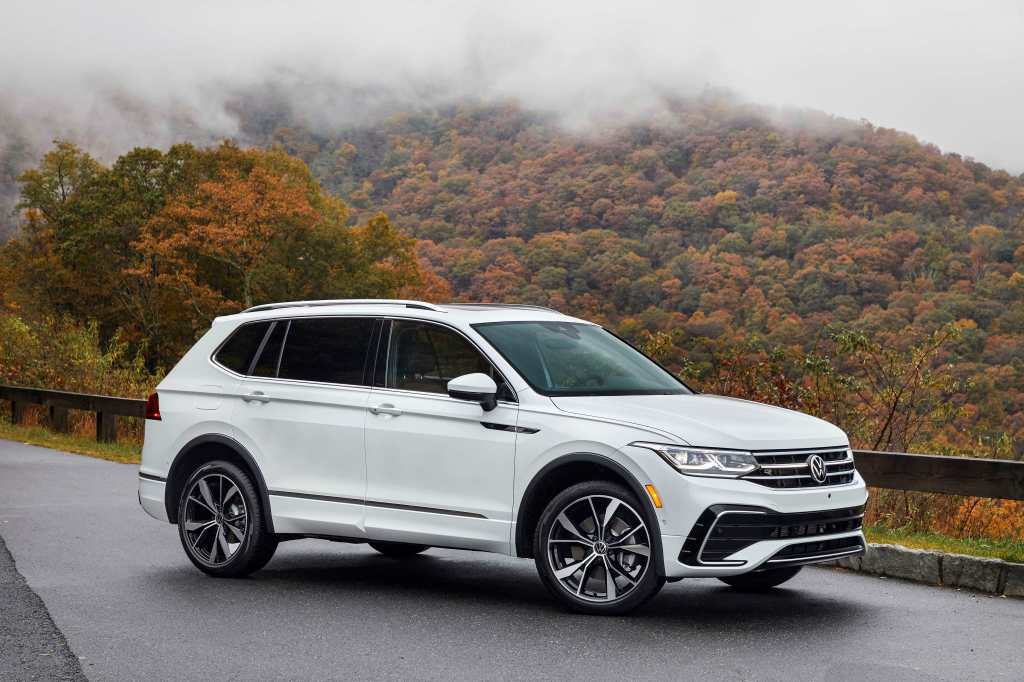
Some have thought that the Tayron will become the Tiguan.
The next-gen Tiguan will be on the long-wheelbase configuration for the Tayron.
But the Tiguan will, according to VW of America, have significantly different “sheet metal, powertrain options and equipment set.”
In other words, for ordinary people who don’t care about things like platforms, the U.S. Tiguan is a completely different vehicle than the European Tayron.
That said, the Tayron, which is available as a five- or seven-seater, is an interesting vehicle, largely because of the powertrain choices.
There will be:
A mild hybrid based on a 148-hp engine
Two plug-in hybrids, each of which will offer an electric range of over 100 km (62 miles)
Two turbocharged diesels
The Tayron will be slotted between the Touareg and the Tiguan in the European market.
The Touareg, a premium crossover, hasn’t been available in the U.S. market since model year 2017.
However, the U.S. has both the Atlas and the Atlas Cross Sport, which the Euros don’t have.
The next Tiguan will be announced at the LA Auto Show in November.
Most people need transportation but don’t necessarily want to compromise on how they achieve it but don’t want to be crushed by the sticker price. Enter the Jetta. . .
By Gary S. Vasilash
Cox Automotive’s “Auto Market Snapshot” for October 3, 2024, has it that the average used vehicle listing price was $25,172 (updated 9/20/24) and the average loan rate for a used car was 13.91%. And the average new vehicle listing price was $46,841 and the loan rate was 9.51%.
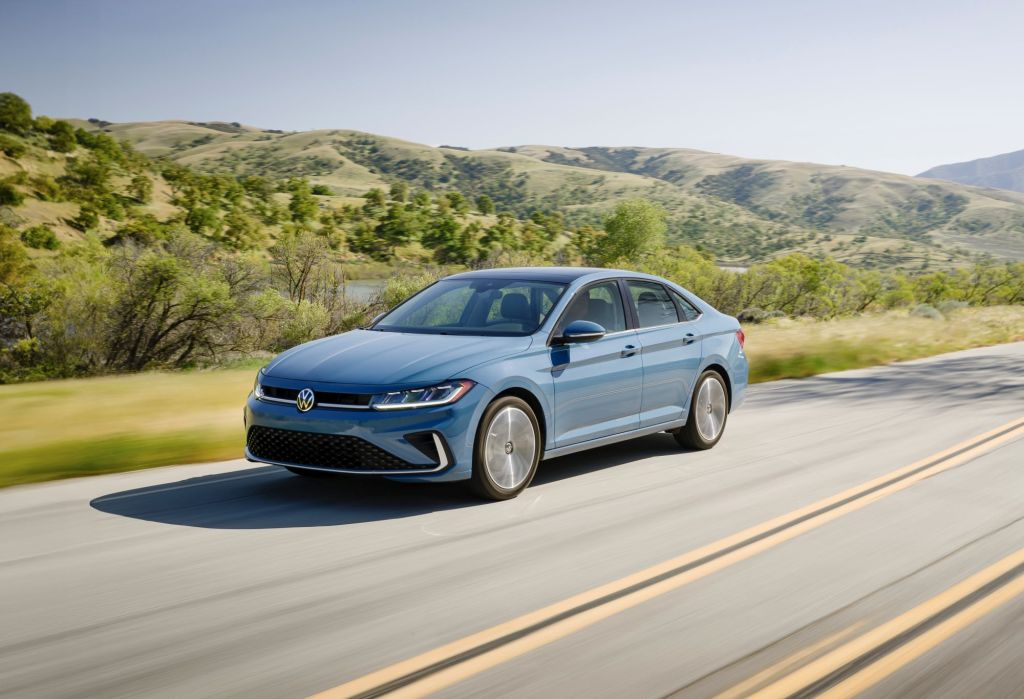
So taking those numbers into account, I am exceedingly impressed with the MSRP for the 2025 Volkswagen Jetta 1.5 SEL: $29,000. (Adding destination bumps it to $30,225).
Now were you to buy a used car at that average listing price of $25,172 and get a five-year loan fat the 13.91% rate (assuming nothing down) that vehicle would end up costing $34,929.
If you were to buy a brand-new 2025 Jetta for $30,225 and finance it for five years at 9.51% (again, assuming nothing down), you’d pay $38,320.
Or, a difference of $3,391 over the five-year period, or $678.20 per year.
Somehow it seems that ponying up $56.52 per month is well worth it for getting a car that is really quite impressive—and if you took at the average new vehicle listing price of $46,841, that $29K MSRP cannot be overlooked when the Jetta is a complete package.
2025 Volkswagen Jetta. (Image: VW)
When it comes to VW sedans, the compact Jetta is the proverbial last-man standing. The Passat, which the company once hoped would be its answer to the Toyota Camry and Honda According, went out of production in the U.S. after model year 2022.
Then there was the Arteon, model year 2024 was it in the U.S. for the upscale-but-affordable sedan.
This goes to the point that the U.S. is a tough market for sedans, especially when companies, including VW, are promoting their electric SUVs (the ID.4 in VW’s case), or their ICE SUVs (the Atlas, Atlas Cross Sport, Taos, and Tiguan, in VW’s case).
But apparently there are some people who recognize that the Jetta is a vehicle that fits their needs.
That is, in Q3 2024 in the U.S. there were 19,379 Jettas sold—making it the second best-selling vehicle in the VW lineup, with the Tiguan taking first place, at 21,231. This means the Jetta outsold the Atlas, Atlas Cross Sport, Taos, and ID.4.
Notably, compared with Q3 2023 the Jetta sales are up 35%, the biggest percentage increase of any of the VW vehicles.
This may go to the point of Cox’s findings about the high prices of vehicles nowadays.
The thing about the Jetta is that this is a completely competent vehicle, and that is not damning with faint praise.
The SEL is the top-of-the line Jetta. The S starts at $21,995, which is certainly something that plenty should consider (i.e., $3,177 less than that used vehicle).
But the SEL has much of the “stuff” that people want in a new vehicle—heated and cooled leather front seats (heated in the two back positions), a sunroof, 10.25-inch screen with navigation, BeatsAudio. . .
There is a 1.5-liter, turbocharged, direct-injection engine that provides 158-hp mated to an eight-speed automatic that offers both a sport mode and paddle shifting. The front-drive car is surprisingly peppy.
Adaptive cruise control, lane keeping assist, blind spot monitor. . .these and other tech-based features are part of the package.
The styling is more sophisticated than sporty or extreme: it is a design that won’t age fast.
It is sometimes said that kids swerve from the types of vehicles their parents owned.
So it went from sedans to minivans to SUVs. Perhaps we are getting to a point of a full circle.
The Jetta is certainly a good reason why that could be the case.
Römers understands the importance of first impressions. . .
By Gary S. Vasilash
“Polestar is the role model of a design-driven automotive company and it’s a great honor to take on the responsibility for the Design department. I’m looking forward to working with the creative team to design the next generation of Polestar cars,” said Philipp Römers, who is taking the Head of Design position at the electric vehicle company, succeeding Maximilian Missoni.
Römers is moving to the company from AUDI AG. He has been with the Volkswagen Group for the better part of his career. (He had had a stint at Ford.)
Born in Cologne in 1979, Römers studied transportation design at Pforzheim University.
He started at Volkswagen in 2005, where he designed exteriors for models including the Golf 7 and the Passat B8.
Philipp Römers, new head of Design at Polestar. (Image: Audi).
Then he moved from Wolfsburg to Ingolstadt in 2014, where he led teams developing the Audi A3, A6 and Q8.
And undoubtedly his work in the Audi e-tron and the e-tron GT, both electric, will serve him well in his position at Polestar.
While at Audi Römers said:
“The very first thing that people who are interested come into contact with is still the exterior. It has to arise desire. Ultimately, the first impression is decisive with respect to whether someone stays or just walks away, zooms in on their screen or quickly keeps browsing. Ideally, aesthetic form and function are combined.”
“Your typical city involved in a typical daydream. . . .”
By Gary S. Vasilash
Dead & Company played 30 shows at the Sphere in Las Vegas in July and earlier this month to legions of dedicated Deadheads, a large percentage of whom are pushing into or out of their middle years.
The venue seats 18,600 people, so over 30 shows that means 558,000.
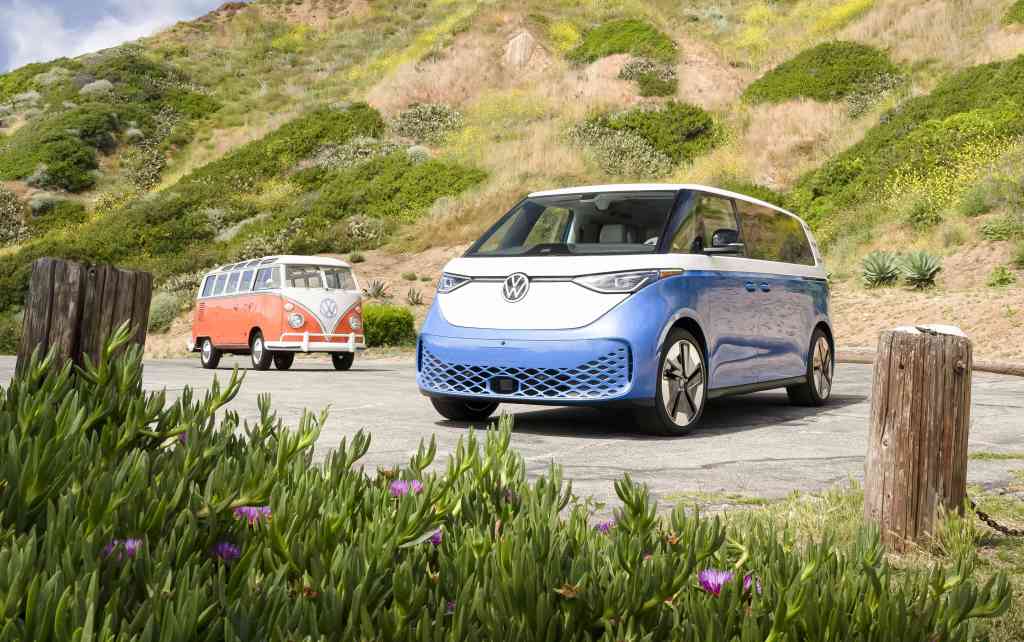
The Microbus and the 2025 VW ID. Buzz. (Image: Volkswagen of America)
Presumably a percentage of them will be interested in the Volkswagen ID. Buzz, the electric evolution of the beloved Microbus.
Almost a built-in audience for the band. (Which didn’t go unrecognized by VW, as it had a display of the vehicles—old and new—at the Sphere.)
VW has revealed the EPA-estimated range for these EV vans, which will become available in the U.S. later this year.
Rear-wheel drive models will achieve 234 miles, while the 4Motion (a.k.a., AWD) models will go 231 miles before charging.
That three-mile difference is not a big deal, even for those who have a history of racking up many miles following their favorite musicians, be they the Dead or otherwise.
There are there models in the lineup:
Pro S. It is a RWD model that starts at $59,995
Pro S Plus. This starts at $63,495 for RWD. The AWD model starts at $67,995.
1st Edition. This is the special setup. It starts at $65,495 for RWD and $69,995. This is the one that the people who are really interested in tributes—to the Microbus, not necessarily Dark Star Orchestra or Bearly Dead—as it comes in two-tone pain schemes: Candy White top with Cabana Blue, Energetic Orange, Mahi Green, Metro Silver, or Pomelo Yellow below. All would look good with a dancing bear sticker or several. And just as important as the look is the sound: a 700-Watt harman/Kardon audio system.
“Chicago, New York, Detroit and it’s all the same street. . . .”
The Volkswagen Touareg was first available in the U.S. and pulled from the market in 2018. The rather, um, exotic name refers to a Berber tribe that inhabits the Sahara. It was, after all, a midsize luxury SUV, so this whole nomadic adventuring what presumably descriptive in the naming.
It probably had more than a little something for the vehicle not being as successful as had been hoped in the burgeoning SUV-crazy U.S. market.
Many people probably didn’t know how to say it (phonetically: “two-are-egg”), so rather than embarrass themselves at a VW dealership they went and bought a Ford Edge.
But one of the characteristics of the Touareg—which continues to exist in other markets—that I recall with respect is that it was substantive. This was a solid SUV, not something that was fundamentally a car in SUV’s clothing.
It was the sort of vehicle that you could imagine rolling across the Sahara.
Not that you would, of course, but in the event that you suddenly found yourself in North Africa you’d be good to go.
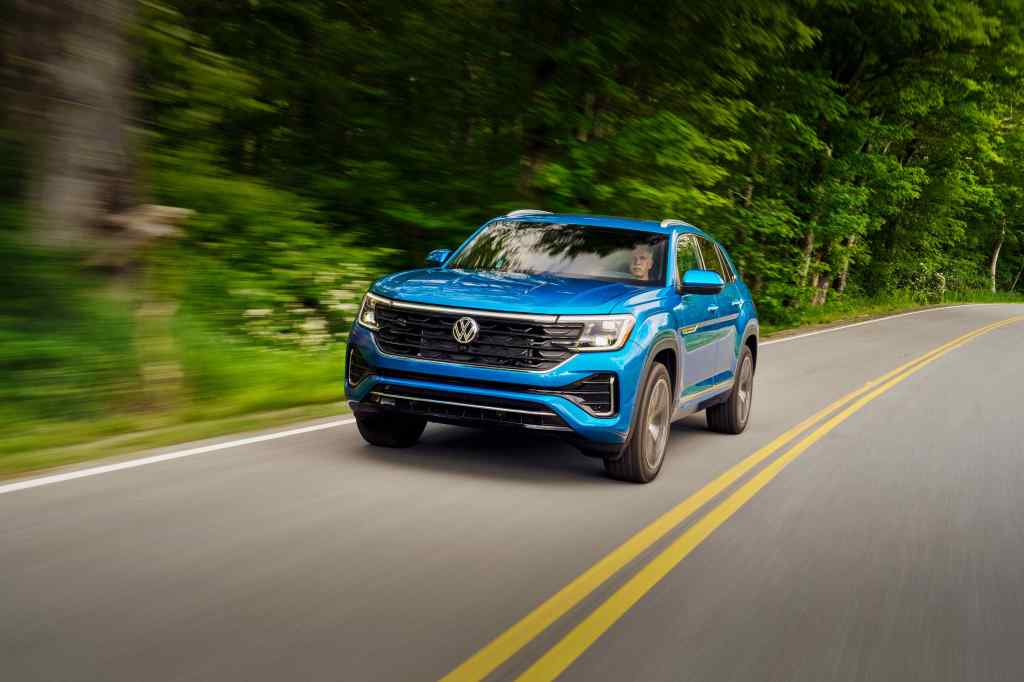
While l am not 100% confident that the Atlas Cross Sport could go trekking though sand dunes, one of the things that struck me about it is that compared to some other SUVs I’ve been in of late, this really feels well-built. . .and it so happens to be built by Volkswagen in Chattanooga, Tennessee.
When you shut the door you think “vault” not “vague.” When you drive the Atlas Sport you think “capable” not “cheap.”
It is, simply, the real deal.
What’s more, in a category where there is such proliferation of models that there is a stultifying sameness, there is another word that comes to mind, which is “style.”
I don’t want to go completely overboard on this, but the Atlas Cross Sport is an SUV that deserves more consideration that it evidently gets.
I say “evidently” because it is a, well, sportier variant of the Atlas. And in Q2 2024 the Atlas outsold what the Atlas Cross Sport did for Q1 and Q2 combined:
Atlas Q2: 19,293
Atlas Cross Sport first half: 18,835
And I suspect that the difference has to do with these numbers:
Atlas: three rows
Atlas Cross Sport: two rows
and:
Atlas: 96.8 cubic feet of cargo with seats folded
Atlas Cross Sport: 78 cubic feet of cargo with seats folded
I guess you could sort of say it is the difference between a pair of Timberlands and Louboutins (of course, the Cross Sport styling isn’t quite that exotic, but you get the analogy).
The Cross Sport is powered by a turbocharged 2.0-liter engine that produces 269 hp and 273 lb-ft of torque. It is mated to an eight-speed automatic. This model has AWD.
The stickered fuel economy numbers are 19 mpg city, 26 mpg highway and 22 mpg combined.
An important characteristic for a vehicle in this class: it has 5,000 pounds of towing capacity.
While the interior is well adorned with serious-seeming-but-attractive materials and there are metal-clad pedals that signify that you’re in R-Line trim, the interface for the 12-inch touchscreen is too fussy for purpose. (Funny thing: many OEMs seem to think that they know how create the digital interfaces for their vehicles, yet compared to companies in that field they just don’t: consider that while Waymo’s first vehicle, the Firefly, was purpose-built, that quickly gave way to vehicles from the likes of Stellantis and Jaguar because Waymo understands what its competencies are.)
There is a vast array of midsize SUVs out there. Lots to consider. Probably too many to reasonably consider.
But while things like Beetles still remain in the consciousness of many Americans and while Golfs are out there in number, these smaller vehicles should not make one not checkout something larger, the Atlas Cross Sport.
A special edition of a special (as in “uncommon”) type of car
By Gary S. Vasilash
Sets are collections of objects, or elements. And the Jetta GLI is an interesting study in that it belongs to the set of automobiles, then that of sedans, then that of performance sedans, then that of performance sedans with a manual transmission.
VW Jetta GLI: quick car . (Image: VW)
While set theory in mathematics is essentially neutral (I mean, people aren’t going to get worked up about things like prime numbers), the Jetta GLI set is a rather interesting one.
That is, take sedans and the Motor City Three (MC3).
Over at Stellantis, there was the Dodge Challenger, which went out of production at the end of last year.
At Ford, there’s nothing.
General Motors, there are a few offerings. Chevy still has the Malibu, but that ends at the end of this year. Cadillac is where you’ll find sedans, with the most economical being the CT4, which has a starting MSRP of $35,990, which is certainly a good price for a Cadillac. What is somewhat unusual is that while there seems to be this notion that no one wants sedans anymore, the ultra-uber halo Cadillac Celestiq, which went into production earlier this year and which has a starting price of some $340,000, is a sedan. (Maybe the rationale is that because so few will be hand-built and sold, this almost provides credibility to the claim about people not wanting sedans: the number of Celestiqs will be comparatively infinitesimal).
Then there’s the issue of the Jetta GLI being a performance vehicle.
That is, there is the regular Jetta, which comes in four trims—S, Sport, SE, and SEL—all of which are powered by a 1.5-liter, turbocharged four that provides 158 hp and 184 lb-ft of torque.
Then there is the GLI—which in model year 2024 is celebrating its 40th anniversary, which explains the trim on the model driven here calling out that achievement—that has a 2.0-liter turbocharged and direct-injected four that generates 228 hp and 258 lb-ft of torque. Given that the curb weight is 3,358 pounds, there is plenty of pep to drive the front wheels of the car. So while this may not be “performance” in the context of a Charger with a HEMI, it is still one in the context of a competitive set, all of which includes Asian brands, from Honda to Hyundai to Subaru to Toyota (all of which also provide vanilla versions of their Jetta-competitors, too).
Then there is the manual transmission. It is standard for the GLI. There is an optional seven-speed dual-clutch automatic.
It is not like the set of vehicles available with manual transmissions is tiny. Car and Driver, which has a campaign to “Save the Manuals,” which brings Quixote to mind, puts the number of car models with manuals available right now at 27—including the Jetta.
However, it seems as though the percentage of vehicles sold in the U.S. equipped with manuals is under 2%, so here we find a rather small subset.
Sedan→performance→manual→yikes!
The Jetta GLI is clearly—based on everything from the painted black alloys to the black-and-red color scheme on the interior—a car that is meant to show that it is built for go.
Which might make some people a bit reticent to even consider it: After all, even if you drive hard on the weekends, you probably have to drive somewhat more sedately during your daily drive for the other five days.
The GLI has all of the amenities that one can expect from a contemporary car, whether it is a solid audio system, infotainment setup, various safety sensors (for things like cross-traffic alert, blind-spot, etc.), or nicely bolstered front bucket seats.
But one of the things that is important—though probably not something that someone would admit to being important, were that person inclined toward something of a performance nature—is that it has a 14.1-cubic foot trunk. Yes, a good size to carry one’s gear and groceries.
And with a starting MSRP of $28,085, stuff is more attainable (i.e., the monthly payments won’t be crippling).
This is not a car for everyone.
But looking at those sets, clearly the people at Wolfsburg know that.
(And while of the subject of sets, here’s a bonus that might be good for bar trivia: the modern father of set theory is Georg Cantor, a German.)
It is not hard to imagine that at some point, as the issue of Dieselgate was still burbling like the surface of the La Brea Tar Pits, there was a meeting at Volkswagen HQ in Wolfsburg at which point someone smacked the surface of a conference room table and said, “Verdammt! We’re going to develop vehicles that are going to reestablish some green credentials for the company!”
So it set to work on its ID. line of vehicles. It introduced, in Germany, the ID.3, a small hatchback, in 2020. Because the company figured that Americans aren’t all that keen on small cars, its first in the new line of electric vehicles (there had been the e-Golf, but that was more of a novelty than a commercial product) for the U.S. was the ID.4, in 2021, a compact crossover.*
The ID.4 didn’t get much of a reception given that it was available with a maximum range of 260 miles, with most models south of that.
2024 VW ID.4. A highly credible EV crossover. (Image: VW)
A Pivot
The company dedicated to that proposition of going green has improved the ID.4 for 2024 in many ways, including improving the range to a maximum 291 miles (for the ID.4 Pro, driven here, and the ID.4 Pro S), which is close enough to that 300-mile mark that seems to be what people are looking for.
(And although the starting MSRP for the ID.4 Standard is $39,735 and it, like the others in the ’24 lineup, is eligible for the $7,500 federal tax credit, a 206-mile range probably is not a good thing from a marketing standpoint—not that that is the least range in an EV out there (the MINI Cooper SE is rated at 114 miles), but if someone goes into the dealership and hears that 206-mile number, they may be a bit turned off, even though for a few grand more they can get a model with an 82-kWh battery rather than the entry 62-kWh and get a more reasonable range.)
Performance
What’s more, the ID.4 Pro is peppy: the rear-drive model (VW points out that just like the original Beetle, the motor is in the back) produces 282 hp.
All of which is to say the range and performance have both been improved, so those who were lukewarm for the earlier entry may want to give the ’24 ID.4 consideration.
(And while this doesn’t strike me as a vehicle that anyone is going to be doing performance driving in—more likely something to load up with soccer gear or Costco cargo, and it can do a good job at that: cargo volume is 30.3 cubic feet behind the second row and 64.2 cubic feet with the seats folded—it does feature a vehicle dynamics control system that debuted on the Mk 8 Golf GTI.)
Driving
To drive the ID.4 one climbs into the driver’s seat while carrying the fob, then uses a stalk (similar to the automatic transmission gear selector of yore) to select forward or reverse by turning it. No key rotation or button push.
There is an option labeled “B.” This is for “Brake.” But what it does is increase the amount of regenerative braking automatically applied so that there is more otherwise-wasted energy put back into the battery. It doesn’t provide what’s known as “one-pedal driving,” meaning that when lifting on the accelerator the vehicle doesn’t come to a full stop. Apparently VW wanted a bit of normalcy for those who are used to driving vehicles with what is still by far the dominant form of propulsion.
Useful
Another thing addressed in the new model is the interface.
In the Pro (and other models) there is a 12.9-inch touchscreen interface configured for ready access to apps without layers of confusion. Along the top of the screen are icons for things like music, navigation, and battery; at the bottom there are HVAC settings. This means that regardless of what’s going on in the center of the screen, items that are regularly used are a finger touch away. Just below the display are illuminated touch sliders that can be used to adjust temperature although there is the ability to set the temp using the infotainment screen.
American-Made
An interesting thing about the ID.4 is that Volkswagen manufactures it in its plant in Chattanooga, Tennessee. It ranks #3 in the Cars.com 2024 American-Made Index. This not only means that it is the only non-Tesla in the Top 10, but Teslas aside, you have to scroll down the list to #56 to get to another Cars.com American-Made electric vehicle: the Ford F-150 Lightning. Yes, VW at #3, Ford at #56. Imagine.
All in all, the 2024 VW ID.4 is something that ought to be on the list of those who are considering a move to an EV.
(Why didn’t I simply say “on the list of those who are considering a new crossover”? Simple. In terms of size and capacity, the ID.4 is fairly close to the VW Tiguan, which has a starting MSRP of $28,880. And the VW Atlas, the largest SUV on offer, has a starting MSRP of $37,995. Yes, the $7,500 tax credit for the ID.4 makes it effectively less expensive than the Atlas, but the Atlas is still more substantive. You have to want to move to an EV.)
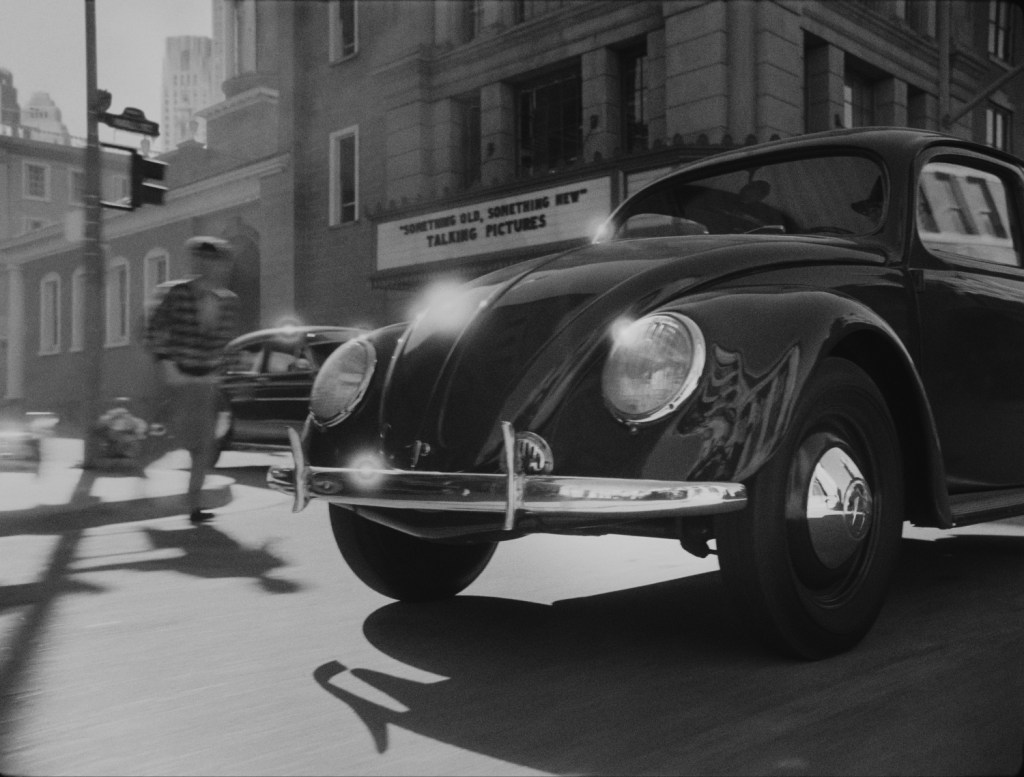
*VW has made a decided shift from cars to crossovers in the U.S. market, which has been improving its fortunes here. However, I’d argue that the company should have brought the ID.3 to the U.S. market. “But people don’t buy small cars,” you say. That is partially true, but you can still buy a Civic or an Elantra and others. What’s more, consider this: when VW brought the Beetle to the U.S. in 1949 it sold. . .two. But through the 1950s, when Americans otherwise weren’t buying small cars, to say nothing of small cars that looked like the Beetle, the vehicle managed to defy expectations. In a big way. And while on the subject of small cars, when GM was boasting about the number of EVs sold in 2023, the only vehicle that really made a difference to those numbers was the Bolt EV/EUV, which had sales of 62,045. As for the rest there were Silverado EV, 461; Hummer EV 3,244; Blazer EV, 482; Lyriq, 9,154. Yes, small cars can matter and I’d submit that VW could have done that with the ID.3.
Something you actually need to drive—assuming you are one of the remaining few who knows how that third pedal works in an era being increasingly characterized by one-pedal driving
By Gary S. Vasilash
“Wow! You should drive the wheels off that!”
Which isn’t the sort of remark that you’d ordinarily get when someone sees a parked car. Not even a muscle car.
2024 VW Golf GTI: Engineered to be driven. (Image: VW)
Especially not something when the guy saying it probably grew up watching muscle cars on Telegraph or Woodward.
It was clear that one look and he thought that it is a vehicle to be driven and everything else would just be icing on the cake.
He was looking at the VW Golf GTI.
In autodom in general the GTI is somewhat rare.
That is, it didn’t appear in the U.S. until 1983.
And while 41 years is a non-trivial number, there isn’t an abundance of the cars out there.
In 2023 Volkswagen of America delivered 7,451 GTIs.
Through Q1 2024 it has delivered 2,412, which is a 156% increase over Q1 ’23.
If it maintains the Q1 pace through the remaining three quarters it could reach 9,648 by the end of the year. As a percentage, a lot. But as tires on the ground, not so many.
And the reason is simple.
While the Golf in Germany* is still primarily a family car that is available with a variety of powertrains, the GTI is, quite simply, a car that it categorized by enthusiasts as a “hot hatch.”
The hatch configuration lends itself to, say, stocking up on things for the family. And with the rear seat folded the GTI offers 34.5 cubic feet of cargo capacity. Plenty.
But odds are Costco is not the destination for the car, especially not the Mk3 GTI 380, as it is equipped with a six-speed manual transmission.**
It is meant to have its wheels driven off. So to speak.
When the observation was made, even though the car was standing still the bright-red brake calipers seen though the gloss-black wheels inserted in the summer tires telegraphed the message that this car is meant to go.
And it does.
The transmission is mated to a 2.0-liter turbocharged engine that produces 241 hp and 273 lb-ft of torque.
It is a front-drive car. To help mitigate issues when getting on the accelerator therew is an electronically controlled torque-sensing limited-slip differential that keeps the car going where pointed.
There is something that strikes me as somewhat ironic about the GTI with the six-speed.
There are metal surfaces on the pedals. A massive metal dead pedal. It is a car that you have to, comparatively speaking, work at driving.
In effect, it is more “mechanical” that your run-of-the-road vehicle. And I mean that in a positive way.
Yet as this is a contemporary car it has, in the words of VW, a “technologically advanced cabin, which offers an integrated high-end digital experience.”
Yes, this means digital gauges for the driver and an infotainment system. Now obligatory.
But the thing that is amusingly odd that for being such a “mechanical” vehicle, the interfaces are not knobs and buttons but smooth, touch-sensitive surfaces.
If there is any car that really needs a large, knurled volume knob, it is the GTI.
//
*Whenever an auto plant is launched, politicians typically come out and make a speech. When the eighth-generation Golf went into production in Hall 12 of the Wolfsburg plant, Stephan Weil, Minister President of the State of Lower Saxony, made some remarks including, “I’m an absolute fan of the Golf and have myself been driving one for several years. For many people in Lower Saxony, the Golf is a piece of home and something they can identify with. Just like the VW Beetle was in the past, the Golf has been a symbol of mobility and freedom for decades. Since 1974, the Golf has made a significant contribution to the stability and growth of Volkswagen and industry in Lower Saxony.” During the past 50 years there have been more than 37-million Golfs sold around the world, of which more than half were produced in Wolfsburg. More of these cars are transportation vehicles rather than enthusiast cars.
**The GTI is also available with a seven-speed DSG automatic transmission with Tiptronic. The automatic is optional. Here’s something that seems, well, different. The MSRP for the GTI with the six-speed ranges from $32,685 to $40,825. But the MSRP for the vehicle with the optional seven-speed ranges from $31,965 to $40,505—less than the models with the manual. Presumably this has something to do with volume: something made in fewer numbers tends to have a higher price than something made in greater numbers. Or maybe it goes to the point that this is the final year there will be a manual in the GTI, so if you want it you’ve got to pay a bit more for the privilege.
The verb whelm means to roll over something so that it is submerged.
Which gives rise to the terms overwhelm and underwhelm, with the former being a sense of being overcome by something and the other, well, provoking a shrug.
However, it doesn’t seems as though whelm on its own has the sense of being in the middle of those two conditions, one being, in effect, excited and the other indifferent.
If you are submerged, then there’s a bit of overwhelming going on.
This exercise in the state of whelmedness is provoked by the VW Tiguan S, which left me feeling in a neutral zone between like and dislike.
It is just sort of there.
Some people give the compact crossover high marks for styling which resembles the midsize VW Atlas. While the Atlas is a handsome vehicle, somehow the scaling down the lines for the Tiguan doesn’t seem to be an distinct advantage for a vehicle that is competing in one of the most fierce of all, the compact crossover.*
VW Tiguan: Credible compact crossover. (Images: Volkswagen of America)
There are nice touches, such as the LED lighting fore and aft.
But inside—and recognize that we’re talking about the S, the base model, so that needs to be taken into account here—things are a little iffy.**
Like the 6.5-inch infotainment display that resembles what one found on a Game Boy—which has been out production since 2003. The backup camera display lacks the sharpness that is now common in vehicles in this category.
There is an 8-inch digital instrument display that, like displays when there were physical gauges, with needles that moved around a spindle, is nonconfigurable.
For years, German interior design was by far best-in-class. The fit, finish and particularly materials were top-notch, and it seemed as though this was not only an Audi thing, where it began, but was manifest just as well in Volkswagen products, too.
While there is still the appearance of this execution, the plastics are a bit, well, plasticly, which is not a good thing unless you are a fan of plastics. (Lest it be thought that I am being a bit persnickety about this, a friend, who is not in the auto business, climbed in the Tiguan and immediately commented about the “hard plastics.” Admittedly I wouldn’t have likely used his observation if it didn’t tally with mine, but that’s why you should take impressionistic reviews with a boulder-sized grain of salt, no matter what the source.)
Staying on the inside, as this is a front-drive version of the Tiguan (there are also AWDs), there are three rows of seats (the AWD version gets the more reasonable two): the first row with 40.2 inches of leg room, the second row with 36.6 inches of leg room and the third, with 27.7 inches of legroom—which really isn’t much in the way of legroom at all.
Cargo capacity, however, when you fold that third row flat is a good 33 cubic feet; with that seat up it is 12. If the second and third are folded it goes to 65.3 cubic feet, which means a lot of stuff can be swallowed.
Where German engineering comes to the fore in the Tiguan is under the hood. The 184-hp turbocharged four (mated to an eight-speed automatic) responds to right-foot input with remarkable alacrity. You want to merge: no problem. This was my favorite aspect of the Tiguan.
If there was a pleasant surprise, that is it.
Look: as stated, this is a tough category. But it is worth noting that the third-generation Tiguan will be introduced later this year, so. . . .
==
*This “familial resemblance” is something that many vehicle manufacturers pursue with their products, presumably thinking that if someone likes X but can’t afford it or X is the wrong size, then having W and Y that look like X is good. To be sure there can be cues from one to the other, but shouldn’t something have its own visual characteristics that make it special? The Beetle became the icon it did because it looked like nothing else, not something else.
Icons don’t look like something else.
**Car and Driver recently did a comparison of The Dodge Hornet, Ford Escape, Honda CR-V, Kia Sportage, Mazda CX-50, Nissan Rogue, Toyota RAV4, and VW Tiguan and the Tiguan came in number two. . .but it was the upper trim SEL R-Line model, so that needs to be considered.
Although the VW Golf is available in the U.S. only in performance-oriented variants—as in the Golf GTI and the Golf R—in other parts of the world it is also a car that is, well, a car.
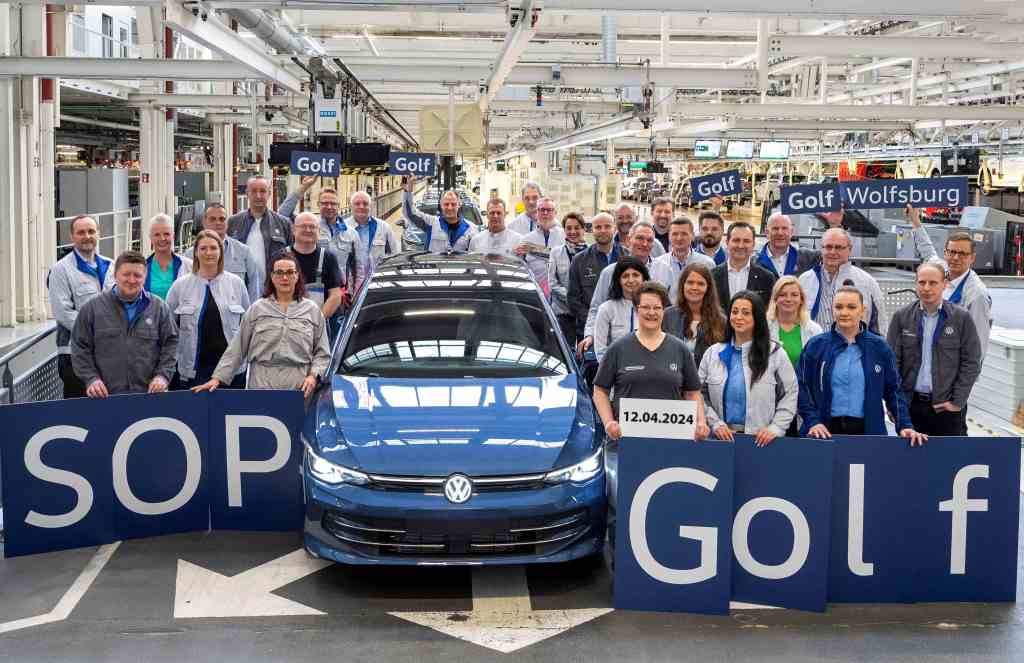
Last week at VW’s main plant in Wolfsburg, Germany, in Hall 12 of the complex, VW held a line-off ceremony for the refreshed 8th-generaiton Golf.
Start of production of the new Golf in Wolfsburg. (Image: VW)
A few interesting numbers:
Since 1974 there have been more than 37 million Golfs produced. Approximately half of that number were built in Wolfsburg. Plant manager Rainer Fessel: “Wolfsburg is the Golf—and the Golf is Wolfsburg.”
The Golf is the most-built vehicle at Wolfsburg. The Beetle is the second-most produced. Between 1945 and 1945 some 12 million Beetles were built at the plant.
The Golf is available with five propulsion options: a conventional ICE engine, a mild hybrid, two plug-in hybrids, and a diesel.
There have been a total 48 million vehicle built in Wolfsburg.




 shinymetalboxes