Often EVs are made with steel. And steel production means CO2 emissions. . .
By Gary S. Vasilash
When people think about reducing vehicular emissions, the first—and likely only—thought is about either what comes out of the tailpipe or whether there is a tailpipe (i.e., the first in the hybrid category and the second in the EV category).
But consider what most cars, crossovers and trucks are made with: steel.
And steelmaking is a carbon-intensive process. It is estimated that steel-making accounts for about 8% of global CO2 emissions, which is just a couple of percentage points behind the auto industry (though that’s both production and use: steel is calculated on the basis of just production).
Volkswagen Group in Germany is doing something to reduce its Scope 3 (things it buys from the supply chain emissions).
It signed a memorandum of understanding with Thyssenkrupp Steel under which the latter will provide the former with low-carbon steel.
Thyssenkrupp Steel is to open a direct reduction steel plant in 2027 that will use hydrogen and green electricity to produce what it calls “bluemint Steel.”
This will be certified under various organizations as being low carbon.
Volkswagen group calculates that 15 to 20 percent of an EV’s CO2 emissions are related to the steel used in its production.
So in order to reach carbon neutrality by 2050 it has to start vigorously reducing its CO2 emissions across the board.
Opens recycling plant in Germany. But given the longevity of its vehicles, it may take a while for there to be an ROI, even with the cost of battery materials. . .
By Gary S. Vasilah
As is well known the battery in an electric vehicle is the priciest part of the vehicle.
That’s because of the raw materials that the battery is made of. Things like lithium, nickel and cobalt.
Contrast that with an internal combustion engine, which has a block made out of an aluminum alloy or an iron variant. The cost of a pound of nodular iron to produce an engine block is about 10 cents and an aluminum alloy for a block about twice that.
The cost of the aforementioned battery materials are much, much higher.
So while recycling of iron and aluminum is common—after all, there are literally billions of light-duty vehicles that have been built in the last 20 years alone, so there’s a lot of recycle—it is still early stages for recycling electric vehicle batteries.
To that end, Mercedes-Benz has just opened a battery recycling plant in Kuppenheim, Germany.
Inside the Mercedes battery recycling plant in Germany. (Image: Mercedes-Benz)
It is based on something called “an integrated mechanical-hydrometallurgical process” that is said to have a material recovery rate of >96%.
Apparently the mechanical part includes shredding, sorting and separating. The hydrometallurgical process separates out the cobalt, nickel and lithium.
Compared to the pyrometallurgic process that is used by others in Europe, the Mercedes’ approach is said to be less energy-intensive and because green electricity is used to power the plant, it is also net carbon-neutral.
The plant has an annual capacity of 2,500 tonnes that results in materials that can be used to produce 50,000 battery modules.
According to Mercedes it has invested “tens of millions of euros” to build the plant.
In reporting its 2024 third-quarter earnings the company noted: “The market environment for battery electric vehicle (BEV) sales remained subdued with competitive pricing in important markets.” Globally, the group has sold 148,500 electric vehicles so far this year.
Clearly this integrated mechanical-hydrometallurgical process is part of the long game, because it will take a while for the Mercedes EVs to be taken to the scrap yard in considerable numbers.
Its passenger vehicle competitors make big rigs. BMW doesn’t. . .
By Gary S. Vasilash
Although Mercedes and Audi (well, as in its owner, Volkswagen Group) make semitrucks, BMW doesn’t.
BMW announced that to bring components to its battery production operation at BMW Group Plant Leipzig, it is using two trucks to shuttle between the factory and a logistics center.
To make this appropriate, the trucks are electric.
BMW uses e-truck to deliver e-components. (Image: BMW)
The company was founded in 2008. Its first vehicle launched in 2009: a three-wheel mail delivery vehicle.
It began work on commercial trucks in 2018 and now has models ranging from 18 to 44 tons.
However, the trucks are based on Volvo FM, Volvo FMX and Volvo FH series chassis.
Designwerk also offers one based on “the low-entry chassis of the Econic from Daimler Trucks AG.”
The trucks in the BMW application are based on the Volvo chassis.
An interesting thing: Volvo Group—the company that builds commercial vehicles, not the Volvo that makes passenger vehicles—bought 60% of Designwerk in 2021.
Although it is Fall in the Northern Hemisphere, now’s the time when new lawn and garden equipment debuts for the following Spring. . .
By Gary S. Vasilash
A few years ago I had a Honda push mower in my garage collecting cobwebs. Circumstantial changes had caused me to engage a service to get the lawn clipped.
After many years that included many mowers, from Snapper to John Deere, the Honda was both my ultimate and final mower. (Let’s face it: they weren’t inexpensive—when you could go to the local hardware store and get one from about two hundred bucks and there was quite a comparative premium for the Honda, that was a tough choice. And I’d opted for a non-self-propelled model to keep the cost down.)
But in the garage it sat. Neglected.
A nephew bought a house in the spring. It was on a somewhat large lot.
As I knew that his finances were stretched, I offered him the Honda, pointing out that I hadn’t done the recommended procedures for maintain a mower in storage (i.e., one day, after a cut, I put it in the garage, and that was that). I didn’t know if it would even turn over.
I cleaned it off with a rag and he picked it up.
Later that day he texted me a video showing him mowing.
Money well spent.
Honda started producing gas-powered lawn mowers in 1978. It stopped in producing its “award-winning HRX, HRN and HRC gas-powered lawn mowers due to multiple factors, including stricter environmental regulations, shifting customer preferences and the need to align local manufacturing resources around other products in high demand.”
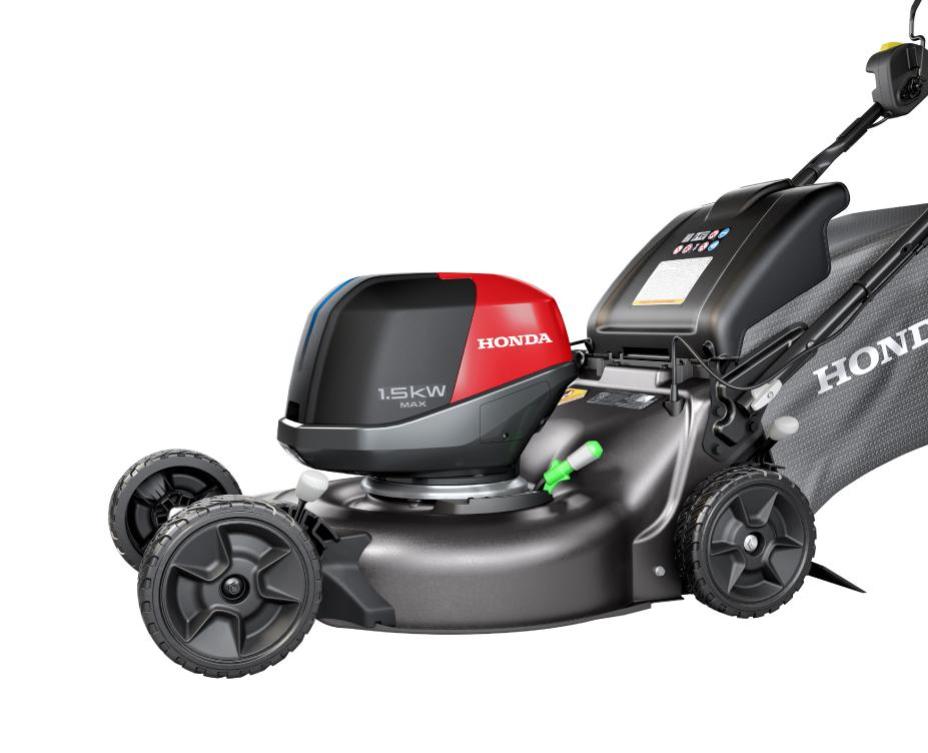
Honda goes electric for the lawan. (Image: Honda)
Given what’s going on in the weather, odds are the “other products in high demand” in the Honda Power Sports & Products portfolio are its generators.
And it is worth noting that Honda is working toward having 100% of its auto sales in the U.S. be battery- or fuel cell-electric vehicles by 2040. While Honda mower engines do go beyond CARB/EPA emissions standards, somehow a loud power mower cutting the lawn next to a Prologue or ZDX in the driveway would seem off-brand for that goal.
This week Honda introduced the HRX-BV, HRX-BE, and HRN-BV electric mowers for residential use.
Said Mark Kohls, vice president of Honda Power Sports & Products, American Honda Motor Co., Inc., about the development of the new mowers (and there is a commercial model, too) “Reducing greenhouse gas emissions is only part of the challenge, as battery-powered power products must meet Honda standards for rugged performance, ease of use and comfortable operation to meet the high expectations of our residential and commercial customers.”
I wonder: Years from now my nephew will undoubtedly move to an electric mower.
And if he does, and the mower goes into his garage for a few years unused, will he be able to gift it to his nephew who will get the same results that were achieved with the mower that had been mine?
Mike Austin, executive editor of Road & Track, so he knows things like this, recently told me that a number of supercar manufacturers are developing vehicles with internal combustion engines rather than with full battery electric propulsion systems because people like the visceral sensation of the thrum of an engine. He acknowledges that there is no doubt that EVs can go really, really fast. But that speed is achieved accompanied with the sound of a whine characteristic of something from the Star Wars universe, not Le Mans or Nürburgring.
McLaren W1: mid-engined hybrid. Yes, there’s a V8 in there. (Image: McLaren)
Case in point is the McLaren W1 supercar, which is based on a V8 hybrid powertrain that produces 1250 hp—915 hp from the engine and 342 hp from the “E-module” (a combination of electric motor and control unit).
Quick? 0 to 62 mph in 2.7 seconds.
Of course, a powerful engine like the MHP-8 twin-turbo V8 itself can’t make a vehicle go fast if the structure it needs to propel is too bulky.
So McLaren, per usual, has constructed a carbon-fiber “Aerocell” monocoque and even uses things like 3D-printed suspension components.
Honda and Acura Go Electric with Ultium and Then Some. . .
By Gary S. Vasilash
As is widely known, when it comes to the contemporary electric vehicle, Honda was a bit late to the party. Given that the company has extensive experience in electrified vehicles. It is often forgotten (or unknown), for example, that the first hybrid on the U.S. market wasn’t the Toyota Prius, but the Honda Insight, which was launched in December 1999, edging out the Prius by a few months.
(This gives rise to another consideration. Toyota has also been criticized for its approach to the EV market, being tagged as a laggard. One could argue that this isn’t a mistake, given the still rather small number of EVs being sold in the U.S. market. According to Kelley Blue Book, for Q3 2024 there were 346,309 EVs sold, a number that will undoubtedly help the number of EVs sold in the U.S. to exceed the 1.2-million sold in 2023. But here’s something to think about: if you take away the Tesla sales from the Q3 numbers this means that 27 brands cumulatively sold 179,386 vehicles. That would be 6,644 if the number was evenly distributed. But no matter how you look at it, there is a long way to go in order to achieve the necessary scale to have a profitable production operation.)
Anyway, I’ve just been driving the Honda Prologue and the Acura ZDX, the two contemporary EVs from the company.
A sign of the times is that in order to get these vehicles on the market, Honda worked with a company that it has been collaborating on for some time (on things ranging from the engine for the Saturn Vue Red Line to hydrogen fuel cells).
The two vehicles are based on the GM Ultium platform (yes, even though GM is going to stop calling them “Ultium,” the platforms were Ultium when the Prologue and the ZDX were developed).
Just as the Saturn Vue Red Line was a Saturn through and through, not a Honda, the Prologue isn’t a Chevy Blazer EV, which it shares the platform with, just as the ZDX isn’t a Cadillac LYRIQ.
In the case of the Prologue—which is available with a single-motor (212 hp) front-drive setup that provides a range of up to 296 miles or as a dual motor (288 hp) with a 281-mile range (although there is the Elite trim package that goes 273 miles); all have an 85-kWh battery pack—the design inside and out are characteristic of the brand.
The design-speak for the exterior design—which was executed in L.A.—is “Neo Rugged.” It is, after all, an crossover. Arguably, it is a simple, straightforward design with a sufficient number of creases in the sheet metal to keep it from looking innocuous or as something that it isn’t (i.e., like something you’d take on the Rubicon).
Inside there is the clean, straight-forward Honda approach to ergonomic instrumentation. However, I have two quibbles with the interior design:
An excessive use of piano black plastic on the IP. Whereas the Civic Hybrid (a hatchback was recently released) has an interior that looks of the moment, the piano black in the Prologue is dated.
The distance from the top front edge of the instrument panel to the bottom of the windshield is a tremendous amount of real estate. Someone had better have a Swiffer on a long handle to be able to keep that surface clear because it is a reach.
But while on the inside it should be noted that there is as much as 57.7 cubic feet of cargo space, so it can handle a reasonable haul.
Of the two cars, the ZDX is the one that I find to be most impressive. (Of course, the starting MSRP for the Prologue is $47,400 and it is $64,500, so there has to be some bandwidth there.)
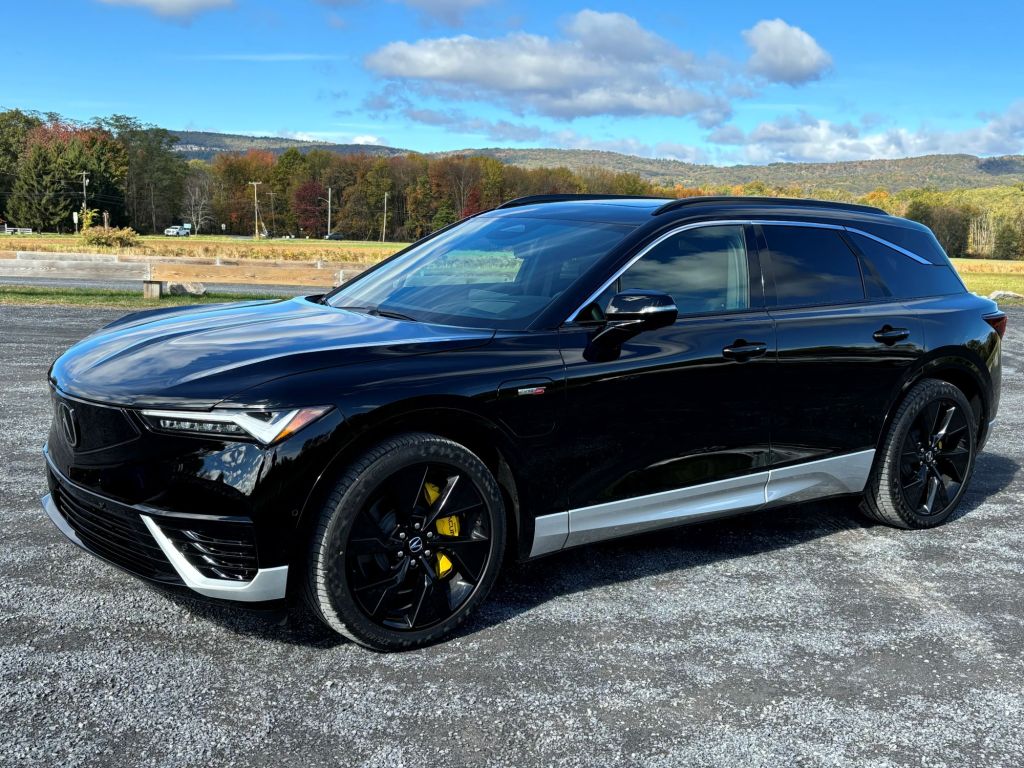
The ZDX comes as a rear-drive vehicle with 358 hp and a range of 313 miles from its 102-kWh battery. Or there is an all-wheel drive version (A-Spec) that provides 490 hp and 304 miles of range from the same battery pack. Or there is another AWD version (Type S) that generates 499 hp and will take you 278 miles with some alacrity.
2024 Acura ZDX Type S. Wicked quick. And you can shop for groceries with it, too. (Image: gsv)
Although Acura does have two cars in its lineup—the TLX and Integra—its two crossovers—the MDX and RDX—are focal points. In terms of powertrain performance, the ZDX smokes the other crossovers (or maybe that should be it “ozones the other crossovers”).
It, too, was styled in LA. And although it is a crossover, its exterior body style resembles for me more of a contemporary station wagon, with a lower, longer, more angular sideview than many other crossovers.
While it seems as though all vehicles today have some sort of light signature up front, credit should be given to the Acura designers for the sharp styling they’ve brought to the lighting of this vehicle.
On the inside the seats in the front are bolstered in keeping with the type of vehicle it is, and the layout of the instruments and gauges are intuitive. A cowl over the gauge screen provides something of a cockpit feeling when sitting behind the wheel.
Both are solidly engineered vehicles that go well beyond the propulsion systems.
The Prologue seems like a Honda (presumably because it is) and the response from the market is good: According to numbers from KBB, through the third quarter there have been 12,644 Prologues sold—more than the 7,998 Blazer EVs sold, and closing in on the popular Mustang Mach-E, which had sales of 13,392.
The ZDX, which is essentially a new nameplate (yes, Acura built a ZDX until 2013, but its sales were so tiny that it isn’t likely remembered by many (outside those who smacked their heads getting into or out of the rear seat on the C-pillar)) has had sales through Q3 of 2,647—which is not far from the Lexus RZ’s 2,742, which has been available for longer.
In 2026 Honda will roll out its 0 Series, which it is developing sans GM.
But neither the Prologue nor ZDX are placeholders until then.
Creating a tactical vehicle based on something that may be in your driveway. . .
By Gary S. Vasilash
One of the things that Ford, Ram and GM are really, really (yes, two reallys) good at is building trucks. Although many people buy pickups for non-work purposes, the engineers at those companies develop their trucks for all manner of demanding contingencies.
So it isn’t entirely surprising that GM Defense has rolled out with a Chevy Silverado 2500HD ZR2 truck that has been upfitted for war-fighting applications.
The “Next Gen” tactical vehicle prototype was introduced this week at the annual meeting and exp of the Association of the U.S. Army in Washington, DC.
You’re not going to pick up 2 x 4s or a load of mulch at Home Depot in this Silverado. (Image: GM Defense)
The truck is primarily powered by a 2.8-liter Duramax turbo-diesel but there is also a 12-module battery pack that power electric motors that are on both axles.
So when the truck goes into “Silent Drive” or “Silent Watch” modes, the electric propulsion system comes into play. So the truck can approach in silence. What’s more, there is sufficient power on board to handle the electrical needs of various sensors and other equipment.
According to Steve duMont, president of GM Defense:
“This rugged and highly capable diesel-powered vehicle offers tactical advantages, such as Silent Operations, exportable power, and increased range with extended mission duration. Our warfighters deserve the latest technology that industry can offer in order to gain and maintain competitive advantage over our adversaries. Our Next Gen mobility solution can be customized and fielded now.”
Presumably, as this is based on a vehicle that is in mass production it would be more economical than one that is purpose-built. But GM is adding the tech necessary to make the truck sufficiently robust to handle fighting missions.
After all, these trucks need to deal with conditions that the standard truck engineers don’t need to think about.
One would assume that when buying a vehicle in the >$100,000 vicinity it will have a full suite of amenities, both infotainment and safety-oriented (a.k.a., “stuff,” albeit that being a somewhat plebian term), as well as comfortable (e.g., seats that could be utilized in an upscale house) and capable (as in all-wheel drive).
One thing that may not has as top-of-mind consideration as it probably should, something that may be taken for granted, is the level of dependability of the vehicle.
It is one thing to feel a bit of quiet satisfaction of dropping off one’s luxury vehicle with the valet at the front of the club. It is something else entirely to be waiting for the valet to return said vehicle because there happens to be a glitch in the lot.
Or it could be simply the issue of getting something to work (e.g., perhaps if you want to open the glove box you should simply, well, use the pushbutton-style mechanism to open the glove box, not have to find a button or something on a screen to do it—otherwise, it could be frustrating/annoying).
Which is to say that all luxury vehicles aren’t built with the same levels of quality and dependability as others.
And there is information to back this claim up.
The J.D. Power 2024 U.S. Initial Quality Study (IQS), which surveys owners 90 days after they’ve owned their vehicles. Presumably that is sufficiently long to get a sense of one’s vehicle and if something is going to break early, it has.
Lexus comes in second in the Premium category of the survey, behind Porsche (174 for Lexus and 172 for Porsche, with lower being better). Although one might argue that Lexus models and those from Porsche are largely different (but both are big in the SUV space), the most Porsche-like Lexus model, the LC, had the highest initial quality of any vehicle surveyed.
But there is another study that J.D. Power does, one that is more about the long run. It is the J.D. Power Vehicle Dependability Study (VDS). While IQS is after three months, VDS is after three years.
The categories VDS asks about include climate, driving assistance, driving experience, exterior, features/controls/displays, infotainment, interior, powertrain, and seats.
In the 2024 VDS Lexus comes out on top—by a considerable margin.
That is, the metric is “problems per 100 vehicles,” or PP100. A lower number is better.
Lexus has a score of 135 PP100.
Porsche came in second. It scored 175 PP100.
(Oddly enough, whereas Porsche came in first in the IQS but a Lexus was the overall highest in initial quality, in the VDS Porsche, second overall to Lexus, has the vehicle with the highest dependability, the 718.)
So one can feel confident that the LS 500h is something that is built with quality and dependability.
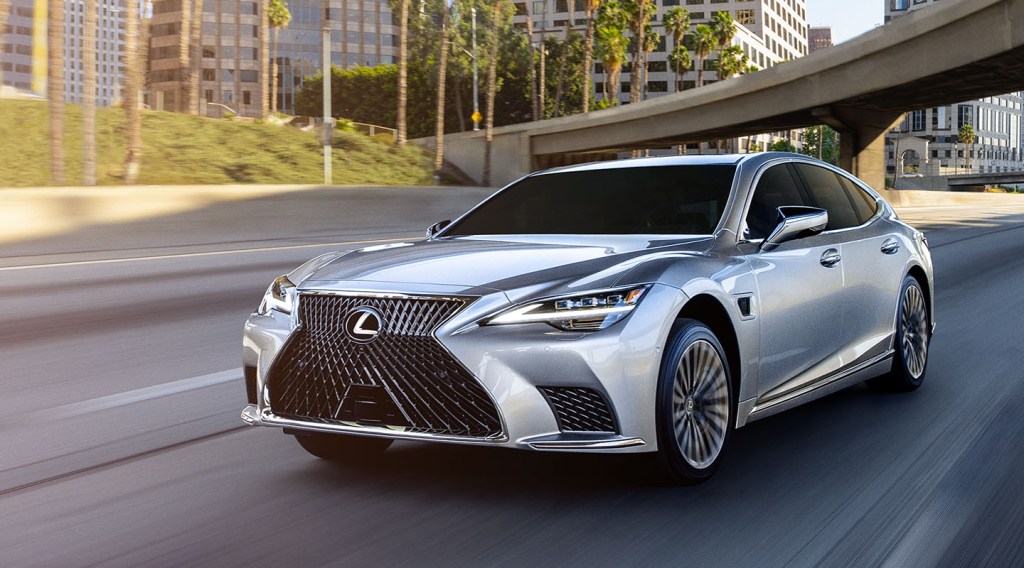
LS 500h AWD: Looks good. Drives well. Brings the amenities. And is built to be a quality vehicle. (Image: Lexus)
The Look
The sedan is low and lean. Specifically, 206.1 inches long, 57.5 inches high, and with a 5.8-inch ground clearance. It rides on 20-inch wheels. And the other obligatory specs are that it has a 123-inch wheel base and is 78.8 inches wide.
The Power
This is a big sedan, one might feel environmentally awkward driving it.
But this is a hybrid. There is a twin-turbo 3.5-liter V6 engine that is supplemented by electric motors so the total system horsepower is 354. This may not be the stuff of being pushed back in your semi-aniline leather seat when you push down on the accelerator (there are other LS trim levels for that), but it is something that results in a combined fuel economy number of 25 mpg, which is certainly outstanding for something of this scale.
(And going back to the issue of dependability, know that Toyota started building the Prius in October 1997, so it is undoubtedly the most capable producer of automotive hybrid powertrains by a long shot.)
The Interior
Luxurious. Sumptuous. Like that.
Leather is leather. Wood is wood. Metal is metal.
You’d think that’s, well, normal.
It’s not.
But it is normal in the LS.
Which is impressive.
(Although I must confess that when there’s white leather seating surfaces, I have some, well, concern. . . .)
The Tech
There is Lexus Teammate, a Level 2 advanced driver assistance system that provides the means for hands-off driving predicated on both a sensor suite (radar, lidar and camera sensors) and GPU processors. Eyes must be kept on the road and it works on highways that have been digitally mapped. Arguably, this type of system de rigueur for vehicles in this category, and in the case of Teammate, it provides the hands- and feet-free capability as would be expected.
A Thought
LS 500h AWD: All that is expected—and then some—in a reliable package.
Let’s face it: when it comes to Halloween, capacity matters when it comes to candy
By Gary S. Vasilash
Although things are undoubtedly scary right now in Auburn Hills, one vehicle that is holding its own against its primary competitors is the Pacifica minivan.
Through the third quarter 92,386 Pacificas have been sold.
That bests both the Honda Odyssey with 59,248 and the Toyota Sienna at 50,789.
Taking advantage of the season, Chrysler has decided to name the vehicle “the Official Minivan of Trunk or Treat.”
Load up the Pacifica minivans for Halloween. (Image: FCA)
This isn’t entirely fanciful, as the vehicle does offer the Stow ‘n Go Seating and Storage System, the built-in Stow ‘n Vac, and the Uconnect Theater System, which are key features for the season. (Arguably any season, but. . . .)
The seating system is helpful because when the second and third rows are folded into the floor there’s more than 140 cubic feet of cargo candy space.
The theater system allows the showing of scary films.
And, probably the most-vital feature of all is the vacuum cleaner, because let’s face it: Halloween is probably has the highest level of debris-generation of any holiday.
Incidentally: the Pacifica is available as a plug-in hybrid, so there is built-in efficiency on the way to the trunk-or-treat venue.
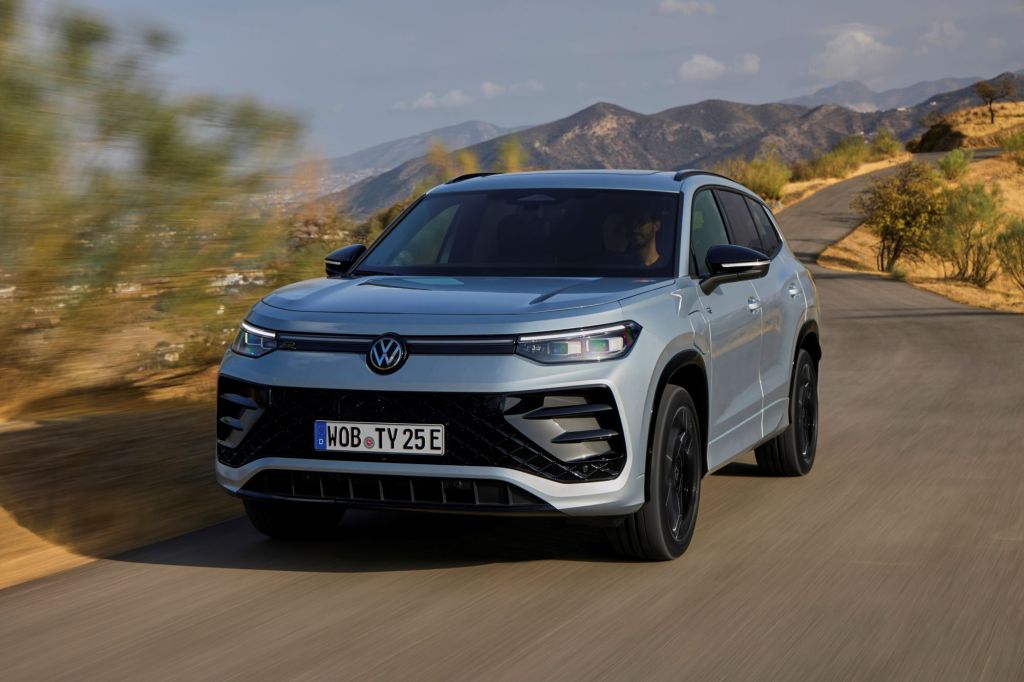
Some have thought that the Tayron will become the Tiguan.
The next-gen Tiguan will be on the long-wheelbase configuration for the Tayron.
But the Tiguan will, according to VW of America, have significantly different “sheet metal, powertrain options and equipment set.”
In other words, for ordinary people who don’t care about things like platforms, the U.S. Tiguan is a completely different vehicle than the European Tayron.
That said, the Tayron, which is available as a five- or seven-seater, is an interesting vehicle, largely because of the powertrain choices.
There will be:
A mild hybrid based on a 148-hp engine
Two plug-in hybrids, each of which will offer an electric range of over 100 km (62 miles)
Two turbocharged diesels
The Tayron will be slotted between the Touareg and the Tiguan in the European market.
The Touareg, a premium crossover, hasn’t been available in the U.S. market since model year 2017.
However, the U.S. has both the Atlas and the Atlas Cross Sport, which the Euros don’t have.
The next Tiguan will be announced at the LA Auto Show in November.







 shinymetalboxes