Sticking with the Euro theme, the European Automobile Manufacturers’ Association (ACEA) released its figures for March 2024—and there’s a decline.
The EU car market was down 5.2%.
A factor?
The Easter Bunny.
That’s right. According to the ACEA, “The timing of the Easter holidays negatively impacted last month’s sales across most EU markets.”
Oddly enough, last year Easter was in April and EU car sales were up 17.2%.
As is the case in the U.S. EV sales were down (now 13% of the market there, or nearly double of what they are here (OK: less than double as EV sales in Q1 in the U.S. are 7.3%, per Kelley Blue Book)) and hybrid sales up, now at 29% of the total market.
One interesting thing about the 13% EV market share.
It is 0.6% greater than. . .diesels.
That’s right. Diesel passenger vehicle registrations in the EU are 12.4% of the market.
In March diesel registrations fell an overall 18.5%, with major drops in France (-32.1%), Spain (-38%) and Italy (-27.6%).
In Germany, however, sales were down only 0.5%. (No, that’s not because it is the home of Rudolf Diesel. He was born in Paris.)
Although the VW Golf is available in the U.S. only in performance-oriented variants—as in the Golf GTI and the Golf R—in other parts of the world it is also a car that is, well, a car.
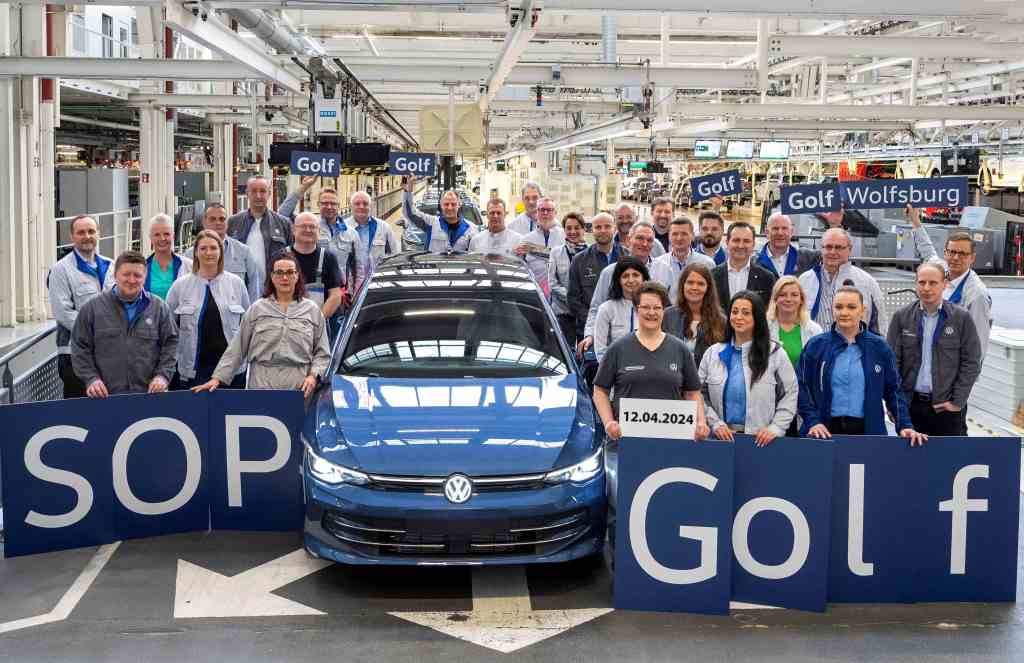
Last week at VW’s main plant in Wolfsburg, Germany, in Hall 12 of the complex, VW held a line-off ceremony for the refreshed 8th-generaiton Golf.
Start of production of the new Golf in Wolfsburg. (Image: VW)
A few interesting numbers:
Since 1974 there have been more than 37 million Golfs produced. Approximately half of that number were built in Wolfsburg. Plant manager Rainer Fessel: “Wolfsburg is the Golf—and the Golf is Wolfsburg.”
The Golf is the most-built vehicle at Wolfsburg. The Beetle is the second-most produced. Between 1945 and 1945 some 12 million Beetles were built at the plant.
The Golf is available with five propulsion options: a conventional ICE engine, a mild hybrid, two plug-in hybrids, and a diesel.
There have been a total 48 million vehicle built in Wolfsburg.
Although Tesla seems to be in the sort of fix that one might expect a traditional OEM to have rather than it, maybe that is because Tesla is turning into something of a traditional OEM, yet it isn’t quite capable of making the transition, which exacerbates the problem.
Now to be fair, the EV market in the U.S. is still pretty much in two categories:
Tesla
Everybody Else
So when you look at the increase in sales of Everybody Else’s EVs you have to recognize that in terms of overall numbers, there are certainly models that have internal combustion engines in their lineup that may have percentage decreases yet, in terms of the overall number delivered, well above the EV.
However, one of the issues that Tesla faces and doesn’t seem to be particularly interested in addressing is that the technological heat seekers, those who are constantly on the lookout for What’s Next, have likely purchased a Tesla or two. Now this is not to say that they’re suddenly going to go buy an EV from someone else but, rather, to say that there is a set of those people and they’ve pretty much been saturated.
The upside in the EV market will be people who are interested in something advanced but not completely challenging.
Let’s face it: Although driving an EV is pretty much like driving any a vehicle with a combustion engine, there are differences that require some adjustment on behalf of the driver. So at this stage in the proliferation of the technology it is probably a good thing for OEMs to provide prospective EV owners with vehicles that progressive without being perplexing.
Which brings me at last to the Hyundai IONIQ 5, an EV crossover that could draw plenty of customers into Hyundai stores and if they drive off the lot with one they’re not going to have to study how to use it.
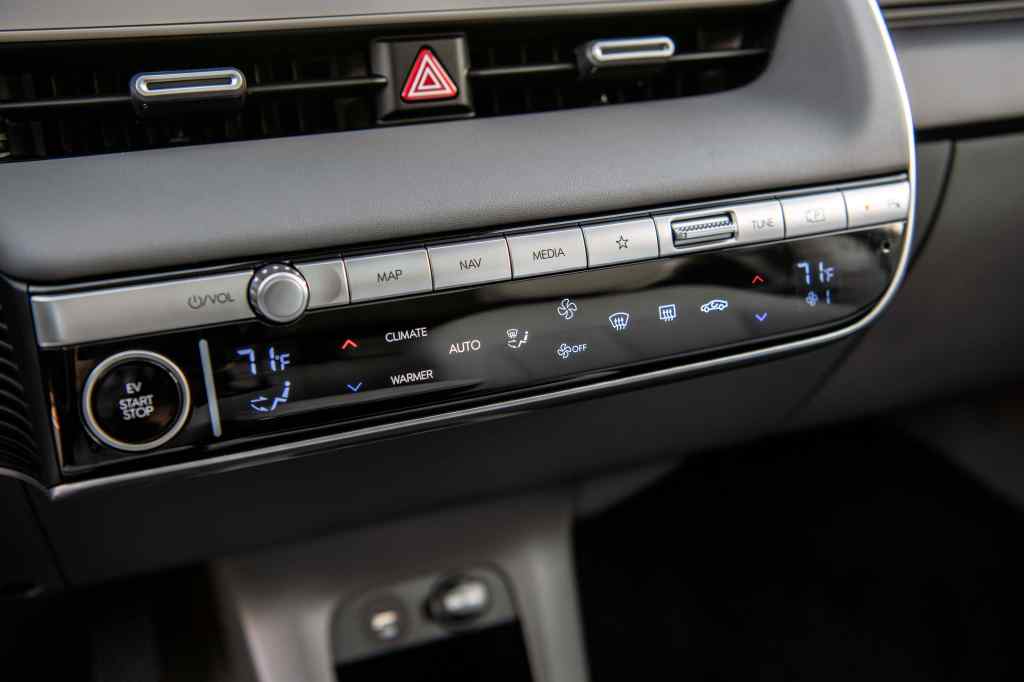
Quick: how do you adjust the temperature in the IONIQ 5? Some things make superior ergonomic sense. (Images: Hyundai)
For example: Want to adjust the HVAC? Yes, there is a 12.3-inch touchscreen. . .but more familiar, on a conductive surface, are red and blue arrows: touch them to get the job done. No searching required through the screen.
Yes, there are buttons and switches. A minimal but familiar assortment of things that can be adjusted.
The design of the IONIQ 5 is superb. There is the now seeming obligatory minimalism, but, more to the point, there is the addition of artistry in the patterns on some of the surfaces that are subtle and provide an overall sense of freshness. This is in contrast to the near-Brutalist approach that is taken inside a Tesla.
The exterior of the IONIQ 5—from the LED lighting up front to the LEDs around back—provides an appearance that is purposeful yet futuristic. I am puzzled by the apparent appeal of the bland front fascia of the Tesla Model Y: the front end of the IONIQ 5 appears as though it was created by a team of innovative engineers and artisans; the Model Y front appears as though the objective was to make a shape that could be readily released from the injection molding tooling.
The exterior is fresh and forward.
And the creases in the body side of the IONIQ 5 speak to a knowledge of forming metal in an aesthetic manner, something that, arguably, is lacking in something like the—admittedly not a competitor—Cybertruck which, again, seems to have been designed so that it could be formed with a press brake rather than a servo press.
The IONIQ 5 comes in RWD and AWD versions, with different motor and battery sizes.
The vehicle driven here is an AWD model; its permanent magnet synchronous motors (one in the front, one in the rear) produce a combined 320 hp. It has a SK Innovation 77.4 kWh lithium-ion battery that provides the vehicle with a range of 260 miles. The on-board charger is capable to being charged at a station with up to 800 v/350 kW; that means the battery charge can go from 10% to 80% in as little as 18 minutes.
People are catching on to the IONIQ 5. In March sales were up 58%. There were 3,361 delivered. The sales of the Hyundai Palisade—a bigger vehicle with an internal combustion engine—were also up 58% in March. There were 9,785 delivered.
The point being, there is a ways to go before there is greater consumption of EVs.
The IONIQ 5 is a vehicle that will help get more people there.
Adjusting interest rates can be a tricky business for the Federal Reserve.
On the one hand, it wants to reduce the amount of borrowing and—consequently—spending.
That helps reduce inflation.
On the other hand, it doesn’t want to reduce the amount such that the economy falls into a recession.
Consumers don’t like inflation. That’s because things cost more.
Consumers don’t like high interest rates. That’s because they have to spend more to borrow the money to buy things.
Things like cars.
Kelley Blue Book announced the average transaction price (ATP) for new vehicles was down 1% in March compared to the ATP in February.
What’s more (or less), the March ATP was down 5.4% compared with December 2022, when ATPs were at their peak.
It’s not like new vehicles are inexpensive, even with that 1% drop.
The ATP—and remember, this is average—for March is $47,218.
Erin Keating, executive analyst at Cox Automotive, said, “It bears repeating that historically high interest rates and associated inflation combined with an ever-widening deficit of available vehicles at lower price points, will continue to challenge affordability for most car buyers.”
So there’s the interest rate-inflation situation.
The Disappearing Econo Box
Keating’s observation about “widening deficit of available vehicles at lower price points” is key.
KBB found that in March there were some 275 new-vehicle models available in the U.S.
Of the 275 only eight had ATPs of less than $25,000.
Three percent. Imagine trying to find one.
But apparently either people have lots of money or they’re willing to borrow it: in March sales of vehicles with ATPs above $75,000 were greater than those under $25,000: approximately 81,000 of the former and 52,000 of the latter.
Perhaps high interest rates are having an effect—on the lower portion of the market.
Of course, chances are OEMs are putting out vehicles with higher sticker prices because they can make more money on them than those that are more economical.
Let’s say that you are interested in buying a car.
A car as a sedan. Not a crossover. A bread-and-butter car. (Yes, maybe you want to add some spicy tomato jam to it—spoiler, alloy wheels, etc.)
You go to the local Ford dealer.
And discover that the only car is a Mustang, which doesn’t qualify (i.e., two doors).
There happens to be a Lincoln store across the parking lot.
There are no cars, only crossovers of stair-step sizes.
You visit a Chrysler dealership and learn that Stellantis has stopped production of its long-in-the-market 300 at the end of last year, but they’ve got a Pacifica minivan, if you’re interested.
Buick perhaps? Again, no. Only crossovers.
Over at Cadillac things are better: of its seven models, two are sedans, the CT4 and the CT5. Given that the Q1 2024 sales for those are down 36.1% and 34.2%, respectively, how long they’ll be around may be in some question.
Chevy? An impressive array of crossovers and trucks. And one car, the Malibu.
The point is, buying a car is not as easy as it once was.*
Which leads to a thought about electric vehicles.
What if you went into one of these dealerships and discovered that they didn’t have anything on the showroom floor that didn’t have a plug?
What if that was pretty much the case up and down the street of the auto mall?
Clearly there would be an increase in the number of EVs sold out of those dealerships.
Maybe the numbers would be that good.
But they would be better.
Just as they’ve increased the number of models that aren’t cars and so have made buying a car tough, it could be that to help recoup some of the billions being spent on EVs they make buying an ICE tough.
Something’s got to move more of that lithium-powered metal.
(Of the 593,997 vehicles GM sold to customers in Q1, 16,169 were EVs. Not much of a business case there. And it sold twice as many Malibus ((32,749).))
*Interestingly, the Asian and European brands, in general, all have cars in their lineups.
“Mercedes-Benz EVs accounted for 13% of our total group sales volume in Q1,” Dimitris Psillakis, president and CEO of Mercedes-Benz USA, said, reporting how the marque is doing so far in 2024.
Which, on a percentage basis, is quite good.
Ford, which describes itself as “America’s No. 2 electric vehicle brand,” had Q1 EV sales of 3.9%.
Mercedes has three EVs in its U.S. showrooms:
EQB, of which it sold 671
EQE, 5,113
EQS, 2,552
That is a total of 8,336 of the 66,570 passenger vehicles it sold in Q1.
(To be fair to Ford, it sold 508,083 vehicles in Q1, of which 20,233 were EVs.)
But here’s something interesting about the Mercedes sales: It sold 15,096 GLE SUVs.
When the Honda Ridgeline was in its first year on the market, it received the 2006 North American Truck of the Year Award (it is worth noting that back then there wasn’t the Utility category, simply “Car” and “Truck,” and it was a good year for Honda, as the Civic took Car).
Then, when the second-generation Ridgeline, which is the basis for the current model, had its debut year, it took the 2017 North American Truck of the Year. The other two finalists were the Ford Super Duty (which won the NACTOY award in 2024) and the Nissan Titan (which is going out of production this summer).
The point of this is that the NACTOY jurors tend to be a picky lot (full disclosure: I am one of them), and for the Ridgeline to take its category the two times it has been eligible says a lot about the truck.
2024 Honda Ridgeline TrailSport: Yeah, it’s a truck. (Image: Honda)
One of the things that made some people dismissive about the Ridgeline being a “truck” is that doesn’t feature body-on-frame construction but is a unibody.
How dare Honda!
Clearly it was on to something because the U.S. pickup truck leader, Ford, introduced the Maverick in 2021 and it, too, is a unibody. (It took the NACTOY Truck category in 2022.)
(The Hyundai Santa Cruz is also on that type of platform.)
The Ridgeline has a box on the back: 64 inches long; 50 inches wide at the wheel wells, 51 inches wide at the D-pillar, 60 inches wide at bed walls.
The Ridgeline can tow: up to 5,000 pounds.
The TrailSport version has a total payload capacity of 1,521 pounds.
When driving the Ridgeline a friend took a look at the box on the back.
“I need a truck a few times a year.”
And it occurs to me that that is precisely the sort of person who might be inclined to get a Ridgeline rather than the other midsize trucks that are available, all of which are body-on-frame vehicles.
This is because the Ridgeline truly rides and handles like an Accord.
Let’s say for the sake of argument that my friend’s “few times” adds up to a solid month. Let’s say that he goes for one of those other midsize trucks.
That means for 11 months out of the year he’s driving something that doesn’t have anywhere near the ride and handling of the Ridgeline.
Seems to be quite a price to pay for hauling gear or gravel or whatever on occasion.
The TrailSport trim package is new for 2024. It has such things as a suspension tuned for offroad conditions and General Grabber A/T Sport tires (245/60R18), the first deployment of all-terrain tires on a Ridgeline. (Although they are big and chunky, the sort of thing you might imagine would generate all manner of road noise when not driving on a trail (which one might do “a few times a year”), somehow there isn’t a heck of a lot of noise from the tires in the cabin.)
In addition to which the TrailSport has a steal underbody protector for the oil pan.
On the inside there is the use of orange thread for the stitching on the steering wheel, door panels and seats; the front-seat headrests have “TrailSport” embroidered on them.
Just as there is capable rubber on the outside, there are serious rubber floor mats standard: if you’re going to use the truck to play in the dirt you might get dirty, so. . . .
The truck is powered by a 280-hp, 3.5-liter V6 that’s mated to a nine-speed automatic.
There is Honda’s torque-vectoring all-wheel drive system and there is “Intelligent Traction Management” for that system that allows the driver to select for sand, snow, mud, or paved roads. (Here’s betting that depending on where one lives, the last is the normal selection and the second occasional, assuming there are winter conditions.)
There are the now-obligatory infotainment features in the Ridgeline (e.g., nine-inch color touchscreen; Apple CarPlay and Android Auto), and what’s interesting is that Honda says that it has deployed a faster processor in its head-unit which means less lag.
According to Merriam-Webster, a pickup truck is “a light truck having an enclosed cab and an open body with low sides and tailgate.”
The Ridgeline certainly is that. And even more.
One more thing: Cars.com generates an “American-Made Index” each year for vehicles, taking into account assembly location, parts content, engine origin, transmission origin and U.S. manufacturing workforce.
The Ridgeline was designed and engineered in the U.S. It is manufactured in a plant in Lincoln, Alabama.
Of all vehicles—sedans, SUVs, minivans, hatchbacks, coupes, pickup trucks—there is only one truck in the top 10 of the most recent index: the Ridgeline.
Yes, according to Cars.com it is the most American of pickups.
For no reason other than the fact that it is an amazing photo, there’s this: the MINI John Cooper Works WRC, campaigned by Prodrive, a UK-based independent motorsports company, driven by Kris Meeke at Rally Italy in 2011:
Yes, a flying MINI. (Image: Classic Nostalgia)
(The reason this photo has come up is because Prodrive’s 40 years of development will be celebrated at Classic Nostalgia, an event that is being held in the UK on July 20-21.)