Well, the name does describe a wind, and it is a sail boat. . .
By Gary S. Vasilash
What you may not know—but what certainly won’t surprise you—is that Maserati is going to be coming out with a new SUV. Of course they’re putting out a new SUV. It has one, the Levante, but that’s certainly not sufficient because people all seem to want SUVs. More SUVs.
The vehicle will be unveiled in November.
The boat revealed the name of the SUV. (Image: Maserati)
The vehicle name was unfurled today.
Unfurled because it was on the main sail of the Maserati Multi 70, what is described by the company as a “laboratory boat.”
Yes, a boat.
The name of the new SUV is Grecale. It is the word for a north-east wind of the Mediterranean.
A really wonderful supercar will come to an end. The reason? Probably because not many people are buying the car.
By Gary S. Vasilash
Yesterday the auto companies that announce sales figures on a monthly basis made their announcements.
American Honda was modestly happy, noting that for the month of July it delivered more than 135,000 vehicles, which includes 51,815 cars and 83,727 trucks for both the Acura and Honda brands.
One vehicle among the 135,542 units had sales of seven units. Seven.
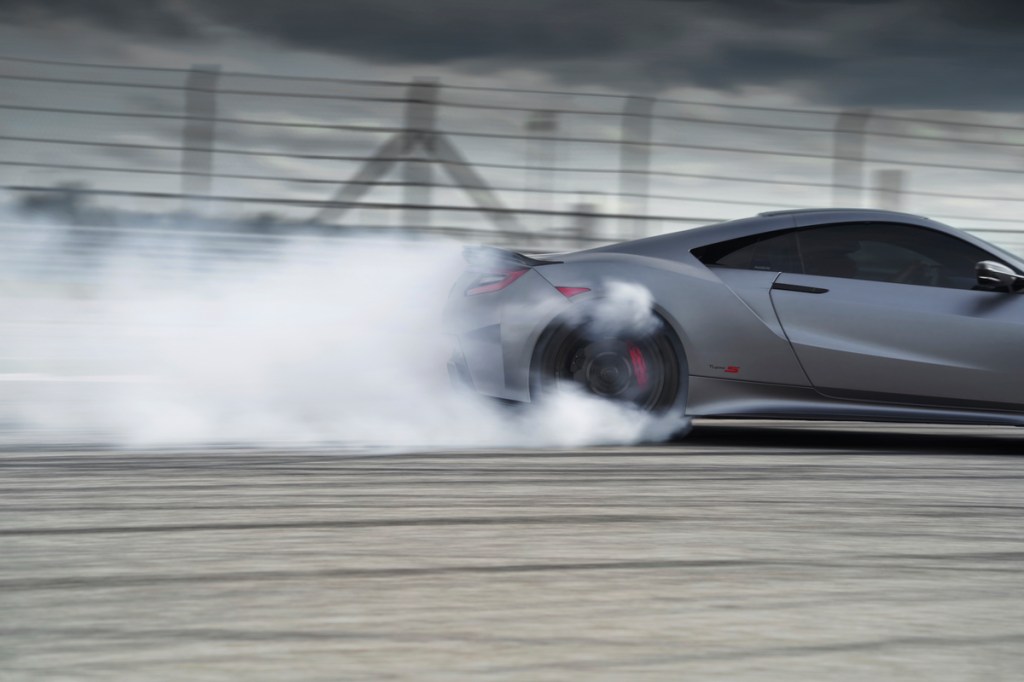
Acura NSX; 22 is the final ride for production. (Image: Acura)
From January to July there have been 67 sold in the U.S.
Yesterday American Honda also announced that the NSX—the vehicle that isn’t selling well by almost any metric—will end with model year 2022.
The second generation NSX, which was launched in 2016, will have a limited run during its final year of production at the Performance Manufacturing Center in Ohio.
There will be 350 NSX Type S vehicles built. Period. Three hundred will be available in the U.S.
Given the sales of the NSX so far, the folks at Acura are evidently optimistic that there will be more than a few collectors looking to get their hands on the final edition.
Jon Ikeda, vice president and Acura Brand Officer, stoically said, “Acura is a performance brand, a company of enthusiasts, and we will continue moving forward, actively investigating what the next generation of sports cars should be in an electrified era.”
A brilliant take written because of the Automania exhibit at MoMA
“There are few consumables that have been designed since their inception to capture every sense and sensibility that humans have more than the car. It is the most practical yet mythic of inventions. It is machine and art. It is the product of genius and object of desire. Yet it is also a tool, and as such promotes good and destroys worlds.”—Steven Heller, Print
Yes, there will be more electric vehicles. But not all EVs. So internal combustion engines need improvement.
By Gary S. Vasilash
Bosch, Sujit Jain, president, Powertrain Solutions for Passenger Cars, Commercial & Off-Road, and Electric Vehicles at the company’s North American operations, points out, has been advancing—and producing—technologies for the auto industry essentially for as long as there has been an auto industry.
And today isn’t any different.
The company is not only making massive investments for developing and utilizing Industry 4.0 capabilities, but it is investing heavily in the development and production of everything from microprocessors and fuel cells in order to advance the functionalities and performance in the auto industry.
It is committed to the electrification of vehicles, whether this makes the form of hybrids, full battery electrics or fuel cell powered vehicles.
But while Jain says company projections have it that the number of battery electric vehicles in the U.S. will grow from about 2% of the market in 2020 to 30% by 2030, that still leaves 70%, the large percentage of being combustion engines. Yes, they may be hybrids, but there is still gasoline or diesel being burned.
So one of the things that Jain and his colleagues are doing is developing the ways and means to increase the efficiency of those engines, both in terms of performance and emissions reduction.
Some of the things that they are pursing, Jain says on this edition of “Autoline After Hours,” include synthetic fuels, electrically heated catalysts to reduce cold-start emissions, and hydrogen fuel injection (i.e., instead of a hydrogen fuel cell, this would be a combustion engine running on hydrogen).
Jain talks with “Autoline’s” John McElroy, Kelsey Mays of Cars.com, and me on this show.
After Jain’s segment, the three of us talk about a variety of subjects, including former Nikola head Trevor Milton being charged with three counts of criminal fraud related to the company he founded; Tesla’s Q2 financials ($1.14-billion in GAAP net income), the possible consequences of it opening up its charging network to other brands, and the move from upscale-shopping districts for its stores and galleries to lower-end real estate; Magna’s growth and technological breadth; and more.
It’s not like we’ve spent a lot (or any) time in open-pit mines. . . .
By Gary S. Vasilash
Odds are you will never be in a vehicle that uses this tire. Unless, perhaps, you drive (pilot?) something like the Caterpillar 789 dump truck, the kind of vehicle that is used in open-pit mining: It resembles a giant box (giant as in having the capacity of 177 tonnes) that is supposed by giant tires with a cab tucked up front in between.
Just the thing for 200-ton trucks. (Image: Goodyear)
According to Eric Matson, Global OTR Field Engineering Manager, Goodyear, “The 40.00R57 has become Goodyear’s dominant fitment on 200-ton trucks, such as the Caterpillar 789. With a higher TKPH and load carrying capacity, the new Goodyear RH-4A+ tire size is a great option for customers who have converted their 789 fleets to this larger tire.”
TKPH? Tonne-kilometers-per-hour. We don’t know, either.
One of the features of this tire is that it is said to provide “higher productivity in hard rock underfoot positions.”
Bet that’s not going to be your concern the next time you go out tire shopping. . . .
If it hadn’t last $2-million on Bitcoin, the number would have been bigger
By Gary S. Vasilash
A few things from Tesla Q2 numbers
Consider this:
Models S/X production numbers were:
Q2 2020: 6,326
Q3 2020: 16,992
Q4 2020: 16,097
Q1 2021: 0
Q2 2021: 2,340
Were they not electric vehicles, the phrase “running out of gas” comes to mind.
To be fair to the people in the Tesla plants, for the Models 3/Y:
Q1 2021: 180,338
Q2 2021: 204,084
So they’re certainly busy.
///
Here’s an interesting understatement:
“Solving full autonomy is a difficult engineering challenge in which we continue to believe can only be solved through the collection of large, real-world datasets and cutting edge AI.”
The emphasis on the dataset comes from the more than one-million Teslas the company is collecting data from.
However, there are plenty of companies that believe that in addition to the critical datasets there is a need for a sensor suite on the vehicles in order to assure that the real world is discerned by the vehicle in real time.
///
The company also stated in its report to shareholders, “Public sentiment and support for electric vehicles seems to be at a never-before-seen inflection point. We continue to work hard to drive down costs and increase our rate of production to make electric vehicles accessible to as many people as possible.”
Presumably much of this growing support among the public is predicated on the availability of EVs from OEMs other than Tesla. Vehicles like the Audi e-tron and the Mustang Mach-E.
That last phrase—“accessible to as many people as possible”—seems to echo what Mary Barra has been saying for some time. At the Aspen Ideas Festival in June Barra said, “As we move to an all-electric, zero-emissions future, it is on us to lead positive change and implement inclusive solutions that bring everyone along, especially our employees and communities.”
///
So here’s a question: Is it possible that its Q2 net income of $1.1-billion, its largest-ever quarterly profit, notwithstanding, Tesla is coming from behind for a change?
Behind in terms of the development of automated driving, as it tries not to use an array of sensors.
Behind in terms of having vehicles that come at a price point that are more affordable?
As for the first, the need for things like LiDAR seem clear.
As for the second, time will tell whether companies like Volkswagen and GM are truly going to give Tesla a run for its money on the closer-to-entry end of the EV market.
Incumbents will gain some share. But it is going to take a lot of work to get it
By Gary S. Vasilash
When GM announced its sales for the first half of 2021, the Chevrolet Bolt EV and the new variant the Bolt EUV did quite well. Comparatively speaking.
That is, sales were up 142.4% compared with the first half of 2020.
Of course, 2020 was the COVID year, so the sales of pretty much every vehicle has shown robust signs of sales, but few with such a high percentage rise.
That said, the total number of sales for the two models in the first half of 2021 was 20,288. To put that number into context, realize that the company sold 31,886 Malibus during the same period—and that represented a decline of 33.5% for the stalwart sedan.
And to put the Bolt EV/EUV sales into context, know that in the second quarter alone of 2021 Tesla delivered 199,360 Model 3 and Model Y units—or looked at another way, Tesla sold in three months 179,072 more vehicles than Chevrolet did in six months.
“IONIQ 5 introduces the Hyundai brand to a while new set of buyers, Jose Munoz ,president and CEO, Hyundai Motor America, said of the forthcoming EV. Buyers matter. Especially new ones. (Image: Hyundai)
General Motors has a lot of commitment to EVs going forward, In November 2020 it announced that it would have 30 new EVs on the global market by 2025, of which two-thirds would be available in North America. Then in June 2021 it announced it was adding commercial trucks to the North American mix, as well as additional EV production capacity.
In the GM boilerplate it describes itself as “a global company focused on advancing an all-electric future that is inclusive and accessible to all.”
Last week Mercedes announced its all-EV approach by 2030.
But presumably this is not a plan that is “inclusive and accessible to all.”
Also last week GM announced a recall of 2017-2019 Bolt EVs. A problem with the vehicles potentially bursting into flames.
This is the second time these models have been subject to a recall, with the first being in November 2020.
The new GM EVs that are on the way will not have the same battery system used by the Bolt EV and Bolt EUV. It is an all-new design.
However, GM is not exactly in a position to make that as a benefit of the new vehicles because it would throw some serious shade on the Bolts.
Perhaps the limited sales of the Bolts works in GM’s favor because if the number of recalled vehicles was larger, if there were more people aware of the problem, then it would have even more work ahead of it trying to convince people that it, too, can make EVs with the best of them.
It is widely known that Tesla owners give Tesla a pass in a way that traditional OEMs have never gotten, nor will they. If there are manufacturing defects, shrug. If there are performance problems, shrug. If owners learn of those who are using the so-called “Autopilot” system and run into the side of a semi, a moment of silence followed by a shrug.
If any of these things are related to a traditional OEM: Wailing and gnashing of teeth by the customer base—and that’s just the start.
To be sure there will be more people buying EVs from the traditional brands. While in some cases it may be because the vehicles look damn good—Audi is certainly staking a claim in the design space—in more cases it will probably be predicated on the availability that can come from volume: not only availability in terms of the vehicles being on lots, but availability in terms of economies of scale helping reduce prices.
But given the delta between Model 3/Y sales and Chevy Bolt EV/EUV sales, I can’t help but think that the traditional OEMs may have a bigger problem on their hands than they might expect.
Although Hyundai has certainly been in the U.S. market since 1986, arguably it is still a challenger brand in the market compared to those that have been around for 100 years or more.
While its sales numbers are still modest in the U.S. vis-à-vis the established players, in the first half it sold 407,135 vehicles, or 49% more than it did in the first half of 2020.
Hyundai has been offering hybrids, EVs and even fuel cell vehicles in a way that many traditional OEMs don’t match.
So let’s say for the sake of argument that the same people who buy Samsung phones rather than iPhones would be more likely to go with a Hyundai than a Chevy. (If we go back to the aforementioned design advantage, Hyundai is certainly proved that point.)
So a chunk of the traditional goes there.
Then there are the new entrants. Lucid. Fisker. Lucid is staring at a high price point (think of it as a Cadillac competitor) and Fisker is more in the middle. Both of those companies have announced that they are working on what could be described as vehicles that are more inclusive and accessible.
While it might seem that the incumbents have the advantage simply because of their name recognition and availability, IBM doesn’t make PCs; when’s the last time you bought an image-related product from Kodak; and although a Pan Am shuttle took people to a space station in 2001: A Space Odyssey, Pan Am went out of business in 1991.
Sure, the electric vehicle market is growing. But there’s the non-trivial issue of critical materials for the batteries for all of those new cars, trucks and SUVs. . .
By Gary S. Vasilash
Ajay Kochhar, CEO and co-founder of Li-Cycle, points out something that should give everyone a bit of pause when it comes to the burgeoning electric vehicle market: In 2013 there were three electric vehicle battery plants. In 2021 there are 225 existing on the way.
According to the Critical Materials Institute, which is under the U.S. Dept. of Energy, the definition of critical material is: “Any substance used in technology that is subject to supply risks, and for which there are no easy substitutes.”
Things like lithium used in batteries. Or nickel. Or cobalt.
Lots of battery plants. Not a whole lot of readily available—to say nothing of environmentally available (mining is not necessarily conducted in places where there is more concern with getting the stuff out of the ground than how that ground will be after the important stuff is removed in an environmentally benign manner)—critical materials.
Kochhar and his colleague Tim Johnson once worked on the lithium-extraction part of the business, Kochhar says on this edition of “Autoline After Hours.” He also points out that there is a whole lot of work that occurs between the extraction of lithium and it ending up in a battery (here’s something amusing: cylindrical cells are sometimes referred to as “jellyrolls” and the pouch-style batteries as “chocolate bars”).
So Kochhar and Johnson established Li-Cycle, which is dedicated to recycling lithium-ion batteries in a safe manner.
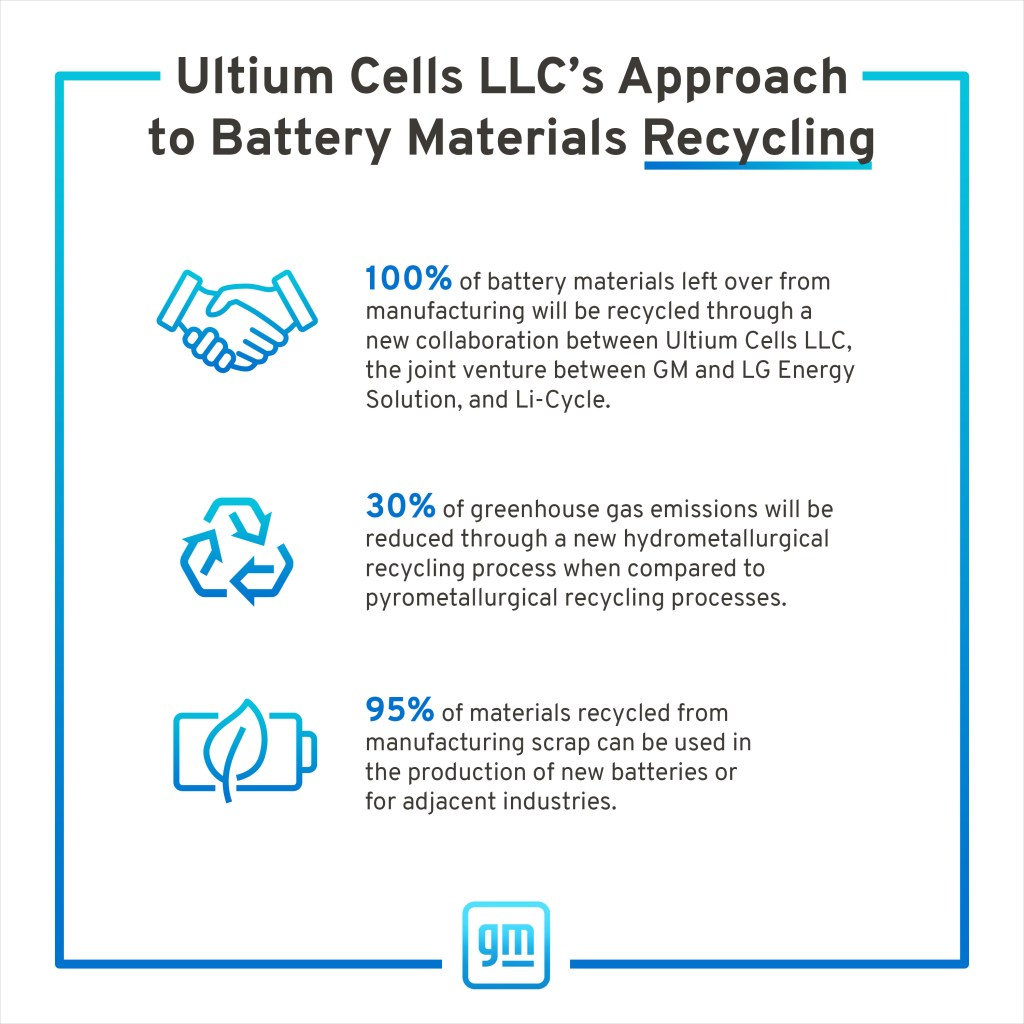
(image: GM)
Kochhar says that they are able to recover approximately 95% of the important materials—like lithium, nickel and cobalt—from the batteries, which can then go back into the production of new batteries.
This past May Ultium Cells LLC, a joint venture between General Motors and LG Energy Solution, announced that it had selected Li-Cycle to recycle up to 100 percent of the material scrap from battery cell manufacturing from its battery-manufacturing facility in Ohio. This will include things like offcuts and scrap, which, Kochhar says, may be comparatively small, but given that the plant in Lordstown will have a capacity of >30 gWh, it is a non-trivial amount.
While Kochhar acknowledges that even within the next 10 years the amount of recycled critical materials from batteries will be limited—perhaps no more than 20%–there is an important need to do this.
Kochhar talks with “Autoline’s” John McElroy, Joann Muller of Axios What’s Next, and me.
On the one hand, the company is all in. On the other, there is a recognition that people need to buy the vehicles
By Gary S. Vasilash
The important point about Mercedes-Benz announcement of its transition to “electric-only output” by the end of the decade “where market conditions allow” is that: where market conditions allow.
If people aren’t buying EVs, then there is little point in making EVs—except the whole thing that legislation may make it a requirement to do so.
Ola Källenius, Chairman of the Board of Management of Daimler AG and Mercedes-Benz AG: Desirability is key. (Image: Mercedes-Benz)
Which is something that gets lost in most of the discussion of the subject.
But if people are buying a whole lot of a given type of car with a given type of powertrain may be predicated on the fact that the alternatives are rather insufficiently appealing.
The phenomenon that is Tesla proves the point that if there are vehicles that are sufficiently desirable people will buy them.
In is only recently that OEMs have gotten to the point where they aren’t just sticking electric powertrains in vehicles in order to meet the aforementioned legislative demands, that OEMs have twigged to the fact that Tesla is not only annihilating these traditional OEMs when it comes to EVs, but is also crushing it when it comes to sales of premium vehicles.
People want to buy Teslas. Teslas look good. They have class-leading performance. They are supported by an extensive charging infrastructure.
As Ola Källenius, CEO of Daimler AG and Mercedes-Benz AG, acknowledged, “Our main duty in this transformation is to convince customers to make the switch with compelling products.”
Otherwise, the market conditions are not going to be such that people are going to want to buy electric Mercedes in any great numbers. The same goes for any other OEM that is putting out EVs.
Now in the case of Mercedes the company doesn’t need to worry so much about gross volumes as it does gross margins.
It acknowledged, “An important lever is to increase net revenue per unit by raising the proportion of high-end electric vehicles such as Mercedes-Maybach and Mercedes-AMG models, while at the same time taking more direct control over pricing and sales. Rising revenue from digital services will further support results. Mercedes is also working on further reducing variable and fixed costs and cutting the capex share of investments.”
So get the top end revenues while decreasing the amount it takes to build them, and supplement that with digital income.
Källenius: “This step marks a profound reallocation of capital. By managing this faster transformation while safeguarding our profitability targets, we will ensure the enduring success of Mercedes-Benz.”
Clearly, unless it makes a move now, then that success may not be as enduring as the company would like.





 shinymetalboxes