Because building electric vehicles costs lots and lots of money
By Gary S. Vasilash
This doesn’t sound good:
“LOS ANGELES–(BUSINESS WIRE)–Faraday Future Intelligent Electric Inc. (“Faraday Future” or the “Company”) (NASDAQ: FFIE), a California-based global shared intelligent electric mobility ecosystem company, filed a Form 12b-25 notifying the SEC that it is unable to file its Form 10-Q for the fiscal quarter ended September 30, 2021 within the prescribed time period, and does not expect to file it by the extended filing date pursuant to Rule 12b-25. The Company is also unable to file its amended Registration Statement on Form S-1 (File No. 333-258993) (the “Form S-1/A”) at this time.”
But maybe that’s just a financial maneuver that has little to do with the actual development of the FF 91 vehicle, which the company says it “remains on track” to deliver to initial customers in July 2022.
However, the company has established a “special committee of independent directors to review allegations of inaccurate disclosures.”
Meaning financial things gone potentially awry.
The company is building a plant in Hanford, California, for the vehicle. It says that during Q3 it completed its first major milestone there, which is the installation of pilot equipment in the pre-production build area. It seems that if they’re going to be delivering production vehicles in little more than eight months, the “pilot” and “pre-production” are going to have to give way to the actual stuff.
And after Q3 it hit its second milestone, obtaining its “Certificate of Occupancy, which allows the Company to begin building additional pre-production vehicles for final testing and validation.”
The company is taking reservations for the FF 91 Futurist, which it descrbies as its “class defining, 1,050 hp and a revolutionary user experience designed to create a mobile, connected and luxurious third internet living space.”
Except for the 1,050 hp, it sounds like a cross between an Airstream and a Starbucks.
In the first three quarters of 2021, these are the U.S. sales numbers of the leading luxury brands:
259,237 BMW
245,864 Lexus
230,855 Tesla
213,708 Mercedes
That’s right: Tesla outsold Mercedes.
And then there is this, the market capitalization (on 11/11/21) of the three companies that were once known as the “Big Three”:
GM: $89.14 billion
Ford: $77.5 billion
Stellantis: $64.21 billion
(It is worth noting that in addition to Chrysler, Dodge, Jeep, Mopar and Ram, Stellantis includes Abarth, Maserati, Open, Alfa Romeo, Citroen, DS Automobiles, Fiat, Fiat Professional, Lancia, Peugeot, and Vauxhall. Meaning it is a much larger company back when it was part of the Big Three.)
Although how exactly this works isn’t entirely clear to us, but it is fascinating nonetheless.
Lamborghini has announced that it is deploying Alexa-enabled what3words into it Huracán line of vehicles for purposes of navigation.
The company what3words, which was founded in London in 2013, has divided the globe into 57 trillion three-meter squares. Each of these squares has a unique combination of three words.
what3words navigation. (Image: Lamborghini)
For example, the spot that provides the best view of the Golden Gate Bridge in San Francisco.
According to Chris Sheldrick, CEO and co-founder, “Traditional addresses aren’t suitable for voice input, and a lot of the time, the best spots don’t have an address at all.”
Apparently the square for that ideal spot in San Francisco is found by entering ///usual.trying.highs
Something that ought to be top of mind, tends not to be. But it still is for Toyota
By Gary S. Vasilash
One of the areas in automotive development that doesn’t get the attention it deserves—probably as it is not particularly sexy—is safety.
But find yourself in the process of an accident and you hope that the OEM that built the vehicle you’re traveling in is on the leading edge of safety research.
Toyota, which established the Collaborative Safety Research Center 10 years ago with the objective of performing open research with universities and hospitals (the former have lots of smart people and the latter have lots of smart people who are on the receiving end of things gone wrong) is sticking with it, as it has announced a five-year, $30-million commitment to the CSRC.
The CSRC has three research tracks that it is pursuing:
Human-centric, or helping people understand what advanced mobility can do. Also, customer health and wellness are part of it.
Safety assurance, or looking into the intersection of human drivers and automated driving systems. Let’s face it: there is going to be a mixed of the manual and the automated for some time to come.
Assessment, or helping individuals and industry participants understand appropriate decision making predicated on quantitative mobility safety measures.
Explained Dr. Danil Prokhorov, director of Toyota’s Future Research Department and CSRC:
“Humans are at the center of Toyota’s technology development strategy, so we are designing our new safety research in pursuit of ‘Safety for All.’ As part of this, our projects will explore the diversity of safety needs and analyze safe mobility options that accommodate different applications, physical characteristics and levels of accessibility for people and society.”
Safety may not be sexy. But neither is a visit to an ER.
Years ago, before there were plug-in hybrids, I remember having an early Prius to test drive.
My neighbors were sufficiently knowledgeable about cars to know that it was something different.
So I explained to them that at some points during the drive cycle the Prius was capable of driving on electricity alone, that there were both electric motor and generator functions, as well as a good-ol’ internal combustion engine.
And the single question that came: “Where do you plug it in?”
I explained that it didn’t have a plug.
“How does it run on electricity?”
I tried to explain that the generator charged the battery and the battery powered an electric motor that drove the wheels.
And I might as well have been talking in some alien language.
After there were plug-in hybrids out there for a few years, when the then-FCA launched the Pacifica plug-in hybrid, the company didn’t promote it as a “plug-in hybrid,” but simply as a “hybrid.” The marketing folks knew that it would be too confusing for their own good.
One of the problems with people who are deeply involved in the auto industry in some way is that they expect everyone else is as fascinated as they are.
The other people aren’t.
Not by a long shot.
What seems ever-so fascinating to the enthusiast is, well, some irrelevance being described in some alien language.
The Volkswagen ID.4 is an electric vehicle.
Fully electric. (For my neighbor: “No, you can’t fill it with gas.”)
It strikes me that one of the best things about it is that it is sufficiently straightforward and simple. Yes, there are some things to get used to, like getting into the vehicle and not turning a key or hitting a button to activate it. And like turning a knob to put it into gear.
Small things, though.
Otherwise, it is all rather obvious.
Which is a good thing.
Regular people can drive it without feeling like they’re taking part in a science experiment.
So massive credit to the folks at VW for creating a video series, “Electric Like I’m Five,” hosted by Volkswagen Director of E-Mobility Dustin Krause and his daughter, Harper.
I can imagine the EV enthusiasts gasping: “How dare they simplify this exquisite technology!”
But I submit that is exactly the point.
VW realizes that to make EVs mainstream, then it needs to be something that is understood by adults and children alike.
This is not some sort of ultra-advanced technology (brought to us by aliens). It is an advancement in transportation.
Once people understand that it will get them to work in the morning—while providing advantages (like not having to go to a gas station unless snacks are desired)—then there will be more EVs purchased.
That’s the goal of on-going work in San Jose. It is using lithium sulfur and a 3D grapheme that it has developed.
By Gary S. Vasilash
One of the more interesting aspects of the on-going transition to electric vehicles (EVs) is that there are all manner of companies that are pursuing the technology, not only companies like Foxconn, more ordinarily associated with making things like iPhones rather than EVs, but a growing number of companies whose names are new, typically companies based in Silicon Valley who are busy developing things ranging from control software to batteries.
One such company is Lyten, which is based in San Jose, not exactly a place associated with motor vehicles (although the Tesla plant in Fremont is close, and there used to be a Ford assembly plant in San Jose, although it closed in 1983 and eventually became a shopping mall).
One of the cofounders of Lyten is Dan Cook, currently the company’s CEO. Cook began his career working at GM but has spent the better part of it in the tech space in northern California.
As he describes his professional point of view, “I’m half auto, half tech.”
Which is a good thing for someone who is working for a company that is undoubtedly hoping to become a supplier to a vehicle manufacturer.
Lyten is developing batteries.
The batteries it is working on are based on three-dimensional graphene and use a lithium-sulfur chemistry rather than the currently conventional lithium nickel manganese cobalt (NMC) chemistry.
Cook, on this edition of “Autoline After Hours,” explains why the three dimensional grapheme is important to the batteries and the benefits of using sulfur rather than NMC for batteries. Among the benefits are energy density, which means long range, and another is that the materials used can be domestically sourced, which is advantageous as regards the supply chains that we are so now very aware of.
As for the chemistry part of it, let’s just say that you should want the show because Cook provides a better description of it than any summary here could.
The air may be getting better. At some point in the future
By Gary S. Vasilash
Arguably, OEMs have been, and continue to, address emissions concerns. Let’s face it: for more than 100 years the fundamental getting to there from here has involved combustion, whether of gasoline or diesel fuel, combustion that leads to a variety of outputs (beyond kinetic energy) like emissions that aren’t particularly healthful for people.
That said, there are millions of vehicles on the roads of the planet right now, and as vehicles are retired out of the fleet there are new ones taking their places. While the OEMs are, by and large, working hard to develop more fully electric vehicles—which don’t even have tailpipes—this work takes time, and even were they to replace every single gas- or diesel-powered vehicle on their lots with EVs, it takes even more time for the replacement to take place.
There is a drive by corporations (e.g., car companies) and countries to become “carbon neutral” within the next few decades, Which is no mean feat. An objective is to eliminate carbon dioxide emissions because of the effects of that gas on the atmosphere.
But there is another gas that is associated with fuels, methane. And while there is less of it produced, it is more nefarious climate-wise.
So the U.S. EPA has proposed a rule that, it says, “would reduce 41 million tons of methane emissions from 2023 to 2035, the equivalent of 920 million metric tons of carbon dioxide. That’s more than the amount of carbon dioxide emitted from all U.S. passenger cars and commercial aircraft in 2019.”
A large amount of the methane emissions is a result of leaks in the oil and natural gas industry. Unlike those leaks associated with massive oil slicks, these leaks are not the sort of thing you can see.
You’d think that plugging leaks would be something that the oil and natural gas industry would be interested in doing. But given that there needs to be a proposed rule, apparently that is not always the case.
But it is a bit concerning that the metric being used by the EPA in terms of methane reduction is 12 years to accomplish what was emitted in one.
Here’s something else to think about:
Although it is hard to have a whole lot of sympathy for the oil companies (this is not to blame them for the chemistry of combustion, mind you), it does seem that they’re the ones who are going to be in tough straits going forward: There are the car companies who are looking to replace their petroleum-powered vehicles with those that run on electricity, which means there will be less gas bought at corner stations around the world, and in the case of this proposed (remember: proposed) methane mitigation, they’re going to have to plug the leaks.
Ford Performance, working with MLe Racecars and the Roadster Shop, has developed the F-100 Eluminator concept—an electric truck.
It is based on a 1978 F-100 pickup, which explains the retro styling (i.e., because it is retro).
F-100–customized with electric motors. (Image: Ford)
But bringing the truck up to the moment, it features two electric traction motors—front and rear—which are the same type as those used in the Mustang Mach E-GT.
The traction motors produce 480 hp and 634 lb-ft of torque.
Eric Cin, Ford global director, Vehicle Personalization, Accessories and Licensing. “Our F-100 Eluminator concept is a preview of how we’re supporting customers as they go all-electric and embrace zero-tailpipe emissions performance, even for our heritage vehicles.”
One can only imagine that were a truck like the Eluminator pull up along side a [fill-in-the-blank performance car] at a stop light it would get a glance from the other driver. . .who would then stare at the taillights as the truck has left him behind.
With its Hertz deal, Tesla continues to defy us skeptics
By Todd Lassa
Contributor
Electric cars are the future. No matter how attracted you are to the charms of the internal combustion engine, it should be obvious by now we need to stop burning fossil fuels ASAP and begin to try and reduce greenhouse gases, if it’s not already too late.
When the transition finally comes, when internal combustion engines are powering only a few collectible cars out for a cruise on warm summer days – and two or three of them may be mine, I’m afraid – it will be right and appropriate to celebrate Tesla’s contribution to the shift. Full disclosure here: I’ve long been a Tesla skeptic, not so much because of the cars, which are undeniably state-of-the-art in their battery chemistry (until solid-state batteries become the order of the day), but mostly because of its CEO, Elon Musk.
(Image: Tesla)
From the beginning, I was skeptical about Telsa’s ability to make money. Most of the few profitable quarters since Tesla’s 2012 IPO were from selling zero-emissions vehicle credits in California to automakers whose sales of vehicles were anything but zero-emissions.
Then there’s Musk’s techie hucksterism and his faked astonishment at the value of the company’s shares. He’s long been known for unveiling new products with ridiculously short development schedules. The vehicle is introduced. The stock goes up. And in many cases, the vehicle is nowhere to be seen after it has left the stage. The Cybertruck has been delayed again and again. As has the Roadster. No matter, it seems. The Tesla faithful will wait.
Were it a brand from Detroit or Stuttgart, these delays would be derided. Not so for Musk.
When Hertz announced in October that it has signed a contract to buy 100,000 Tesla Model 3 EVs, one-fifth of its rental fleet, conventional auto business wisdom might have been, “why would Musk do that?”
“Heritage” automakers historically relied on rental fleets to take as much as one-quarter of the production of their mainstream compact and midsize models. A Nissan Sentra sold to a retail customer will make a razor-thin profit for both the automaker and the dealer – and even less when leased to Hertz or Enterprise and then sold after a couple of years at another huge discount, damaging resale values even more for those who drive these models every day.
Many of the mainstream automakers have been talking for years about reducing their rental fleet business because of the negative effect those sales had on residual values. But when the Hertz-Tesla deal was announced, Tesla Inc.’s shares shot up by 9.6% to make it the latest tech firm to top $1-trillion in market cap. Musk may soon pass Amazon’s Jeff Bezos as the world’s wealthiest human. As I write this, one share is worth $1,096.02, or $1.1 trillion in market cap. GM is at $79.1 billion and Ford Motor is worth $68.53 billion.
Bloomberg News explains that Hertz will pay “full price” for the Teslas, worth $4.2 billion in revenue to the automaker. Citing a Hertz spokeswoman, the report says the Model 3 rental rates will be “similar” to other luxury car rates, and charging will be covered by the rental company through January of next year. Tesla will deliver all 100,000 Model 3s within the next 14 months.
What is interesting about the Hertz-Tesla deal is another individual: Hertz acting CEO Mark Fields. Fields had been the CEO of Ford, but “retired” from the company in 2017. Fields is 60. One of the rumored reasons why he departed Dearborn was because he wasn’t doing enough to message to Wall Street the OEM’s mobility vision.
Seems that what he’s contributed to Tesla’s valuation underscores his mobility vision.
What worries me about the Hertz-Tesla arrangement is this detail, also from the Bloomberg News report: You will be able to re-load your smartphone with the Hertz app, for on-demand access to Supercharger credits and to the car’s Autopilot system.
Autopilot is Tesla’s “autonomous driving” system, which Musk has promoted as the car being able to drive itself. It is not self-driving, and by most accounts it’s less sophisticated than the GMC Super Cruise commercials you might have seen on television, lately with the Queen hand-claps.
In case you rent a Tesla from Hertz and choose to download the Autopilot system on your smartphone, I’m going to give you a piece of advice I would never otherwise give for a rental car: You might want to take the supplemental insurance from Hertz.
Jim Morrison talks about the venerable brand on this “Autoline After Hours”
The numbers are notable.
Through the first three quarters of 2021 Jeep sold 604,671 vehicles in the U.S.
That makes it, by far, the most important brand within the Stellantis U.S. group.
While everyone knows that pickup trucks are driving the market in a big way, Jeep handily outsold Ram brand, which had sales of 495,410 units.
Of course, in terms of product offerings Ram pretty much has the Ram pickup variants, which accounted for 434,772 of the sales. The ProMaster Van and the ProMaster City account for the rest.
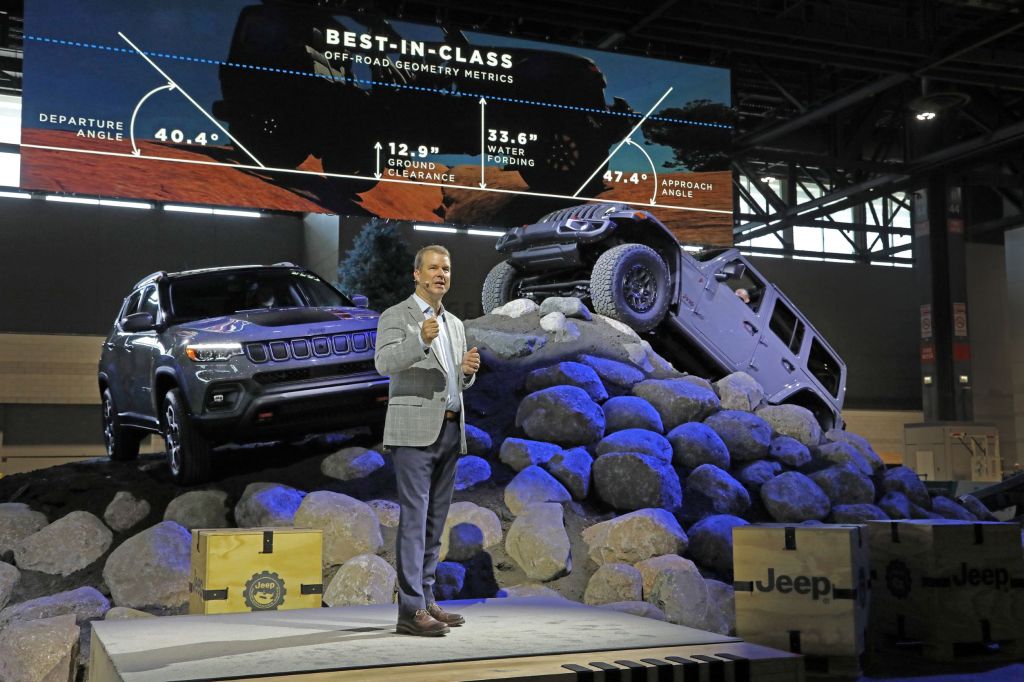
Jeep vp Jim Morrison (Image: Jeep)
In the case of Jeep, there are the Wrangler (164,710) and the Grand Cherokee (189,727). Having two popular models is certainly beneficial.
And as for the other brands—Chrysler, Dodge, Fiat and Alfa Romeo—realize that all in for the first three quarters the entire group had sales of 1,365,881.
Jeep and Ram combined account for 1,100,081 units, so you can figure how the others did.
Jim Morrison is vice president, Jeep Brand North America. On this edition of “Autoline After Hours” he talks with “Autoline’s” John McElroy, Mike Austin of Hemmings and me about where the brand is and where it is going.
The importance of having some solid nameplates is something that they’re taking into account which is leading to an expansion of offerings.
For example, the fifth generation Grand Cherokee is now also available as the 4xe (plug-in hybrid) and Grand Cherokee L (a three-row vehicle).
In addition, this year Jeep has also launched the Wagoneer and Grand Wagoneer. The Grand Wagoneer starts at $86,995. It is not only the most sumptuous Jeep, but what is important to note is that it is still a Jeep: the engineers didn’t forget capability when developing the vehicle.
Morrison talks about those vehicles, as well as about the influx of competition that Jeep is now facing, such as with the Ford Bronco and the GMC HUMMER.
He thinks that what is going to happen is that the entire segment is going to grow as people begin to think more and more about vacations that put them behind the wheel of a vehicle and not strapped into a seat on an airplane, and that an increasing number of those vacation trips will be out in the wilds, a place where Jeeps excel.
Morrison also thinks that Jeep will maintain its share of the market, not lose it to the other companies.
He also talks about whether there could be fully battery electric Jeeps, and while he is cautious about talking future product, he does make an interesting statement that encompasses Jeep:
“We don’t care what puts power to the ground. We just want to do it better than anyone else.”



 shinymetalboxes