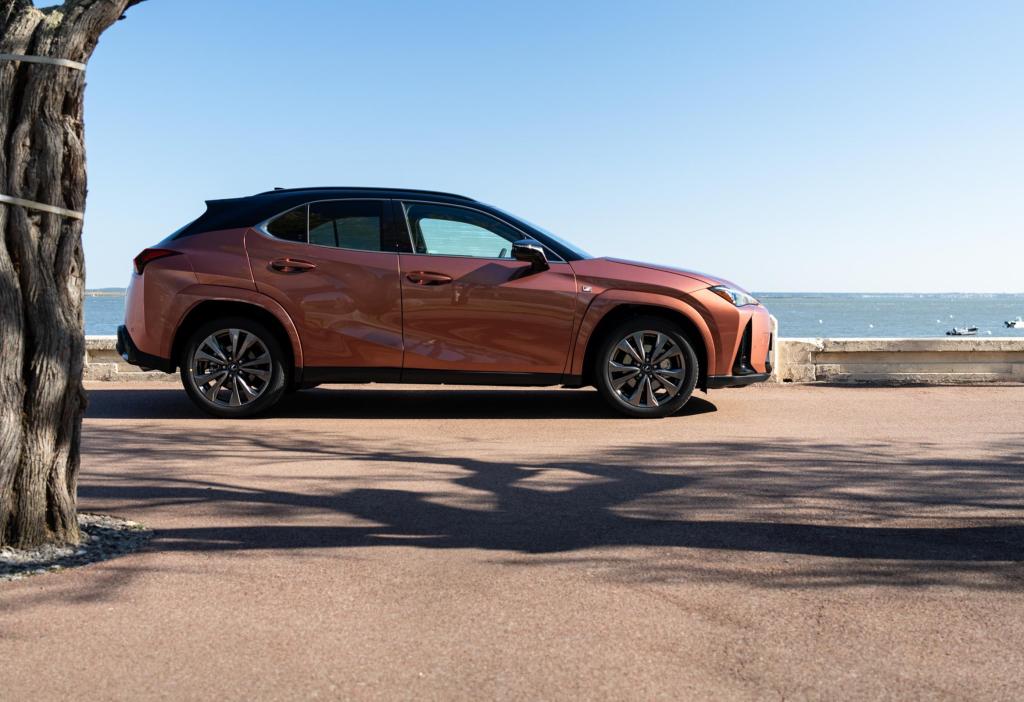
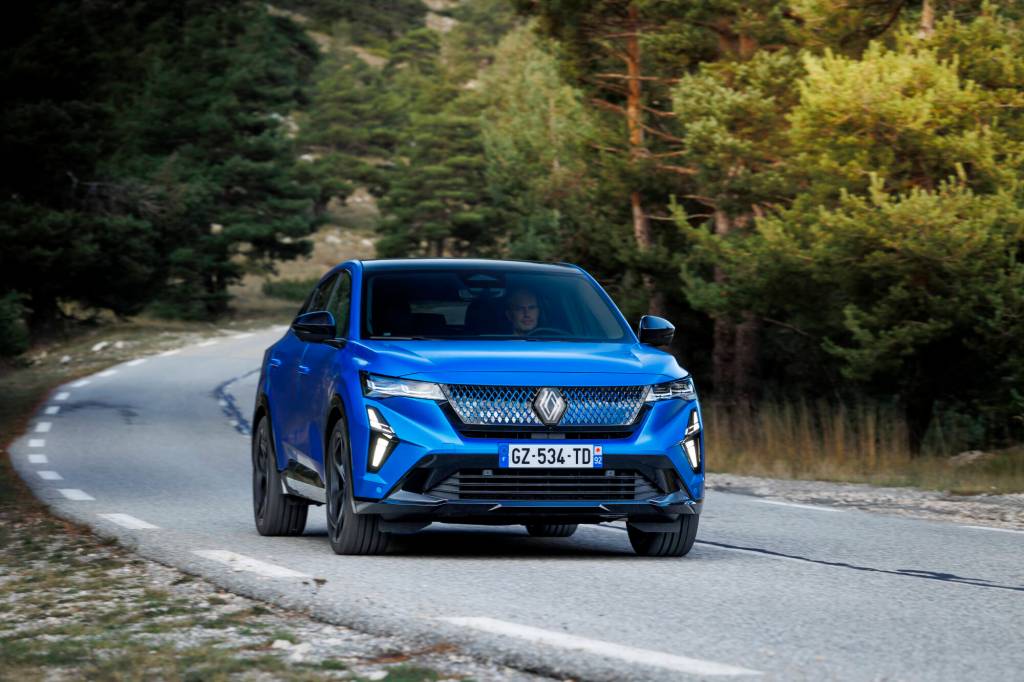
Some have thought that the Tayron will become the Tiguan.
The next-gen Tiguan will be on the long-wheelbase configuration for the Tayron.
But the Tiguan will, according to VW of America, have significantly different “sheet metal, powertrain options and equipment set.”
In other words, for ordinary people who don’t care about things like platforms, the U.S. Tiguan is a completely different vehicle than the European Tayron.
That said, the Tayron, which is available as a five- or seven-seater, is an interesting vehicle, largely because of the powertrain choices.
There will be:
A mild hybrid based on a 148-hp engine
Two plug-in hybrids, each of which will offer an electric range of over 100 km (62 miles)
Two turbocharged diesels
The Tayron will be slotted between the Touareg and the Tiguan in the European market.
The Touareg, a premium crossover, hasn’t been available in the U.S. market since model year 2017.
However, the U.S. has both the Atlas and the Atlas Cross Sport, which the Euros don’t have.
The next Tiguan will be announced at the LA Auto Show in November.
When the subject is NVIDIA and the auto industry, it is often related to how companies like Volvo are leveraging the company’s silicon for getting autonomous capabilities.
But what is possibly more germane and interesting on the road to autonomous driving is an announcement by MITRE Corporation, a government-sponsored nonprofit research firm, that it is partnering with Mcity, a 32-acre site in southeastern Michigan operated by the University of Michigan where autonomous driving systems can be safely developed.
Mcity includes various road surfaces, road signs, building facades, various types of crossings, underpasses, guard rails, and other real-world elements of driving.
NVIDIA’s Orin. Not only does it develop tech for autonomy in vehicles, it also has tech that allows the simulations necessary to get autonomous capabilities developed. (Image: NVIDIA)
What MITRE and Mcity will be doing is using NVIDIA Omniverse Cloud Sensor TRX APIs.
Or said more simply: developing the means by which their will be a comprehensive digital representation of the entire Mcity environment, including the cameras, lidars, radars, and ultrasonic sensors on vehicles.
The objective of having things like a digital twin of Mcity is providing the means by simulations can be run to test the performance of virtual vehicles. Then this information can be used in the development of physical vehicles.
By running the tests first in the virtual environment there can be repeated consistent tests as well as the ability to adjust parameters to present different conditions and/or capabilities so that when the real car is on the roadways of Mcity it is more likely to be able to perform as expected due to the virtual testing.
Sure, in order to get autonomous capabilities vehicles are going to need to use things like the NVIDIA Orin processor. But to get to the vehicles, there needs to be a whole lot of development, which things like the NVIDIA Omniverse Cloud Sensor TRX APIs can be instrumental for.
Renewables are nice, but petroleum provides the profits, it seems. . .
By Gary S. Vasilash
In defining its purpose, energy company bp states, “Our purpose is reimagining energy for people and our planet.”
Apparently there’s not a whole lot of imagination at the company because it seems, according to reporting from Reuters, that said reimagination is going to be more of the same.
“BP has abandoned a target to cut oil and gas output by 2030 as CEO Murray Auchincloss scales back the firm’s energy transition strategy to regain investor confidence, three sources with knowledge of the matter said.”
The whole notion of cutting oil and gas output by 40% by 2030 was announced in 2020. But that 40% was ratcheted back to 25% in February 2023.
That “abandoned” seems to indicate it is now closer to 0, if not all the way there.
As you may recall, bp came up with a moderately clever “Beyond Petroleum” slogan to play upon its name.
Seems like it is more like “Bullish (on) Petroleum.”
Meanwhile, over at ExxonMobil, when it announced its Q2 2023 financials, Darren Woods, chairman and CEO, stated, “We delivered our second-highest 2Q earnings of the past decade as we continue to improve the fundamental earnings power of the company.
“We achieved record quarterly production from our low-cost-of-supply Permian and Guyana assets, with the highest oil production since the Exxon and Mobil merger.”
Yes, oil is not going away anytime soon, EV investments notwithstanding
And while there are regulations around the world regarding the reduction of carbon emissions, how long are they going to stand if the market isn’t interested in those vehicles?
Most people need transportation but don’t necessarily want to compromise on how they achieve it but don’t want to be crushed by the sticker price. Enter the Jetta. . .
By Gary S. Vasilash
Cox Automotive’s “Auto Market Snapshot” for October 3, 2024, has it that the average used vehicle listing price was $25,172 (updated 9/20/24) and the average loan rate for a used car was 13.91%. And the average new vehicle listing price was $46,841 and the loan rate was 9.51%.
So taking those numbers into account, I am exceedingly impressed with the MSRP for the 2025 Volkswagen Jetta 1.5 SEL: $29,000. (Adding destination bumps it to $30,225).
Now were you to buy a used car at that average listing price of $25,172 and get a five-year loan fat the 13.91% rate (assuming nothing down) that vehicle would end up costing $34,929.
If you were to buy a brand-new 2025 Jetta for $30,225 and finance it for five years at 9.51% (again, assuming nothing down), you’d pay $38,320.
Or, a difference of $3,391 over the five-year period, or $678.20 per year.
Somehow it seems that ponying up $56.52 per month is well worth it for getting a car that is really quite impressive—and if you took at the average new vehicle listing price of $46,841, that $29K MSRP cannot be overlooked when the Jetta is a complete package.
2025 Volkswagen Jetta. (Image: VW)
When it comes to VW sedans, the compact Jetta is the proverbial last-man standing. The Passat, which the company once hoped would be its answer to the Toyota Camry and Honda According, went out of production in the U.S. after model year 2022.
Then there was the Arteon, model year 2024 was it in the U.S. for the upscale-but-affordable sedan.
This goes to the point that the U.S. is a tough market for sedans, especially when companies, including VW, are promoting their electric SUVs (the ID.4 in VW’s case), or their ICE SUVs (the Atlas, Atlas Cross Sport, Taos, and Tiguan, in VW’s case).
But apparently there are some people who recognize that the Jetta is a vehicle that fits their needs.
That is, in Q3 2024 in the U.S. there were 19,379 Jettas sold—making it the second best-selling vehicle in the VW lineup, with the Tiguan taking first place, at 21,231. This means the Jetta outsold the Atlas, Atlas Cross Sport, Taos, and ID.4.
Notably, compared with Q3 2023 the Jetta sales are up 35%, the biggest percentage increase of any of the VW vehicles.
This may go to the point of Cox’s findings about the high prices of vehicles nowadays.
The thing about the Jetta is that this is a completely competent vehicle, and that is not damning with faint praise.
The SEL is the top-of-the line Jetta. The S starts at $21,995, which is certainly something that plenty should consider (i.e., $3,177 less than that used vehicle).
But the SEL has much of the “stuff” that people want in a new vehicle—heated and cooled leather front seats (heated in the two back positions), a sunroof, 10.25-inch screen with navigation, BeatsAudio. . .
There is a 1.5-liter, turbocharged, direct-injection engine that provides 158-hp mated to an eight-speed automatic that offers both a sport mode and paddle shifting. The front-drive car is surprisingly peppy.
Adaptive cruise control, lane keeping assist, blind spot monitor. . .these and other tech-based features are part of the package.
The styling is more sophisticated than sporty or extreme: it is a design that won’t age fast.
It is sometimes said that kids swerve from the types of vehicles their parents owned.
So it went from sedans to minivans to SUVs. Perhaps we are getting to a point of a full circle.
The Jetta is certainly a good reason why that could be the case.
No, not for an Accord. It’s for the boating enthusiasts. . .
By Gary S. Vasilash
Back in the day when the Honda Accord was about the size of the current-generation Civic, Honda put a four-cylinder engine in the car, which did the job that needed to be done.
When a new Accord was launched, there was always praise among the motoring press that had a seemingly obligatory, “But only if it had a V8.”
After all, sedans were meant to have those things and it just seemed odd that Honda was more concerned with things like efficiency.
By 1995 the company gave in and put a V6 in the Accord.
But it never put in a V8.
Had it, it would probably been one heck of a V8 because Honda Marine has launched a new outboard motor, the BF350, which is a V8.
The award-winning Honda BF350—a V8 outboard. (Image: Honda Marine)
The new engine has garnered several awards already, including the National Marine Manufacturers Association and Boating Writers International 2024 Innovation Award and a Red Dot Award for Product Design (Red Dot awards, if you’re not familiar with them, are prestigious in the design community).
The Honda Marine description of the engine rings with familiarity for those who are more interested in powertrains for things with four wheels:
“a broader, flatter torque curve; smoother power delivery throughout the engine’s operating range. . .excellent fuel efficiency. . .superior reliability, ease-of-use, maintenance and ownership. A fully balanced, 60° offset precision crankshaft eliminates the need for a harmonic balancer—saving weight and seamlessly integrating with 60° engine design and nonlinear engine mount to provide exceptional operation with minimal vibration.”
And there’s this:
“VTEC (Variable Valve Timing & Lift Electronic Control), the BLAST (Boosted Low Speed Torque) System, Lean Burn Control, Programmed Fuel Injection (PGM-FI), a new Friction Reduction Technology, and Honda Intelligent Shift & Throttle (iST).”
Sounds like it has all of the characteristics that automotive V8 enthusiasts of yore were seeking from Honda.
One thing that doesn’t get a whole lot of attention in discussions about EVs are the volumes in the factories where they are built. . . .
By Gary S. Vasilash
In announcing its Q3 performance, General Motors did the typical approach of accentuating the positive. As the company’s sales were down 2.2% in the quarter compared with Q3 ’23 and are down 1% year-to-date compared with ’23, that wasn’t going to be it.
Rather, as Rory Harvey, GM executive vice president and president of Global Markets is quoted:
“GM’s EV portfolio is growing faster than the market because we have an all-electric vehicle for just about everybody, no matter what they like to drive.”
While in Q1 ’24 GM’s U.S. share of the EV market was 6.5%. It reached 9.5% in Q3.
Clearly its EV sales are on an upward trajectory. But multiple models can drive up production costs.
The Models
Taking BrightDrop commercial vehicles out of the picture, since January GM has sold 70,450 EVs.
Specifically:
20,318 Cadillac LYRIQs
15,232 Chevy Blazer EVs
8,582 Bolt EV/Bolt EUVs
10,785 Equinox EVs
5,252 Silverado EVs
8,902 GMC HUMMER EVs
387 Sierra EVs
The LYRIQ is built in Spring Hill, Tennessee.
The Blazer EV is built in Ramos Arizpe, Mexico.
The Bolts are built in Orion, Michigan.
The Equinox EV is built in Ramos Arizpe.
The Silverado EV, HUMMER EV and Sierra EV are made in Detroit-Hamtramck.
Seven vehicles.
Three factories.
And some 70,450 have been built over a nine-month period.
While there is certainly some sharing of components, there are things like body stamping that aren’t common, which means dies. And the interiors of the three vehicles built at the Factory ZERO plant are different executions, though, again, there are some common parts.
But the point is, there are different costs associated with these vehicles’ production.
Capacity Utilization
Let’s say that the production capacity of an assembly plant is 250,000 vehicles per year.
A rule of thumb is that such a plant must operate at 80% capacity in order to be profitable, so that would be 200,000 units.
Even if the production of EVs doubles from the end of Q3 to the end of Q4, that’s 140,900 vehicles, or 70.45% of a 250,000-unit-capacity plant.
Now in the case of the Ramos Arizpe plant, in addition to the Chevy EVs it is producing the ICE Blazer and the Honda Prologue EV. The former has sales through Q3 of 40,545 vehicles and the latter 14,179.
So with all four of the vehicles being built there, there is an output through Q3 of 80,741.
If that number is doubled by the end of the year to 161,482 (which, of course, won’t happen), that would be about 65% capacity utilization of a 250,000-vehicle plant.
But let’s go back to the 70,450 units of GM EVs sold through Q3.
It is worth noting that during the same period there were 70,710 Chevy Colorados sold.
One model. One plant.
And it shares Wentzville Assembly with the GMC Canyon (26,956 sold through Q3, or 6,638 more vehicles than the best-selling GM EV. In fact, you could add the sales of the Silverado EV and the Sierra EV onto that LYRIQ number and it would still be short of the Canyon: 25,957.)
Profitability in EVs is going to take GM and some of its competitors a bit more than reduced battery costs.
Ford makes it easier for EV buyers to charge at home. What do Bronco buyers get?
By Gary S. Vasilash
Earlier this year the Boston Consulting Group released a report that says, in part, “perhaps the biggest challenge for OEMs is to produce the next generation of EVs profitably. We estimate that most OEMs currently lose around $6,000 on each EV they effectively sell for $50,000, after accounting for customer tax credits.”
Given that the current generation of EVs is what’s presently on dealer lots, that’s lots of money that the legacy OEMs are spending to move the metal.
But because of the billions of dollars they have spent on building out the capacity to produce EVs, they want to keep the production lines running.
Consequently, they are coming up with things that will make EVs more appealing to customers, the $6,000 be damned.
Buy an EV. Get a charger. (Image: Ford)
Earlier this week Ford CEO Jim Farley wrote, “Cheap lease deals on electric vehicles are popping up everywhere. Ford believes it will take more than jumbo rebates to truly break through with the estimated 19 million people in the U.S. interested in electric vehicles.”
Note that he writes “it will take more”—something additive. The rebates and incentives are still part of the game.
Farley goes on to provide details on how Ford is addressing this, through what they call the “Ford Power Promise.”
To provide ease of mind for people, this includes such things as complementary roadside assistance, expanded 24/7 advisor support, and the ability to use its Plug and Charge service that allows a driver to plug in at a charging station and have the electricity charged to the driver’s FordPass account.
But perhaps most significantly, Farley writes: “Buy or lease a retail Ford Mustang Mach-E, F-150 Lightning or E-Transit and take a complimentary home charger with you or have it delivered, and when you’re ready, an expert comes out to install it at no charge for a standard install.”
That’s right: Ford is paying for customers to have home charging capability, something that costs, on average, $1,000.
This could be a clever marketing approach to getting more people in Ford EVs now (the offer expires on January 2, 2025) and presumably next-gen EVs—after all, if the charger is there, people probably figure they might as well use it.
Consider that both the Mach-E and the E-Transit qualify for the IRA tax credit of $3,750 and the F-150 Lightning the full $7,500.
Go buy an Explorer or Bronco and the only tax-related thing will be the sales tax that you’re paying.
Seems that this EV transition is not only costing the OEMs an enormous amount of money, but let’s face it: the government isn’t magically making those credits appear, so all tax payers are kicking in, as well.
This is not something that was designed in Cupertino. . .
By Gary S. Vasilash
“Apple design” isn’t as often in the conversation today as it once was.
While for some people it was essentially just a matter of using a clean, simple white surface and a name that had the letter “i” stuck on its front, that really misses the fundamental nature of Apple design.
It came down to something that someone could use without having to read a user’s guide or manual.
What is astonishing about this is that no matter what product Apple designed—from computer to phone—it was a highly technical product, something that in the pre-Jobs period necessitated study to use.
A subtle proof that Jobs wanted people to use products right after they were unboxed is that there is a charge in that iPhone (as there had been in iPods) so that it isn’t necessary to plug it in and wait.
Its use would be both intuitive and immediate.
All of which might make you wonder what this has to do with the 2024 Lexus NX 450h+ F Sport luxury compact crossover.
It’s this:
The inside door handle is confusingly absurd. (While it would be grammatically appropriate to just use the word absurd and leave it at that, this handle takes it up a notch.)
It is a metal component that is flush with the surface of the arm rest it is embedded in. To use it it is a matter of inserting your finger into a space between the plastic housing and the handle.
But the is not just pulled once. It is necessary to pull it twice.
And to use what is ordinarily a simple lever of some sort, Lexus has added small iconic instructions on both the plastic housing (an arrow with points on each end indicating the intended movement to be achieved) and on the door pull’s top surface, a red label.
I’m sorry, but this is a horrible execution.
Is it a deal-breaker for those who might be interested in getting a nice, well-handling plug-in hybrid that features sumptuous seats and an array of safety tech and infotainment tech, a vehicle that provides an approximate 36-mile electric-only range before it reverts to a conventional series-parallel hybrid that has an EPA-estimated 36 mpg combined?
Probably not.
Although the thing is, this is something that the buyer will have to live with. Certainly it is something that she’d get used to. Certainly something that would be highly annoying were a freshly manicured fingernail to be fractured by working the handle. Certainly something that would come to mind every time the owner was in a model with a more-utile actuator.
And maybe the folks in the Lexus Handle Department got an atypical assignment and assiduously went at it.
On the outside there are what appear to be conventional door handles that you reach in from the top or bottom and pull toward you.
In the case of the NX there is a rubberized surface on the interior surface of the handle that covers an electronic button. By pulling the button is activated and the door opens.
Is this a “luxury” feature or, well, a solution to a non-existent problem?
Again, overall—from the exterior styling to the cargo capacity (22.7 cubic feet with the rear seat up; 46.9 cubic feet when folded down)—this is a nice vehicle.
It is based on the GA-K platform that it shares with the hybrid-only Toyota Venza and the Toyota RAV4—in all of its powertrain configurations—so one can have not only Lexus-level amenities with the NX, but Toyota-level reliability.
Still, this would be a better vehicle if some of the designers and engineers asked themselves, “What would Steve do?”
Four North American Car, Truck and Utility Vehicle of the Year jurors talk about the semifinalists for the awards in a lively discussion. . .
By Gary S. Vasilash
The North American Car, Truck and Utility Vehicle of the Year (NACTOY) Award has been around since 1994. Back then, of course, utility vehicles, by and large, weren’t what they are now, vehicles, to borrow a phrase from Alfred Sloan, for every purse and purpose. So there was no category for CUVs/SUVs at the start.
But in 2017 the decision was made to add the Utility category.
That year there were three finalists:
Chrysler Pacifica
Jaguar F-Pace
Mazda CX-90
Oddly, the Pacifica won. (Not that it didn’t deserve an award and it is not like minivans aren’t the most package-efficient architectures, but if were to run the elementary school test, wherein you’d show a picture of a Pacifica and a Wrangler to a 10-year-old and say, “Which is the sport utility vehicle,” odds are the Pacifica wouldn’t get the nod.)
Nowadays, the Utility category is the most-contested, by far.
The Jurors
You might be wondering just who picks the winners.
Obviously, the MotorTrend Car of the Year is selected by that publication. And there is no mistake the Car and Driver 10 Best are selected by the journalists for Car and Driver.
In the case of NACTOY, there are 50 journalists from the U.S. and Canada, a mix of people working in all types of media, from ink-on-paper to YouTube to radio.
Clearly there is an array of opinions generated by this group.
Three of the current NACTOY jurors are Henry Payne, car critic for the Detroit News (yes, he reviews trucks and utilities, too), Mark Phelan, who reviews vehicles for the Detroit Free Press, and auto writer Greg Migliore.
Oh, and I am a juror, too.
I brought the three of them together to talk about the “NACTOY Best of 2025,” a.k.a., the semifinalists, on “Autoline After Hours.”
That group of vehicles will be winnowed down to three finalists in each category. The finalists will be announced in LA on November 21, and the winners at the Detroit Auto Show on January 10, 2025.
The Vehicles
The vehicles in question at the moment are:
Cars
BMW 3 Series
BMW M5
Cadillac Celestiq
Dodge Charger EV
Fiat 500e
Honda Civic Hybrid
Kia K4
Mercedes-AMG E Class
Porsche Panamera
Toyota Camry
Trucks
Ford Ranger
GMC Sierra EV
Ram 1500
Rivian R1T
Toyota Tacoma
Utilities
Chevrolet Equinox EV
Honda Prologue*
Volvo EX90
Hyundai Ioniq 5 N
Hyundai Santa Fe
Jeep Wagoneer S
Lincoln Nautilus
Porsche Macan EV
Toyota Land Cruiser
VW ID. Buzz
So if you’re thinking about getting a new vehicle, you might want to watch the show.
If you’re interested in a lively discussion of the offerings made by the auto industry, you certainly want to watch it.
By the way: Henry Payne goes out on the proverbial limb and names the vehicles that he thinks will win the awards. While you could simply slide that fast-forward dot on YouTube and bring it toward the end of the show to see Henry’s predictions, you’ll want to watch the whole thing to see his reasoning to get to those conclusions.