Seems like the EV slowdown is happening elsewhere, too
By Gary S. Vasilash
The South Korean-based brands—Hyundai, Kia and Genesis—are producing some of the most-appealing electric vehicles available in the U.S. market.
Award-winning Kia EV9 (Image:Kia)
Consider, for example: for the 2024 North American Car, Truck and Utility Vehicle of the Year Awards, the Hyundai Ioniq 6 was one of the three finalists in the Car category. The Genesis Electrified GV70, Hyundai Kona/Kona EV, and Kia EV9 were the three finalists; the EV9 received the award.
And, of course, these products (and others, too) are available to Korean consumers.
GlobalData has run numbers for how well electric vehicles are doing in the home market of those companies, and finds that through April 2024, zero-emissions vehicle sales in Korea, 97% of which are EVs and the balance fuel-cell vehicles, are down 17% compared with April 2023.
Meanwhile, hybrids (including plug-ins) are up by some 45%.
Why are EVs not doing so well? GlobalData suggests:
Early adopters have gotten them. The majority isn’t buying yet.
And on the subject of buying, there is the comparative higher costs of EVs.
Charging is a concern.
Residual value decreases make an EV purchase less appealing.
GlobalData points out that while there had been dismissiveness expressed by some pundits regarding hybrids as being a bridging technology between internal combustion engine vehicles and EVs, the numbers are showing that that is indeed the case.
The good news for Hyundai, Kia and Genesis is that they offer compelling hybrid products as part of their global portfolios, too.
The “Car Wars 2025-2028” study from Bank of America Securities includes an interesting assessment of what OEMs need to do.
Simply:
“Automotive manufacturers can compete through cost leadership, superior product, or product differentiation.”
As for the first, the analysts think this is likely “unachievable for most OEMs.” There is pretty much cost parity across the board. Which, no doubt, makes auto execs extremely nervous about the potential of low-cost Chinese vehicles being made available in the U.S. 100% tariffs may not be enough to get them through sleepless nights.
Superior product is certainly something all consumers are looking for. But the BoA folks say there has been “a convergence in product quality, as all automakers have improved to a relatively common level.” Based on findings from Consumer Reports and J.D. Power, “relatively common” is rather relative, as some OEMs are putting out significantly more superlative products.
While it is generally true that there are no longer any “bad cars,” there are much better cars than the not-bad choice.
And finally, there is product differentiation. The study has it that OEMs pursuit of this includes such things as new model introductions, unique models, increased vehicle technology, and “attempts to stand out with new EVs.”
But there is something else that they found, which seems to indicate that product differentiation is something that isn’t getting a whole lot of effort:
“The CUV segment is becoming increasingly saturated by new product, and across all price points (from higher-end, luxury European brands to lower-end, entry-level Korean brands), so little incremental benefit is likely to accrue to the industry as a whole, in our view.”
In fact, BoA projects that of the 223 new models to be launched for model years 2025 to 2028, 53% (121 units) will be CUVs.
Hard to be different when you’re doing the same thing.
So my neighbor, a guy in is mid-20s said: “I really like that car a lot. I quite nearly bought one.”
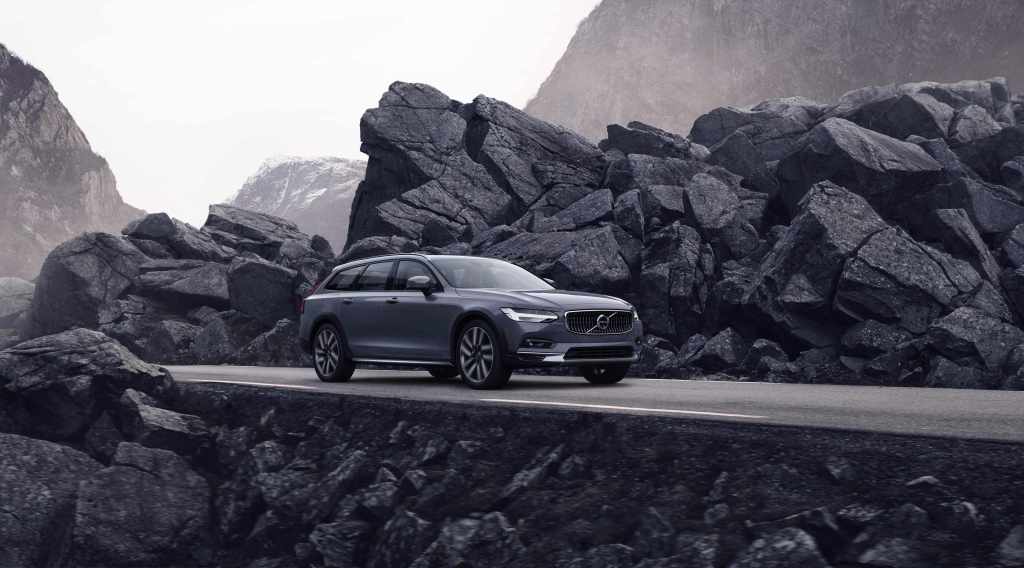
He was talking about the 2024 Volvo V90 Cross Country B6 AWD.
Volvo V90 Cross Country. OK. Maybe this doesn’t look like your neighborhood. But it takes a good-looking vehicle to hold its own with that impressive setting. (Image: Volvo)
Which is surprising for two reasons:
He is in his mid-20s
The car in question is a station wagon
He said that not only does he like the styling of the Volvo, but he’d taken one for a spin and thought it drove well.
To fill out this little vignette, know that he bought an Alfa Romeo Giula sedan instead.
He had had another Giulia, a Quadrifoglio, that he’d leased. He purchased the one now in his driveway.
He said he bought the Alfa because he likes the way it handles.
It is worth noting that in the first quarter of 2024 Alfa sold 640 Giulas in the U.S., so perhaps my neighbor is something of an outlier.
Style vs. Utility
The station wagon body style—more puzzling referred to in other markets as a “shooting brake” (not that “station wagon” isn’t odd: the “wagon” bit makes sense because it can carry goods, but the “station” part seems to indicate that it is something that is static, like a train station—has gone out of favor for the sport utility vehicle.
In part, this goes to the notion that the sport utility vehicle configuration provides utility. Presumably that means the ability to contain a lot of stuff, whether it is golf clubs or hockey gear, suitcases or Costco-sized personal paper items.
The V90 Cross Country provides 25.2 cubic feet of cargo capacity with the second-row seat back up and 69 cubic feet if that is folded down.
So let’s say someone opts for a Jeep Grand Cherokee. Let’s face it: that vehicle is the absolute poster child for an SUV with comfort and style. The Jeep, of course, has four-wheel drive, which makes it incredibly capable when the pavement has given way to an undeveloped surface.
The Volvo has all-wheel drive, which means that it is configured to handle things like snow (after all, Volvo HQ is in Sweden, so they know more than a little something about that).
For what most people are likely to encounter in their driving, AWD is the ticket.
Anyway. . .the Grand Cherokee offers 37.7 cubic feet behind the second row, which is significantly greater than what the Volvo provides, but the Grand Cherokee has 70.8 cubic feet of space with the second row back folded, so it is pretty much a wash.
The V90 Cross Country is longer than the Grand Cherokee—195.2 inches vs. 193.5 inches—but with mirrors folded narrower—74 inches vs. 77.5 inches—and a lot lower: a height of 60.5 inches vs. 70.8 inches. All of which is to say that doing a bit of geometry explains the differences in capacity.
Looks Right. Drives Right.
But let’s get back to my neighbor.
He said he finds the styling of the Volvo appealing, which goes to show that the company has gone a long way from when it seemed as though the designers were kitted with a T-square and right-triangle. It could also go to the point that it very well may be that given the endless proliferation of SUVs and crossovers there may be a small-but-growing group of people who are looking for alternatives.
Yes, he didn’t buy the Volvo, but he did buy a sedan.
Also, he said that he thought the Cross Country handled well. Presumably this has something to do with the vehicle having a lower center of gravity than, say, an SUV.
The Volvo is a mild hybrid. Which means that there is, in addition to the regular 12-Volt battery, a 48-Volt battery that recovers some of the energy produced by braking and stores it until it is used when it works through an integrated starter-generator to provide assistance when starting from a stop.
The vehicle has a 2-liter turbocharged four-cylinder engine. It is mated to an eight-speed automatic. There are 295 hp and 310 lb-ft of torque. All of which is to say that it comports itself as you would expect something like a station wagon to. What’s more, it has a maximum towing capacity of 3,500 pounds. Combined fuel economy is 25 mpg.
Volvo has gone all-in with Google, so there are Google Maps, Google Assistant and Google Play. (Yes, it does support CarPlay.)
Will the Era End?
Swinging back to the Giulia, as previously mentioned, there weren’t a whole lot sold in the U.S. in Q1 2024.
But there were fewer V90 Cross Country models sold during that same period: 164.
At some point, perhaps, more people are going to want to get something that they don’t see in every other driveway on their block. On mine there is an array of F-150s.
And a Giulia.
But I suspect that car makers—Alfa and Volvo alike—are going to have to phase out things that are not gaining traction.
Market churn and vehicle costs are making a big difference on program launches
By Gary S. Vasilash
Pity the product planner.
Pity the consumers of vehicles near the end of the decade.
The first is one of the things that John Murphy, senior U.S. Auto Analyst for Bank of America Securities, in effect, said at an Automotive Press Association meeting held yesterday in a BoA facility in Farmington Hills, Michigan.
Or, in Murphy’s words, “The unprecedented EV head-fake over the last three years has wreaked havoc on product planning. The prior acceleration in EV launches is doing a U-turn in favor of extending ICE programs and new hybrids. However, while there is a lot of talk about hybrids, there isn’t much action. The next four+ years will be some of the most uncertain and volatile in product strategy ever.”
So while it wasn’t all that long ago that people talked about how EVs had it the “tipping point” and henceforth they would be the powertrain of choice, comparative consumer indifference has led to a reconsideration of what had thought to be fait accompli.
Pity the product planner who has to explain why what was to be a winner is just doing OK—at best.
As part of the BoA Car Wars proprietary analysis, which Murphy has been working on, it is determined that looking ahead—from model years 2025 to 2028—the rate of alternative powertrain launches—which includes hybrids—is being trimmed back a bit, with what had thought to be 79 launches in MY 2025-26 being reduced by one and launches in MY 2027-28 being down from 123 to 112.
Remember: there only seemed to be upside in that space not all that long ago.
Enjoy your opulent interior while it is still there
As for the consumers: Murphy explained that Tesla has figured out how to build cost-effective EVs in a way that the traditional OEMs haven’t. Unless the traditional can design and engineer vehicles that are just as cost effective, then while they will eat into Telsa’s market share, they won’t impact Tesla’s profitability.
Murphy said the place where the traditionals really need to focus their cost-cutting efforts are on things like the structure of the vehicle and the creature comforts (or lack thereof).
Consider: you’re unlikely to hear someone tout the comfortable cabin experience in a Tesla, but there have been plenty of thumbs-up for the interior of the Cadillac Lyriq.
But if Cadillac really wants to compete with Tesla, then that interior needs some significant change—which may not be beneficial so far as the customer is concerned.
What does Murphy recommend the traditional domestic OEMs do while they try to figure out how to get those costs out of EVs?
Go to where the money is.
Concentrate on pickup trucks with internal combustion engines.
In order to get change, thing evidently also have to stay the same.
Yes, Murphy said, the trend is still going EV. But not quite as rapidly as seemed to be the case.
If you’ve ever been in an automotive plant you’ve undoubtedly been surprised by the number of forklift trucks zipping around that are transporting parts, equipment and various other things that go into building things.
An autonomous vehicle operating in a BMW plant–capable of handling 55 tonnes. (Image: BMW)
The BMW Group Plant Regensburg is quite similar to other state-of-the-art factories. . .but then there’s this, which apparently is something that doesn’t exist elsewhere: Its uses of an electric lidar-equipped transport vehicle.
What’s notable is not only that this is an autonomous vehicle, but that it transports payloads up to 55 tonnes.
It operates at speeds up to 2.5 mph.
“Not fast,” you think. But (1) it is inside a facility where people are working, so speed is relative, and (2) it is carrying up to 55 tonnes of steel—not the sort of thing you want to bump into.
The autonomous vehicle operates in the factory’s stamping operation. It is used to transport tools for the presses—there are four press lines that turn some 1,100 tonnes of steel into approximately 131,000 stamped parts (e.g., side frames, door outers, hoods) per day—as well as steel blanks that are turned into those parts.
Ever wonder why Western governments are concerned about their domestic auto manufacturers?
By Gary S. Vasilash
The U.S. is applying big tariffs on electric vehicles from China (as in 100%), and the European Union, moderately big (38%). (Apparently the Chinese are doing a bit of retaliation, as it has opened an investigation into pork products exported from the EU.)
Some numbers from GlobalData provide a sense of the sort of numbers associated with Chinese vehicle manufacture that are concerning to those in the U.S. and Europe.
Looking at sales of passenger vehicles in China from January to through April, there was an increase of 5.5% year-over-year to 6.3 million units.
But the red flag is this number: a rise in production by 9%, or 7.6 million units.
Simply: 1.3 million more passenger vehicles made than sold.
This means overcapacity. Which also means that companies are probably interested in finding markets where they can offload those excess vehicles.
And while the 7.6 million number is all passenger vehicles, not just those with batteries in addition to the 12-V battery under the hood, in April there were 424,0000 vehicles exported from China, a year-over-year increase of 36.9%.
And those joint ventures. . .
Once, Western brands were almost giddy when it came to the opportunity to create joint ventures in China with Chinese companies. The market size was (and is) nothing short of amazing.
GlobalData finds that when it comes to NEVs—or “New Energy Vehicles,” which are the hybrids and full EVs—the penetration rate of Chinese local brands was close to 60% of the market, up 7% from the same period last year, while the joint venture brands have a penetration rate of 12%–still up from last year’s number. But only 1%.
So one can expect the Chinese OEMs that produce NEVs to up the production of those vehicles, which will undoubtedly lead to overcapacity there, too, which means they’ll have to do something to do with those vehicles.
Although the U.S. government is rolling out various and sundry rules, regulations and funding schemes meant to increase the number of electric vehicles on the roads, elsewhere governments are drawing lines in the proverbial sand and saying, “After this date certain, no more ICE.”
In the UK there had initially been a plan to ban the sale of new vehicles with combustion engines (gas or diesel) by 2040, but even that was considered extreme by people in the auto industry.
Still, in 2020 the UK government set the time when it would no longer be permissible to sell new combustion vehicles: 2030.
But last year, British prime minister Rishi Sunak, member of the Conservative Party, pushed that deadline back by five years, to 2035. That happens to be when the European Union has announced it will enact a ban. Seems like there was something the UK and the EU could agree on.
(It is worth noting that the Germans are taking a carve out: it will be permissible to sell combustion engine powered vehicles there beyond 2035—if those vehicles use carbon-neutral fuels. Odds are there aren’t going to be a whole lot of e-fuels available there or anywhere else at that time, unless the big oil companies go at it right away, and given that as about 85% of crude oil by weight is carbon, carbon neutrality will be a tough assignment.)
Back to the UK.
There will be an election for a new prime minister in the UK on July 4.
Sunak will be facing Keir Starmer of the Labour Party.
The party has written a “manifesto” outlining its approach to various social and economic issues facing the UK.
And in it there’s this:
“Labour will support the transition to electric vehicles by accelerating the roll out of charge points, giving certainty to manufacturers by restoring the phase-out date of 2030 for new cars with internal combustion engines, and supporting buyers of second-hand electric cars by standardising the information supplied on the condition of batteries.”
That’s right: going back to 2030.
Somehow this probably isn’t “giving certainty to manufacturers.”
When you think of the quintessential full-size pickup truck, the sort of thing that you imagine farmers loading with bales or hay or contractors carrying loads of gravel, it is probably the Ford F-Series.
With good reason, given Ford sells those trucks the way McDonald’s sells hamburgers. The numbers are staggering.
But odds are, those images of the F-Series are probably not entirely accurate.
BMW 5 Series. Or you could consider a pickup truck. (Image: BMW)
Listen to Erin Keating, executive analyst for Cox Automotive, talking about vehicle transaction prices in May.
First she notes: “The popularity of fully loaded, full-size pickup trucks that are more luxurious than many luxury vehicles is unique to the U.S. market.”
Which can be understood that (1) there aren’t a lot of full-size pickup trucks sold in other markets around the world* and (2) those trucks are probably used as utility vehicles (e.g., the opening examples).
Keating does on: “The Ford F-Series outsold BMW 2-to-1 in May, and BMW’s ATP [average transaction price] was only marginally higher than the F-Series.”
Whereas the average transaction price for a BMW in May was $72,946, the ATP for an F-Series was $67,837.
Now that’s about a five-grand difference, which isn’t exactly trivial.
But somehow a Bimmer seems as though it is in another category all together compared with something that you probably once saw with a decal of Calvin relieving himself on a Chevy bowtie on the back window of the truck.
Of course, not a $68,000 truck, but nonetheless. . . .
//
*That full-size pickups are pretty much indigenous to the U.S. market is something that makes the development of EV versions of the trucks somewhat problematic in the long run. That is, on a global basis something like the Ford Mustang Mach-E has more applicability than an F-150 Lightning. While it seems to have been thought by some OEM execs that because customers in the U.S. buy lots and lots of trucks, then if a somewhat sizable percentage of them buy electric versions then everything will be great. For reasons including cost and/or performance, that is not proving to be the case. This means that scale isn’t being achieved, and if there is something that is necessary for an OEM, it’s that. So by spending lots of engineering and manufacturing resources on making a type of vehicle that has a limited domestic market and a nearly non-existent global market, achieving scale is anywhere is not particularly likely.
Something you actually need to drive—assuming you are one of the remaining few who knows how that third pedal works in an era being increasingly characterized by one-pedal driving
By Gary S. Vasilash
“Wow! You should drive the wheels off that!”
Which isn’t the sort of remark that you’d ordinarily get when someone sees a parked car. Not even a muscle car.
2024 VW Golf GTI: Engineered to be driven. (Image: VW)
Especially not something when the guy saying it probably grew up watching muscle cars on Telegraph or Woodward.
It was clear that one look and he thought that it is a vehicle to be driven and everything else would just be icing on the cake.
He was looking at the VW Golf GTI.
In autodom in general the GTI is somewhat rare.
That is, it didn’t appear in the U.S. until 1983.
And while 41 years is a non-trivial number, there isn’t an abundance of the cars out there.
In 2023 Volkswagen of America delivered 7,451 GTIs.
Through Q1 2024 it has delivered 2,412, which is a 156% increase over Q1 ’23.
If it maintains the Q1 pace through the remaining three quarters it could reach 9,648 by the end of the year. As a percentage, a lot. But as tires on the ground, not so many.
And the reason is simple.
While the Golf in Germany* is still primarily a family car that is available with a variety of powertrains, the GTI is, quite simply, a car that it categorized by enthusiasts as a “hot hatch.”
The hatch configuration lends itself to, say, stocking up on things for the family. And with the rear seat folded the GTI offers 34.5 cubic feet of cargo capacity. Plenty.
But odds are Costco is not the destination for the car, especially not the Mk3 GTI 380, as it is equipped with a six-speed manual transmission.**
It is meant to have its wheels driven off. So to speak.
When the observation was made, even though the car was standing still the bright-red brake calipers seen though the gloss-black wheels inserted in the summer tires telegraphed the message that this car is meant to go.
And it does.
The transmission is mated to a 2.0-liter turbocharged engine that produces 241 hp and 273 lb-ft of torque.
It is a front-drive car. To help mitigate issues when getting on the accelerator therew is an electronically controlled torque-sensing limited-slip differential that keeps the car going where pointed.
There is something that strikes me as somewhat ironic about the GTI with the six-speed.
There are metal surfaces on the pedals. A massive metal dead pedal. It is a car that you have to, comparatively speaking, work at driving.
In effect, it is more “mechanical” that your run-of-the-road vehicle. And I mean that in a positive way.
Yet as this is a contemporary car it has, in the words of VW, a “technologically advanced cabin, which offers an integrated high-end digital experience.”
Yes, this means digital gauges for the driver and an infotainment system. Now obligatory.
But the thing that is amusingly odd that for being such a “mechanical” vehicle, the interfaces are not knobs and buttons but smooth, touch-sensitive surfaces.
If there is any car that really needs a large, knurled volume knob, it is the GTI.
//
*Whenever an auto plant is launched, politicians typically come out and make a speech. When the eighth-generation Golf went into production in Hall 12 of the Wolfsburg plant, Stephan Weil, Minister President of the State of Lower Saxony, made some remarks including, “I’m an absolute fan of the Golf and have myself been driving one for several years. For many people in Lower Saxony, the Golf is a piece of home and something they can identify with. Just like the VW Beetle was in the past, the Golf has been a symbol of mobility and freedom for decades. Since 1974, the Golf has made a significant contribution to the stability and growth of Volkswagen and industry in Lower Saxony.” During the past 50 years there have been more than 37-million Golfs sold around the world, of which more than half were produced in Wolfsburg. More of these cars are transportation vehicles rather than enthusiast cars.
**The GTI is also available with a seven-speed DSG automatic transmission with Tiptronic. The automatic is optional. Here’s something that seems, well, different. The MSRP for the GTI with the six-speed ranges from $32,685 to $40,825. But the MSRP for the vehicle with the optional seven-speed ranges from $31,965 to $40,505—less than the models with the manual. Presumably this has something to do with volume: something made in fewer numbers tends to have a higher price than something made in greater numbers. Or maybe it goes to the point that this is the final year there will be a manual in the GTI, so if you want it you’ve got to pay a bit more for the privilege.
Yes, it is still round. But it provides increased functionality
By Gary S. Vasilash
Steering wheels have increasingly become not only the means by which drivers can aim their vehicles, but as a user interface for a variety of functions, from controlling the audio system to engaging cruise control.
Then there is the packaging for the airbag.
Oh, and the steering wheel still is the place where one honks the horn. (Something that is more apparent in, say, New York City.)
Note the horizontal interface across the wheel. (Image: ZF LIFETEC)
A new approach to the steering wheel has been concepted by ZF LIFETEC.
No, this isn’t something where the configuration is radically changed, as though someone is piloting an aircraft rather than an auto.
But there is a horizontal element that goes across the diameter of this concept steering wheel that is described as serving as a control for the “vehicle’s entertainment and assistance functions.”
It is a seamless surface with force-sensitive “buttons.”
The airbag?
It “deploys from the top side of the steering wheel through the upper steering wheel rim toward the driver.”
By this repositioning from where the airbag is typically located the designers and engineers are able to provide that horizontal section with a variety of functions, perhaps even at some point a central screen.




 shinymetalboxes