F-150 Range Considerations

The EPA-estimated range of a Ford F-150 Lightning XLT SR is 230 miles. Ford had been targeting 230 miles and nailed it.

The EPA-estimated range of a Ford F-150 Lightning XLT ER is 320 miles. Ford had been targeting 300 miles, so that extra 20 miles is a positive accomplishment.

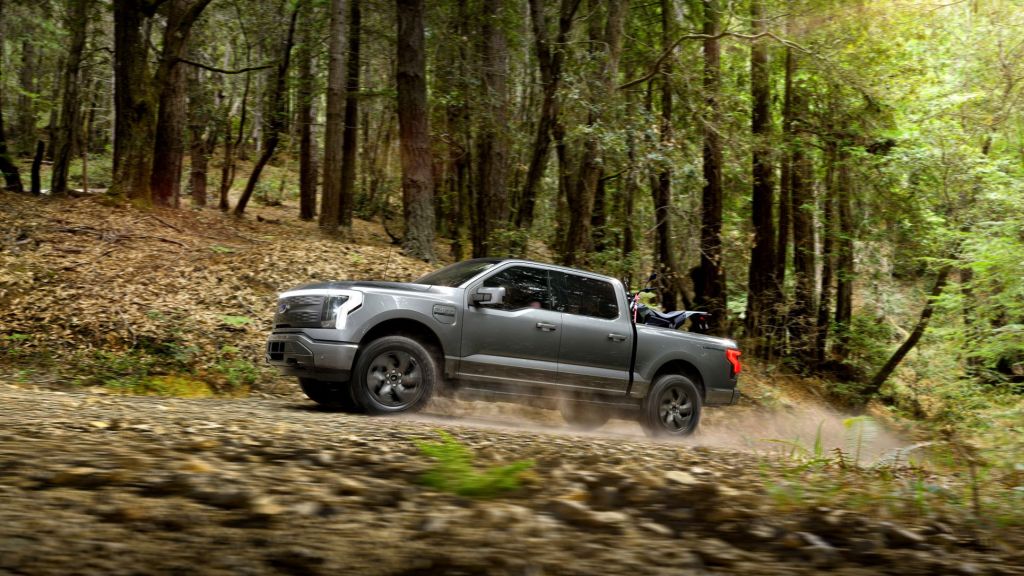
F-150 Lightning. Gets you there. Just not too far away. (Image: Ford)

Still, some people look at those number and are, well, underwhelmed.

Of course, take into account that this is a pickup truck, so that means it is big and heavy, which doesn’t do wonders for electric vehicle range.

Ford offers a 5-liter V8 for the F-150.

A 4×4 with the engine returns a combined 19 mpg.

The truck can be specified with gas tank size. The smallest is 23 gallons. The largest is 36 gallons.

A V8 F-150 with the 23-gallon tank has a range of 437 miles.

A V8 F-150 with the 36-gallon tank has a range of 684 miles.

Somehow really makes those Lightning numbers seem, well, underwhelming.

Getting It Fixed

By Gary S. Vasilash

One aspect of contemporary vehicles is that there is plenty of tech on board, which not only provides an array of consumer benefits, from safety to entertainment, but which also makes them comparatively more complicated to diagnose what has gone wrong when something inevitably does, and it is just as tricky to fix it.

There is something else about today’s motor vehicles that may not be even known by the owners: many of them are transmitting information about their state of being to the OEMs. This information—say about a fault of some sort—can then be used to send a message to the owner saying, in effect, “Something is wrong with your vehicle; go to your dealer to get it taken care of.”

The information about the fault is then shared with said authorized dealer. “Authorized,” of course, means approved by the OEM in question.

Local repair shops?

Nope.

What’s more, as Gabrielle Hopkins, vice president of Federal Affairs, Auto Care Association, which represents the automotive aftermarket, including service, maintenance and repair shops, points out, not only are the independents kept out of the loop when it comes to this telematics information, but there are typically special tools that are necessary to access and repair vehicles that these outlets can’t get.

They are restricted to the “authorized” service centers, typically found within dealers’ organizations.

While there are all manner of arguments put forth as to why this is the case by the OEMs—e.g., they want to protect the intellectual property that is represented by the operating systems developed for their vehicles; cybersecurity issues might arise—this essentially means that there is a protected ecosystem that keeps the independent shops from being able to fix vehicles.

Hopkins and her colleagues are lobbying on behalf of the Right to Equitable and Professional Auto Industry Repair (REPAIR) Act, which the Auto Care Association, CAR Coalition and Automotive Aftermarket Suppliers Association explain, in part:

“The legislation would prohibit impeding the vehicle owner or a repair shop from obtaining service information, tools, or parts, including the ability for a vehicle owner to choose aftermarket parts needed to fully maintain and repair a vehicle.”

Let’s face it: Vehicles aren’t going to get less complicated.

Limiting choice generally means that prices are higher.

And as has been seen during the pandemic, there are limited resources at a given dealership for repair, so should one need something fixed sooner rather than later, the availability of more repair options rather than fewer is a consumer advantage.

Of course, the OEMs and the dealerships may not care much about that.

Learn more from Hopkins on this edition of “Autoline After Hours,” where “Autoline’s” John McElroy, Richard Truett of Automotive News and I talk with her.

You can see it here.

Tire(d)

At some point, tires on one’s vehicle need to be changed.

It could be wear.

It could be a flat.

It could be to obtain some additional performance.

It could be because of looks.

Tires? Looks?

That is a surprising—and possibly disturbing—finding in the J.D. Power 2022 U.S. Original Equipment Tire Customer Satisfaction Study.

“High levels of satisfaction typically yield loyalty”—and Michelin, Goodyear, Pirelli, BF Goodrich and Firestone all rack up good numbers in that context—“but we’re seeing many owners purchase replacement tires based on a narrow focus, such as solely on appearance or price,” said Brent Gruber, senior director of global automotive, J.D. Power.

Sure, price is one thing, especially with the rise in prices of everything (yes, petroleum is not only used to make gasoline, but tires, too).

But appearance?

When faced with a tire change, keep these words from Gruber in mind:

“Tires are a highly engineered component of the vehicle—designed to very exact specifications—which influence how that vehicle performs. With tire replacement, there’s a risk of negating some of those key characteristics and product benefits if expert recommendations aren’t utilized.”

They may not be attractive. But that’s not the point.

Plastics Makers Don’t Like High Oil Prices, Either

One of the things that high oil prices impacts besides the numbers at the pump is the production of plastics.

Some plastics manufacturers have been looking at various alternatives to reduce the amount of fossil fuels that are involved in the production of plastics for the reason of trying to achieve carbon neutrality.

But now there is even a greater incentive, with the rising costs.

Asahi Kasei, an engineering plastics producer (i.e., these plastics can be used in automotive applications) has announced it is working with Genomatica, a company that develops sustainable materials, on a biomass-derived raw material (bio-HMD) that can be potentially used as a feedstock for the production of polyamide 66 (a.k.a., nylon 66).

While this isn’t a certainty, Asahi Kasei is working toward carbon neutrality by 2050, so efforts in the right direction are good to see.

Oliver Schmidt & VW Dieselgate

By Gary S. Vasilash

Diesels have had a popularity in Europe that has never been the case for the U.S. Outside of pickup trucks purchased by contractors rather than by those who simply want a pickup truck because (a) it is a truck or (b) there is that need to buy mulch every now and then, the diesel has had the approximate popularity of manual transmissions in the U.S.

Volkswagen executives in the mid-00s thought that they might be able to gain some market share in the U.S. market were they to develop a “clean diesel”—one that didn’t have the smelly exhaust associated with diesels (it is somewhat inexplicable how Europeans didn’t seem to mind) yet would provide the oft-touted low-end torque seemingly beloved by everyone, as well the kind of fuel efficiency that the compression ignition engine would provide.

So the EA189 engine was developed. But it turns out there was a non-trivial problem with it: It wouldn’t meet the U.S. emissions requirements. VW obviously couldn’t sell a whole lot of Jetta TDIs in the U.S. with that problem.

So the engineers in Wolfsburg came up with what can innocently be described as a “work-around,” or what is now a term of art, “defeat device.”

But it wasn’t a device as in something physical that was stuck in the tailpipe.

Rather, it was software. The software was developed so that it was able to determine whether the vehicle in question was being tested or not. If it was being tested, then it adjusted things so that there wouldn’t be excessive emissions.

Otherwise. . . .

Apparently the engineers who came up with this figured it would be a short-term “fix.”

But as those things happen, short turned into long.

So VW was merrily selling diesel-powered vehicles in the U.S. About 500,000 of them.

In 2014 the International Council on Clean Transportation (ICCT) contracted with researchers at the University of West Virginia. The task was to check the emissions of the VW diesels.

So the researchers drove around in instrumented vehicles. . .and discovered the emissions were on the order of 35 times greater than was permitted.

In September 2015 the U.S. Environmental Protection Agency served a “Notice of Violation” to VW telling the vehicle manufacturer that its diesel-powered vehicles were equipped with a defeat-device.

And so “Dieselgate” began.

The questions of “What did they know and when did they know it?” became the order of the day, with questions at all levels, including to the very top, to Dr. Martin Winterkorn, then CEO of the company.

And there were evident coverups galore, changes at the top, and fines that would make anyone gulp.

Oliver Schmidt had been assigned by VW Wolfsburg to move to the U.S. and take charge of the U.S. operation’s emissions office in 2012. This was before the shit hit the fan. But he was there when it did hit. And there were meetings that he’d participated in with various government officials, from the federal EPA as well as the California Resources Board (CARB).

He was transferred back to Germany and in January 2017, when he and his wife were going to be returning to Germany after their annual vacation in Florida, we was arrested by the FBI and charged with conspiracy to defraud the U.S.

In December 2017 a federal judge sentenced Schmidt to seven years.

He managed to get transferred to German prison in September 2020. He was granted parole in January 2021.

On this edition of “Autoline After Hours” we talk to Schmidt about Dieselgate and his time in prison.

Realize that this is a guy who is as far from being a criminal as you can imagine. A regular engineer in his early 40s.

And due to all manner of what can be described as “political machinations” within Volkswagen AG, he, not the people who were running the place, ended up behind bars.

Schmidt talks with “Autoline’s” John McElroy, Brett Smith director of Technology at the Center for Automotive Research, and me in a conversation that is unlike any you’re likely to watch.

And you can see it here.

Socially Popular

Since social media attention is one of the most important metrics for those in the automotive industry, some findings from Zutobi.com* are undoubtedly of interest.

According to its research, the most popular vehicles in terms of social media mention are:

  1. Nissan GT-R
  2. Honda Civic
  3. Ford Mustang

Here’s how they made the assessment:

The GT-R gets 8,623 weekly Twitter mentions, 9.5 million Instagram posts and 9,890 articles on Reddit.

The Civic’s respective numbers are: 7,863, 8.2 million and 16,500.

And for Mustang: 9,827, 14.7 million and 6,610.

Nissan GT-R: as popular as it is quick. (Image: Nissan)

One could argue that the Nissan GT-R is by far the most popular.

Why? Well, in 2019, the last “normal” pre-COVID year, Nissan sold 331 GT-Rs in the U.S. market. Last year it sold 227.

The Civic and even Mustang sales dwarf those of the GT-R.

So given its share of market its share of attention is massive.

//

*Zuboti is an on-line driver’s ed course. Presumably it did this research because it figured it would get picked up on social media.

On the ID.Buzz

By Gary S. Vasilash

Volkswagen “officially” revealed the electric ID.Buzz van today. The vehicle looks much like the concept vehicle that was revealed at the Detroit Show in 2017, and it even has the same name. Car companies show concepts at shows in order to gauge the interest of potential consumers. Clearly the ID.Buzz scored big points.

Although its heritage goes back to the T1 van introduced in 1950 in Germany, for many Americans there is almost no need to squint so as to see the VW microbus that was (and is) beloved by a whole cadre of free-spirits, from surfers to people who long for the days chronicled in Tom Wolfe’s The Electric Kool-Aid Acid Test.

The phrase “No one likes minivans” will certainly go away when the ID.Buzz hits the road. (Image: VW)

The ID.Buzz (which also comes in a cargo variant: probably ideal for those who shape surfboards or do a lot of precision spray painting) will not arrive in the U.S. until 2024.

But between now and then there will undoubtedly be lots of—dare I say?—buzz about this new vehicle. There will be announcements galore about the interest being exhibited by consumers in a way that might even make Elon Musk feel moderately envious.

What’s interesting to note is how one of the things that traditional OEMs are doing to draw interest to their EVs is to borrow from their heritage.

There is the ID.Buzz. Ford’s first serious entrant into the New Era of EVs was the Mustang. GM is going with the HUMMER.

To be sure, VW has the ID.4 available right now in the U.S. market. It is doing reasonably well sales-wise.

But there is absolutely no question that the ID.Buzz is going to do unreasonably well—there will be a sell-out situation—and a large part of that probably has to do with the nostalgic feelings it will provoke in plenty of people.

David Woodhouse of Nissan Design America on Nissan Design

By Gary S. Vasilash

David Woodhouse is Nissan Design America vice president of Design, a position that he’s held since June 2019. Prior to joining Nissan Woodhouse held a number of senior design positions at Ford, including as director of Design at Lincoln and design director for its Global Strategic Design function.

Put simply, Woodhouse is well versed in automotive design. (He also races, so this is more than theoretical to him: he knows what makes something good.)

He began his professional design career in 1994 (at BMW), so he’s been around long enough to know what’s going on without having been around so long that he isn’t resistant to what’s going on.

Nissan—including Infiniti—is an interesting place to be as it is a full-line manufacturer with utes, pickups, sedans, sports cars, and EVs in its portfolio. There’s the Nissan Versa at one end of the spectrum and the Infiniti QX80 at the other.

2023 Nissan Ariya interior (Image: Nissan)

On this edition of “Autoline After Hours” Woodhouse talks with “Autoline’s” John McElroy, Eric Noble, founder and president of automotive consultancy The CARLAB, and me about some of the new developments at Nissan—like the electric Ariya and the forthcoming Z—and his view in a more macro sense of what’s going on in car design.

In something of a departure from other interviews, Woodhouse also answers a couple questions from transportation design students at ArtCollege School of Design (Noble is on the faculty there).

One of the intriguing things about Nissan’s design approach is that they are embracing the heritage of the company, using what Woodhouse calls “J DNA,” with the single letter standing for “Japanese.” For example, the interior of the Ariya is meant to be comfortable like the room of a house, so the Japanese Omotenashi approach to hospitality was taken into account when executing the interior design.

During the second half of the show, McElroy, Noble and I discuss a variety of topics, including Ford’s separating its ICE and EV operations, the February vehicle sales (a SAAR of 14 million: not good), the consequences of rising petroleum prices due to the Russian invasion of Ukraine, and the competitive space in electric vehicles (with this last bit being somewhat. . .lively).

And you can see the whole show right here.

Rivian’s Big Slip & Recovery

By Gary S. Vasilash

One of the things that Tesla is able to do is to have no traditional marketing communications, whether in the form of advertising or public relations activities.

When the CEO is nothing but voluble and he has 76.3-million Twitter followers, the company really doesn’t need a whole lot in the way of traditional comms. In addition to which, many people with Teslas aren’t simply owners but are absolute advocates. The amount of messaging they do dwarfs any conceivable paid media.

Earlier this week Rivian, the nascent EV company, announced that it was boosting the prices for its pickup and SUV. Anyone who has gone to a grocery store or a gas station knows that there are nontrivial price hikes.

But what Rivian did was not only announce the price rise, but said that it was applying it to those who had preordered the vehicles and had a configured price.

Suddenly that expected cost was increased by some 20%.

The backlash was swift and expected. At least expected by everyone who wasn’t in the Rivian executive suite.

Credit, however, must go to CEO RJ Scaringe, who publicly announced the error of their ways in an open letter.

Unlike other many other CEOs he announced that mistakes were made. He wrote:

“I am truly sorry and committed to rebuilding your trust.”

Those who had orders in place prior to the March 1 announcement will have their price honored.

Scaringe acknowledged, “trust is hard to build and easy to break.”

Although these are still comparatively early days in the EV world, the fact that there are a growing number of providers in that space mean that there are more options that consumers can select from.

No company wants to get a customer just once. And no startup company wants to lose a customer that it had.

It will be interesting to see whether Scaringe’s apology is going to not only recover all of Rivian’s pre-order customers but gain new ones.

At least the apology is good.

Sunk Anticipation

By Gary S. Vasilash

One of the things that hasn’t been mentioned about the burning then sinking of the Felicity Ace cargo ship, the vehicle carrier that caught fire on February 17, then sank this week in the Atlantic, is that there are now some 4,000 customers who are not going to be getting their Bentleys, Audis, Porsches, Lamborghinis, and Volkswagens anytime soon.

While there isn’t a specific brand or model delineation, Porsche has acknowledged that about 25% of the vehicles that are now sunk (possibly the charred husks of said vehicles), let’s face it: When it comes to Bentleys and Lambos, there is an inverse relation between their volume and their MSRP, so even if there are but a few, that is undoubtedly a big chunk of the estimated $438-million worth of cargo on board.

Audis, of course, are not inexpensive, but compared to the other three, not nearly as much. And Volkswagens, of course, are the everyman accessible brand among the group.

But those brands (all, incidentally, under the umbrella of the Volkswagen Group) are, like any right now, be it Ford or Toyota or Kia, still facing the chip shortage. Which means the ability to make vehicles is still restricted.

Which means there are some order-holders who will find their wait has just gotten that much longer.