The Ford E-Transit Explained

By Gary S. Vasilash

Imagine: a 266-hp electric motor that generates a maximum torque of 317 lb-ft located between the rear wheels for operational performance. . .and it is in a cargo van.

That’s the Ford E-Transit, a Class 2b vehicle that comes in eight configurations: You can get it as a chassis-cab or a cargo-van, you can get three different roof heights, you can get three different wheelbases.

The 68-kWh battery is good for about 126 miles. Pulling into a DC fast charger will bring the battery from 15% to 80% in 34 minutes. Plugged into a Level 2 charger will take it from 0 to 100% in about eight hours.

Tim Baughman of Ford Pro North America sees a transition to electrification in commercial applications and acknowledges that there are some applications that are not necessarily applicable. (Image: Ford)

The e-Transit is a work truck, something that Ford knows more than a little something about. As Tim Baughman, general manager of Ford Pro North America—and know that Pro is the organization that focuses on the commercial side of things for the Blue Oval—points out, Ford has about 40% of that market, the leader in the space.

So as they were developing the E-Transit they had the opportunity to talk with the people who get fleets of vehicles of this type, whether it is a handful or a lot-full, so that their interests and concerns could be taken into account.

One of the things that they did when developing the E-Transit was to pretty much take the existing gasoline-powered Transit and use it for the electric truck. (There is the addition of an independent rear suspension for the E-Transit because things like battery packs are rather heavy.) While some might think that this is something of a quick-fix approach to getting an electric cargo van out there, as there are things like the BrightDrop ev600 and the electric Amazon delivery van being built by Rivian, Baughman points out that by having the same interior dimensions and mounting points, it is much simpler for upfitters to configure the e-Transit because of their experience with the Transit.

On this edition of “Autoline After Hours” there is a comprehensive examination of the Ford E-Transit as Baughman talks with “Autoline’s” John McElroy, Chad Kirchner of EV Pulse, and me.

Not only do we discuss the truck itself, but the Ford Pro software solutions that the organization has developed in order to do things like track and charge vehicles in order to keep the fleet up and running at its maximum efficiency, again taking into account Ford’s experience in this commercial space. And you can see it all here

NASCAR on TV: Still A Lot of People, But. . .

Last Sunday the NASCAR Daytona 500, the opening race and a special one for the entire season, was held. It was televised on Fox Sports.

Reportedly, the audience was 8.9 million. Which would be like everyone in Chicago tuning in.

However, the number of viewers has been declining for the race over the years:

  • 2013: 16.65 million
  • 2015: 13.36 million
  • 2017: 11.92 million
  • 2019: 9.17 million

So since 2013 the Great American Race has lost about half of its viewership.

Some people say that there is a falloff in the viewership of Major League Baseball because the game is so slow.

The average speed at the Daytona 500 was over 140 mph.

Slow is not the issue for televised sports, it seems.

Purpose-Built for Delivery

Although electric vehicles are generally thought of in the context of, say, a Tesla, and while autonomous vehicles (AVs) are something that will allow drivers to become passengers, there is a whole realm of other electric AVs that are being developed.

One is going into trials later this year, the Faction D1.

Driverless EV for deliveries. (Image: Faction)

Faction Technology focuses on the development of driverless tech for logistics applications.

It teamed with Arcimoto, which builds small, three-wheeled electric vehicles.

Ain McKendrick, CEO of Faction, said of the Faction D1 development, “Scalable driverless vehicle systems require engineering from the chassis up, and by leveraging the revolutionary Arcimoto Platform, we’re able to develop our driverless system much faster than using legacy vehicle designs. The end result will be a rightsized, ultra-efficient driverless delivery vehicle that reduces pollution and drives down costs for local and last-mile delivery fleets.”

The vehicle has a top speed of 75 mph and a range of about 100 miles. It can handle 500 pounds of cargo.

That 75 mph seems a bit, well, quick for even pizza delivery.

Free Gas

By Gary S. Vasilash

Back in 2005, when gas prices were rising, some OEMs, as well as local dealers, offered consumers pre-paid gas cars. Mitsubishi, for example, depending on model, provided $1,500 to $2,500 for a vehicle purchase.

What’s interesting is that 2005 wasn’t really all that bad a year gas-price-wise.

That is, in 2002, according to the U.S. Energy Information Administration, gas averaged at $1.38 a gallon. It was something of a steady climb to $3.29 a gallon in 2008. The average price in 2005 was $2.31.

Today Kia America and Electrify America announced that buyers of the Kia EV6 electric SUV will get 1,000 kilowatt-hours of free charging at Electrify America stations.

In a clearer context: that’s enough energy to drive from 3,500 to 4,000 miles. Depending on the model. And the comparative heaviness of one’s right foot.

While that is certainly a nice bonus, it is puzzling that when there are vehicles ostensibly as good as the EV6 that the pot needs to be sweetened with some electrons.

To be sure it is a customer convenience, but doesn’t it, in some way, undercut the basic goodness of the vehicle (i.e., “Hey, you might be thinking of something else, but we’re going to put a cherry on top, so it is better!”)? Not that I have anything against free energy, but somehow the value proposition of the vehicle itself ought to be sufficiently compelling.

“So, Sally, why’d you buy the EV?”

“Free charging.”

The Future of Engines Examined by James Martin of IHS Markit

By Gary S. Vasilash

Motor racing is a space where many OEMs have the opportunity to test out new technologies and to obtain learnings about performance at the edge.

Mazda Motor Corp. is participating in the Japanese Super Taiku Series, endurance racing that consists of seven rounds, including a race titled the “24 Hours of Fuji” (what a great name!).

Mazda is campaigning the Mazda2 Bio concept. This is a Mazda2 production car that has a Skyactiv-D diesel engine under its hood.

What makes this conceptual is that it will be running on bio-fuel, a product called “Susteo” that was developed by Euglena Co. Ltd.

This biofuel is made from things like microalgae fats and used cooking oil. Some biodiesels compete with food crops. Not this.

The fuel can be run in the diesel engine without modification.

The point is to help develop Mazda’s growing portfolio of vehicles that are meant to help the company reach climate neutrality.

There is a lot of discussion of powertrains for vehicles that can, like the Mazda2 Bio, use existing engines with varying degrees of modification rather than wholesale replacement, engines that can run on advanced liquid fuels or even hydrogen.

Let’s face it: There are lots of engine plants in the world, so keeping them running might be something that automakers would not be opposed to doing versus shutting them down.

However, as James Martin, associate director, IHS Markit Automotive Advisory Practice, an expert on powertrains, points out on this edition of “Autoline After Hours,” if there is combustion involved—whether it is spark- or combustion-ignited—there is going to be emissions.

So running hydrogen to power an engine and using hydrogen to power a fuel cell may both turn the wheels, but only the latter is going to be emissions-free.

Credit to Mazda for trying. But ultimately, the Super Taiku Series is likely to be powered by Tokyo Electric Power Co.

Martin says that there is momentum behind electric vehicles that is unlikely to be stopped, particularly as automotive companies announce billions of dollars of investments and investors announce their support of these advances by supporting the shares of the companies that are making the transition.

However, Martin notes, this isn’t going to be a flip-the-light switch phenomenon. Yes, Ford will sell you a Mustang with a 760-hp V8 under its hood. And Ford will also sell you a Mustang Mach-E with a 314-mile all-electric range. And that is likely to be the case for some time to come. (Yes, the same holds for an F-150 with and without an electric powertrain.)

This is what the future doesn’t look like–a Chevy LT5 crate engine. (Image: Chevrolet)

Internal combustion engines aren’t going away next week, but Martin points out that while there are likely to be some new engine programs, there are unlikely to be new engine platforms. That is, what’s there can be modified. What’s not there will not be designed from the proverbial clean sheet.

Martin talks with “Autoline’s” John McElroy, Lindsay Brooke, editor-in-chief of Automotive Engineering, and me on the show.

Among the areas visited are what becomes of some existing engines and how OEMs can wind down their production—which turns out to be a tricky proposition (Martin, when he was at GM, worked on the LT5 Corvette engine program, a 375-hp, 5.7-liter small-block V8 that was produced for GM by Mercury Marine; Martin was there when the engine was taken out of production: you’ll be surprised at the complexity of stopping production).

And, of course, the landscape of electric powertrains.

You can see it all here.

Has Tesla Distorted the EV Market?

Everyone wants to have their cake and to eat it, too.

And said cake will be delicious. And although said cake will have an exceedingly high number of calories (after all, it is delicious), there will be no added weight to everyone who eats their cake.

Are electric vehicles ecologically oriented or are they performance vehicles?

Well, given that performance numbers are something that Tesla has been able to post, many people think both.

Of course, going Plaid also means going to the Supercharger more frequently. And the electricity that comes out of the units doesn’t get generated by magic.

Still, people are snapping up Teslas to the extent that the traditional purveyors or luxury vehicles can only look on with sublimated horror and try to determine what it is that they can do to get their piece of the market.

And the answer seems to be to opt for performance.

Nice green background, eh? (Image: Mercedes)

Or as Philipp Schiemer, Chairman of the Board of Management of Mercedes-AMG GmbH, puts it about the forthcoming Mercedes-AMG EQE sedan:

“With the new model, we are expanding our range with a purely electrically powered performance vehicle and are thus addressing additional target groups. The AMG EQE focuses on sportiness and impressive driving dynamics. And that’s not the end of our Future of Driving Performance: After performance hybrids and all-electric AMG derivatives based on EVA2, stand-alone AMG electric vehicles will follow in the not too distant future. These are based on AMG.EA, our new, completely in-house-developed platform.”

The Mercedes-AMG EQE with the AMG DYNAMIC PLUS package produces 677 hp and 738 lb-ft of torque. It is said to be able to go from 0 to 60 in 3.2 seconds and has a top speed of 149 mph.

Mercedes has AMG in its portfolio, so it might as well use it wherever and whenever it can.

What’s more, there is something to be said for getting more electric vehicles on the road so as to increase the public’s level of comfort with the technology.

And while the two permanently excited synchronous motors that the car uses are certainly more efficient than an equivalent gasoline engine would be, let’s face it: The only green this car is about is the color of the traffic signal when the accelerator is mashed.

Perhaps the person who buys an AMG EQE can feel noble about their environmental footprint. Perhaps.

LMC’s Schuster on the State of the Industry

By Gary S. Vasilash

There is pent-up demand. People are driving more. But. . .there are not enough vehicles out there to fulfill demand. There is that chip shortage accounting for the vast majority of vehicles not being on lots (an impact on the order of 85-90% of missing vehicles). According to Jeff Schuster, president of Global Forecasting, LMC Automotive, inventories will improve. Which will help that situation. Somewhat.

Because there is that other big issue that those who are in the market for a new vehicle: cost. (Latest average transaction price according to KBB: $46,404).

Schuster suggests that if prices stay elevated—and for the foreseeable future there doesn’t seem to be any driver for why prices would decrease—there are going to be plenty of people who are sitting on the sidelines, not going out and buying new vehicles.

So on the one hand, while OEMs and dealers are making profits by producing and selling high-ticket vehicles rather than more conventional family haulers (i.e., if there is a limited number of chips, then they get installed in the more-profitable vehicles); on the other hand there are people who can’t afford to buy something that has a price tag more analogous to luxury vehicles, so they are likely to figure out the ways and means to get transportation at a more affordable rate.

But here’s something to consider: What if an OEM decides that there could be an opportunity to sell entry-level vehicles, vehicles that have slim margins, but vehicles that could sell in large numbers? Schuster says this is not entirely outside the realm of possibility.

And what if said OEM happens to be one that isn’t particularly familiar to U.S. buyers: as in a Chinese company coming in with low-end vehicles? Schuster says that this is a possibility—yes, even despite the currently existing 27.5% tariff that is tagged onto vehicles imported to the U.S. from China. Apparently there is a lot of capacity to build vehicles in China, and so there could be an interest in keeping those plants running.

EVs? There will be more of them. (Which, Schuster notes, is something that isn’t going to reduce the price paid by consumers as they tend to be more expensive than comparable ICE-powered vehicles.)

Tesla? Yes, it will continue to grow. Schuster says that while it is ahead of other global automakers in terms of tech—a cycle or two ahead of others—LMC analysts anticipate that it will begin to lose some of its dominance in the EV space because of the other OEMs entering it.

Jeff Schuster has a whole lot more of interest to say about the state of the auto market today and in the near future on this edition of “Autoline After Hours.” He talks with “Autoline’s” John McElroy, Reuters’ Global Automotive Correspondent and me.

And you can see it here.

Toyota’s Big Spend in West Virginia

Last November Toyota announced a $240-million investment in its plant in Buffalo, West Virginia, its only combined engine and transmission plant in North America. The monies will be invested in a production line for hybrid transaxles.

And today the company announced that it was adding an additional $73-million to its spend for not only more hybrid transaxle production but to assembly rear motor stators.

All of which is to say that Toyota is amping up its spend on hybrid vehicle production capacity.

In addition, it is spending $17 million at its Toyota Motor Manufacturing Tennessee plant for casting hybrid transaxle cases and housings.

Last December Toyota announced that it would be launching 30 battery electric vehicles globally by 2030, which would represent sales of 3.5-million EVs per year.

Then it would, by 2035, have 100% of its global vehicle sales be EVs by 2035.

However, between now and then there will evidently be more hybrids available at Toyota and Lexus dealers in the U.S.

Wouldn’t You Really Rather Have a Buick?

Buick doesn’t always get the respect that it has earned, especially when it spent many years in the shadow of Cadillac. (If you can’t afford a Cadillac, then. . . .)

Now the company has switched to an all-SUV lineup. There are four. One is built in the U.S. The others are from South Korea and China. It is worth knowing that David Dunbar Buick was born in Scotland.

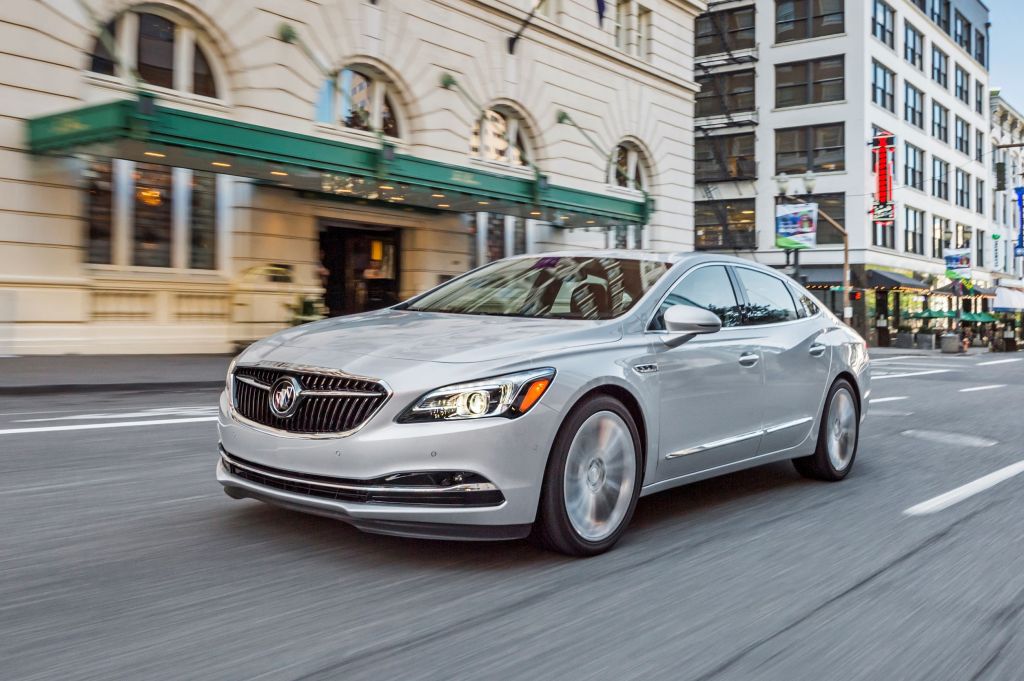
2019 Buick LaCrosse. (Image: Buick)

J.D. Power has released its latest Vehicle Dependability Study. This looks at how people feel about their vehicle’s performance after three years of ownership.

The top brand is Kia with a score of 145. The second-best brand is Buick, at 147 points. (As you may discern, a lower numerical score is better.)

Know that this means Buick beat out the likes of Lexus and Porsche and Lincoln and BMW and Jaguar and others—in many cases, rather handily.

Buick.

What is somewhat ironic is that in terms of vehicle categories, in Large Car Buick also came in second, with the LaCrosse. It no longer offers it.

In first place is the Chevrolet Impala. That is going away, too. (Last year in the U.S. GM delivered 750 Impalas.)

What You Need to Know If Vehicle Shopping

First the good news, according to Michelle Krebs, executive analyst for Cox Automotive:

“The surge in new car prices appears to have peaked.”

That is the new vehicle average transaction price fell 1.8% in January compared to December.

Now it is “just” $46,404.

But while not exactly an entire shoe dropping, Krebs adds:

“Yet, while we expect vehicle supply to improve, it will continue to be tight particularly through the first half of the year. Because of this, we expect prices to remain high for the foreseeable future, but car shoppers can rest assured we don’t anticipate any more record highs.”

Not records. Just high.

Here’s another thing that probably won’t make you feel much better.

Cox calculates that car shoppers for non-lux vehicles are paying, on average, more than $900 above sticker. A year ago those customers were paying $1,600 or more below sticker.

For those in the lux segment it is a similar story, just higher numbers. As in paying $1,300 above sticker when last year the prices out the door were $2,400 under MSRP.

One way of looking at this is that for non-lux cars customers are paying a $2,500 penalty for waiting (the swing from minus $1,600 to plus $900) and the lux buyers $3,700.

With inflation and rising interest rates, however, it may be a good idea to shop earlier rather than later lest those factors add to the sticker.

Remember: MSRP is “suggested” price, not what you’re going to sign off on.