The number of electric vehicles being offered–or announced that they’re on their way–by traditional OEMs is increasing with a beat that it reminiscent of that person in the apartment above yours tapping his or her giant foot: BAM! BAM! BAM!
And in addition, there is the influx of new manufacturers, which are seeing the opportunity to get into automotive manufacturing, something that, say, 10 years ago, was about as appealing as a session at an endodontist who had just run out of Novocain.
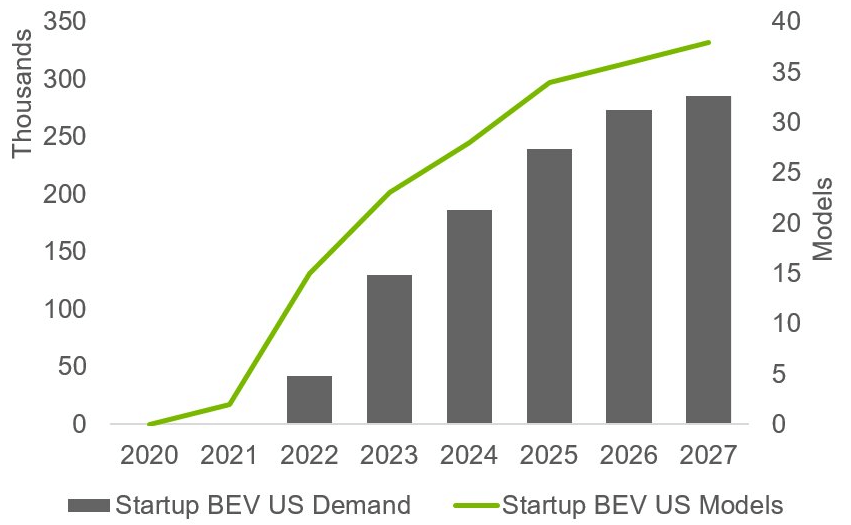
According to LMC Automotive, the startup EV brands in the U.S. are going to have nearly 40 models on offer in the U.S.
(Image: LMC)
However, LMC reckons that few of the new brands are likely to have sales of more than 50,000 units per year.
That said, a sufficient number of 50K-selling OEMs means that the sales are likely to be taken from the traditional OEMs.
However, LMC thinks that it is going to be costly for the upstarts that build factories. The firm calculates that the capacity utilization of a given plant is going to be on the order of 30%, which is about 60% less than it really ought to be. (I.e., 30% capacity utilization means that 70% of the personnel and equipment are not making vehicles, which is the whole point of their being there.)
“2022, in a lot of ways, is going to look like 2021”—Stephanie Brinley, senior analyst, IHS Markit, in a presentation to the Automotive Press Association.
Among the ways are chip shortages, low inventories and high prices.
Everything you didn’t want to see if you’re in the market for a new vehicle.
In 2019 some 148,000 went to a facility in Wolfsburg, Germany. Not surprisingly, COVID 19 reduced the numbers (97,570 in 2020).
The reason those people went to Autostadt was to pick up their new Volkswagen.
And while there they could visit a museum, walk through vehicle pavilions, eat everything from light fair to fine dining, and even stay at a Ritz-Carlton. They could even attend concerts.
Autostadt is the world’s largest auto delivery center.
Volkswagen has turned getting a vehicle into an amazing experience.
People don’t have to pick up their VWs at the Autostadt. It is a choice.
(While I’ve never personally picked up a car at Autostadt, I’ve been there on more than one visit to Wolfsburg and it is remarkable.)
There is nothing like it in the United States.
One of the towers at Autostadt where vehicles are located before delivery. (Photo: Landmann, Lars)
There are factory-owned dealerships in Germany. Meaning, for example, VW-owned.
There are no factory-owned dealerships in the U.S.
Why? Why isn’t there a Ford Factory Store in Dearborn where you could go pick up an F-150 that has been built for you, a facility that is affiliated with the Henry Ford so that there would be the opportunity to have a complete experience beyond the vehicle delivery alone?
Simply because of dealer franchise laws in all 50 states.
Did you ever wonder why you can’t but a vehicle from Amazon?
The same reason. The franchise laws.
What’s the rationale?
According to the National Auto Dealers Association:
“automobiles are sold through franchised dealers because that business model is a good deal for everyone. Consumers are given extra protection in the marketplace, local communities benefit when local businesses compete to sell and service great products, and manufacturers get to invest their capital into designing, engineering and marketing great products in lieu of low-margin retailing. For these and other reasons, state legislatures have passed laws that promote the buying, selling and servicing of cars through local franchised dealers.”
Tim Jackson, the president and CEO of the Colorado Automobile Dealers Association, simplifies that as “Win, win, win.” A win for the OEM. A win for the consumer. A win for the community.
And, as anyone who has bought a vehicle within the past several months from a dealer knows, a win for the dealership, as they have racked up record profits.
On this edition of “Autoline After Hours” Jackson explains why dealers are a good deal for consumers to “Autoline’s” John McElroy, Alexa St. John of Business Insider, and me.
Although there are surveys indicating that people do want to purchase on line and to get vehicles delivered where and when they want them rather than having to go through a dealership, Jackson, not surprisingly, argues that dealerships will continue to play a role in the transaction.
Of course, perhaps trying to emulate Tesla, which doesn’t have franchise dealers, it seems that more and more startup companies (e.g., Lucid, Rivian) are foregoing the franchise model.
Here’s a thought: Aren’t all traditional OEMs doing their damnedest to compete with Tesla on product?
Might they not rethink their model of getting products to consumers?
Well, there are all of those laws that makes that difficult to achieve, to say the least.
But I’m willing to bet that the Germans who have had the Autostadt experience think far more of VW than anyone who has picked up a car from their local dealer, cappuccino machine notwithstanding.
“In 2020, 48% of all EVs on the road could be found in China — more than the combined figure for the US and Europe. China’s EV fleet will be 60% of the world’s total by 2030. Xi Jinping has extended both the sales tax exemption on EVs and subsidies for domestically built EVs to the end of 2022.
“China’s large domestic market, raw materials access, and favorable government policies mean it will continue to dominate the EV landscape and won’t be as disadvantaged by the lithium shortage. Xi Jinping has facilitated the growth of the domestic EV market, causing Tesla to lose market share in China to BYD. This is not only to cement China’s dominance in EVs but also to help meet the net zero target year of 2060.”–Amrit Dhami, Thematic Analyst at GlobalData
Volkswagen Group—Volkswagen, Volkswagen Commercial Vehicles, Škoda, SEAT, CUPRA, Audi, Lamborghini, Bentley, Ducati, Porsche—announced its combined electric vehicle sales on a global basis for 2021.
The company delivered 452,900 battery electric vehicles in ’21, a 95.5% increase over ’20 numbers, when it delivered 231,600 units.
The vehicles that are the biggest contributors:
Volkswagen ID.4: 119,600 units
Volkswagen ID.3: 75,500 units
Audi e-tron: 49,200 units
ŠKODA Enyaq iV: 44,700 units
Volkswagen e-up!: 41,400 units
Porsche Taycan: 41,300 units
Of that, the ID.3, Enyaq iV and e-up! are not available in the U.S. market. That represents a total of a non-trivial 161,600 units.
Here’s something to consider about that 452,900 EVs:
The Group delivered a total 8,882,000 vehicles in 2021.
Here are some interesting observations from Charlie Chesbrough, senior economist and senior director of Industry Insights at Cox Automotive.
Chesbrough, during a presentation at the Federal Reserve of Chicago’s 28th Annual Automotive Insights Symposium, pointed out that new vehicle inventory at the end of 2021 was 63% below what it was in 2020.
Not a whole lot of inventory on those dealers’ lots.
He said the day supply of vehicles is about 35 days, and that when vehicles show up on dealer lots they get bought up just as quickly as they are dropped off.
What’s more, the average price of a vehicle is MSRP plus something.
In other words, that sticker is a suggestion. The price goes up from there.
What’s more, people are paying more than ever—average transactions at $47,077, according to Kelley Blue Book—and dealers and OEMs are racking up the rewards.
“This is a tight supply situation and I don’t know that the industry is in much of a hurry to change it.”
Car: Honda Civic, Lucid Air, Volkswagen Golf R and Golf GTI
Truck: Ford Maverick, Hyundai Santa Cruz, Rivian R1T
Utility: Ford Bronco, Genesis GV70, Hyundai IONIQ 5
The vehicles were voted on by a group of 50 journalists who are located in the U.S. and Canada. They are staffers and freelancers, print, digital and broadcast workers.
(Image: NACTOY)
To get to the nine they assessed eight cars, six trucks and nine utilities.
And that was winnowed down from 12 cars, 8 trucks and 18 utility vehicles.
So all of those vehicles and those 50 jurors means that during the past several months plenty of miles were racked up on odometers.
The winners were announced this morning.*
The ceremony literally had sealed results, which were tabulated and kept secret by Deloitte.
And when they were opened the results:
Honda Civic (11th generation)
Ford Maverick (a new entry in what is arguably a new segment of small pickups)
Ford Bronco (when accepting the award, Ford president Kumar Galhotra said that when developing the vehicle he heard from Bronco fans who said, “Don’t screw it up.”
The group has been doing this since 1994. Seems like they got it right.**
///
*The presentation was made at an Automotive Press Association meeting in Detroit at Huntington Place. And during the presentation, the Detroit Auto Dealers Association announced that the next North American International Auto Show will be held September 14-25 at Huntington Place as well as in outdoor venues around Detroit.
**I’m a juror and so am not exactly unbiased about this.
One of the things that OEMs are touting is the range that their electric vehicles can travel before they need a charge.
This, of course, is a means by which the dreaded consumer “range anxiety” with EVs can be assuaged.
For example, when Mercedes introduced its VISION EQXX concept car last week one of the points that people stressed about this sleek concept is that it has a range on the order of 620 miles.
When Chevy introduced the 2024 Silverado EV it noted that it has an estimated range of 400 miles.
While not a Mercedes, think about a Hyundai Sonata Hybrid. Stylish. Seats five. Fully fitted with tech. Depending on which trim level, it returns a combined miles per gallon rating of either 52 mpg or 47 mpg.
So, with its 13.2-gallon fuel tank, this means that you have range of 686 miles or 620.4 miles. In a car that you can buy today. (Assuming that you can find one.)
Then the Silverado.
While the numbers aren’t available for the 2022 3.0L I-6 turbo-diesel, there are for the ’21 model with that engine. The 4WD truck has a combined miles per gallon rating of 26 mpg.
The Crew Cab has a 24-gallon tank.
So this means that the Silverado diesel has a range of 624 miles.
Somehow that electric 400-mile range is impressive only for an EV.
And then, of course, there is that whole thing about charging.
One of the features of the ’24 Silverado is that thanks to its fast-charging capability, one can get 100 miles of range within 10 minutes.
According to the American Petroleum Institute, it takes an average of two minutes to fill a vehicle with liquid fuel.
Somehow that 10-minute charge doesn’t seem all that impressive.
When you think “Mercedes Benz,” presumably it is in the context of something like the S-Class, a swanky motor vehicle.
And you wouldn’t be wrong, because a new S-Class was launched in 2021 and not only is it swanky, but it is chockfull of so much tech that it is probably like most PCs that people own: there are so many possible programs that one is unlikely to ever use all of them or even a few of them to their full capabilities.
And people clearly find it appealing because S-Class sales in 2021 were up 66.3% in 2021 over 2020, or 14,282 units.
Actually, in the car space, that was Mercedes top performer in 2021. Although it moved more C-Class cars, 30,815, on a percentage basis the C-Class was up only 17.2% from the previous year.
And while there were more E-Class vehicles sold than S-Classes—20,947—on a percentage basis that is down 22.7%.
In fact, there were a lot of minus signs in Mercedes’ 2021 results.
Fortunately for it, there are the “G” vehicles, crossovers, where, not surprisingly, the action was. For example, the GLE, with sales of 65,074 had a stellar performance, as it was up 35.1% compared with 2020. (The GLE has a variety of variants, so that undoubtedly was beneficial for those going into the showroom.)
Mercedes-AMG GLE 63S Coupe (Image: Mercedes-Benz)
But the bottom line for the Mercedes-Benz passenger vehicles shows an increase of just 0.4% compared to 2020. Yes, positive territory. But then, 0.4%.
However, Mercedes has something else, something that you probably don’t think about, something not stylish and swanky:
Vans.
Things like the Sprinter and Metris Vans.
Van sales in 2021 were up 4.8% compared with 2020. A total of 53,472 units.
The morning of General Motors’ reveal at CES in Las Vegas of new electric vehicles—most notably the Chevrolet Silverado EV pickup truck and also the Chevy Blazer EV and Equinox EV, which will be coming in 2023 and ’24—the most-read op-ed column in The Washington Post was entitled, “Imagine Virginia’s icy traffic catastrophe – but only with electric vehicles.”
WaPo editorial writer and columnist Charles Lane relates the story of a Canadian semi driver stuck in the storm’s 40-mile backup on I-95 in Virginia earlier this week. A Tesla driver knocks on the semi’s door and tells the trucker that his kids are stranded in the car and there’s no way to recharge the EV. The truck driver, who told the story in his Twitter account @MyWorldThroughaWindshield, gave the Tesla driver water, a spare blanket and a mylar thermal blanket.
Lane points out that pure-electric vehicles lose range in cold weather and cannot be revived as easily as a petroleum-fueled vehicle. To make the Tesla driver’s prospects for recharge tougher, the power grid failed in parts of Virginia Monday night.
As Gary Vasilash notes in his post “Still the EV Charging Question,” there is no solution in sight for how to quickly re-charge electric vehicles that run out of juice between any two charging points.
But the source of the problem is far older than the accelerating shift from internal combustion engines to EVs. The core issue is the priority the U.S. gave in the last century to designing and building infrastructure centered around the automobile.
In his column Lane references GM’s EV commercial for last year’s Super Bowl, in which Will Ferrell satirically takes on Norway for its then-actual 54% EV market share (which increased to 65% in 2021). Norway is much colder than most of the U.S., though with a much smaller population, and it’s beginning to back out of “massive” EV subsidies. Then the columnist gets to the core of the country’s advantage regarding EVs: In Norway “a mere 10% of workers in the largest city – Oslo – commute by car.”
Eureka. Transportation alternatives are a way of life in places like Norway. That makes a big difference.
Meanwhile, back in Virginia after the huge mid-Atlantic storm, Senator Tim Kaine (D-VA) spent 26 hours, 45 minutes driving up I-95 to Washington, D.C., for a voting rights meeting—a drive that usually takes two hours. Kaine told NPR’s All Things Considered he once took a bicycle ride from Richmond to D.C. in an event with Virginia police officers one Memorial Day weekend, “basically the same ride up Route 1,” in 13 hours.
Now, I’m not the least-bit anti-car, and I’m not advocating a wholesale shift to alternative transportation sources. But our overcrowded highways, freeways and city streets have long been an anathema to any pleasure associated with driving.
The clean, efficient way to commute in that part of the country should be an electric-powered commuter rail system, though it’s far too late for that.
The best we can hope for is to face 40-mile snow-clogged traffic jams with EVs rated 400+ miles of range (probably 325-350 miles in cold weather) and a proliferation of recharging systems along the way. That’s assuming we can afford such EVs, as even ICE-powered new vehicles average more than $46,000. Middle-class commuters can always get a deal on a three-year-old off-lease EV featuring yesterday’s state-ot-the-art range, while the working class – the people who drive the snowplows, semi-trucks and emergency vehicles – get to work in our gas- and diesel-powered trade-ins.




 shinymetalboxes