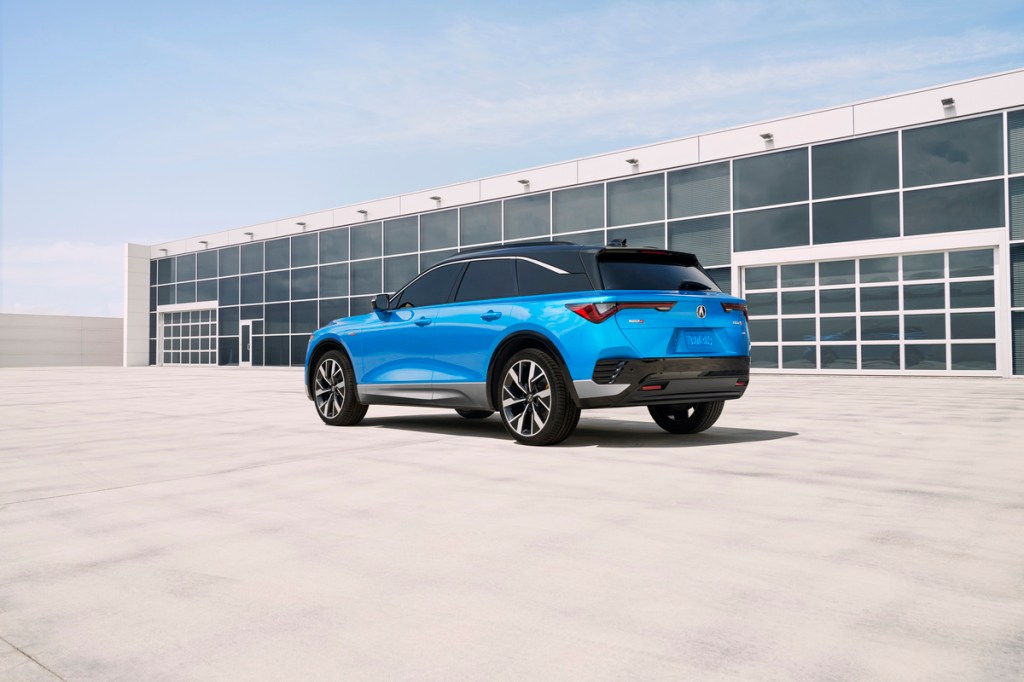
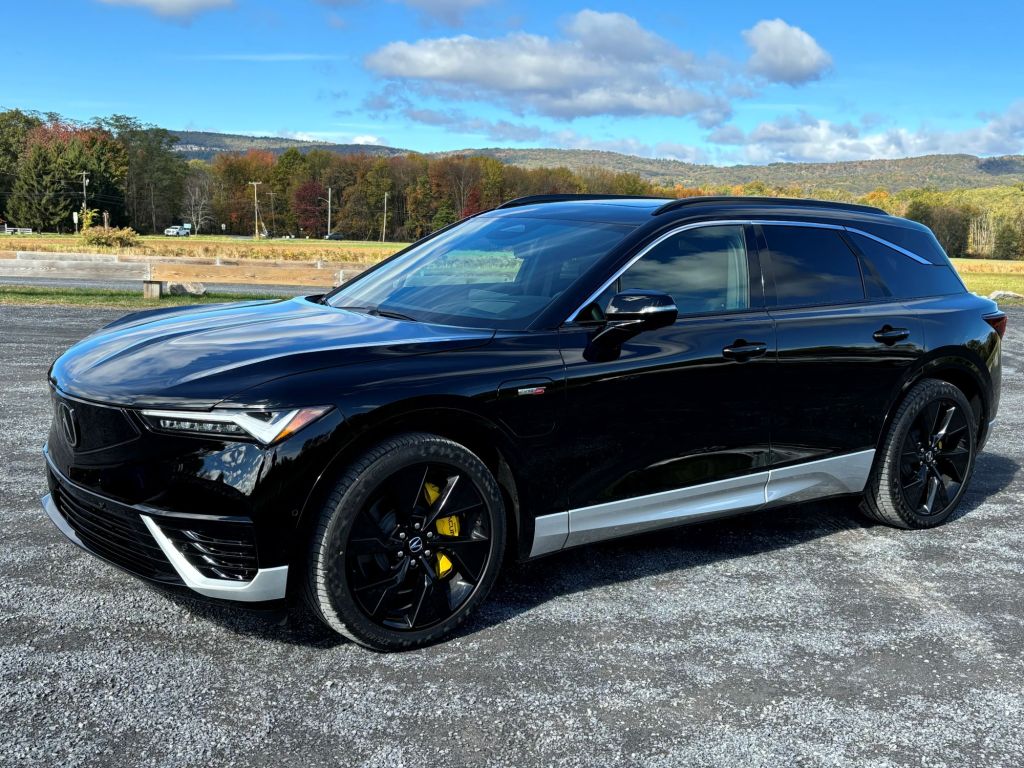
2025 Acura ADX A-Spec AWD Advance

By Gary S. Vasilash

Acura, the premium division of Honda, had its start in 1986 in the U.S.

That was before Toyota launched Lexus and Nissan Infiniti.

Both of those arrived in 1989.

When Acura started, there were two vehicles on the showroom floor:

  • The Legend. This sedan, with a rather ostentatious name (c’mon: somebodies else decide whether something is a legend or not), was actually developed by Honda and the now-non-existent Austin Rover Group.
  • The Integra. This was something of a polar opposite of the Legend. It was a sporty three- or five-door. A more affordable vehicle.

The Legend went into the history books after the 1995 model year. In 2001 the Integra was replaced by the RSX. The RSX had a short run: until model year 2006. There was a bit of a hiatus in this car space: the ILX replaced the RSX in 2012. It had a run until model year 2022, when it was replaced by the current-generation Integra.

The point of this is that Acura has consistently maintained what can be considered an affordable, entry-way vehicle in its lineup. Of late it has been the Integra. That car has a starting price of $33,000.

And Now This

But the interest in cars has cooled*, and Acura has stocked the showroom floor with an array of SUVs. Until lately, the least-expensive Acura SUV was the RDX, with a starting price of $44,700. (In case you’re wondering; the starting price of the most-expensive is the ZDX, an electric vehicle, that begins at $64,500.)

So in order to, in part, get people into an affordable SUV Acura, the company has launched the ADX.

Acura’s new entry: the ADX. (Image: Acura)

It has an entry price of $35,000.

The top-of-the-line ADX A-Spec Advance AWD takes the MSRP to $44,000.

But the ADX has a bit of a problem. The problem is a good one for American Honda (the overall company). But not a good one if your job is moving Acuras.

Too Good for Its Own Good

The problem is the Honda CR-V.

The 2026 CR-V LX FWD starts at $30,920. The top-of-the-line CR-V AWD Sport Touring Hybrid starts at $42,250.

Yes, there is a difference between a “Honda” and an “Acura” badge.

But there are some similarities between the two models.

Like in the ADX there is a 1.5-liter, turbocharged four that produces 190 hp. In that CR-V LX there is a 1.5-liter, turbocharged four that produces 190 hp.

Whether it is the entry ADX or the top model, there’s the same engine.

In the top-of-the-line CR-V AWD Sport Touring the powertrain produces 204 hp.  And not only is it more powerful than the ADX powertrain, it gets better fuel efficiency (40 mpg city/34 mpg highway/37 mpg combined vs. 25 mpg city/30 mpg highway/27 mpg combined).

But one might point out that when it comes to that powertrain, there’s less mass to move: the AWD ADX has a mass of 3,611 pounds and the AWD hybrid CR-V is at 3,926 pounds. But there is that additional horsepower in the CR-V, so at the very least it is a wash.

Sized Right

It should also be pointed out that dimensionally the two vehicles are fairly similar, with the ADX being 185.8 inches long and the CR-V at 184.8 inches; the ADX 72.5 inches wide and the CR-V at 73.5 inches wide. The big difference is in the height, with the ADX at 63.8 inches and the CR-V at 66.5 inches, which I suppose goes to the point of the ADX being a sport utility vehicle and the CR-V a sport utility vehicle. (And on the subject of utility, the ADX A-Spec Advance offers 23.2 cubic feet behind the second row and 53.9 cubic feet with the second row folded; the CR-V Sport Touring has 34.7 cubic feet behind the second row and 76.5 cubic feet with it folded.)

Of course, comparisons are not typically made of vehicles from the same company so perhaps the above is inappropriate (though not if you’re in the market for a new vehicle).

So just to look at the ADX A-Spec Advance driven here, it provides:

  • A 10.2-inch digital gauge cluster
  • 9-inch touchscreen
  • A 15-W wireless charger
  • 15-speaker Bang & Olufsen audio system
  • Built-in Google and Alexa
  • Adaptive cruise control
  • Ventilated front seats (i.e., cooled as well as heated)
  • Leather for seating surfaces and wrapping the steering wheel
  • Sport pedals (i.e., metal)
  • Powered liftgate
  • 19-inch alloy wheels
  • Panoramic moonroof
  • And more

And it has that stylized “A” on the Diamond Pentagon grille.

But still, even if there wasn’t economic uncertainty in the world at large at the moment due to everything from tariffs to roiling in the Middle East, anyone who is looking to get the most for their money would be hard pressed not to consider the Honda rather than the Acura.

The company that encompasses Acura and Honda simply makes great products.

==

*In addition to the Integra, Acura still offers the TLX. It seems as though that model may not be long for this world.

About the Honda Prologue & Acura ZDX

Honda and Acura Go Electric with Ultium and Then Some. . .

By Gary S. Vasilash

As is widely known, when it comes to the contemporary electric vehicle, Honda was a bit late to the party. Given that the company has extensive experience in electrified vehicles. It is often forgotten (or unknown), for example, that the first hybrid on the U.S. market wasn’t the Toyota Prius, but the Honda Insight, which was launched in December 1999, edging out the Prius by a few months.

(This gives rise to another consideration. Toyota has also been criticized for its approach to the EV market, being tagged as a laggard. One could argue that this isn’t a mistake, given the still rather small number of EVs being sold in the U.S. market. According to Kelley Blue Book, for Q3 2024 there were 346,309 EVs sold, a number that will undoubtedly help the number of EVs sold in the U.S. to exceed the 1.2-million sold in 2023. But here’s something to think about: if you take away the Tesla sales from the Q3 numbers this means that 27 brands cumulatively sold 179,386 vehicles. That would be 6,644 if the number was evenly distributed. But no matter how you look at it, there is a long way to go in order to achieve the necessary scale to have a profitable production operation.)

Anyway, I’ve just been driving the Honda Prologue and the Acura ZDX, the two contemporary EVs from the company.

A sign of the times is that in order to get these vehicles on the market, Honda worked with a company that it has been collaborating on for some time (on things ranging from the engine for the Saturn Vue Red Line to hydrogen fuel cells).

The two vehicles are based on the GM Ultium platform (yes, even though GM is going to stop calling them “Ultium,” the platforms were Ultium when the Prologue and the ZDX were developed).

Just as the Saturn Vue Red Line was a Saturn through and through, not a Honda, the Prologue isn’t a Chevy Blazer EV, which it shares the platform with, just as the ZDX isn’t a Cadillac LYRIQ.

In the case of the Prologue—which is available with a single-motor (212 hp) front-drive setup that provides a range of up to 296 miles or as a dual motor (288 hp) with a 281-mile range (although there is the Elite trim package that goes 273 miles); all have an 85-kWh battery pack—the design inside and out are characteristic of the brand.

2024 Honda Prologue. Efficient packaging design. (Image: Honda)

The design-speak for the exterior design—which was executed in L.A.—is “Neo Rugged.” It is, after all, an crossover. Arguably, it is a simple, straightforward design with a sufficient number of creases in the sheet metal to keep it from looking innocuous or as something that it isn’t (i.e., like something you’d take on the Rubicon).

Inside there is the clean, straight-forward Honda approach to ergonomic instrumentation. However, I have two quibbles with the interior design:

  1. An excessive use of piano black plastic on the IP. Whereas the Civic Hybrid (a hatchback was recently released) has an interior that looks of the moment, the piano black in the Prologue is dated.
  2. The distance from the top front edge of the instrument panel to the bottom of the windshield is a tremendous amount of real estate. Someone had better have a Swiffer on a long handle to be able to keep that surface clear because it is a reach.

But while on the inside it should be noted that there is as much as 57.7 cubic feet of cargo space, so it can handle a reasonable haul.

Of the two cars, the ZDX is the one that I find to be most impressive. (Of course, the starting MSRP for the Prologue is $47,400 and it is $64,500, so there has to be some bandwidth there.)

The ZDX comes as a rear-drive vehicle with 358 hp and a range of 313 miles from its 102-kWh battery. Or there is an all-wheel drive version (A-Spec) that provides 490 hp and 304 miles of range from the same battery pack. Or there is another AWD version (Type S) that generates 499 hp and will take you 278 miles with some alacrity.

2024 Acura ZDX Type S. Wicked quick. And you can shop for groceries with it, too. (Image: gsv)

Although Acura does have two cars in its lineup—the TLX and Integra—its two crossovers—the MDX and RDX—are focal points. In terms of powertrain performance, the ZDX smokes the other crossovers (or maybe that should be it “ozones the other crossovers”).

It, too, was styled in LA. And although it is a crossover, its exterior body style resembles for me more of a contemporary station wagon, with a lower, longer, more angular sideview than many other crossovers.

While it seems as though all vehicles today have some sort of light signature up front, credit should be given to the Acura designers for the sharp styling they’ve brought to the lighting of this vehicle.

On the inside the seats in the front are bolstered in keeping with the type of vehicle it is, and the layout of the instruments and gauges are intuitive. A cowl over the gauge screen provides something of a cockpit feeling when sitting behind the wheel.

Both are solidly engineered vehicles that go well beyond the propulsion systems.

The Prologue seems like a Honda (presumably because it is) and the response from the market is good: According to numbers from KBB, through the third quarter there have been 12,644 Prologues sold—more than the 7,998 Blazer EVs sold, and closing in on the popular Mustang Mach-E, which had sales of 13,392.

The ZDX, which is essentially a new nameplate (yes, Acura built a ZDX until 2013, but its sales were so tiny that it isn’t likely remembered by many (outside those who smacked their heads getting into or out of the rear seat on the C-pillar)) has had sales through Q3 of 2,647—which is not far from the Lexus RZ’s 2,742, which has been available for longer.

In 2026 Honda will roll out its 0 Series, which it is developing sans GM.

But neither the Prologue nor ZDX are placeholders until then.

Honda: EVs and Beyond

How it is going to leverage manufacturing to advantage

By Gary S. Vasilash

Ostensibly the briefing was to see up-close-and-personal the Acura Performance EV Concept which had only otherwise been shown during Monterey Car Week.

Who doesn’t want to see what is likely to be very similar to the electric vehicle that is going to go into production in Ohio in late 2025?

Acura Performance EV Concept. (Image: gsv)

Two points about the concept:

  1. It is a concept vehicle, something that is becoming less and less common in the industry today—because of the time, effort, energy, and investment made in these full-scale models. Sure, there could be the argument made that this can all be done digitally. But Honda and Acura have those digital tools, too, and there is something to be said for a physical model.
  2. Dave Marek, who is executive advisor for Design for Honda R&D and Global Honda (which essentially means he’s the go-to guy for design considerations across the company), points out that Honda and Acura typically hew rather closely to their concepts when it comes to production vehicles, so the Acura Performance EV Concept, which he says features “hydrodynamic design” principles—think “superyacht”—may be something rolling off the line at what is being called the “Honda EV Hub.”

Which brings us to the second part of this, which is an explanation of the strategy and the tactics of the EV Hub by Mike Fischer, who is the lead on the project and an executive chief engineer to boot.

First of all, the “Hub” is not a singular place.

Rather, Honda is retooling the Marysville Auto Plant, the East Liberty Auto Plant, and the Anna Engine plant to have the capabilities to produce EVs in a highly efficient manner that produces high quality, consumer-valuable products, processes that are both human- and environmentally-friendly.

But here’s the thing, and not something that Fischer and his colleagues just came up with during the past few months when EV sales softened.

Fischer explains that this “reimagining of Honda manufacturing” is something that is predicated on flexibility.

So they are developing production capability that will allow them to build EVs, hybrids, and ICE-vehicles all on the same line.

(One way this will be accommodated is by having feeder lines that will do the subassemblies for the varying types of vehicles that then feed into the main line.)

Yes, they are developing a dedicated EV platform that will allow various models to be derived from it.

Yes, they are installing 6,000-ton high-pressure diecasting machines—there will be six of them—in the Anna plant to perform “megacasting” of the Intelligent Power Unit (IPU) case; the case houses the battery and associated electronics and functions as part of the vehicle platform.

But what’s notable is that in this undertaking, which the company is investing more than $5-billion and which will serve as a model for Honda facilities around the world, Honda is getting back to its manufacturing roots in essentially taking a clean-sheet approach to the way things are done.

While product certainly matters, the ability to produce those products so that they meet customer demands—cost, quality, availability—is something that Honda has shown itself to be superb at over the years, so while some argue that it is comparatively late to the game in terms of EVs, the flexible manufacturing capability Fischer and his team are developing will more than make up for any delay—and will provide Honda and Acura with the powertrain options that its customers are looking for.

That will put it not merely in the game, but quite possibly ahead of it.

2024 Acura TLX Type S

(Images: Acura)

By Gary S. Vasilash

According to Merriam-Webster luxury is defined as “something adding to pleasure or comfort but not absolutely necessary” and “an indulgence in something that provides pleasure, satisfaction, or ease.”

Premium is “of exceptional quality.”

While purveyors of vehicles that are beyond the mainstream certainly want those vehicles to be considered “luxury vehicles,” I’d argue that with few exceptions (e.g., a Bugatti or Rolls-Royce) “premium vehicles” is a better moniker.

It’s not that premium vehicles don’t provide pleasure or comfort or satisfaction or ease, but generally they are necessary (i.e., people need to get somewhere; these are not necessarily vehicles that are weekend-only) and consequently they must be of “exceptional quality.”

Exceptional

And an excellent example of that is the Acura TLX Type S, the top-of-the-line version of the sport sedan.

This car has a 3.0-liter turbo V6 under its hood that produces 355 hp and is mated to a 10-speed automatic.

This car has sport seats with Milano leather with Ultrasuede inserts that help hold on in the seat when that engine is put to work.

Capable

This car has the Acura-exclusive Super Handling All-Wheel Drive (SH-AWD) system, which may have an awkward name, but which makes the performance of the car anything but, as it transfers torque—based on an array of inputs, from steering angle to throttle position to g-forces to. . .—from the front to the rear (as much as 70% of the torque can be transferred to the back) as well as from side to side, depending on conditions.

Which brings me back to the notion of “exceptional quality.”

Credible

Here is a vehicle that can go, according to Car and Driver, from 0 to 60 mph in 4.6 seconds that has an array of amenities—ranging from a superb ELS Studio 3D audio system to Brembo brakes that not only are functional but, peeking out from within the alloy wheels, telegraph the seriousness of the performance of the car—that can comfortably fit a family and, as it is built at the legendary Honda Marysville Assembly Plant (the engine is built at the nearby Anna (Ohio) Engine Plant), one has the confidence that there is build quality, as well as the quality associated with the visible craftsmanship on how everything thing goes together, from the panel gaps on the exterior to the stitching on the interior.

The TLX Type S starts at $57,000. For most people, I suspect, that is in the category of “luxury.”

But definitions notwithstanding, this is a car that looks good, drives well, and will probably provide many miles of confident driving, whether that’s throwing it through the proverbial curves or taking the kids to school.

Dimensions

  • Length:                   194.6 inches
  • Width:                    75.2 inches
  • Height:                   56.4 inches
  • Wheelbase:             113 inches
  • Passenger volume:  93.4 cubic feet
  • Cargo volume:         13.5 cubic feet

You Can Reserve an Acura MDX EV Right Now

By Gary S. Vasilash

Although it is widely known that Acura is late to the proverbial electric vehicle party, it announced today that reservations are now open for its forthcoming ZDX crossover, which is available as an A-Spec (single-motor, RWD; dual-motor AWD) or as a Type S (dual-motor, AWD, ~500 hp) vehicle.

The 2024 Acura ZDX: coming to a dealership near you (well, assuming you know where an Acura dealership is) sometime next Spring. They say. (Image: Acura)

So it is getting closer, as close as Spring 2024 for those who put down a $1,000 reservation fee. . .but given that the ZDX is based on the GM Ultium platform, there could be some minor or major delivery delays, given that the Ultium track record to date is not exactly confidence-inspiring.

The A-Spec models are said to be “Starting in the range of $60,000” and the Type S offering “Starting in the range of $70,000,” so the vehicles both of which are offered with a 102 kWh battery, don’t have particularly surprising price points.

That is, the Acura MDX has a starting MSRP of $49,850 and makes its way to $73,500.

Acura has always been premium, so for the money it tends to be a good value.

Often better than good.

So maybe it will be late, but it has the right body style for selling EVs, and a handsome body style out of its LA studio (which is undoubtedly surrounded by EVs from various and sundry OEMs, established, burgeoning, trying, and Tesla).

Let’s just hope the ZDX isn’t really late.

It’s not that the party will be over. It will be that people will have all selected their party hats vehicles and so the number Acura will be able to move will be less than it might be thought and there won’t be a whole lot of popping the cork.

Return of the Acura ZDX: Why Bring Back That Name?

By Gary S. Vasilash

One of the things that Japanese OEMs do that American OEMs tend not to is to recognize when something isn’t working and then moving on.

There isn’t a tendency to say, “Gee, maybe if we add some exterior trim and increase the amount of stitching on the seats people will buy it.”

Rather, the vehicle goes out of production.

Case in point is the Acura ZDX. It lasted from model years 2010 to 2013.

The vehicle design was something of an amalgam of a car and an SUV. It has a fast sloping roofline such that people who were trying to get into the back seat could get a nice bump on the head. And there is a sharp backward-angled cutline for the rear door which helped with the awkwardness.

Acura had made much of the vehicle prior to launch, given that it was something that it hoped would have the success of something like the MDX, which is was then and is now unmistakably an SUV.

But the so-called “Luxury Four-Door Sports Coupe” simply didn’t appeal to anyone, so it went away.

Oddly, Acura has brought back the ZDX moniker for the electric SUV that was officially debuted today at Monterey Car Week.

2024 Acura ZDX Type S. (Image: Acura)

It will be available with a standard single motor in the entry A-Spec and with a dual motor setup in the sportier Type S. The former will produce an estimated 340 hp, a 325-mile range and a starting price of around $60K. The latter will produce 500 hp, have a 288-mile range and start at some $70K.

On the subject of the “increased styling and packaging freedom EVs offer,” Dave Marek, Acura Executive Creative Director, said, “Embracing that creative liberation, our team was energized designing ZDX, Acura’s new modern expression of performance.”

To be sure, the vehicle is far more fetching than the other vehicle that carried the name.

Which makes one wonder why the previous name was brought back.

Sure, Acura reselected the name “Integra.” But unlike the original ZDX, the Integra was a success in the market.

End of the Line for the NSX

The last Acura NSX, a Type S, was built today at the Performance Manufacturing Center (PMC) in Marysville, Ohio.

The NSX–this, the second generation–has been in production since 2016.

The last Acura NSX Type S. (Image: Acura)

The supersports car is powered by a hybrid that combines a 520-hp, twin-turbo V6 with a motor generator in the rear and a twin traction motor in the front, all of which means the NSX has a combined horsepower of 600.

And while no one probably spent too much time thinking about this who had the chance to drive one, the EPA fuel economy ratings are 21 city, 22 highway and 21 mpg combined.

The car has a top speed of 191 mph and gets 21 mpg.

Amazing.

Today’s build was #350 of 350.

The associates at the manufacturing center are now building the 2023 Acura TLX Type S PMC Edition. There will be a build of 300.

But there is nothing like the NSX.

The Return of the Acura Integra

By Gary S. Vasilash

Acura has been around since 1986. When the luxury and performance division of Honda appeared on the American landscape it came with two vehicles, the Legend at the lux end and the Integra at the performance.

The Legend lasted for two generations. The Integra ran for four consecutively, wrapping up in model year 2006.

But now the Integra is back for its fifth.

A lot has happened in the auto industry since 1986. Heck, a lot has happened since 2006.

A big part of the change is the comparative collapse of the car and the explosive growth of the crossover.

This change is quite evident in the Acura sales.

From January 2022 through the month of May it sold 12,216 cars. That includes the ILX, NSX, TLX and Integra (which was new in May, so there were only nine sold).

During the same period Acura sold 33,460 crossovers. That includes the RDX and the MDX.

So essentially, cars account for about a third of the brand’s sales.

Here’s another set of figures that makes one scratch one’s head:

In a 2020 CarMax survey, the retailer found that while 93.6% of customers wanted Bluetooth in their vehicles, only 2.5% were interested in a manual transmission.

2023 Acura Integra: Engineered to be driven with brio. (Image: Acura)

While the 2023 Integra, which has a VTEC-enhanced 1.5 liter turbocharged engine that produces 200 hp at 6,000 rpm and 192 lb-ft of torque at from 1,800 to 5,000 rpm, has a standard continuously variable transmission (CVT), the option for the car, in the up-trim A-Spec package, is a six-speed manual. . .and the Acura folk anticipate a 65% take rate for the manual.

So to learn more about the new Integra we talk with Emile Korkor, Assistant VP, Acura National Sales, on this edition of “Autoline After Hours.”

Korkor emphasizes that Acura is about performance, and the new Integra is engineered for that cohort of buyers who are interested in performance cars.

An interesting aspect is that the car starts at $30,800 so it is certainly affordable. The A-Spec with Technology Package, adding in the six-speed, has an MSRP of $35,800. Again, affordable.

Korkor points out that this isn’t simply a car that is built to be quick, but that it has premium amenities, as well. After all, if you’re going to be driving it hard, you might as well get comfortable while you are doing it.

Korkor talks with “Autoline’s” John McElroy, Eric Weiner of Hagerty and me.

In addition, McElroy, Weiner and I discuss a variety of other subjects, including why Honda, ford, VW, BMW and Volvo filed a motion to intervene in a federal lawsuit regarding California emissions laws and other OEMs haven’t; whether pricing for electric vehicles is realistic (Sandy Munro, for example, suggests that the Rivian R1T, which starts at $67,500, should be selling for $100,000); and other topics.

Which you can see right here.

A Few Things About the Acura Integra

Very few

By Gary S. Vasilash

There isn’t a heck of a lot known about the Acura Integra, a sport compact with a five-door design, which will be launched next year.

One of the things that is known is that unlike the other vehicles in the Acura lineup—the ILX, TLX, RDX, and MDX—the Integra has a name. Yes, it is a made-up name, but not sequence of three letters.

1986 Integra RS–the original (Image: Acura)

The name goes back to the model introduced in 1986 and had a run until it was renamed. . .RSX in 2001.

Remember: Alphanumeric designation, with or without one or the other, was long thought to denote luxury, and Acura has been working for decades now trying to make people understand it is a luxury brand.

(Arguably, of the Japan-based company brands, only Lexus has achieved that with Infiniti and Acura trying to make their way to that category.)

The current tagline of Acura is “Precision Crafted Performance.”

The last word in that—performance—has a lot to do, no doubt, with the fact that the Integra will be offered with a six-speed manual.

Let’s face it: people who bought sport sedans in 1986 liked to slam though the gears.

But today. . .?

Yes, there is performance cred still associated with manuals. At least for some people.

Acura NSX Sets Track Record in Long Beach

Perhaps it is home track advantage. Or the paint.

By Gary S. Vasilash

A 2022 Acura NSX Type S, driven by Ricky Taylor of Wayne Taylor Racing, who happens to drive an Acura in IMSA racing, set a record for a production car on the street course in Long Beach, California, which happens to be the Acura Grand Prix of Long Beach circuit.

He lapped the two-mile course in 1:32:784, besting the 2019 record time set by Peter Cunningham of 1:35:663. Cunningham also drove an Acura.

Ricky Taylor setting a record on the streets of Long Beach in an Acura NSX Type S. (Image: Acura)

The car that Taylor drove—realize that this is a car that you can get at your local Acura dealer—produces 600 hp and 492 lb-ft of torque.

And it is a hybrid. (Makes you rethink the econo-characteristics of hybrid powertrains, eh?)

It is worth noting that they’re going to produce a total of 350 Type S models this, the NSX’s final year, of which 300 will be available in the U.S.

So maybe you should head on down to your dealer at Ricky Taylor speed.

One more thing about the record-setting car: the color it is painted is Long Beach Blue Pearl.

Coincidence?