Getting It Fixed

By Gary S. Vasilash

One aspect of contemporary vehicles is that there is plenty of tech on board, which not only provides an array of consumer benefits, from safety to entertainment, but which also makes them comparatively more complicated to diagnose what has gone wrong when something inevitably does, and it is just as tricky to fix it.

There is something else about today’s motor vehicles that may not be even known by the owners: many of them are transmitting information about their state of being to the OEMs. This information—say about a fault of some sort—can then be used to send a message to the owner saying, in effect, “Something is wrong with your vehicle; go to your dealer to get it taken care of.”

The information about the fault is then shared with said authorized dealer. “Authorized,” of course, means approved by the OEM in question.

Local repair shops?

Nope.

What’s more, as Gabrielle Hopkins, vice president of Federal Affairs, Auto Care Association, which represents the automotive aftermarket, including service, maintenance and repair shops, points out, not only are the independents kept out of the loop when it comes to this telematics information, but there are typically special tools that are necessary to access and repair vehicles that these outlets can’t get.

They are restricted to the “authorized” service centers, typically found within dealers’ organizations.

While there are all manner of arguments put forth as to why this is the case by the OEMs—e.g., they want to protect the intellectual property that is represented by the operating systems developed for their vehicles; cybersecurity issues might arise—this essentially means that there is a protected ecosystem that keeps the independent shops from being able to fix vehicles.

Hopkins and her colleagues are lobbying on behalf of the Right to Equitable and Professional Auto Industry Repair (REPAIR) Act, which the Auto Care Association, CAR Coalition and Automotive Aftermarket Suppliers Association explain, in part:

“The legislation would prohibit impeding the vehicle owner or a repair shop from obtaining service information, tools, or parts, including the ability for a vehicle owner to choose aftermarket parts needed to fully maintain and repair a vehicle.”

Let’s face it: Vehicles aren’t going to get less complicated.

Limiting choice generally means that prices are higher.

And as has been seen during the pandemic, there are limited resources at a given dealership for repair, so should one need something fixed sooner rather than later, the availability of more repair options rather than fewer is a consumer advantage.

Of course, the OEMs and the dealerships may not care much about that.

Learn more from Hopkins on this edition of “Autoline After Hours,” where “Autoline’s” John McElroy, Richard Truett of Automotive News and I talk with her.

You can see it here.

Oliver Schmidt & VW Dieselgate

By Gary S. Vasilash

Diesels have had a popularity in Europe that has never been the case for the U.S. Outside of pickup trucks purchased by contractors rather than by those who simply want a pickup truck because (a) it is a truck or (b) there is that need to buy mulch every now and then, the diesel has had the approximate popularity of manual transmissions in the U.S.

Volkswagen executives in the mid-00s thought that they might be able to gain some market share in the U.S. market were they to develop a “clean diesel”—one that didn’t have the smelly exhaust associated with diesels (it is somewhat inexplicable how Europeans didn’t seem to mind) yet would provide the oft-touted low-end torque seemingly beloved by everyone, as well the kind of fuel efficiency that the compression ignition engine would provide.

So the EA189 engine was developed. But it turns out there was a non-trivial problem with it: It wouldn’t meet the U.S. emissions requirements. VW obviously couldn’t sell a whole lot of Jetta TDIs in the U.S. with that problem.

So the engineers in Wolfsburg came up with what can innocently be described as a “work-around,” or what is now a term of art, “defeat device.”

But it wasn’t a device as in something physical that was stuck in the tailpipe.

Rather, it was software. The software was developed so that it was able to determine whether the vehicle in question was being tested or not. If it was being tested, then it adjusted things so that there wouldn’t be excessive emissions.

Otherwise. . . .

Apparently the engineers who came up with this figured it would be a short-term “fix.”

But as those things happen, short turned into long.

So VW was merrily selling diesel-powered vehicles in the U.S. About 500,000 of them.

In 2014 the International Council on Clean Transportation (ICCT) contracted with researchers at the University of West Virginia. The task was to check the emissions of the VW diesels.

So the researchers drove around in instrumented vehicles. . .and discovered the emissions were on the order of 35 times greater than was permitted.

In September 2015 the U.S. Environmental Protection Agency served a “Notice of Violation” to VW telling the vehicle manufacturer that its diesel-powered vehicles were equipped with a defeat-device.

And so “Dieselgate” began.

The questions of “What did they know and when did they know it?” became the order of the day, with questions at all levels, including to the very top, to Dr. Martin Winterkorn, then CEO of the company.

And there were evident coverups galore, changes at the top, and fines that would make anyone gulp.

Oliver Schmidt had been assigned by VW Wolfsburg to move to the U.S. and take charge of the U.S. operation’s emissions office in 2012. This was before the shit hit the fan. But he was there when it did hit. And there were meetings that he’d participated in with various government officials, from the federal EPA as well as the California Resources Board (CARB).

He was transferred back to Germany and in January 2017, when he and his wife were going to be returning to Germany after their annual vacation in Florida, we was arrested by the FBI and charged with conspiracy to defraud the U.S.

In December 2017 a federal judge sentenced Schmidt to seven years.

He managed to get transferred to German prison in September 2020. He was granted parole in January 2021.

On this edition of “Autoline After Hours” we talk to Schmidt about Dieselgate and his time in prison.

Realize that this is a guy who is as far from being a criminal as you can imagine. A regular engineer in his early 40s.

And due to all manner of what can be described as “political machinations” within Volkswagen AG, he, not the people who were running the place, ended up behind bars.

Schmidt talks with “Autoline’s” John McElroy, Brett Smith director of Technology at the Center for Automotive Research, and me in a conversation that is unlike any you’re likely to watch.

And you can see it here.

David Woodhouse of Nissan Design America on Nissan Design

By Gary S. Vasilash

David Woodhouse is Nissan Design America vice president of Design, a position that he’s held since June 2019. Prior to joining Nissan Woodhouse held a number of senior design positions at Ford, including as director of Design at Lincoln and design director for its Global Strategic Design function.

Put simply, Woodhouse is well versed in automotive design. (He also races, so this is more than theoretical to him: he knows what makes something good.)

He began his professional design career in 1994 (at BMW), so he’s been around long enough to know what’s going on without having been around so long that he isn’t resistant to what’s going on.

Nissan—including Infiniti—is an interesting place to be as it is a full-line manufacturer with utes, pickups, sedans, sports cars, and EVs in its portfolio. There’s the Nissan Versa at one end of the spectrum and the Infiniti QX80 at the other.

2023 Nissan Ariya interior (Image: Nissan)

On this edition of “Autoline After Hours” Woodhouse talks with “Autoline’s” John McElroy, Eric Noble, founder and president of automotive consultancy The CARLAB, and me about some of the new developments at Nissan—like the electric Ariya and the forthcoming Z—and his view in a more macro sense of what’s going on in car design.

In something of a departure from other interviews, Woodhouse also answers a couple questions from transportation design students at ArtCollege School of Design (Noble is on the faculty there).

One of the intriguing things about Nissan’s design approach is that they are embracing the heritage of the company, using what Woodhouse calls “J DNA,” with the single letter standing for “Japanese.” For example, the interior of the Ariya is meant to be comfortable like the room of a house, so the Japanese Omotenashi approach to hospitality was taken into account when executing the interior design.

During the second half of the show, McElroy, Noble and I discuss a variety of topics, including Ford’s separating its ICE and EV operations, the February vehicle sales (a SAAR of 14 million: not good), the consequences of rising petroleum prices due to the Russian invasion of Ukraine, and the competitive space in electric vehicles (with this last bit being somewhat. . .lively).

And you can see the whole show right here.

The Ford E-Transit Explained

By Gary S. Vasilash

Imagine: a 266-hp electric motor that generates a maximum torque of 317 lb-ft located between the rear wheels for operational performance. . .and it is in a cargo van.

That’s the Ford E-Transit, a Class 2b vehicle that comes in eight configurations: You can get it as a chassis-cab or a cargo-van, you can get three different roof heights, you can get three different wheelbases.

The 68-kWh battery is good for about 126 miles. Pulling into a DC fast charger will bring the battery from 15% to 80% in 34 minutes. Plugged into a Level 2 charger will take it from 0 to 100% in about eight hours.

Tim Baughman of Ford Pro North America sees a transition to electrification in commercial applications and acknowledges that there are some applications that are not necessarily applicable. (Image: Ford)

The e-Transit is a work truck, something that Ford knows more than a little something about. As Tim Baughman, general manager of Ford Pro North America—and know that Pro is the organization that focuses on the commercial side of things for the Blue Oval—points out, Ford has about 40% of that market, the leader in the space.

So as they were developing the E-Transit they had the opportunity to talk with the people who get fleets of vehicles of this type, whether it is a handful or a lot-full, so that their interests and concerns could be taken into account.

One of the things that they did when developing the E-Transit was to pretty much take the existing gasoline-powered Transit and use it for the electric truck. (There is the addition of an independent rear suspension for the E-Transit because things like battery packs are rather heavy.) While some might think that this is something of a quick-fix approach to getting an electric cargo van out there, as there are things like the BrightDrop ev600 and the electric Amazon delivery van being built by Rivian, Baughman points out that by having the same interior dimensions and mounting points, it is much simpler for upfitters to configure the e-Transit because of their experience with the Transit.

On this edition of “Autoline After Hours” there is a comprehensive examination of the Ford E-Transit as Baughman talks with “Autoline’s” John McElroy, Chad Kirchner of EV Pulse, and me.

Not only do we discuss the truck itself, but the Ford Pro software solutions that the organization has developed in order to do things like track and charge vehicles in order to keep the fleet up and running at its maximum efficiency, again taking into account Ford’s experience in this commercial space. And you can see it all here

The Future of Engines Examined by James Martin of IHS Markit

By Gary S. Vasilash

Motor racing is a space where many OEMs have the opportunity to test out new technologies and to obtain learnings about performance at the edge.

Mazda Motor Corp. is participating in the Japanese Super Taiku Series, endurance racing that consists of seven rounds, including a race titled the “24 Hours of Fuji” (what a great name!).

Mazda is campaigning the Mazda2 Bio concept. This is a Mazda2 production car that has a Skyactiv-D diesel engine under its hood.

What makes this conceptual is that it will be running on bio-fuel, a product called “Susteo” that was developed by Euglena Co. Ltd.

This biofuel is made from things like microalgae fats and used cooking oil. Some biodiesels compete with food crops. Not this.

The fuel can be run in the diesel engine without modification.

The point is to help develop Mazda’s growing portfolio of vehicles that are meant to help the company reach climate neutrality.

There is a lot of discussion of powertrains for vehicles that can, like the Mazda2 Bio, use existing engines with varying degrees of modification rather than wholesale replacement, engines that can run on advanced liquid fuels or even hydrogen.

Let’s face it: There are lots of engine plants in the world, so keeping them running might be something that automakers would not be opposed to doing versus shutting them down.

However, as James Martin, associate director, IHS Markit Automotive Advisory Practice, an expert on powertrains, points out on this edition of “Autoline After Hours,” if there is combustion involved—whether it is spark- or combustion-ignited—there is going to be emissions.

So running hydrogen to power an engine and using hydrogen to power a fuel cell may both turn the wheels, but only the latter is going to be emissions-free.

Credit to Mazda for trying. But ultimately, the Super Taiku Series is likely to be powered by Tokyo Electric Power Co.

Martin says that there is momentum behind electric vehicles that is unlikely to be stopped, particularly as automotive companies announce billions of dollars of investments and investors announce their support of these advances by supporting the shares of the companies that are making the transition.

However, Martin notes, this isn’t going to be a flip-the-light switch phenomenon. Yes, Ford will sell you a Mustang with a 760-hp V8 under its hood. And Ford will also sell you a Mustang Mach-E with a 314-mile all-electric range. And that is likely to be the case for some time to come. (Yes, the same holds for an F-150 with and without an electric powertrain.)

This is what the future doesn’t look like–a Chevy LT5 crate engine. (Image: Chevrolet)

Internal combustion engines aren’t going away next week, but Martin points out that while there are likely to be some new engine programs, there are unlikely to be new engine platforms. That is, what’s there can be modified. What’s not there will not be designed from the proverbial clean sheet.

Martin talks with “Autoline’s” John McElroy, Lindsay Brooke, editor-in-chief of Automotive Engineering, and me on the show.

Among the areas visited are what becomes of some existing engines and how OEMs can wind down their production—which turns out to be a tricky proposition (Martin, when he was at GM, worked on the LT5 Corvette engine program, a 375-hp, 5.7-liter small-block V8 that was produced for GM by Mercury Marine; Martin was there when the engine was taken out of production: you’ll be surprised at the complexity of stopping production).

And, of course, the landscape of electric powertrains.

You can see it all here.

LMC’s Schuster on the State of the Industry

By Gary S. Vasilash

There is pent-up demand. People are driving more. But. . .there are not enough vehicles out there to fulfill demand. There is that chip shortage accounting for the vast majority of vehicles not being on lots (an impact on the order of 85-90% of missing vehicles). According to Jeff Schuster, president of Global Forecasting, LMC Automotive, inventories will improve. Which will help that situation. Somewhat.

Because there is that other big issue that those who are in the market for a new vehicle: cost. (Latest average transaction price according to KBB: $46,404).

Schuster suggests that if prices stay elevated—and for the foreseeable future there doesn’t seem to be any driver for why prices would decrease—there are going to be plenty of people who are sitting on the sidelines, not going out and buying new vehicles.

So on the one hand, while OEMs and dealers are making profits by producing and selling high-ticket vehicles rather than more conventional family haulers (i.e., if there is a limited number of chips, then they get installed in the more-profitable vehicles); on the other hand there are people who can’t afford to buy something that has a price tag more analogous to luxury vehicles, so they are likely to figure out the ways and means to get transportation at a more affordable rate.

But here’s something to consider: What if an OEM decides that there could be an opportunity to sell entry-level vehicles, vehicles that have slim margins, but vehicles that could sell in large numbers? Schuster says this is not entirely outside the realm of possibility.

And what if said OEM happens to be one that isn’t particularly familiar to U.S. buyers: as in a Chinese company coming in with low-end vehicles? Schuster says that this is a possibility—yes, even despite the currently existing 27.5% tariff that is tagged onto vehicles imported to the U.S. from China. Apparently there is a lot of capacity to build vehicles in China, and so there could be an interest in keeping those plants running.

EVs? There will be more of them. (Which, Schuster notes, is something that isn’t going to reduce the price paid by consumers as they tend to be more expensive than comparable ICE-powered vehicles.)

Tesla? Yes, it will continue to grow. Schuster says that while it is ahead of other global automakers in terms of tech—a cycle or two ahead of others—LMC analysts anticipate that it will begin to lose some of its dominance in the EV space because of the other OEMs entering it.

Jeff Schuster has a whole lot more of interest to say about the state of the auto market today and in the near future on this edition of “Autoline After Hours.” He talks with “Autoline’s” John McElroy, Reuters’ Global Automotive Correspondent and me.

And you can see it here.

What Happened to Local Motors?

By Gary S. Vasilash

Justin Fishkin was the chief strategy officer at Local Motors for seven years (2011 to 2018), then senior advisor for the firm for two years after that.

Local Motors seemed to have it all going for it in terms of what it was doing and how it was doing it.

It was crowd sourcing design. It was using 3D printing to the extent that others were only dreaming about. It was developing vehicles fast. It was putting autonomy into application. It was creating mobility systems.

Olli: Electric. Autonomous. Built in a microfactory. (Image: Local Motors)

From Wired to IMTS Today and an array of media outlets in between, Local Motors was the “it” company in the transportation field.

And a few weeks ago word leaked out that Local Motors was closing up shop.

So on this edition of “Autoline After Hours” Fishkin talks with “Autoline’s” John McElroy, Chris Paukert of Roadshow by CNET and me about what the company set out to do and what conceivably happened.

One of the primary factors, Fishkin suggests, is that there was a case of mission creep in that the company found itself stretching in different directions as different constituents became involved in the company.

They went from crowdsourcing designs that led to vehicles like the Rally Fighter, 3D printing an entire vehicle (the Strati) then creating Olli, a compact people-mover with autonomous capabilities, and along the way created fans and attracted companies that wanted to get some of the “stuff” that was allowing the company to do what it was doing.

An early intention was to have micromanufacturing capabilities set up as a network such that there would be the development of vehicles that would lend themselves to specific markets. The company ended up having two, in Chandler, Arizona and Knoxville, Tennessee

It also built a demo microfactory in National Harbor; GE Firstbuild built a microfactory in Louisville, Kentucky, with Local Motors’ assistance.

In addition to GE, Local Motors worked with companies including Airbus and Siemens. All of which is to get to the point that this was something real, not speculative.

Its Olli had deployments in Buffalo, New York; Turin, Italy; Sacramento, California; Arlington, Virginia; Holdfast Bay, Australia; Akron, Ohio; Dunedin, Florida; Jacksonville, Florida; Clarksburg, Maryland; Yellowstone, Wyoming; Thuwal, Saudi Arabia; Durham, Florida; Marysville, Ohio; Neustadt, Germany; Jacksonville, Florida; Palo Alto, California; Concord, California; Ghent, Belgium; Lake Nona, Florida; Peachtree Corners, Georgia; Peoria, Arizona; Whitby, Canada; Toronto, Canada; and Crozet, Virginia, yet in the broader scheme of things, that is but a handful of places.

Fishkin also talks about his current activities with a startup Future/Of, which is helping, well, startups. One of the companies Fishkin is working with is Biliti, Inc., a company that is producing electric three-wheelers for last-mile transport.

But not just startups, he notes. As he puts it, “Future/Of works with organizations to scale disruptive business models and frontier technologies.” Which established companies can benefit from. And NGOs.

Still, in the context of Local Motors and where it came to, the question becomes where will micromobility and distributed microfactories go? This is a question that Fishkin help provide some solid perspective on.

And you can see it right here.

Engineering the ’24 Chevrolet Silverado EV

By Gary S. Vasilash

“Let’s determine what must be true to make it happen—and then let’s make it happen.”

Although it sounds rather simple, what Nicole Kraatz is referring to is the approach that she and her team took to product development under the restrictions that were presented to them because of COVID-19.

Business wasn’t as usual.

And what they were, and are, developing is something that is unlike what had been done before and absolutely important in the offerings of GM:

Kraatz is chief engineer of the Chevrolet Silverado EV.

Imagine: they had to develop a new vehicle while, in many cases, working at their kitchen tables, not the engineering center where there is immediate access to people and tech, not situations where you have to ask the kids to stop streaming because the Internet connection is wonky.

Determine what needs to be done. Then do it.

///

Pickup trucks are essential to the offerings of Chevy in particular and GM in, well, general.

In 2021 Chevrolet delivered a total 1,437,671 vehicles, of which 529,765 were Silverados.

GM sold a total of 2,218,228, vehicles, so Silverado is nearly a quarter of all of its sales.

2024 Silverado EV RST, style meets capability and electricity. (Image: Chevrolet)

In addition to which, GM is committed to transforming its vehicle portfolio to all-electric in the years to come, and is in the process of spending some $35-billion in transforming from combustion, including $2.2-billion at the Detroit-Hamtramck Assembly Center, which has been transformed to Factory ZERO, where the Siliverado EV will be built.

The 2024 model is interesting compared with the cross-town rival’s F-150 Lightning in that the Chevy is a new vehicle from the tires up, with nothing being brought over from the conventional truck, while the Ford is largely the combustion-based truck that is electrified.

(In the case of the Chevy, the Ultium platform is being used, an all-new EV battery-based architecture that provides a range of modularity such that pickup trucks and midsize SUVs—as in the Cadillac Lyriq—and other vehicles can be based on it.)

The Silverado EV will come in two versions at the start: the WT and the RST. The former is the work truck version, the sort of thing that contractors would be interested in as it will offer 8,000 pounds of towing and 1,200 pounds of payload.

The RST is the truck that someone will boast to their neighbors about was it offers everything from four-wheel steering to automatic adaptive air suspension, and when the Wide Open Watts mode is activated, it will have a 0 to 60 mph time of less than 4.5 seconds. (Remember: this is a full-size pickup truck.)

Both will have an estimated range of 400 miles on a charge and be capable of handling DC fast charging (up to 350 kW).

The Silverado EV represents an opportunity to Kraatz and her team to take the learnings of more than 100 years of GM trucks and make it something new.

Kraatz talks all about the Silverado EV on this edition of “Autoline After Hours” with John McElroy, Joann Muller of Axios What’s Next, and me.

And you can see it here.

Car Buying in America

By Gary S. Vasilash

In 2019 some 148,000 went to a facility in Wolfsburg, Germany. Not surprisingly, COVID 19 reduced the numbers (97,570 in 2020).

The reason those people went to Autostadt was to pick up their new Volkswagen.

And while there they could visit a museum, walk through vehicle pavilions, eat everything from light fair to fine dining, and even stay at a Ritz-Carlton. They could even attend concerts.

Autostadt is the world’s largest auto delivery center.

Volkswagen has turned getting a vehicle into an amazing experience.

People don’t have to pick up their VWs at the Autostadt. It is a choice.

(While I’ve never personally picked up a car at Autostadt, I’ve been there on more than one visit to Wolfsburg and it is remarkable.)

There is nothing like it in the United States.

One of the towers at Autostadt where vehicles are located before delivery. (Photo: Landmann, Lars)

There are factory-owned dealerships in Germany. Meaning, for example, VW-owned.

There are no factory-owned dealerships in the U.S.

Why? Why isn’t there a Ford Factory Store in Dearborn where you could go pick up an F-150 that has been built for you, a facility that is affiliated with the Henry Ford so that there would be the opportunity to have a complete experience beyond the vehicle delivery alone?

Simply because of dealer franchise laws in all 50 states.

Did you ever wonder why you can’t but a vehicle from Amazon?

The same reason. The franchise laws.

What’s the rationale?

According to the National Auto Dealers Association:

“automobiles are sold through franchised dealers because that business model is a good deal for everyone. Consumers are given extra protection in the marketplace, local communities benefit when local businesses compete to sell and service great products, and manufacturers get to invest their capital into designing, engineering and marketing great products in lieu of low-margin retailing. For these and other reasons, state legislatures have passed laws that promote the buying, selling and servicing of cars through local franchised dealers.”

Tim Jackson, the president and CEO of the Colorado Automobile Dealers Association, simplifies that as “Win, win, win.” A win for the OEM. A win for the consumer. A win for the community.

And, as anyone who has bought a vehicle within the past several months from a dealer knows, a win for the dealership, as they have racked up record profits.

On this edition of “Autoline After Hours” Jackson explains why dealers are a good deal for consumers to “Autoline’s” John McElroy, Alexa St. John of Business Insider, and me.

Although there are surveys indicating that people do want to purchase on line and to get vehicles delivered where and when they want them rather than having to go through a dealership, Jackson, not surprisingly, argues that dealerships will continue to play a role in the transaction.

Of course, perhaps trying to emulate Tesla, which doesn’t have franchise dealers, it seems that more and more startup companies (e.g., Lucid, Rivian) are foregoing the franchise model.

Here’s a thought: Aren’t all traditional OEMs doing their damnedest to compete with Tesla on product?

Might they not rethink their model of getting products to consumers?

Well, there are all of those laws that makes that difficult to achieve, to say the least.

But I’m willing to bet that the Germans who have had the Autostadt experience think far more of VW than anyone who has picked up a car from their local dealer, cappuccino machine notwithstanding.

You can see the show here.

Remarkable Rotary Engine and Agreeable NACTOY Jurors

Power in a small package. Jurors before casting their ballots

By Gary S. Vasilash

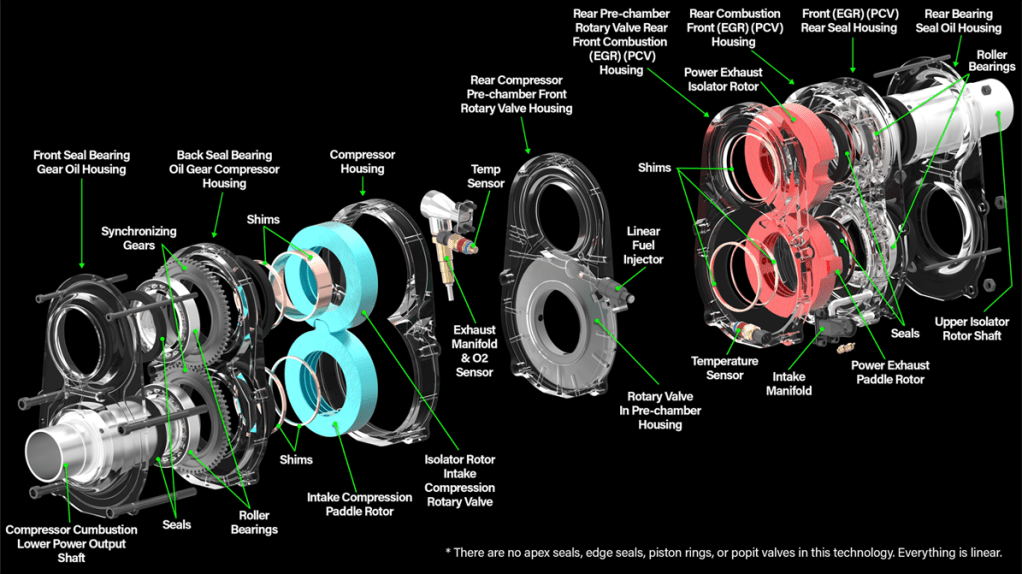
The Omega 1 is a highly efficient engine, one that can produce 160 hp and 170 lb-ft of torque. Yet it weighs just 35 pounds.

While it is a combustion engine, it doesn’t have pistons. Doesn’t have crankshafts.

Rather, the output from the engine comes from a single rotating power shaft.

Yes, the configuration of the engine is predicated on rotary motion. In fact there are no moving parts besides the rotational elements.

It can be fueled with gasoline or hydrogen.

On this edition of “Autoline After Hours” we are joined by Matthew Riley, the founder, CEO of Astron Aerospace and inventor of the Omega 1 and Chris Theodore of Theodore & Associates and technical advisor to Astron.

They explain the way this engine works.

Astron Omega 1. Looks complicated. But simpler and lighter than a reciprocating engine. (Image: Astron Aerospace)

Given the name of the company, there is a focus on use in aircraft applications. For example, drone use would be certainly something that this lightweight engine would lend itself to.

But it also is conceivably applicable to automotive applications: Think of how it could be used to power a vehicle using hydrogen as fuel—there would be no need for a fuel cell to transform the hydrogen.

Then on the second half of the show “Autoline’s” John McElroy and I are joined by Matt DeLorenzo of Kelley Blue Book and Jack Nerad of “America on the Road Radio.” All four of us are jurors for the North American Car, Truck and Utility Vehicle of the Year (NACTOY) awards and will soon be voting on the winners for the 2022 awards.

The finalists are:

CAR

  • Honda Civic
  • Lucid Air
  • Volkswagen GTI/Golf R

TRUCK

  • Ford Maverick
  • Hyundai Santa Cruz
  • Rivian R1T

UTILITY

  • Ford Bronco
  • Genesis GV 70
  • Hyundai IONIQ 5

The four of us discuss which vehicles are likely to win.

The surprising part of the discussion is how much agreement there is, with little in the way of dispute.

But you be the judge by watching it here.