
What Do Potential EV Pickup Buyers Think?

By Gary S. Vasilash

It is always interesting to see surveys that ask about how people perceive autonomous vehicles because most people have only seen an AV on TV.

Things are a bit better with electric vehicles. But still, if you take Tesla out of the calculations (in the first half of 2023 Kelley Blue Book calculates that there were 556,707 EVs sold in the U.S., of which 336,892, or 60% of the total were Teslas), there aren’t all that many EVs out there for people to buy.

Cox Automotive (which, incidentally, owns KBB) recently ran a study of pickup shoppers who are planning to buy a truck within the next two years.

The information related to those considering EV pickups is interesting.

For example, consideration for an EV from a brand that one already owns is solid, which perhaps help explain why the Ford F-150 Lightning has the highest level of consideration.

What’s more, Cox found Lightning is clearly the most appealing to people.
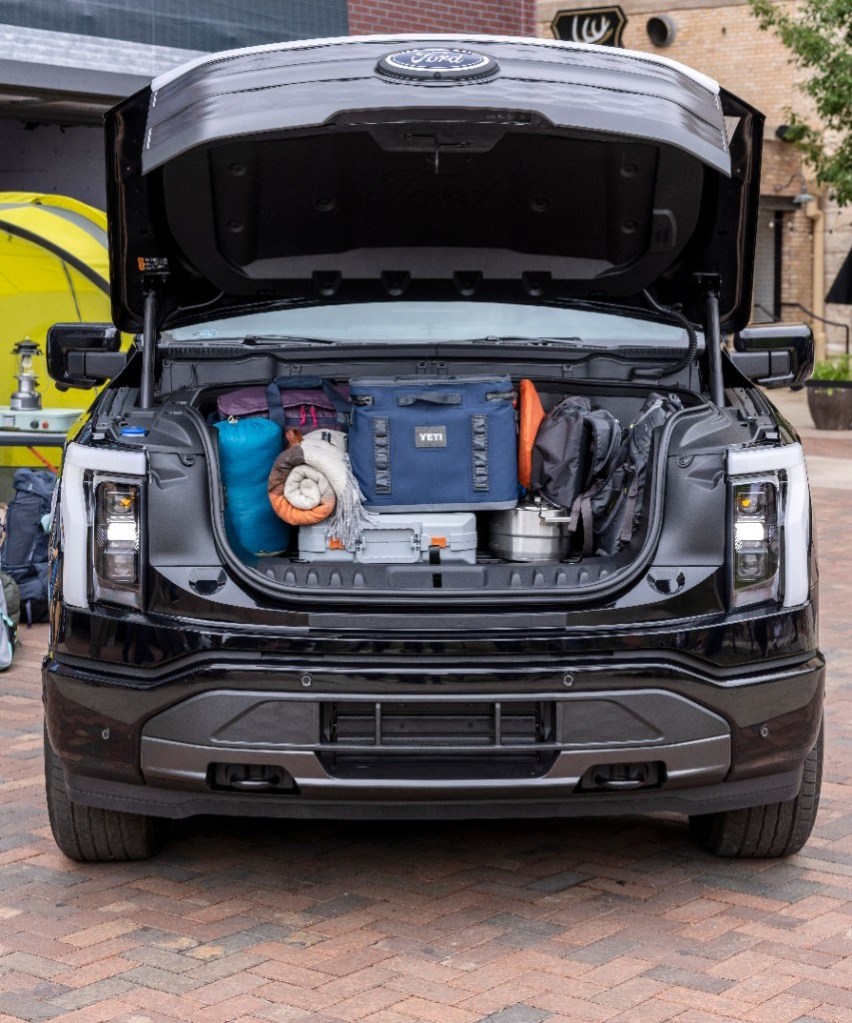
Ford F-150 Lightning frunk. (Image: Ford)

When asked about appeal before a truck was revealed and consideration after the reveal, of the Ram 1500 REV, Chevy Silverado EV, GMC Hummer EV pickup, Rivian R1T, and Tesla Cybertruck, and the Lightning, only the Lightning had a higher post-reveal consideration number.

And when looked at from the perspective of the following metrics, the Lightning got the top score in all of them:

  • Mileage range/fuel efficiency
  • Driving performance
  • Price
  • Overall look/styling
  • Technologically advanced

Which brings us back to the aforementioned survey about AVs.

Of the vehicles on the list, only the Lightning, Rivian R1T, and Hummer EV pickup are out there, and the number of Hummers is capable of being parked in a strip mall lot with spaces to spare.

How do people know about driving performance?

And how does the Lightning, with a top range of 320 miles, out score the Silverado EV, which has an estimated range of 450 miles?

When it comes to technology, it is hard to figure how the Lightning is more advanced than the R1T—unless it is that the Lightning has a 14.1-cubic foot frunk and the R1T’s is just 11.

The Cost of Cars & a Considered Alternative

By Gary S. Vasilash

According to the most-recent numbers from Kelley Blue Book, the average transaction price paid for a vehicle in May 2023 was $48,528. And this is even though, KBB found, the average price paid was $410 below sticker, not some wild figure well above it, which people were paying as a result of the pandemic: KBB notes that in May 2022 the price paid was $637 above sticker.

S&P Global Mobility reports that account-level delinquency rates of auto loads 60+ days past due are now up 26 basis points from Q1 2021, from 1.43% to 1.69%.

While that is a non-trivial jump, the folks at TransUnion and S&P Global Mobility point out that this is a situation that is being faced by a segment of the consumers and lenders, those who are in the subprime category and more than likely to be buying a used car.

So since that $48,528 MSRP may not apply to those people, know that according to Cox Automotive, the average used vehicle listing price in May was $27,256, “the highest since early January.”

Meaning, new or used, vehicle are pricy.

But this statement related to the loan delinquencies is somewhat startling:

“The interest rate rise is squeezing the monthly budget for the average American consumer. Consumers set aside money monthly for housing, vehicles, and insurance, but may not pay other obligations with the same frequency, such as medical bills and credit cards. People need their vehicles to get to work to make money and pay their obligations.”–Jill Louden, product management associate director for S&P Global Mobility

Something of a vicious cycle: buy a car, go into debt, use the car to go to work, pay for the vehicle and other things, but rack up even more debt for things like health care and presumably things like food.

If some company comes to market with appealing vehicles that have a low price—and this might be a Chinese company, 25% tariff notwithstanding—then this industry could be upended.

Presumably there is a considerable percentage of people who use their vehicles strictly for transportation and not as a signifier of their wealth or coolness. If the vehicle can do the job and do so reliably–without seeming like vehicular penance–then being able to acquire such a vehicle would be the way to go.

Let’s face it: not everyone—even those who are well above subprime—can afford an electric vehicle, which Kelley Blue Book found had an average transaction price of $55,488 in May—down 14% compared to May 2022, but probably because of Elon Musk adjusting the prices of his cars in a way that is completely uncharacteristic of traditional OEMs, so probably not something that can be counted on going forward.

Everyone talks about the transition to EVs and OEMs are tripping over one another to make this change to their showrooms.

But consider: How many people will be left by the side of the proverbial road by OEMs those consumers could once count on for reliable, affordable vehicles?

Start of an EV Price War?

By Gary S. Vasilash

Last month Tesla did something that OEMs almost never do. (And in its history, Tesla has done lots of things that traditional OEMs almost never do, so at least in this regard it is being consistent.)

It cut the price of its vehicles in China, Germany, and the U.S.

These weren’t slight, either. In the U.S., for example, the Model Y Performance was cut by 19% and the Long Range version by 20%.

There were all manner of assessments as to why this happened. Some suggested that Elon Musk’s Twitter distraction was causing the company to lose sales. Others were pointing out that there is increased competition from some of the traditional OEMs. (Who, to be frank, are bigger on rhetoric about their electric scale today and tomorrow than they are in putting EVs in customer’s driveways.)

Tesla has some 2/3 of the U.S. EV market.

Mustang Mach-E: When does a popular vehicle–and it is popular–get a price reduction? (Image: Ford)

Consider: while the Ford F Series seems like a force of nature when it comes to sales, in 2022 there were 653,957 of those trucks sold—and GM sold 764,771 Silverados and Sierras combined, so it isn’t like either of the primary players have anything near 2/3. Yet a company that wasn’t taken all that seriously 10 years ago now dominates a category.

Shortly after Tesla made its announced cuts, the folks at Ford joined in on reducing the prices of its 2023 Mustang Mach-E models. The reductions ranged from $600 on the Select eAWD Standard Range model to $5,900 for the GT Extended Range.

Ford clearly wants to move metal. What’s curious, though, is that in 2022 it sold 39,458 Mach-Es, which is a 45.4% increase over the number it sold in 2021. It’s not like things were lagging. (Ford execs may have noticed that in July of last year GM cut the prices of the Bolt EV and Bolt EUV by $5,900 and $6,300, respectively, and those vehicles ended the year at 38,120 deliveries, not only close to that Mach-E number, but a 53.5% increase over 2021–greater than the Mach-E rise. Although it is hard to imagine the vehicles being cross-shopped..)

Everyone knows that EVs are more expensive than vehicles with internal combustion engines for a wide array of reasons. And while the overall percentage of EVs sold in the U.S. is still small—5.8%–it is growing, not declining.

So why were the cuts to prices made and will other OEMs follow suit?

Those are the primary questions raised and discussed on this edition of “Autoline After Hours.” Charlie Chesbrough, Cox Automotive Senior Economist, and Joe White, Reuters Global Automotive Correspondent, join “Autoline’s” John McElroy and me to talk about those topics and more.

And you can see the show here.

About Those (Absent) Auto Ads

By Gary S. Vasilash

Some 41% less was spent by automakers on national TV advertising in July 2022 compared with July 2021 according to iSpot.tv information cited by MediaPost.

The MediaPost article points out, “Without the Olympics, NBA Finals and Stanley Cup (which all took place during at least part of July last year), TV ad spending was down for automakers. . . .”

Fair point, because ads for OEMs during sporting events are absolutely ubiquitous.

However, there is another factor that probably plays a bigger role I the absence of ads:

The lack of product to sell.

According to Cox Automotive, the U.S. auto industry’s days’ supply of vehicles is in the mid-30s, a fraction what is ordinarily the norm.

Honda had just 21 days’ supply on dealer lots.

The point is, it makes very little sense to advertise products that people can’t buy.

Sure, there is something to be said to maintain brand awareness, but if there are ads that are extolling all of the wonderful features of a vehicle that is unicorn-like in its available existence, then the potential consumer is going to be highly annoyed (especially when that person tries to be sold something completely inappropriate by a dealer: guess who certainly won’t go back to that store and who is likely not to shop that brand?).

So sporting notwithstanding, the issue of sparsely available vehicles on dealer lots is a massive roadblock to commerce.

Buying Electric Pickups

People buy a lot of trucks. According to NADA, in 2021 U.S. light truck sales (admittedly not all vehicles with cargo boxes on the back, as SUVs make it into this space) accounted for 77.6% of all light-duty vehicles moved off of dealer lots.

With the transition toward electrification, OEMs have undoubtedly taken this into account. So whether it is a traditional OEM like Ford and the now-in-volume-production F-150 Lightning or a startup like Rivian and its R1T, electric pickups are rolling out and there are more to come.

Cox Automotive has done some interesting research on potential purchasers of electric pickups.

Looking at those who currently own gas-powered trucks, they found that when it comes to what they are likely to buy next, 50% said they’d stick with gas-powered trucks. 37% said electrified (hybrids or full battery electric). And 14% will consider both.

What’s good news for the OEMs is that only 36% of buyers under age 35 would consider just gas-power, so the future looks better because the OEMs are putting a big bet on the future. 53% of those older than 35 say they’ll be sticking with gasoline. The first group will be buying more vehicles than the latter.

One finding puts the why-buy into perspective for pickups.

While some might imagine that the trucks are mainly for vocational use, turns out that only 12% of those who are considering an electrified for truck say they are doing so because they need it for work.

And 45% say they need it for their hobbies/interests.

What You Need to Know If Vehicle Shopping

First the good news, according to Michelle Krebs, executive analyst for Cox Automotive:

“The surge in new car prices appears to have peaked.”

That is the new vehicle average transaction price fell 1.8% in January compared to December.

Now it is “just” $46,404.

But while not exactly an entire shoe dropping, Krebs adds:

“Yet, while we expect vehicle supply to improve, it will continue to be tight particularly through the first half of the year. Because of this, we expect prices to remain high for the foreseeable future, but car shoppers can rest assured we don’t anticipate any more record highs.”

Not records. Just high.

Here’s another thing that probably won’t make you feel much better.

Cox calculates that car shoppers for non-lux vehicles are paying, on average, more than $900 above sticker. A year ago those customers were paying $1,600 or more below sticker.

For those in the lux segment it is a similar story, just higher numbers. As in paying $1,300 above sticker when last year the prices out the door were $2,400 under MSRP.

One way of looking at this is that for non-lux cars customers are paying a $2,500 penalty for waiting (the swing from minus $1,600 to plus $900) and the lux buyers $3,700.

With inflation and rising interest rates, however, it may be a good idea to shop earlier rather than later lest those factors add to the sticker.

Remember: MSRP is “suggested” price, not what you’re going to sign off on.

Something to Think About Regarding Vehicle Prices

By Gary S. Vasilash

Here are some interesting observations from Charlie Chesbrough, senior economist and senior director of Industry Insights at Cox Automotive.

Chesbrough, during a presentation at the Federal Reserve of Chicago’s 28th Annual Automotive Insights Symposium, pointed out that new vehicle inventory at the end of 2021 was 63% below what it was in 2020.

Not a whole lot of inventory on those dealers’ lots.

He said the day supply of vehicles is about 35 days, and that when vehicles show up on dealer lots they get bought up just as quickly as they are dropped off.

What’s more, the average price of a vehicle is MSRP plus something.

In other words, that sticker is a suggestion. The price goes up from there.

What’s more, people are paying more than ever—average transactions at $47,077, according to Kelley Blue Book—and dealers and OEMs are racking up the rewards.

“This is a tight supply situation and I don’t know that the industry is in much of a hurry to change it.”

Why would they?

Not A December to Remember: At Least If You’re Shopping

By Gary S. Vasilash

Cox Automotive reports that there are two things going on in the new vehicle market right now that certainly aren’t particularly beneficial if you’re looking for something new to put in your driveway.

On the one hand, average transaction prices (ATPs) are continuing to climb. In November the ATP was $46,329, a record, and while the December number has yet to be calculated, Cox notes, “A new record in December would not be surprising.”

Then on the other hand, there are incentive programs, which are continuing to disappear.

Cox points out that in 2019 new-vehicle incentive programs reached an all-time high. This year, incentive programs have decreased month after month such that in the fourth quarter it was at the lowest point in five years.

Of course, all of this matters only if vehicles can be found.

Charlie Chesbrough, senior economist at Cox, says, “While sales in the first half of 2021 were relatively strong, the industry ran out of vehicles, and sales stalled in the second half.

“Total sales in the second-half of 2021 were the slowest in a decade. Demand is healthy, but supply and production disruptions kept the industry in check. You can’t sell what you don’t have.”

Nor can you buy what you can’t get.

So if you can, you might want to wait until next year.

Chesbrough: “Heading into 2022, we believe the supply situation will improve but it will take time to restock the shelves at dealerships.  We expect modest gains in new-vehicle sales in the first quarter, and by the second half of the year a much more robust market should emerge.”

This, of course, is dependent on things like the semiconductor issue to be solved, to say nothing of improvement in the logistics situation (i.e., shipping and trucking).

But the numbers for 2021 are improved over ’20, so. . . .

They’re Probably Not Throwing in the Mats

Challenges and opportunities in the dealer model and other contentious issues

By Gary S. Vasilash

Research from Cox Automotive, which is a source that dealers find exceedingly useful in their efforts to conduct their business, found that there is an increasing interest among customers to do more of their transactions digitally.

As in 80% of consumers would like to do part of the buying transaction on line. (Who doesn’t do research on the vehicles they’re interested in on line; who doesn’t want to get some of the “paperwork” related to the transaction done in the comfort of their own home rather than under the fluorescent lights of a dealership?)

And 25% of customers would like to have the whole thing done and dusted on line.

What’s more, KPMG conducted a global survey among executives in the auto industry—OEMs, suppliers, dealers, financial services providers, etc.—and they found (again, realize this is a global survey and the Cox Automotive survey in U.S. only):

  • 78% think the majority of purchases will be on line by 2030
  • 34% think that from 60 to 79% of the vehicles delivered will be direct to the consumer by 2030
  • 84% think vehicle subscriptions will be competitive to buying and leasing by 2030 and only 22% dealers are the best channel for subscriptions (OEMs are the biggest choice, 45%)

There is some concern that due to the reduced inventories that are a result of supply chain issues dealers—not all, but some, some that get attention—are increasing prices well above the sticker price.

If consumers were thinking there might be an alternative before this occurred, then those who were subjected to or simply heard about this behavior might be thinking harder about new approaches to getting vehicles (e.g., the Tesla approach).

This is one of the topics that is discussed on this edition of “Autoline After Hours” with “Autoline’s” John McElroy, Cars.com editor-in-chief Jennifer Newman, the Wall Street Journal’s vehicle expert Dan Neil, and me.

Other topics include whether Apple is going to get into the vehicle business (Neil and Newman both think that it is a when not an if), and whether electric vehicles are going to be the end of muscle cars as we know them.

And there’s much more in one of the more animated shows in some time.

Which you can see right here.

Cox Finds EV Interest Not Yet Sparking

Sure, there are lots of people who want to buy Teslas, but one brand does not a solid segment make

Cox Automotive took a look at what real people think about their likelihood when it comes to the possibility or potential of their buying an EV the next time they’re in the market for a new vehicle and it seems that they are more likely to buy an ICE-powered pickup truck or SUV.

That is:

  • 38% are considering an EV within the next 12 months. Let’s face it, all of us consider lots of things. But when it comes to actually signing the documents. . . .
  • 21% say they are >50% confident their next vehicle will be an EV. There are a couple of ways of looking at this. Is the 21% a subset of the 38%. Or are these confident people, people who are likely to buy a new vehicle. . .oh, sometime.
  • 3% are 100% confident their next vehicle will be an EV. It so happens that 3% is the share of market that EVs will have this year.

Here’s something that’s not surprising:

If an EV is available for $5,000 less than a comparable gasoline vehicle, 71% will consider the EV.

Price is the second-highest barrier to buying, at 51% citing EVs and being too expensive.

The others are:

  • 57% think there’s not enough charging stations in their local vicinity
  • 42% are worried the battery won’t hold a charge
  • 41% are concerned with the cost of potential battery replacement (shouldn’t that be 42%, or is it that 1% who are worried about the lack of a sustained charge will just live with it?)
  • 37% still have range anxiety—although the positive news for EV purveyors is that two years ago 47% cited low range as a concern

Here’s something that ought to be of concern of the marketers at Nissan (LEAF) and Chevy (Bolt EV): 63% of those surveyed don’t know that Nissan offers an EV and 69% are unaware that Chevy has one in the showroom.

Oddly enough, 21% are aware of and considering a Toyota EV. Which leads one to wonder whether this is in anticipation of the bZ4X coming next year or that there are actually people who are aware of the fact that although the Mirai is powered by a fuel cell, it actually is an EV, just not a BEV (battery electric vehicle).