Toyota, GM, Ford; EVs, AVs and ADAS

By Gary S. Vasilash

Last week Norihiko Shirouzu of Reuters reported “Toyota is considering a reboot of its electric-car strategy to better compete in a booming market it has been slow to enter.”

Toyota’s Prius is synonymous with “hybrid.” The company has pretty much hybridized everything. It argues—or maybe that would be “argued”—that it is better to build a whole bunch of affordable hybrids than a comparatively few electric vehicles that are comparatively more expensive: according to Kelley Blue Book, the average price of an electric vehicle in the U.S. in September was $65,291. The average transaction price for vehicles overall, KBB calculated, was $48,094. Which is roughly a 27% delta, which is certainly non-trivial.
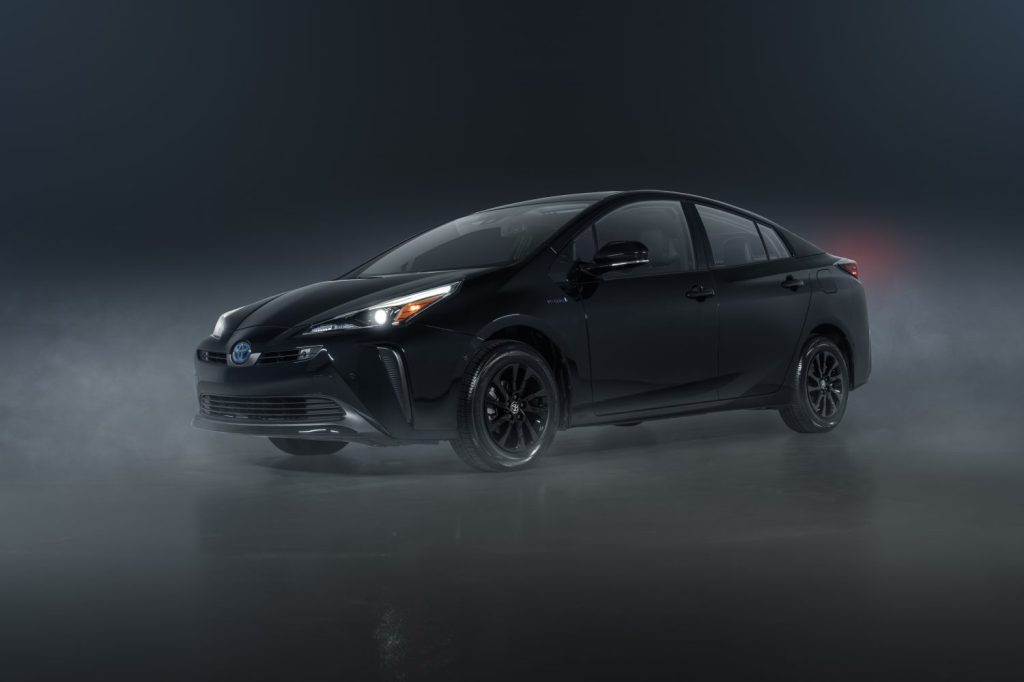
Yes, this is a Prius. (Image: Toyota)

Be that as it may, Shirouzu’s sources indicated that “Toyota’s planning had assumed demand for EVs would not take off for several decades.” Which is decidedly not the case.

So is Toyota making a pivot? That is one of the subjects discussed on this edition of “Autoline After Hours.” Joining “Autoline’s” John McElroy and me are automotive consultant/analyst Jack Keebler and long-time auto journalist, currently freelancing at Autoweek, Todd Lassa.

Other topics discussed are the Q3 earnings of both General Motors and Ford, as well as those companies positions on autonomous driving: GM continues to be bullish on the prospects for Cruise, still anticipating revenue of $1-billion from the operation by 2025; Ford is far more conservative, as it announced that Argo AI, the AV company that was owned primarily by it and Volkswagen (each had 39%), was closing. Ford going forward would focus more on Level 2+ and Level 3 ADAS. (Ford CEO Jim Farley: “It’s mission-critical for Ford to develop great and differentiated L2+ and L3 applications that at the same time make transportation even safer.”)

The conversation is wide ranging and lively. And you can see it here.

Interesting EV Numbers

The good news for EV enthusiasts (as in those who enthusiastically support the proliferation of EVs not necessarily because of any environmental considerations but simply because (a) they have one and figure that others should, too, or (b) they simply think it is cool tech, and while they can’t afford it—according to KBB.com, EVs had an average retail price of $65,291 in September—they still think it is cool for those who can):

According to Elizabeth Krear, vice president, electric vehicle practice, J.D. Power: “October breaks a three-consecutive month decline in EV consideration.” More people are thinking about getting an EV.

J.D. Power data have it that 27.4% of people who are going to be in the market for a new vehicle in the next 12 months are “very likely” to consider an EV.

While that is a move in the right direction for EV sales, Krear has some other figures that are less propitious:

“Adoption has been flat for the past six months with the retail monthly share for BEVs hovering at 5.6%. The top two reasons for EV rejection are lack of public charging and price.”

As for that all-important price component, she points out that affordability has decreased by 15 points during the past 12 months and the recent rise in interest rates is having an effect, as well.

But the federal EV support money for EV purchases as well as an increase in the number of models (J.D. Power has 51 in its data set; two years ago it contained 27) are at least helping people consider EVs, even though they still might opt for that ICE model.

Bob Boniface on Automotive Design

By Gary S. Vasilash

Here’s something that you probably don’t know about Bob Boniface, director of Global Buick Design, even if you know Bob Boniface.

He began his career. . .working at a mutual fund in Boston after receiving his undergraduate degree. . .in psychology and economics.

Boniface did go to the College of Creative Studies in Detroit and while there was hired as an intern to work at Chrysler which led to a job offer from then-head of Chrysler Design, Tom Gale.

Buick Wildcat EV concept. If Buicks look like this, then the brand has a bright, electric future. (Image: Buick)

Boniface was to work at Chrysler for 12 years, during which time he worked on a variety of projects including the second-generation Dodge Intrepid, the Dodge Intrepid ESX (a diesel hybrid with wheel motors), the Stow ‘n Go seating for the minivans, the 300C, and the Jeep Liberty.

In 2004 Boniface moved across town to General Motors. The first thing he worked on was the GM Sequel—a fuel cell-powered vehicle. Then the gen-five Camaro.

Boniface says, on this edition of “Autoline After Hours,” that he was, in effect, employee #1 on the Chevrolet Volt.

Then he moved to Cadillac for six years. He worked on XT4, XT5, CTS, CT6 and. . .he says the best part was working on the V-Series, the CTS-V and the ATS-V. (He says one of the engaging parts of the V programs was the level of commitment across all the functions involved: by having everyone working toward making something special, the results is–something special.)

Boniface moved to Buick in 2016 and has worked on vehicles including the Enclave and the Envision.

He points out that a lot of his work involves overseeing the studios in Korea and China. The China market is huge for Buick—roughly four times that of the U.S. market, so that part of the world is important. He notes that a lot of developments in the interior space are occurring in that part of the world, and interiors are part of his portfolio.

But then there’s the Wildcat EV Concept.

Realize that Buick arguably gave rise to the whole notion of the concept vehicle with the 1938 Buick Y-Job. The brand has had a number of vehicles with striking designs since then, such as the Wildcat I and II of the 1950s to the Velite in 2004 to the Avenir in 2016.

Back in 2018 Boniface says that they went to work on developing not so much a new vehicle as a new design language. But that exercise gave rise to the Wildcat EV Concept, a 2+2 coupe that is an expression of the electric future of Buick and that expression includes a new face—although being new, it also includes a nod to the brand’s design paste (e.g., high lamps, body-mounted badge).

Again: it is the language that they created and the vehicles to come will be spelled with those words.

If you have any interest in automotive design over the past 30 years, then this edition of “Autoline After Hours” is must viewing.

Joining the discussion are Greg Migliore of Autoblog and Joe DeMatio of Hagerty Media.

And you can see it here.

Lucid Through Q3

Back in May, Lucid Group, which produces the magnificent Lucid Air line of electric vehicles, thought that it would produce from 12,000 to 14,000 of those vehicles in 2022.

But, as they say, stuff happens.

After delivering 679 vehicles in Q2 it adjusted its guidance to be at 6,000 to 7,000 for the year.

Lucid Air Sapphire. Starts at $249,000. (Image: Lucid)

It just announced its Q3 production figures, which had 2,292 vehicles built at its plant in Casa Grande, Arizona.

So far this year it has built 3,697 vehicles.

To reach 6,000 units it would need 2,303 more.

That seems eminently do-able.

While the numbers are small, the Airs start at $87,400 and go north of $249,000.

Bigger numbers would be better. But in that context, small isn’t bad.

The Tricky Challenge of Meeting the EV Future in the (Mainly) ICE Present

By Gary S. Vasilash

One of the things that isn’t often considered when OEMs announce still another new electric vehicle is that just as is the case with their vehicles with internal combustion engines, suppliers make a considerable number of the parts and systems that go into those vehicles.

This puts suppliers in something of a tricky situation because chances are they have the capacity to produce parts for ICE vehicles and now, assuming that they want to continue to have business, they have to acquire or develop the wherewithal to make the EV componentry.

And let’s face it: this EV transition isn’t going to happen overnight, so there is still the need to supply the things for the ICE vehicles.

Consider the situation at GM, an example that is simply representative of the industry as a whole.

Buick has four vehicles in its lineup and zero EVs. Cadillac has seven and one EV. Chevy has 18 vehicles and one (or two if you could the Bolt EV and Bolt EUV as two, but they count it as one). And there is GMC with eight vehicles and one EV.

It should be noted that there were 22,830 EVs delivered in the U.S. by GM through Q3—out of a total 1,650,827 vehicles.

Still, suppliers see the proverbial writing on the wall and as such they are looking to what they can do to make the transition to electric.

One of the top global auto suppliers is Schaeffler. And on this edition of “Autoline After Hours” we talk to Jeff Hemphill, chief technology officer of Schaeffler Americas.

Hemphill explains how the company is making the transition to electrification, providing everything from motors that are used in hybrid systems to complete e-axles for battery electric vehicles. The company is both responding to what OEMs want and working to develop the tech that is expected to be needed.

(Remember: EVs are still pretty much a nascent technology for most OEMs–and suppliers–even though it seems fait accompli.)

Hemphill talks with “Autoline’s” John McElroy, Mike Austin of Guidehouse and me about how the company is working to provide OEMs with what they need now—and will need tomorrow.

And you can see it all here.

EV Is VE: Very Expensive

The average transaction price for an electric vehicle this past August—that is, the average price that a real person paid to get the vehicle off the lot—was $66,524, according to Kelley Blue Book. A full-size pickup truck (presumably powered by gasoline) was less costly: $63,456. (Here’s something random to consider: That is a $3,068 difference. If gasoline is $5 per gallon, then that would buy 613.6 gallons. If the vehicle gets 18 mpg, then one could drive said pickup 11,044 miles.)

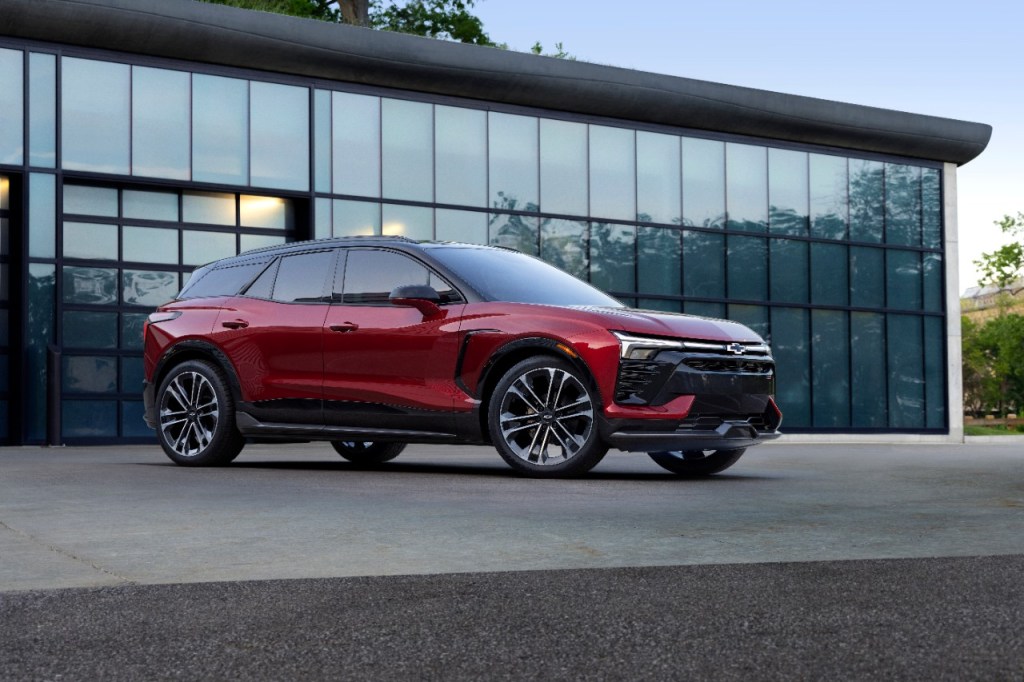
Forthcoming (albeit pre-production) 2024 Chevrolet Blazer EV SS. (Image: Chevrolet)

Next fall Chevy is to bring out the Equinox EV with an announced, anticipated, starting price of $30,000. The company will also be bringing out the Blazer EV, that has an “estimated MSRP starting around $44,995.” The photo on the webpage has a photo of a preproduction version of the Blazer EV. The “as shown” price for that midsize SUV: $67,990.

Somehow that $30,000 is likely to be closer to $40,000 for someone going for an average transaction.

Or more.

Dodge CEO Tim Kuniskis on the Transition to Electric

By Gary S. Vasilash

Perhaps more controversial than Dylan going electric in 1965. . .

If you think about “Dodge,” you have a pretty good idea of what it is: A lineup of muscle cars. It is a brand that has pared itself down to an essence, as things like the Journey and Caravan have gone away, leaving the bulk of the brand on the shoulders of two vehicles, the Charger and the Challenger. (The Durango is still in the showroom.)

The positioning of the brand is unapologetically the “Brotherhood of Muscle,” although all genders are encompassed within the club.

Dodge Charger Daytona SRT Concept: Dodge goes electric. (Image: Dodge)

One might think that this whole muscle car thing is an anachronism. HEMI engines don’t seem to a thing that would resonate in the age of Greta Thunberg.

However, in the first half of 2022, Dodge outsold Chrysler, Fiat and Alfa Romeo combined: 84,761 to 73,010.

There is a defined niche of buyers for whom muscle cars matter. And they buy them.

Although the platform underpinning the Charger and Challenger is, by contemporary standards, vintage, the people at Dodge have kept things going by introducing special editions and packages for the cars (e.g., the SCAT Pack Swinger, a tribute to the late ‘60s and early ‘70s).

Tim Kuniskis is the CEO of Dodge. And on this edition of “Autoline After Hours” he explains how Dodge will keep being propelled forward with cars even though he admits “cars are dead”—albeit dead for those who don’t necessarily consider their vehicles to be a representative of who they are. The Brotherhood of Muscle knows what matters to them and prove it every day.

Still, Kuniskis and his team are fully aware that the market is changing, moving away from HEMIs to electric propulsion.

So rather than pretending that it is otherwise, they have rolled out with “Last Call” editions of the Charger and Challenger and revealed the bad-ass battery electric Charger Daytona SRT Concept.

They are putting the proverbial pedal to the metal as they drive toward an electric future.

As Kuniskis points out in the show, people who drive muscle cars think somewhat differently than ordinary car consumers.

For example, do you think someone with a supercharged 6.2-liter HEMI Hellcat high-output V8 under the hood—a 797 hp or 807-hp engine, depending on package—is at all concerned with the fact that they may get a combined mpg of 15? Given that, what is the likelihood that someone getting an electric muscle car is going to be concerned whether the range is 300+ miles or a fraction of that—as long as the car moves like a bat-out-of-hell (which explains why the propulsion system in the concept is named “Banshee”)?

Ordinary EV buyers are largely concerned about range. Dodge EV buyers will focus on performance. (OK: some of them will be concerned with range, but they’re going to want to make sure that their cars seem to be hellacious performers.)

Kuniskis talks about the present and the future of Dodge with “Autoline’s” John McElroy, Chris Paukert of Edmunds, Mike Musto of Hemmings and me.

Even if you aren’t particularly interested in muscle cars per se it is a fascinating look at how a brand that is as intensely focused on one segment as Dodge can make a transition to a different technology model without disaffecting its customer base.

One can imagine that the Dodge switch to an electric future will become a business school case study, which you can learn about now, for free, here.

Mike Ramsey on Autonomy and Electrification

By Gary S. Vasilash

Mike Ramsey, as a vp and analyst for Gartner on the topics of Automotive and Smart Mobility, spends his time researching and thinking about those two topics and consulting with a wide array of people in the auto industry on the subjects. And on this edition of “Autoline After Hours” Ramsey talks to “Autoline’s” John McElroy and me about, primarily the subjects of autonomous vehicles (AVs) and electric vehicles (EVs).

Although AVs are getting far less attention than EVs, Ramsey suggests that work continues apace on the development of the technology. One of the factors that is going to play a big difference for the greater availability of AVs, Ramsey says, is a decrease in the cost of sensor technology (e.g., lidar). This will help make the calculations for the function more in line with what are automotive economics.

Ramsey suggests that with the amount of data that Tesla is collecting from its vehicles it may be in a prime position to make the move to actual full self-driving capability—but Ramsey underscores that it is probably not going to be with the present setup of sensors that are currently used for the various Tesla models.

EVs are going to be more widely accepted, Ramsey says—but this will require that the price points of the vehicles have to go down in order for people to be able to get into the vehicles, with most of the models out there being in the luxury pricing strata.

Another thing that needs to be addressed vis-à-vis EVs is the charging infrastructure, which many consumers have found to be quite disappointing. Ramsey thinks that automotive OEMs are going to have to think long(er) and hard(er) about what their role in charging needs to be because no matter how good the product is, if the charging experience is a negative one (a recent J.D. Power study on charging found that people are not exactly pleased with their experiences), then that will reflect poorly on the whole undertaking.

You can see the show here.

Sandy Munro on Tesla and Other Electric Vehicles

By Gary S. Vasilash

Sandy Munro is a Tesla teardown artist.

“Teardown” as in Munro and his team at Munro & Associates taking apart Teslas—and other electric vehicles—and then carefully cataloging and assessing each element that goes into making an entire vehicle.

Munro brings to the activity a 30+ year understanding of what it takes to build a vehicle with best practices. And because he is deeply versed in things like design for manufacturing, he is able to identify where those best practices aren’t being performed.

While Munro had done extensive work on analyzing vehicles that have internal combustion engines, he says that that is behind him for the simple reason that he believes that electric vehicles are going to take a considerable portion of the new vehicle market.

He says that somewhat analogously to Moore’s Law in computing, there is Munro’s Law that has it that if 2022 has electric vehicles at 5% of the new car market, then it will be 10% in 2023, 20% in 2024, 40% in 2025, 80% in 2026.

Given the amount of money global OEMs are spending on developing battery production capacity, it seems that they don’t disagree with Munro.

One of the interesting things that has happened to Munro’s career is that whereas the suburban Detroit firm that he heads once performed its work in relative obscurity, some of the work that the company is doing—like his teardowns of the Model 3 and Model Y—have been put on a YouTube channel, which has led Munro to considerable fame or notoriety—depending on your point of view—particularly within the Tesla community.

On this edition of “Autoline After Hours” Munro talks with “Autoline’s” John McElroy and me on a variety of subjects, including his fame among nine-year-olds. Seriously. (Munro points out one reason why an increasing number of EVs will be sold is predicated on kids influencing their parents, and he thinks that OEMs who ignore the young do so at their peril.)

You can watch the entire show here.

Foxconn in Ohio

Monarch Tractors–which is located in Livermore, California, which is about 45 minutes east of Mountain View so it is Silicon Valleyesque yet still has something of the region’s former agricultural glory about it—has developed an electric tractor.

The MK-V, which produces up to 70 hp, and is fitted with a swappable battery that has a runtime of ~10 hours, is described as being “smart.” There is a screen on board that provides the ability to access live video, weather and other farming-related information.

But what is even more interesting is that it is “driver optional.”

The tractor can be operated remotely.

Apparently your favorite local restaurant isn’t the only place that has trouble finding workers.

The MK-V can mitigate some of that labor shortage for ag.

Also interesting is the company that has just signed on to manufacture the tractors for Monarch: Hon Hai Technology, which is better known as “Foxconn.”

The tractor is scheduled to go into production at Foxconn’s facility in Lordstown, Ohio.

Foxconn acquired the factory last May from Lordstown Motors. Foxconn is to build the Lordstown Endurance electric pickup in the plant.

And in 2024 the Fisker Pear, an EV with a presently intended starting price of $29,900.

No matter how the MK-V, Endurance or Pear do, Foxconn will undoubtedly do well.