About the 2024 Chevrolet Silverado EV

By Gary S. Vasilash

When Chevrolet introduced the 2024 Silverado EV today, there was an interesting quote made by Steve Hill, vp of Chevy.

Hill said: “The Ultium Platform”—the thing that General Motors is using to underpin all of its post-Bolt EV models—“is a critical enabler of next-level pickup truck performance for both fleet and retail customers, whether they are currently driving a Silverado or are considering a pickup for the first time.”

The interesting bit is that Hill said “fleet and retail customers,” with the first being fleet.

The Silverado EV, when launched, will come in two versions, both in Crew Cab configurations.

There is the flagship RST First Edition:
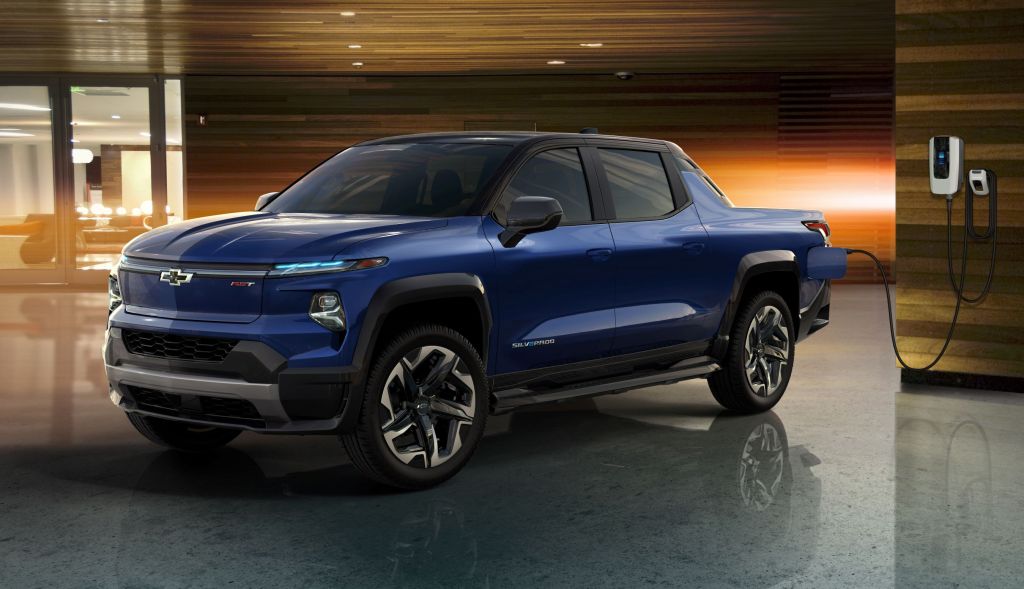
(Images: Chevrolet)

And there is the WT:

The RST First Edition brings such things as four-wheel steering and automatic adaptive air suspension. There’s a 17-inch diagonal LCD infotainment screen.

Simply, inside and out this looks like a very cool pickup truck that anyone who is interested in such things would be chuffed to have in her or his driveway.

The WT is a bit more, well, pragmatic. Chevy points out that it offers 510 hp and 615 lb-ft of torque; 8,000 pounds of towing and 1,200 pounds of payload.  The a bit later after launch there will be a model with 20,000 pounds of trailering capability.

RST owners will be able to access Ultium Charge 360, which is what consumers of other GM EV crossovers and cars will undoubtedly use. WT owners will have the opportunity go to a variant, Ultium Charge 360 Fleet Service. When that was announced in July 2021, Ed Peper, U.S. vice president, GM Fleet said, “Fleets have a significant impact on the transition to EVs and by expanding Ultium Charge 360 to our fleet customers, GM aims to be a significant industry leader to advance fleet EV adoption at scale and accelerate our goal of reaching 1 million EV sales globally by 2025.

“Fleet electrification is an important element of our growth strategy, and we will leverage our leadership and expertise in this space to support customers at home, at depots and in public with our suite of providers.”

The first models to be built at the GM Factory ZERO (Detroit-Hamtramck Assembly Center) will be the WT. It will be available in the spring of 2023. It will have a base MSRP of $39,900.

Then the RST First Edition vehicles—the fully loaded Silverado EV—will follow in the fall of that year. The base MSRP of that model is $105,000.

Other variants—with price points of some $50K, $60K, $70K and $80K—are planned.

Two points:

  1. The $105,000 RST First Edition might seem a bit pricy for, well, a pickup truck, but this is an electric pickup that is not only tricked out with all manner of tech, but it will come with a battery capable of, GM says, an estimated range of over 400 miles. Typically, EV models (e.g., the GMC HUMMER EV) start out at a high price point and then go down from there. . . .
  2. . . .which brings us to the point that GM is actually starting out with a much more modest price for the WT before going to the RST First Edition. There is a clear understanding that if they want to move lots of EV pickups, then the sweet spot is with contractors and other commercial service providers. Sure, the RST First Edition will probably have its reservation bank fully subscribed by the time you read this. But that will be a limited number of trucks. Although the margins on the RST First Edition will probably make the WT look like some sort of Dickensian orphan, the WT is going to be the thing that is going to make EV pickups a mass market phenomenon, not the RST First Edition.

It is a purpose-built pickup. The purpose is not only to have an offering in the segment, not only to provide style and functionality, but to expand the number of EVs on the road.

Which GM is committed to doing.

Still the EV Charging Question

By Gary S. Vasilash

The excitement associated with electric vehicles (EVs) in some corners makes it seem as though it is a foregone conclusion that the world is going to be full of what are, at this point in time, Teslas and vehicles that want to prove that they are better than Teslas.

When Ford announced that it was going to nearly double the production of its forthcoming F-150 Lightning, an electric pickup, to 150,000 units by mid-2023, you’d think that someone announced free beer at a football stadium. Happy days are here again!

But there are still hurdles that have to be overcome before there is massive acceptance of EVs, and a big one remains the whole issue of batteries, range and charging.

Better batteries, which have been and continue to be developed, generally means more range and faster charging.

That’s good.

But at this point there are still comparatively few charging stations, and when you see announcements of additional stations being built out by companies like Electrify America, take into account that unlike a visit to your local Fossil Fuel Emporium: Purveyor of Fine Snacks, where you spend about five minutes, the amount of time—even for the hyperfast chargers and the vehicles that can accept that level of charge—is generally on the order of 20 minutes.

So a bit of simple math has it that four liquid-fueled vehicles can be handled in the amount of time that it takes a single EV to get a charge.

Then there is the issue of what happens when a vehicle is out of fuel.

Who hasn’t seen someone walking down the road with one of those red gasoline containers, having had a vehicle run out of gas and in need of something to get it going?

A gallon of gas weighs a little over six pounds.

But what happens if an EV runs out of electricity?

Were there something analogous, it is probably going to be something that no one is going to want to lug for much of a distance.

A regular 12-volt battery such as the one that is undoubtedly under the hood of your vehicle weighs 30 pounds or more—not the sort of thing you’re going to want to carry very far.

The massive 40-mile I-95 traffic jam that occurred earlier this week in Virginia, where people were stuck in their vehicles for more than a day, has given rise to stories about how some EVs fared, and it seems not particularly well.

Yes, liquid-fueled vehicles ran out of gas.

But here’s the thing: someone can buy a five-gallon gas cannister at Walmart for about 13 bucks. The price of gas in Virginia is an average $3.15 a gallon. So to fill that container with fuel would cost $15.75. That’s less than $30 all-in. The gas would be good to get a few cars on the side of the road running.

What is the analogous answer for a Ford Lightning or another EV that is out of juice?

Interesting XPeng 2021 EV Sales Numbers

By Gary S. Vasilash

The numbers for Chinese electric vehicle manufacturer XPeng—not merely EVs, but “Smart EVs”—for 2021 are rather impressive, especially when looked at as a percentage basis compared to 2020.

As in:

  • 181% increase in the number of vehicles delivered in December 2021 vs. December 2020
  • 222% increase in deliveries in Q4 2021 vs. Q4 2020
  • 263% increase in total vehicles delivered in 2021 vs. 2020

But then when you drill down the numbers are somewhat less impressive.

  • 16,000 vehicles delivered in December 2021
  • 41,751 vehicles delivered in Q4 2021
  • 98,155 vehicles delivered in 2021

Still, directionally things are going well for the company.

XPeng P7 sport sedan. (Image: Business Wire)

The company offers both sedans and SUVs in the China market.  It is notable, as the interest in sedans in the U.S. is waning, that of its December deliveries of 16,000 vehicles, only 3,511 were SUVs—the largest share was taken by the sport and family sedans.

Another interesting thing about XPeng is that the company is building out a supercharging network—661 stations in all, located in 228 cities.

But even more notable is this: it has 311 retail outlets across 121 cities.

For a nascent company in the EV space, 311 is a lot of dealerships.

Tesla, for comparison, has about 170 galleries and showrooms in the U.S.

EVs Can Be More Green

Assuming you’re concerned with your carbon footprint

By Gary S. Vasilash

Polestar, the growing EV brand, is running life cycle assessments of putting its vehicles on the road, from start to finish.

One of the areas of focus is on the materials and manufacturing. They can deal with the carbon footprint there.

But then the vehicle goes into the hands of consumers.

And then they reach the end of their usefulness and are recycled (good) or scrapped (bad).

Polestar has expanded its focus to the vehicle-in-use stage. To that end it is working with a Dutch solar designer, Marjan van Aubel, working on increasing the amount of vehicle charging that is being performed via renewable sources.

Van Aubel: “There still needs to be significant integration. Solar energy only accounts for a small percentage of the electricity in the European grid, and just 34% of the energy we use comes from renewable resources. But together, we’re expanding the possibilities of generating energy from wind, water and solar sources. Designers are coming up with completely new ideas, too. They are proof that we are well on our way to creating a fully renewable energy grid and truly sustainable electric mobility.”

Here’s something to consider: In the U.S. solar adds 3.3% to the grid.

The importance of renewables in charging an EV: Polestar has determined that by using renewable electricity the carbon footprint of an in-use EV can be cut in half.

Non-trivial.

Major Commercial Euro EV Truck Order

This is a serious commitment to electric logistics

By Gary S. Vasilash

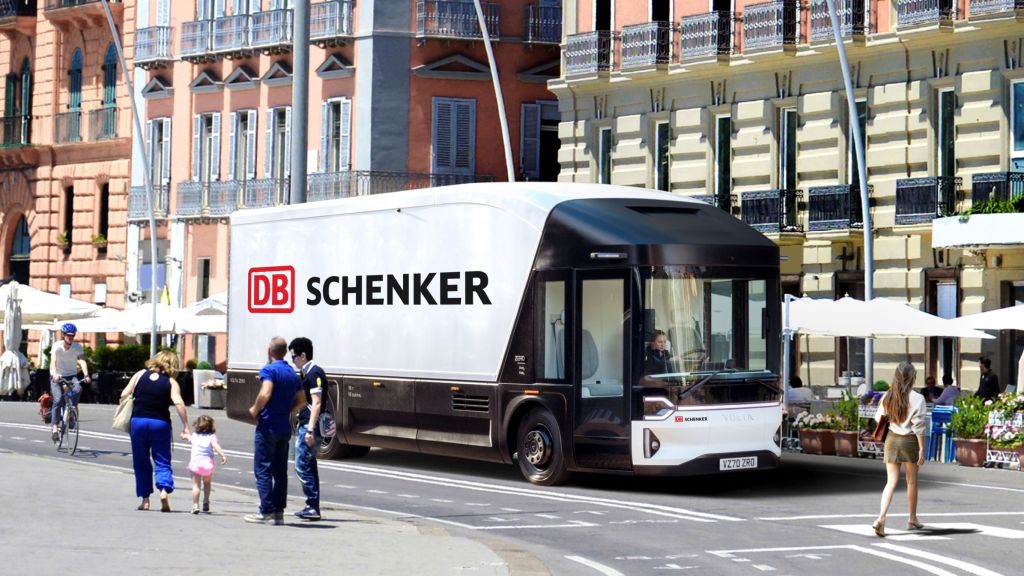
DB Schenker has been around since 1872, moving things first between Vienna and Paris, then, with time, around the world. Clearly the company knows what it is doing to have existed for so long.

It is not unusual for a logistics company to announce that it is buying some electric trucks. Generally the number announced is not all that large. After all, when you are being depended on by someone to get whatever from here to there within a set period of time, you don’t want to depend on some technology that is still somewhat new.

It is one thing for someone to have an electric passenger car.

It is entirely another for a company that could be moving critical goods to put it on an electric 16-tonne electric truck.

Note the clever cab design of the truck–high visibility for the driver to make driving in city centers (or “centres”) easier. (Image: Volta Trucks)

So it is notable that DB Schenker has announced that it is purchasing 1,470 such trucks to transport goods from distribution hubs to city centers from Volta Trucks.

Volta Trucks?

A Stockholm-headquartered company established in 2017. An objective of the founders is to “decarbonize last-mile logistics and to make city centre environments safer, more pleasant and sustainable places to live and work.”

And to do so with the development of commercial vehicles like the Volta Zero.

DB Schenker will be working with Volta to develop a 12-tonne variant of the Zero, as well.

The logistics company will test a prototype of the Volta Zero during the spring and summer of 2022, then the learnings from that will be rolled into the production trucks.

It will utilize the vehicles at 10 locations in five countries.

Cyrille Bonjean, executive vice president, Land Transport at DB Schenker said, “The large-scale partnership with Volta Trucks allows us to significantly increase the pace of electrification of our fleet and invest in greener transport solutions, brings us closer again to our goal of carbon neutral logistics.”

Cox Finds EV Interest Not Yet Sparking

Sure, there are lots of people who want to buy Teslas, but one brand does not a solid segment make

Cox Automotive took a look at what real people think about their likelihood when it comes to the possibility or potential of their buying an EV the next time they’re in the market for a new vehicle and it seems that they are more likely to buy an ICE-powered pickup truck or SUV.

That is:

  • 38% are considering an EV within the next 12 months. Let’s face it, all of us consider lots of things. But when it comes to actually signing the documents. . . .
  • 21% say they are >50% confident their next vehicle will be an EV. There are a couple of ways of looking at this. Is the 21% a subset of the 38%. Or are these confident people, people who are likely to buy a new vehicle. . .oh, sometime.
  • 3% are 100% confident their next vehicle will be an EV. It so happens that 3% is the share of market that EVs will have this year.

Here’s something that’s not surprising:

If an EV is available for $5,000 less than a comparable gasoline vehicle, 71% will consider the EV.

Price is the second-highest barrier to buying, at 51% citing EVs and being too expensive.

The others are:

  • 57% think there’s not enough charging stations in their local vicinity
  • 42% are worried the battery won’t hold a charge
  • 41% are concerned with the cost of potential battery replacement (shouldn’t that be 42%, or is it that 1% who are worried about the lack of a sustained charge will just live with it?)
  • 37% still have range anxiety—although the positive news for EV purveyors is that two years ago 47% cited low range as a concern

Here’s something that ought to be of concern of the marketers at Nissan (LEAF) and Chevy (Bolt EV): 63% of those surveyed don’t know that Nissan offers an EV and 69% are unaware that Chevy has one in the showroom.

Oddly enough, 21% are aware of and considering a Toyota EV. Which leads one to wonder whether this is in anticipation of the bZ4X coming next year or that there are actually people who are aware of the fact that although the Mirai is powered by a fuel cell, it actually is an EV, just not a BEV (battery electric vehicle).

GM Takes to the Water

Electric vehicles don’t all have to have wheels

By Gary S. Vasilash

From 1919 to 1979 General Motors owned Frigidaire, the appliance company that made, primarily, refrigerators.

Toyota was once cracked for making “appliances.” GM once did, literally.

(The Toyota comment was related to the fact that its designs were rather innocuous, like those white rectangles that are in kitchens and laundry rooms. Of course, a positive spin would go to the point that many major appliances are often highly reliable. . . .)

GM has announced that it is taking a 25% ownership in Pure Watercraft.

Seattle-based Pure Watercraft make boats.

But not your ordinary run-of-the-lake boats but electric boats. For the sake of argument, these are not “EBs” but bona fide “EVs.”

Said Dan Nicholson, GM vice president of Global Electrification, Controls, Software and Electronics, “GM’s stake in Pure Watercraft represents another exciting opportunity to extend our zero-emissions goal beyond automotive applications.”

The company recently announced that it is working with Wabtec Corp., a locomotive builder, providing batteries and its hydrogen fuel cell technology.

So obviously they’re serious about “beyond automotive.”

If you think back to the last time you were trying to take a snooze on a beach and then a boat with a massive outboard came blasting by, the whole notion of the silent running of a battery-powered boat seems all the more understandable.

At the very least the GM investment is going to expand scale to boat electrification, which should make it more accessible to more people.

And let’s face it: GM’s involvement in watercraft makes a whole lot more sense than refrigerators.

Kia Introduces Angular EV Concept

What the American family may be rolling in sometime in the not-too-distant future

The Concept EV9 is a concept EV SUV that Kia has introduced. It is a three-row vehicle that is 194 inches long, 81 inches wide, 70 inches high, and has a 122-inch wheelbase. It rides on 22-inch wheels.

Kia Concept EV9: a three-row family hauler with an EV powertrain. (Image: Kia)

While it is not clear exactly what the battery or motor are, according to Kia the Concept EV9 has a 350-kW charger that would allow the battery to go from 10 to 80% in 20 to 30 minutes. The driving range is said to be 300 miles.

The design of the vehicle is based on Kia’s “Opposites United” design language.

It seems that it might be influenced by a Ford Flex having a collision with a Tesla Cybertruck.

Faraday Future Financials

Because building electric vehicles costs lots and lots of money

By Gary S. Vasilash

This doesn’t sound good:

“LOS ANGELES–(BUSINESS WIRE)–Faraday Future Intelligent Electric Inc. (“Faraday Future” or the “Company”) (NASDAQ: FFIE), a California-based global shared intelligent electric mobility ecosystem company, filed a Form 12b-25 notifying the SEC that it is unable to file its Form 10-Q for the fiscal quarter ended September 30, 2021 within the prescribed time period, and does not expect to file it by the extended filing date pursuant to Rule 12b-25. The Company is also unable to file its amended Registration Statement on Form S-1 (File No. 333-258993) (the “Form S-1/A”) at this time.”

But maybe that’s just a financial maneuver that has little to do with the actual development of the FF 91 vehicle, which the company says it “remains on track” to deliver to initial customers in July 2022.

However, the company has established a “special committee of independent directors to review allegations of inaccurate disclosures.”

Meaning financial things gone potentially awry.

The company is building a plant in Hanford, California, for the vehicle. It says that during Q3 it completed its first major milestone there, which is the installation of pilot equipment in the pre-production build area. It seems that if they’re going to be delivering production vehicles in little more than eight months, the “pilot” and “pre-production” are going to have to give way to the actual stuff.

And after Q3 it hit its second milestone, obtaining its “Certificate of Occupancy, which allows the Company to begin building additional pre-production vehicles for final testing and validation.”

The company is taking reservations for the FF 91 Futurist, which it descrbies as its “class defining, 1,050 hp and a revolutionary user experience designed to create a mobile, connected and luxurious third internet living space.”

Except for the 1,050 hp, it sounds like a cross between an Airstream and a Starbucks.

EVs Made Simple

Why shouldn’t they be simple?

By Gary S. Vasilash

Years ago, before there were plug-in hybrids, I remember having an early Prius to test drive.

My neighbors were sufficiently knowledgeable about cars to know that it was something different.

So I explained to them that at some points during the drive cycle the Prius was capable of driving on electricity alone, that there were both electric motor and generator functions, as well as a good-ol’ internal combustion engine.

And the single question that came: “Where do you plug it in?”

I explained that it didn’t have a plug.

“How does it run on electricity?”

I tried to explain that the generator charged the battery and the battery powered an electric motor that drove the wheels.

And I might as well have been talking in some alien language.

After there were plug-in hybrids out there for a few years, when the then-FCA launched the Pacifica plug-in hybrid, the company didn’t promote it as a “plug-in hybrid,” but simply as a “hybrid.” The marketing folks knew that it would be too confusing for their own good.

One of the problems with people who are deeply involved in the auto industry in some way is that they expect everyone else is as fascinated as they are.

The other people aren’t.

Not by a long shot.

What seems ever-so fascinating to the enthusiast is, well, some irrelevance being described in some alien language.

The Volkswagen ID.4 is an electric vehicle.

Fully electric. (For my neighbor: “No, you can’t fill it with gas.”)

It strikes me that one of the best things about it is that it is sufficiently straightforward and simple. Yes, there are some things to get used to, like getting into the vehicle and not turning a key or hitting a button to activate it. And like turning a knob to put it into gear.

Small things, though.

Otherwise, it is all rather obvious.

Which is a good thing.

Regular people can drive it without feeling like they’re taking part in a science experiment.

So massive credit to the folks at VW for creating a video series, “Electric Like I’m Five,” hosted by Volkswagen Director of E-Mobility Dustin Krause and his daughter, Harper.

I can imagine the EV enthusiasts gasping: “How dare they simplify this exquisite technology!”

But I submit that is exactly the point.

VW realizes that to make EVs mainstream, then it needs to be something that is understood by adults and children alike.

This is not some sort of ultra-advanced technology (brought to us by aliens). It is an advancement in transportation.

Once people understand that it will get them to work in the morning—while providing advantages (like not having to go to a gas station unless snacks are desired)—then there will be more EVs purchased.

Simple as that.

Even a five-year old could understand that.